History
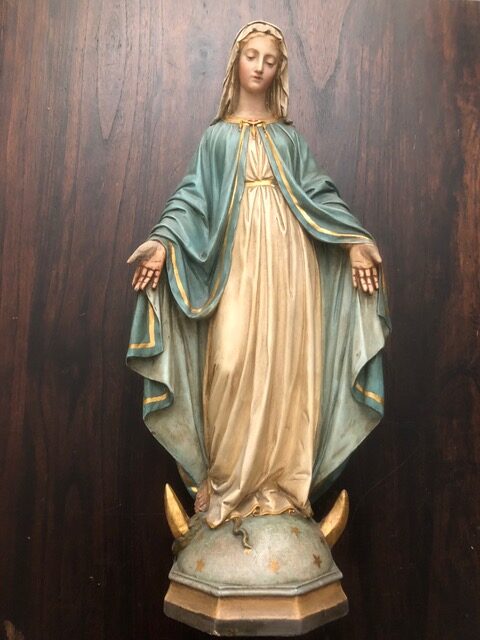
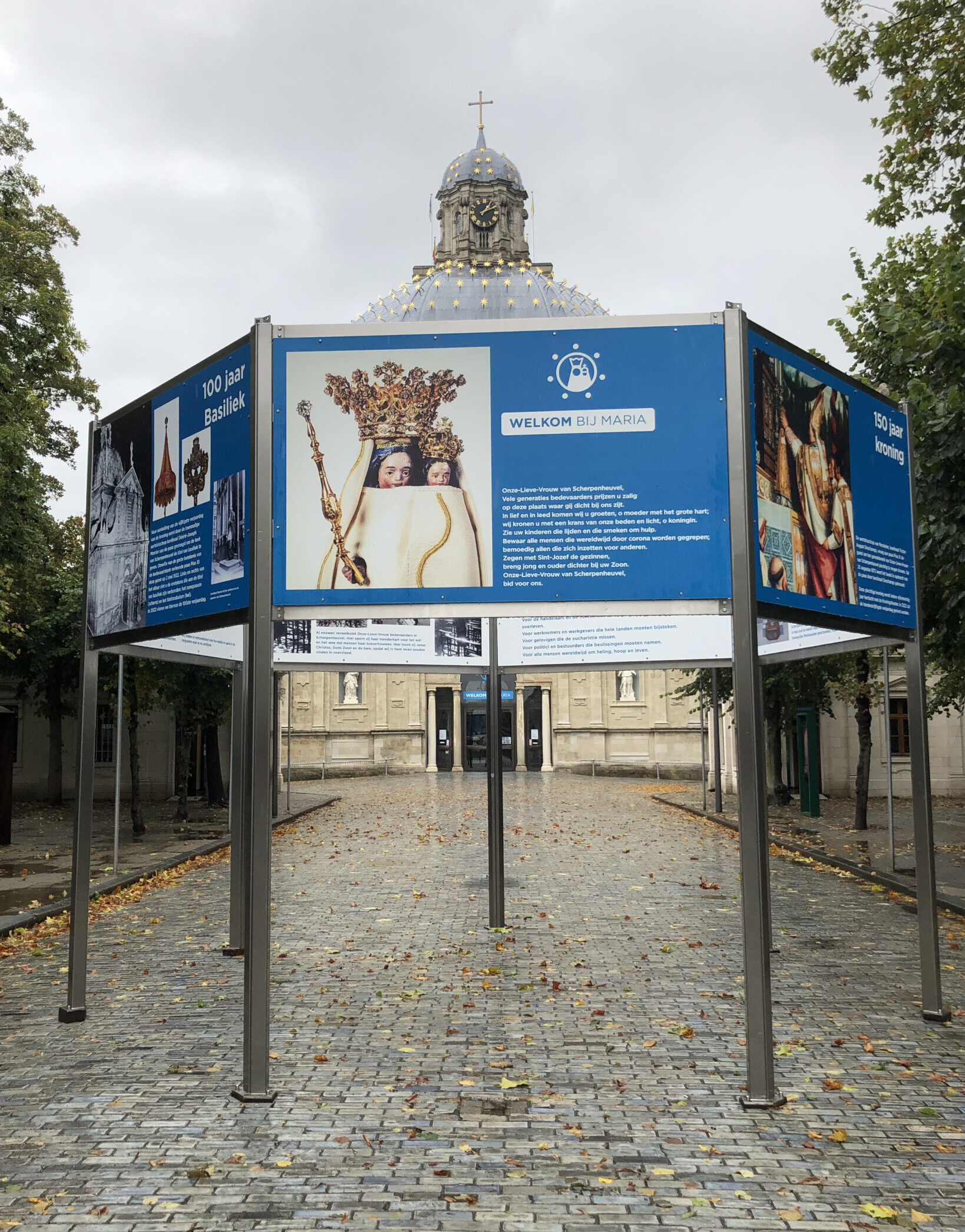
The statue of Mary lies at the heart of centuries of history filled with legends and true accounts. Originally, near Zichem, the devotional image was attached to an oak tree. Around 1200, the first pilgrims arrived at the tree. In 1314, Louis of Veltem (c. 1260–c. 1317), a Brabant cleric and writer, mentions the oak tree with the statue of Our Lady. Since 1400, miraculous healings have been recorded. In 1483, the place name Scherpenheuvel is mentioned for the first time. The oldest mention of the oak tree and a statue of Mary in Scherpenheuvel dates from 1604.
In 1514, a rather remarkable event took place. Legend has it, passed down through generations, that a shepherd from Zichem wished to pick up and take with him a small statue of Mary lying on the ground. However, when the man took the statue into his hand, he froze on the spot. He was unable to move. Several hours later, the man was found. The statue was taken from his hands and reattached to the oak tree. From that moment on, the shepherd could move again. This was seen as a sign that a chapel should be built with the statue. It was the chronicler Philips Numan (c. 1550-1617) who recorded the shepherd's legend in his publication “Historie van de Miraculen”.
In 1578, Alexander Farnese (1545–1592), Governor-General of the Netherlands (1578–1592) and later Duke of Parma (1586–1592), comes to pray in Scherpenheuvel. He then proceeds with his troops to the nearby Zichem to drive out the Geuzen.
Around 1580, during Calvinist rule, the depiction of Mary disappeared. It is assumed that the Sea Beggars (Geuzen) destroyed the statuette.
Godfried van Thienwinkel (c. 1544-1616) is important for the history of the pilgrimage site of Scherpenheuvel. At the age of 6 (1550), he was seriously ill. His desperate parents took Godfried to the oak tree with the statue of Mary, and he was cured there. He was the parish priest of Zichem from 1574 until his death in 1616.
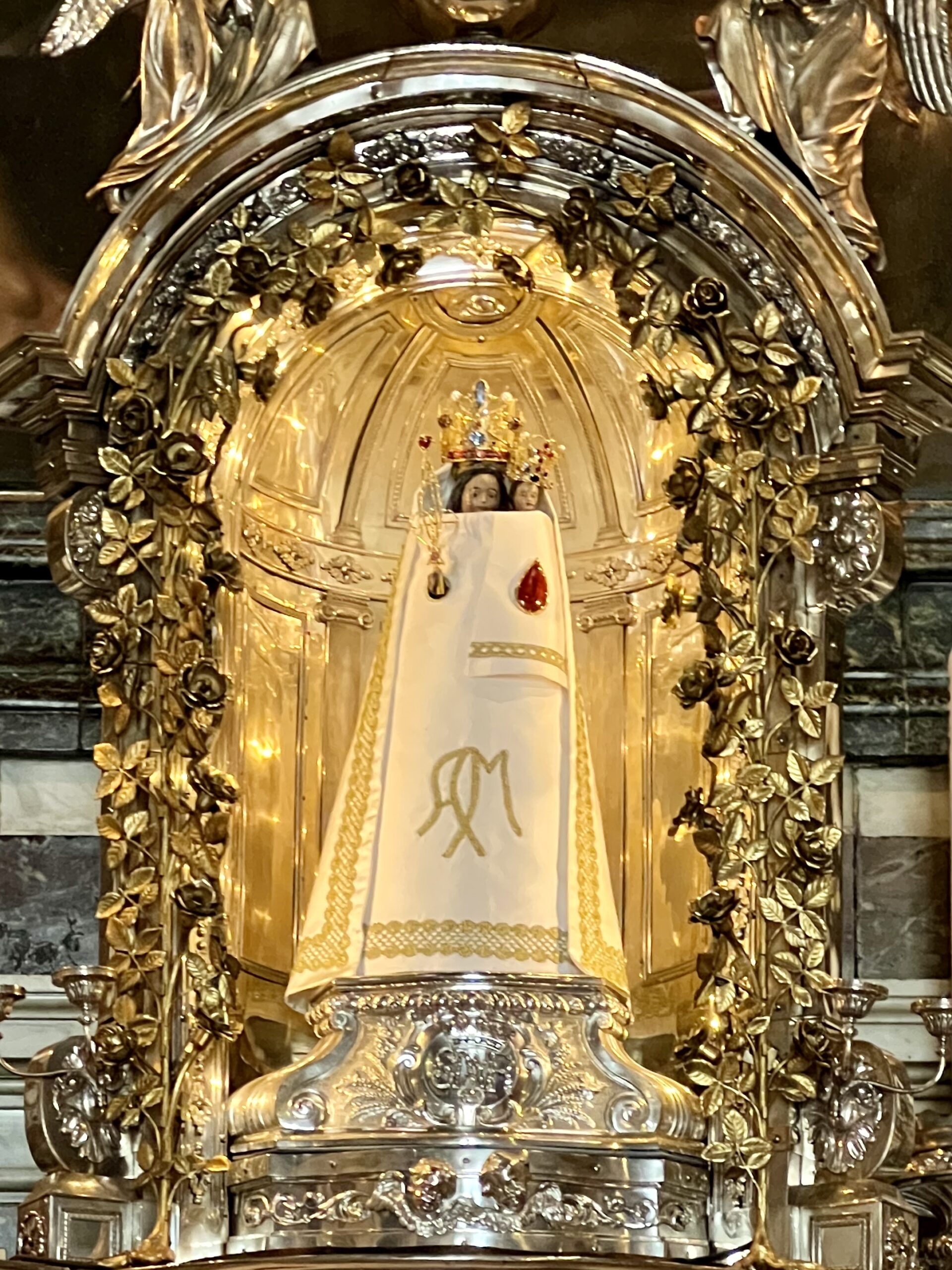
In 1587, Agnes Frederix donated a new statue of Mary, which bore a resemblance to the lost statuette. This effigy replaced the first statuette, is carved from walnut wood, stands 30 cm tall and is 11 cm wide. This statue of Mary is still located above the main altar in the basilica. Inhabitants of Zichem affixed this statue to an old oak tree on Scherpenheuvel. In the late 16th century, there is mention of military pilgrimages.
It is assumed that on 13 June 1604 the old oak tree was cut into four pieces, and a small wooden chapel measuring 1.5 m by 1.75 m was built in its place. The statue was then taken to Zichem. This was perhaps done to put an end to the superstitious practices at the oak tree. Taking pieces of the oak tree appears to have been a widely practised ritual on pilgrimages. Then a highly remarkable event took place, as the statue in Zichem began to bleed spontaneously. Blood was seen on the lips of Our Lady, and this occurred on 3 January 1603. This prompted Duke Albrecht and his wife Isabella, who ruled the Habsburg Netherlands from 1598 to 1621, to have a stone chapel built on the Scherpenheuvel.
Albert VII (1559-1621) was Archduke of Austria, Governor of the Southern Netherlands (1595-1598) and the Habsburg Netherlands (1598-1621). Isabella Clara Eugenia (1566-1633) was a daughter of Philip II (1517-1598), King of the Spanish Empire (1556-1598). She became Archduchess of Austria through her marriage to Albert VII of Austria in 1599 and Governor of the Southern Netherlands (1621-1633). In 1621, she joined the Franciscan lay order of the Poor Clares. On 14 July 1603, the first stone of the chapel was laid by a representative of Albert and Isabella. Albert VII was unable to attend as he was defending ‘s-Hertogenbosch on behalf of the King of Spain. Maurice of Orange (1567-1625) attempted to capture ‘s-Hertogenbosch in 1601 during the Siege of ‘s-Hertogenbosch but failed. In 1603, Maurice made a new, unsuccessful attempt, but Albert VII and his troops held their ground. In 1604, the stone chapel was completed. The small, wooden building was replaced, and the chapel was consecrated.
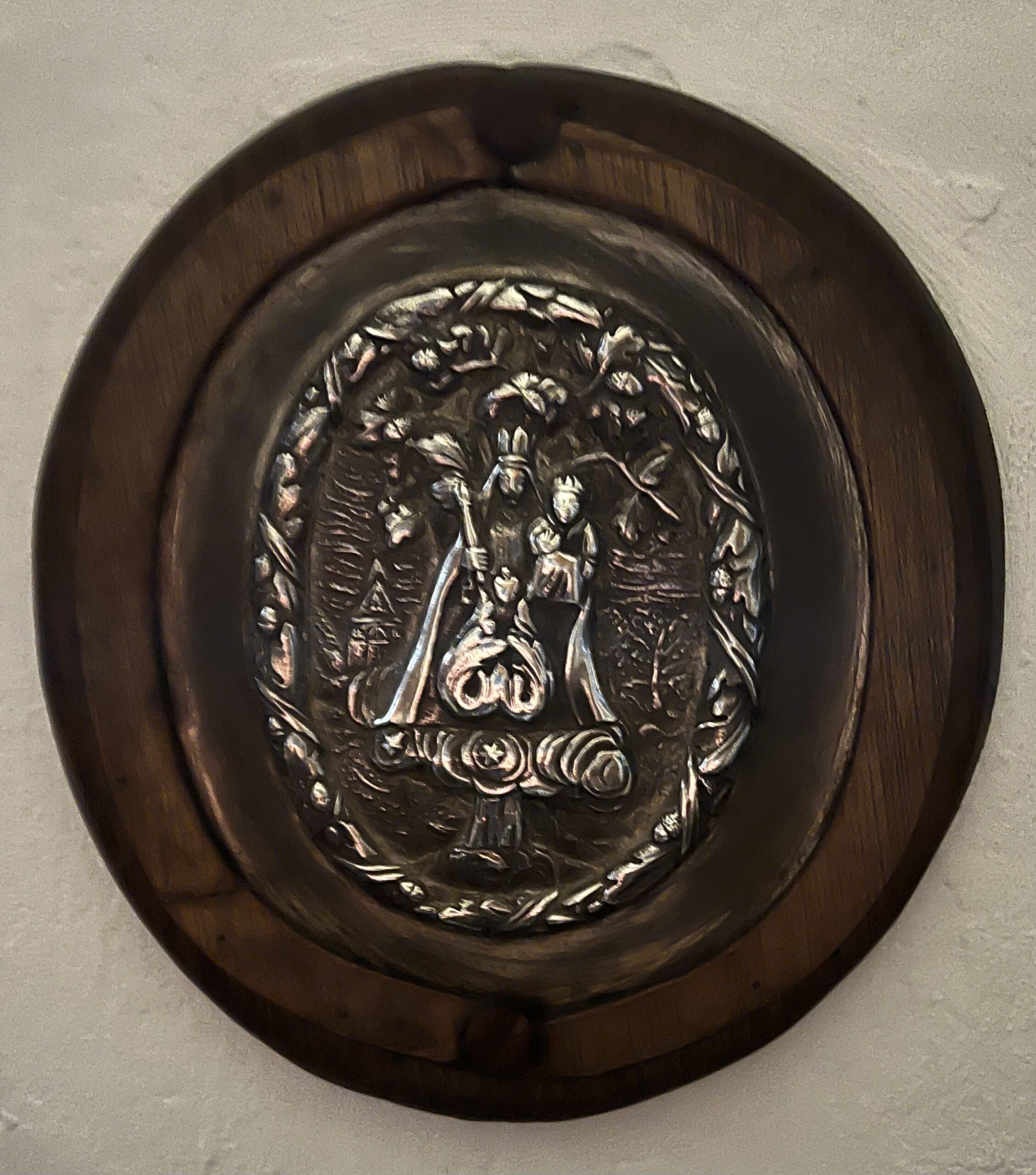
On 21 November 1603, the first pilgrimage together with Albert and Isabella took place. They gifted a cloth to the statue of Mary.
In 1605 there was a beguine who made wooden statues. It is believed that the effigies were made from a felled oak. This has been made possible by dendrochronology or tree-ring research; a scientific discipline dedicated to dating wooden objects by studying growth rings.
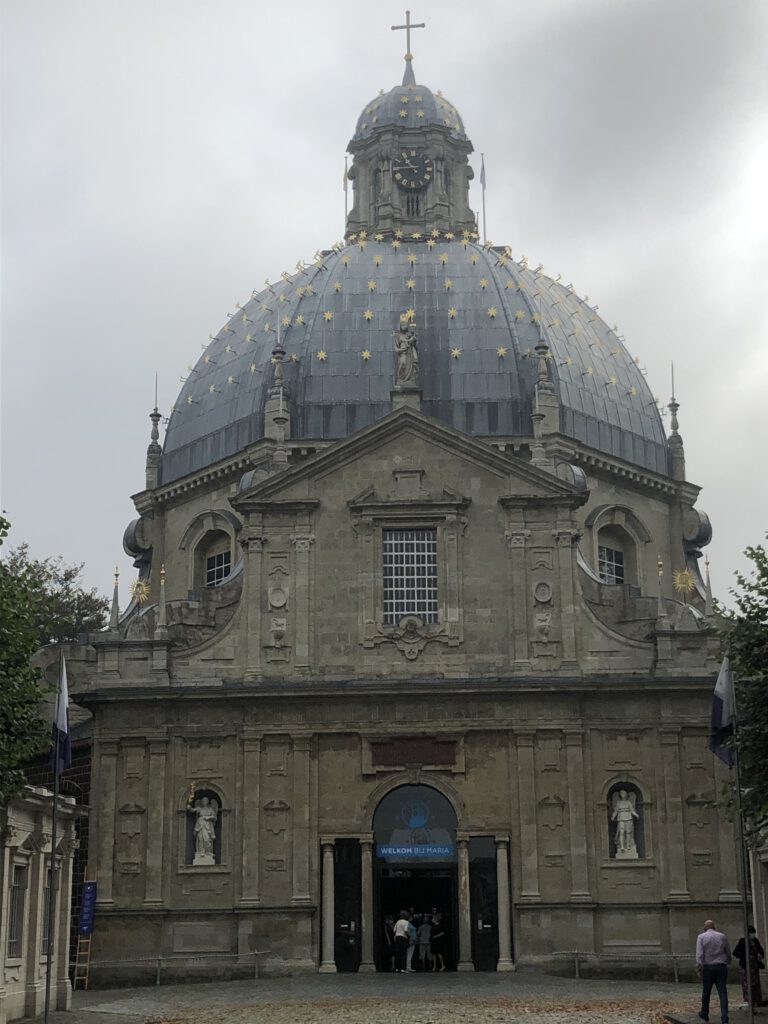
Initiated by Archdukes Albert VII and Isabella, the archdukes' court architect, Wenceslas Cobergher (1560-1634), began designing the current church building in 1607. The architect designed a domed church in a seven-pointed star. This star refers to Maria Stella Maris, Mary Star of the Sea. It became the first Baroque church in the Netherlands. Construction began in 1609, and the first stone was laid by Archdukes Albert and Isabella. The large dome is supported by cross-shaped stone buttresses. This created 8 small chapels. Each chapel is dedicated to a saint and measures approximately 7 metres by just over 4 metres.
The church becomes a powerful symbol of the Counter-Reformation (16th-18th century). In 1627 the church was completed and consecrated by Jacobus Boonen (1573-1655), Archbishop of Mechelen (1621-1655). It is the first Baroque-style church in the Netherlands and a bastion of Catholic Counter-Reformation. The Archduchess Isabella was also present. The distinctive church building made the pilgrimage site more well-known, even abroad. The building is the oldest domed church in Belgium and the Netherlands. The pilgrimage site of Scherpenheuvel is seen as a striking, symbolic act of Catholic renewal, which began with the Council of Trent (1545-1563).
In November 1629, the foundation was laid for a tradition that continues to this day. On the first Sunday after All Saints' Day, a candle procession is held. Participants in the procession and onlookers carry lights and walk with the statue of Mary around the basilica.
Many miracles have been attributed to the statue of Mary. For example, in the period 1603-1682, there were nearly 300 unexplained healings, such as the healing from a curse, from eye injuries, from a wound on a leg, and deliverance from the devil.
In 1797, the church was plundered by the French occupiers.
On 25 August 1872, Pope Pius IX had the statue of Mary crowned. Pius IX was Pope from 1846 to 1878 and was born Giovanni Maria Mastai-Ferretti (1792-1878). The crowning was performed by Victor Augustin Isidore Dechamps (1810-1830), Archbishop of Mechelen (1867-1883). This coronation celebration is commemorated every 25 years, and after 1997 it was held again in 2022 and will be again in 2047.
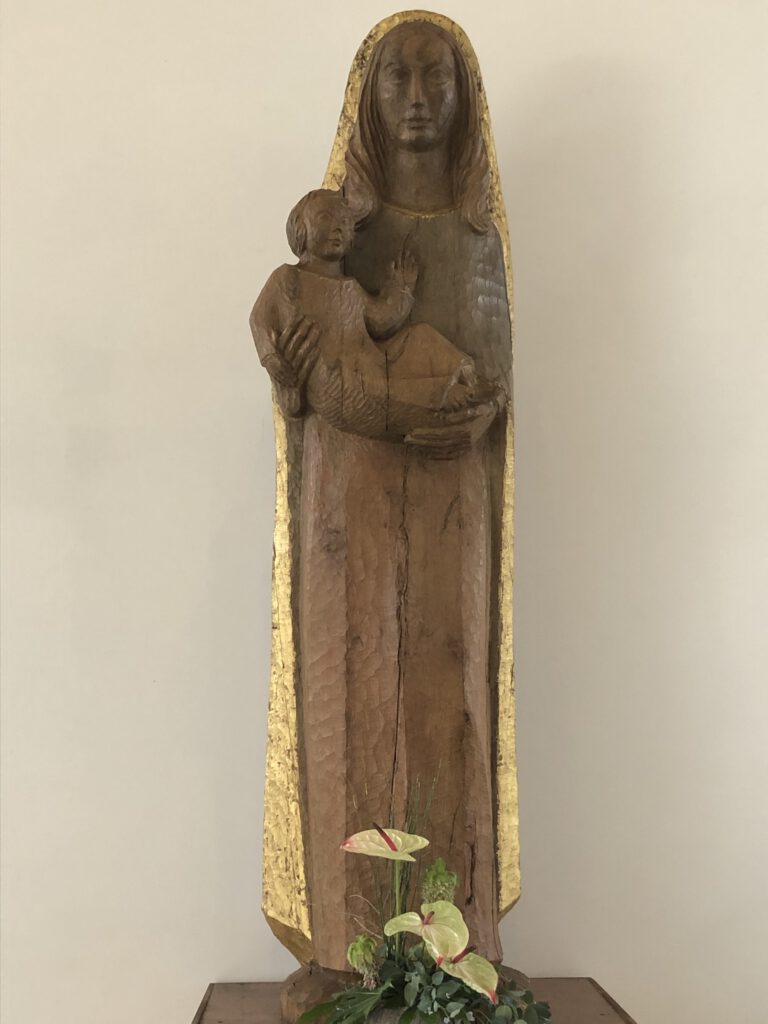
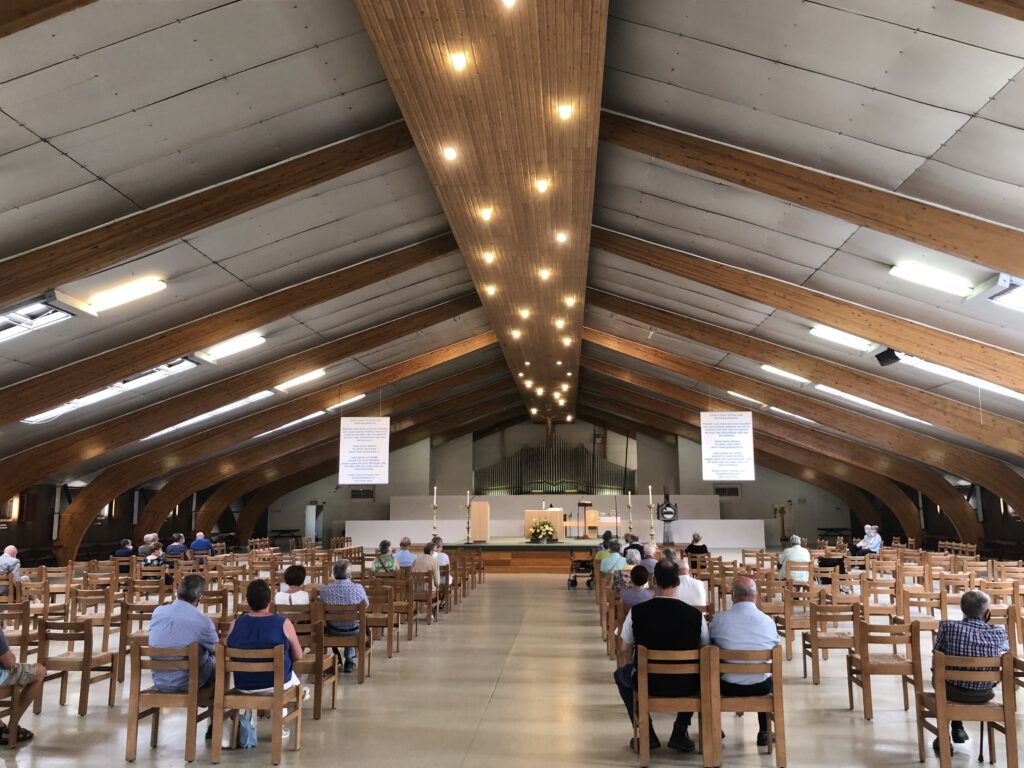
In 1922, the church was granted the title of basilica by Pius XI, Pope from 1922 to 1939, born Ambrogio Damiano Achille Ratti (1857-1939). The elevation of the church to basilica also caused even more people to make pilgrimages to Scherpenheuvel. The need arose for a large, covered space to hold services, where many could be present. This resulted in the construction of the Mariahal, behind the basilica, in 1972. This hall has 3500 seats. The oak statue of Mary, “Mary Mother of God,” standing there, was sculpted in 1980 by Elisabeth Schaffrath.
In 1980, the basilica was enriched with 49 bells. The carillon was made by the company Clock-O-Matic from Herent and the bells were cast by the French company Paccard.
The reception centre “De Pelgrim” will undergo a name change in September 2021 and will subsequently be called “Huis van Maria” (House of Mary). This name explicitly emphasises the relationship with the basilica by embodying hospitality. Everyone is welcome in the “Huis van Maria”.

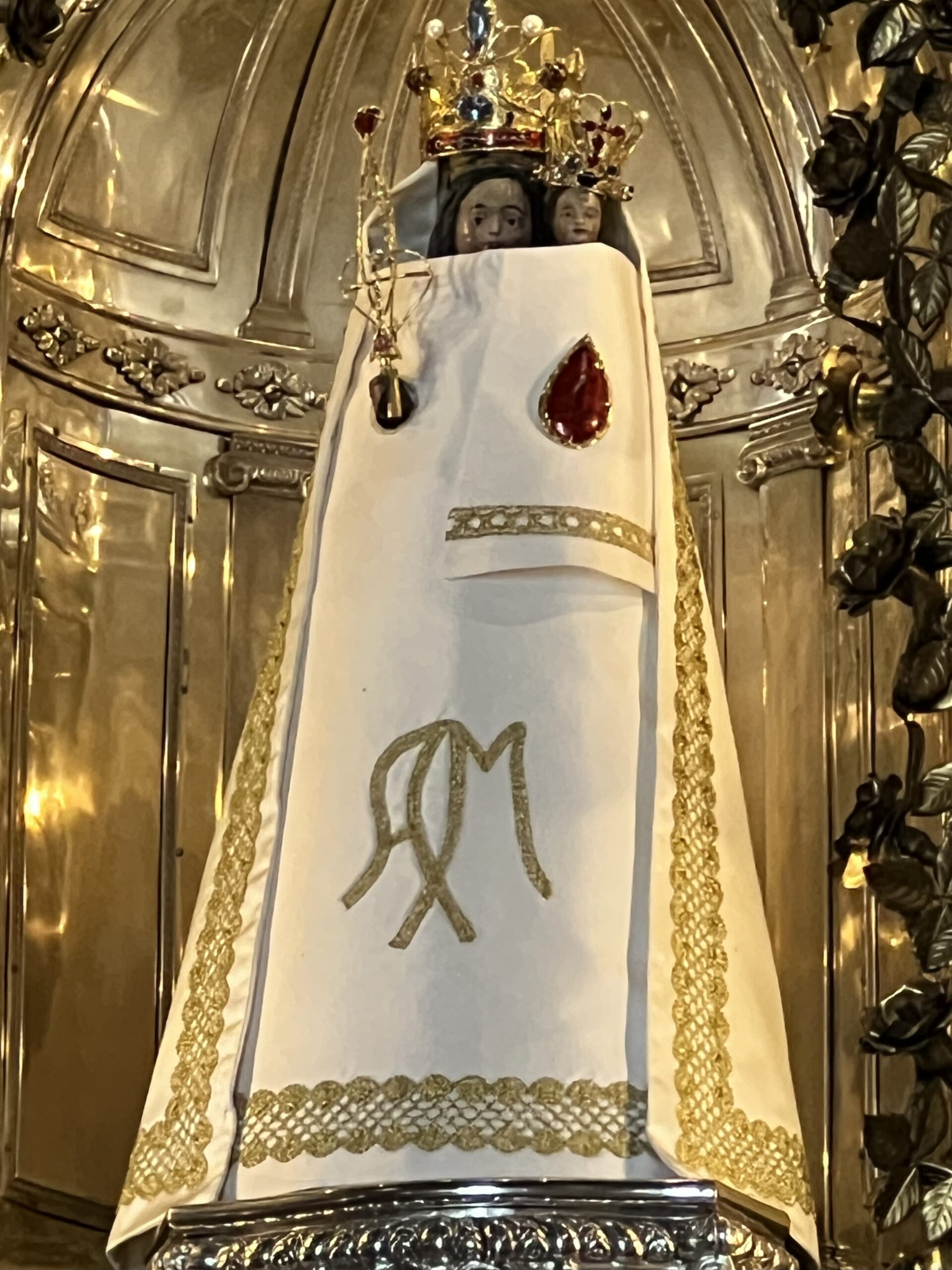
On 28 August 2022, 150 years after the crowning of the statue of Our Lady with Jesus in 1872, two new crowns will be added. Mary will also receive a new sceptre. These have been made from jewellery donated by pilgrims in Scherpenheuvel. Goldsmith Lies Wambacq has crafted the crowns, as well as a new sceptre for Mary. The Coronation Festivals are commemorated every 25 years.
In 2023, a red artificial tear will be placed on the robe of the devotional image. This tear is a golden plaque in the shape of a teardrop positioned at the height of the heart. An anchor is incorporated onto the plaque with the teardrop. This refers to a quote from the Apostle Paul: “Hope is a sure and steadfast anchor for the soul.” Red enamel has been applied over this anchor. This has been done as a sign of solidarity with victims of sexual abuse by clergy of the Catholic Church. The tear was made by goldsmith and jewellery designer Lies Wambacq (c. 1989), who also created the new crowns for Mary and the Child in 2022. When pinning the red tear, pastor-dean Luc van Hulst (c. 1967), the initiator of the tear, states that Scherpenheuvel is a place of pilgrimage where people find comfort, and among them are also victims of sexual abuse.
Scherpenheuvel is the most visited pilgrimage site in Belgium. In the 21st century, it receives an average of around 700,000 visitors per year.
Pilgrimage site
In the domain of Mary, there is much more to visit besides the basilica, such as the festival meadow, Stations of the Cross, the Mary Hall from 1972, rosary statues and a large well from 1632. There is also a bronze statue of the “Mother of Beautiful Love” by artist Camiel/Camille Colruyt (1908-1973) to greet.
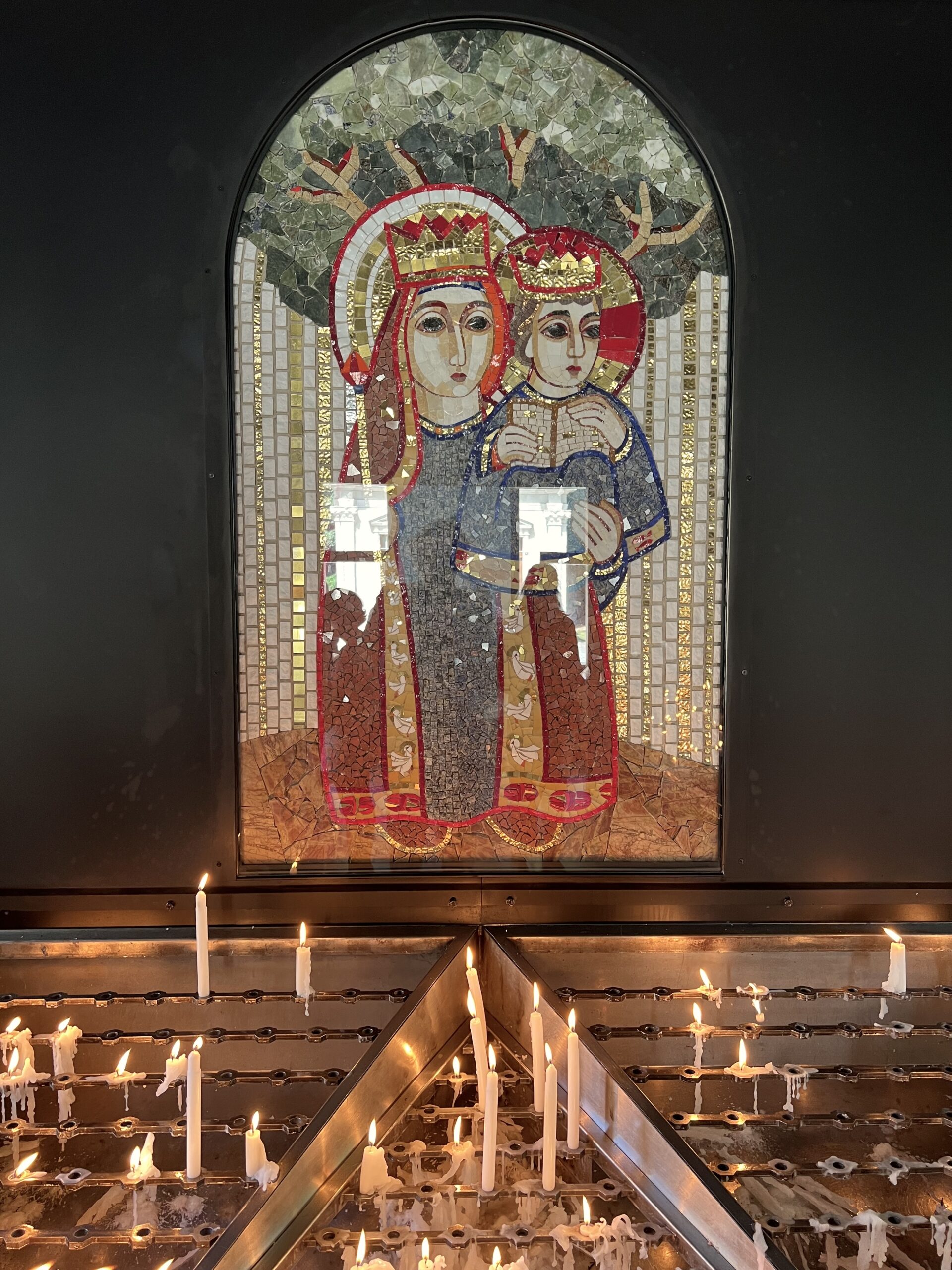
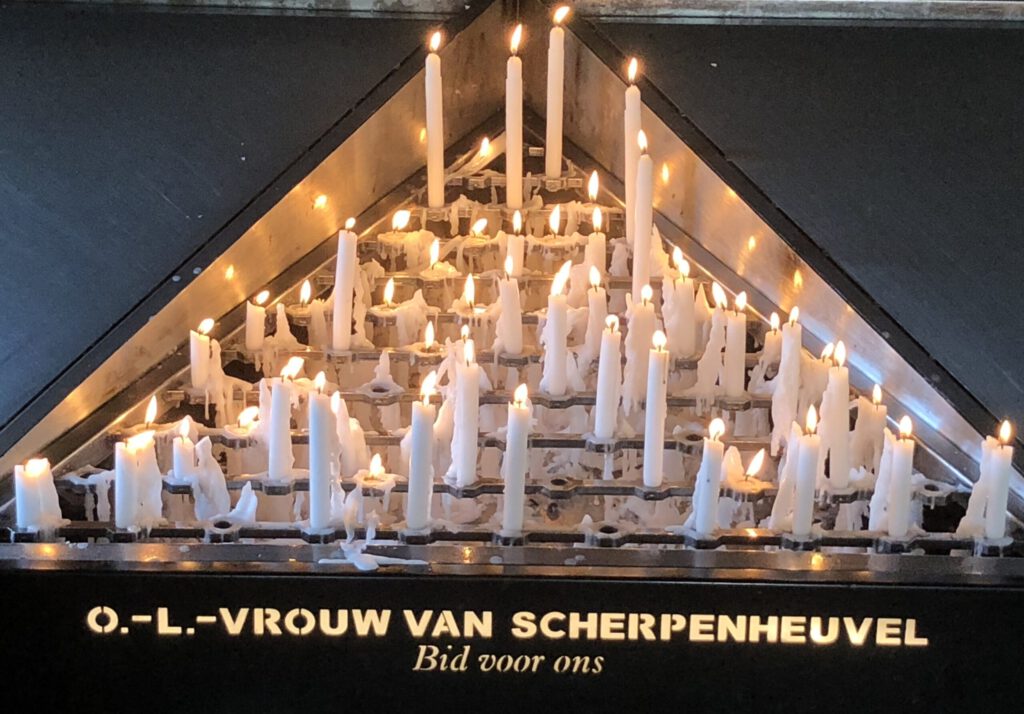
Next to the basilica, there are spaces for lighting candles for Our Lady. Many pilgrims make use of this.

In the niches by the entrance to the basilica, an archangel stands on either side, namely Michael with a flaming sword and Gabriel with a lily branch.
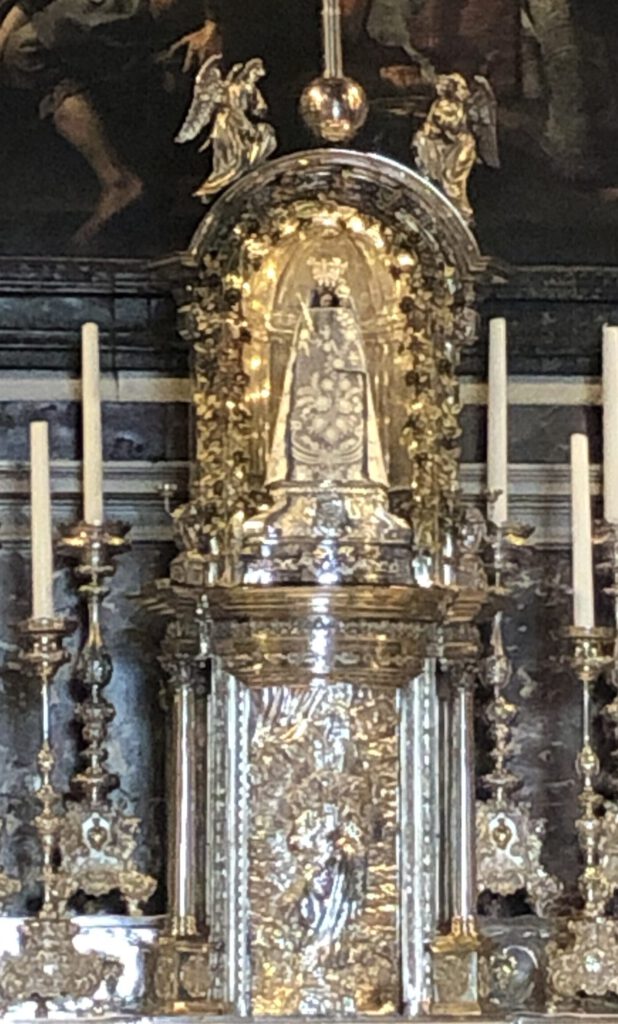
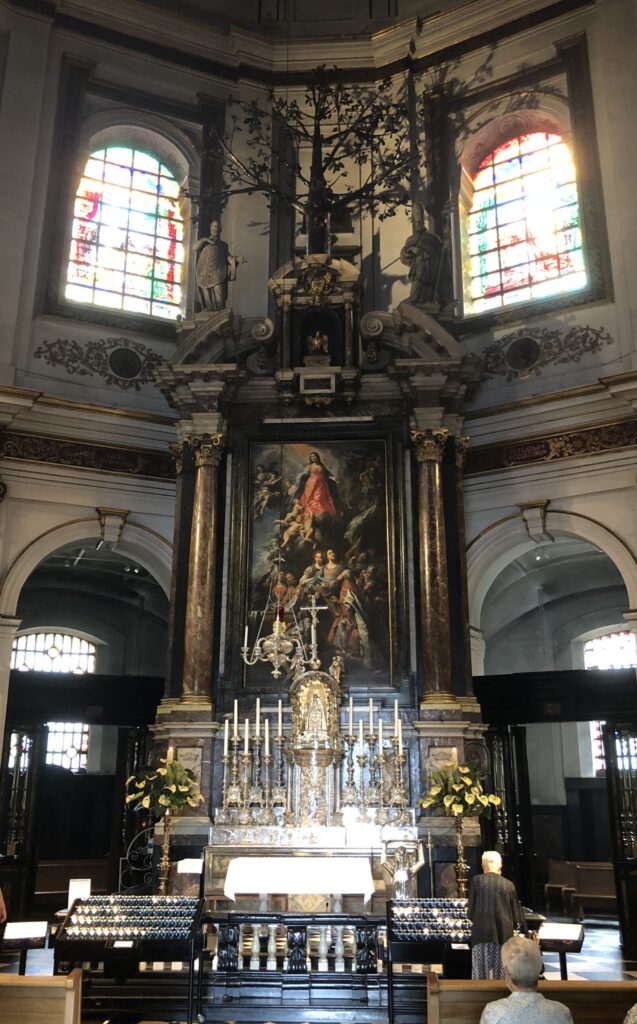
The miraculous statue of Our Lady of Scherpenheuvel is at the heart of the basilica. The statue is located, along with the silver tabernacle where the Blessed Sacrament is kept, in the lower part of the high altar. The silver shrine, in which the miraculous statue is housed, dates from the 19th century. The high altar stands on the same spot where the famous oak tree once stood.
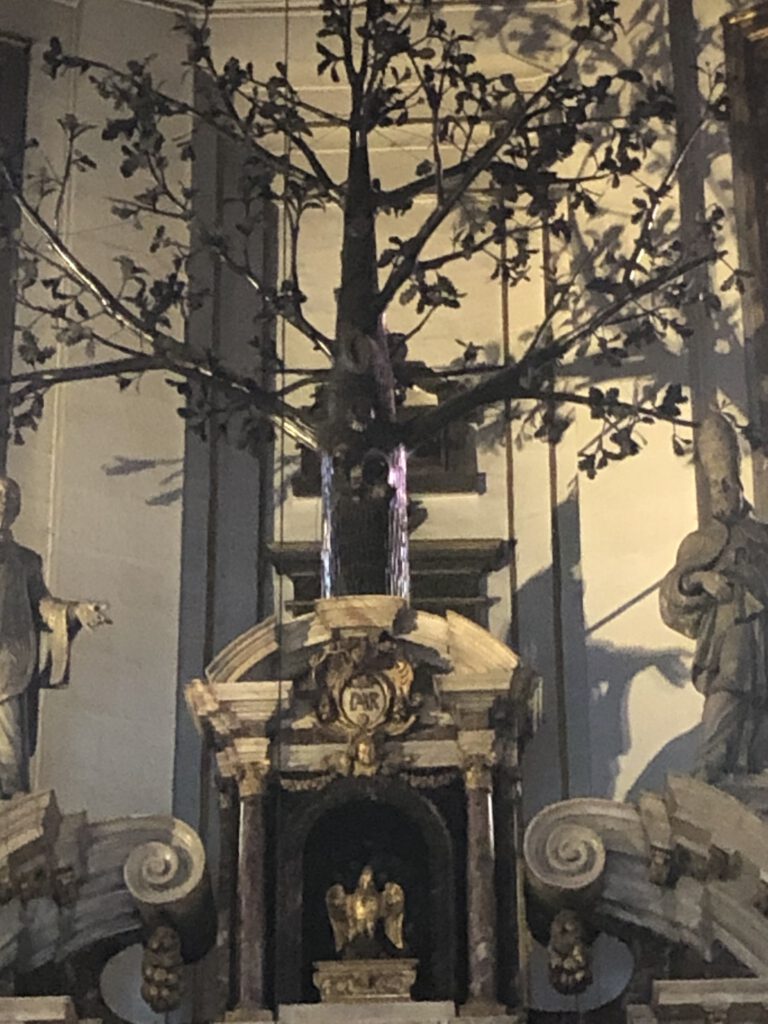
The upper part of the main altar shows the reconstructed oak tree, to which the miraculous image was attached until 1602. To the left of the tree is depicted Saint Philip Neri, the founder of the first oratory in Rome. In Scherpenheuvel, the first congregation outside of Italy of the oratory of Saint Philip Neri was founded. To the right stands the effigy of Pope Gregory the Great. On his feast day, 12 March, the house of prayer in Scherpenheuvel was built in 1624.
The niches in the basilica accommodate statues of six prophets, namely Moses, Isaiah, Ezekiel, Daniel, Jeremiah, and David.
The basilica's organ was built in 1782 by the Van Peteghem company. In 1959, it was enlarged by the d'Hondt company.
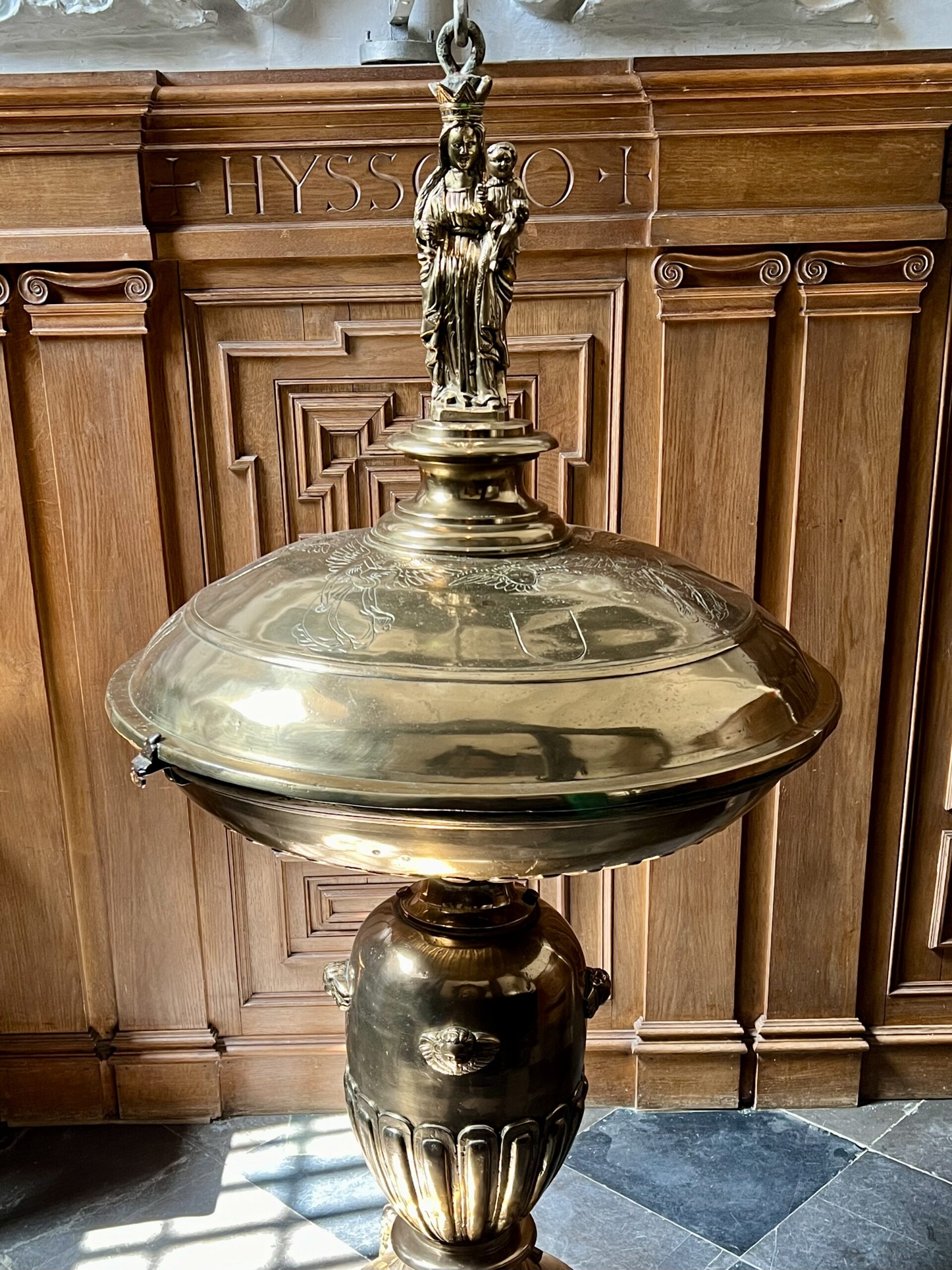
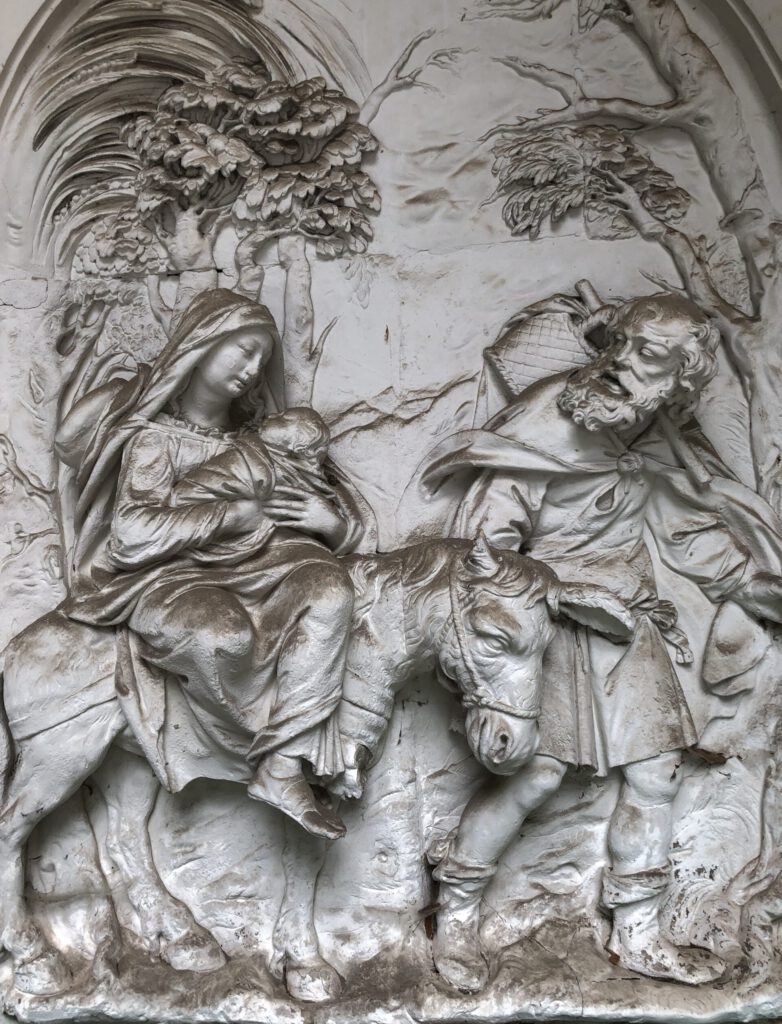
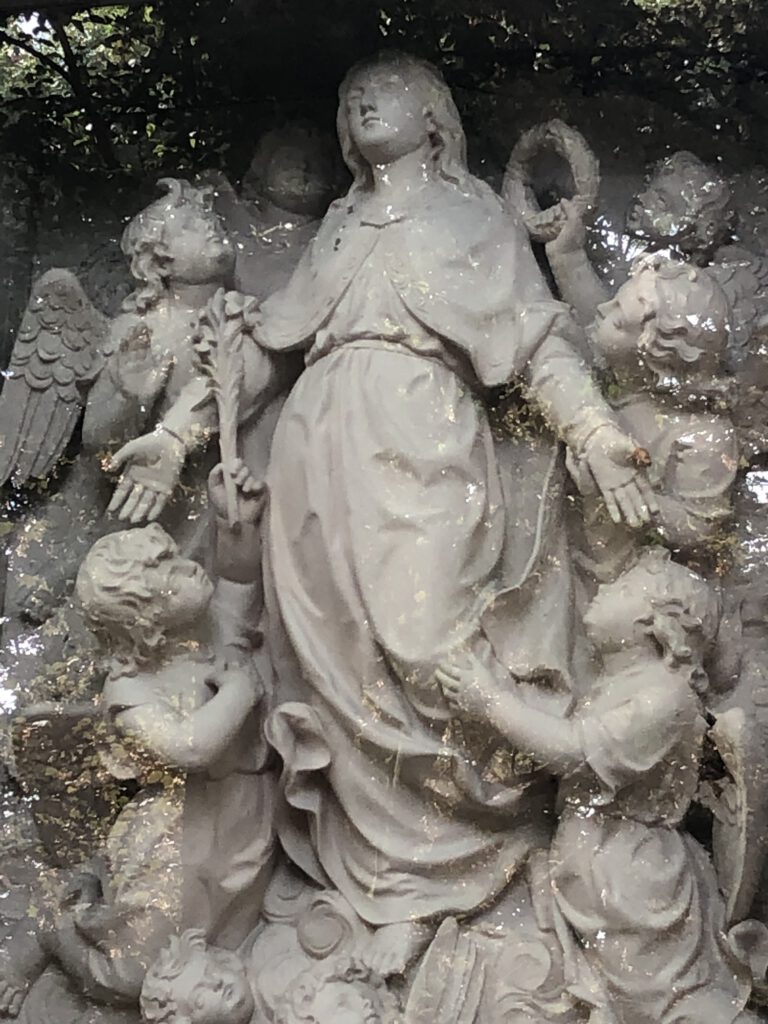
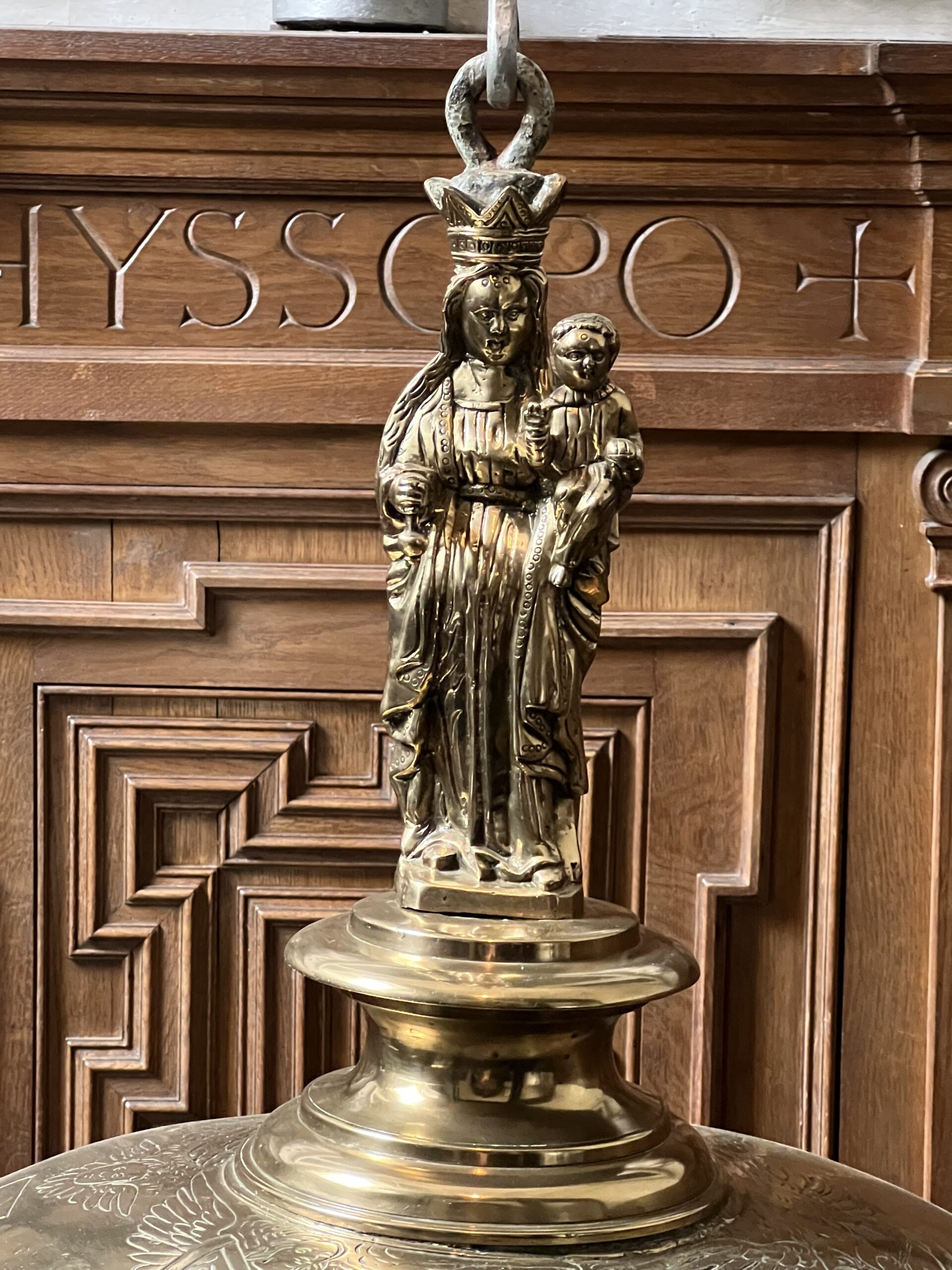
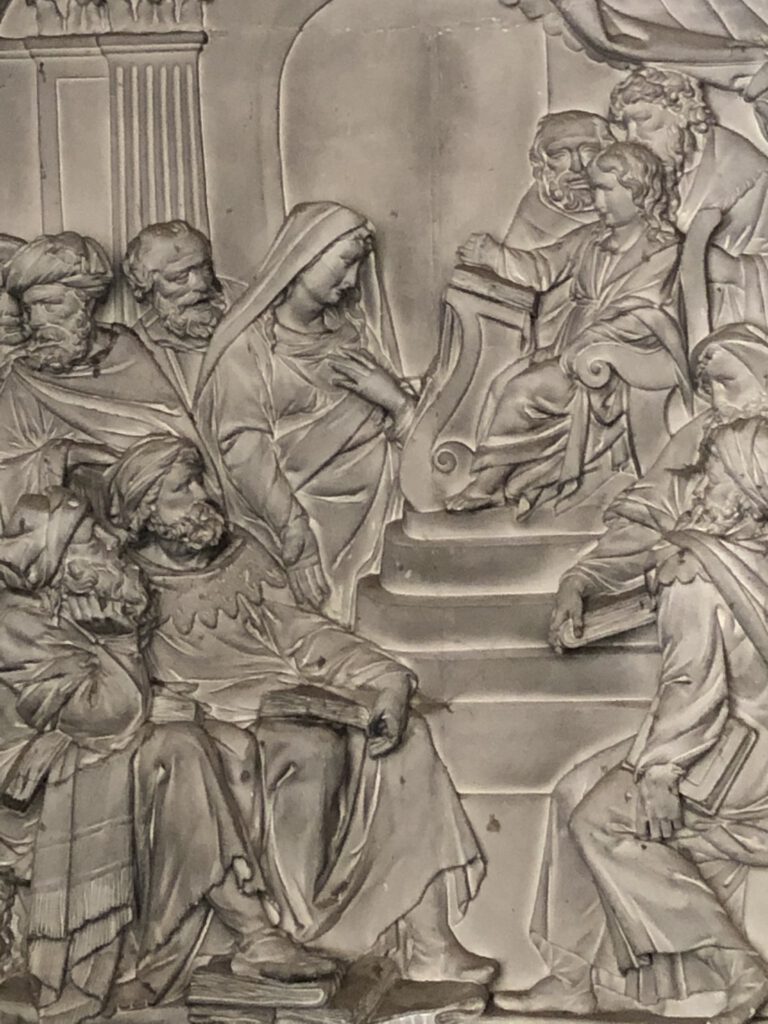
In the niches around the basilica, seven altars have been installed, each decorated with bas-reliefs. The sculptures always depict a sorrow or joy of Mary. There is also a separate room with an impressive font, featuring a gilded image of Mary and Child on the baptismal bowl.
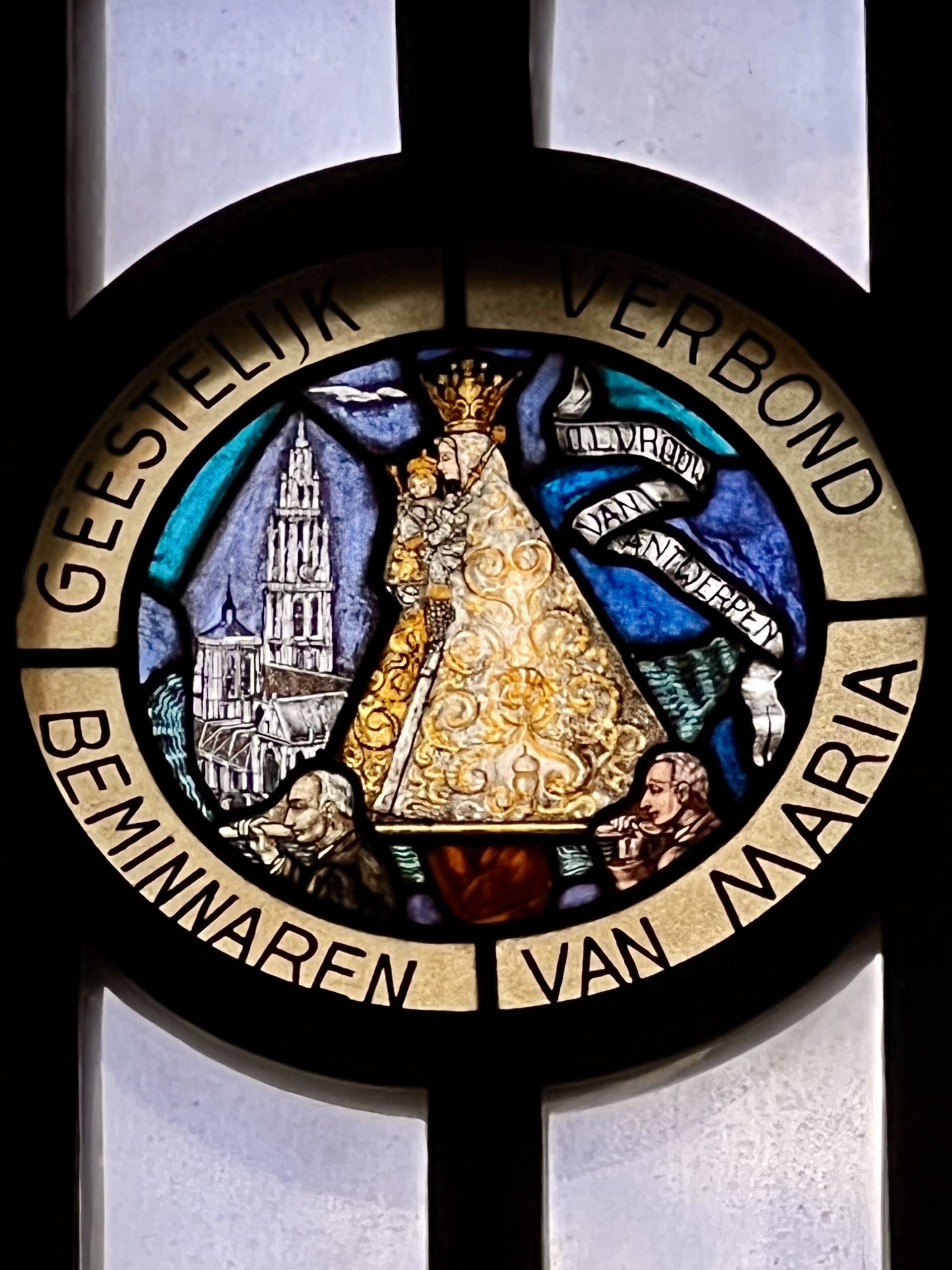
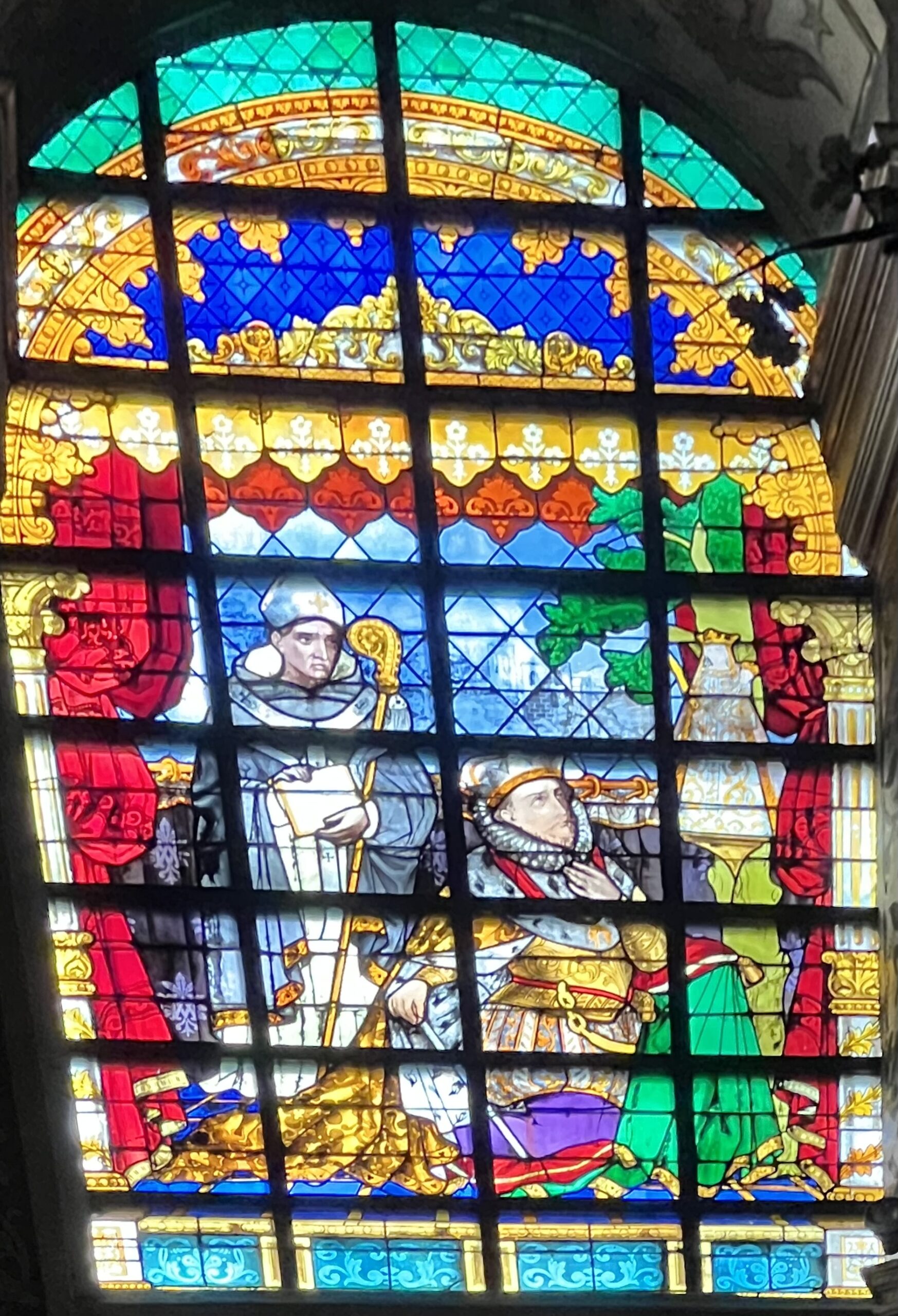
The dome of the basilica features colourful stained-glass windows. These windows depict parts of the history of the pilgrimage site of Scherpenheuvel.
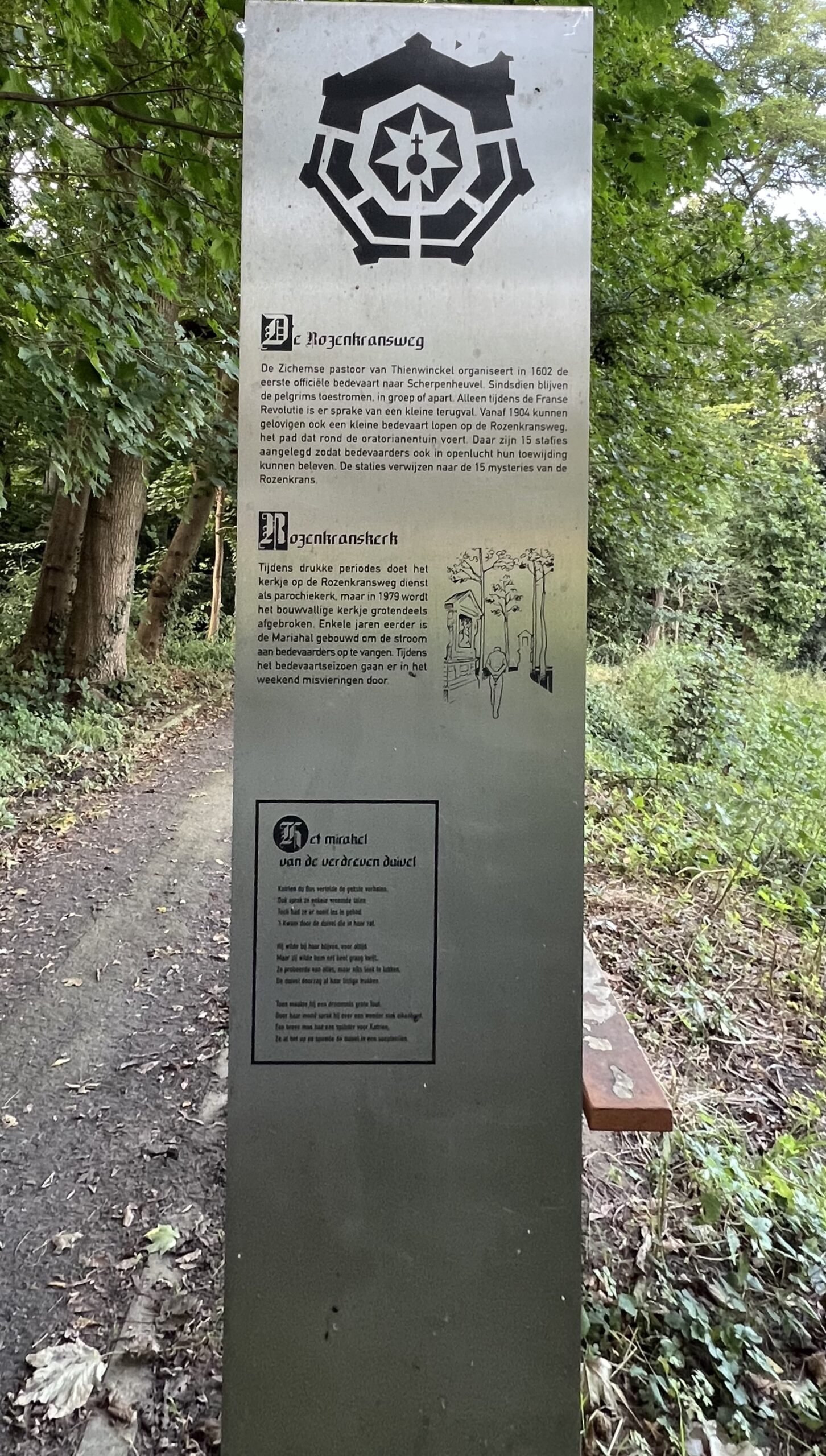
Behind the basilica is the imposing Mary's Hall. Celebrations are held here with many pilgrims. Next to the basilica, a particularly deep well can be seen. A Way of the Cross has been laid out around the domain, as well as a Rosary path behind the basilica.
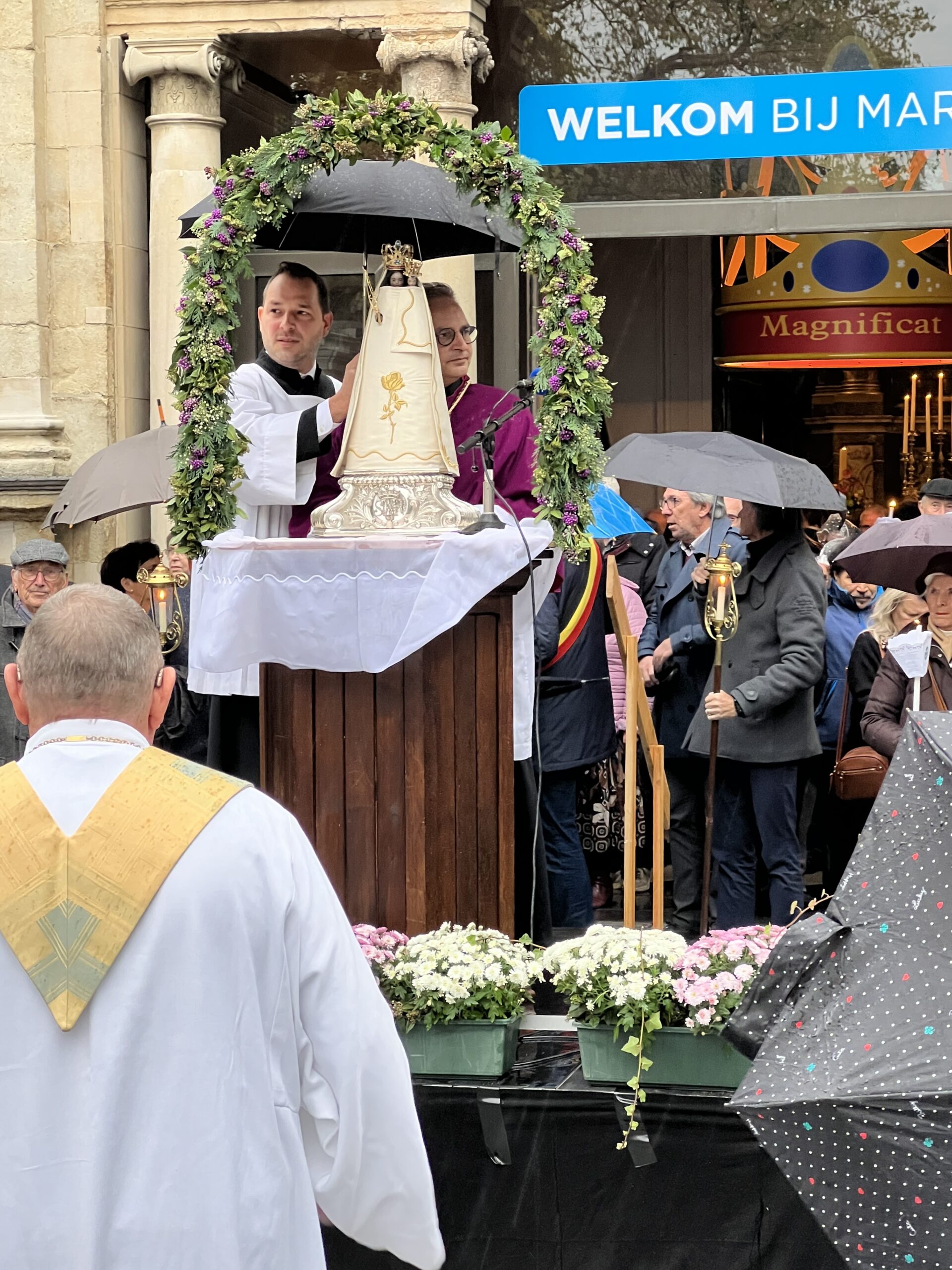
A special event is the annual Kaarskensprocessie (Candle Procession). This procession dates back to 1629 and takes place on the afternoon of the first Sunday after All Saints' Day. The origin of this procession is that for centuries, candles were placed on the graves of the deceased every year. The churchyard was located around the church. It is also said that the Kaarskensprocessie originated as an act of thanksgiving to Our Lady after the disappearance of the great plague epidemic in the early 17th century.
The pilgrimage site of Scherpenheuvel is characterised by authentic popular devotion; thousands of pilgrims visit it per week, the number of candles lit is countless, hundreds of bicycles and cars are blessed annually, and in the immediate vicinity are cafes, restaurants, and shops.
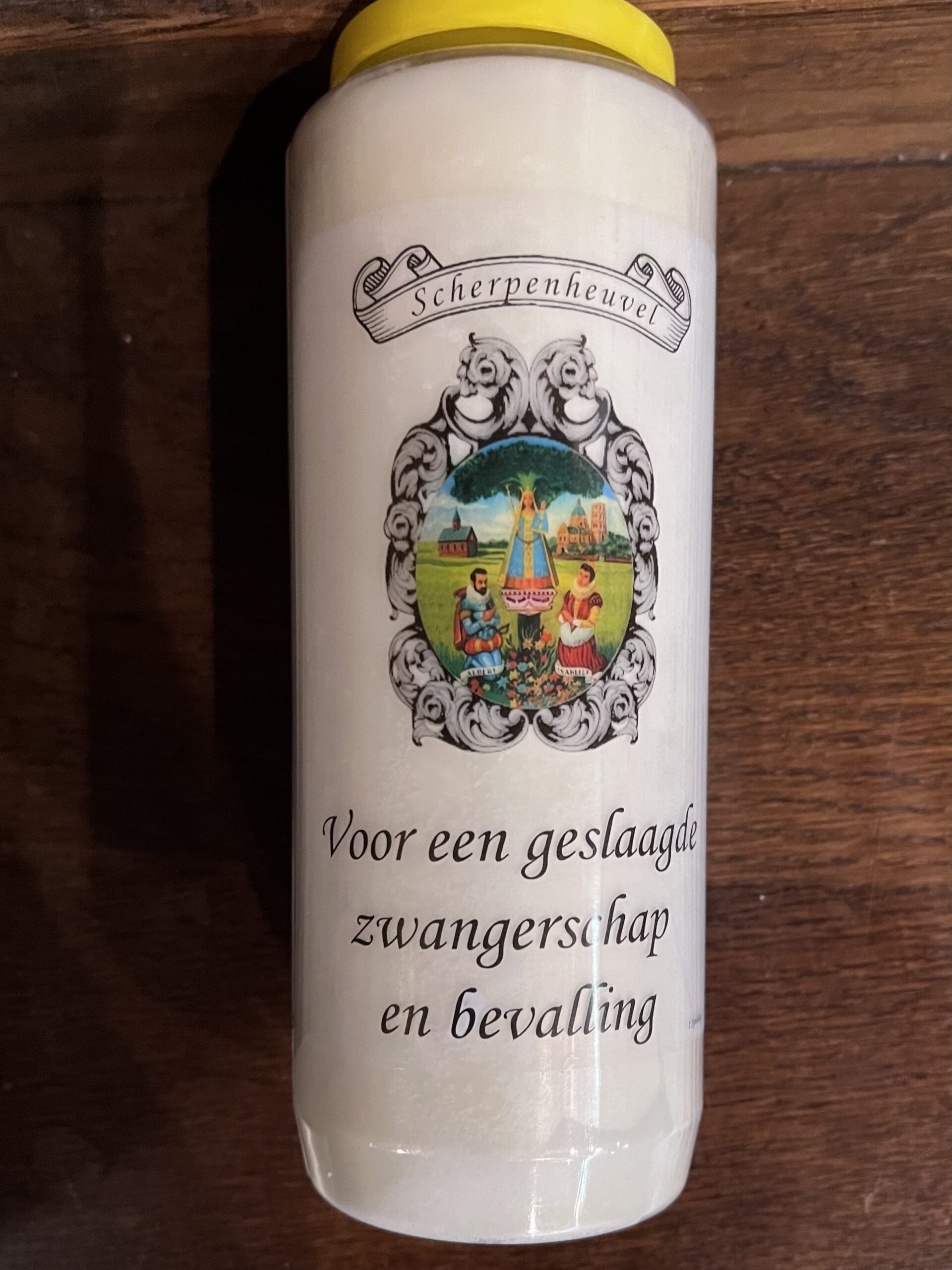
In the sales areas for the basilica, many different candles are for sale with all sorts of images.
The basilica can be visited daily.
ACCESSIBILITY
On the motorway from Antwerp to Liège (A13, E313), take exit 23 at Geel-West. Then take the N19 in the direction of Veerle and Diest. At Diest, take the N10, which leads to Scherpenheuvel.
From Brussels/Leuven, take the A2/E314 towards Bekkevoort and take the Scherpenheuvel exit.
Address: Mariabedevaartsoord Scherpenheuvel, Isabellaplein 1, 3270 Scherpenheuvel.
More information can be found at www.scherpenheuvel.be.
Experience
From afar, I see the unfinished bell towers of the pilgrimage church. They look like the towers of David and Solomon. As I approach Scherpenheuvel, I notice the dome of the basilica.
As I arrive at the basilica, I am immediately struck by the high altar, with Mary and the recreated oak tree. I look up and see the oak tree high above the altar. The original tree stood on the spot where the high altar is now. The history of Scherpenheuvel comes to mind. What an image a statue on an oak tree can bring about... What fascinates me most is the crowned statue of grace. Mary and Jesus received new crowns in 2022, and Mary also received a new sceptre.
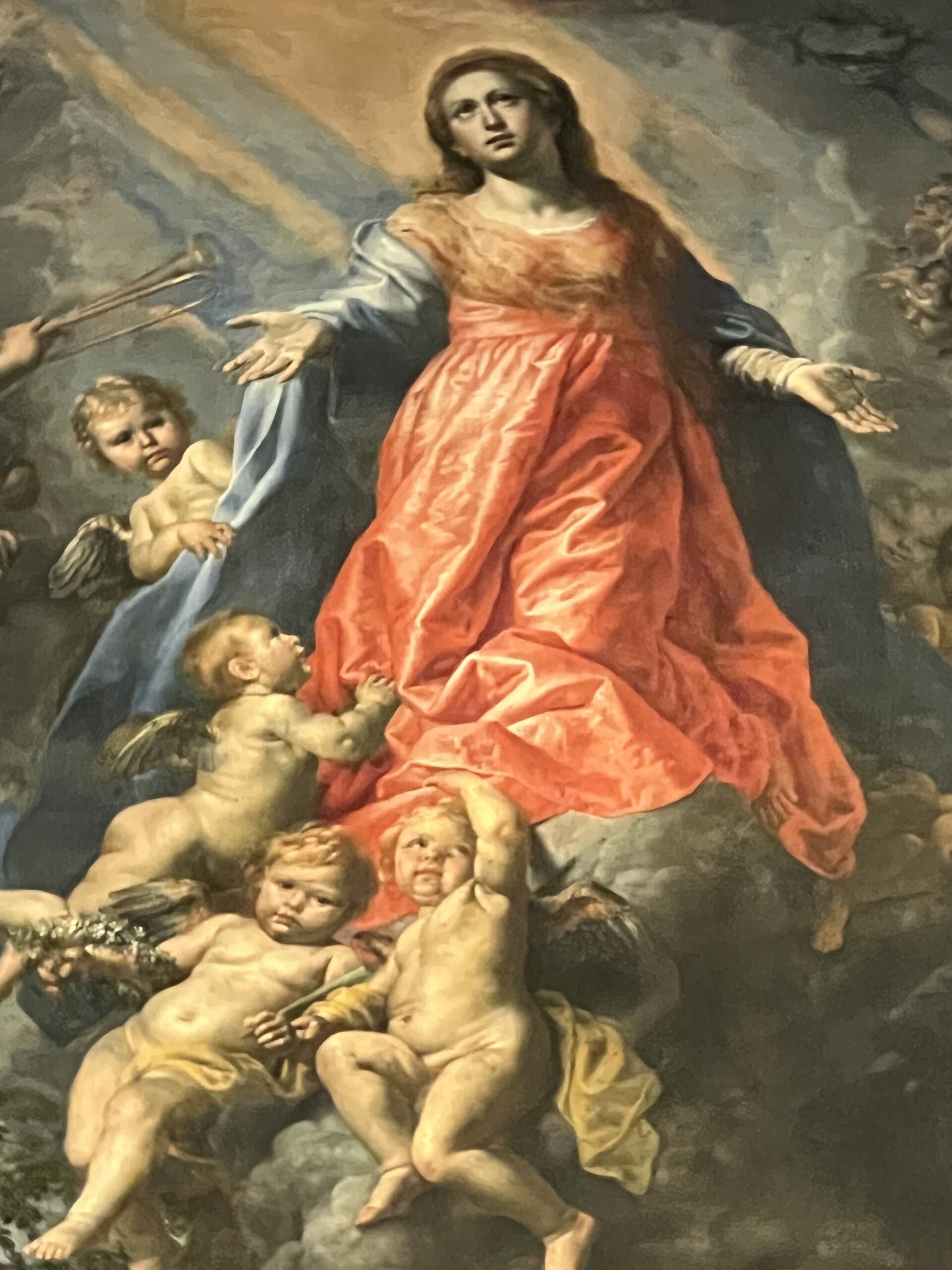
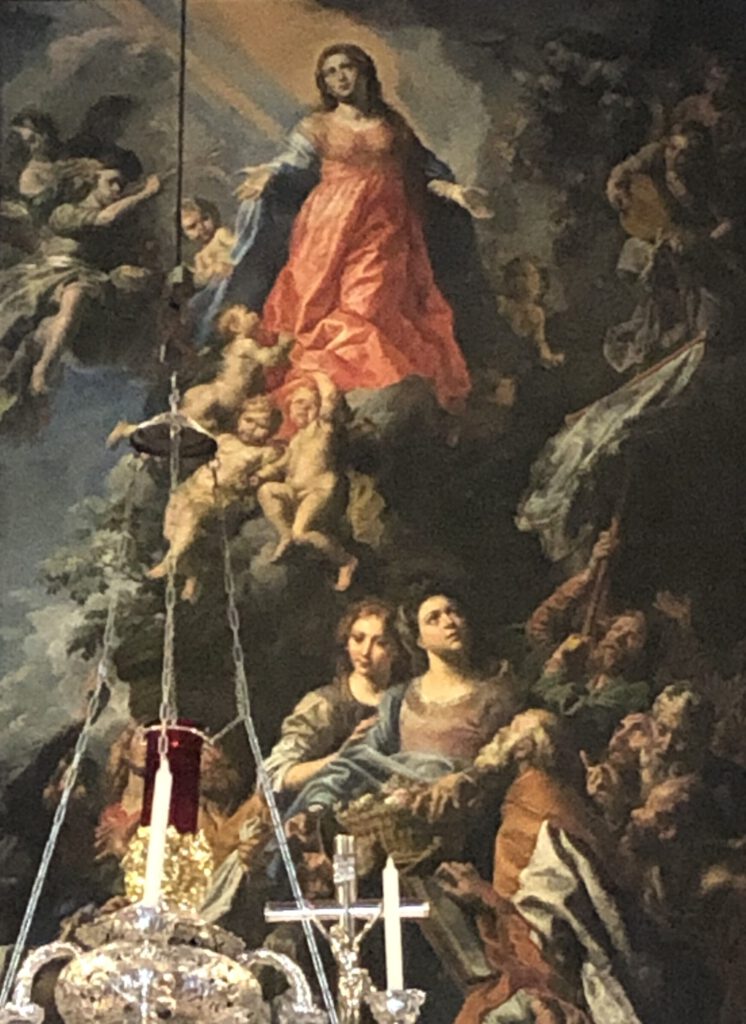
In the basilica, I see one of the most beautiful artworks for me, namely the painting by Theodoor van Loon, called “The Assumption of Mary”. Mary is being brought to heaven by naked child figures, called putti. There, jubilantly playing angels await her, while apostles look on from the earth. The open tomb is also visible in the painting, as well as a basket of flowers.
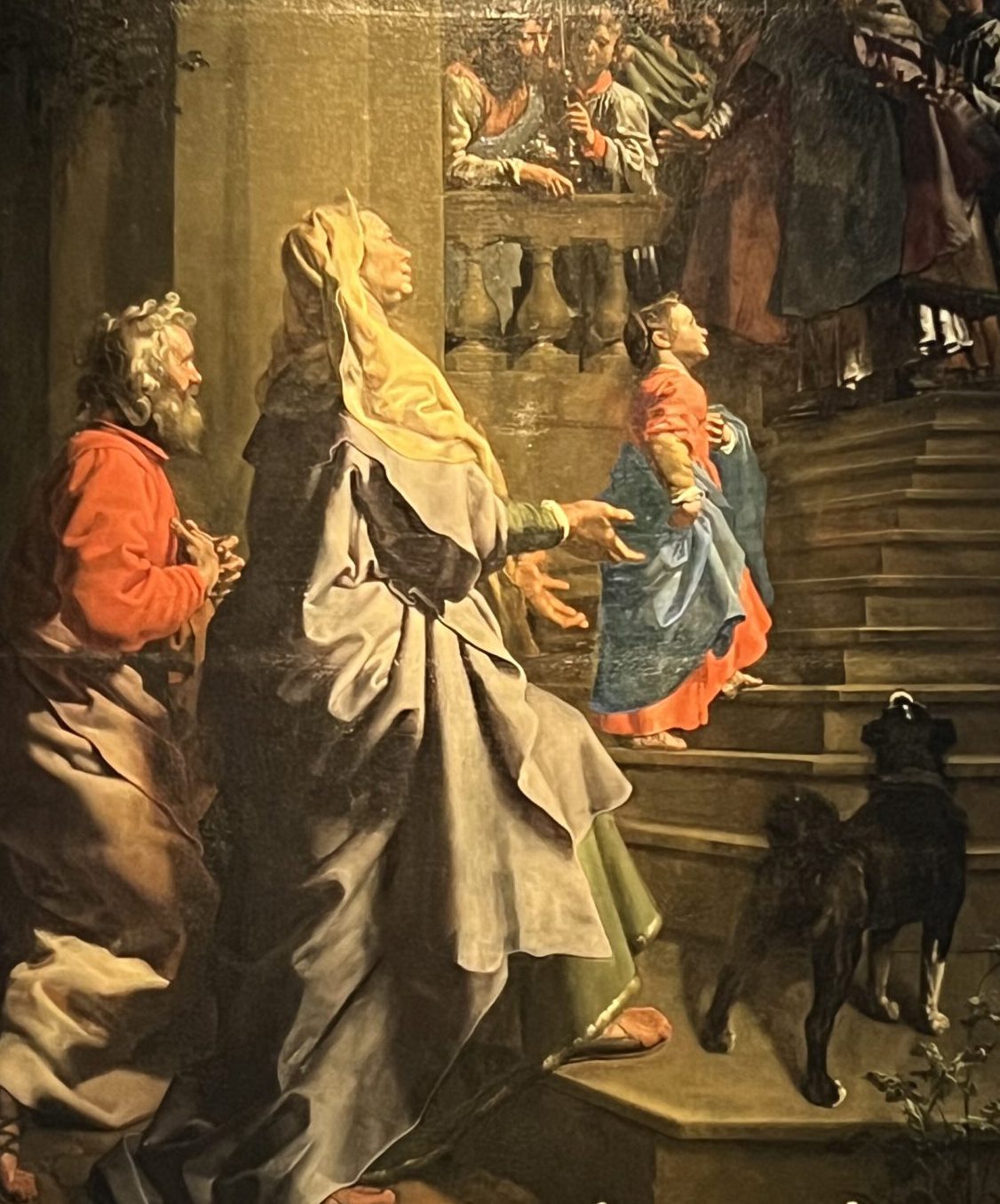
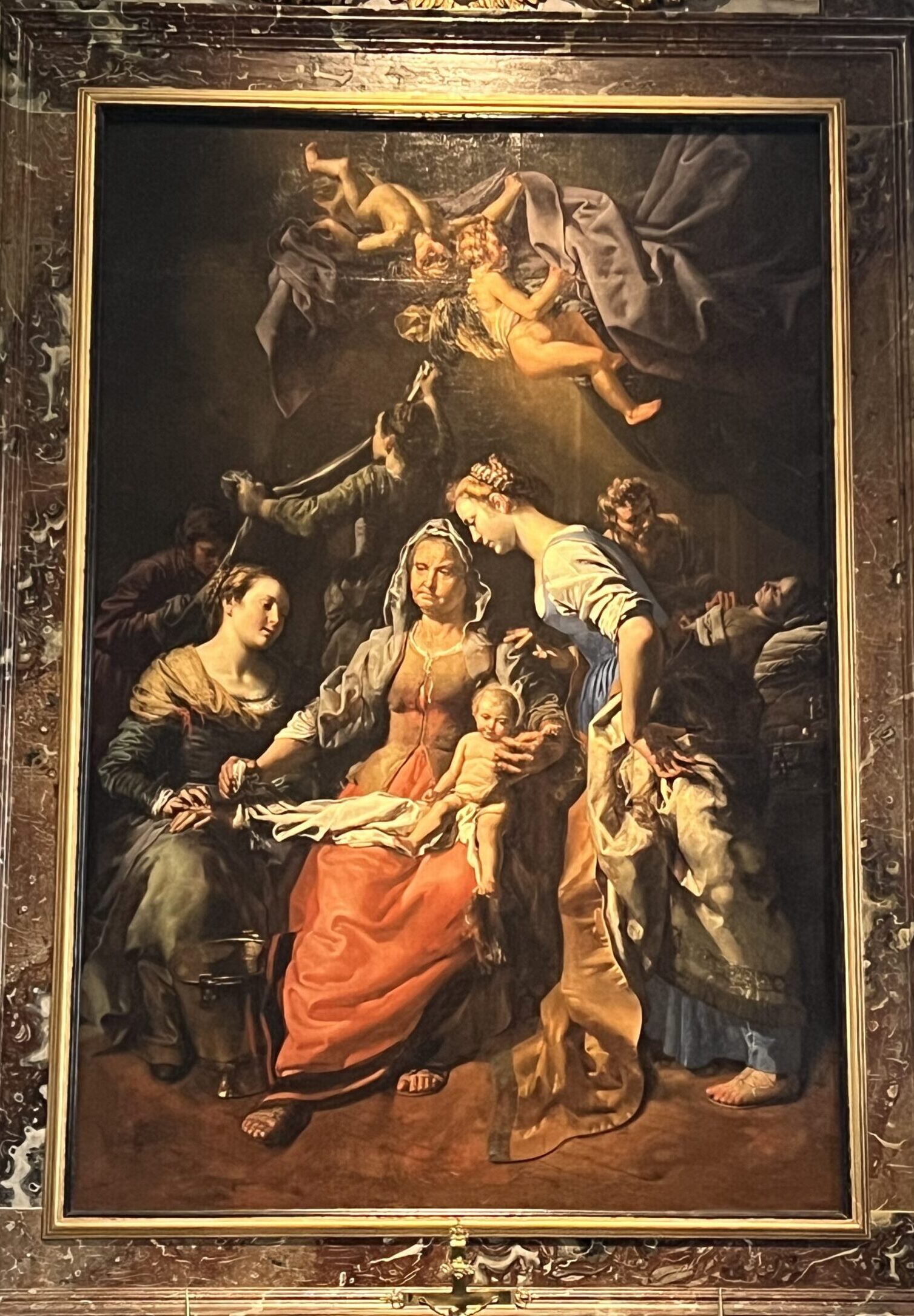
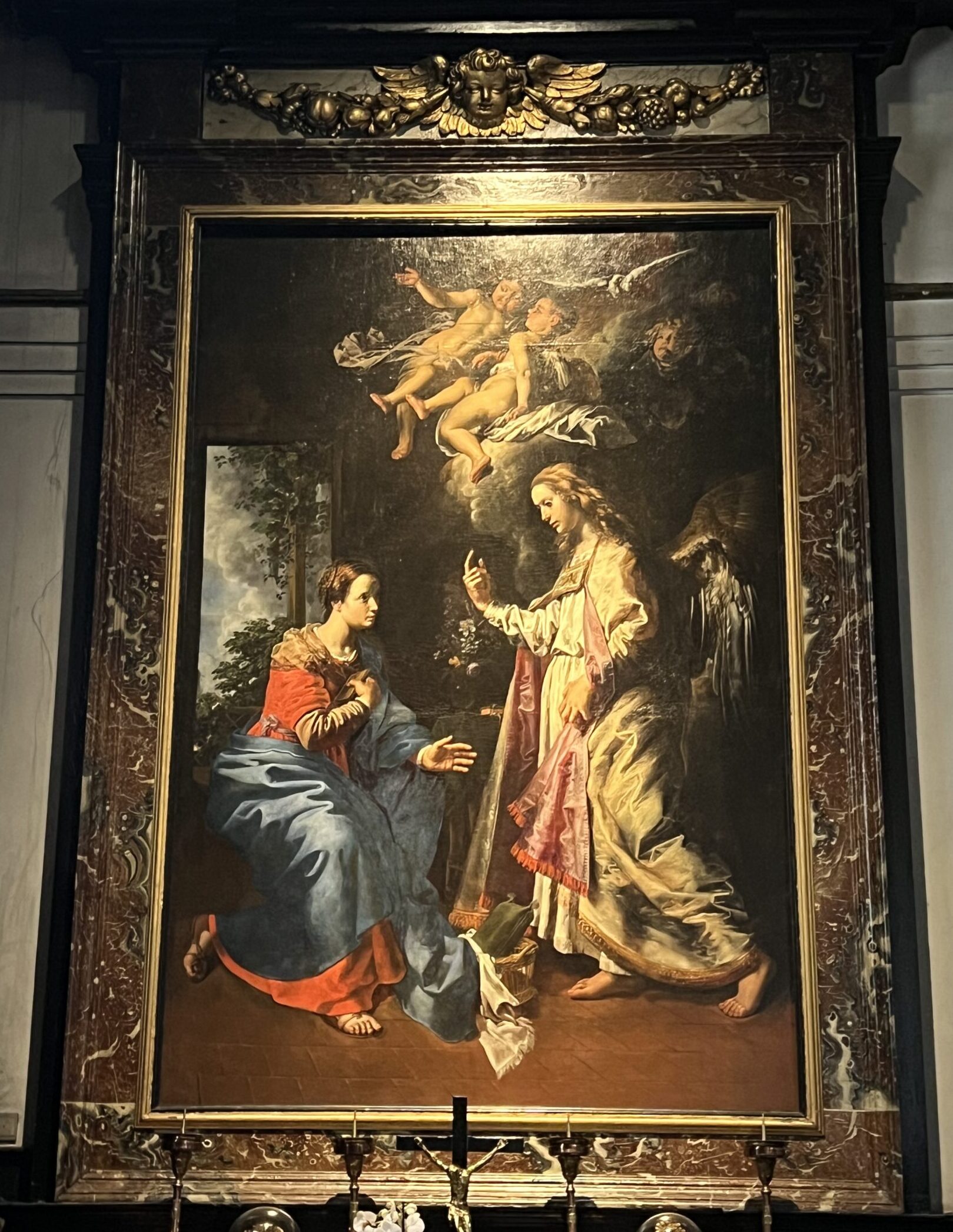
His paintings “The Meeting at the Golden Gate of Anne and Joachim” and “The Visitation” can also be admired. How these artworks move me! I also see other paintings, such as “The Annunciation”, “The Birth of Mary”, “The Presentation of Mary in the Temple”, “The Presentation of Jesus in the Temple”, and “The Mater Dolorosa”. What works by Theodoor van Loon!
I am leaving the basilica, I will take a walk around and come to the Mary Hall behind the basilica, where I have been able to attend a eucharistic celebration with many others on several occasions. Then I will go to the back of the domain. There is peace here, even though many pilgrims are present.
Then I walk to the well. I look into it. What a depth! How many visitors do you think have already looked into this well?
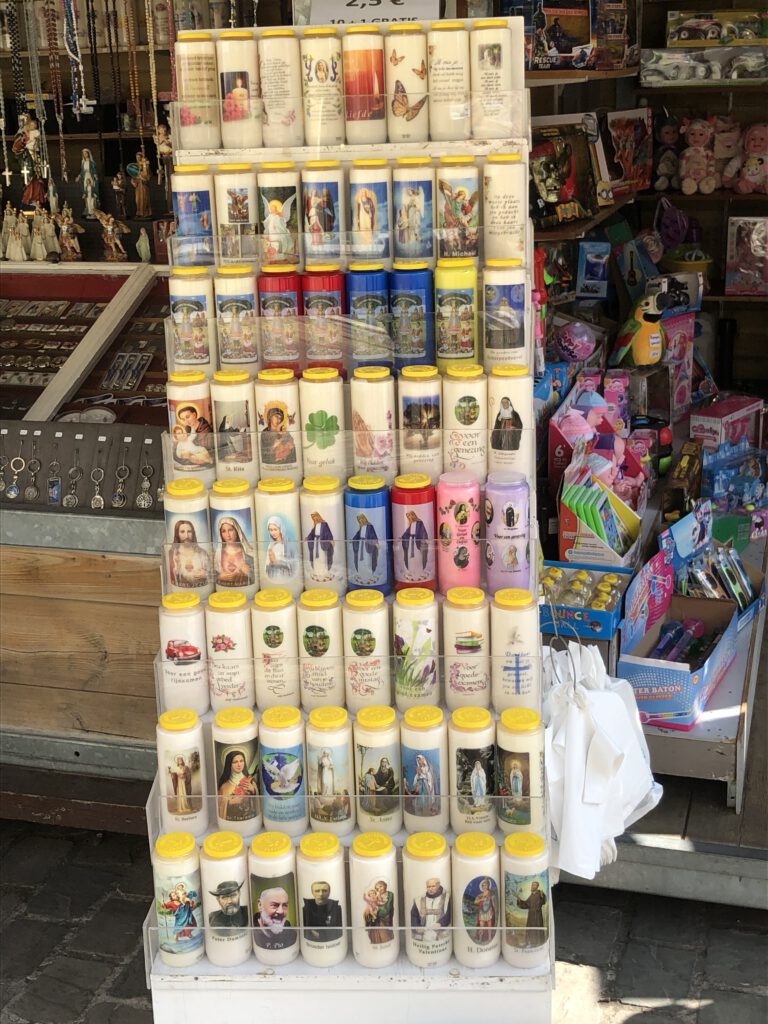
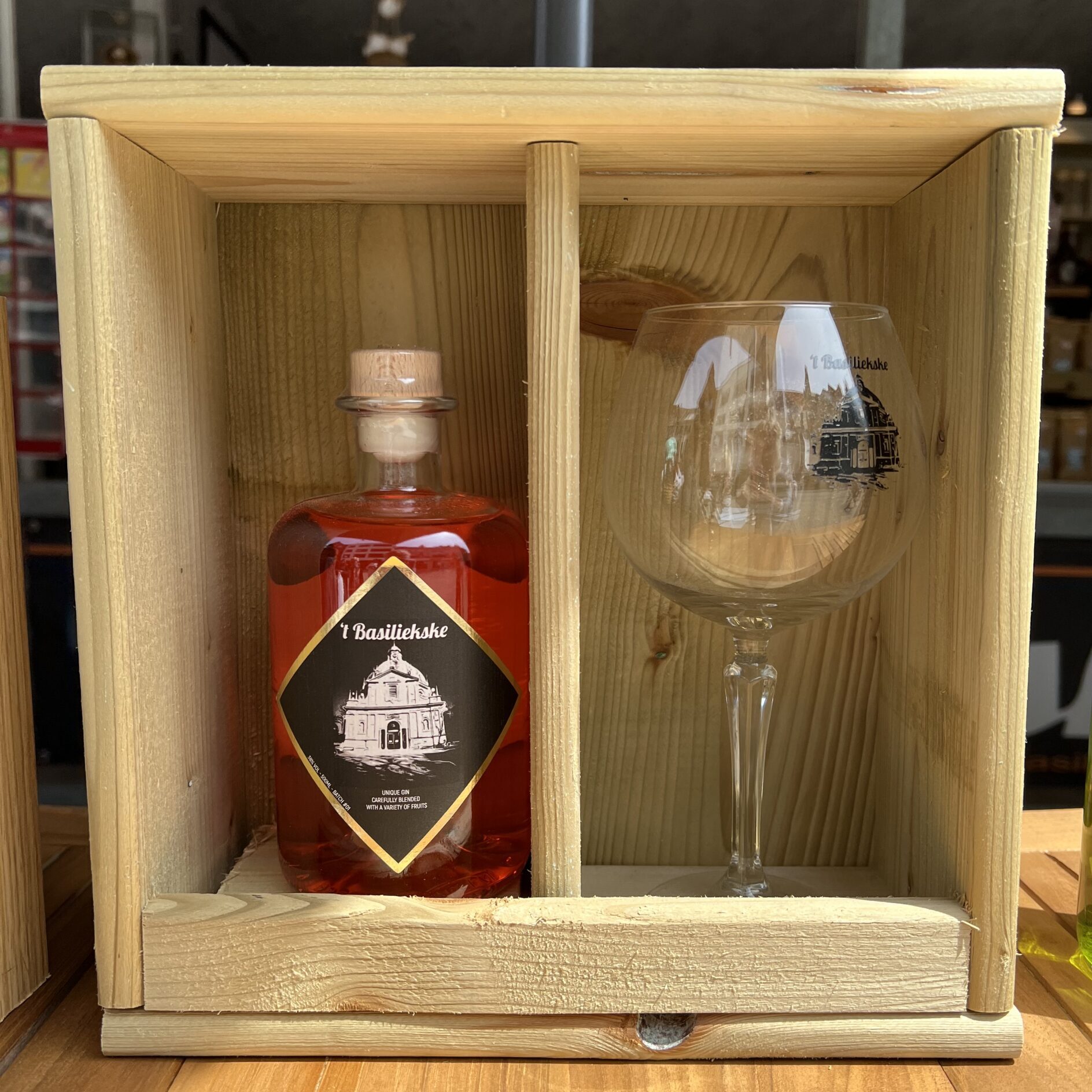
Opposite the basilica, there are several stalls selling devotional items, shops, cafés and restaurants. I buy some novena candles for friends and myself. “Gin” is also available there, named ’t Basiliekske. It's a homemade, smooth gin with orange, cloves, cinnamon and tea, with an alcohol content of 38%.
I will then go to the reception centre “The House of Mary” at Isabellastraat 15a. This is an excellent opportunity to have some tea and process the impressions from my visit.
After an hour, I will return to the basilica to attend a Eucharist service. Again, I thank Mary for the exceptionally beautiful day I have experienced here.
At the end of the celebration, the prayer to Our Lady of Scherpenheuvel is recited aloud:
Our Lady of Scherpenheuvel
Mother of God and our mother
with confidence, we pray to you:
Give us some of your faith
and teach us to be of service
To the people.
Help our sick
and all whose heart
doorleefd en getekend is.
Let happiness and love
living in our family;
Bless all those dear to us,
and also stay close to me
with your protection.
Our Lady
from Scherpenheuvel,
Pray for us.
After the Eucharist service, I take another walk around the basilica and find a prayer card with a text about “Our Lady of Scherpenheuvel”. I take a few copies for friends with great devotion to Mary. Afterwards, I leave the basilica. It is time to go home. With thoughts of the experience in the Jerusalem of the Low Countries, I leave Scherpenheuvel. What a rich person I feel.
~~~

 Nederlands
  English (UK)
  Deutsch
  Français