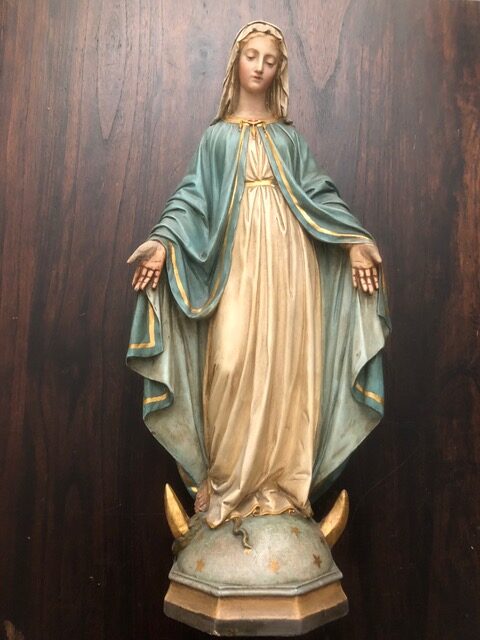
Kevelaer
History
It is 1641, just before Christmas. Hendrick Busman, a peddler from Geldern, hears a voice calling. It is about building a chapel near a hail cross on the heath of Kevelaer. This cross was placed in the field to ward off hail damage. Hendrick Busman hears the voice two more times. One night, his wife, Mechel Schrouse, has a vision of the little chapel. Hendrick perceives this as a signal to build a statue.
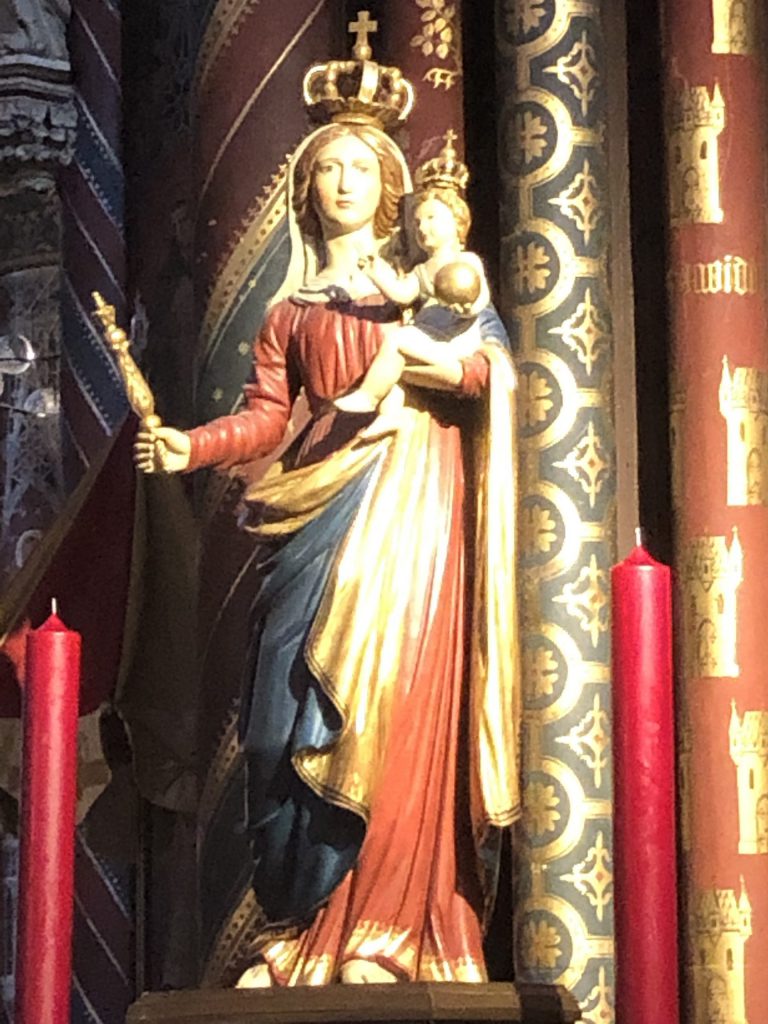
A few days earlier, Mechel was presented with a holy picture by two soldiers. The image on the holy picture depicts Mary in a flowing robe, with the infant Jesus on her left arm. In her right arm, Mary holds a sceptre. Jesus holds the globe in his hand. Both Mary and Jesus are crowned. It is an image of a small statue, 7.5 by 11 centimetres, with the silhouette of Luxembourg City in the background.
Hendrick Busman and his wife Mechel Schrouse go to Pastor Johannes Schink and tell him about their experiences. After consultation, the pastor takes action. In 1642, he places the miraculous statue in the constructed statue column, a cabinet with an image against a post. The statue immediately attracts believers, and the first procession takes place in 1643. Shortly after the statue was placed, eight miraculous healings were recorded and these were recognised as miracles quite soon after. In the 19th century, there were more remarkable healings, such as blind people being able to see, mute people suddenly speaking and invalids taking steps again.
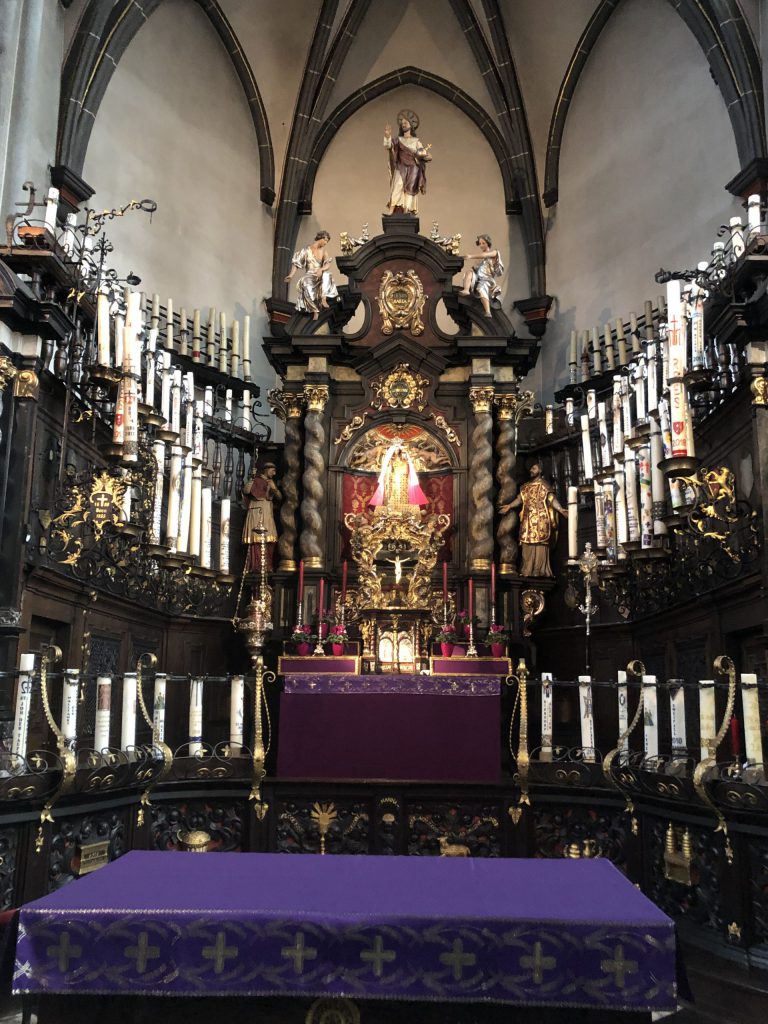
In 1643, the foundation stone was laid for the Candle Chapel. This would become the first pilgrimage church in Kevelaer. The chapel was built between 1643 and 1645 by Hendrik van Arssen. It is a brick building measuring 32 metres long, 10 metres wide, and 15 metres high. The Baroque high altar features a great deal of wood carving. The tabernacle originates from Antwerp. Following the Peace of Münster in 1648, the chapel was consecrated on 2 May 1649. Over 300 candles stand in this space, hence the name Candle Chapel.
The Oratorian monastery was built in 1647 on Kapellenplatz. This is now the Priesterhuis, where courses, retreats and training days are also held.

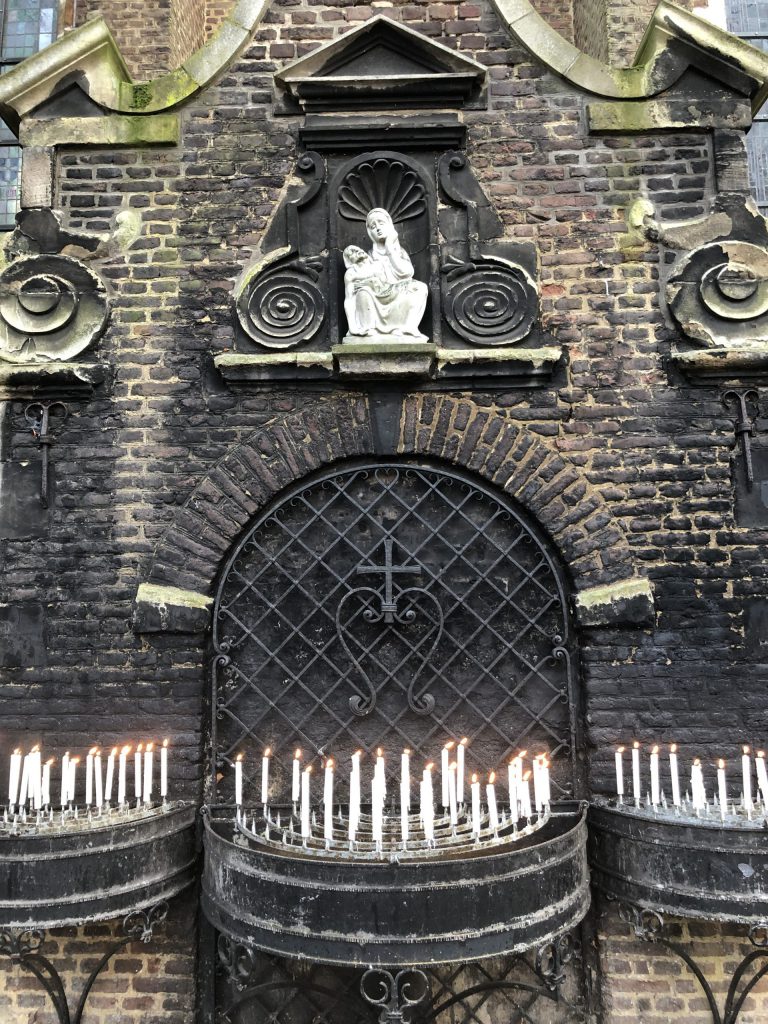
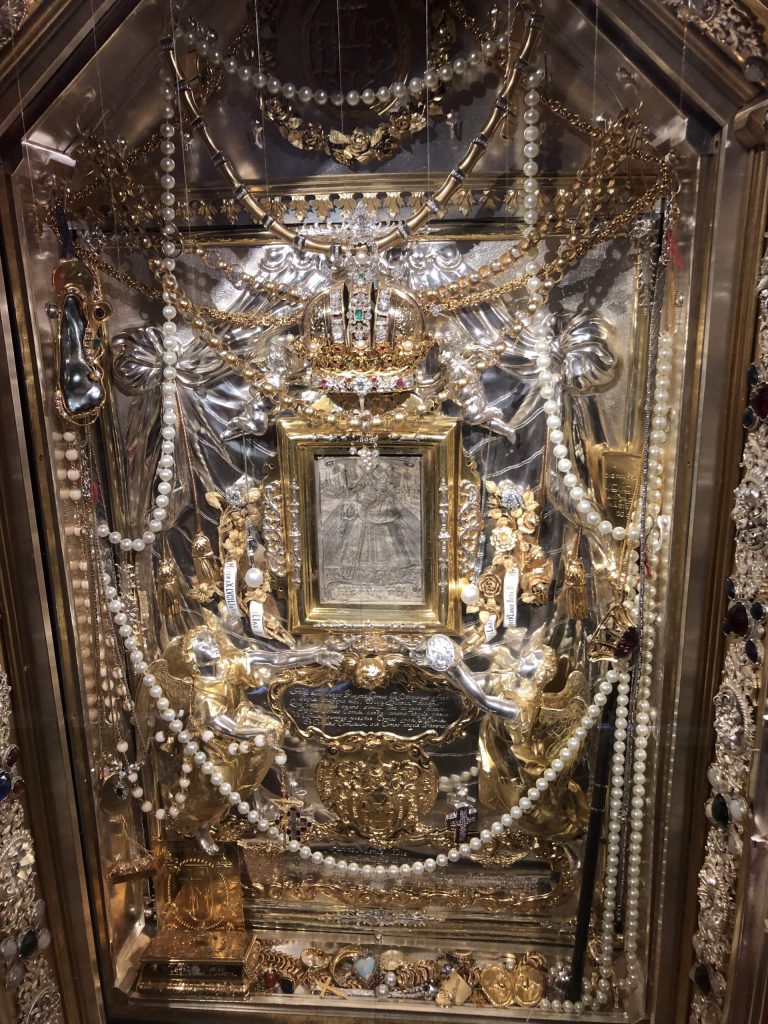
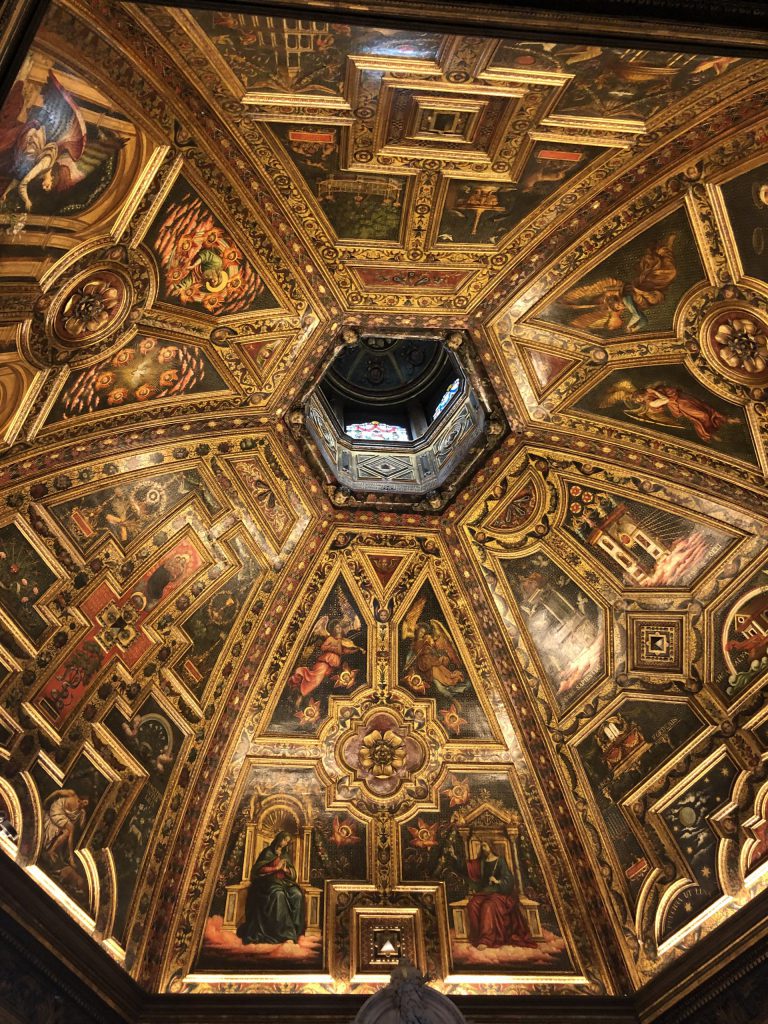
In 1654, the Oratorians had a hexagonal chapel built around the image pillar. This is the Chapel of Grace. The 2.5-metre-high image pillar shows the copper engraving, which was made from the print that Mechel Schrouse found. The Luxembourg Madonna is the “Consolatrix Afflictorum,” or “Comforter of the Afflicted.” In the chapel's masonry, there is an opening through which the statuette can be seen from the outside of the chapel. In 1664, the devotional print was placed in a gilded silver frame. The interior dates from the 19th century. The furnishing of the small building took no less than four years (1888-1892). The designs for the paintings are by the artist Friedrich Stummel. His works are in the Neo-Renaissance style. In 1892, the devotional print was adorned with a golden crown. Two angels hold the crown. This is a gift from the Vatican in Rome. At the top of the print it reads: “Consolatrix Afflictorum Ora Pro Nobis,” which means: “Comforter of the Afflicted, pray for us.”.
Between 1858 and 1864, a large church was built to accommodate the growing number of pilgrims attending services. This is the parish church of St. Mary, located close to the Chapel of Grace. First, the north and south transepts were completed, following the plans of Vincenz Statz (1819-1898). The 90-metre high tower was only finished 20 years later. Artists worked for nearly 30 years on the paintings in this church. Many iconographic paintings were added to the church. Church painter Friedrich Stummel, with his many pupils, created around 170 paintings featuring approximately 1200 figures. The church building is 70 metres long and can accommodate 800 visitors. In 1923, Pope Pius XI granted the Church of St. Mary the title of basilica.
The pilgrimage church of Saint Mary is connected to the Confession Chapel, which was built in 1858. The Baptistery is also located in this chapel. The text on the baptismal font reads: “Fons Hic Est Vitae Qui Totum Diluit Orbem Hoc Natus Flumine Sanctus Erit”. This translates to: “This is the source of life, which cleanses the whole earth, whoever is born of this water shall be holy”.
Since 1985, there has been an annual pilgrimage for motorcyclists, and since 1987, a pilgrimage with Tamils has been held. In 1987, Pope John Paul II came to Kevelaer for the opening of the pilgrimage season. In the same year, Mother Teresa and Cardinal Joseph Ratzinger, the later Pope Benedict XVI, were also in Kevelaer.
Pilgrimage site
Since 1642, Kevelaer has been a popular Marian pilgrimage site. Every day, many pilgrims come here to the centre of the town. The heart of Kevelaer's town centre is formed by the Kapellenplatz with the Chapel of Grace (Gnadekapelle), the Pilgrimage Church of St. Mary (Wallfahrtskirche St. Marien), the Candle Chapel (Kerzenkapelle), the Confession Chapel (Beichtkapelle), and the Priests' House (Priesterhaus).
Most visitors come for the statue of grace in the Chapel of Grace. This copper engraving is called “Consolatrix Afflictorum”, or “Comforter of the Afflicted”. The small Chapel of Grace is therefore constantly visited.
The Candle Chapel is more than impressive with over 300 candles, many banners and shields from visiting pilgrimage groups.
The Pilgrimage Church of Saint Mary stands out with its 90-metre-high tower. The statue of Mary is the focal point of this church. Also special is the altarpiece in the apse; this depicts the Seven Sorrows of Mary and in the centre, the Pietà can be seen. Above the altar, the representation of the Assumption of Mary into heaven is more than worth a look.

The Sacrament Chapel features Neo-Gothic wooden panelling. The windows depict striking scenes: the Annunciation to Mary, the Nativity of Jesus, the Wedding at Cana, the Coronation of Mary, and Joseph the Worker.
The Pax Christi chapel was enlarged in the late 20th century by adding a glass roof to the adjacent area. This entire complex is called “Forum Pax Christi”. The round altar stone houses relics of Saint Ludger, the first bishop of Münster, and Saint Willibrord, the first missionary in the region around Kevelaer. The Orthodox Chapel of St. John is also located in Kevelaer.
Kevelaer does not wish to be seen as a place of miracles, but as a place of solace. The attractive centre boasts around 200 listed buildings, numerous shops, various restaurants, a few galleries and many studios. There are also many cycling routes laid out in and around the town. All of this already makes Kevelaer beloved by many. It is the largest Marian pilgrimage site in Northwestern Europe. After Altötting, it is the second Marian site in Germany. The pilgrimage season in Kevelaer begins on 1st May. Pilgrims arrive on foot or by bicycle from various cities. For instance, the ecclesiastically approved cycling pilgrimage from the Dutch town of Tilburg to Kevelaer has been taking place since 1909. On average, over 800,000 visitors come to the pilgrimage site each year.
ACCESSIBILITY
Kevelaer is located in the district of Kleve, close to the border with the Netherlands. From the Netherlands, the pilgrimage site is easy to reach by crossing the border after Boxmeer or Venlo.
The address is: Kapellenplatz, D, 47623 Kevelaer.
Further information: www.wallfahrt-kevelaer.de.
Experience
My actual destination in Kevelaer is the “Gnadenkapelle” on the “Kapellenplatz”. In the Chapel of Grace, I see the copper engraving of the Mother of God. There is an opening in the chapel's masonry, making the engraving visible to visitors outside the chapel too. In the chapel, I see a beautiful altar and, in the dome, artful depictions of Mary.
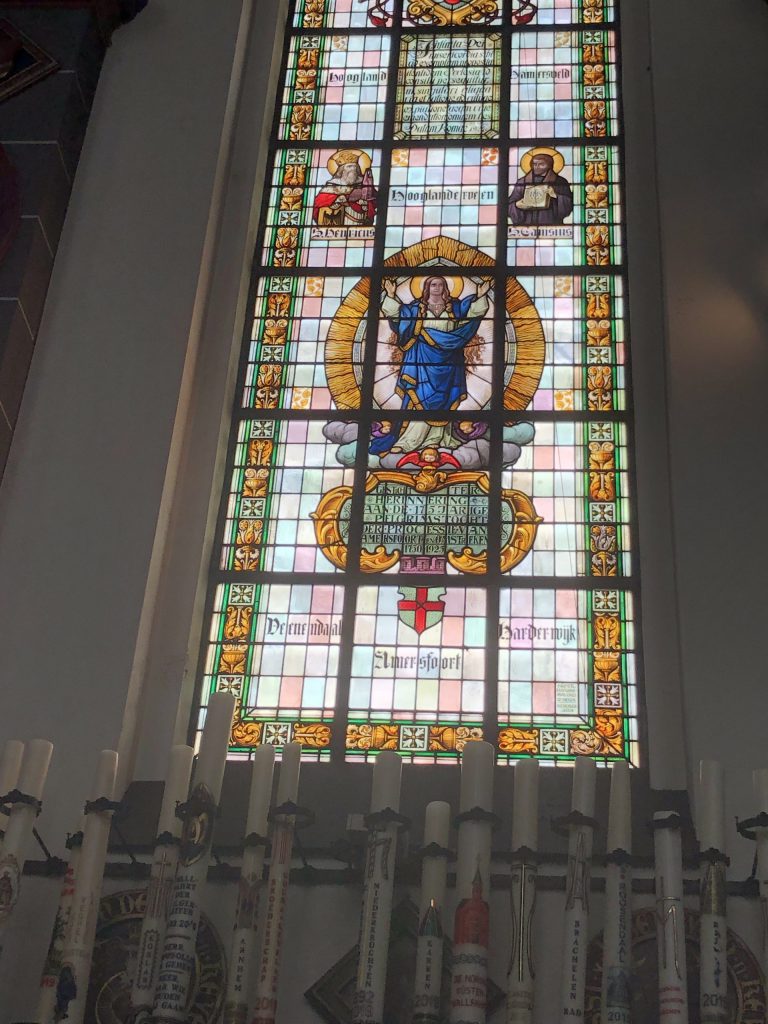
Next, I am going to the Chapel of Candles. Traditionally, this is the true pilgrimage church. I hear that many processions arrive here. In the chapel, I see many large candles, quite a few coats of arms, ex-votos, and stained-glass windows. What splendour there is in this chapel!
After the Chapel of Candles, I will go to the basilica. Many paintings transport me to another world. Inside this building, I am moved by the statue of Mary. She is crowned, as is Jesus, who sits on her left arm and holds the orb in his left hand. Mary holds a sceptre in her right hand. The colours blue and red are a successful choice. Next, it's time for prayer to Mary.
Later in the afternoon, I will visit the Way of the Cross in the Kruiswegpark. To do this, I will make my way to St. Klara Platz and enter the park opposite the Clarissenklooster. How impressive the stations are here too! The Way of the Cross ends in the Mariapark by the statue of the Mantle Madonna. This monument also commemorates those who fell in the two world wars. What a lovely stay in Kevelaer!
Posted: 26 March 2020
Last modified: 24 July 2024
~~~

 Nederlands
  English (UK)
  Deutsch
  Français