History
On 10 August 1519, Mary, with Child in her arms, appears on a crescent moon. She is accompanied by the Archangel Michael, Saint Catherine, the Martyr, and Saint Bernard of Clairvaux. Mary appears to Jean de la Baume, a woodcutter and a devout man. The apparition makes herself known and says that she is the Virgin Mary. This happens in the middle of a field and Mary instructs the man to bring the message to the clergy and town councillors of Cotignac, that she wants a chapel built on Mount Verdaille and named “Notre-Dame de Grâces” (Our Lady of Graces). People should also come in procession to receive her graces. However, Jean takes no action.
One day later, on 11 August 1519, Jean de la Baume sees Mary again, in the same place as the previous day. Once again he hears her requests. This time he decides to comply with what Mary asks him to do. The authorities and villagers believe him immediately and support him with one accord, as he is known to be a serious and devout person. On 14 September 1519, the first stone is laid for a chapel at the site of the apparitions, but it soon proves to be too small and a larger one has to be provided. This happens in 1537. When building the chapel, the workers come across a large number of skeletons. The skeletons are of martyrs from the Roman Empire, therefore from the period ± 600 BC to 395 AD. The Christians were killed because of their faith.
The graces of Mary, granted in Cotignac, attract many pilgrims. The influx of pilgrims is further reinforced by Pope Leo X (Giovanni de’ Medici, 1475-1521). Leo X was Pope during the period 1513-1521 and, in a letter dated 17 March 1521, granted indulgences to pilgrims, also recognising the apparitions.
In 1637, Father Fiacre (1609-1684), an Augustinian friar in Paris, had an idea. He asked that Mary visit Queen Anne of Austria (1601-1666), who had been married to King Louis XIII (1610-1643) for 20 years and had remained childless all those years, to help her. He received a vision of Mary on 5 September 1637. The instruction was to pray three novenas in honour of the Virgin Mary, and then they would be blessed with a son. The royal couple observed the third novena in Cotignac. Nine months later, the royal son was born; Louis XIV (1638-1715). In 1638, as a sign of gratitude for the Virgin Mary's intercession, the king donated the church of Notre-Dame de l’Assumption (Church of the Assumption of Mary).
On 21 February 1660, Louis XIV came to Cotignac with his mother, Anne of Austria, to thank Our Lady of Graces.
On 7 June 1660, a young shepherd, weakened by heat and thirst, suddenly sees a man at his side near Mont Bessillon, who introduces himself as Joseph. Joseph tells him that if he goes up the rock, he will find water. Later, Joseph with Child appears again in Cotignac to a shepherd. It is rare for Joseph to appear in the world.
During the French Revolution (1789-1799), the religious buildings in Cotignac also suffered, as the sanctuary was looted and destroyed. In 1809, many wished to rebuild the Sanctuary of Cotignac. Work began at the start of 1810. The chapel was restored and converted into a church.
In 1938, the statue of Maria in Cotignac was crowned. This occurred during the commemoration of Louis XIII's vow in 1638, three hundred years earlier.
In 1950, the gilded statue of Our Lady made a journey to Rome to represent France at the proclamation of the dogma of the Assumption of Mary.
In 1975, the Congregation of the Holy Apostles John was founded by Father Marie-Dominique Philippe (1912-2006). The spirituality of the members is based on the Apostle John. Since 1981, the congregation members, brothers of Saint John, have been looking after the pilgrimage church at the request of the Bishop of Fréjus-Toulon, Gilles-Henri-Alexis Barthe (1906-1993).
In 1980, the Benedictine nuns, who had returned from Algeria, founded a monastery on Mont Bessillon, with the chapel of Saint Joseph.
The Bishop of Fréjus-Toulon, Dominique Rey (born 1952), who has been a bishop since 2000, commissioned the construction of the current basilica in 2005.
Pilgrimage site
In Cotignac, the sanctuary with monastery lies just outside the village. The “Sanctuaire Notre-Dame de Grâces” can be visited daily.
In the left wall of the church is a memorial plaque in remembrance of Father Fiarce, who played a mediating role in asking Mary not to let the marriage of Louis XIII and Anne of Austria be childless. On other walls, ex-votos and expressions of gratitude have been placed.
For pilgrims, devotional items and religious books are available, as are regional products, such as honey and oil.
In the sanctuary, there is accommodation for pilgrims in the “Foyer de la Sainte Famille”.
Every year, around 100,000 pilgrims arrive with organised pilgrimages. The actual number of visitors is significantly higher, as many come to the shrine independently.
ACCESSIBILITY
Cotignac is located in Provence, about 60 kilometres north of Toulon. Take exit 35, “Brignoles”, from the A8 motorway. Then head towards “Le Val” and subsequently take the road to “Montfort sur Argens” to reach Cotignac.
Address: Sanctuaire Notre-Dame de Grâces, F 83570 Cotignac.
You can find current information on www.nd-de-graces.com.
Experience
At the bridge over the small river La Cassole, I follow the road upwards. It's nearing 11:00 am and the temperature reads 36 degrees. Soon I will be able to attend mass at the sanctuary.
I find the colourful window with images of Mary and Jesus, which can be seen above the church entrance, beautiful. When I enter the space, there is information about pilgrimages to Mexican Guadalupe and Portuguese Fatima. Here I see images that Mary appeared here on 10 August 1519 to Jean de la Baume and of the visit of King Louis XIV on 21 February 1660 with his mother Anne of Austria. Then I attend the Eucharist.
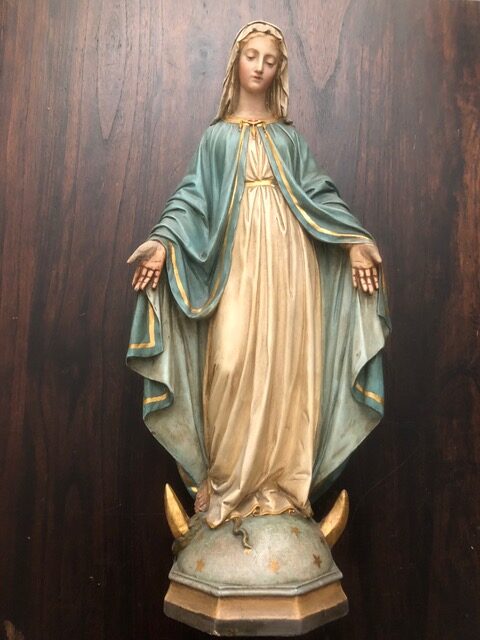
Afterwards, there will be an opportunity to make a round of this house of God. I see a commemorative plaque in the wall of the church and the text makes it clear that Father Fiacre's heart rests here. This came about at his request and by order of King Louis XIV. I also notice a photo of Saint Thérèse of Lisieux, as well as dark brown coloured images of the Way of the Cross and a statue of Saint Joseph. I find the statue of Mary with Jesus in her arms by the altar remarkably beautiful. Mother and Son are crowned. Our Lady has a blue cloak with golden stars on it.
Furthermore, I'm paying a visit to the shrine shop to buy something special for a great friend, who often has Mary on their mind. I'll take something for myself too. The stock in the shop is impressive. What a choice!
Afterwards, I visit the monastery where the apparition of Saint Joseph is commemorated. This is situated on another hill from Cotignac.
The other day I parked my car on the edge of Cotignac town centre and walked to the sanctuary. The path goes steeply uphill. After about a kilometre there's a fork as cars and pedestrians are separated. The pilgrim path is strewn with loose pebbles of all shapes and sizes. With temperatures nearing 40 degrees, progress is very slow. Finally, I reach the sanctuary. The bells chime to signal that mass will begin shortly. Inside the church it feels quite cool and my sweaty shirt slowly dries. How fortunate that the church walls are thick; they keep the heat outside. I take a seat and look up. The ceiling is blue and above the altar, gold stars have been added. What a gift it is to be able to stay here.
Posted: 29 June 2022
Last modified: 27 October 2022
~~~

 Nederlands
  English (UK)
  Deutsch
  Français