History
In the year 1515, the Virgin Mary appeared three times to Anglèze de Sagazan (1503-1582). She lived in impoverished circumstances with her family members. Anglèze herded sheep near her family home. The Marian apparitions took place near the spring, where the sanctuary church now stands.
A beautiful lady, surrounded by light and dressed in a white gown, appears to Anglèze. This lady smiles at her and speaks the words: “Do not be afraid, I am the Virgin Mary, the Mother of God. I ask you to go to the bailiff, an official with judicial powers, of Mouleon. This place is not far from Garaison. Mary asks her to tell the bailiff that a chapel must be built in this place because She wishes to bestow gifts of grace here. She also says that we must not forget to thank God for his good deeds. Mary also says that there is food available in the house. She lets Anglèze look in the bread cupboard and take the bread. Anglèze sees that the bread is no longer black, but white. This is called the miracle of the bread.".
The sanctuary was built 25 years after the apparitions, in 1540.
Anglèze de Sagazan becomes, after the apparitions, a nun with the Cistercian Sisters in the convent at Fabas in the Haute-Garonne.
In 1590, during the Reformation, the church was looted by Protestants. In this religious war, Huguenot soldiers destroyed the sanctuary. The statue of Our Lady withstood the flames of a two-hour inferno. Since then, the wooden statue has been placed in the heart of the chapel.
In the 17th century, many frescoes were created in the church, depicting miracles. After all, many healings took place at the spring.
From 1600, Garaison became a major pilgrimage site, a status that lasted until 1792. In that year, the French Revolution led to the chapel's closure. During the period 1600-1792, many sick people flocked to the sanctuary, and numerous miracles of grace were obtained. Our Lady received the title of “guérison,” meaning “healing.” In the local dialect, this is “garaison,” and thus the shrine's name, “Notre Dame de Garaison,” originated.
In 1836, Jean-Louis Peydessus (1807-1882) arrived in Garaison. He founded the Missionaries of the Immaculate Conception, also known as the Fathers of Garaison, and the Sisters of Our Lady of Lourdes. He then took the initiative to restore the sanctuary. In 1841, he established the school, which stands next to the church.
In 1865, the statue of Our Lady of Garaison was crowned by Bertrand-Sévère Laurence (1790-1870), Bishop of Tarbes (1844-1870). Shortly thereafter, the first auxiliary priests departed for the new Sanctuary of Lourdes, where Mary appeared to Bernadette Soubirous (1844-1879) in 1858. With this, the priests responded to the worldwide calling of Lourdes, where the number of pilgrims increased year by year.
In 1903, the College was closed.
During the First World War (1914-1918), the buildings of the sanctuary were used to house 1700 prisoners. Among them was the German professor, philosopher, doctor, musician, writer, and Lutheran theologian Albert Schweitzer (1875-1965).
In 1923, former pupils took over the College and returned it to the congregation.
In 1924 the chapel was classified as a historic monument.
In 1956, the process for the beatification of Jean-Louis Peydessus began.
In 1958, the remains of the seer Anglèze de Sagazan are transferred from Fabas to Garaison. Anglèze is laid out in the chapel.
In 1976, the Christmas celebrations are broadcast across Europe from the Sanctuary of Garaison.
In May 2015, the commemoration of 500 years of apparitions of the Virgin Mary took place on a grand scale. The ceremony was accompanied by eucharistic celebrations, a concert, procession, and conference.
Nowadays, a new community, the Fathers of the Holy Cross, has taken responsibility for the Sanctuary of Garaison and the regional parish of Garaison.
Anglèze de Sagazan has not been canonised by the Catholic Church because she lived as a true saint. She did so with full modesty, obedience, discretion about the apparitions, and with her calling as a religious. These characteristics correspond with Bernadette Soubirous (1844-1879), the visionary of Lourdes.
Pilgrimage site
The entrance to the monumental chapel dates from 1620. The seer Anglèze de Sagazan lies in state in the chapel, where magnificent frescoes can be seen. The altarpiece is the heart of the chapel and is beautifully depicted. It was made in 1635 by the French sculptor Pierre Affre (1590-1669). The miraculous statue from 1590 is a Pietà and shows the compassionate Virgin Mary. Every visitor is touched by this effigy.
Behind the chapel is the spring, where shepherdess Anglèze de Sagazan sees the apparition. This spring was already present before the apparitions. The water from the spring can be drawn daily.
Next to the church is a Catholic school with hundreds of students; the Notre-Dame de Garaison institute.
In Garaison there is a special song made for Mary, namely
“O, Our Lady of Garaison.
The chorus goes:
“O Our Lady of Garaison
My soul ignites for you with love
From your area
O white star
Guide my sail to Sion.
At its heart, this means: “O Our Lady of Garaison. The love of my soul ignites for Thee. The white star shows me the way even unto Zion”.
ACCESSIBILITY
The “Notre Dame de Garaison” is located about 70 kilometres east of Lourdes, in the south of France, near Lannemezan. On the Tarbes-Toulouse motorway, take the Montrejeau exit and head in the direction of Boudrac and Mouléon-Magnoac.
More up-to-date information can be found at www.garaison.com/le-sanctuaire.
Experience
As I approach the sanctuary, I see an impressive complex of buildings. It is a large domain of “Notre Dame De Garaison”. A sign states that a boarding school is also located here.
Upon entering the chapel, the Ave Maria sounds. This comes across as heartwarming in this ancient place of worship. This is an oasis of peace, as I am the only visitor. That feels very peculiar. Outside it is 34 degrees Celsius and in this building with thick walls it is cool with barely half the temperature of the outside air.
The main altar of the chapel displays a 50-centimetre sculpture of the Pietà in the centre. This statue has survived a fire and the flames have not affected it. The Pietà is surrounded by more than ten cherubs. Above this are the statues of Saint Anne and Saint Joachim. I also see a wooden statue, which depicts the Assumption of Mary. Furthermore, two large paintings can be seen in the main altar. To the left of the main altar is the chapel of Saint Joseph, and to the left of the altar is that of John the Baptist. I also see the chapel of Saint Catherine. Here is the altar with the remains of the visionary Anglès de Sagazan. What special encounters this shepherdess had with the Virgin Mary! Afterwards, I will go to the other side of this house of worship to visit the chapel of the Immaculate Conception.
The chapel boasts numerous ceiling and wall paintings from the period 1699-1702. These old frescoes have been partly preserved and were restored in 1974. The chapel is a jewel to me!
Next, I visit the sacristy, which dates from the 17th century. The sacristy door is open. I go inside and here too, I am alone. The ceiling is entirely painted. What a lot of paintings to admire here. How beautiful the frescoes are! The artworks were created many years ago. The paintings depict, among other things, the symbols of the Eucharist, such as hosts, bread, and wine. There are also images of angels, evangelists, and apostles. I see paintings of Peter with the keys, Paul with a book, the Virgin Mary, and a suffering Jesus. In 1988, the images were restored. In that room, I get into conversation with a clergyman and speak about my visit to this part of France. I ask him about the number of pilgrims who visit here annually. Apart from the regular weekend services, there are about 10,000 visitors. Once, hundreds of thousands of pilgrims came here annually, but since the apparitions in Lourdes in 1858, the crowds have significantly decreased.
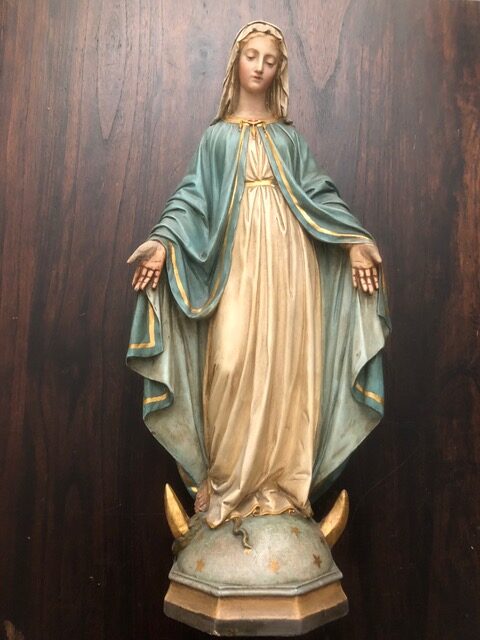
Walking through the vast garden, I arrive at the rear of the chapel. There are benches in front of a built-in, lower-lying chapel. A Marian apparition is depicted in white stone, and below it is the spring of Garaison. Above the entrance to the spring stands a large statue of Mary, and the Mother of God is trampling on the serpent. The spring constantly flows with water. I buy a candle and descend the stairs. I light the candle and pray.
Later, I will go back to the car and get empty bottles. These will then be filled with spring water. This water is to be shared with other believers upon returning home. After putting the water in the car, I will go back to the garden. I arrive at a chapel, where the deceased Jesus hangs on the cross with a weeping Mary at his feet. In another small chapel, I see a large scene with Mary, Jesus, and a dying Joseph. How valuable it is to be here.
Environment
The pilgrimage site of Lourdes is 73 km to the west. To visit Saint-Bertrand de Comminges, you need to go 31 km to the southwest, and the pilgrimage site of Montoussé is not far from there. The distance from Garaison to Montoussé is 22 km.
Posted: 2 July 2021
Last Modified: 20 February 2024
~~~

 Nederlands
  English (UK)
  Deutsch
  Français