History

The origins of the pilgrimage site Maria Weissenstein date back to 1553. The Virgin Mary then appeared to landowner Leonhard Weissensteiner. He was suffering from a nasty, painful illness and Mary healed him. In gratitude, she asked Leonhard to build a chapel with a tower. In this chapel, believers could then ask her for help. Leonhard promised to fulfil her request. However, once healed, he forgot his promise. Some time later, Leonhard fell deep down a shaft. He was in a very precarious position and again Mary came to his aid. Subsequently, Leonhard really got to work on his promise. He had the chapel with a small tower built. This site dedicated to Mary increasingly received pilgrims visiting, and the space soon became too small. The need for a larger place of worship became apparent. The construction of the church was a gigantic undertaking, partly due to the height at which work was carried out. Work began in 1638 and the church was completed in 1654. The church is built in Baroque style. The miraculous image of Mary and Jesus, the Pietà, was crowned in 1885. In 1985, the church was elevated to the status of a basilica.
Pilgrimage site

The pilgrimage church, adorned with many frescoes, reigns majestically over the Petersberg. This house of God is world-renowned as the Cathedral of the Dolomites and is situated at an altitude of 1520 metres. From here, there is a magnificent view of the surrounding area, including the Weisshorn/Corno Bianco at an altitude of 2317 metres.
In the basilica, the miraculous image of Mary is central. She is depicted with her Son on her lap. This image is made of white stone. The original chapel of Leonhard Weissensteiner, the gold and silver high altar, the many frescoes, and the vaults have been drawing many pilgrims to this spot for years. In a side aisle, hundreds of votive offerings can be seen. Next to the church is the chapel of Saint Peregrine Laziosi, the patron saint of cancer patients.
The later Pope John Paul I, as a cardinal, enjoyed a summer holiday here. Pope John Paul II also visited this pilgrimage site on 17 July 1988. A picture and a candle commemorate this visit. Since this visit, Maria Weissenstein has become more famous than ever.
In Maria Weissenstein, there is a special prayer through Mary to Jesus:
“Prayer to Our Lady of Weissenstein
Lord Jesus,
the one on Calvary Hill
by the presence
you were comforted by your mother
and after death
rested on your lap again,
Look upon our distress
and hear our prayers,
which we by Maria von Weissenstein
to address you.
Amen!”
In Dutch, this is:
“Prayer to the Mother of God of Weissenstein
Lord Jesus,
as you on Golgotha
by the presence
the Mother was consoled
and after death
rested on her lap again
Look at our need
and hear our requests,
that we via Maria van Weissenstein
to address you.
Amen!”
The pilgrimage site is spacious and includes a guesthouse, pilgrim's house, youth hostel, shop, bar, large car park, and conference centre. It is South Tyrol's best-known pilgrimage site.
ACCESSIBILITY
Maria Weissenstein is located in Deutschnofen/Nova Ponente in South Tyrol. The Sanctuary is only 20 kilometres east of Bozen/Bolzano. This place is in the north of German-speaking Italy.
On the A12 Brenner Autobahn, head towards Bolzano. After the Bozen Nord exit, take the road leading to the Eggental valley. You will then reach Deutschnofen. The pilgrimage site Maria Weissenstein is located near the Petersberg at an altitude of 1520 metres.
Address: Weissenstein 10, Petersberg, 38036 Deutschnofen.
For more information, there is the website “www.weissenstein.it”to visit.

Experience
On my journey through the Italian-speaking South Tyrol in Germany, I am visiting Maria Weissenstein. Arriving at the church, stories of the origin of this Marian shrine come to mind. This pilgrimage site is so special because, as a place of Mary, it is a source of strength and a meeting place in the Dolomites for believers and those seeking help. Pilgrims come there with hope of meeting Mary. Like me, they lay their worries at Her feet. Praying for healing and insights, which they hope will become reality.
I am impressed by this Mariaplaats. The church and the thousands of expressions of gratitude particularly move me. These tokens of thanks to Mary are found next to the prayer chapels. What expressions of gratitude, and then displayed as personal displays of folk art. People are so creative in their depictions, expressing their devotion to the Mother of God. Afterwards, I will return to the church and begin to pray.
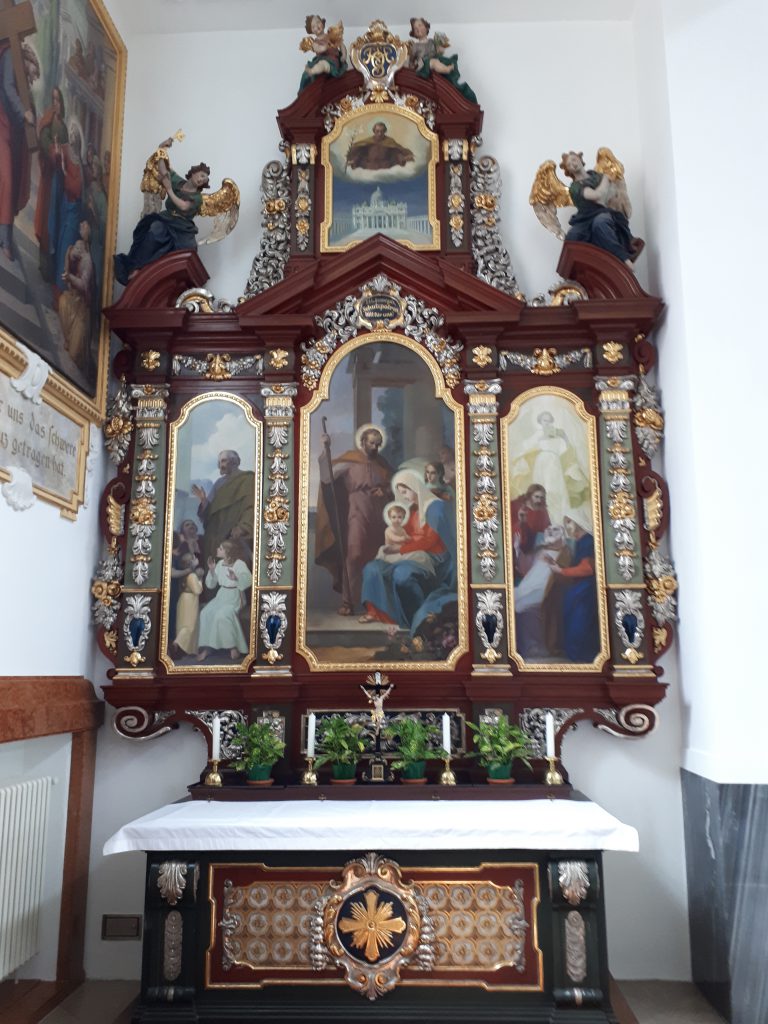
I am thankful to be here, Maria, and for the good things I experience in my life. Afterwards, I spend a long time contemplating the small chapel from 1553, which is located in the back left of the church.
Before I leave this place of pilgrimage, I will visit the religious gift shop. I will buy a few things for friends and for myself a holy water font with a depiction of the Pietà on it.
It's a truly beautiful and immersive experience for me to be able to come here.

Posted: 8 September 2019
Laatst bijgewerkt: 11 februari 2021
~~~

 Nederlands
  English (UK)
  Deutsch
  Français