History
The place Gietrzwald was German (Prussian) territory for years and was then called Dietrichswalde. Around 1352, a wooden chapel was built in Dietrichswalde in honour of Our Lady. The chapel was destroyed during the Battle of Grunwald/Tannenberg on 15 July 1410 between Prussian forces on one side and Lithuanian and Polish forces on the other.
In the 15th century, after the Battle of Grunwald/Tannenberg, many pilgrims were received in a newly established, small shrine to Mary. The image of Our Lady is presumably from 1425. It is a stone chapel. Later, this site was expanded several times. At the end of the year 1500, the expanded sanctuary was consecrated by Johann Wilde (1438-1532), auxiliary bishop and titular bishop (1495-1532), serving as auxiliary bishop of Warmia from 1499 until 1532.
From 1500, September 8th is the annual feast day of Our Lady of Gietrzwald. In 1568, reports were made of Marian devotion, including accounts of miracles and miraculous events. Witnesses have submitted reports and given statements about these occurrences. From that year, the sanctuary has been officially dedicated to the Nativity of Mary. On September 29th, 1580, the main altar was consecrated by Marcin Kromer (1512-1589), Bishop of Ermland (Warmia) from 1579-1589. The then-current miraculous image of Mary, dating from 1425, was placed in the main altar.
Research indicates that the miraculous image of Mother Mary and her Child was created at the end of the 16th century, but the painter is unknown. The image belongs to the category of icons with Byzantine influence.
During the apparitions, the location is in Northeast Germany. These apparitions occur to two Polish children and other German citizens of Dietrichswalde. In 1807, the village of Dietrichswalde (Gietrzwald) is attacked and plundered by Napoleon's French army.
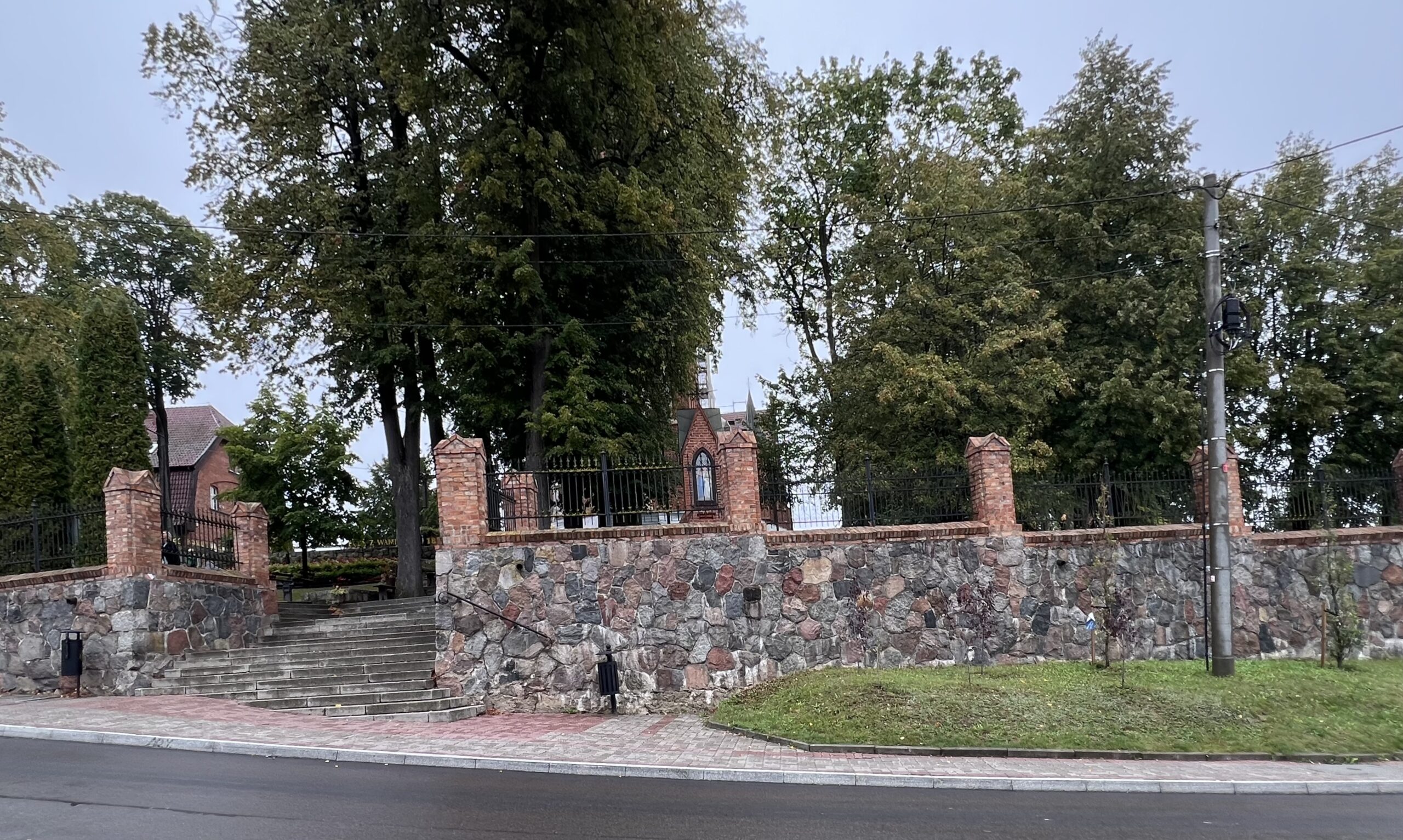
In 1877, Gietrzwald faced the “Kulturkampf” (Cultural Struggle) of 1872-1879, led by Otto Eduard Leopold von Bismarck (1815-1898), Chancellor of the German Empire (1871-1890). It was a struggle waged by the government against the Catholic Church, aiming for its eradication. German troops occupied Dietrichswalde (Gietrzwald) at the time. The region was primarily composed of families whose members worked in agriculture and animal husbandry.
A few kilometres north-east of Gietrzwałd lies the hamlet of Nowy Młyn. Here live 13-year-old Augustyna (Justyna) Szafryńska (1864) and 12-year-old Barbara Stanisława Samulowska (1865-1950). Both children are raised in poor families and receive a Catholic upbringing. The two girls see Mary on multiple occasions. During the time of the apparitions, the two seers are often separated so as not to influence each other. Two women also claim to have seen Mary and Joseph in 1877. They are 23-year-old Katarzyna Wieczorkówna (1853-1897) and 48-year-old Elżbieta Bilitewska (1828-1903). Their reported experiences differ from those of the other two girls. For this reason, only the events reported by Augustyna (Justine) Szafryńska and Stanisława Barbara Samulowska are taken seriously.
In Gietrzwald, Mary appeared in 1877, from June to September. The apparitions began on 27 June 1877 and ended on 16 September of that year. Mary spoke to the children in Polish. Why did She appear here? The answer is not immediately forthcoming. Mary said that people must pray and made herself known, as in Lourdes in 1858, as the Immaculate Conception. The two girls said they had more than 160 visions.
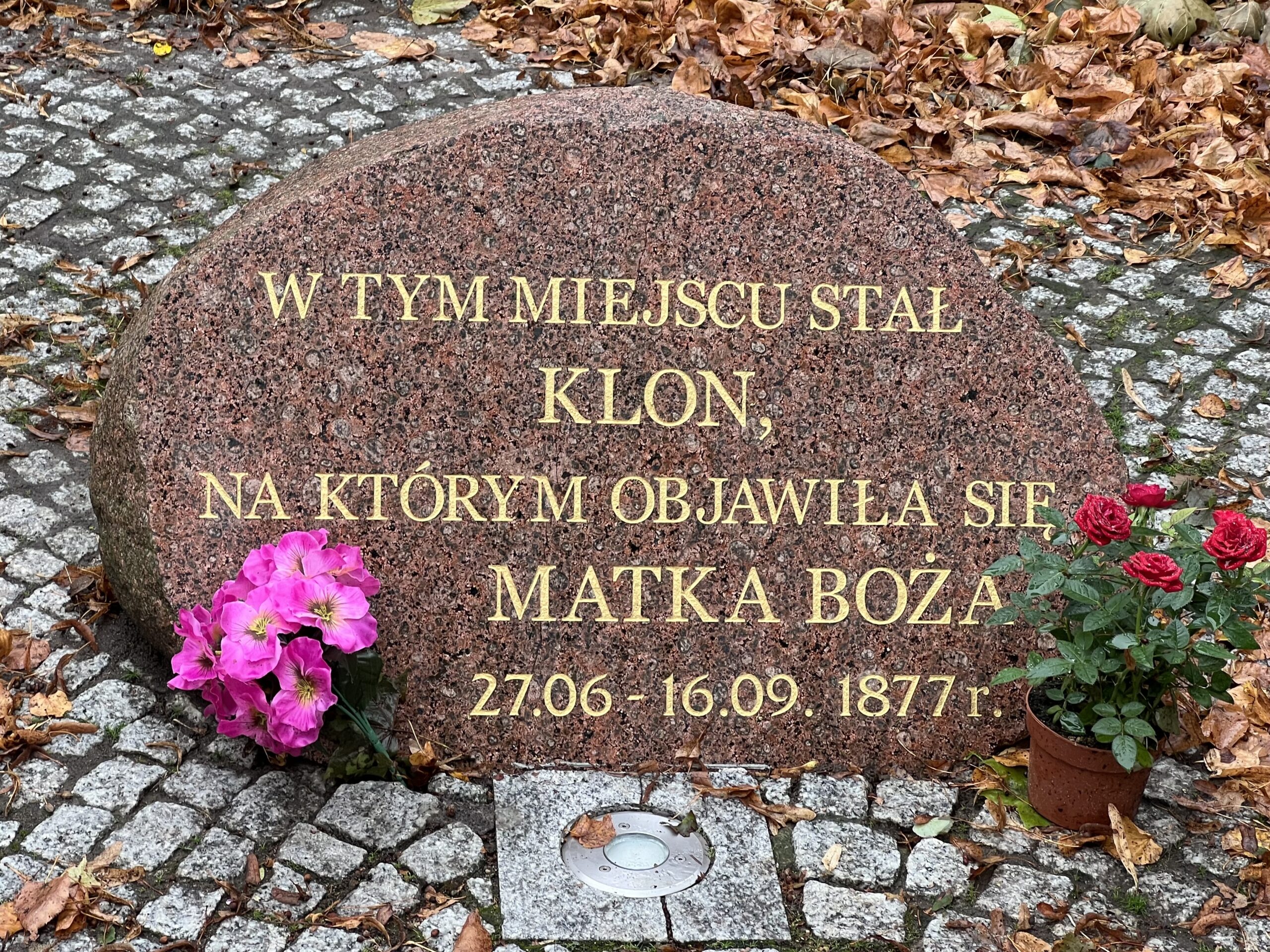
On 27 June 1877, the first apparition occurs. In the morning, a Franciscan friar from the monastery in Przasnysz sees a bright cloud. It drifts from Częstochowa towards Warmińska/Warmia, near Gietrzwald. This cloud is more beautiful than the sun. Later, it turns out that many others also saw the cloud and the words “Warmińska Częstochowa”. On this day, Justyna Szafryńska returns from church with her mother. She has just successfully passed her “First Communion Catechesis” exam. This allows her to receive communion from now on. The girl sees a Woman dressed in white and gold, holding a Child, and thinks they are Mary and Jesus. Mary is carrying her little Son on her left arm. After a few minutes, Mary and the Child rise towards heaven. Justyna's mother does not see the apparition.
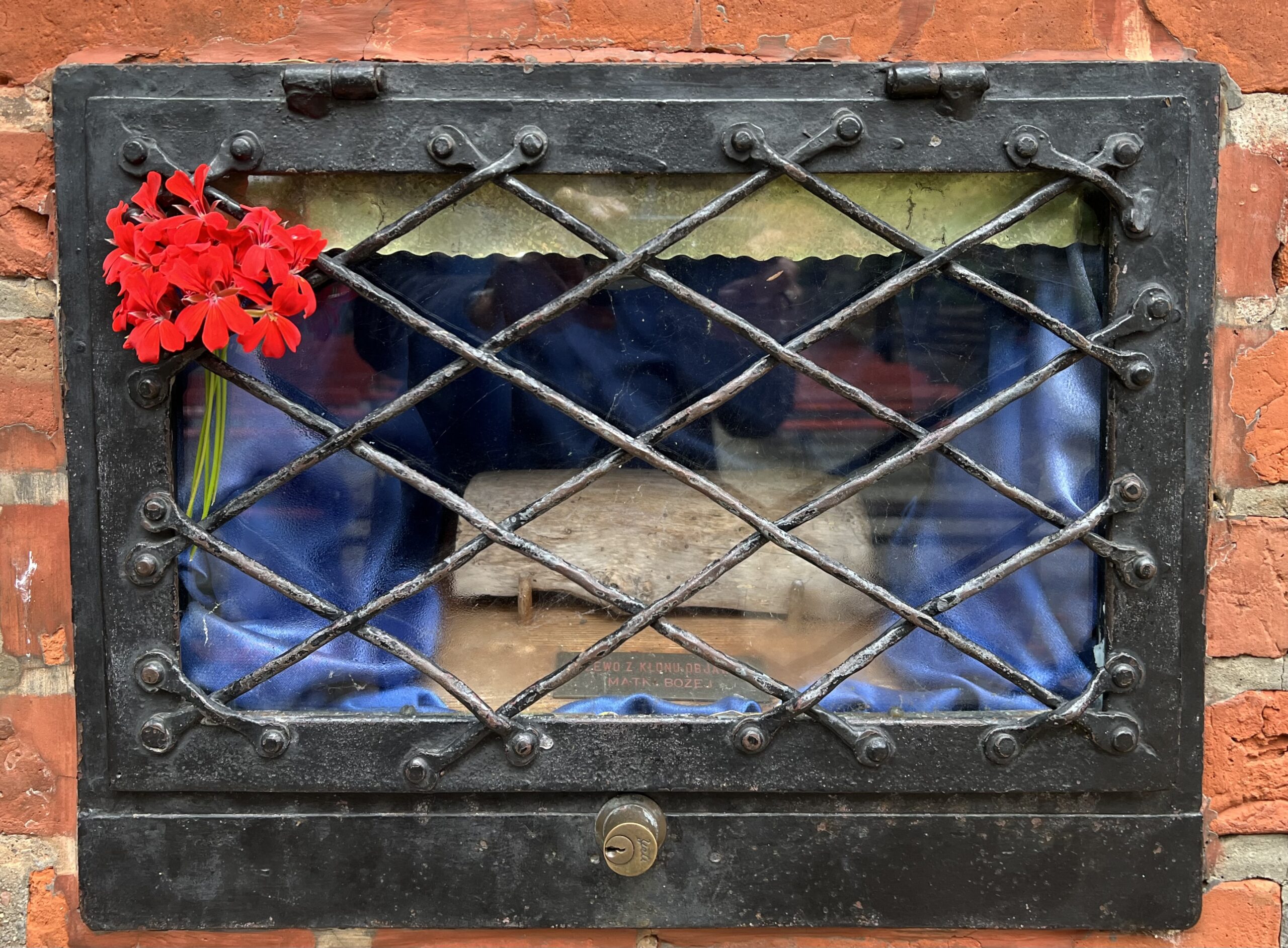
A day later, on June 28, 1877, the second apparition occurred. Both Justyna Szafryńska and Barbara Samulowska saw the apparition of a “Beautiful Lady.” The apparition was located above a maple tree, near the church. The Lady was seated on a throne with her Son. Angels surrounded them and crowned Mary. The young Jesus held a ball with a small cross on it.
The third apparition takes place two days after the second apparition, namely on 30 June 1877. For the third time, Justyna Szafryńska sees the Mother of God and asks Her what She desires. The answer is that the children should pray the rosary every day.
After the 3rd apparition, priest Augustyn Weichsel (1830-1909) interrogates each girl separately about the apparitions. He concludes that their accounts are always the same. The priest wants to rule out any form of deception regarding the apparitions. Augustyn Weichsel comes to the final conclusion that the apparitions of Our Lady are real. The German historian, priest, and theologian Franz Hipler (1836-1898), a high-ranking official in the Diocese of Warmia, is also involved in the investigation into the events concerning the two seers.
The fourth apparition takes place on 1 July 1877. This is a special day, as young children in the village are making their First Holy Communion. While praying, Justyna asks the Apparition: “Who are You?” The answer is: “I am the Most Holy Immaculate Virgin Mary”.
On 3rd July 1877, the 5th apparition takes place. The children ask Mary if the sick who come here will be healed. Mary replies with the prediction that a miracle will occur and that afterwards there will be healings. Mary also says: “I will be here for the next two months. The sick must also pray the rosary.”
The 6th apparition takes place on 28 July. Mary is asked what it means if someone makes a false promise. The Apparition says that this person then does not deserve heaven. The devil has misled that person into making a false statement.
In August 1877, Mary states that the devil wants to mislead the children. For instance, there were witnesses to the apparitions to the girls who claimed to see Mary as well. Later, Mary tells the children that this is the work of the devil.
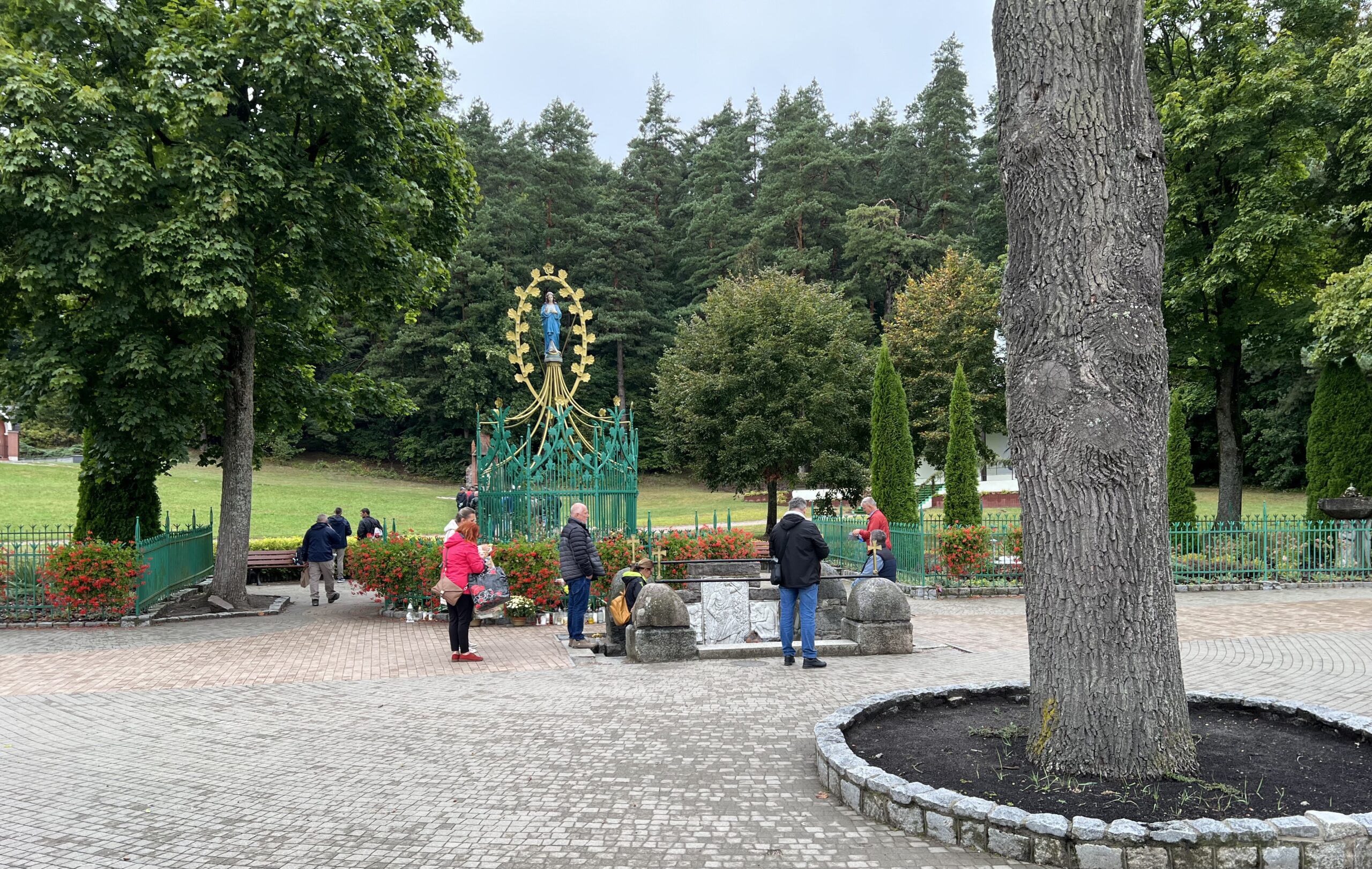
On 8 September 1877, Mary appears in wondrous light, accompanied by many angels. She blesses the spring, which lies a few dozen metres behind the church, and also blesses the water placed near a large tree. It is the Feast of the Nativity of Mary, and approximately 50,000 people are present in Gietrzwald.
The seers also ask Mary if the Catholic Church in Poland will regain its freedom. The country is partly occupied by Germans, who have no time for the Catholic Church, and partly by Russians. Army units of Alexander II Nikolaevich of Russia (1818-1881) from the Romanov family, Tsar of Russia (1855-1881), are very unfavourably disposed towards the Catholic Church in Poland.
The festive consecration of the Maria Chapel takes place on 16 September 1877. On this day, the apparitions of Mary to the two girls end.
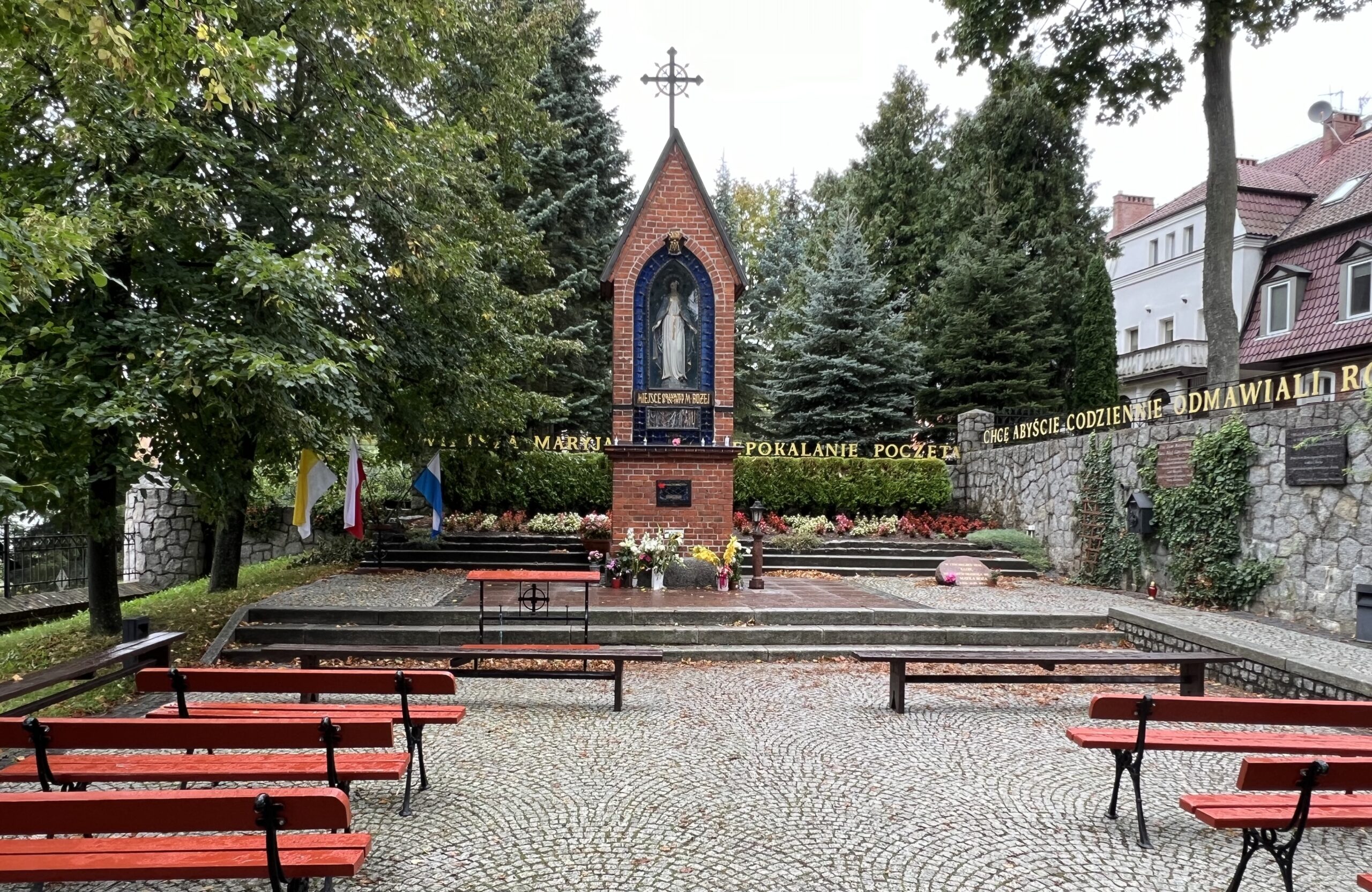
The bishop establishes a commission tasked with investigating the apparitions to the two girls. The two seers consistently give honest, exact answers to the commission members and prove themselves to be innocent. The investigation reveals that the apparitions to the two girls are free from fraud and lies. In 1877, the investigating commission declares that the events in Gietrzwald/Dietrichswalde are real. Official, ecclesiastical recognition only comes a century later, in 1977.
As there are more apparitions, the number of visitors increases considerably, even exceeding 10,000 on Sundays. This is despite the atheistic government and media. The German (Prussian) government opposes pilgrims going to Gietrzwald/Dietrichswalde.
During the apparitions, the political situation is comparable to that in Marpingen, where Mary visits in 1876. On July 1, 1877, the fifth apparition, Justina at Gietrzwald/Dietrichswalde asks the apparition the same question as the visionaries in Marpingen on July 4, 1876: “Who are You?” Then, too, the answer is: “I am the Blessed Lady, the Immaculate Conception.”
Barbara Samulowska, one of the visionaries, is undergoing spiritual training in Poland. She then goes to the convent in Rue du Bac, Paris, in 1885, where she makes her profession in 1889. In 1895, she leaves for missionary work in Guatemala. She works in the seminary and in the hospital as superior. Barbara dies in 1950 after being ill for a year. She was a nun for 66 years, 54 of which were spent in mission work.
Due to the increase in pilgrims, the church has become too small. The German architect Arnold Güldenpfenning (1830-1908) designed the renovation and expansion of the church. The work was carried out between 1878 and 1884. This happened during the time of Augustyn Weichsel (1830-1909), parish priest in Gietrzwald (1869-1909).
In 1945, Augustinians took over the administration of the shrine and also took on responsibility for its pastoral care.
On 10 September 1967, the crowned effigy of Mary and Child by Stefan Wyszynski (1901-1981), Archbishop of Warsaw (1948-1981) and Cardinal (1957-1981) took place. The coronation was performed with golden crowns. Karol Józef Wojtyla (1920-2005), Archbishop of Krakow (1964-1978) and Cardinal (1967-1978), who would become Pope John Paul II in 1978, was also present. Tens of thousands of believers came to attend the official event. The painter of the picture is unknown. It is assumed that the artwork was created in Poland at the beginning of the 18th century.
On 2 February 1970, the church was elevated to the status of a basilica by Paul VI, Pope from 1963 to 1978, born in Italy as Giovanni Battista Enrico Antonio Maria Montini (1897-1978). Approximately 70,000 faithful attended this ceremony, including Karol Józef Wojtyla.
On 11 September 1977, 100 years after the apparitions, the Catholic Church recognised the apparitions of the Mother of God in Gietrzwald as authentic. This was done by Józef Drzazga (1914-1978), Bishop of Warmia (1972-1978). The solemn celebration in Gietrzwald is led by Karol Józef Wojtyla. Following the recognition, the village became an official pilgrimage site.
In 1991, the well-known miraculous image of Gietrzwald leaves the basilica for a single occasion and travels to nearby Olsztyn. This happens when the Polish Pope John Paul II comes to visit there.
Between 1997 and 2007, a Way of the Cross with 14 stations was established. This was made possible by numerous donations from Poland and abroad.
The Foundation Friends of the Sanctuary of Our Lady of Gietrzwałd was established in 2003. The aim of this organisation is to support works of a cultural, social and charitable nature, among others. Actions are also undertaken for the combating and prevention of alcoholism and other addictions.
The beatification process for seer Barbara Stanislawa Samulowska began in 2005.
On 27 June 2007, Wojciech Ziemba (1941-2021), Archbishop of Warmia (2006-2016), consecrated the Way of the Cross. The sculptures of the Stations were created by sculptor Jan Stepkowski (1952-2011).
Pilgrimage site
The shrine is surrounded by woods and is beautifully situated in a rolling landscape. On 27 June, the apparitions of Mary are commemorated.
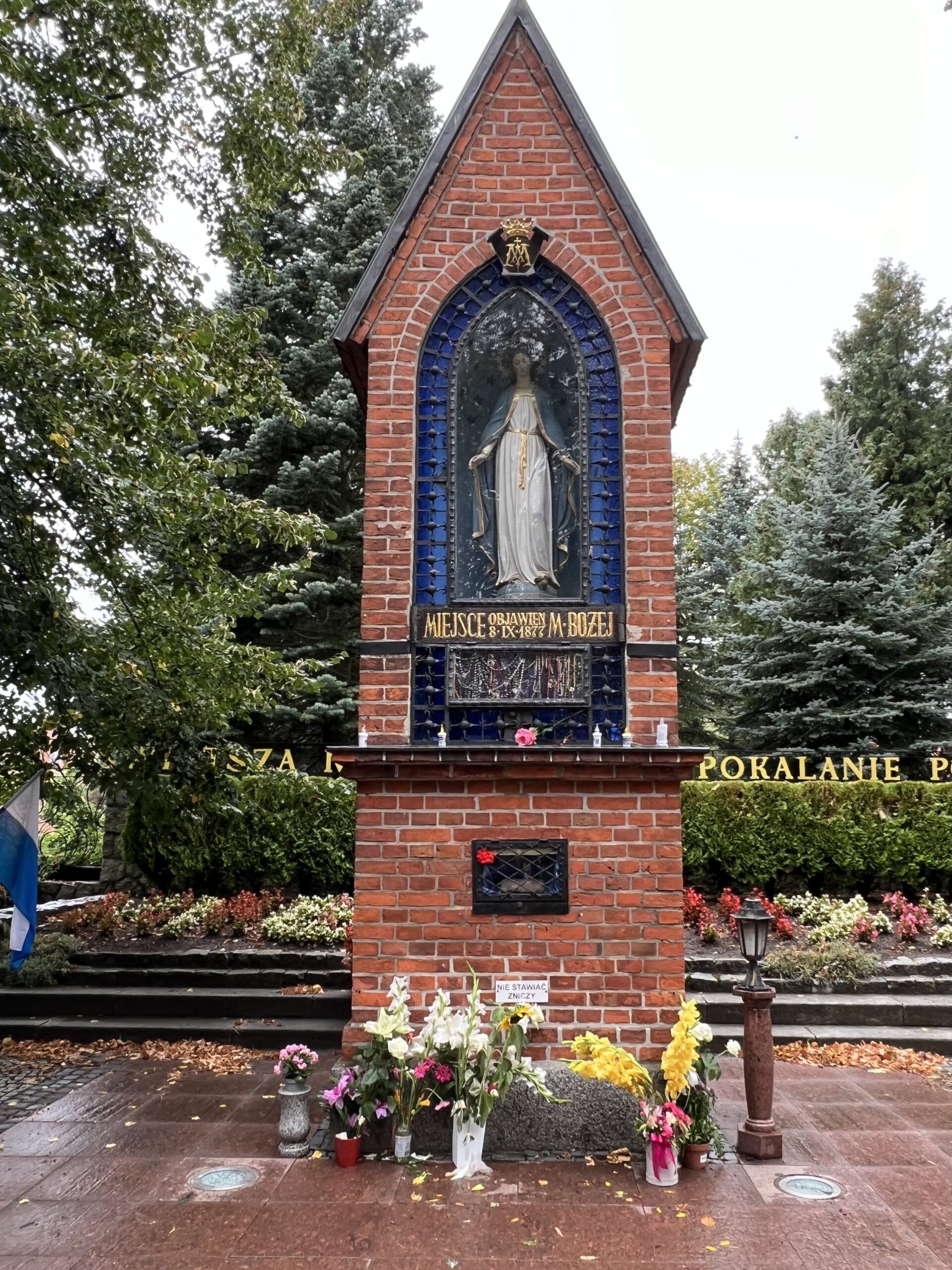
Pilgrims primarily come to Gietrzwald to see images of Mary and visit the miraculous spring. Important religious monuments include the apparition site of Mary and the Stations of the Cross on the hill near the spring. A Rosary path has also been created to the spring, along an avenue lined with trees on both sides. The site of the apparitions is a chapel; it is the most well-known in the entire region.
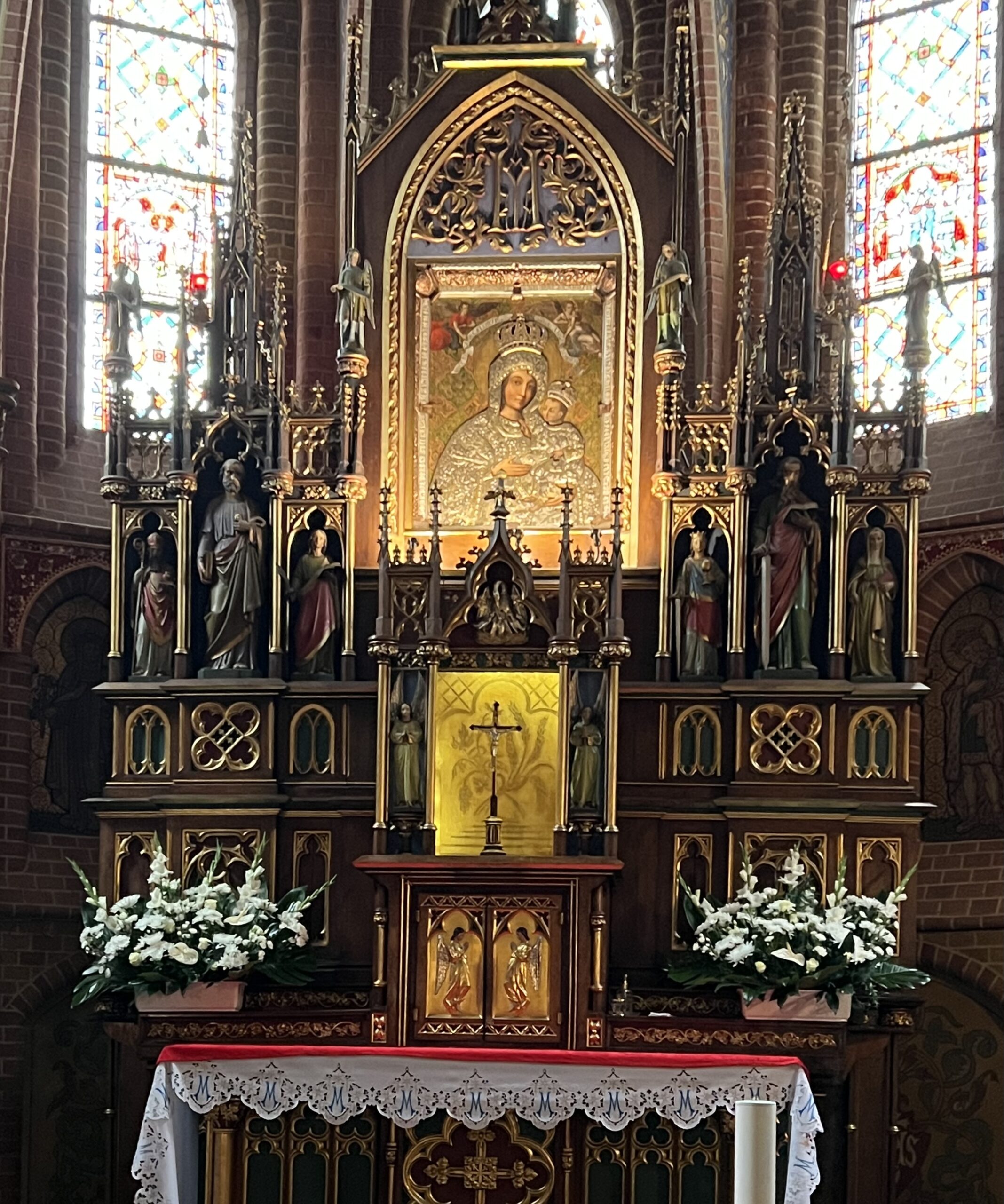
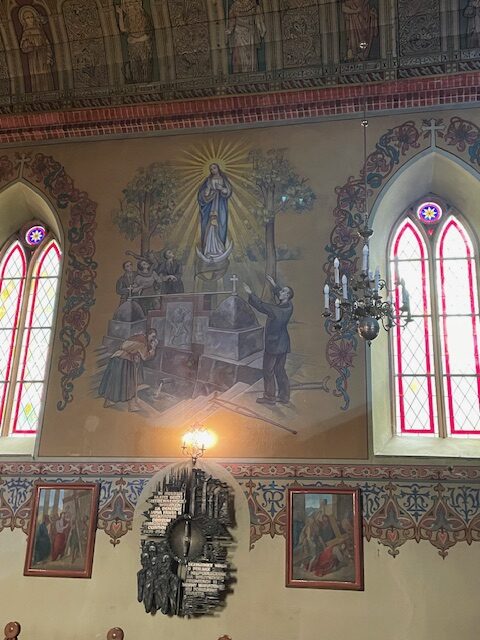
The Basilica of the Nativity of the Blessed Virgin Mary features many depictions of the Mother of God. The icon of grace is an image of Mary with Child incorporated into the structure of the tabernacle of the high altar. The basilica's ceilings and walls are extensively painted. The church contains numerous statues, including those of Saint Anthony, the Deposition of Jesus, Our Lady of the Rosary, Saint Joseph, and the four evangelists on the monumental pulpit.
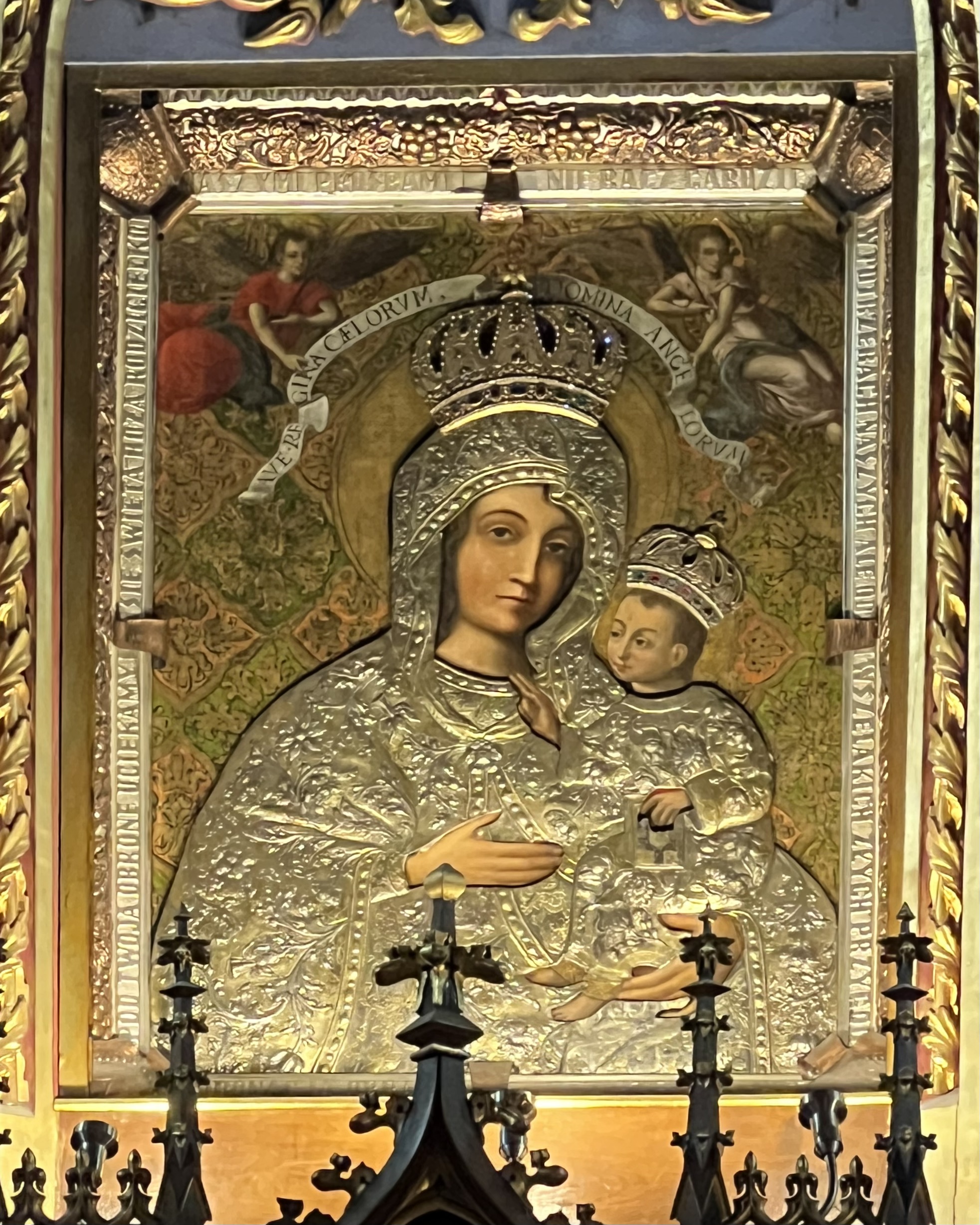
The original icon of grace is the painting of Mary and Child, which has been greeted by millions of pilgrims and during which many prayers have been said. The artwork is painted in oil on a linen canvas and is 122 centimetres high. The painting depicts the crowned Mary and Child. Mary wears a blue cloak with a hood, trimmed with gold ribbons, on which several coloured stones are set. The Child is dressed in red and sits on His Mother's left arm. In His left hand, Jesus holds a book and He makes a sign of blessing. Above Mary and Jesus, two angels are depicted. They are holding a ribbon which reads “AVE REGINA COELORUM AVE DOMINA ANGELORUM”. This Latin means “Hail Queen of Heaven, Hail Lady of the Angels”. The icon of grace is crowned and covered in silver, meaning less of the original image can be seen.
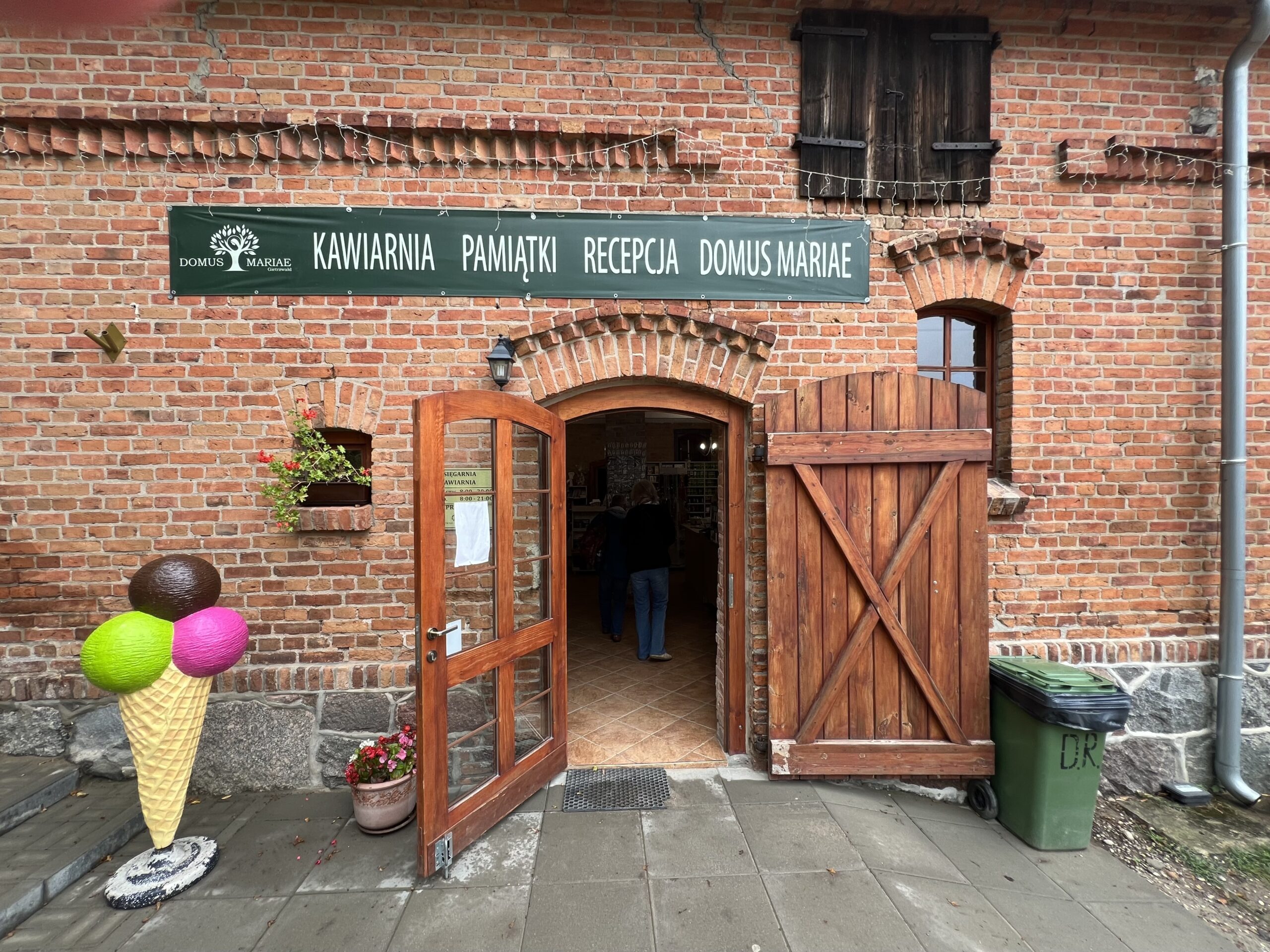
On the estate there are two buildings where devotional items are available, and also where you can get something to drink and eat.
In Gietrzwałd, there is a municipal Cultural Centre which is open all year round. Tourist information can be obtained here.
ACCESSIBILITY
Gietrzwald is not far from the large town of Olsztyn (Allenstein), in northeastern Poland, on the river Gilawka on the southern border of Warmia. The sanctuary has the official name of:
Sanctuary of Our Lady of Gietrzwałd.
Address: Koscielna 4, 11-036 Gietrzwald.
More information can be found at: www.sanktuariummaryjne.pl and www.catholicshrinebasilica.com.
Experience
I have visited the pilgrimage site in Gietrzwald twice, specifically in 2012 and 2024. My experiences of both pilgrimages are described below.
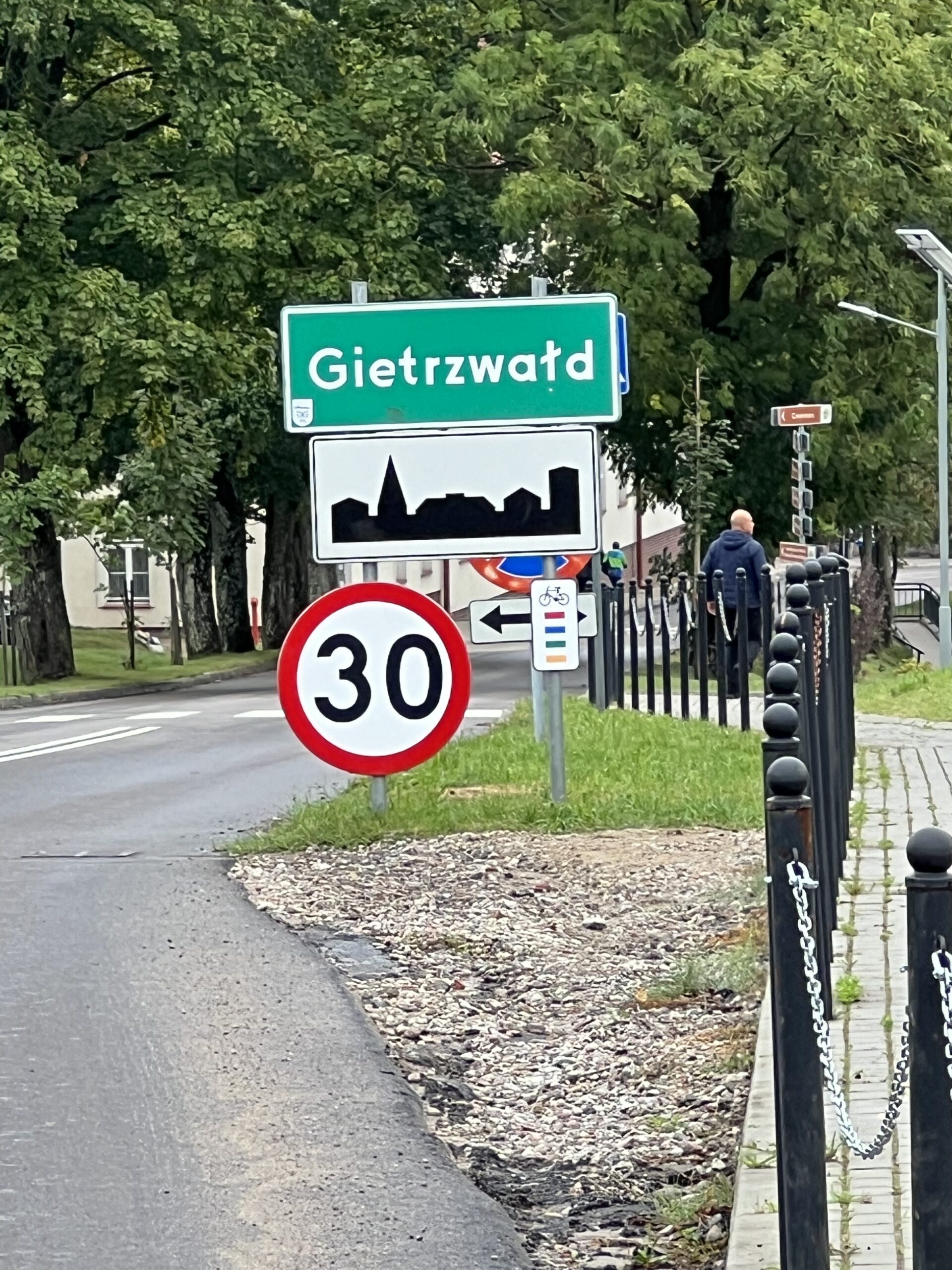
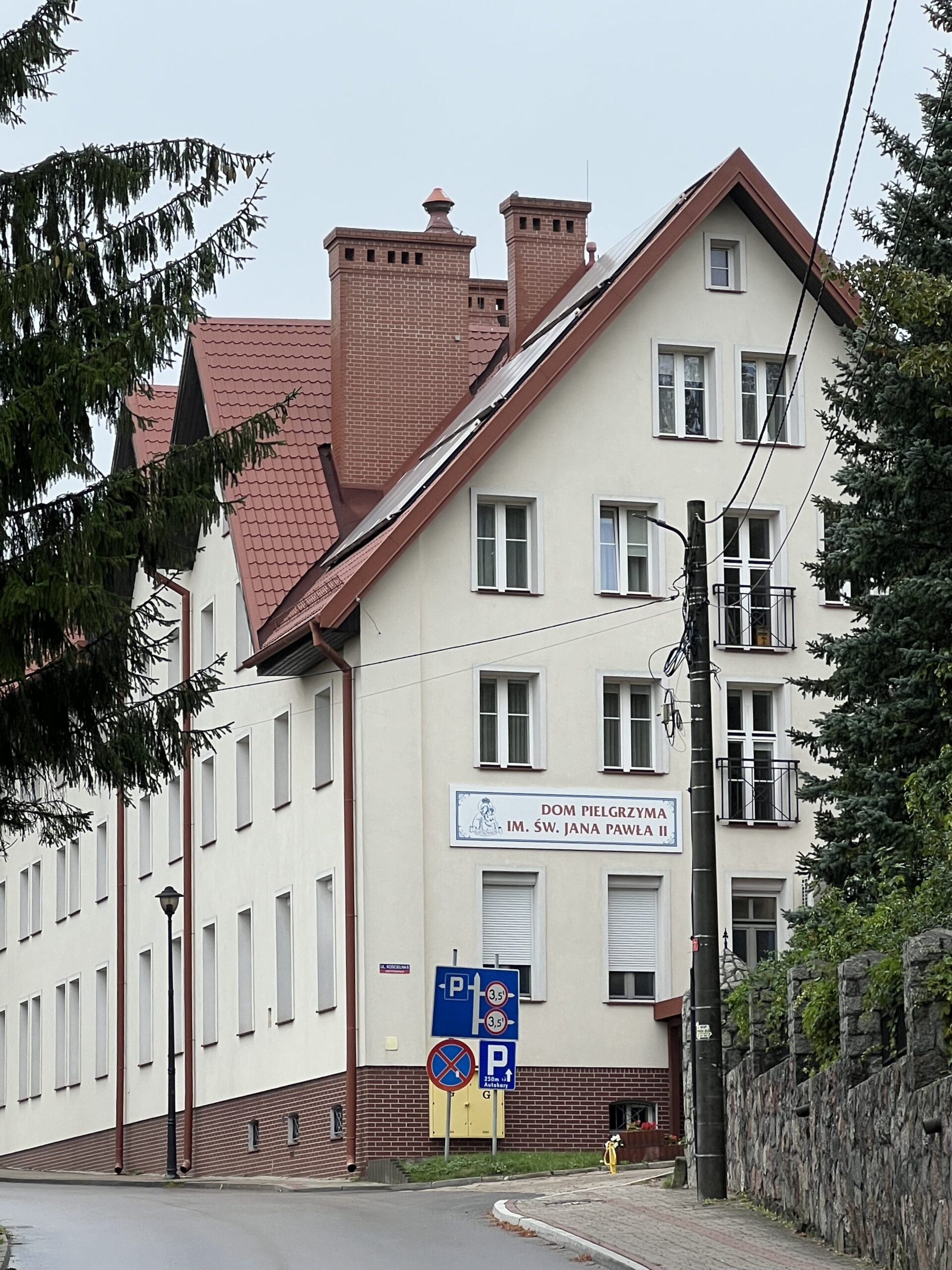
During the car journey to Gietrzwald, I often think of my mum and dad as it's their wedding anniversary today. Today would have been their …, but they have been in heaven for years. So, it's a celebration there today. Roadworks, traffic jams, diversions and over 10 hours of driving in the rain have caused delays on my route to the Polish shrine. Now that I'm not far from my destination, the rain clouds have blown over and the road suddenly seems quite dry. After many hours on the road, it's time to find a hotel, have something warm to eat, go for a walk and read a few more chapters in a book about Mary. A little later, these four wishes have been fulfilled. It seems as if heavenly powers have arranged this quickly.
The following morning, after breakfast, I will drive to Gietrzwald and look forward to visiting the shrine of Mary “Sanktuarium Maryjne”.
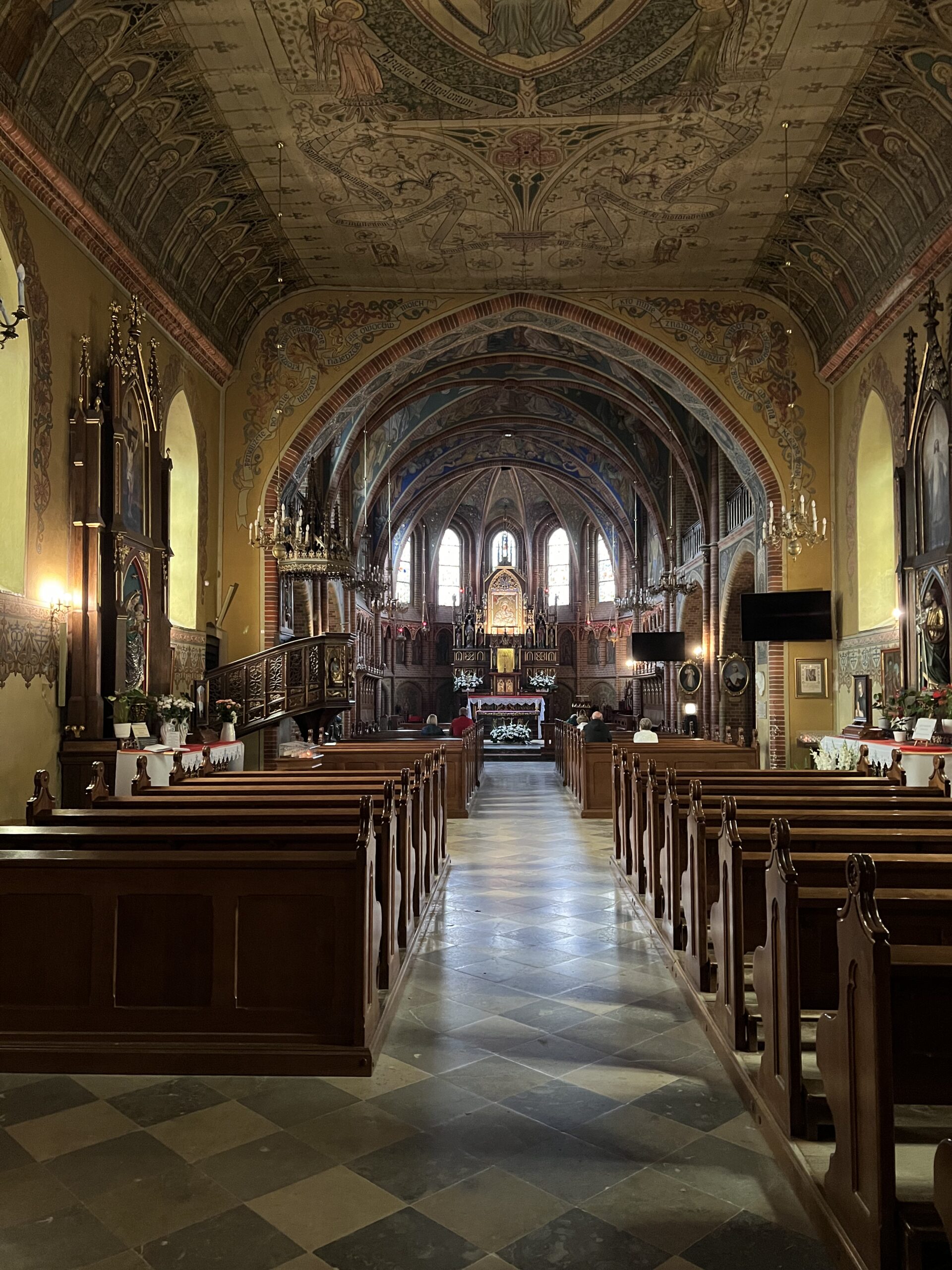
Upon arriving in Gietrzwald, I first head to the basilica, and upon entering, I notice there’s hardly an empty seat left. I manage to sit on the last pew and gaze in admiration at the wall paintings, altars, statues, and paintings of the Stations of the Cross that adorn the walls. Each window displays stained-glass images, and the ceilings are entirely painted. The pulpit is made of particularly beautiful wood carving. When the service ends, I move forward and approach the main altar. At a height of about four metres, I see the well-known depiction of Mary and Child. This blessed work of art is illuminated. For minutes, I observe the altar and am impressed by the silence in this space, even though dozens of pilgrims are present. Many pilgrims come to Gietrzwald to see this work of art. A little later, I want to light a candle. Unfortunately, that won’t be possible here, as there are no candles. I have to make do with candle lamps, which I find to be fake. I put a few coins into the slot for burning lamps. I always have intentions, such as for a rather older friend, a friend with health issues, and a good acquaintance whose condition is constantly hanging by a thread. After I’ve spoken my words to Mary, I take my seat again in the last row of pews. This gives me a perfect view of the basilica’s interior. I clasp my hands and begin to pray. While praying, many thoughts come to mind. Good acquaintances, relatives, most of whom are dead. I see my deceased parents again, as well as a dear aunt who is no longer alive. I think of my current friends. How grateful I am to feel surrounded by good people. Suddenly, I have thoughts of Mary, and I see her in this basilica.
Later this afternoon, in the basilica, I will attend a Polish-language Eucharist. Since I don't speak Polish, I can still follow the Mass reasonably well due to my church visits in the Netherlands and Flanders. The fixed rituals of a service are familiar to me, which makes the whole thing understandable. There are over 100 visitors in the church building, including about twenty girls and boys dressed in white. I assume they recently received their solemn communion. Some churchgoers are taking photos of the young visitors. If I could place a high-stakes bet right now, I would assume the photographers are the parents of the children. Unfortunately, there's no gambling here. As usual, I stand during the Gospel, make three sign of the cross, and always add an extra one with a large sign of the cross. During the sermon, I see the priest gesturing animatedly, and for non-verbal communication, he certainly deserves a pass. A little later, I go for communion. Almost everyone goes forward and kneels at the communion rail. I follow the Poles. They stick out their tongues. I don't do that and hold my hand up. The priest doesn't seem to mind. In a flash, I decide to open my mouth, and an unusually large host for me is pressed onto my tongue. That's how it's done here...
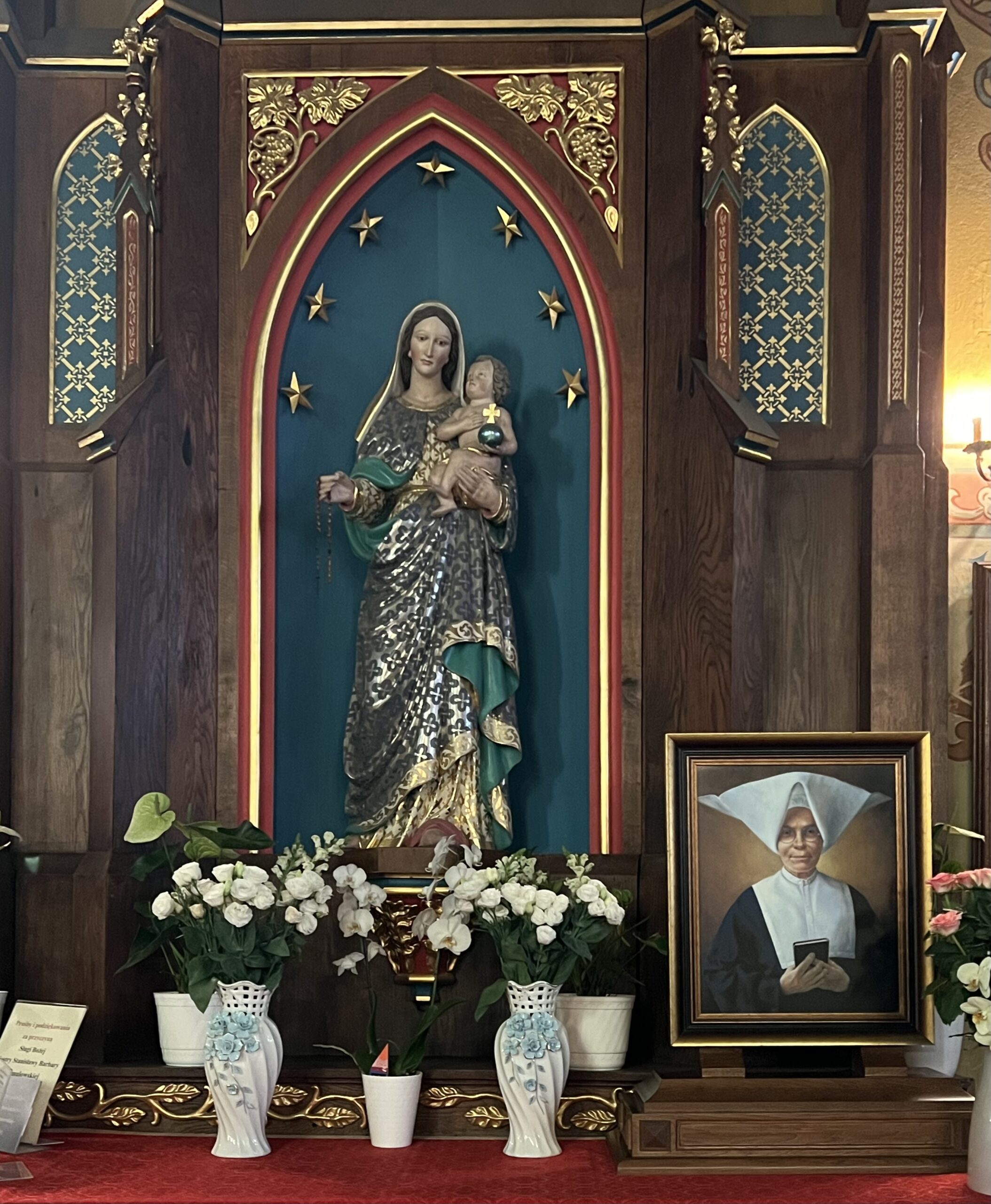
In the basilica, I see a photograph of seer Barbara Samulowska on a side altar, halfway down the building. There is also a photograph of John Paul II, the Polish Pope. He is kneeling in this church before the image of Mary and Child. During his visit, the framed masterpiece of the altarpiece was removed and placed about a metre high. This allows the Pope to be face to face with Mary.
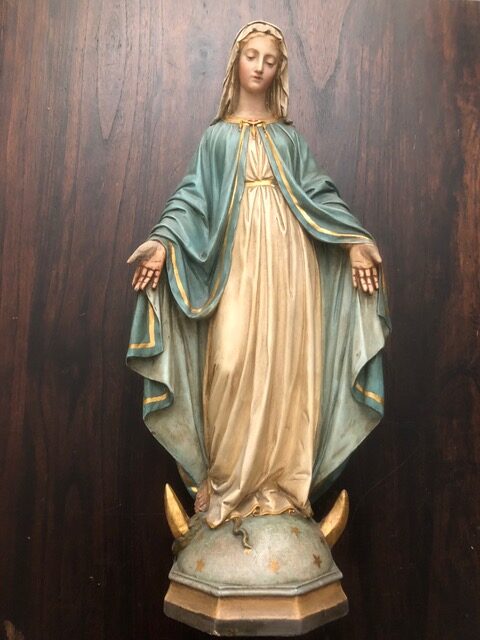
Besides the basilica, there are two small shops selling a lot of items related to devotionalia. For a good friend, I'll buy a book about the shrine written in English, and for myself, a similar publication in German. I'll also take about ten postcards and a depiction of Mary on wood. The latter will have a place in a meaningful Mary room at my home. The other shop offers cold and hot drinks. A cup of coffee will come in handy. When the coffee cup is empty, I'll head to the sales area. Here, Pope John Paul II is frequently depicted on plates, small paintings, and books. This Polish pope is immensely popular here. In the shop, I see a cabinet displaying statues of Mary. The effigies are of various sizes and prices. If the face of Mary is expressive, it appeals to me. A statue about 40 centimetres high says a lot to me. The face is friendly and Mary is standing on a serpent. I'll pay, have the statue carefully packed, as Mary must remain whole; She has suffered enough already. In the small shop, I'll buy two more empty bottles with images of Gietrzwald. One bottle is for my great Mary friend, and the other will go to my very devout teacher from the first year of primary school. She is struggling with her health, and I believe I can help her with the water from here.
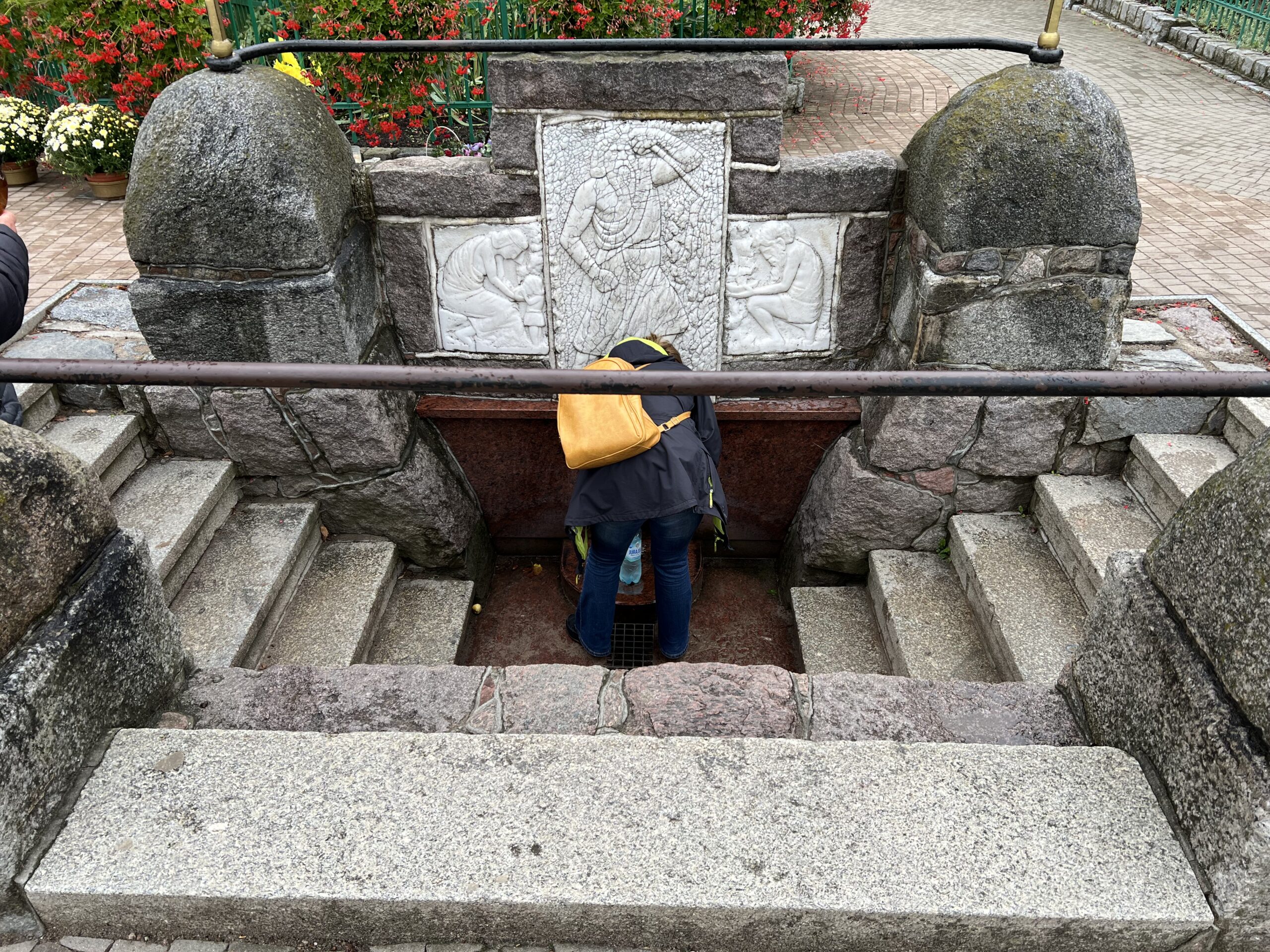
Next, I will go to the spring and take the flasks to fill them with special water. Once this is done, I will take the water to the car and place the image and the filled flasks safely on the back seat. Then I will get a box of empty bottles that I brought with me and go and fill them with water at the spring. This water will have destinations once I am back home.
After my activities with the vials, I head back to the basilica. Upon entering, I hear that the rosary is being prayed. There are 20 attendees with rosary beads. I take a seat in the back pew and watch a further ten pilgrims come in. I suspect they are all Polish, and this is confirmed when I later see the number plates of the cars parked by the church. As I spend more time in the basilica, I observe more of the interior. I notice more and more details, such as stained-glass windows, altarpieces, and ceiling paintings. This building is a jewel of beauty and history.
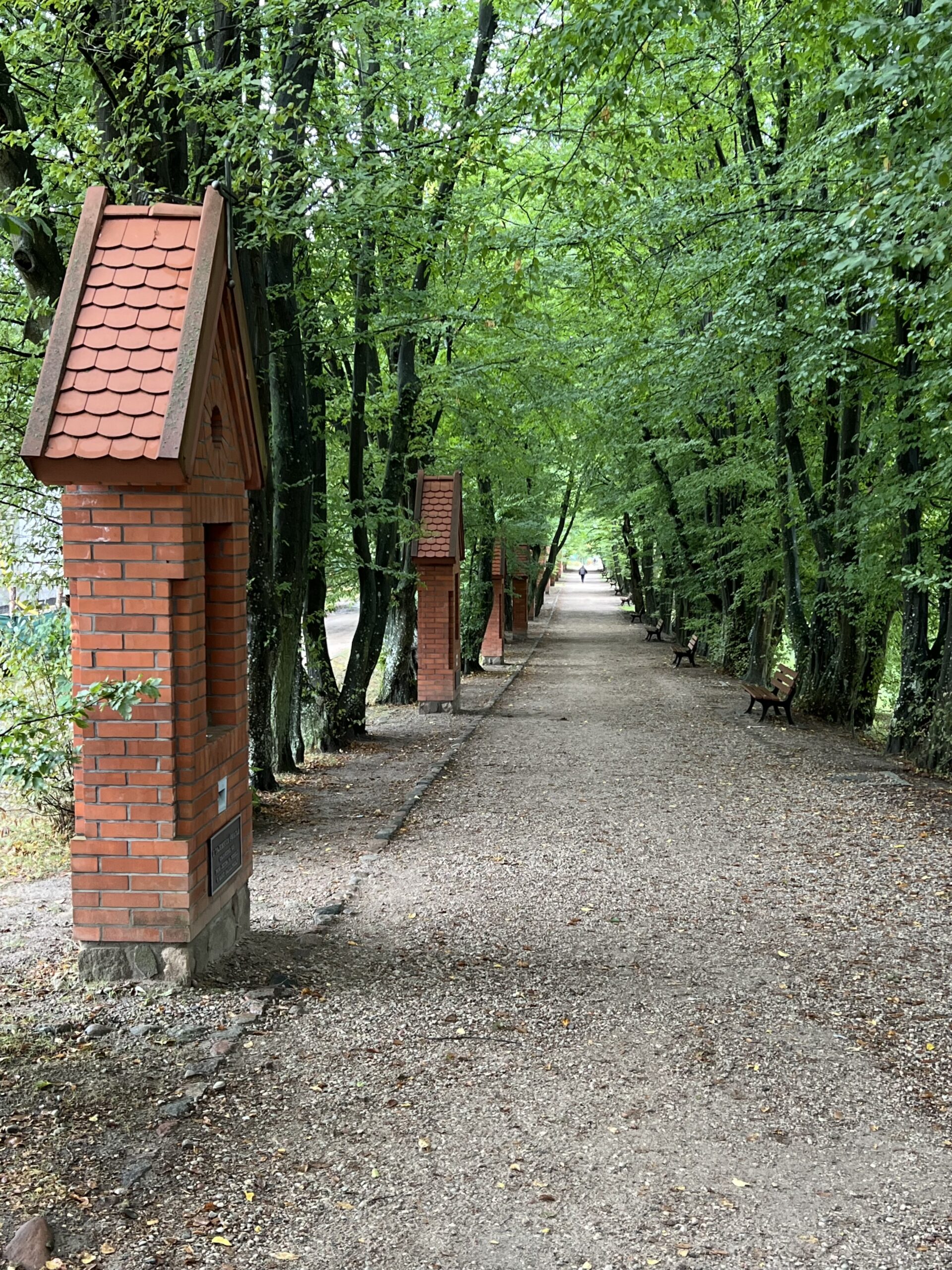
After praying the rosary, I go to the spring again and think about the apparitions of Our Lady. Mary was here in 1877 and the seers met Her. Now that I stand here, I find myself on holy ground. What a heavenly sensation an encounter with Mary must be. Then I take a seat on a step by the spring and look at the statue of Mary standing nearby with rosaries and candles. What a serene atmosphere there is. What must it have been like in 1877... Now is the time to pray, and I'm taking my time for that. Later, I take a walk and go up the hill by the spring to visit the Stations of the Cross. Each station has its own little chapel. To the left and right of the chapels are large, heavy plaques, listing the names of the sponsors with their country. I notice that “USA” is frequently mentioned.
After greeting Maria once more, I thank Her for my stay in Gietrzwald. I am returning home with a warm feeling.
Environment
In the vicinity of Gietrzwald, there are many lakes, forests and green fields. Cycling and walking opportunities are abundant here. The larger town of Olsztyn lies 20 km to the east. Visiting the port city of Gdańsk means travelling 150 km to the northwest. To get to Elbląg, you need to go 92 km in a northwesterly direction. The town of Ostróda is located 23 km west of Gietrzwald.
The Marian pilgrimage site of Krosno/Krossen is located 60 km north of Gietrzwald.
~~~

 Nederlands
  English (UK)
  Deutsch
  Français