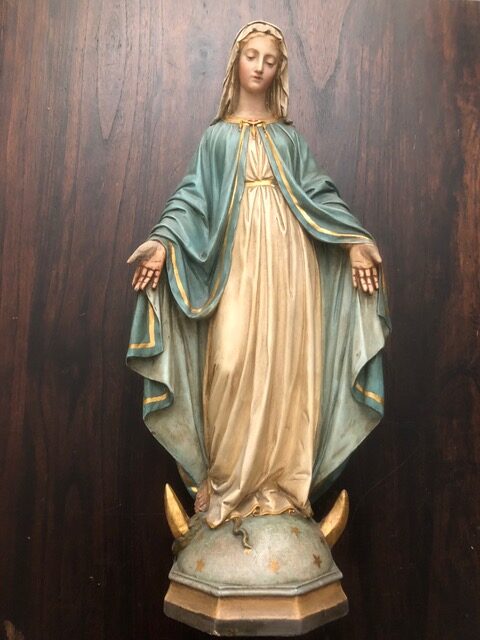
History
In 1942, in the midst of the Second World War (1939-1945), it was 25 years since the apparitions of Mary in Fátima, Portugal. The population of Luxembourg was suffering under wartime conditions. The people in Niederwiltz were in great distress, praying much to Mary, and the idea arose to erect a monument to Our Lady of Fátima.
On 13 January 1945, the Ardennes Offensive is in full swing. German troops are attempting to recapture parts of Belgium and Luxembourg from Allied forces. Evacuation of the population, including from Niederwiltz, is being considered. On this day, 10 people in a cellar sign a wartime pledge, which they make to Mary for protection. The text of this pledge is also printed on leaflets and distributed. The pledge entails that the war's memory will take shape through the establishment of a Way of the Cross with a chapel and a depiction of the Mother of God.
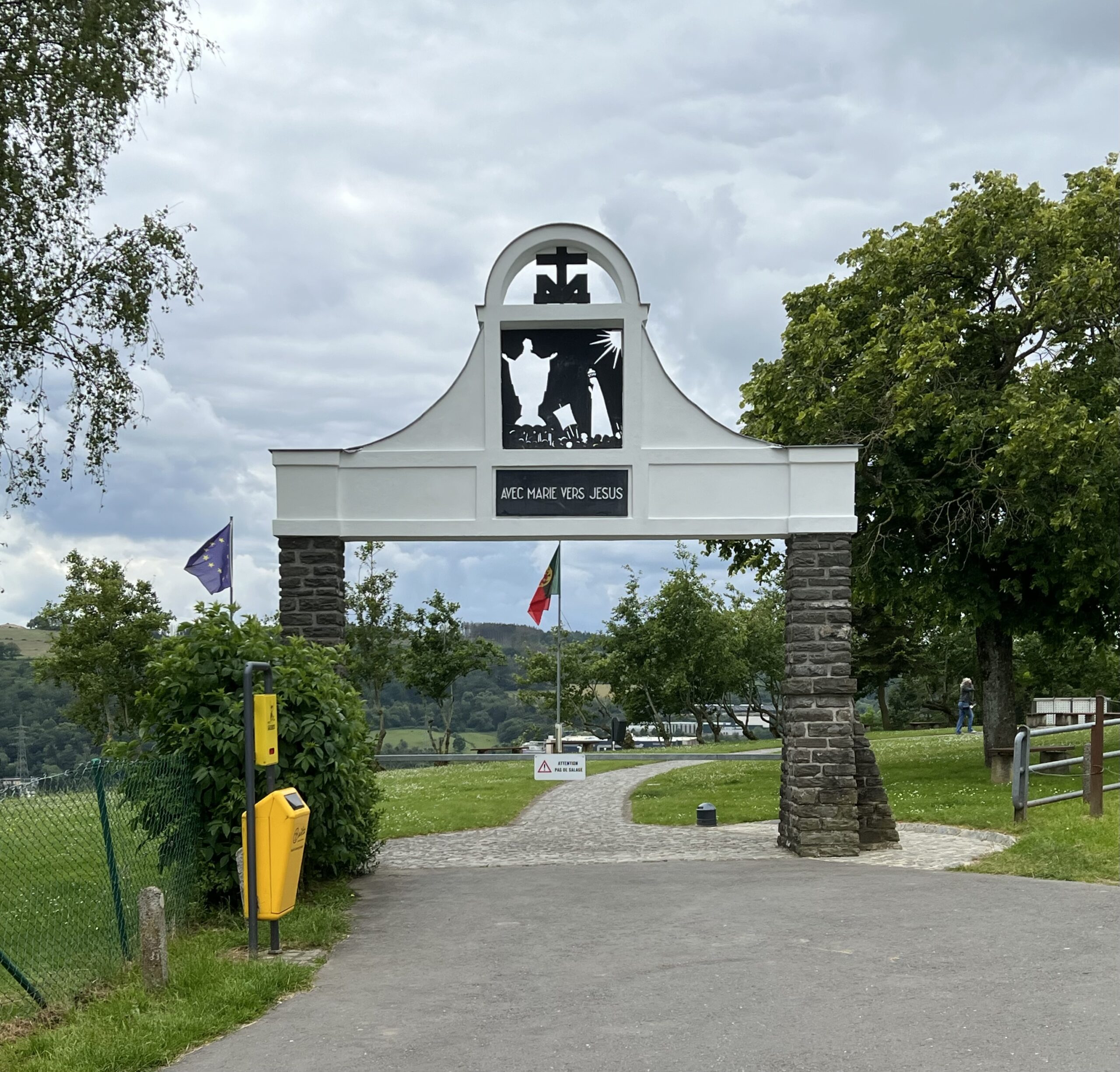
On 20 January 1945, after a novena, the wartime promise is solemnly renewed during the eucharistic celebration.
Wiltz earned the title “city of martyrs” due to the Second World War, as the Battle of the Bulge, from late 1944 to early 1945, claimed so many victims here.
The statue of Our Lady of Fatima is travelling through Western Europe and will also visit Luxembourg. On 11 September 1947, the statue will be in Niederwiltz on the hill “op Baessent” and a mass will be held there. This takes place at the site where the Fatima monument will later be erected.
In 1946, a temporary memorial stone was placed at the site of the current pilgrimage site. In 1950, the foundation of the action committee for the Fatima monument was established, and on 8 February 1951, the initiative began for the purpose of establishing and maintaining the monument “on Baessent”. In the autumn of 1951, construction works commenced, and the temporary monument was replaced by the monument that still stands there today. The construction works were the fulfilment of a promise made on 13 January 1945.
On July 13, 1952, the monument was consecrated. This was done by Léon Lommel (1893-1978), Auxiliary Bishop (1949-1956) and later Bishop of the Diocese of Luxembourg (1956-1971). He replaced Joseph Laurent Philippe (1877-1956), Bishop of the Diocese of Luxembourg (1935-1956), who was ill. During the celebratory event, Dean Jean Prosper Colling (1880-1968) renewed the war pledge. Chaplain and writer Albert Gricius (1910-1983) was the festive preacher. The solemn consecration was attended by many, including Pierre Frieden (1892-1959), Minister of Education, Culture and Science, who later became Prime Minister of the country (1958-1959).
There is an altar cross made of shrapnel fragments found after the Battle of the Bulge in the winter of 1944-1945. The names of 108 war victims from the parish of Niederwiltz are listed on it.
The Stations of the Cross were consecrated on 20 July 1958 and were made from various types of stone from the Grand Duchy of Luxembourg. The consecration was performed by Mathias Léon Hommel (1893-1978), Bishop of Luxembourg (1956-1971). The design is by Prosper Colling (1880-1968), Dean of Wiltz (1929-1964). The statues were made by sculptor and ceramist Aurelio Sabbatini (1909-1987).
In 1968, the first pilgrimage was held for Portuguese guest worker families to the pilgrimage site “op Baessent”.
In 1972, Jean Hengen (1912-2005), bishop and archbishop of Luxembourg (1971-1990), gifted a replica of the statue of Our Lady of Fatima to the parish of Niederwiltz.
The crowning of the statue of Mary in Niederwiltz took place in 1974. This was done by Jean Hengen, Bishop of Luxembourg, and António Cardoso Cunha (1915-2004), Bishop of Vila Real in Portugal (1967-1991).
On 20 January 1995, 50 years after the war pledge was made, it was renewed in Niederwiltz.
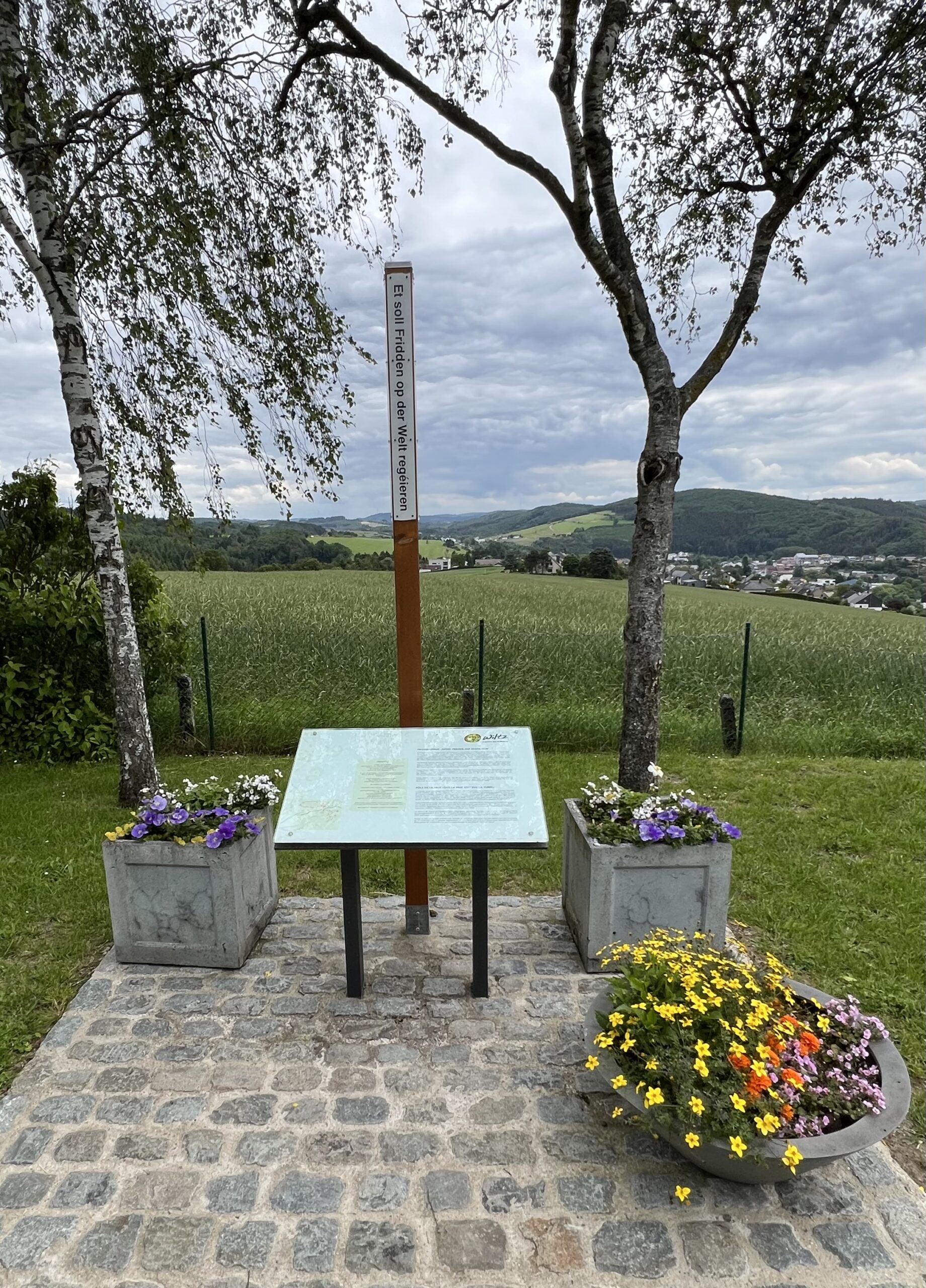
In 2015, a peace pole was erected on the grounds of the pilgrimage site. It is a reminder of the end of the Battle of the Bulge in January 1945.
The Fatima Monument “on Baessent” is the sanctuary that became a pilgrimage site for the Portuguese through the wartime pledge of Luxembourgers.
Pilgrimage site
Around 16 per cent of Luxembourg's population is of Portuguese origin. A link is then made to the Portuguese pilgrimage site of Fátima. Portuguese people, including believers, visit family in the Grand Duchy on more than one occasion. Luxembourgers, especially those of Portuguese origin, have a need to “experience Fátima in Luxembourg”. This is how the pilgrimage site in Niederwiltz came into being.
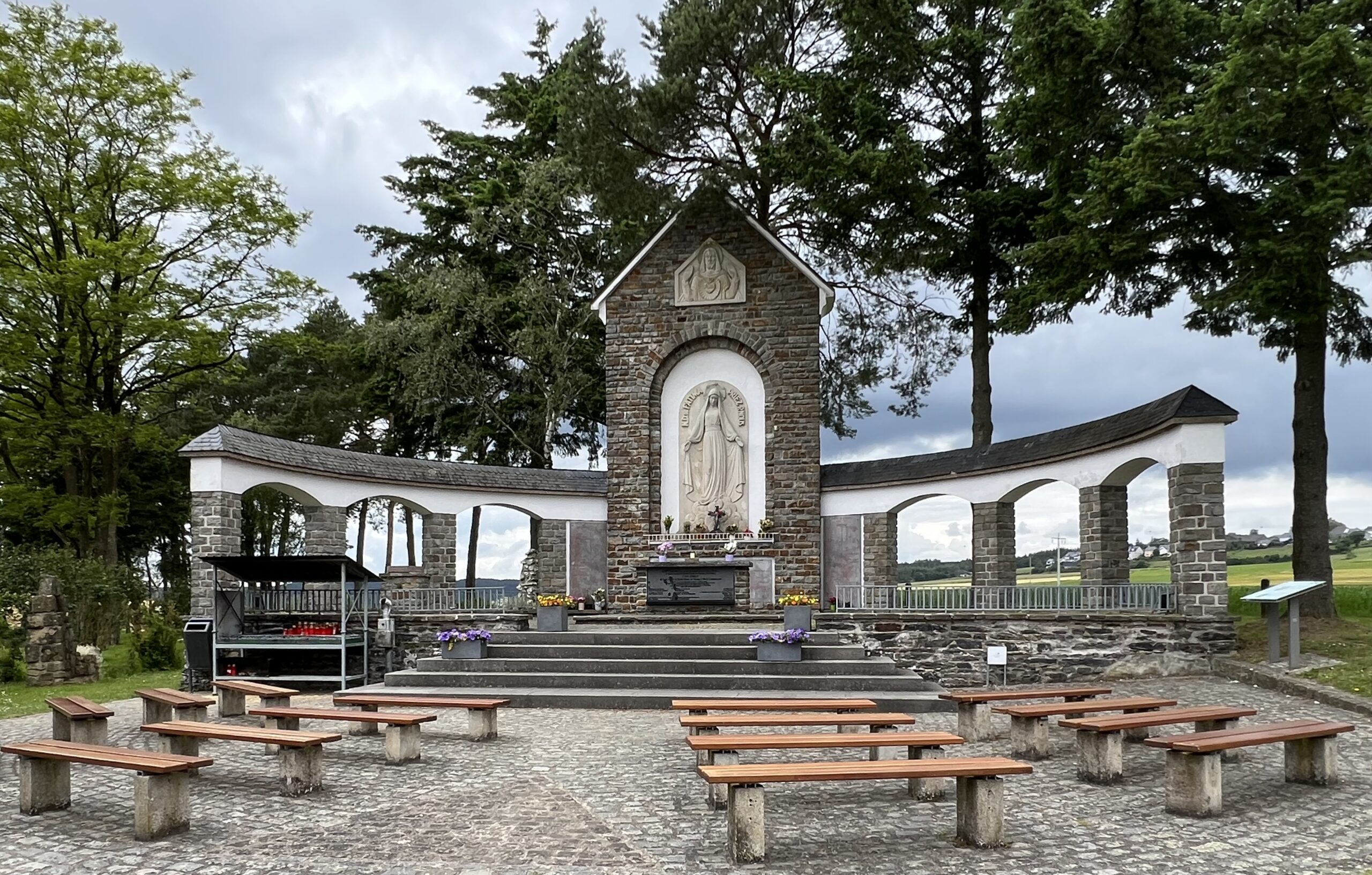
Beneath the effigy of Our Lady of Fatima, a plaque is affixed. The text states that on 13 May 1973, the 56th anniversary of the 1st apparition of Mary in Fátima, Portugal, the sanctuary of Fátima was twinned with that of Wiltz. This clarifies the relationship between Luxembourg and Portugal. Mention is made, among others, of Alberto Cosme do Amarnal (1916-2005), Bishop of Leiria (1972-1984) and Jean Hengen (1912-2005), Bishop of Luxembourg (1971-1990).
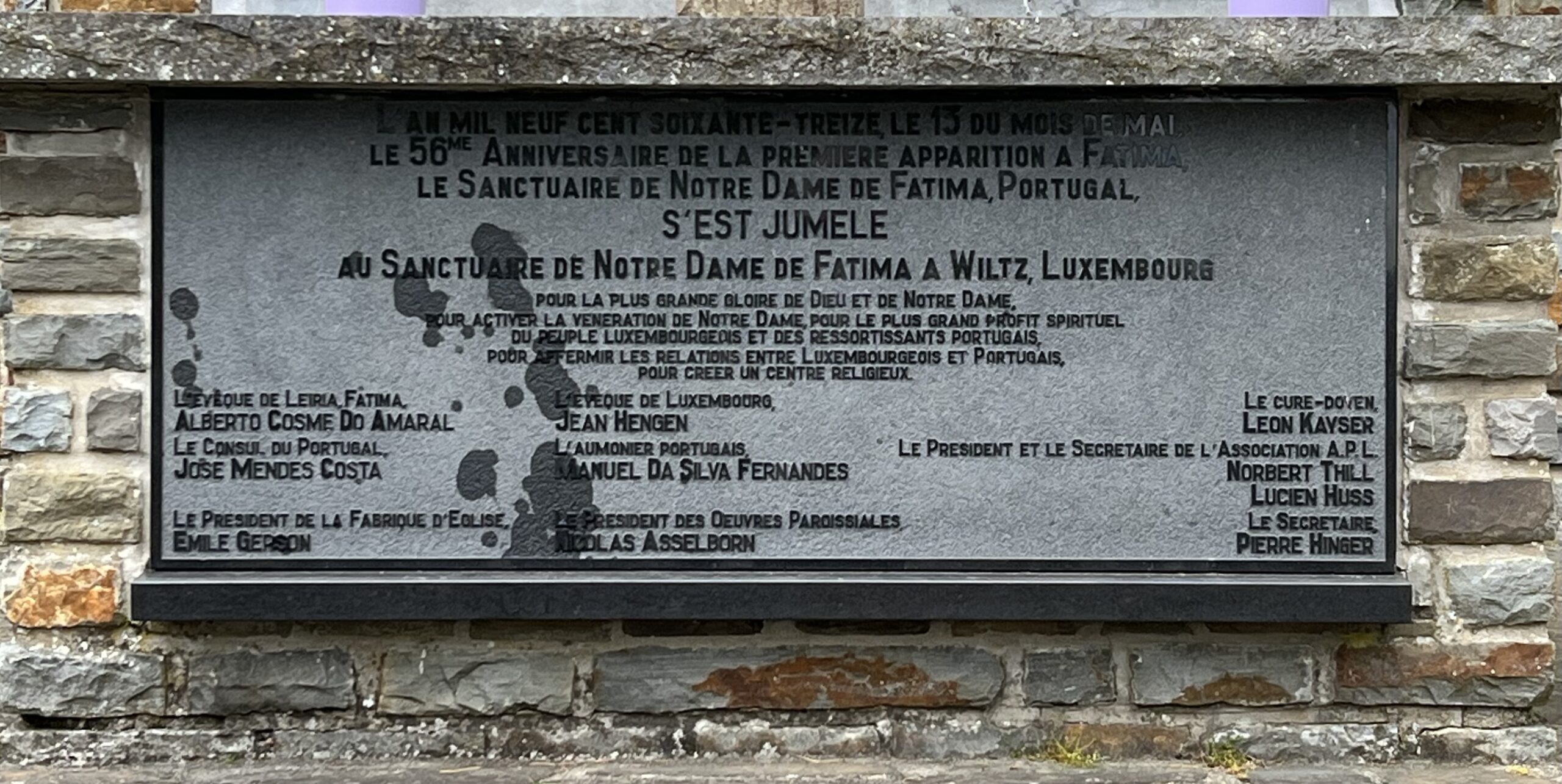
On the shrine grounds, there is also a peace pole with the inscription “May peace prevail on Earth”. The accompanying text is in four languages: Luxembourgish, German, French and Portuguese.
Every year, there is a procession of Our Lady of Fatima, commemorating the apparitions of Mary in Fátima, Portugal in 1917. This takes place on Ascension Day. Many Portuguese people participate in the devotional procession.
Every year, a solemn Way of the Cross is held at the pilgrimage site on Good Friday. The victims of the Second World War are also commemorated during this event. The names of those who died in Niederwiltz during the Battle of the Bulge can be read at the statue.
Approximately 30,000 people visit this pilgrimage site annually, and many come on the apparition days of Fatima in 1917. Mary protects the inhabitants of Niederwiltz with her outstretched arms and hands.
The pilgrimage site can be visited daily.
ACCESSIBILITY
Niederwiltz is part of the municipality of Wiltz and is located in the north of the Grand Duchy of Luxembourg. The pilgrimage site is located slightly north of Niederwiltz. To get there, take Rue du Pont from Niederwiltz and then continue onto Route de Noertrange. After a few hundred metres, turn right onto Rue Notre-Dame de Fatima and the pilgrimage site is located on the hill “op Baessent“.
Address: Rue Notre-Dame de Fatima, 9520 Niederwiltz.
Current information can be found on www.visitwiltz.lu.
Experience
Wiltz is the capital of the Luxembourgish Ardennes and that's where I'm going today. This place has an upper and lower town. In the upper town, there is a castle, among other things. In the lower town, there is a lot of commerce. I'm not going for either of those, because above the lower town, named Niederwiltz, there is a Portuguese pilgrimage site, and visiting that is the purpose of my trip. This time, no church or chapel to go inside, but an open-air pilgrimage site.
Impressive is the Fatima monument with the many names of victims from Niederwiltz from the Second World War. This makes me quiet.
Next, I'll go through the Stations of the Cross and I'm more and more convinced that this pilgrimage site is very special indeed.
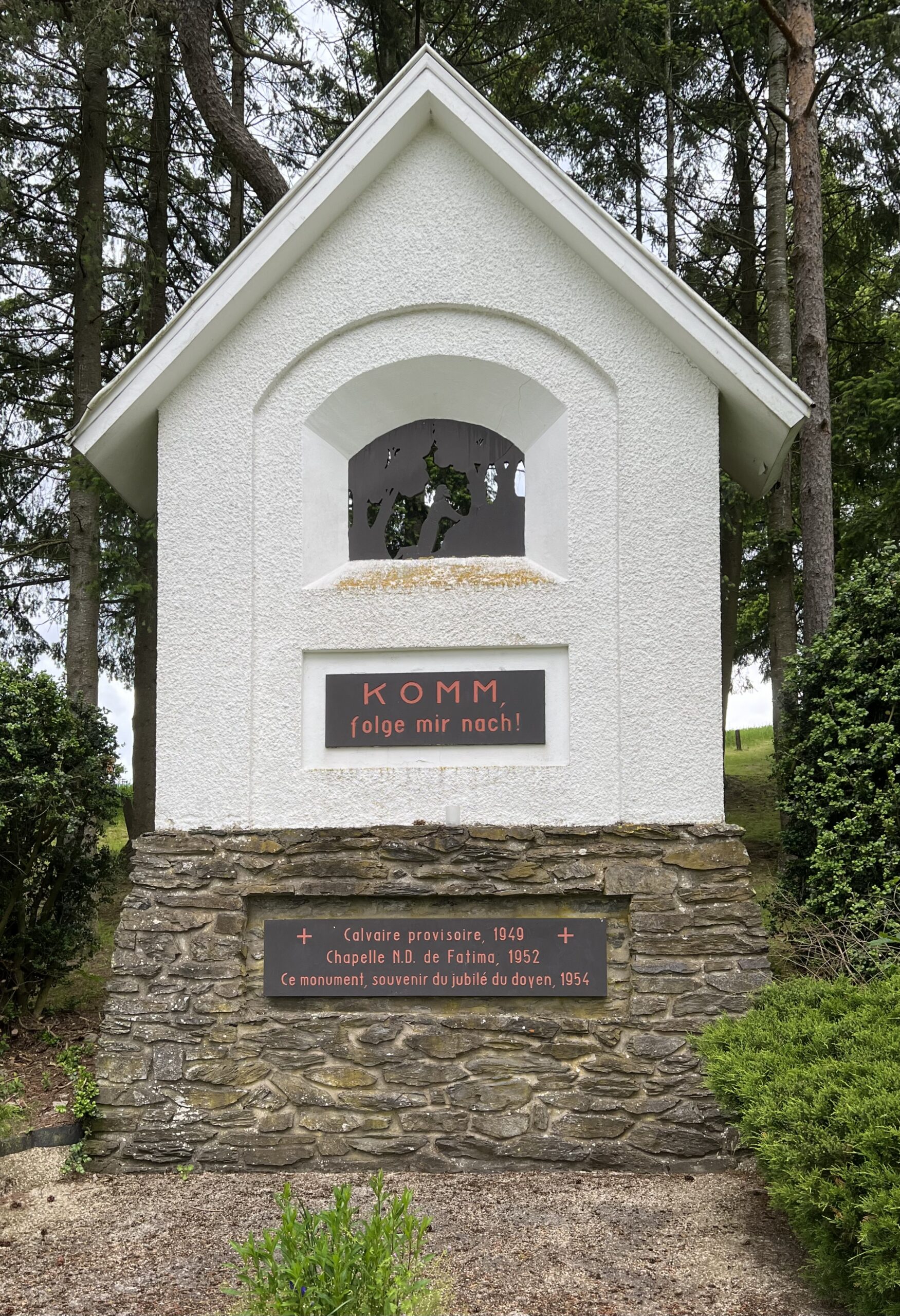
On the grounds, I come across a monument which bears the inscription “Komm, folge mir nach” (Come, follow me). It also states that the provisional Way of the Cross dates from 1949, the Chapel of Our Lady of Fatima from 1952, and that this monument is a remembrance of the dean in 1954.
This place of pilgrimage to Mary is a welcome place for prayer and reflection.
Environment
In the hilly surroundings of Niederwiltz, there are many walking and cycling opportunities.
Travelling from Luxembourg City to Niederwiltz is 65 km to the northeast.
From the tourist town of Vianden, it's 35 km to the west to get to Niederwiltz.
Travelling from the historic town of Echternach to reach Niederwiltz is a journey of 67 km to the west.
From the town of Clervaux, located in the north of the Grand Duchy, it is an 18 km journey south to arrive in Niederwiltz.
~~~

 Nederlands
  English (UK)
  Deutsch
  Français