~~~
History
The word Piekary may come from “piekarz” and mean “baker”. Another source says that Piekary is derived from the word “pieczara”, which stands for “cave”.
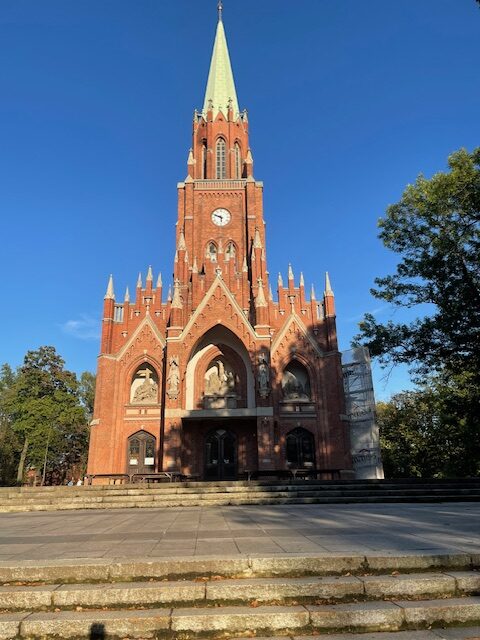
The beginning of spiritual life dates back to the parish with the church in Piekary in 1303, which is dedicated to the glorious apostle Bartholomew. The altar is dedicated to the Immaculate Conception of Mary. A legend from 1303 tells that the necessary wood was delivered, but on the following night, the material appeared in another place. This is seen as a sign that the church should be built there, on Cerkwica hill. The wooden church was consecrated in 1318.
The miraculous image was found in 1659 by Jakub Roczkowski, parish priest during the period 1659-1679, who belonged to the Jesuits. When cleaning the miraculous image, it smelled of roses. Because of this, the parish priest placed the artwork in the high altar and made his discovery known to the parishioners. This happened on 27 August 1659, and subsequently, the pilgrimage began to develop. This parish priest also had the church renovated.
In 1676, a plague epidemic raged in the region. Locals from the surrounding area came to the church to pray before the icon, asking Mary for healing and salvation. Soon after, the epidemic disappeared, and due to this miracle, interest in the icon grew further. In Piekary, Mary was then referred to as “Mater Admirabilis,” which translates to “Miraculous Mother.”.
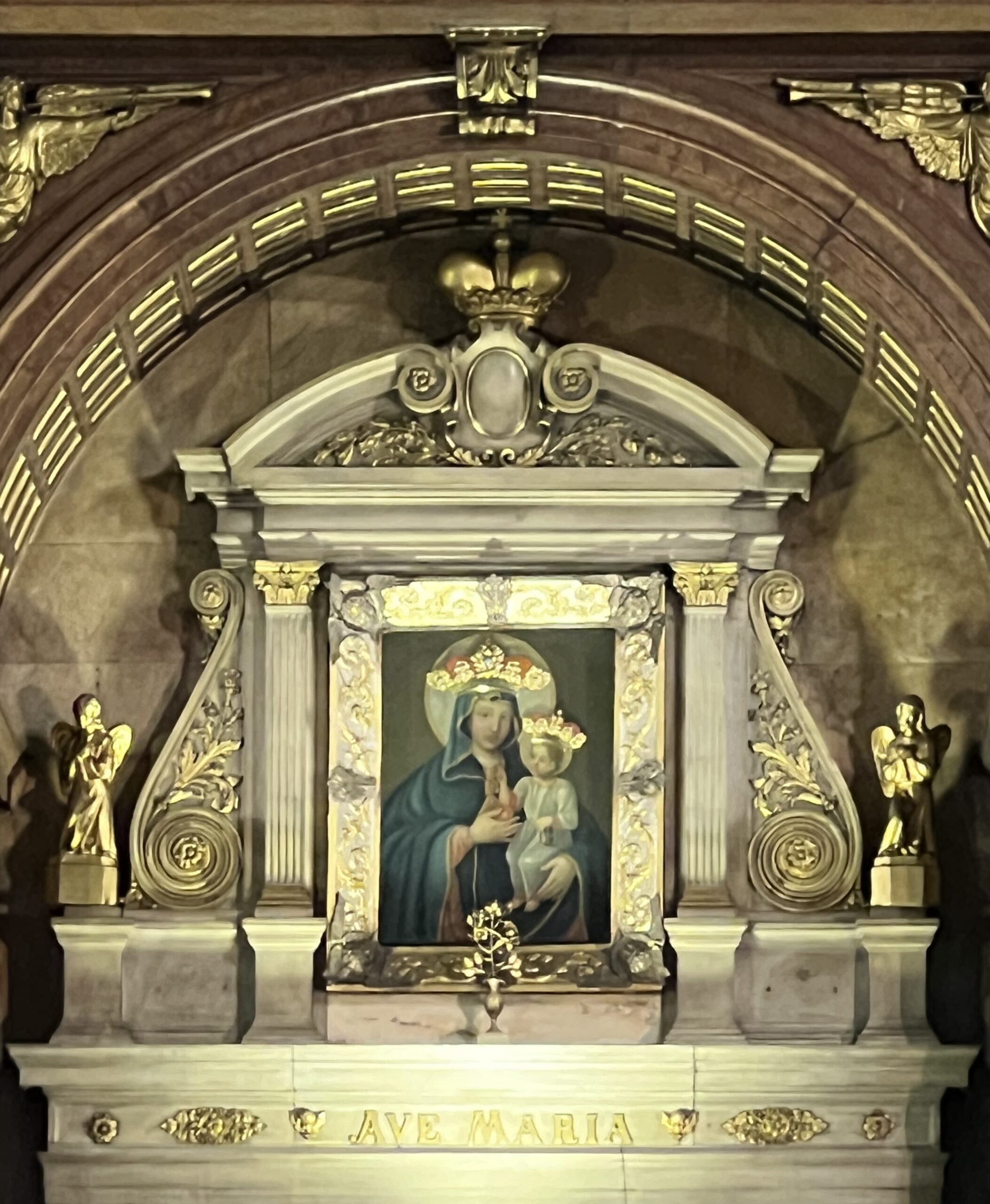
The devotional image in the basilica is not the first depiction. The first icon, located in a side chapel, dates from the late 15th century and its creator is unknown, possibly from an Italian or Czech workshop. It measures 129 cm in length and 92 cm in width. The painting is executed on a tabletop made of linden wood. It shows Mother Mary with her Child on her left arm. In her right hand, she holds an apple, referring to Eve. Jesus carries the gospel book in his left hand and makes a blessing gesture with his right. The portrait belongs to the “Hodegetria” type (she who points the way, guide) and refers to Byzantine painting. The original image of Mary is in Opole (Oppeln). Therefore, in Piekary stands a different image, which has been venerated here since the 17th century.
Later research indicates that the original painting of the icon of grace dates from before 1480. It is not known how the icon came to Piekary.
Around 1600, Protestants gained increasing power in parts of Poland, and expressions of the Catholic faith were severely suppressed. It happened that Catholic churches were violently transferred into Protestant hands. In 1620, the Protestants suffered a defeat, and the situation changed in favour of the Catholics. Ferdinand II (1578-1637), Emperor of the Holy Roman Empire (1619-1636), issued an edict on restitution, meaning that Catholics had to get back all churches and goods.
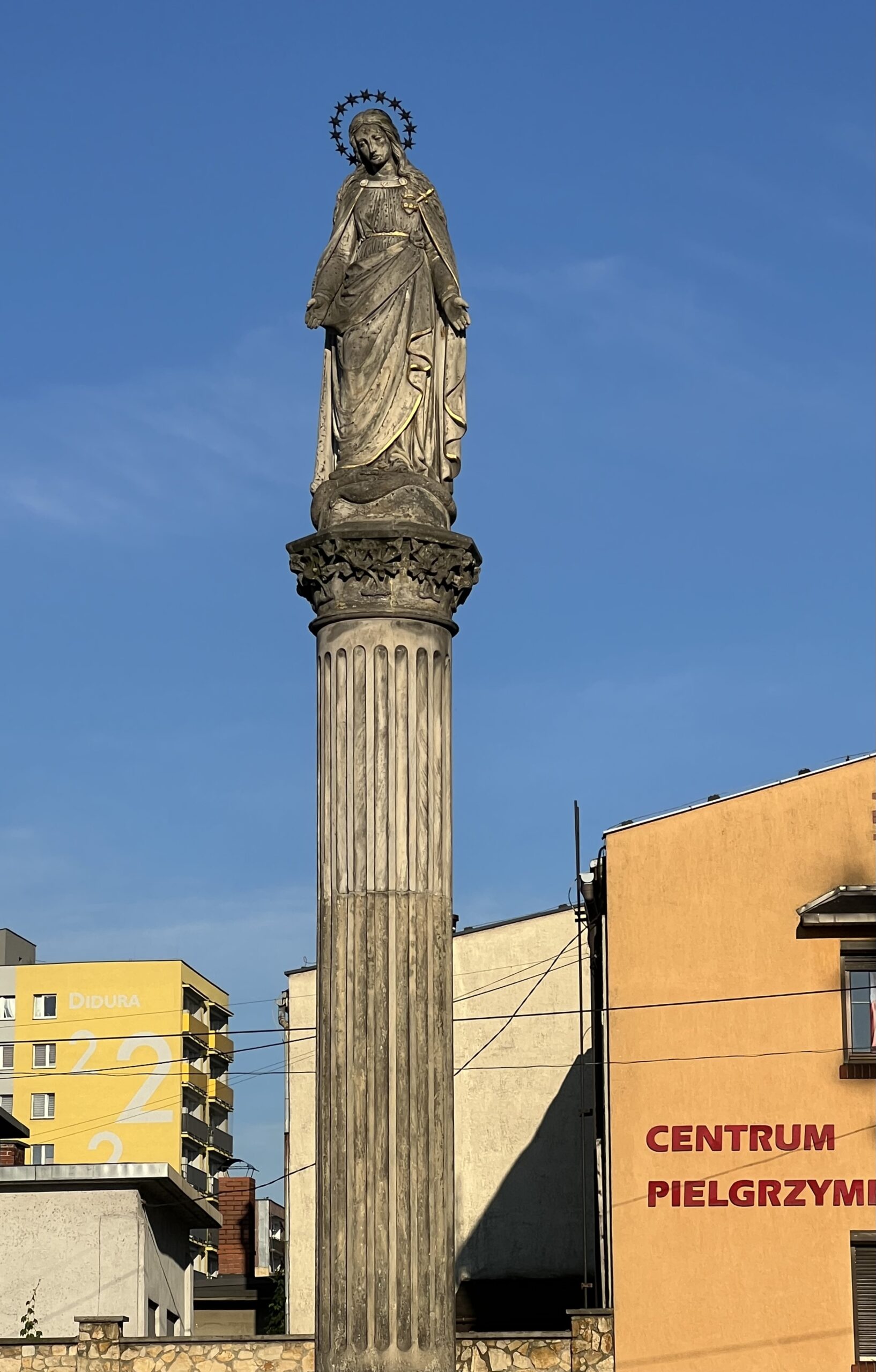
In 1676, the plague broke out in the Piekary region, claiming thousands of lives. Many people went on pilgrimage to the statue of Mary. The plague disappeared, and a miracle had occurred. The cult of Mary of Piekary further expanded. Subsequently, in 1680, the statue was taken to Prague because plague was rampant there at the time, and the epidemic also disappeared. Johann Friedrich von Waldstein (1642-1710), Archbishop of Prague (1675-1710), declared the statue miraculous.
In 1682, there were attacks by Turks in Silesia, and the icon of grace was taken to safety in the Jesuit church in Opole.
In 1683, Jan III Sobieski (1629-1696), King of Poland and Grand Duke of Lithuania (1674-1696), visited the pilgrimage site to thank Mary for the victory over the Turks at the Siege of Vienna in 1683. He covered the last few kilometres on foot to bow before Mary in Piekary and thank Her. As a token of his gratitude to Mary, he brought a golden chalice and also a paten (a plate of precious metal for the eucharistic bread). The visit and the gifts contributed to the wider fame of the pilgrimage site.
In 1697, Friedrich August (1670-1733) made his Catholic confession of faith before the image of grace. He was Elector of Saxony (1697-1704 and 1709-1733) as August I, King of Poland (1709-1733) as August II, and Grand Duke of Lithuania (1698-1706 and 1709-1733). He signed the “pacta conventa”, an agreement between the Polish nation and the new king for his election to the throne. This agreement was also signed by August III (1696-1763). Through the War of the Polish Succession (1733-1738), he became King of Poland (1733-1763) and Elector of Saxony (1733-1763) as Frederick Augustus II. He made his Catholic confession of faith in 1734.
In 1702, the statue of the Madonna was secretly returned to Opole, this time out of fear of Swedish troops. A comparative image of the icon of grace appears on the altar of the church at Piekary. The original statue never returned and remained in Opole, where it is venerated in the cathedral. In 1983, the statue was crowned in Opole by Pope John Paul II as the Mother of God of Opole.
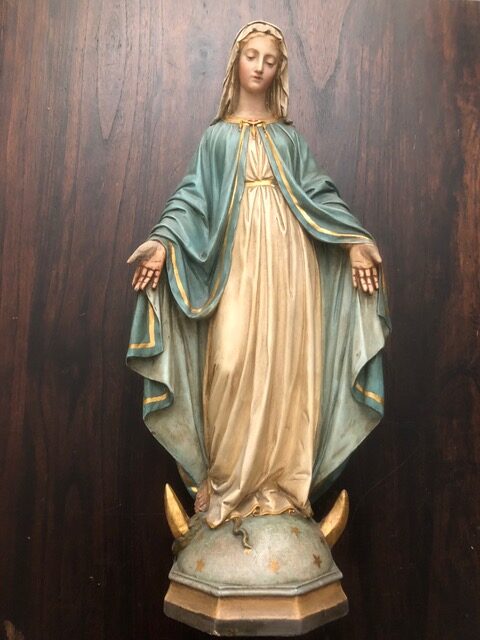
A different image is being placed in Piekary Śląskie. The depiction resembles the original somewhat, but is still significantly different. The link to Byzantine art disappears, hands and fingers are shorter, the folds in the garment are more fluid, the colours change slightly and the faces are altered. Thus, an entirely new image of the Mother of God is created.
Until 1776, the Jesuits organised the pilgrimages and parish activities of Piekary. The diocese took over the duties at the Marian shrine.
The church is becoming too small due to the increasing number of pilgrims, and the construction of a larger pilgrimage church is becoming imperative. Parish priest Jan Nepomucen Alojzy Ficek (1790-1862), parish priest in Piekary (1826-1862), is very active in the pilgrimage site and is also called the “Silesian Apostle”. Among other things, he initiates the Calvary and the work of the publishing house. His successor Bernard Purkop (1808-1882), parish priest of Piekary (1862-1882), realises the Calvary.
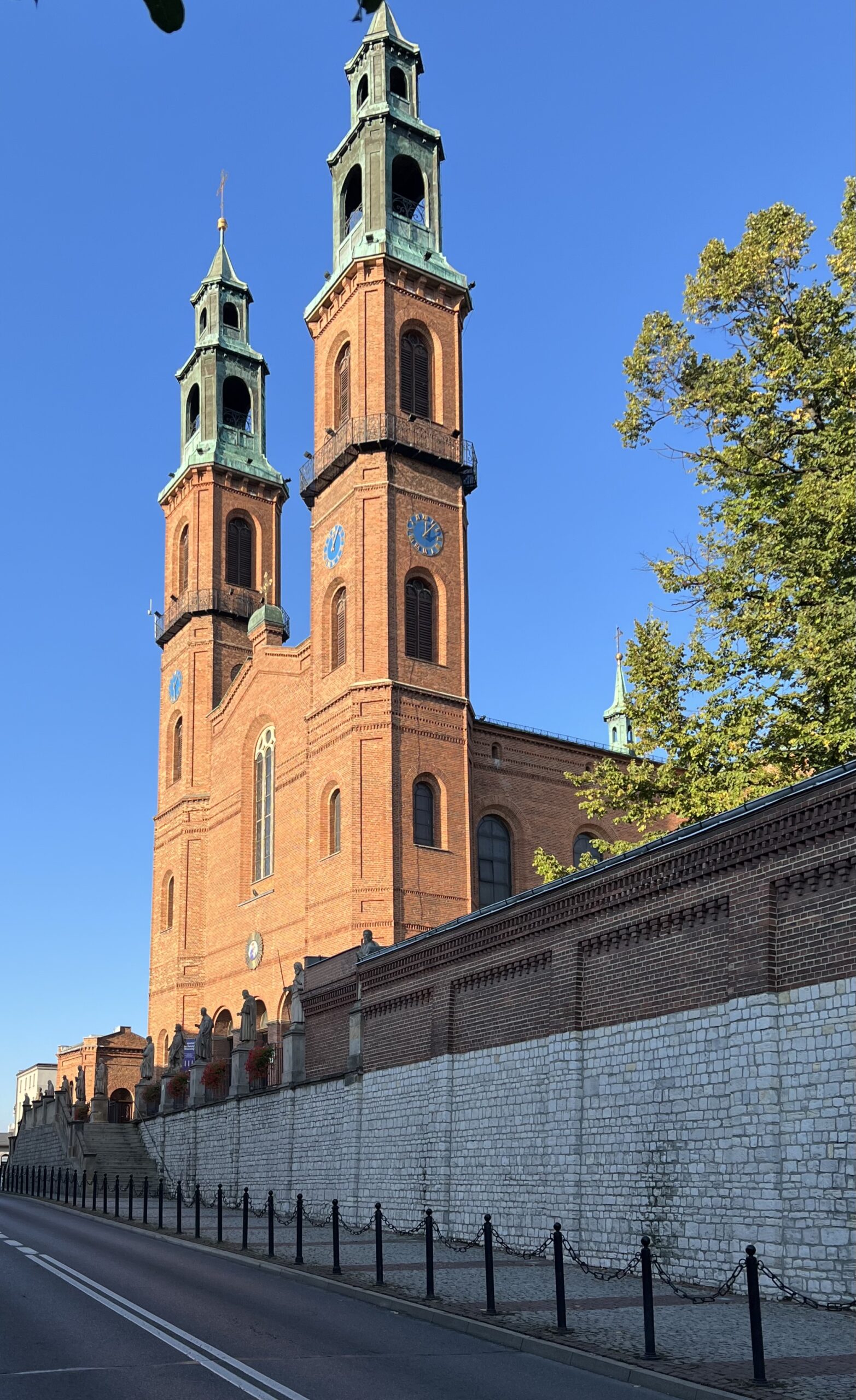
Between 1844 and 1849, four chapels were built on the square near the basilica, referring to the Seven Sorrows of the Virgin Mary. A new church was built in 1848 and was given two tall towers. In 1849, the house of worship was consecrated by Melchior von Diepenbrock (1798-1853), Bishop of Breslau (Wrocław) from 1845 to 1853, Cardinal (1850-1853), and a poet. A monstrance adorned with precious stones, which the bishop possessed, was received from Eleonora Magdalena Theresia von Pfalz-Neuburg (1655-1720), Empress of the Holy Roman Empire, upon the consecration of the church. This work of art was created by Johann Martin Vogelhund/Fogelhundt (1698-1741), a goldsmith from Dillingen a.d. Donau.
Pastor Jan Nepomucen Alojzy Ficek's successor was Bernard Purkop (1808-1882), pastor of Piekary (1862-1882). In 1869, he built the first large chapel on the Golgotha hill for Jesus' tomb, which later became the chapel of the tomb of Mary. By the time of his death in 1882, five other chapels had been built. Subsequently, Leopold Nerlich (1829-1895), pastor of Piekary (1882-1895), took over the work on the Golgotha hill. He was responsible for the vast majority of the buildings on the Golgotha hill and is referred to as the patron saint of Piekary. Karol Nerlich (1843-1900), pastor of Piekary (1895-1900) and brother of Leopold Nerlich, further expanded the Golgotha hill. Ultimately, the large project included the construction of 14 Stations of the Cross chapels, 15 rosary chapels, and 11 other chapels. On June 21, 1896, the complex was consecrated by Georg von Kopp (1837-1914), Bishop of Fulda (1881-1887), Prince-Bishop of Breslau/Wroclaw (1887-1914), and Cardinal (1893-1914).
On 15 August 1925, the coronation of the statue of grace takes place. The silver frame is then ready. The crowns for Mary and Jesus are a gift from Pius XI, Pope from 1922 to 1939 and born as Ambrogio Damiano Achille Ratti (1857-1939). During the Second World War (1939-1945), the crowns were stolen on the night of 7 to 8 December 1940. The Silesian people provide the funding for new crowns and on 13 June 1965, the statue of grace is crowned again.
Since 1 December 1962, the church has been elevated to a basilica by John XXIII, Pope from 1958 to 1963, and born as Angelo Giuseppe Roncalli (1881-1963).
On 12 September (the anniversary of the icon of the Mother of God), 1963, the miraculous icon of Piekary Śląskie is appointed chief patron of the Diocese of Katowice.
In 1984, the crowns of Mary and Jesus were stolen again in the dead of night. The third crowning of the icon of grace took place on 15 September 1985, performed by Herbert Bednorz (1908-1989), Bishop of Katowice (1967-1985). Notably, the crowns stolen in 1984 were recovered shortly after the theft, but were only returned to Piekary in 2015 by Wiktor Skworc (1948), Archbishop of Katowice (2011-2023). These crowns have been restored and have taken their place next to the icon of grace.
In 1986, Mother Theresa, born Anjezië Gonxha Bojaxhiu (1910-1997), was in the pilgrimage town of Piekary Śląskie. She is an Albanian, Catholic nun who in 1950 became the founder of the Missionaries of Charity and is active in India for the very poorest.
On 12 September 2000, the venerated image was covered with a silver veil. This features images of the town of Piekary Śląskie and, above it, the image of Mary with Child. The effigy is unveiled every morning and covered in the evening.
On 14 August 2008, an extensive renovation of both the exterior and interior of the basilica was completed, and a new consecration took place by Józef Kupny (born 1956), auxiliary bishop of Katowice (2006-2013) and later archbishop of Wrocław (2013).
On 1 May 2011, a votive candle will be placed next to the statue of Our Lady. It is the candle that Pope John Paul II gifted to Częstochowa on 6 June 1979.
Besides popes, Polish presidents have also visited the pilgrimage site, such as
– Stanisław Wojciechowski (1869-1953), President of Poland (1922-1926) in 1923
– Lech Walesa (b. 1943), President of Poland (1990-1995) in 1995
– Lech Kaczyński (1949-2010), President of Poland (2005-2010) in 2005.
Pilgrimage site
The basilica in Piekary Śląskie is named “Bazylika Najświętszej Marii Panny i św. Bartłomieja” and in Dutch this is “Basiliek van de Heilige Maagd Maria een Sint-Bartholomeus”. The basilica is thus dedicated to two saints, namely Our Lady and Bartholomew. It is an important pilgrimage site in Silesia.
The basilica is a Neo-Romanesque building.
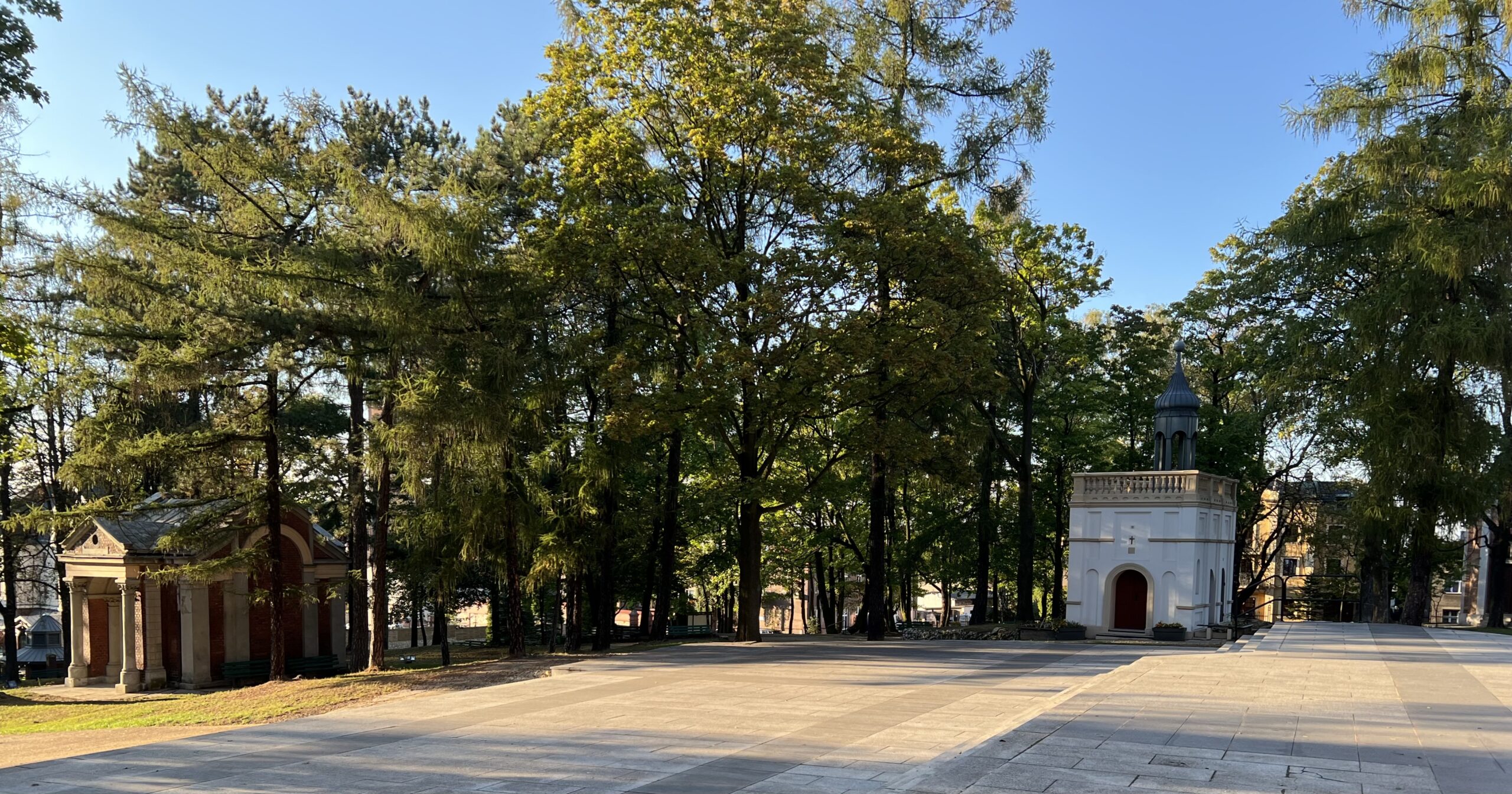
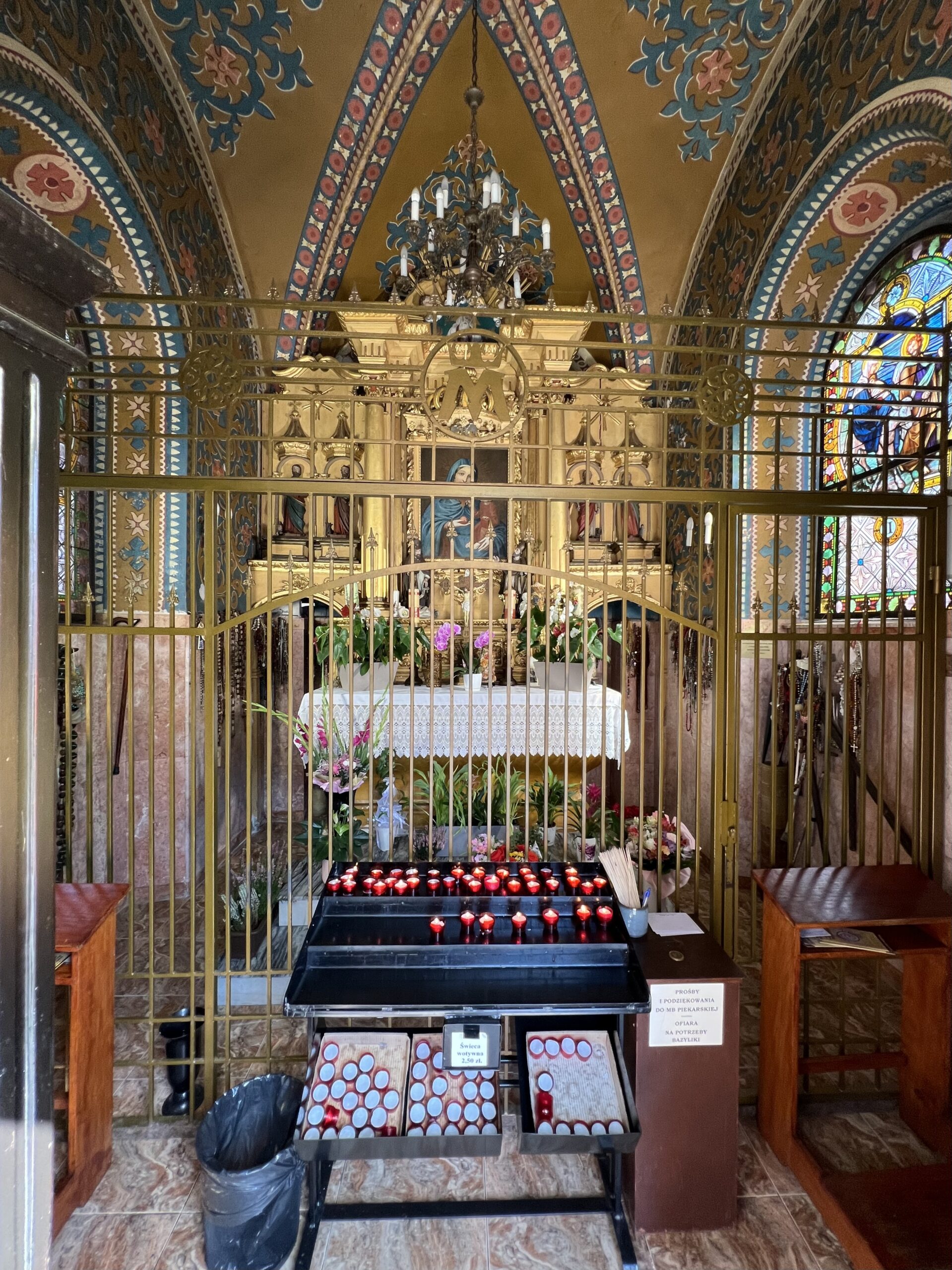
At the square by the basilica, there are four chapels recalling the Seven Sorrows of the Virgin Mary. One of them is the chapel of the “Mother of God the Healer”. Inside it stands a Baroque altar with a statue of Mary of Piekary, known as “ the Healer”.
The miraculous image of Piekary Śląskie bears several titles: “Mater Admirabilis” (Wonderful Mother), “Healer of the Sick”, “Refuge of Sinners”, “The Hospitable One of Silesia” and “Mother of Justice and Love for the People”. The latter title was given by John Paul II, who was Pope from 1978-2005 and was born Karol Józef Wojtyła (1920-2005). This Pope visited Piekary Śląskie on several occasions and always brought gifts in gratitude, such as a stole, a cheese candlestick and a golden rosary.
The Calvary mountain with its many chapels is more than a life’s work. Countless efforts have been made here.
In the pilgrimage site, there is also a department to reduce the consumption of alcoholic beverages.
The pilgrimage site is open every day.
ACCESSIBILITY
Piekary Śląskie, a town of around 60,000 inhabitants, is located in the south of Poland, in Silesia.
Pilgrimage site address: ul. Ks. Jana Ficka 7, 41-940 Piekary Śląskie.
The address of the Pilgrimage House Dom Nazaret is ul. Ks. Popieluski 6, 41-940 Piekary Śląskie.
The pilgrimage centre is located at ul. Ks. Ficka 7a, 41-940 Piekary Śląskie.
More information can be found on www.piekary-bazylika.pl.
Experience
On my pilgrimage through Poland, I will also visit Piekary Śląskie to see the basilica and the Calvary Park. When I arrive in the town, my first priority is to find a place to sleep, as the sun is setting and I would like to have a bed for the night. I find accommodation at Dom Nazaret. This recently opened pilgrim hotel is located between the basilica and the spiritual park. The pilgrimage site forms a large domain, thereby living up to its status as an important pilgrimage destination in Silesia. I place my suitcase in the hotel room and then head to the basilica.
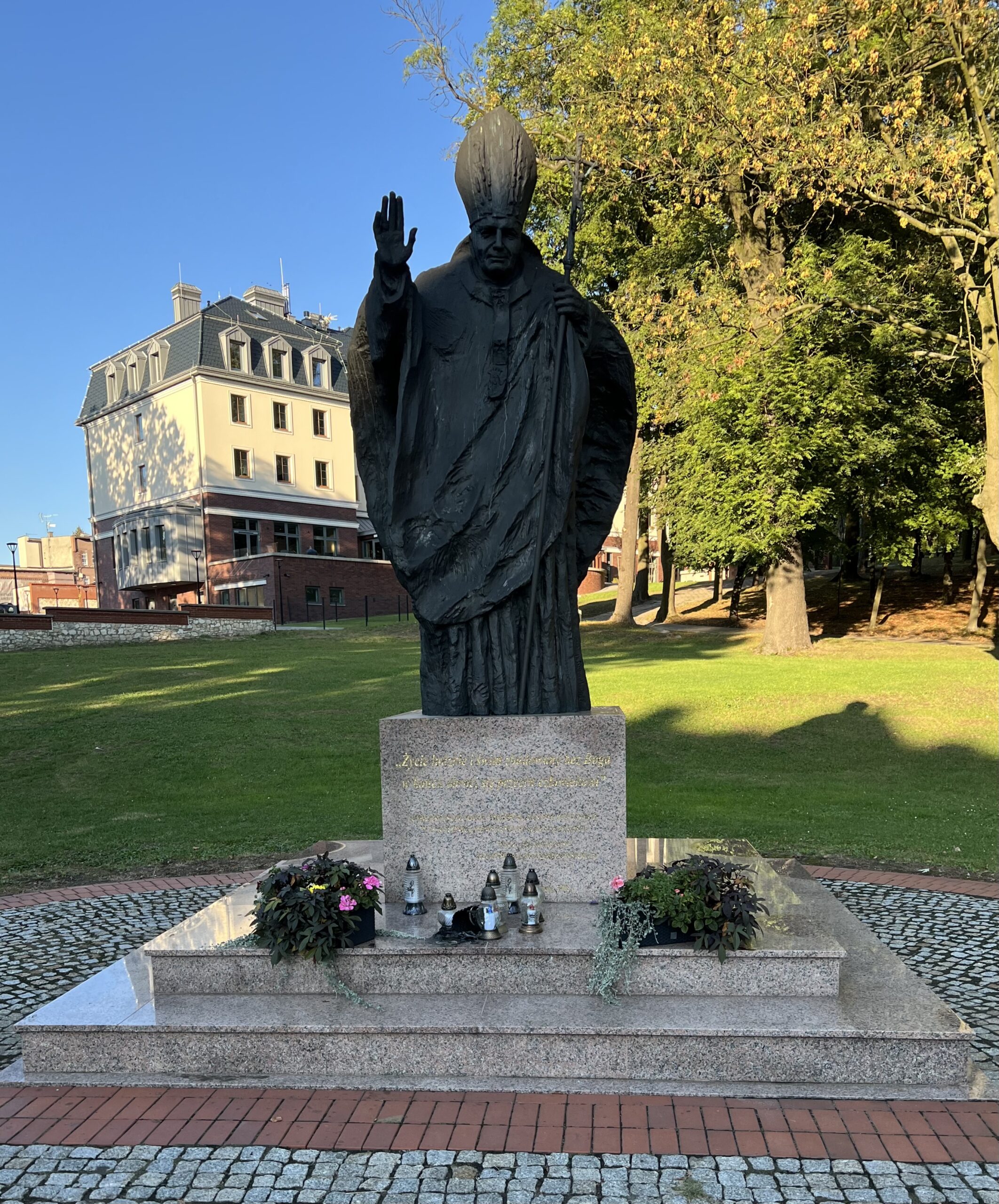
A Eucharist service is underway in the basilica, and I decide not to disturb the attendees. I then leave the church and head to the nearby park. At the front of the park stands a large effigy of John Paul II, Pope from 1978-2005 and born as Karol Józef Wojtyla (1920-2005).
Once again, I become aware that this Pope is seen in Poland as the most famous and revered compatriot.
In the vast park, many chapels stand on a hill, each depicting a part of Jesus' Passion. This is so depicted here that it strongly resembles the special places in Jerusalem. Also in this park is a cave of large stones, in which a beautiful Madonna is depicted. It represents the tomb of Mary.
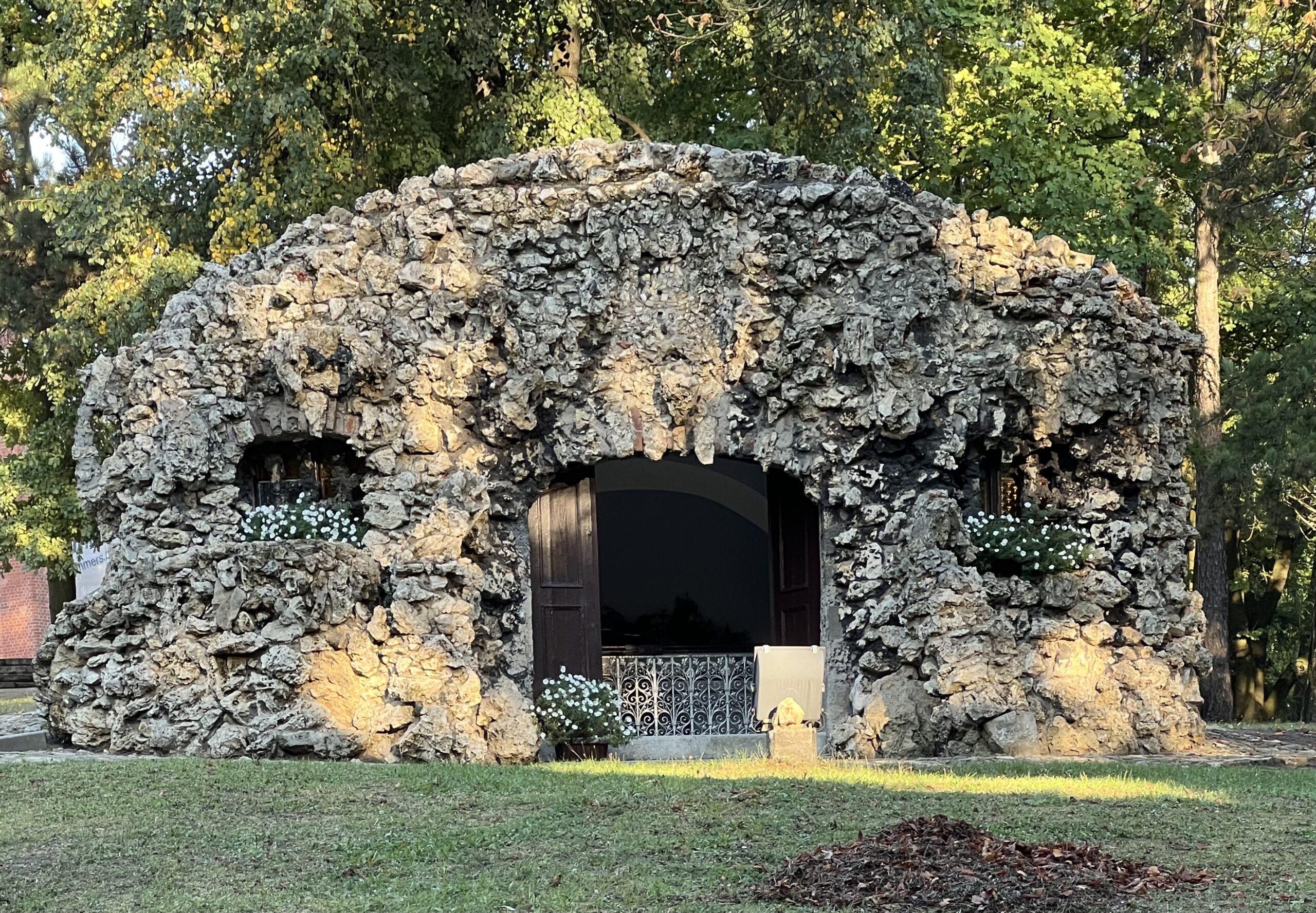
There is more to see in this religious park and I am following an ascending path. After a few dozen metres, I reach a church building with a pointed tower. The church doors are unfortunately closed, and I decide to go down the hill to look for it at the pilgrim hotel.
The following morning involves a tour of the pilgrimage site's grounds and a second visit to the Calvary. After that, the basilica is on the agenda.
In Poland, there are frequent celebrations in one day, and this pilgrimage site of Piekary Śląskie also proves it. In the basilica, there is a third eucharist service this morning. The church is well-occupied by believers. There is so much attention to Our Lady in this country!!! It remains to be seen if the Mass will be completed to tour the basilica.
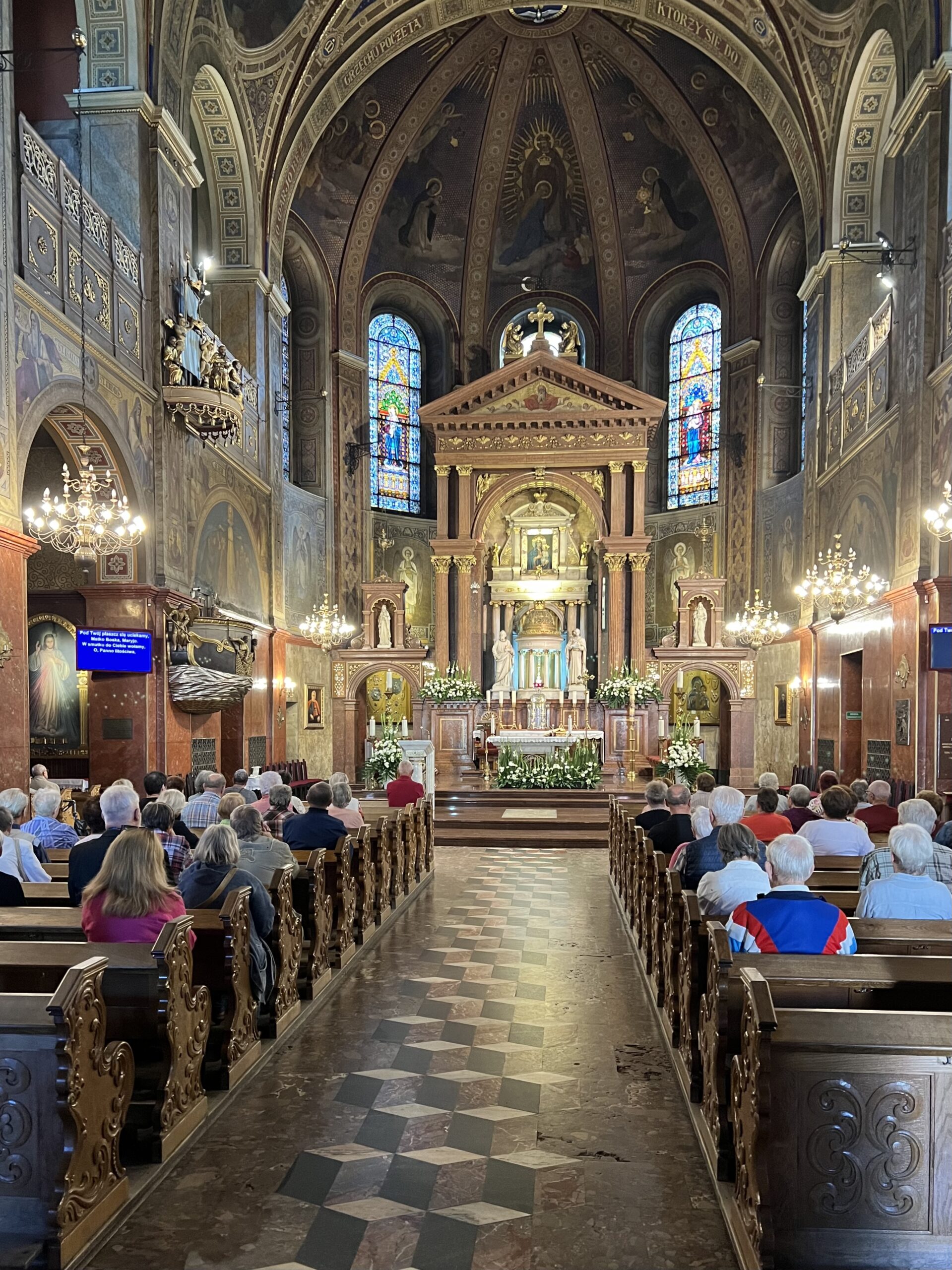
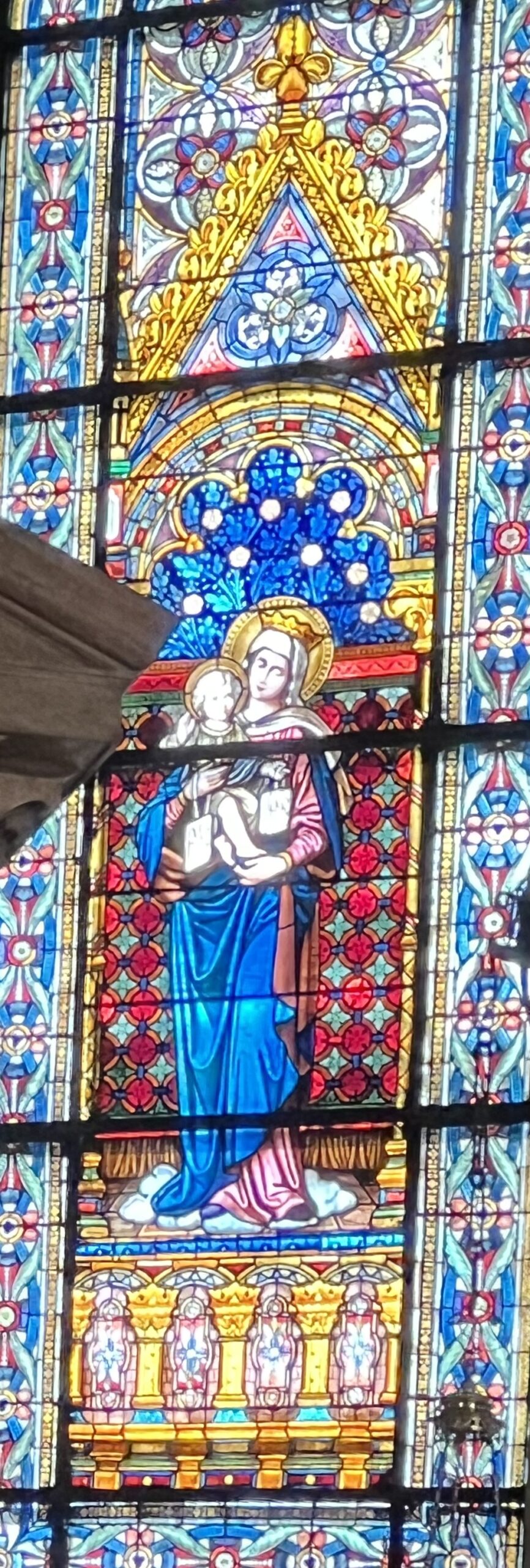
In the basilica, I see the image of Mary gleaming on the main altar. Mary and her Child are depicted centrally there. Both are crowned, and beneath the painting are the words “Ave Maria”. This image is so captivating! After praying for a few minutes, I finish my tour of the basilica. With admiration, I take in the splendour of the interior. I am particularly moved by the images of Mary and the stained-glass windows of the chancel. The separate chapel of the Mother of God is also more than impressive.
To conclude my stay at this pilgrimage site, I visited a chapel situated near the basilica. The small building bears the name “Matki Bozej Lekarki,” meaning “Our Lady the Healer” in Dutch. Midway through the chapel, a railing prevents visitors from proceeding further. This is as far as one can go. I lit a few candles, accompanied by my intentions. I observed the beautiful altar with Mary and colourful stained-glass windows. This is the opportune moment to pray for the well-being of my friends and acquaintances.
Environment
Travelling from Katowice to Piekary Śląskie is travelling 18 km to the north.
Travelling from the pilgrimage site of Czestochowa to the one in Piekary Śląskie is travelling 70 km to the south.
Travelling from Wroclaw to arrive in Piekary Śląskie covers 203 km to the southeast.
Travelling from Warsaw, the capital of Poland, to Piekary Śląskie involves travelling 282 km south-west.
Posted: 31 January 2025
~~~

 Nederlands
  English (UK)
  Deutsch
  Français