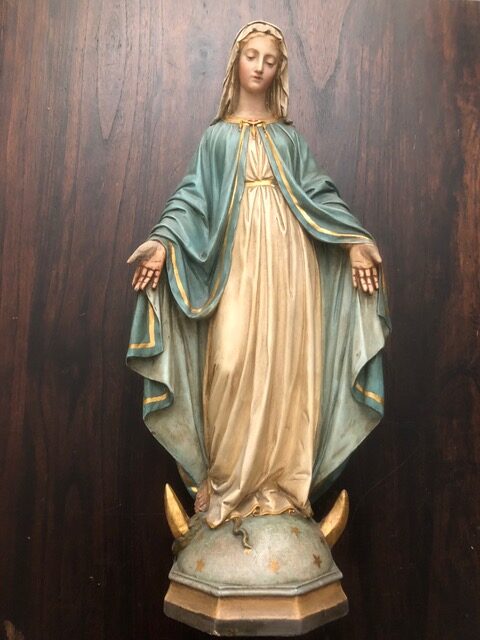
The Miraculous Medal is the most widely distributed medal of a religious nature. The Miraculous Medal is also known as the medal of Our Lady of Graces.
The history of the medal begins in the French capital, Paris, in 1830. Our Lady reveals the plan for the medal to Sister Catherine Labouré (1806-1876) in the convent on Rue de Bac. The sister has an apparition on the evening of July 18, 1830. At 6:30 p.m., Catherine hears: “Sister Labouré, Sister Labouré.” Her guardian angel takes her to Mary. This angel is a little boy, dressed in white. The angel says: “Come to the chapel, Our Lady is expecting you.” Catherine follows the little angel through the suddenly lit corridor of the convent. The chapel door opens when the angel touches it. Catherine sees the candles burning, but does not make out Our Lady. The angel leads her to the presbytery, next to the large armchair. Catherine kneels, and the angel says: “The Blessed Virgin is coming, here she is.” Catherine kneels before Mary and places her hands on her knees. The Virgin Mary tells Catherine that God wants to give her a mission, that she will suffer a lot but will overcome, and that she should not be afraid but have faith.
Four months later, on 27 November 1830, Mary reappeared to Catherine. She saw the Blessed Virgin standing on a half-globe. She was dressed in a silken, white robe and wore a long, white veil on her head, reaching down to her feet. Mary held a golden orb in her hands, representing the globe. Her hands were raised to her waist, her eyes looking upwards. Catherine found Mary's face to be beautiful. Suddenly, rings with stones appeared on Mary's fingers. Rays shone down from the stones. An oval frame formed around the Blessed Virgin, with the words written in gold: “O Mary, conceived without sin, pray for us who have recourse to thee”. The words began at her right hand, travelled over her head, and ended at her left hand. Catherine heard these words: “Have a medal struck according to this model. All who wear the medal, when it has been blessed, will receive great graces, especially if they wear it around the neck. The graces will be abundant for those who wear the medal with confidence.”
A month later, Mary returns to Catherine and says, “The rays symbolise the graces that the Most Holy Virgin obtains for those who ask for them.”
Catherine's confessor is Father Jean-Marie Aladel (c. 1800-1865). He does not believe her words about the medal and the apparitions. But Catherine insists on having medals struck, as Mary commanded.
In January 1832, Father Aladel has an audience with the Archbishop of Paris, Hyacinthe-Louis de Quélan (1778-1839). He tells His Grace what happened at the convent in Rue de Bac, without mentioning Catherine's name. The Archbishop gives permission to start producing the medals immediately.
In the period 26 March to early July 1832, the Parisian population was struck by a devastating cholera epidemic, which had come from Eastern Europe. In total, nearly 20,000 people died from cholera, and the inhabitants of the French capital were afraid of contracting the deadly disease.
In May 1832, Father Aladel placed an order for 20,000 items with the Parisian firm Vachette. Under the leadership of Adrien Jean Maximilien Vachette (1753-1839), the medals were produced. On 30 June 1832, 1,500 medals were delivered. The first medals delivered by Vachette were made of copper and each measured 2.25 cm high. The Sisters of Charity distributed them among the citizens of Paris affected by the epidemic. Immediately, the highly contagious disease lost ground, and there were reports of miracles, as people recovered and were no longer infected by cholera. By early July 1832, the epidemic had disappeared. This led to the Miraculous Medal gaining great fame.
The Vachette Company is receiving more orders but cannot keep up with the production of the medals. The entrepreneur hires other companies from Paris, including the Paris Mint. He also calls on producers outside of Paris. In a period of almost 4 years, just over 2 million medals are made, of which almost 200 are in gold, over 70,000 in silver, and the majority are made of copper. Medals are not only made in French but also in German, Italian, and Dutch. Medals with the maker's stamp also appear. This happens after 1844 when it becomes mandatory in France to mark manufactured articles.
In 1836, 15 million medals were made, and by 1842 this number had risen to 100 million. Reports of extraordinary graces granted through the Miraculous Medal are coming in from all over the world. Many healings and conversions have been reported.
Archbishop Quélan is a great promoter of the distribution of the Miraculous Medal. Gregory XVI, Pope from 1831-1846, and born Bartolomeo Alberto Cappellari (1765-1846), also receives medals and distributes them.
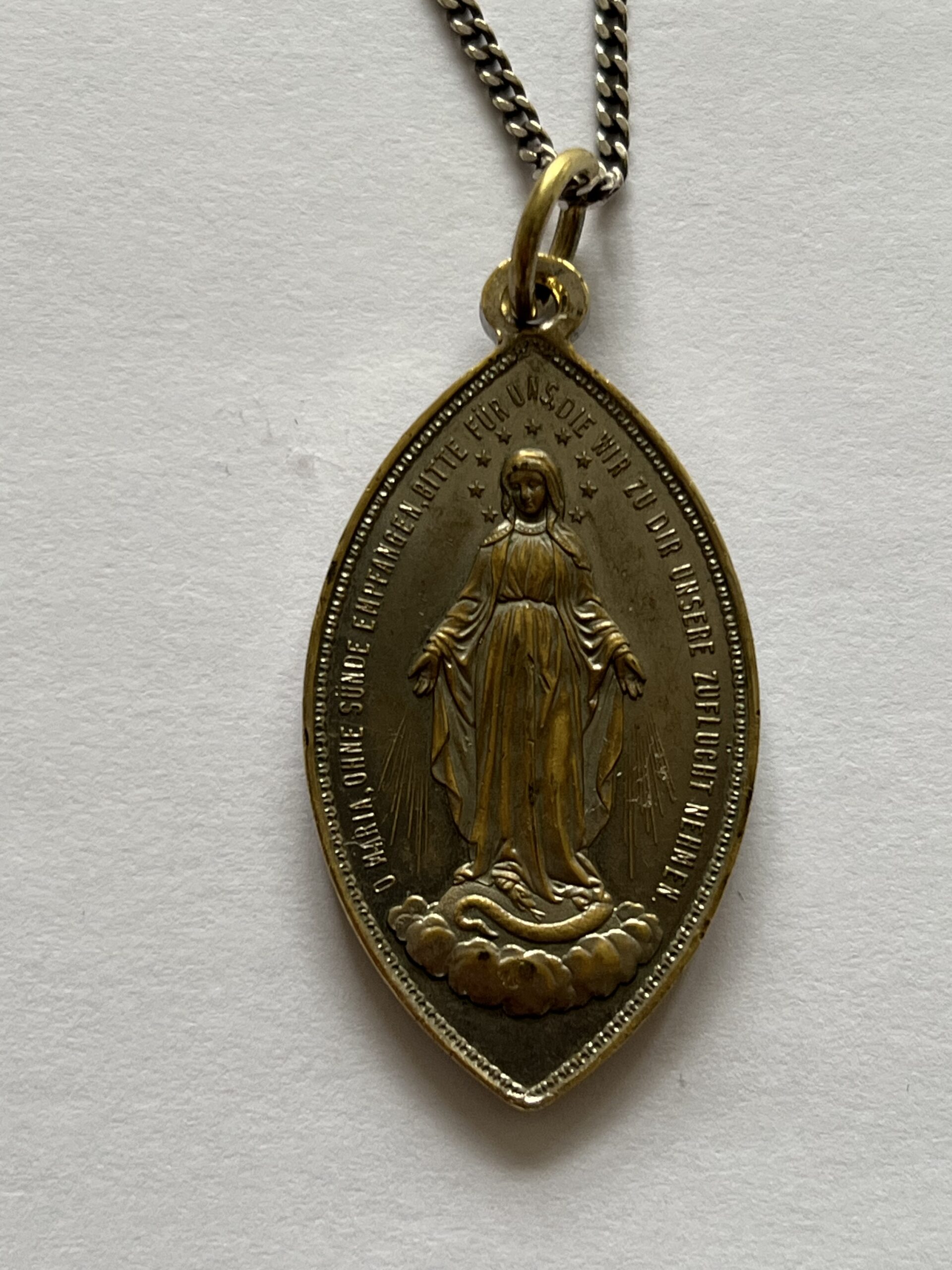
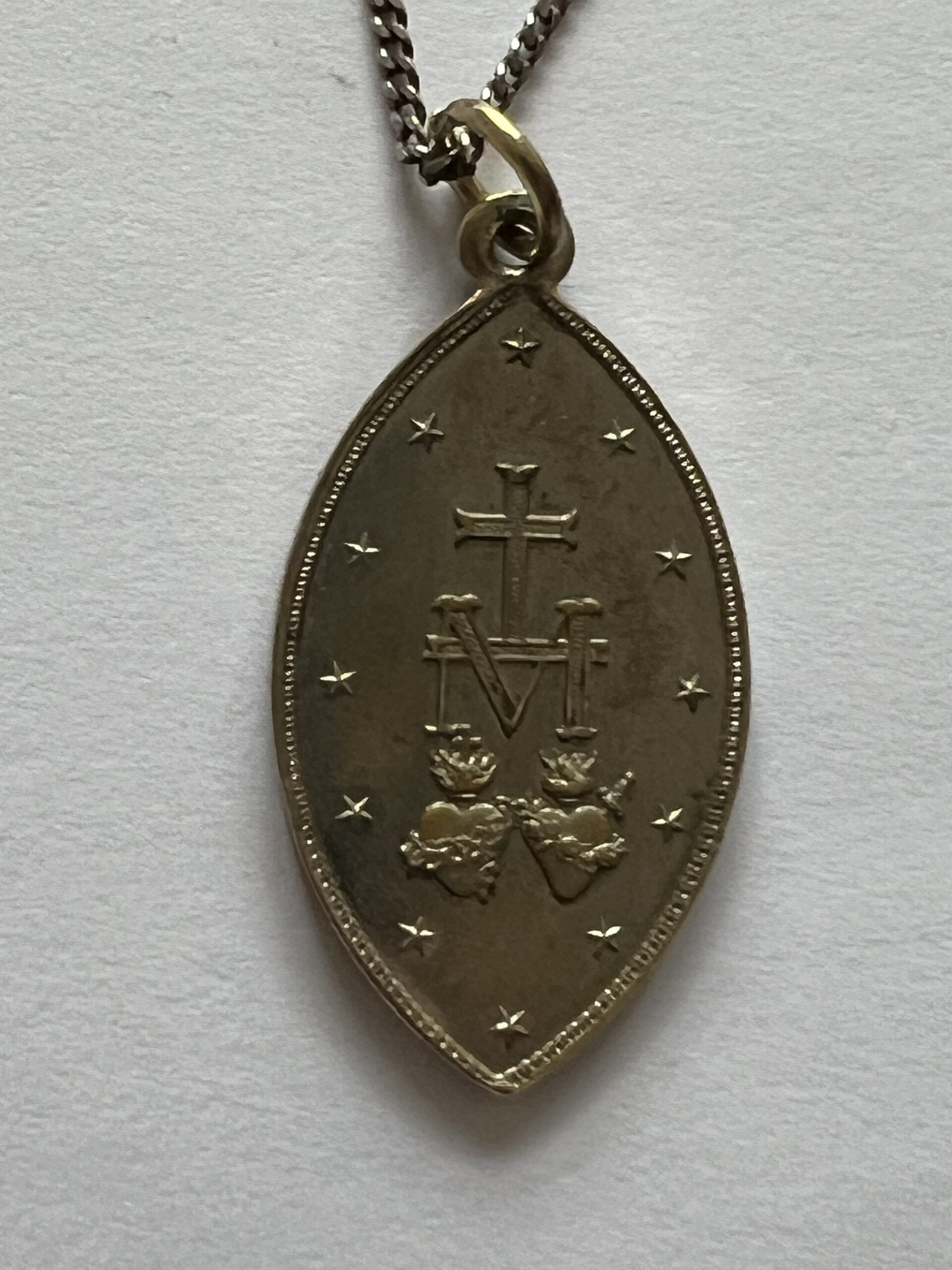
The medal is oval in shape and has an image on both sides. The front shows the effigy of Mary with outstretched arms, from which rays of grace emanate. This signifies that Our Lady showers believers with graces, enabling them to receive forgiveness and mercy. Mary crushes the head of a serpent under her feet, symbolising the fight against evil. Around the image of Mary is the text “O Mary, conceived without sin, pray for us who have recourse to you.“ This text has been translated into many languages, as the medal is distributed worldwide. The reverse of the medal shows the letter ”M“ for Mary with a cross on it. Below this are depicted two hearts, those of Mary and Jesus. The whole is surrounded by 12 stars. The stars refer to the words from the Apocalypse (12:1): ”and a great sign appeared in heaven: a woman clothed with the sun, with the moon under her feet, and on her head a crown of twelve stars.”

 Nederlands
  English (UK)
  Deutsch
  Français