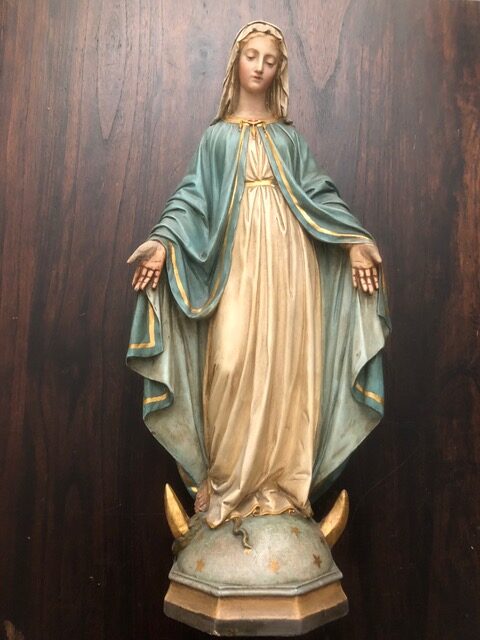
The honorary title “Most Prudent Virgin” belongs to the Litany of Loreto. In Latin, the honorary title is “Virgo prudentissima”. This title refers to the virtue of prudence that Mary possesses. This beautiful, moral quality here has the meaning of good sense and wisdom. It is a cardinal virtue, highly valued especially by ancient philosophers. With her prudence, Mary teaches others to think before a decision is made.
The word “allervoorzichtigst” (most carefully/cautiously) goes further than “wees voorzichtig” (be careful). The word *voorzichtig* (careful) has more meanings, which apply to the honorary title of Mary, such as weighing up, alertness, thoughtfulness, discretion, modesty, diplomacy, tact, consideredness, calmness, circumspection, foresight, and an attentive, calm manner of speaking. *Allervoorzichtigst* is the good, moral quality and relates to consideration and foresight. *Voorzichtigheid* (caution/prudence) then means to consider what must be done in a given situation. Prudence is therefore the mother of wisdom.
What Mary says during the Wedding at Cana is proof of her prudence. Mary says to Jesus: “They have no more wine.” Jesus replies: “Woman, what concern is it of yours to me? My hour has not yet come.” After this, Mary says: “Do whatever he tells you.”
The Dutch composer Heinrich (Henricus) Isaac (c. 1450-1517), who was also known as Arrigo il Tedesco, wrote a six-part motet (composition for singers) in 1507 titled “Virgo prudentissima”.

 Nederlands
  English (UK)
  Deutsch
  Français