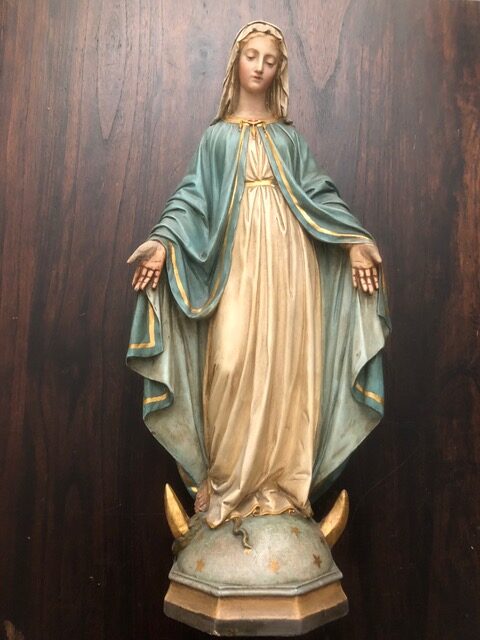
Many images, icons, and paintings of Mary are crowned. Our Lady is a queen, and a coronation is fitting for that. By crowning the Virgin Mary, it is indicated that she is queen. It is claimed that after her assumption, Christ crowned Mary queen of heaven and the universe. This connects Mary with her Son for the third time. First, through the birth of Jesus, Our Lady became His Mother, and then she lovingly raised and followed Him. Finally, Mary is in heaven with her Son.
In the book of Revelation, John (12:1) describes the vision of the Woman Mary, whom he sees appearing in the sky, with the sun as her cloak, the moon under her feet, and on her head a crown of 12 stars.
The history of coronations goes back centuries. The coronation of Mary originated in the 17th century. The initiative for this came from the Italian Capuchin friar Girolamo Paolucci de’Calboli (1552-1620) from Forlì, who began crowning publicly venerated images of Mary. The first coronation took place on 27 May 1601 with a statuette of Mary in Parma, namely the “Madonna della Steccata”. Many statues followed, which is why Calboli is called “L’Apostolo della Madonna” (the Apostle of Our Lady). On 26 August 1601, the coronation of the image of Mary, “Madonna del Fuoco”, took place in Forlì by Calboli.
The coronations of many revered Marian statues by Calboli generate the necessary publicity and their coronings also reach “Rome”. Subsequently, guidelines for the coronation of a statue, where there is a high degree of veneration, come from the Vatican. Crowning a statue of Mary can be done with a crown, tiara (triple crown) or halo (circle of stars) on a statue, icon or painting.
Alessandro Il Sforza Pallavicini (1567-1638), 6th Count of Borgonovo, was wealthy and had a particularly strong devotion to Our Lady. He attended the first coronation by Girolamo Paolucci de’Calboldi in Parma. He made a significant amount of money available for the coronation of statues of the Virgin Mary that were believed to perform miracles. The Holy Office, Congregation for the Doctrine of the Faith, (Chapter of Saint Peter) in Rome was originally responsible for issuing authorisation for the coronation of statues. This organisation was very pleased with the considerable financial support. Furthermore, it was stipulated in the will of the Count of Borgonovo that he would bequeath a large part of his fortune to the Chapter of Saint Peter for the coronation of important statues of the Virgin Mary. With this legacy, numerous effigies of Our Lady were adorned with a crown.
The first statue of Mary, which was crowned with great ceremony using money from the Count of Borgonovo, is the statue of “La Madonna d’ Oropa” in Biella, Italy. This coronation took place on 30 August 1620 and was done without papal approval. The first statue of the Mother of God to be crowned with the Pope's permission is the painting “La Madonna della Febbre” (Our Lady of Fever) by Lippo Memmi (1291-1356). The Count of Borgonovo also financed this. This statue is located in the sacristy of St. Peter's in Rome. This coronation occurred on 27 May 1631. The first statue of Mary to be crowned by the Pope himself was in the cathedral of Cesena. This is the statue “Madonna del Populo” (Our Lady of the People). It was Pope Pius VI, Pope from 1775-1799, who adorned the statue with a crown on 3 June 1782. The crowning of a statue of Mary by the Pope is not a frequent occurrence; usually, this is the work of a bishop or a papal nuncio (a papal envoy to a government). However, Pope Benedict XVI, Pope from 2005-2013, did crown the statue of Our Lady of Lourdes. This took place during World Day of the Sick on 11 February 2007.
In addition to the mentioned coronations of statues, other crowned statues include the Virga Jesse statue in Hasselt (1867), the statue of Our Lady of Scherpenheuvel (1872), the effigy of Mary in Tongre-Notre-Dame (1881), and the statue of Our Lady of Foy (1909). Many statues of Mary were crowned in the period 1875-1925. Often, a festive commemoration is the reason for proceeding with a coronation. The coronation is seen as a special recognition of a Marian pilgrimage site.
The coronation of a statue of Mary is requested from the Vatican in Rome and addressed to the Pope. After all, the church leader decides whether a coronation can proceed. A canonical coronation (Latin: “Coronatio Canonica”) is a religious act carried out by the Pope of Rome by publishing a papal bull; a document for a legal act of the church father. The Chapter of Saint Peter stopped arranging coronations in 1981. However, coronations of statues of Mary have continued, carried out by bishops. This was done with or without the approval of the Pope of Rome. A statue can also be crowned in the name of the Pope.

 Nederlands
  English (UK)
  Deutsch
  Français