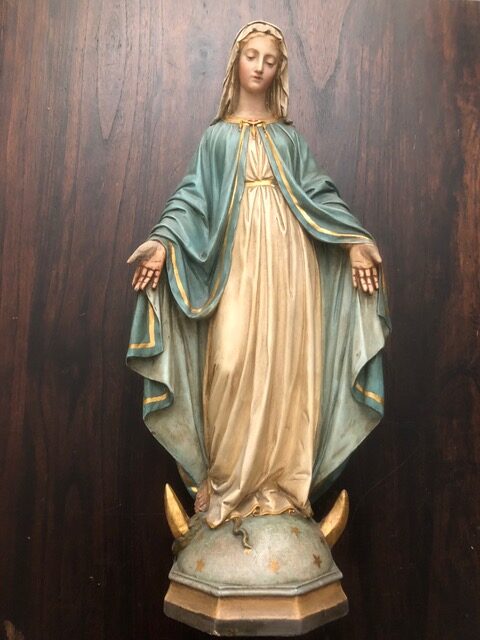
Maria has appeared countless times on all continents of our Earth. Where She has been seen, places of pilgrimage have often arisen, which have become destinations for pilgrims.
Over the centuries, the characteristics of Mary's apparitions have hardly changed. Most often, the Virgin Mary appears in a bright white light, is dressed in a long robe, and often wears a scarf. Frequently, her feet are shrouded in a cloud or mist. Many an apparition announces Mary's arrival through phenomena such as lightning, darkness, light, or wind.
The first Marian apparitions occurred in the 4th century. In the 19th and 20th centuries, there was a significant increase in reported apparitions of Mary.
Our Lady largely addresses simple, innocent people. She usually makes herself known by her name or one of her many titles. When Mary speaks, it is understandable, as she uses words from the language or dialect of the seer or seers. In this way, she provides proof of her authenticity. It is not relevant whether “Rome” has recognised a place of apparition. After all, the point is that in a place of pilgrimage there are people who feel drawn to Mary and the significance of the apparition site. Places of apparition of Mary that attract many pilgrims include Banneux, Fatima, Garabandal, Heede, Heroldsbach, La Salette, Lourdes, Marienfried, Marpingen, Medjugorje and Montichiari.
Extraordinary apparitions also occurred in Russia to Seraphim of Sarov (1759–1833), one of the greatest mystics in Russian history. He was the greatest “starets” (spiritual leader of a Russian Orthodox monastery) of the 19th century and a great saint in Russia. Seraphim was born Prokhor Isidorovich Moshnin and, at a young age, was miraculously healed on several occasions when Mary appeared to him. This convinced him to enter the monastery, and from his mother he received a copper cross which he carried with him throughout his life. The man was highly intelligent, had an exceptional memory, attended church frequently and prayed often. Seraphim studied the Bible and immersed himself in hagiographies. In 1776, he left his hometown of Kursk and made a pilgrimage on foot to the Pechersky Monastery (Cave Monastery) in Kiev. There, he venerated the saints depicted on the icons. He met the monk Father Dositheus, who told him to go to the monastery in Sarov, in the province of Tambov, to take his monastic vows. In 1778, he arrived in Sarov and took his vows. With the abbot’s permission, he withdrew to a forest. In 1780, he fell seriously ill, refused help and placed his trust in Mary. He had a vision of Mary with John the Baptist and was healed. In 1786, he chose the name Seraphim and a year later became a deacon at the monastery. Shortly afterwards, he returned to the forest and lived there for 25 years in seclusion as a hermit. In 1804, he was attacked and assaulted and went to the monastery to recover. Once again, there was an apparition of Mary and the apostles Peter and John, and Serafim took this as a sign to remain in the monastery until he was fully recovered. Seraphim went into seclusion and lived in a cell for 15 years. On 25 November 1825, Mary appeared again; he opened the cell and from then on served as a counsellor to everyone. On 1 January 1833, he received the Anointing of the Sick, and Seraphim died the following day. Tsar Nicholas II (1868–1913) and his wife, the German Princess Viktoria Helena Luise Beatrix (Alix) von Hessen und bei Rhein (1872–1918), who took the name Alexandra Fyodorovna upon marriage, championed his canonisation. In 1903, the canonisation took place, and the Tsar then received a letter from Seraphim, which he had written 70 years earlier. This letter bears the inscription “To the Tsar who will come to Sarov”. In the letter, Seraphim mentions the end of the Tsar’s life and also predicts that Russia will be free again by the end of the century. In 1991, Seraphim’s relics were discovered.
In the 20th century, almost 400 Marian apparitions were reported worldwide. Of this number, 8 are considered supernatural. The assessment of an apparition has in the past largely been left to the bishop of the diocese in which the apparition was reported.
The investigation into the authenticity of an apparition is a very time-consuming procedure and the Vatican of the Catholic Church judged this approach as not very workable. In 2014, the Vatican decided that the bishop, in collaboration with the Dicastery for the Doctrine of the Faith, would determine how to proceed. In that year, criteria were established to investigate a reported apparition. There must be originality and unpredictability. If these conditions are met, it can be referred to as supernatural.
~~~

 Nederlands
  English (UK)
  Deutsch
  Français