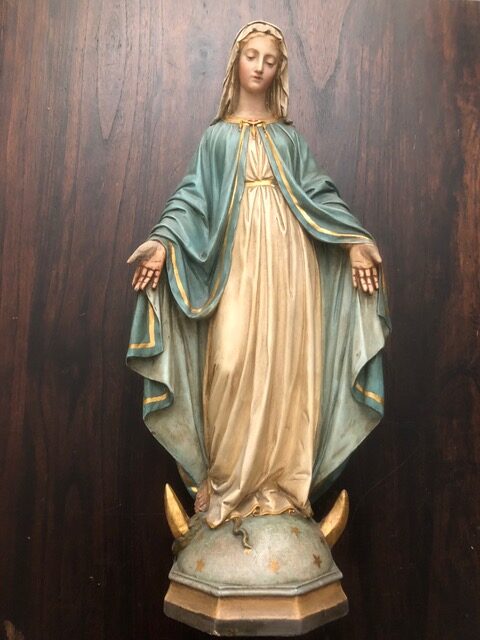
The Rosary is prayed as children of Mary. The Rosary prayer is loved by many and shows that simplicity and depth go hand in hand. The beauty of the Rosary is discovered when praying it.
Praying the Rosary involves the repetition of words. The repeated recitation of prayers forms the strength of devotion to Mary. In this way, prayer becomes tangible, as the beads are moved through the fingers. Through the repetitions of the Hail Mary, it is possible to reflect on the mysteries of the Rosary, which hold significance in the life of the person praying.
The Rosary can be prayed alone, but also with others. When praying the Rosary with more than one person, unity is created. Praying the Rosary offers a way to reflect on the mysteries of glory, joy, sorrow, and light.
The Rosary can be prayed as follows:
Take the cross, make the sign of the cross with your other hand and say the Creed.
2. Recite the Our Father at the first bead.
3. On the following three beads, say the Hail Mary.
4. At the fifth bead, say the Our Father and the “Glory Be...”.
5. To name a secret and pray 10 Hail Marys with an Our Father and repeat this four more times.
6. Making the sign of the cross.
Another way of praying the Rosary is:
Take the cross, make the sign of the cross with your other hand and say the Creed.
2. Recite the Our Father at the first bead.
3. For each of the next three beads: Hail Mary, daughter of God the Father, then the Hail Mary.
4. At the fifth bead: Glory be to the Father, and to the Son, and to the Holy Spirit, as it was in the beginning, is now, and ever shall be, world without end. Amen.
5. Pray the prayer that Mary asked the three children to pray in Fatima, Portugal: O my Jesus, forgive us our sins, save us from the fires of hell, lead all souls to Heaven, especially those who are most in need of Thy mercy. Amen.
6. Praying a secret or mystery, an Our Father, 10 Hail Marys and then “Glory be to the Father...”. This is repeated four more times with a different secret or mystery each time.
7. Making the sign of the cross.
~~~
Rozenkrans van de Goddelijke Barmhartigheid
De rozenkrans van de Goddelijke Barmhartigheid komt door een verschijning van Jezus aan zuster Maria Faustina, geboren in Polen als Helena Kowalska. Zij heeft geleefd van 1905 tot in 1938 en is zuster, mystica en zieneres. In 2000 is zij heilig verklaard door Joannes Paulus II, paus van 1978 tot in 2005, geboren als Karol Józef Wojtyla (1920-2005).
Jezus verschijnt aan zuster Maria Faustina en leert haar de rozenkrans van de Goddelijke Barmhartigheid. Hij zegt haar: Zeg steeds deze rozenkrans die Ik u heb geleerd. Dit komt in het dagboek van zuster Maria Faustina voor. De verschijning heeft plaats op 22 februari 1931.
De rozenkrans van de Goddelijke Barmhartigheid behoort tot de krachtigste gebeden. Vooral is het bidden van deze rozenkrans van toepassing bij stervenden.
De indeling van de rozenkrans van de Goddelijke Barmhartigheid is:
1. Onze Vader
2. Wees gegroet
3. Geloofsbelijdenis
4. Bij de losse kralen: Eeuwige Vader, ik offer U op het lichaam en bloed, de ziel en de Godheid van uw welbeminde Zoon, onze Heer Jezus Christus, tot vergeving van onze zonden en die van de hele wereld.
5. Op elk van de tien kralen: Omwille van zijn smartelijk lijden, wees barmhartig voor ons en voor de hele wereld.
6. Aan het eind driemaal: Heilige God, heilige Sterke, heilige Onsterfelijke, ontferm U over ons en de hele wereld.
~~~

 Nederlands
  English (UK)
  Deutsch
  Français