~~~
History
The church's origins date back to the 16th century. The construction of this church is a result of miracles associated with a shrine housing a wooden Pietà. This shrine has been present since approximately 1490. The first miracle occurred in 1504. After a battle near this chapel, featuring a wooden vesper statue, Nikolaus Lemmerer from Melkendorf in Upper Franconia had a vision. The man was severely wounded and subsequently confined to bed, almost completely paralysed, for a year. In his great distress, he prayed to Mary. One night, he had a vision. He heard a voice say: "Bring a candle to the shrine with the image of Mary near the vineyards of Dettelbach, and you will be healed." The man obeyed. In 1505, he arrived in Dettelbach, lit the candle, and was immediately cured. This man received another vision, instructing him to bring a candle to the town hall to recount his miraculous incident to the assembled councillors. He obeyed again. Following his healing, the miraculous power of the statue of Mary became widely known. After the miracle, a small wooden chapel was erected at the shrine. In 1506, a new chapel was built.
From the very beginning of the pilgrimage site, there have been pilgrimages, primarily from nearby locations. Organised pilgrimages have existed since 1506 from places including Bibergau, Euerfeld, Kitzingen, Mainsondheim, and Prosselsheim.
Lorenz von Bibra (1459-1519), Prince-Bishop of Würzburg (1495-1519), decided in 1506 to have a stone chapel built. His successor, Konrad II von Thüngen (c. 1466-1540), Prince-Bishop of Würzburg (1519-1540), continued the work. In 1511, the many answered prayers were recorded in a book of miracles by Johannes Trithemius/Johannes von Trittenheim (1462-1516). The reason for the pilgrimages is often cited as a vow made due to the danger of epidemics, especially the plague, famine, war, pain, cattle disease, or head ailments. Believers also go on pilgrimage to Dettelbach to thank Mary for surviving a wolf attack, for eating poisonous plants, for recovering from sore eyes, or for surviving a fall.
When the church is finished, the Reformation begins a little later, and pilgrimages are forbidden by the Protestant authorities. No one wants to and is allowed to accompany the pilgrimages. After this, a Peasants' War (1524-1526) breaks out, and pilgrimages are again not possible.
In 1608, Julius Echter von Mespelbrunn commissioned plans for a new church. The current church was then built. This was realised between 1610 and 1613 by Julius Echter von Mespelbrunn (1545-1617), Prince-Bishop of Würzburg (1573-1617). Julius Echter von Mespelbrunn was active during the Counter-Reformation, aiming to give Catholics renewed confidence in their faith and attempting to reconvert Protestants. In 1585, Julius Echter von Mespelbrunn visited the pilgrimage site of Dettelbach and, in 1586, ordered the people of Dettelbach to return to the Catholic faith. The inhabitants did not all comply, and many continued to attend the nearby Protestant church. Consequently, approximately 70 families were forced to leave the town. In 1590, a remarkable incident occurred: a woman, possessed by the devil, was inexplicably healed. This event rekindled many people's interest in the Catholic faith, and pilgrimages increased once more.
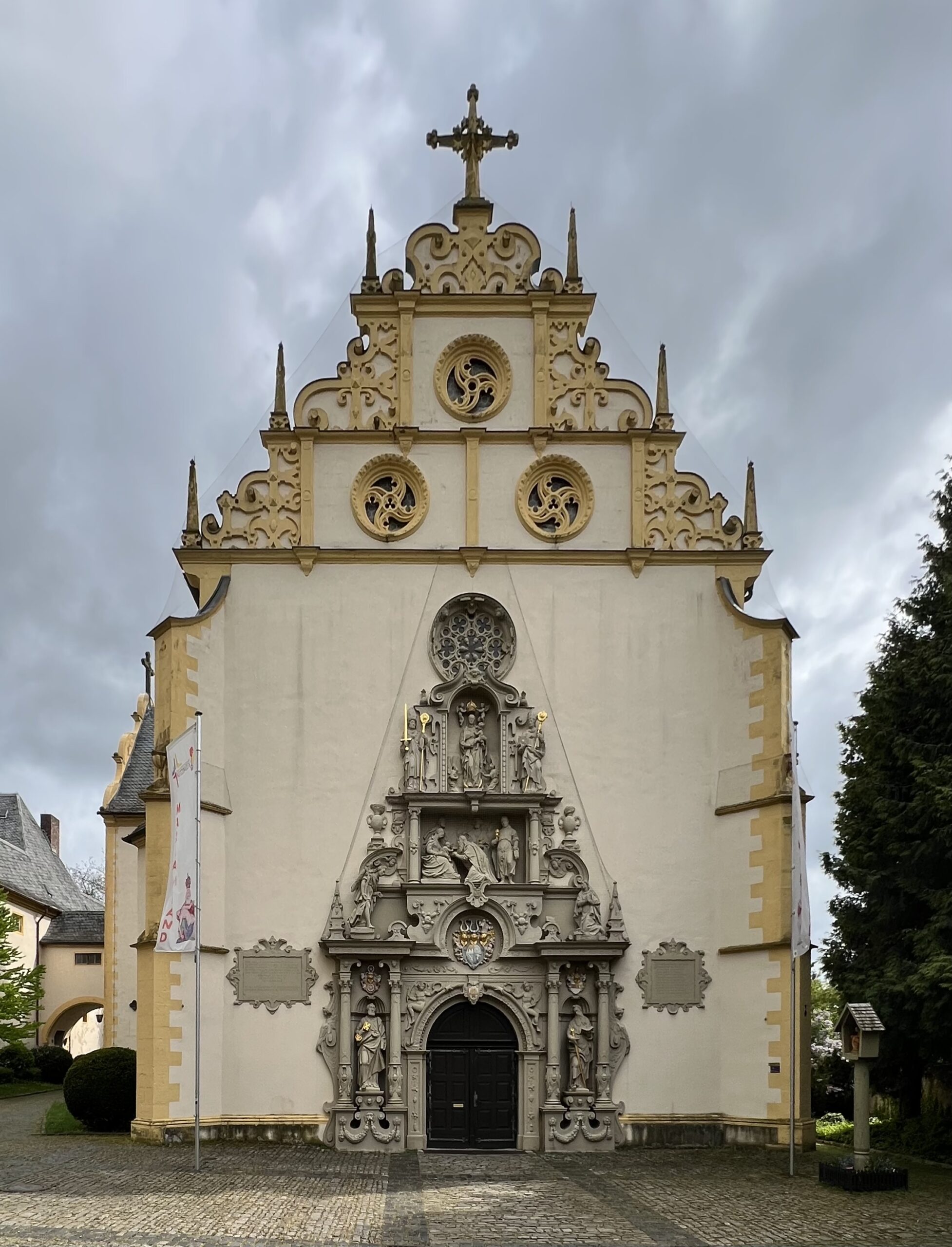
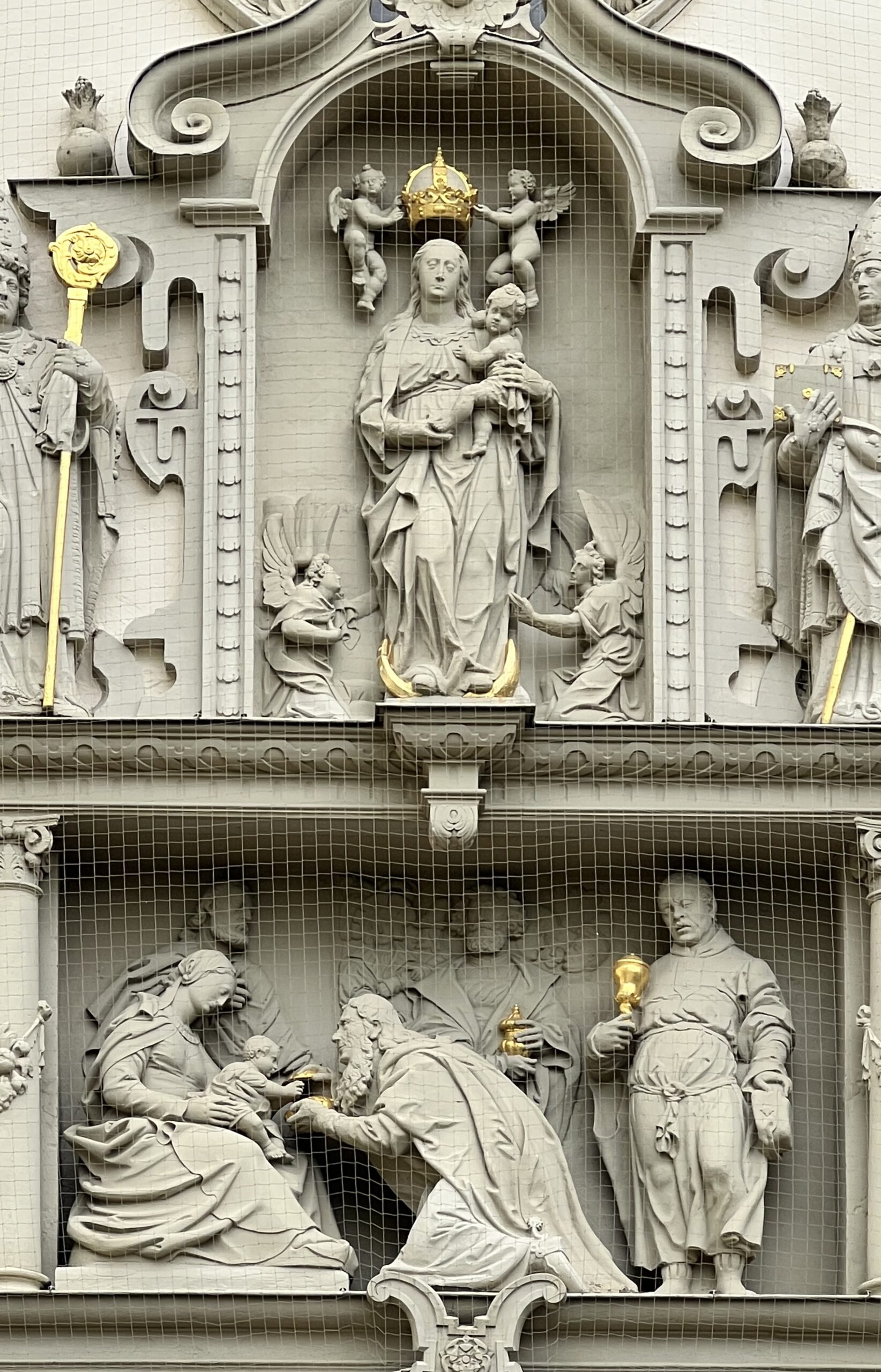
The portal of the pilgrimage church, made in 1612/13 by sculptor Michael Kern/Michael III (1580-1649). The Angel Gabriel and Mary are depicted among other figures.
On 8 September 1613, the church was consecrated by Eucharius Sang (1556-1620), Auxiliary Bishop of Würzburg (1597-1620).
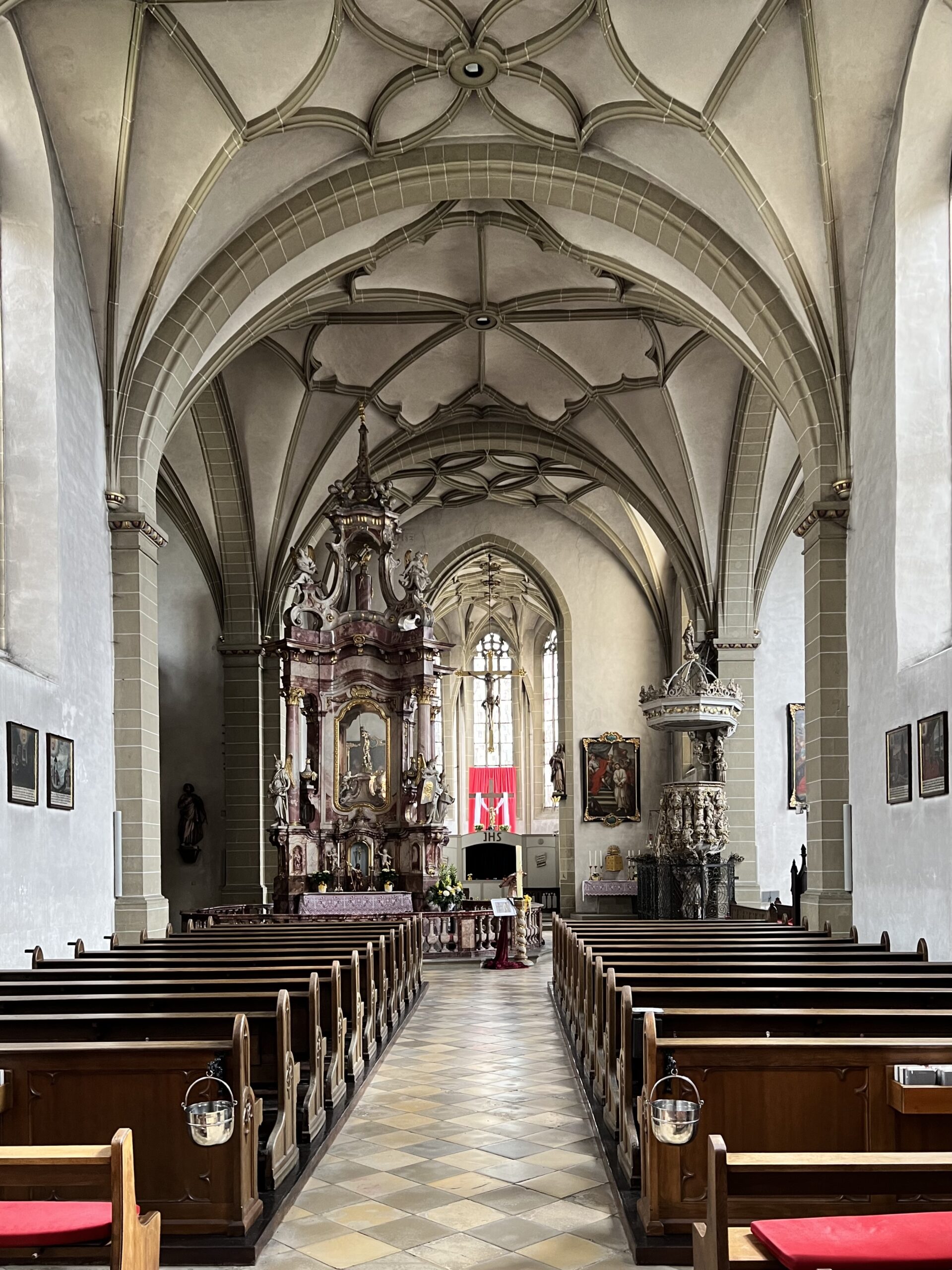
From 1616 onwards, Franciscans have been active in pilgrimages in Dettelbach, a move facilitated by Julius Echter von Mespelbrunn.
Julius Echter von Mespelbrunn commissioned the construction of the monastery. In 1620, the monastery for the Franciscans was completed and consecrated by Johann Gottfried I von Aschhausen (1575-1622), Prince-Bishop of Bamberg (1609-1622) and of Würzburg (1617-1622). The pilgrimage church had then become a monastery church.
During the Thirty Years' War (1618-1648), Swedish troops arrived in Dettelbach in 1631 and plundered the monastery. Monks fled, and some of them were killed. The statue of grace and the church were spared.
The Swedish soldiers are defeated at Nördlingen in 1634, and Ferdinand III (1608-1657), King of Hungary (1625-1657), King of Bohemia (1627-1657), and later Holy Roman Emperor (1637-1657), visits the pilgrimage site at Dettelbach. He presents Mary with valuable gifts as thanks for the victory over the Swedes. After the Thirty Years' War ends (1648), pilgrimages to Dettelbach experience a revival.
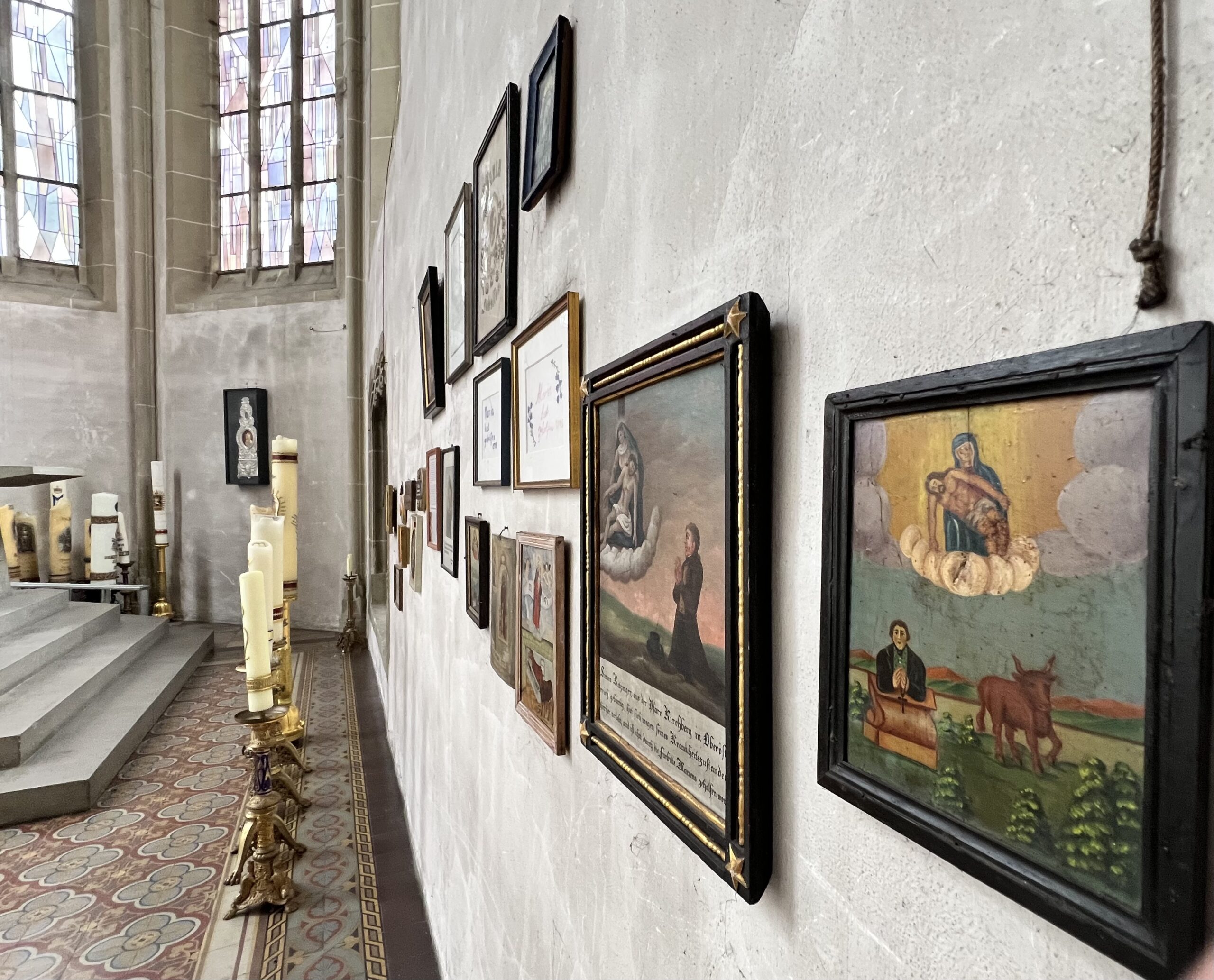
In the church hang 25 paintings of miracles, which were placed in 1660.
On 19 July 1679, the Franciscans founded the fraternity by the name of the “Fraternity of Our Lady of Sorrows”.
The Baroque altar was built between 1688 and 1690.
Johann Philipp II von Greiffenclau-Vollrath (1652-1719), Prince-Bishop of Würzburg (1699-1719), Duke of Franconia (1699-1719) gifted in 1701 a silver throne for the blessed image, a monstrance and a chalice.
During the Seven Years' War (1756-1763) in Europe, soldiers from Prussia plundered the town of Dettelbach and the monastery in 1762. Further misfortune struck in 1770 with a famine.
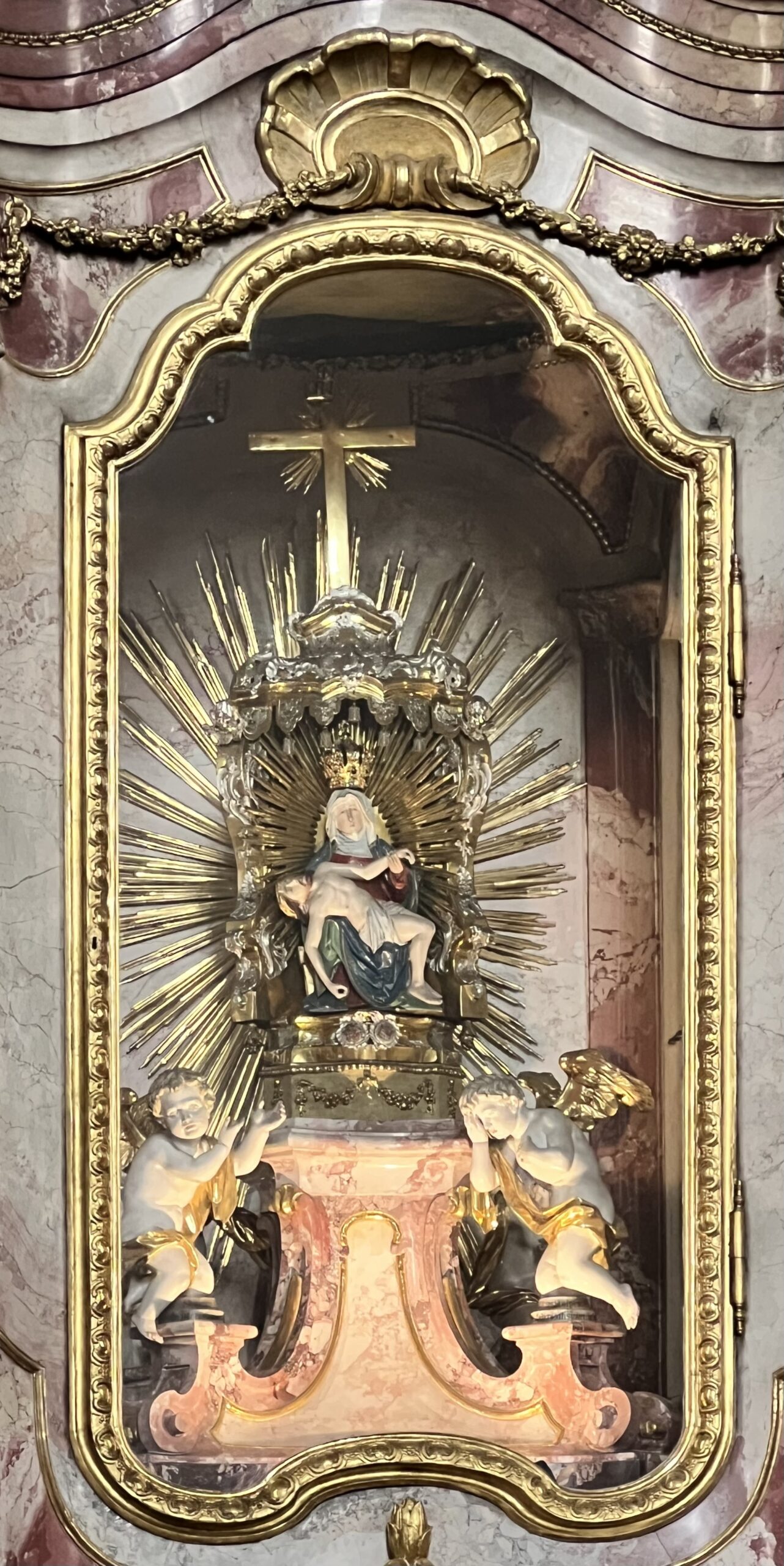
Sculptor Agostino Bossi (1740-1790) is creating a new altar of grace. Since 1778, the image of grace has been housed in a glass shrine within a Rococo altar. The altar of grace is located where the processional shrine once stood.
Due to political upheavals in 1807, Catholics faced hardship and pilgrimages nearly disappeared. It wasn't until 1826 that Ludwig von Bayern (1786-1868), King of Bavaria (1825-1848), allowed the Franciscans to continue existing and to accept new members.
During the period 1890-1895, changes took place in the church. New paintings appeared and Baroque altars were replaced by Neo-Gothic ones.
In 1892, the pilgrimage site of Dettelbach was visited by Prince Ludwig Leopold Joseph Maria Aloys Alfred (1845-1921). He later became the last King of Bavaria (1913-1918).
During the Second World War (1939-1945), there were no pilgrimages to Dettelbach. From 1945 onwards, the pilgrimage revived. Subsequently, renovations took place in stages. These were completed in a celebratory manner on 6 September 1992, with Paul-Werner Scheele (1928-2019), Bishop of Würzburg (1979-2003), in attendance.
Since 2008, there has been a pilgrimage museum.
In 2017, the Diocese of Würzburg decided that the pilgrimages would no longer be managed by the Franciscans. The parish took over the work, and an office was established at the monastery.
Pilgrimage site
The pilgrimage site includes the pilgrimage church, former Franciscan monastery, and cloister with churchyard.
The pilgrimage church is named “Maria im Sand” (Mary in the Sand). The miraculous image “Maria im Sand” is a small Pietà of the grieving Mother of God. Sometimes it was referred to as Maria in vineis, a Latin name meaning Mary in the vineyard, as there is a lot of viticulture in the surrounding area.
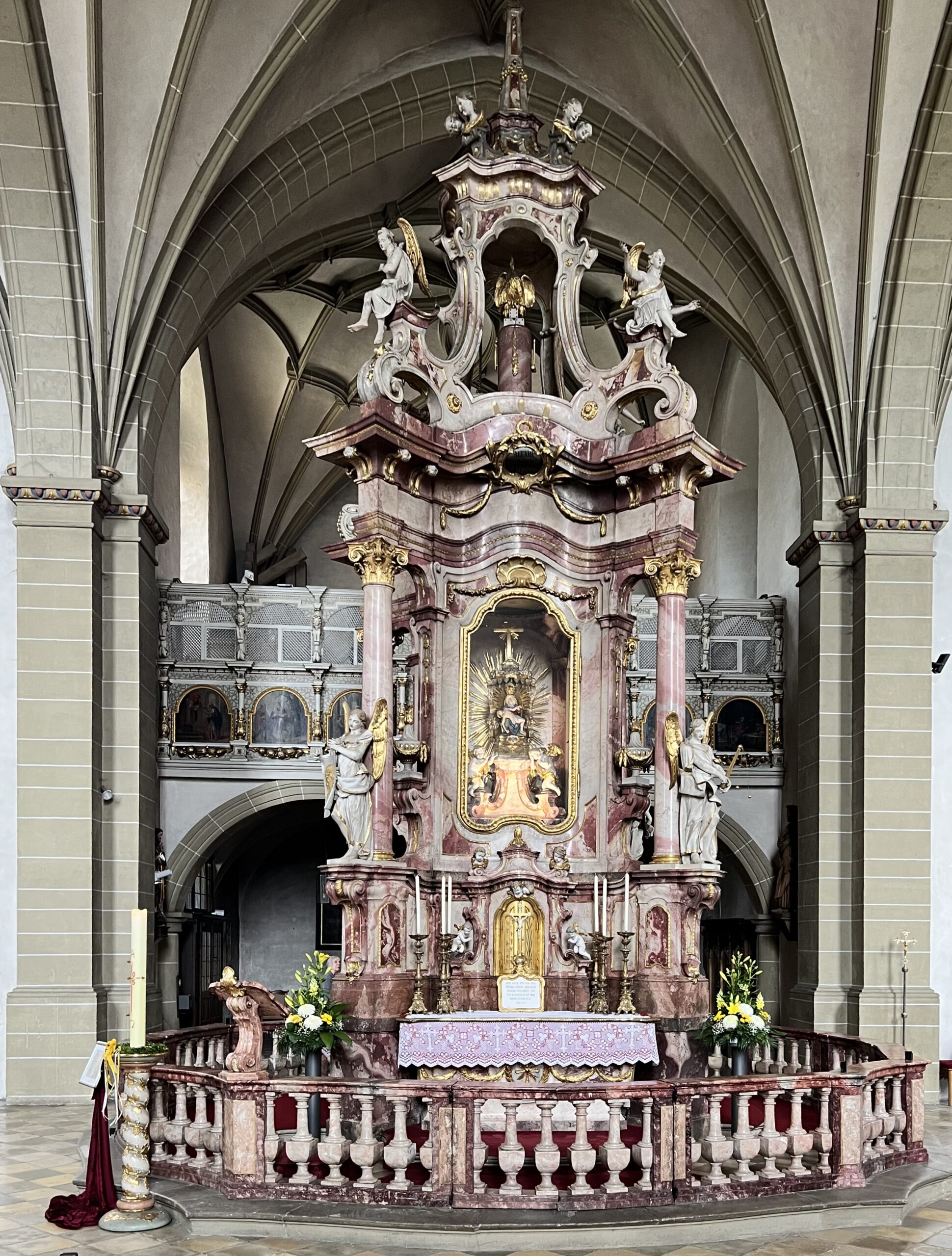
At the heart of the Pilgrimage Church stands the statue of grace. It is a small Pietà behind glass. The organ is impressive, with many scenes from the history of the Catholic faith beneath it.
The parish office is located in the monastery.
Each year, numerous groups of pilgrims visit the pilgrimage site, as well as many individual pilgrims. In total, over 10,000 pilgrims visit the church; if churchgoers are included, the number of visitors on an annual basis is a multiple of 10,000.
There are accommodation options near the pilgrimage site.
The pilgrimage site is located on the “Fränkischer Marienweg”. Along this route, you can visit chapels and churches where you can see statues, frescoes, and paintings of Mary.
The pilgrimage church is open daily.
ACCESSIBILITY
Dettelbach is located in the northwest of Bavaria, in the Kitzingen region.
The pilgrimage church “Maria im Sand” is located on the eastern outskirts of Dettelbach.
The address of the pilgrimage site is Wallfahrtsweg 18, 97337 Dettelbach.
Current information can be found at www.pfarreiengemeinschaft-dettelbach.de.
Experience
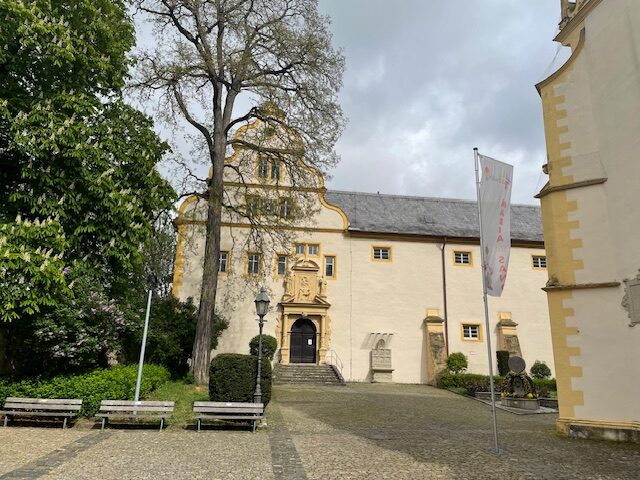
When I get to Dettelbach I go to the edge of town, because that's where the pilgrimage site of “Maria im Sand” is.
The visit to the place of pilgrimage begins with pushing open a large gate, and then I stand before the church. What a facade! The front elevation is richly decorated with beautiful statues. High above the entrance door stands Mary with her Child on her left arm. Two angels are depicted at her feet and two other angels crown the Mother of God. Below this is a depiction of the visit of the Three Wise Men. They are giving gifts to the newborn, who can already accept presents. Mother Mary and foster father Joseph are watching. To my left stands the monastery. Then I enter the pilgrimage church.
When I enter, I don't immediately have a clear view of the whole. You have to walk further to reach a large altar, on which the miraculous image stands. This forms the centrepiece of the pilgrimage church. The miraculous image is the vesper image with the sorrowful Mother of God. Mary is placed in a glass shrine. She has her dead Son on her lap. This expresses suffering. This draws me to Mary. With Her, I can turn to her with what is troubling me. The image is small and measures a good 40 cm. Many golden rays emanate from this effigy and two angels seem to be keeping watch.
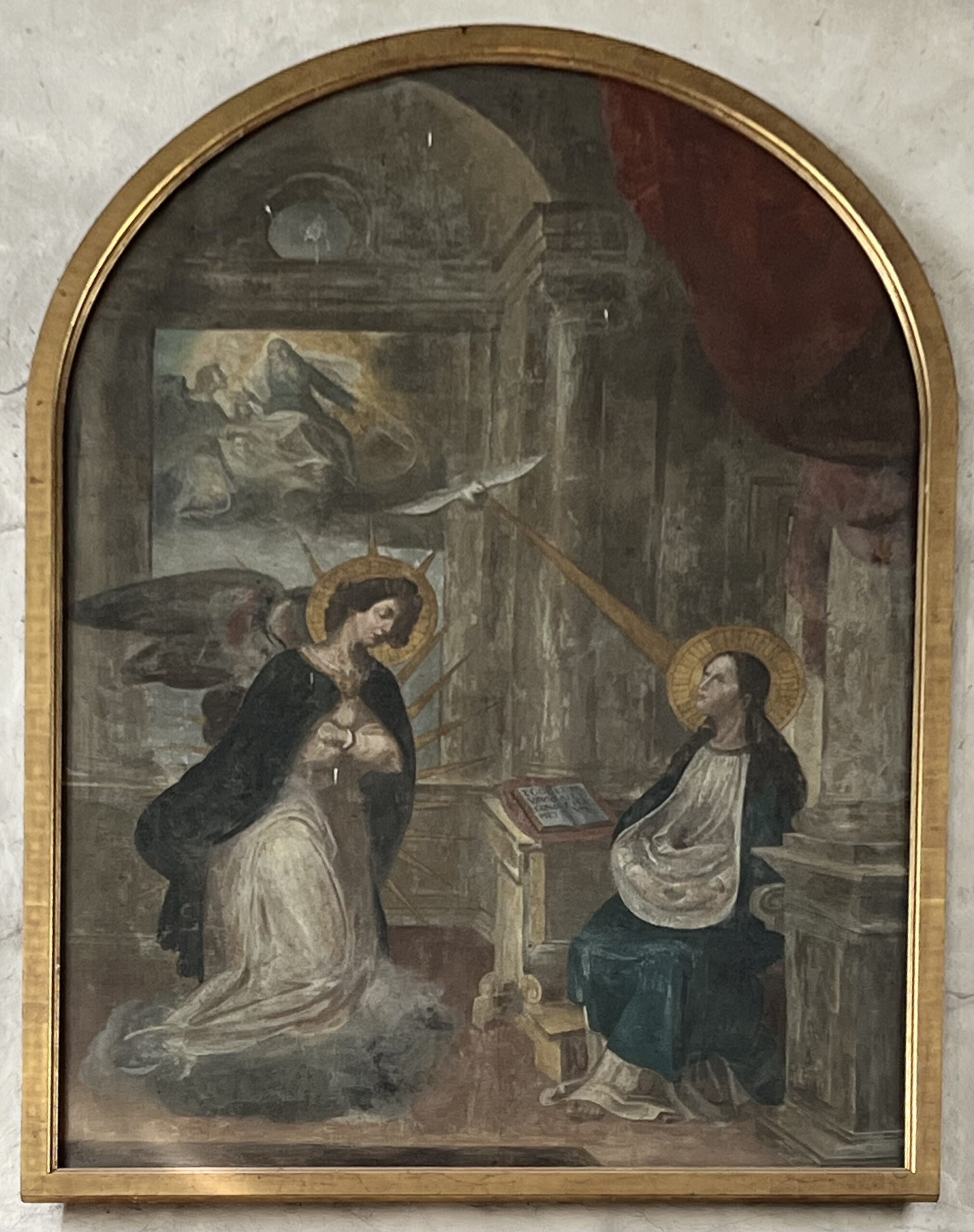
In the pilgrimage church, I see at least 20 depictions of miraculous events; many ex-votos hang there, most of which are paintings. I find a painting depicting the Angel Gabriel visiting Mary very beautiful, and then I feel it's an appropriate moment to pray.
After visiting the church, I want to visit the monastery, but unfortunately, it is closed. Next, it's time for a tour, and behind the church, I come to a large cross. Behind that lies the graveyard, where many rest eternally.
Finally, I visit the hotel/restaurant opposite the pilgrimage site and choose a table. Then the images of my visit return to my mind. What a rich place this is, full of history and experiences.
Environment
Departing from Würzburg for Dettelbach involves travelling 20 km eastwards.
The distance from romantic Rothenburg ob der Tauber to Dettelbach is 60 km in a northerly direction.
After visiting the pilgrimage site of Heroldsbach, visiting the Marian shrine in Dettelbach means travelling 60 km to the west.
Going from Nördlingen to arrive in Dettelbach means going 132 km north.
~~~

 Nederlands
  English (UK)
  Deutsch
  Français