~~~
History
In Porzus, near Attimis, Mary appears three times to Teresa Dush (11 September 1845 – 16 August 1870), specifically on 8, 27 and 30 September 1855. Teresa's poor parents had to wait a long time for their daughter's arrival, as Teresa was only born after 18 years of marriage. The birth of Teresa is seen as a great gift from God. Teresa has fragile health, but she does not complain and works at home on the farm. When Teresa is 9 years old, she receives catechism lessons from the priest.
In the year 1855, the cholera epidemic raged in the region of Friuli, where Porzus is located, and Mary appeared three times in the small village of Porzus to the young girl Teresa Dush.
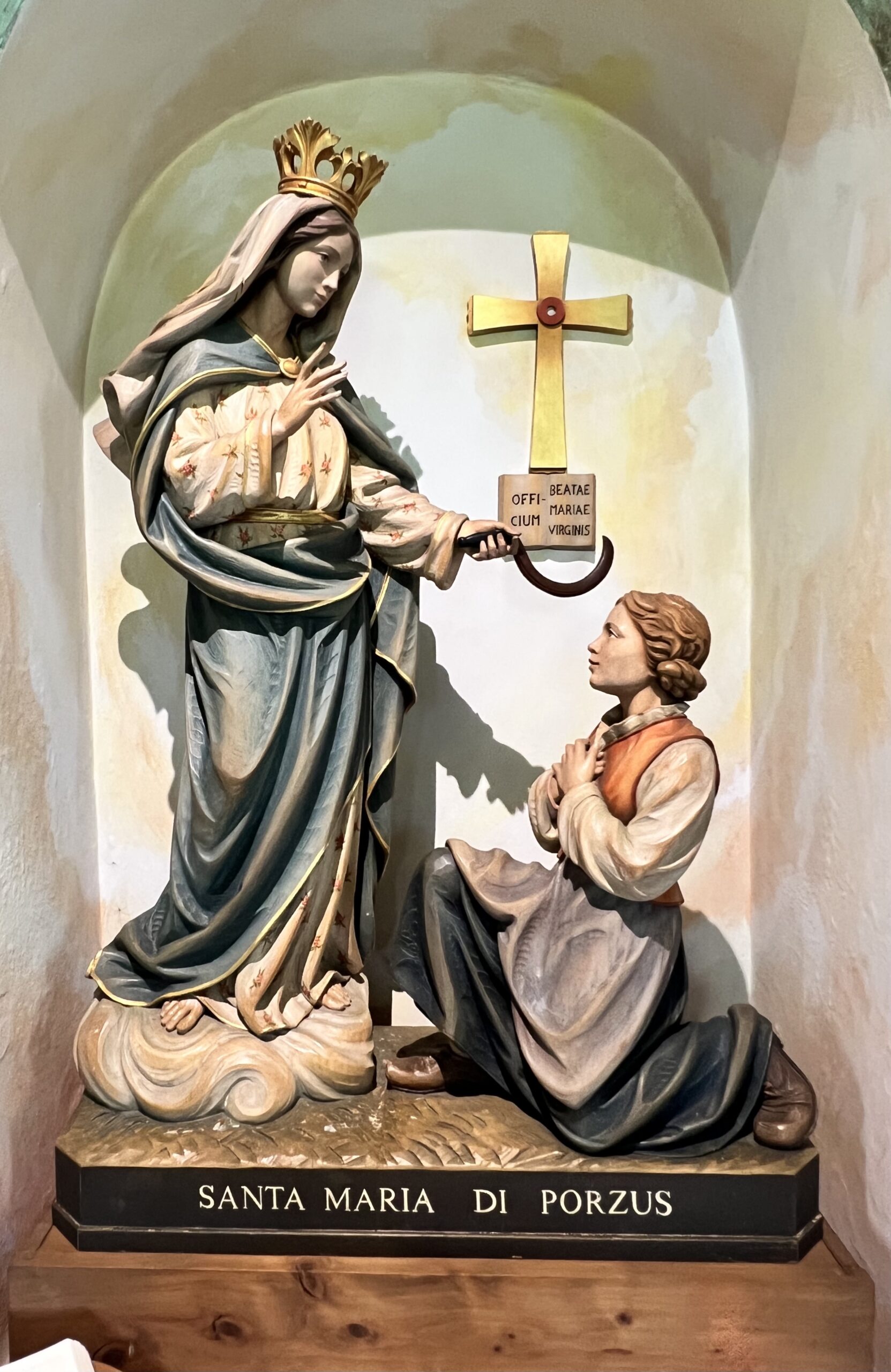
On Saturday 8 September 1855, the first apparition of Mary to Teresa Dush took place. This is the feast day of the Nativity of Mary. Teresa was almost 10 years old and was working, mowing grass meant for the animals of her parents' farm. This task was assigned to Teresa by her mother. Work was done on this Marian feast day because the following day was a Sunday. According to their Catholic faith, Sunday was not a working day, but a day for God. Mary disagreed with this, and this was expressed during the apparition. Teresa used a sickle to mow. While working, she suddenly saw a beautiful lady who said in a gentle voice that Teresa should not be working on this holy day. Mary asked for Teresa’s sickle, cut some grass, and gave it to the girl. She then returned the sickle to the child. Mary said that feast days should also be sanctified. She instructed Teresa to tell everyone that the name of God should be spoken with reverence and not to be mocked, because mockery wounds the heart of Mary. People were also told by Teresa to hold a penance procession. One procession was to start from Attimis, 4 kilometres away, and another from Forame, 5 kilometres from Teresa's village, both proceeding to the church of Porzus. Mary added that praying to her meant her grace would remain and grow. She concluded by saying that poverty, cholera, and diseases of fruit and potatoes would only disappear if people mended their ways.
Teresa tells her parents about the encounter with Maria, and afterwards tells other people in the village. Most of them do not believe her. The people say that Our Lady must show a clearer sign. Notably, a week later the cholera has disappeared, and the villagers' normal lives resume.
The second apparition of Mary to Teresa Dush is on Thursday, 27th September 1855. Teresa sees Mary in the church of Porzus. The apparition stands next to the altar, calls Teresa to her, and tells her a secret that she holds in her heart.
On Sunday, 30 September 1855, the third apparition takes place. Teresa is in church, and Maria appears again next to the altar. In the church, people are praying the rosary, as they always do on a Sunday. The Mother of God wears a dress with roses. Maria calls out to Teresa, and the churchgoers see her in a long conversation, but they do not see Maria. Our Lady draws a small white cross on the back of her left hand, which emits a golden ray of light. Teresa leaves the church in ecstasy. She later says that Maria accompanies her home and then ascends to heaven. The people leave the church, follow Teresa, but do not see Maria. They notice the drawn cross on Teresa's hand and see this as a clear sign from Maria. The cross does not disappear and becomes more radiant.
The remarkable events at Teresa's are becoming known in the neighbourhood, and the canons of the Duchy of Cividale dei Friuli bring Teresa to the Ursulines of the city of Udine.
After the apparitions, people from the village notice an unusual phenomenon at the site of the first apparition. The meadow is always in bloom, and in winter, when it snows, the white precipitation melts at that spot before the white blanket disappears elsewhere.
Teresa Dush will lead a religious, devotional, and service-oriented life. At the Ursuline convent, Teresa learns to speak, read, and write Italian. She ends up at an orphanage run by Father Luigi Scrosoppi (1804-1884), who later becomes the patron saint of footballers. Teresa is a pupil there from 1856 to 1860. In the period 1860-1864, Teresa assists in the wardrobe, kitchen, and with recreational activities.
Teresa Dush has a new vision of Mary. This takes place when she is going through a difficult period in her life. Mary points out the steps she should take. on 7 August 1864, Teresa joins the aspirant sisters. On 19 March 1867, she becomes a novice and on 14 September 1868, a sister. Luigi Scrosoppi gives her the name Sister Maria Osanna.
Teresa Dush, Sister Maria Osanna, is staying for her novitiate for some time in Orzano, which lies east of Udine, and Cormons, southeast of Udine. Father Luigi Scrosoppi receives the church of the Rosa Mystica pilgrimage site in Cormons as a gift from Franz Joseph I (1830-1916), Emperor of Austria (1848-1916).
Her health remained a concern, and in early 1870, Teresa contracted tuberculosis and suffered greatly from her lungs. The cross drawn by Maria on her hand turned red, a sign of her suffering. Teresa returned to the convent in Udine, where she died on 16 August 1870. When Teresa died, the cross on her hand was white, and she was not yet 25 years old. Her body was laid out in the church of the convent. The nuns and the novices could then see Maria's blessed sign on the hand of their sister nun.
The Congregation of the Sisters of Providence (Congregazione delle Suore della Provvidenza) chooses Teresa (Sister Maria Osanna) as the patron saint of the novitiate. She is invoked there during prayer.
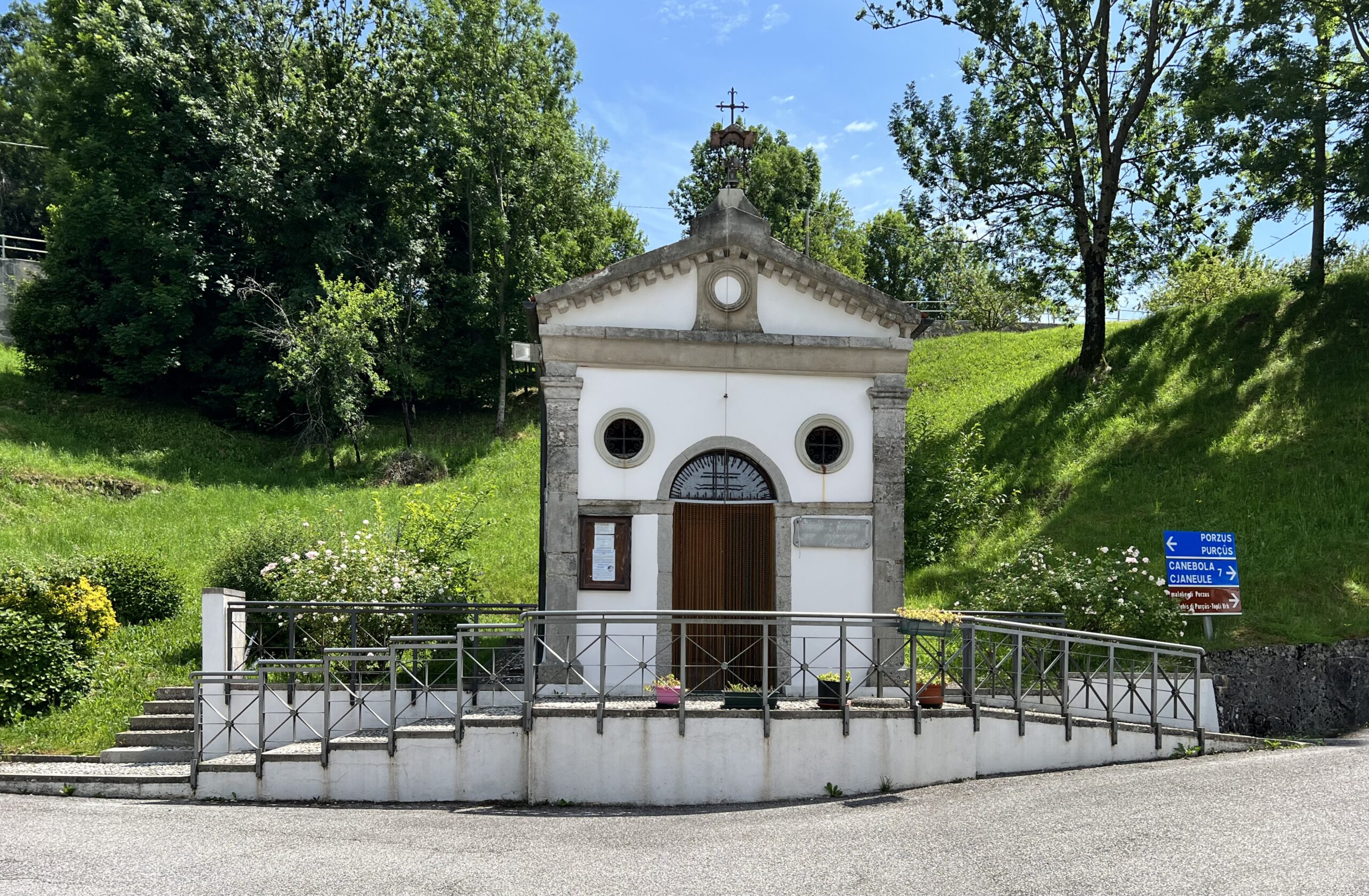
In 1885, the residents of Porzus decided to build a small chapel.
In 1886, an image of the apparition in the small chapel appeared with the message above it: “Keep the holy days holy – do not blaspheme”.
An important visit to the pilgrimage chapel at Porzus was made in 1992 by Alfredo Battisti (1925-2012), Archbishop of Udine (1972-2000). The high-ranking clergyman states that the events of 1855 are authentic. He confirms the words of Mary, which are still relevant today, namely to sanctify holidays, not to engage in blasphemy, and to do penance.
In Porzus, Maria underscores respect for God, the observance of Sundays, and the major feast days, including those of Hers.
Pilgrimage site
The pilgrimage church is located at an altitude of approximately 700 metres above sea level. Porzus belongs to the parish of Attimis and the archdiocese of Udine. The church stands in the middle of the small village.
The chapel, with its focus on the apparitions, is located lower down the hill.
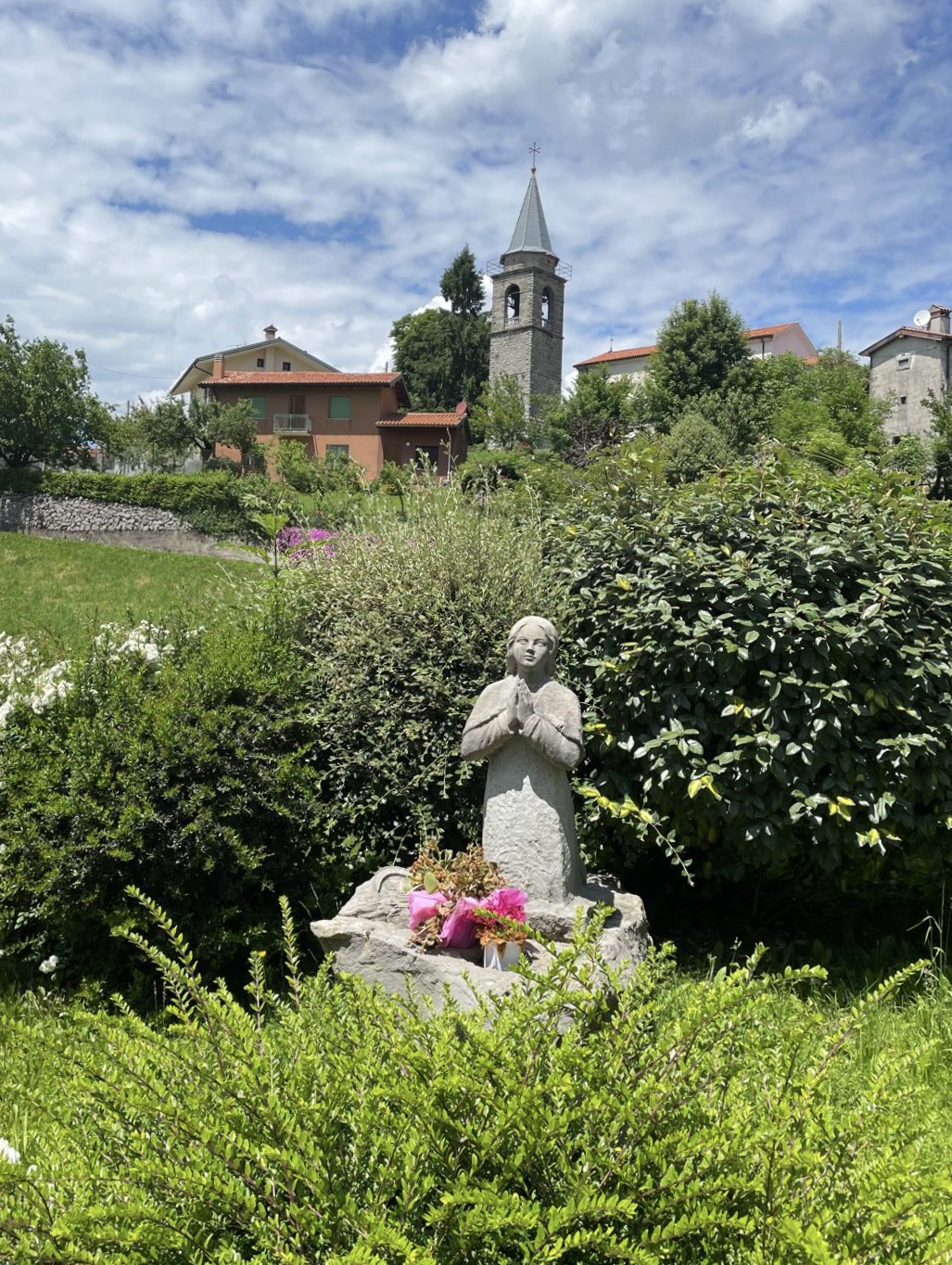
Between the village church and the pilgrimage chapel stands a likeness of the visionary Teresa Dush. The statuette stands in the grass by bushes and has a view of the pilgrimage chapel. Flowers are blooming by this statuette.
When praying to Sister Maria Osanna, the text is:
“Our dear Maria Osanna,
now you can enjoy at your leisure
and amuse yourself
in the presence of your and our most holy Mother Mary,
Pray for us all and obtain for us
a fervent love for Maria combined with a true
and a worthy imitation of her virtues.
Amen.”
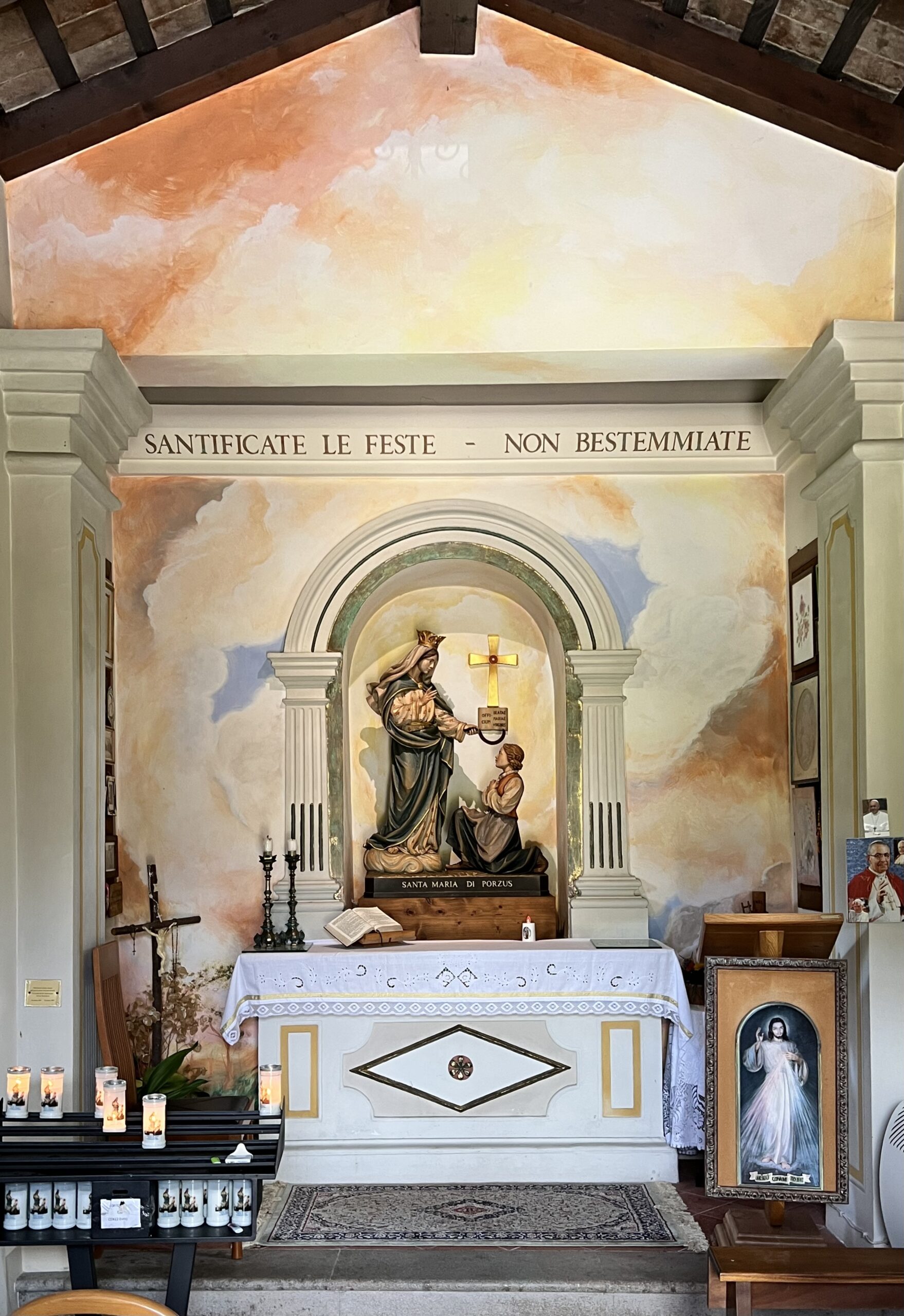
The image of Mary and the young Teresa Duŝ is depicted in the chapel. This is the place where the first apparition took place.
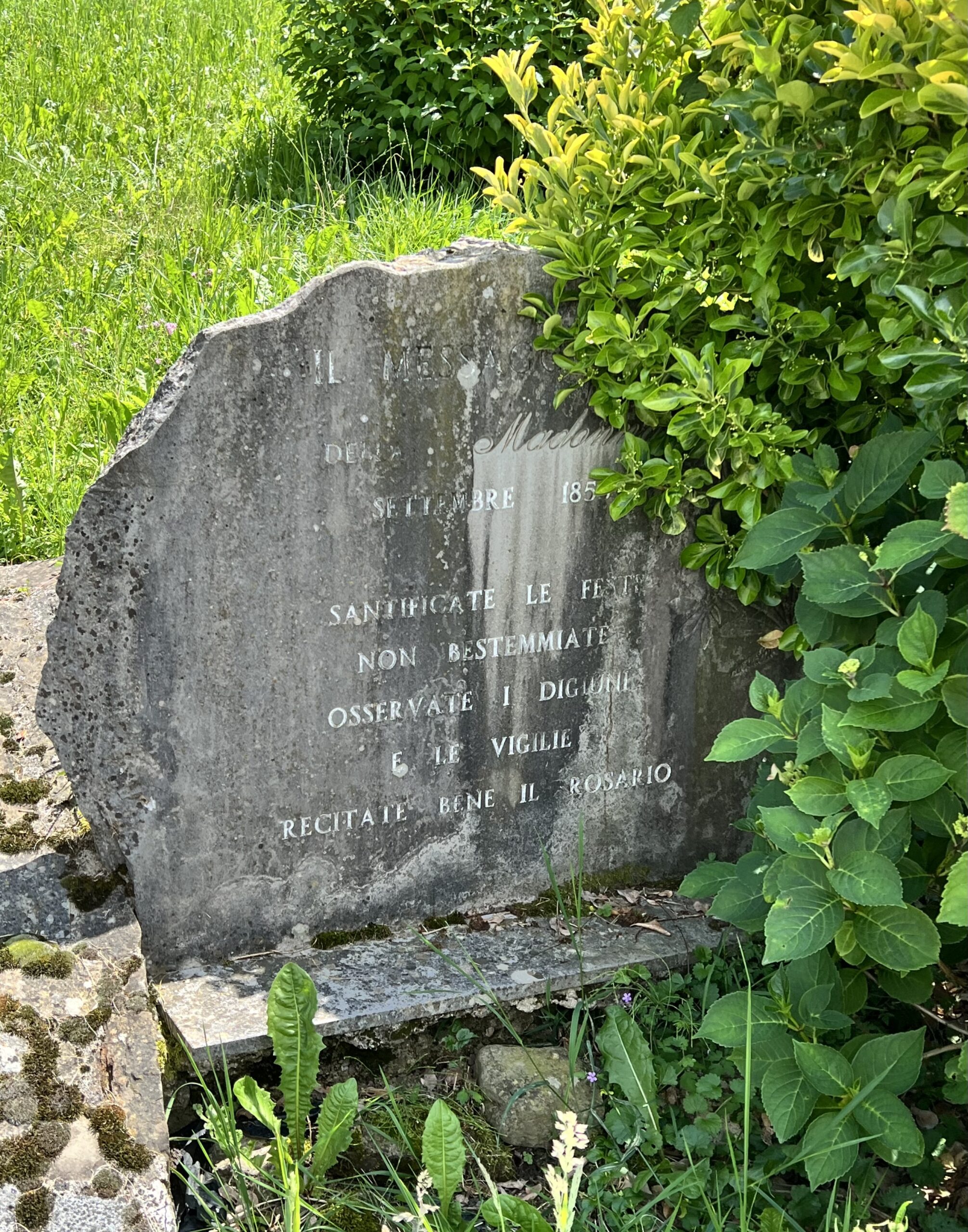
Next to the chapel is a large stone stating that in 1855 Mary appeared here to Teresa Dush. The Italian text also mentions: to sanctify faith, to keep God in mind, and to continue praying the rosary.
Near the chapel lies a path that leads to the 972-metre high mountain Topli Uorh. There, on 7 February 1945, during the Second World War (1939-1945), one of the greatest tragedies took place in the battle between Yugoslav partisans and Nazis.
ACCESSIBILITY
The small sanctuary lies in the northeast of Italy, near Udine, close to the border with Slovenia.
Address: Via Porzus 10, 33040 Porzus (Attimis, UD).
Information sources are www.porzus.net and www.porzus.it.
Experience
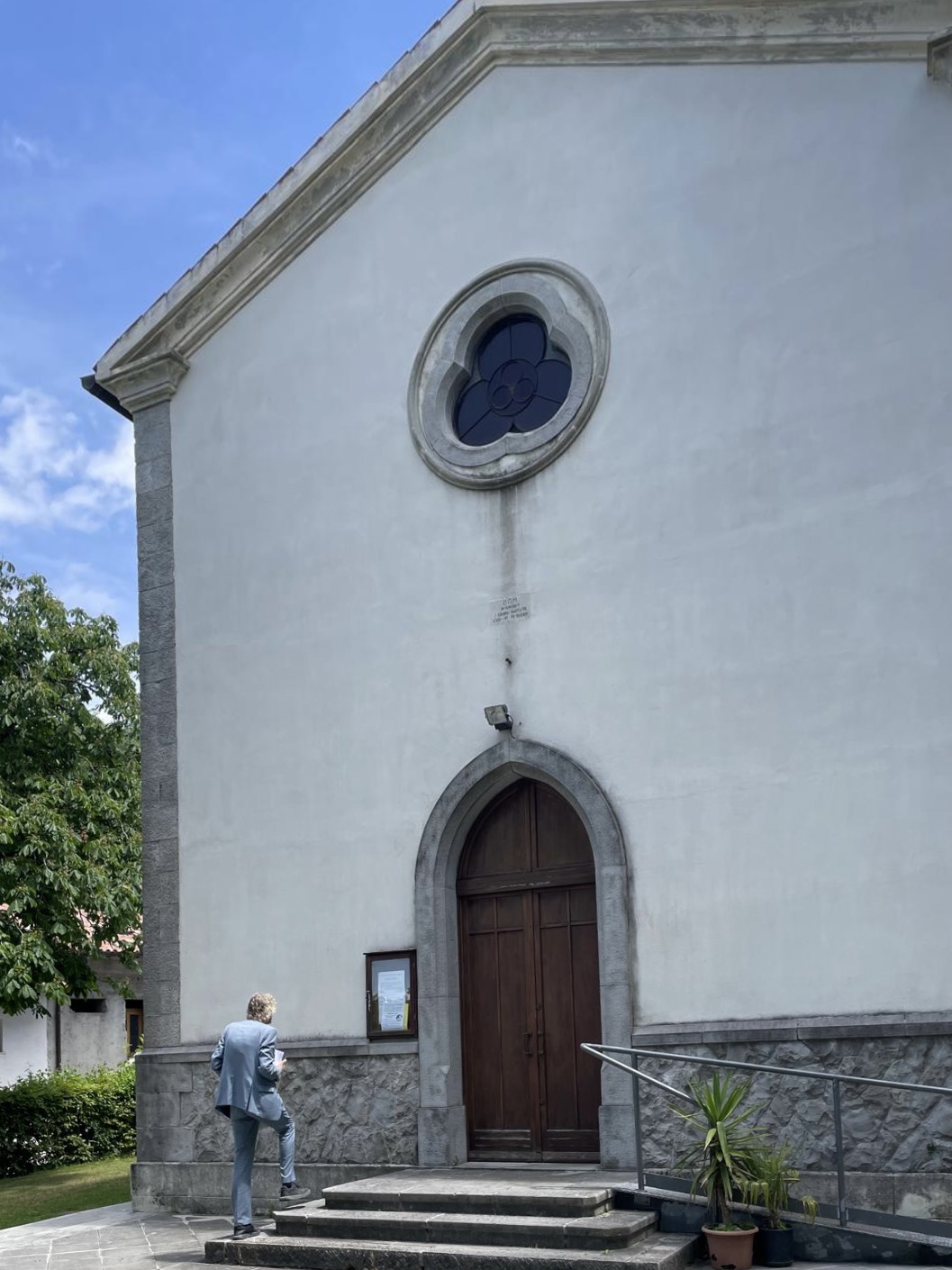
Upon arriving in Porzus, I first want to go into the church. Unfortunately, that visit isn't going to happen, as the building is hermetically sealed. Next, I ask a village resident, who lives near the church. The kind woman directs me to the pilgrimage chapel, which is located a little lower down the hill. When I stand before the pilgrimage chapel, I notice how beautiful this little shrine looks and how well it's maintained. Look, you can see the love in that!
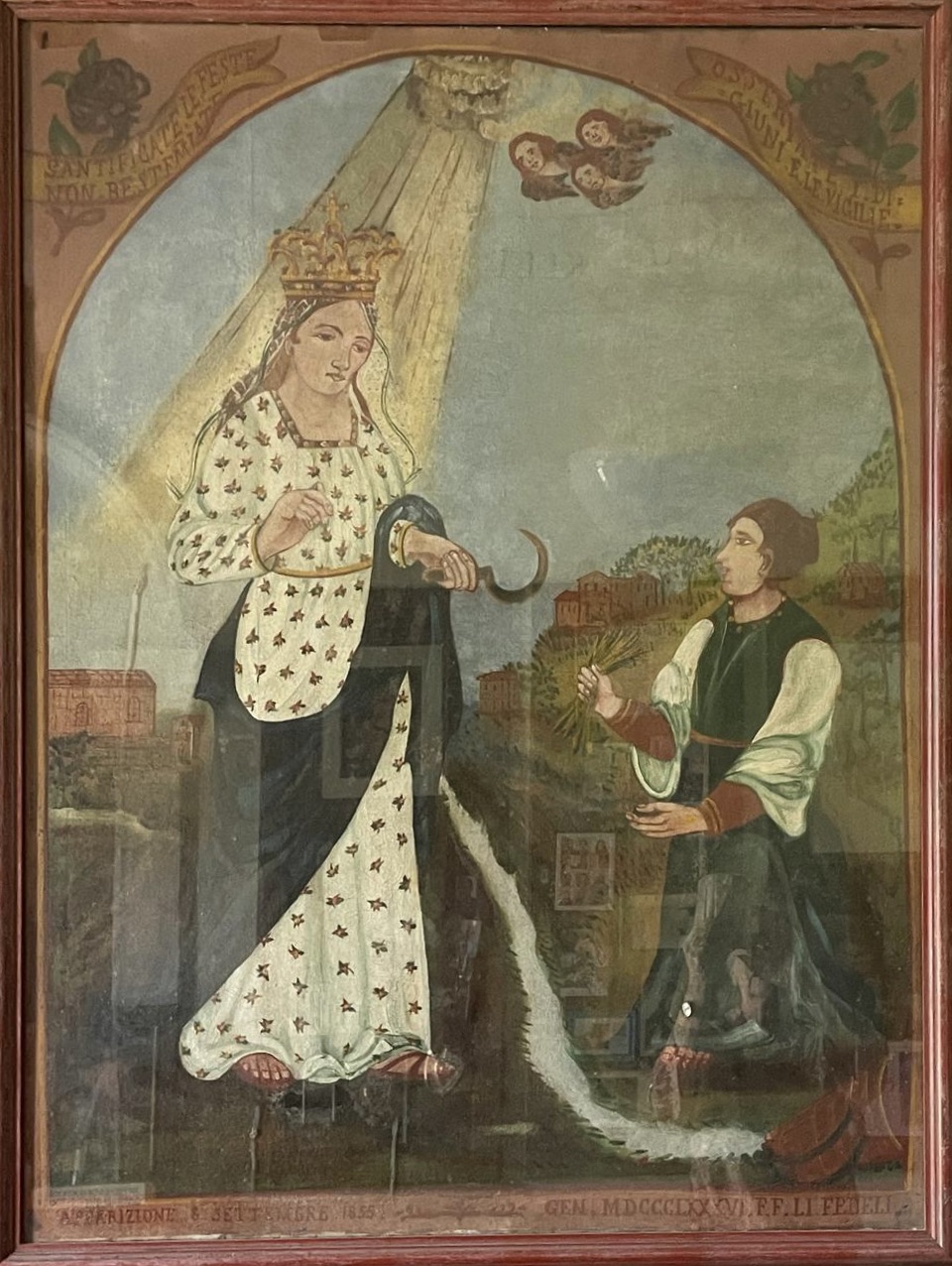
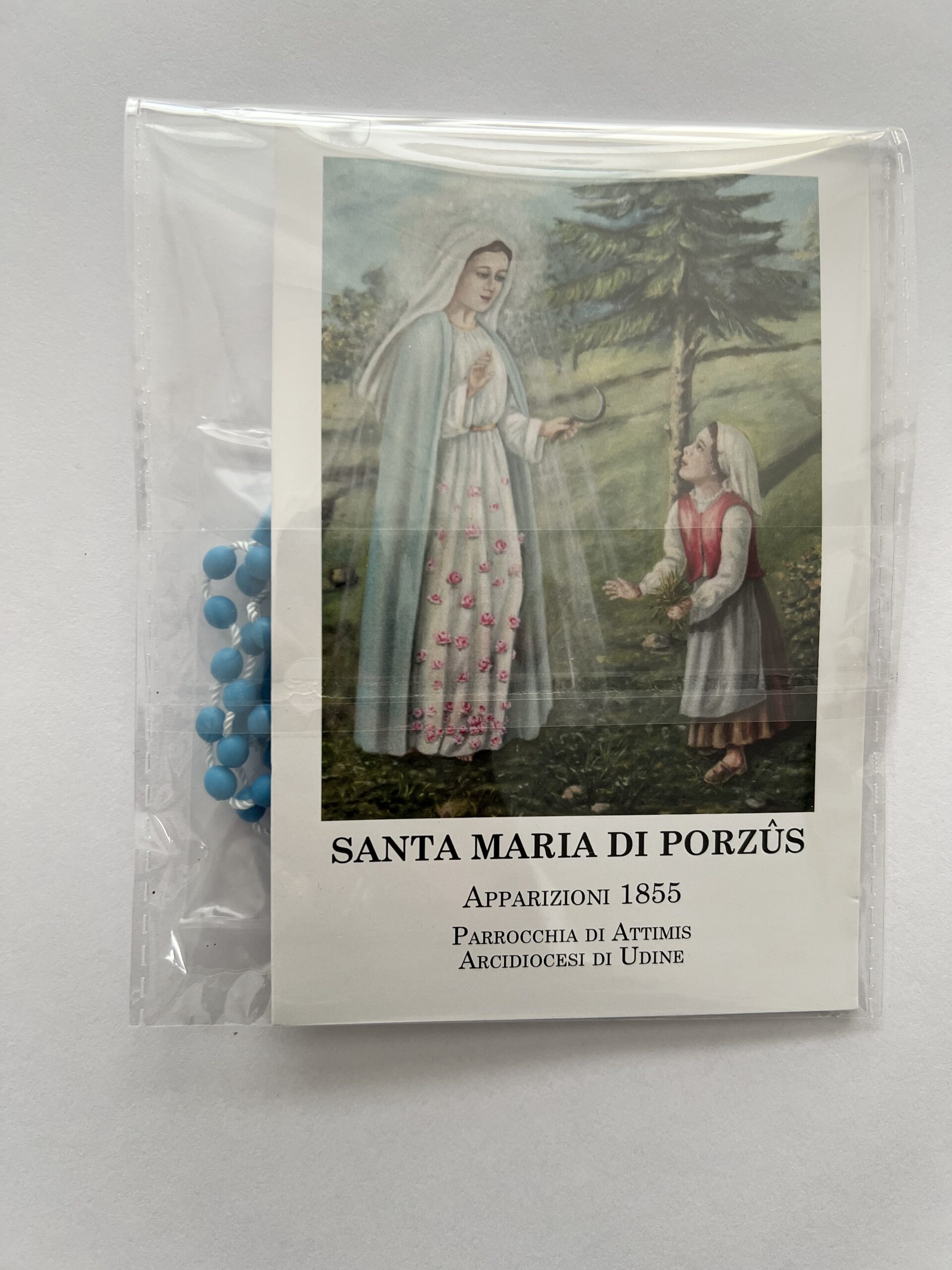
In the pilgrimage chapel, I see a painting depicting the first apparition in 1855. Mary is holding a sickle, and the girl Teresa is looking at Her. What a lovely scene!
Next, I will stand before the altar, above which stands the devotional image with Mary and Teresa. What a beautiful depiction this is. So colourful and so captivating! A good opportunity to pray, occurs to me. Above the devotional image with the seer Teresa, I see the text: “keep the holidays holy – do not blaspheme”.
In the chapel, I see a card lying on the floor with information about the apparitions and a prayer. Part of the text of the prayer reads:
“Prayer to Our Lady of the Chapel.
O Queen of heaven and earth.
You who appear to little Teresa,
the Christian people to
to put the Lord's will into practice,
help us to always do his will, to keep the feasts
and to hallow his blessed name
and to perform works of penitence and goodness.”
In the pilgrimage chapel, there is also a depiction of Our Lady of Lourdes. It is a large statue with the famous rosary.
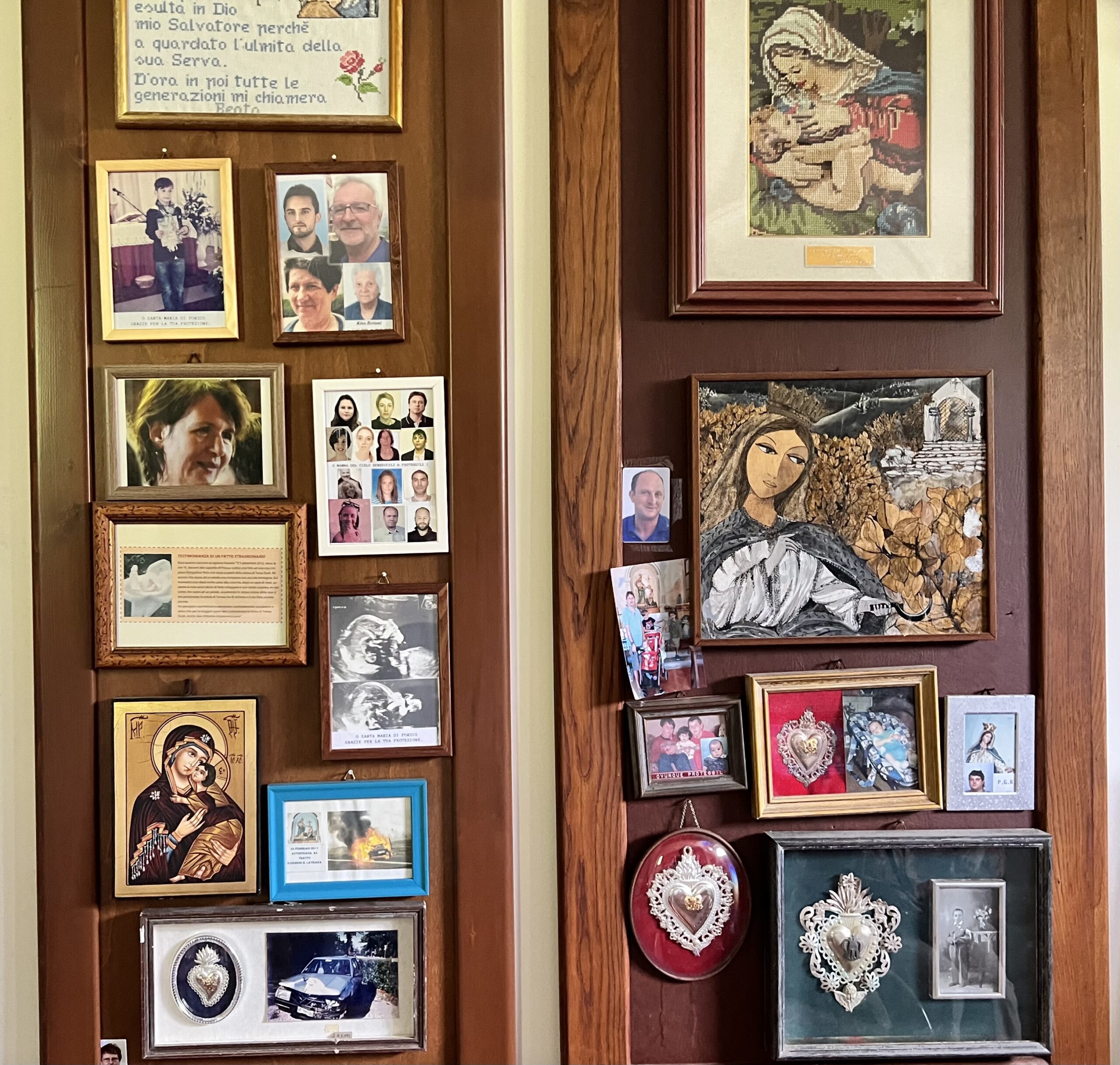
In the chapel, I also see a number of ex-votos and these tributes enrich this small sanctuary.
In the back of the chapel, some mementos of the 1855 apparitions are for sale. I gratefully take advantage of this and purchase a number of bags containing a rosary and some information about the apparitions in Italian. I can translate the text, and when I hand out these souvenirs upon returning home, I will explain what the Italian text says.
I leave the pilgrimage chapel, see the statue with Teresa across the road, turn around, look at the chapel, and a loving feeling for Teresa and Mary comes over me. What a beautiful gift to experience this. Goodbye Teresa, goodbye Mary, ...
Environment
The hilly surroundings offer many opportunities to explore the region. This can be done on foot, and certainly also by bicycle.
From the village of Attimis to the pilgrimage site of Porzus is 4 km heading east.
From the nearby village of Forame to Porzus, it is a 5 km move to the south.
Departing from Cividale del Friuli to head for Porzus implies travelling 22 km to the north-west.
From the large city of Udine to the pilgrimage site at Porzus means travelling 25 km in a northerly direction.
Povoletto is not far from Porzus. It is then a 17 km drive north to reach the pilgrimage chapel at Porzus.
From the pilgrimage site of Lussari, near Tarvisio, it's 97 km south to reach the pilgrimage chapel in Porzus.
~~~

 Nederlands
  English (UK)
  Deutsch
  Français