~~~
History
The first mention of a church in Tuntenhausen dates from around the year 1000. The hamlet was then written as “Tontinhusa” and had a small chapel. In 1226, a church in the village is mentioned again.
The devotional image is a Romanesque Madonna and was carved in 1334 by order of a Bavarian Duke.
In 1441, the first miracle occurred in Tuntenhausen. A woman had been suffering from severe pain for 11 years and had a bloated abdomen. In her sleep, she was visited by Mary. The woman was asked to go to the church in Tuntenhausen on three consecutive Saturdays. The sick woman donated so much yarn that a new altar cloth could be made with it. After her visits to the church, her pains and the abdominal tumour disappeared. The story of an incurably ill woman who suddenly recovered spread. This led to a considerable increase in the number of pilgrims. In 1470/1480, the too-small church was replaced by a larger, late Gothic building.
Miracle books record many miracles from the period 1506-1738.
In 1513-1533 the double tower with high spires was built.
In 1548 there was a fire in the church and the complex was rebuilt. The statue of grace was lost and a new effigy was carved from wood.
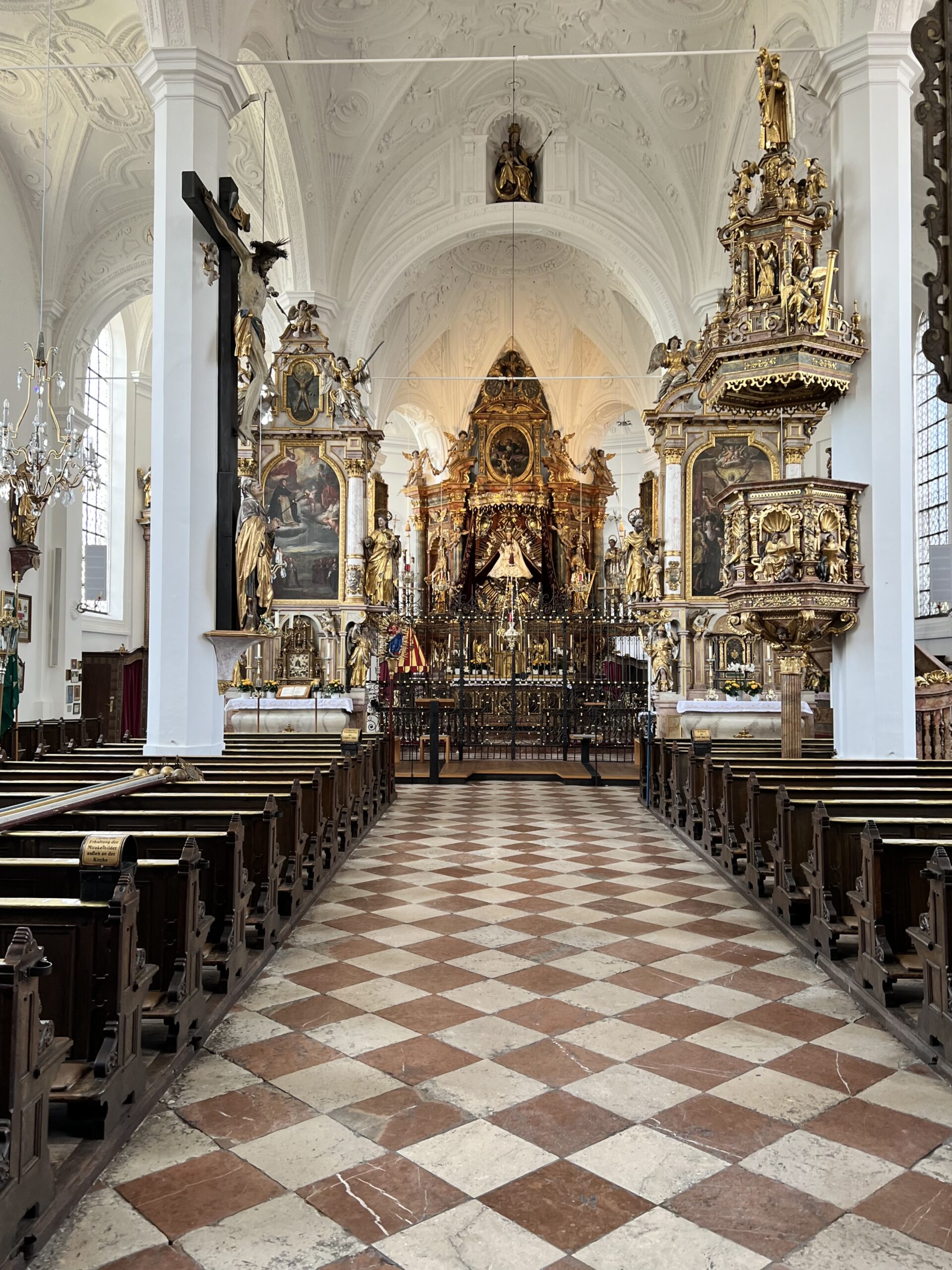
As the number of pilgrims continues to grow, a new church is being built. This is happening under the reign of Maximilian I of Bavaria (1573-1651), Duke of Bavaria (1597-1623), Prince-elector (chosen ruler) of Bavaria (1623-1651) and Prince-elector of the Holy Roman Empire (1623-1648). The building plans are by Veit Schmidt (c. 1600-1648). Construction took place during the years 1628-1629. The consecration occurred on 1 September 1630. The new building is a hall church measuring 32 metres in length. The high altar with the devotional image is a gift from Maximilian I and his wife Elisabeth of Lorraine (1594-1635) in the year 1630, who visited the pilgrimage church on multiple occasions. The image was created in 1534. The high altar was made under the direction of Heinrich Schön the Elder (d. 1640). Franz Kessler (c. 1630-1717), a goldsmith from Munich, created a triumphal arch. Mary is depicted as Queen of Heaven. Her Child wears a small crown.
The Rosary Confraternity was founded in 1624.
The devotional image, which has always been robed, is adorned with a canopy, a silver halo, a cloud-shaped base and angels. The silverware was made by Johann Friedrich Canzler (1710-1782) around 1750. The robes of Mary and Child are carved in a semi-circle and fastened at the back with ribbons.
In 1803, pilgrimages drastically declined and church treasures were seized by anti-Catholic rulers. The consequence of this is that from the beginning of the 19th century, pilgrimages diminished due to the effects of government-imposed secularisation. In 1816, a famine afflicted the region, and a year later, pilgrimages were once again permitted.
In 1869, in Tuntenhausen, the “Bayerisch-Patriotische Bauerverein” (Bavarian-Patriotic Farmers' Association) was founded to oppose the government. The union was dissolved in 1933. As a successor to the dissolved farmers' association, the Catholic Men's Association Tuntenhausen was established in 1945, which, in addition to pilgrimages, sought to connect religion and politics.
The crypt chapel of the Arco-Zinneberg tombs was built in 1876.
In 1890, restoration work was carried out on the two towers.
Renovations to the church took place in the years 1937-1939.
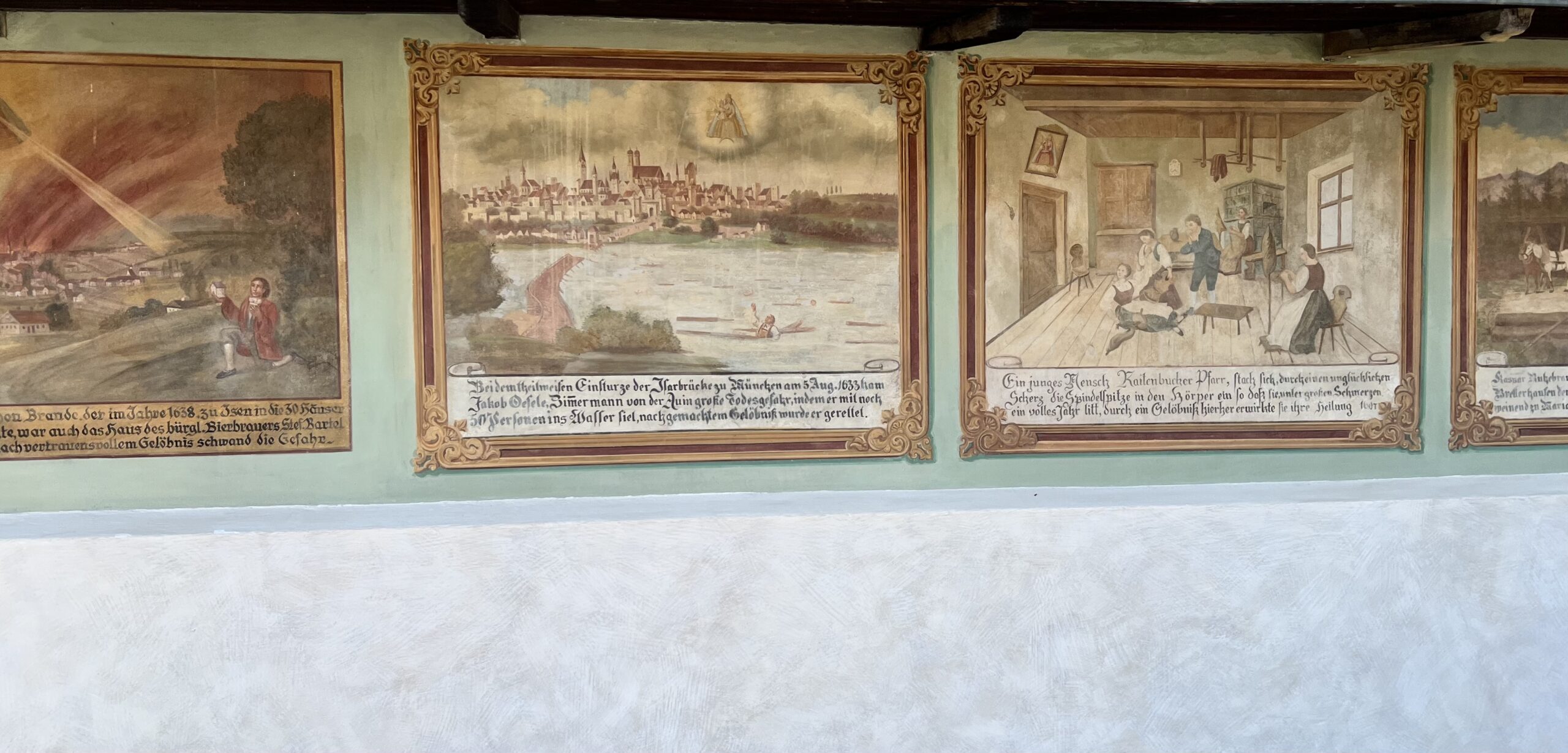
The paintings with images of prayers on the outer walls of the basilica were renovated and supplemented in 1940-1941 by Waldemar Kolmsberger the Younger (1881-1954) from Munich.
In 1942, the church was elevated to the status of a basilica by Pius XII, Pope from 1939-1958 and born Eugenio Maria Giuseppe Giovanni Pacelli (1876-1958).
The pilgrimage church has been restored several times over the centuries, such as in the period 2016-2020 to clean images of miracles from overpainting. After extensive restoration and the installation of a new organ, the basilica was festively reopened on November 24, 2019.
Pilgrimage site
The pilgrimage church is a basilica, located on a hill in the centre of the village and is dedicated to the Assumption of Mary. The pilgrimage site is one of the oldest and best-known Marian churches in Bavaria. Tuntenhausen belongs to the Archdiocese of Munich-Freising.
On the exterior of the basilica, painted prayers are affixed to the walls. This was begun in the 17th century and has been renovated several times since. The oldest image is bipartite, with a woman in bed on the left, where Mary appears in a dream, and on the right, the same woman dressed in her Sunday best standing before the devotional image. This depicts the first miracle from 1441, and the painting dates from around 1740. The text below the image tells the story of the healing.
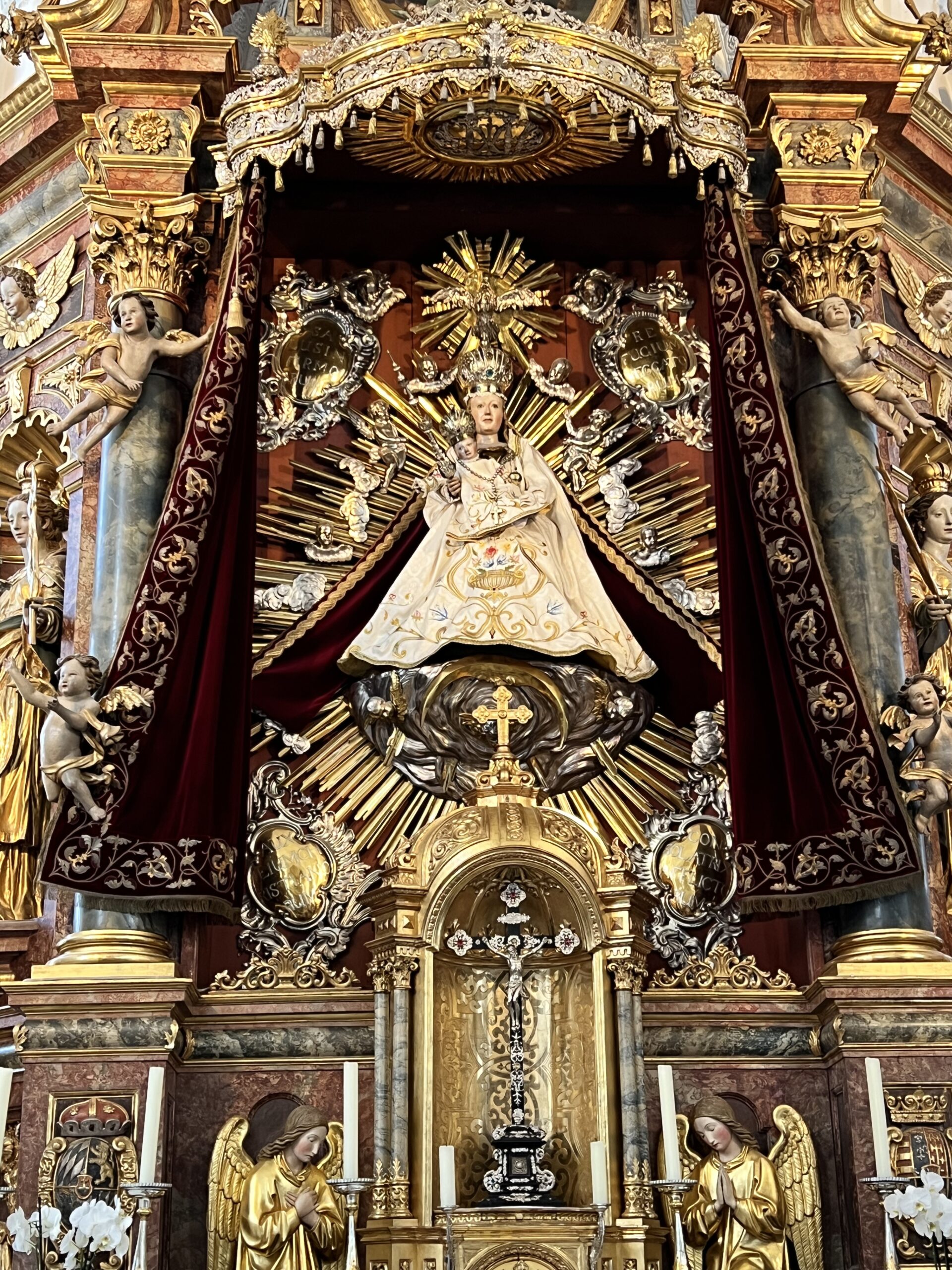
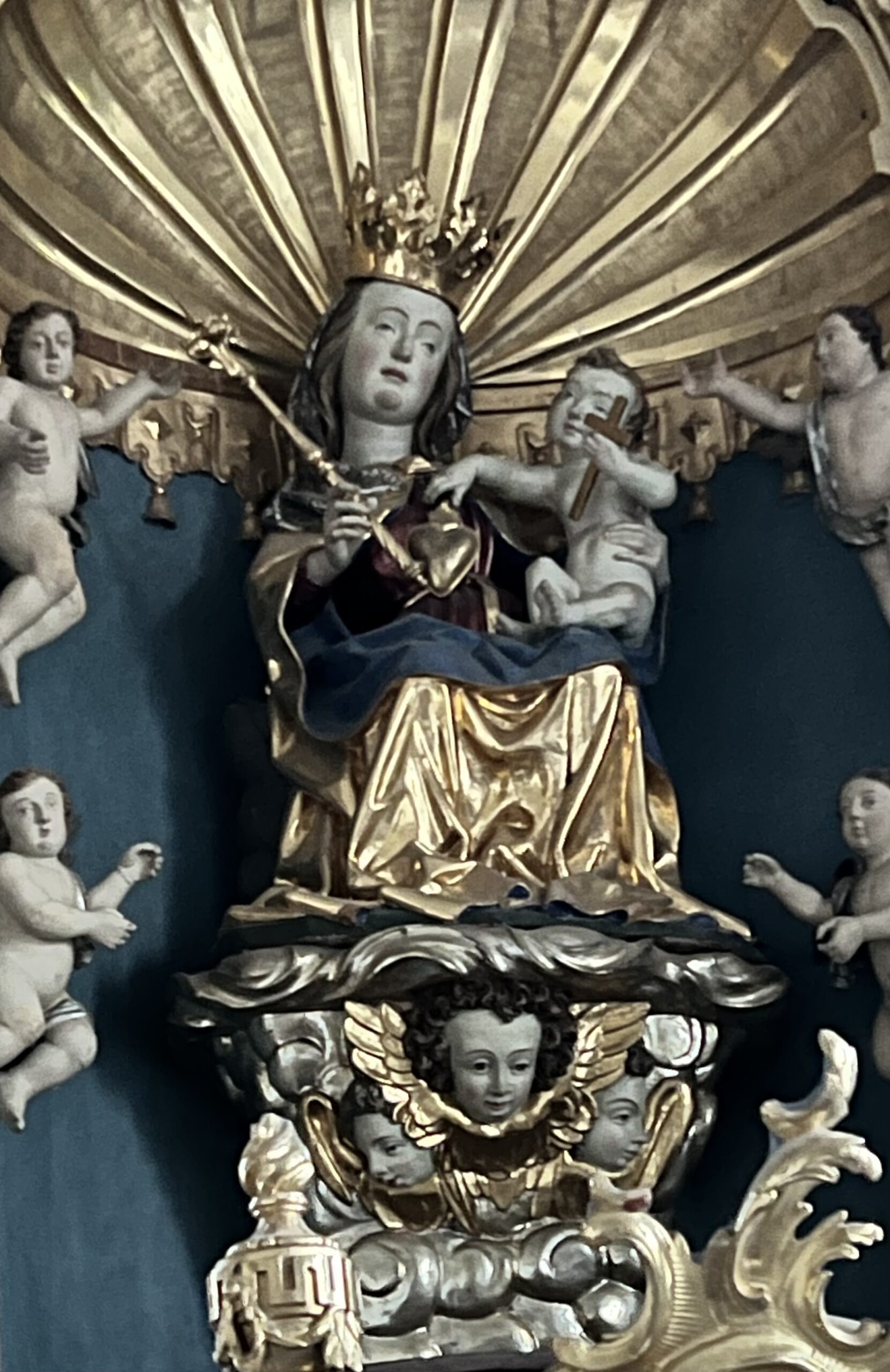
At the shrine, the words read: “Health of the sick, refuge of sinners, comfort of the afflicted, help of Christians”. This comes from the Litany of Loreto. Mary holds her Child in one arm and a sceptre in the other. At the very top of the shrine, two angels hold shields inscribed with the Latin words “VIRGO POTENS” (“Mighty Virgin”). The shrine stands on a silver cloud-shaped base with a gilded halo.
Behind the high altar, ex-votos have been affixed to the walls.
The Vesperbild (Pietà) is made of marble from Carrara in Italy and was created by Wilhelm Achtermann (1799-1884), a German sculptor and honorary citizen of the city of Münster.
Above the nave, just before the chancel, is a depiction of a enthroned Mary with Child; the Mother holds her little son and in her other hand a sceptre, and the little Jesus holds a miniature globe with a small cross on it. Mary's right foot rests on a crescent moon. These statues, as well as those of angels, are attributed to Christoph Angermair (1580-1633) from Munich.
The basilica also contains the crypt of the tombs of Arco-Zinneberg. The sculpture is by Johann Marggraff (1830-1917).
Inside the basilica, there is also a space for the bones of people who died long ago. Here, the “Tuntenhauser Tod” is depicted. This depiction of death is shown with two skeletons.

In the rear part of the basilica, above the sacristy, is the Rosary Chapel with an onion dome. Against the outer wall is a painting of the presentation of the Rosary by Mary to Dominic. Catherine of Siena is also depicted there with a crown of thorns. Below this is the coat of arms of Pope Pius XII, who elevated the pilgrimage church to a basilica in 1942.
Around the basilica there is a walled graveyard.
Twice a year, members of the “Katholischen Männerverein Tuntenhausen” (Catholic Men's Association Tuntenhausen) celebrate their pilgrimage service in the basilica.
A shop selling devotional items is present.
ACCESSIBILITY
The pilgrimage site of Tuntenhausen is located in the German state of Bavaria, between Munich and Rosenheim. Tuntenhausen belongs to the Archdiocese of Munich and Freising.
The address: Kirchplatz 6a, 83104 Tuntenhausen.
More information can be found at:
www.tuntenhausen.de
-www.erzbistum-muenchen.de/pfarrei/pv-tuntenhausen-schoenau.
Experience
By the car park, next to the church, I see a well with an image above it of a robust Mother of God and her Child. Water flows continuously from the tap. This is living water!
In the narthex of the basilica, I pause before a white marble Pietà by the sculptor Wilhelm Theodor Achtermann (1799-1884), and as always, I am deeply impressed by the Mother with her dead Son. Here, I also see the grave slabs of Count Ludwig zu Arco-Zinneberg and his young deceased wife Adolfina zu Arco-Zinneberg. Nearby, ex-votos can be seen, and the small sculptures on the ceiling are beautiful.
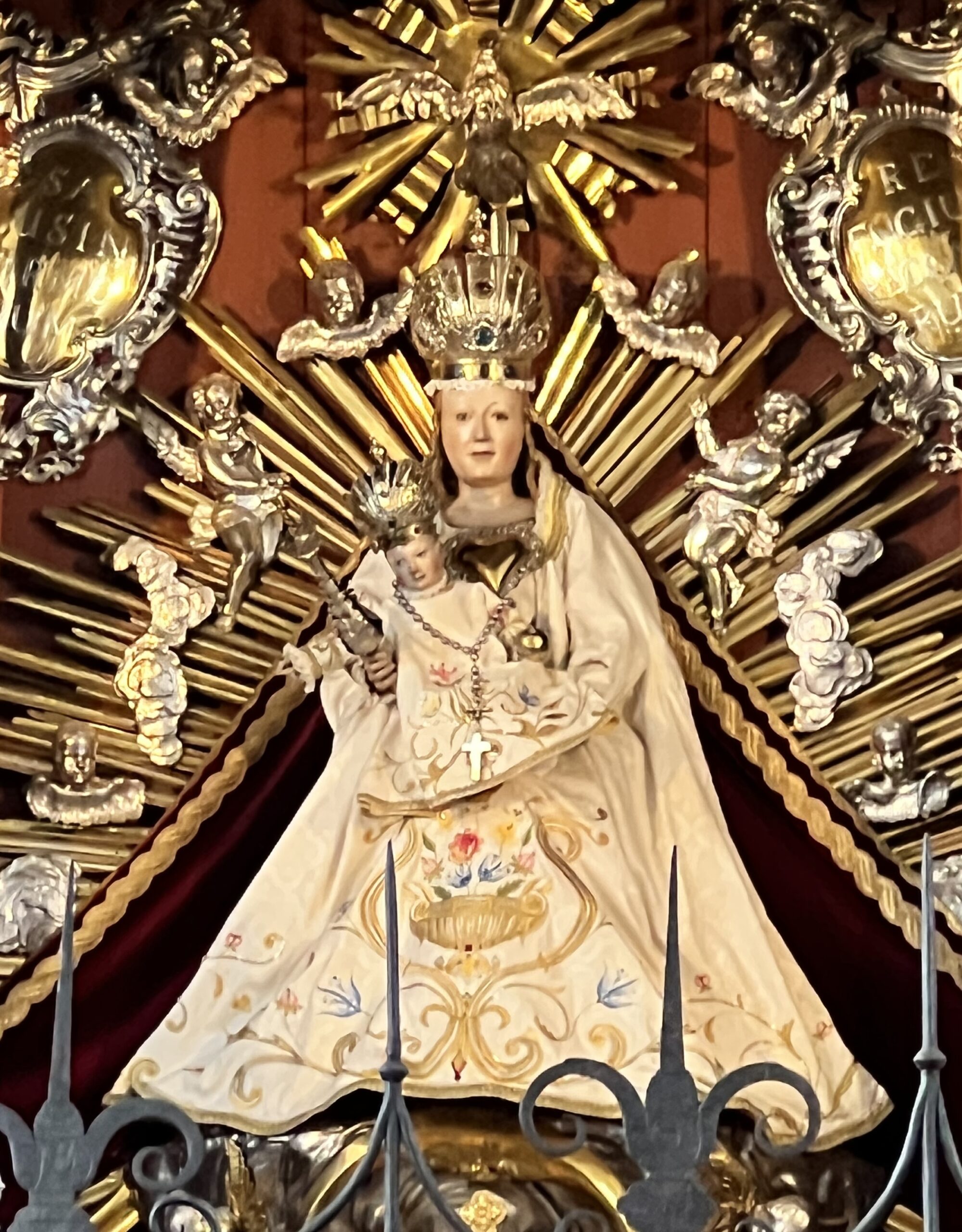
The high altar is cordoned off by a railing. Getting close to the shrine is not for me. The image of Mary and Child stands safely at a distance. Mary is clothed with an embroidered mantle. She is crowned, as is her Child, and golden rays surround the Mother of God. I look at Mary's face. What a kind face She has!
For the chancel and high up at the ceiling, I see the enthroned, crowned Madonna with Child. What a beautiful work of art this is!
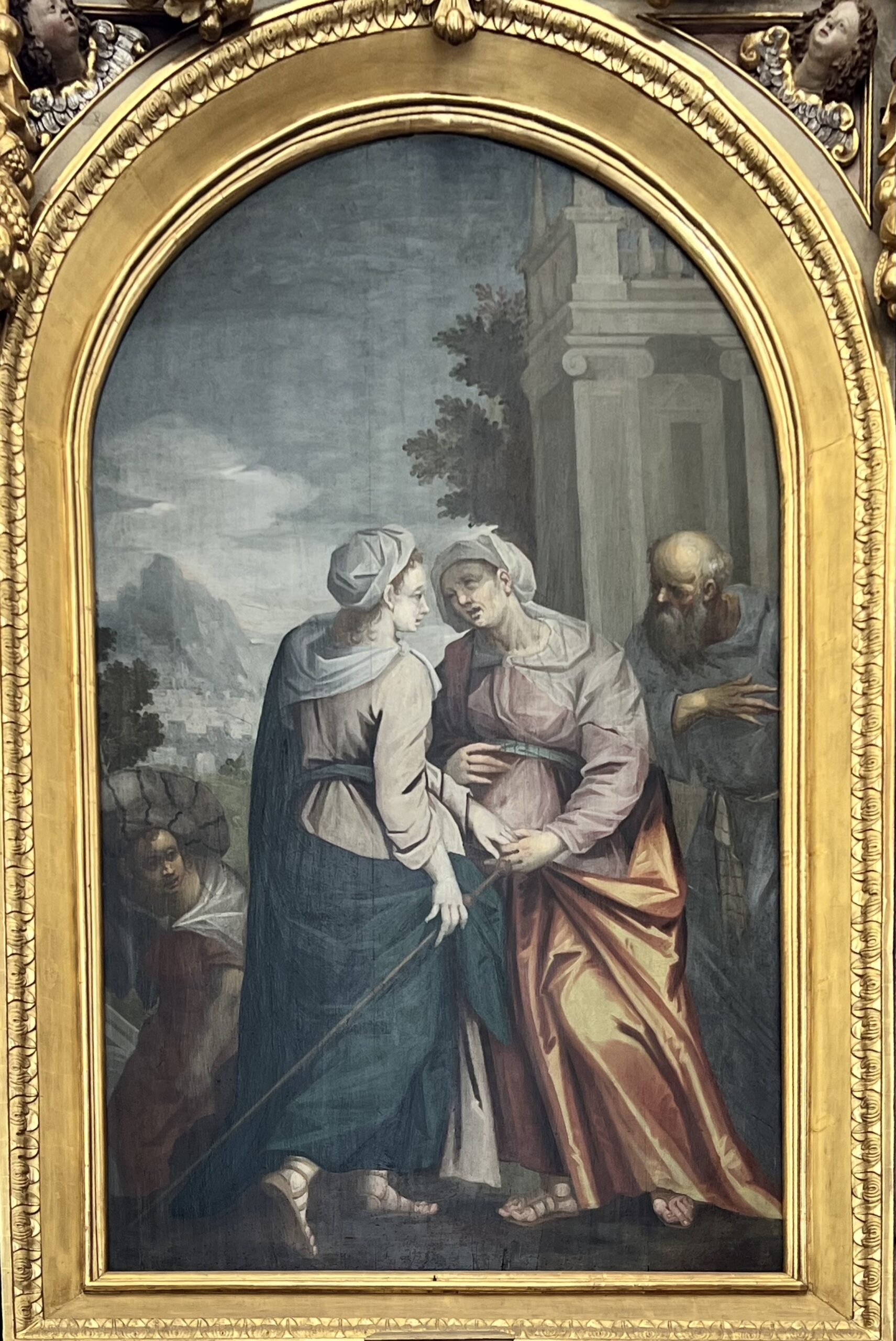
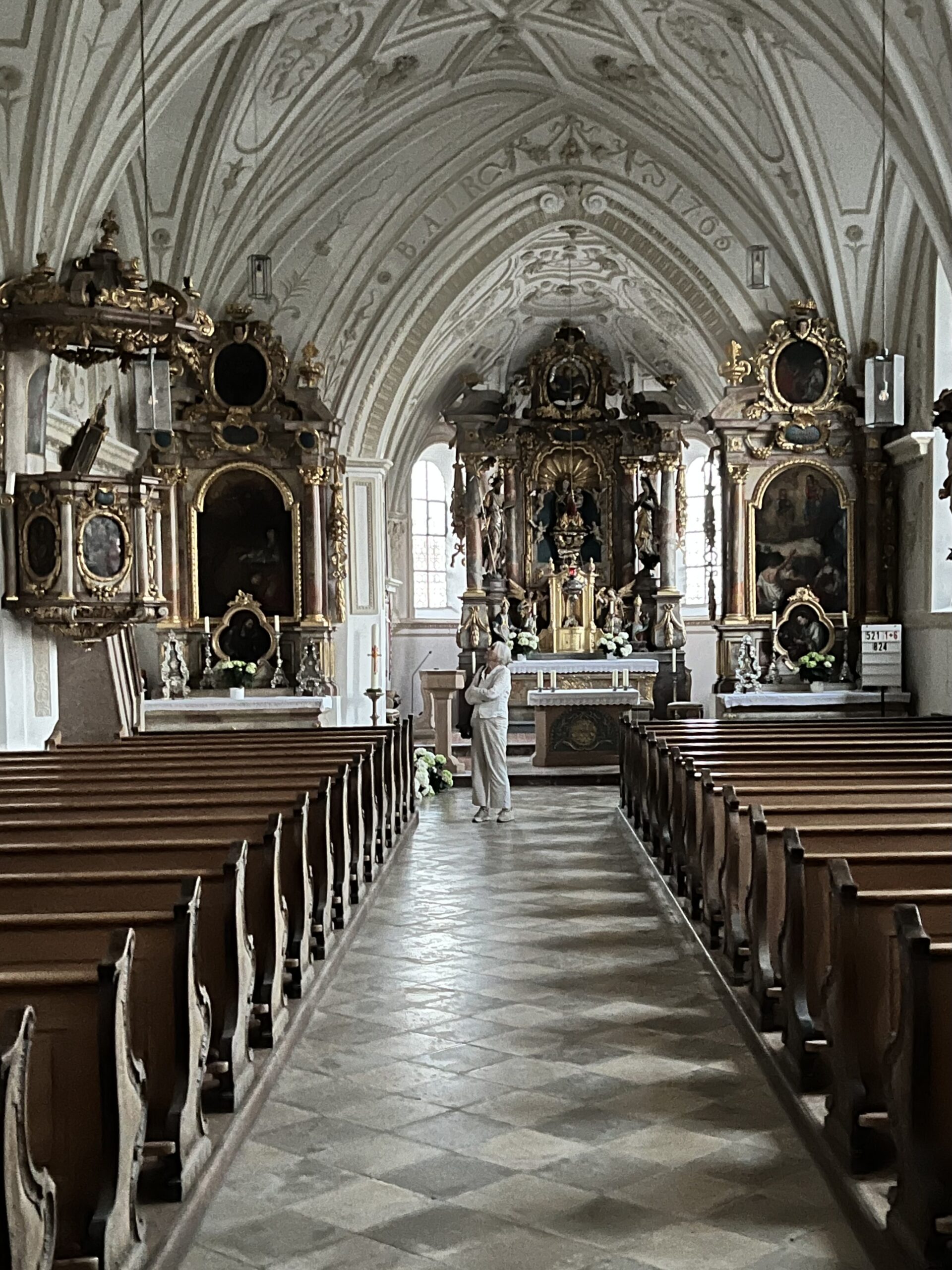
The north choir altar displays a painting of the meeting between Mary and her cousin Elizabeth.
In the north side altar, I see an altarpiece depicting a kneeling Dominic, with a dog, lily, and rosary, beside Mary. In the south side altar, Anne, the mother of Mary, is central. The mother points the way for the daughter.
Leaning against a pillar, I look at the crucified Jesus, with Mary beneath him, a sword in her chest. What suffering!
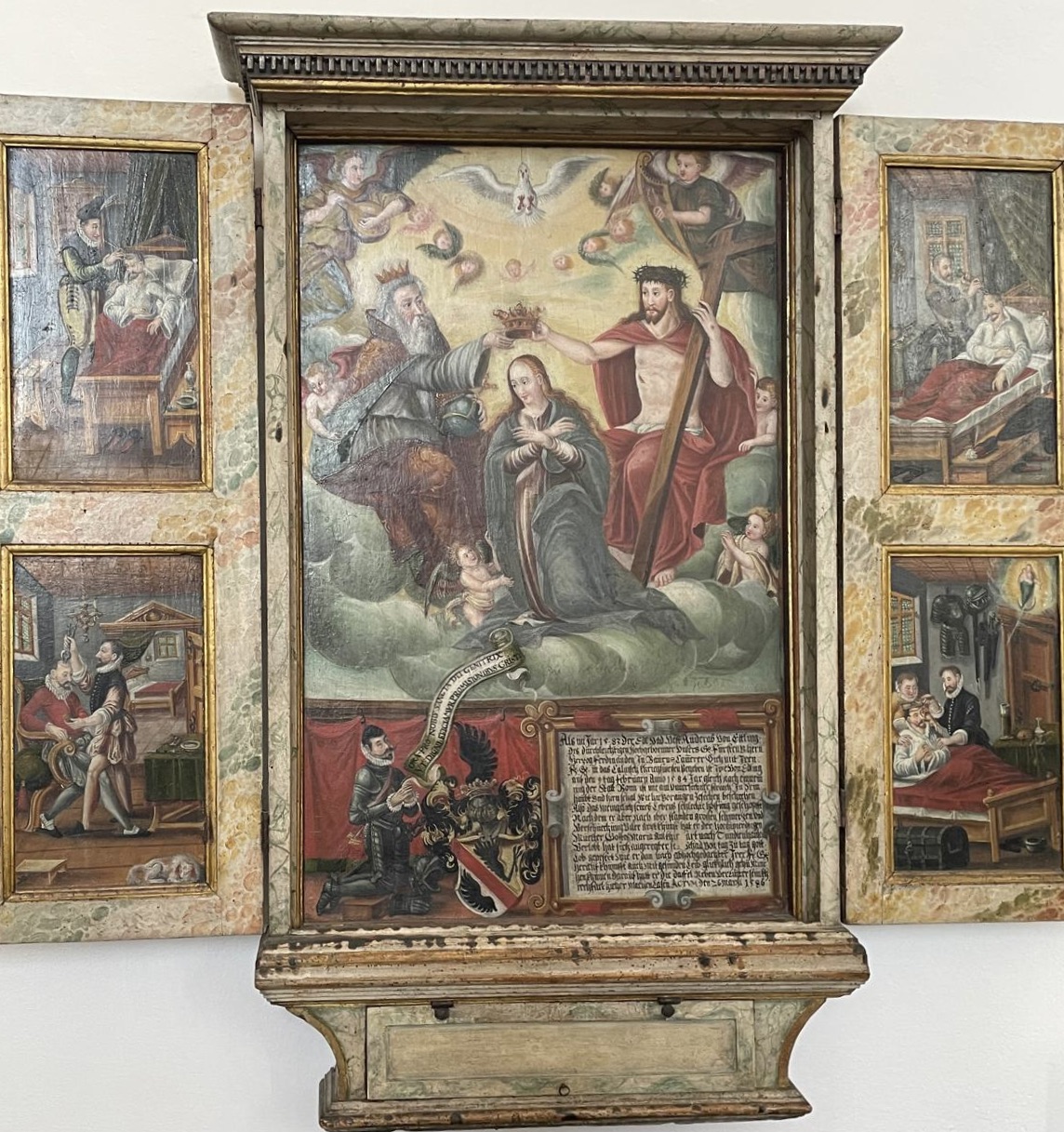
On the other side of the basilica is a triptych, the two side panels of which can be configured in a closed and open position. In the closed state, four images of the knight who donated the artwork are visible. When the whole is open, the coronation of Mary can be seen in the centre, surrounded by the knight being treated. What a captivating work of art this is!
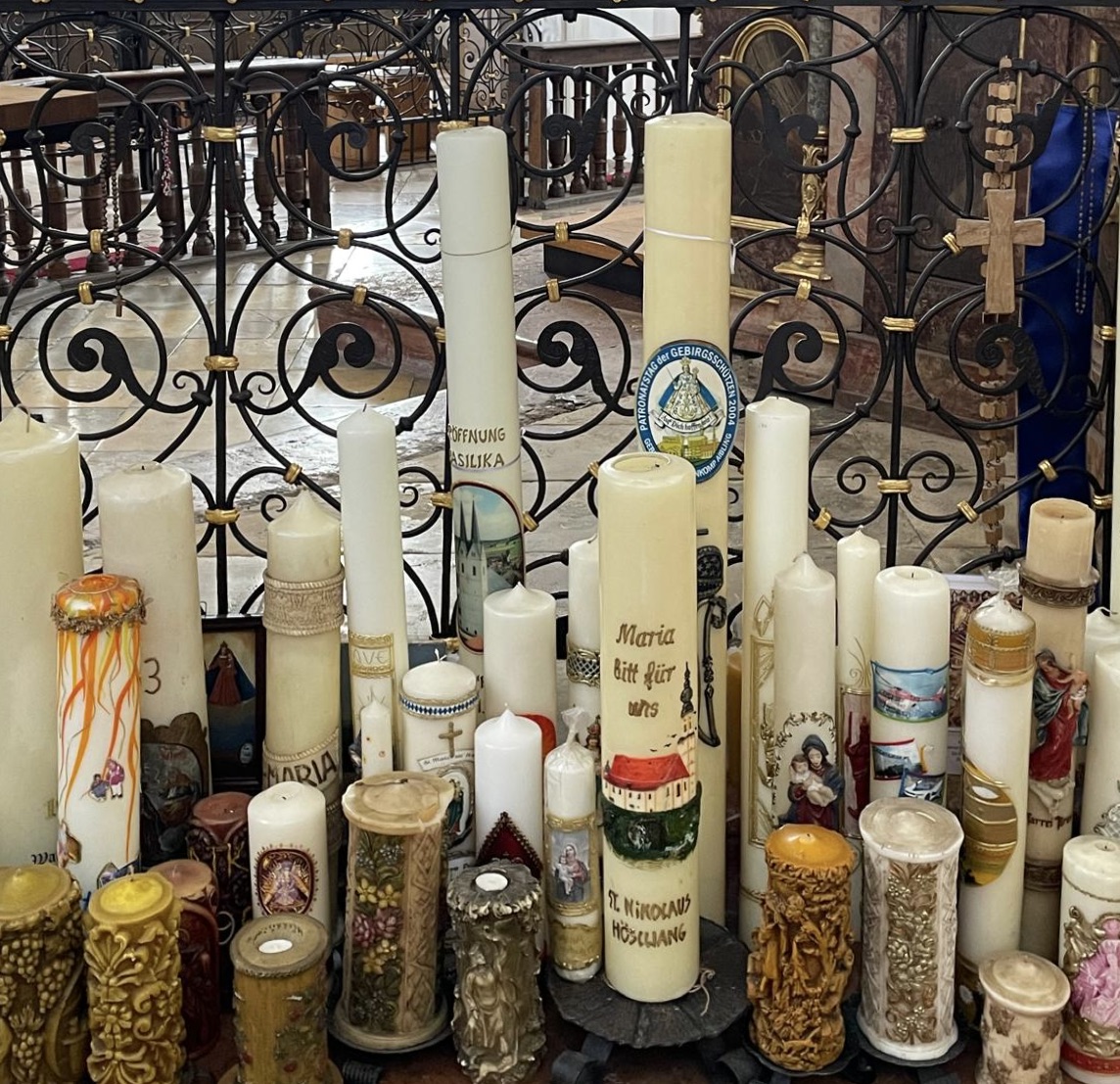
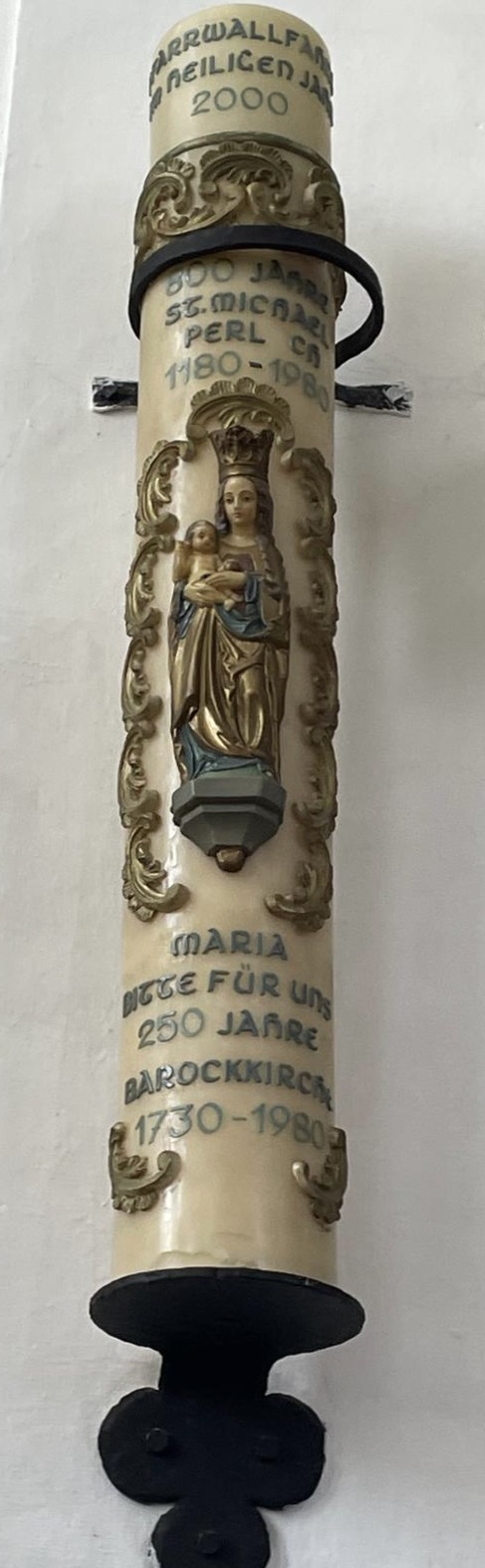
I am also struck by the many large candles displayed in this basilica. These are candles as an expression of gratitude and of a special event in a life.
The basilica displays exceptional beauty with gilded statues, colourful paintings, and carved wooden pews. I feel it's a great gift to be able to come here.
Environment
In Tuntenhausen, not far from the pilgrimage church, stands a very special building, namely a huge, extensive nativity scene named “die Tuntenhausener Krippe”. The museum has limited opening hours. The extensive nativity scene from the Baroque period is a reconstruction of one from the 18th century that was lost. In 1840, a drawing was found with instructions, and the current display was created based on it. Over 1300 elements are depicted, including several hundred figures. Dozens of scenes are elaborated, such as the angel's announcement to the shepherds, the visit of the Three Kings, the Massacre of the Innocents by Herod's soldiers, Jesus in the Temple with scribes, and a wedding with a feast. The whole shows a high quality of artistic expression. Originally, the exhibition was displayed in the pilgrimage church.
From Feldkirchen, near Rott am Inn, to Tuntenhausen is a 13 km journey to the northeast. In the village stands a church with a remarkably beautiful interior and magnificent effigies.
Leaving the large city of Munich to travel to Tuntenhausen involves covering 72 km to the southeast.
Leaving Rosenheim to get to the pilgrimage site of Tuntenhausen means travelling 16 km to the northwest.
Travelling from the pilgrimage site of Maria Eck near Siegsdorf to that of Tuntenhausen means driving 70 km to the west.
Departing from the pilgrimage site of Ponlach near Tittmoning to go to Tuntenhausen, requires covering 75 km to the west.
To travel from the major pilgrimage site of Altötting to Tuntenhausen involves covering 85 km in a south-westerly direction.
~~~

 Nederlands
  English (UK)
  Deutsch
  Français