History
Around 1330, “Ze Soles” is first mentioned, later called Solis. In 1354, there is already a chapel.
Father Bernardo di Marone and his fellow friar Lorenzo da Adolo have three visions and hear angels singing. Mary appears and asks them to build a church. They face opposition from Ulrich de Mont/Demont (1624-1692), Bishop of Chur (1661-1692), but persevere with the realisation of their plan.
In 1687, construction of the pilgrimage church begins, with Father Bernardo di Marone overseeing the works. Within 4 months, the church is completed by residents of Vaz and its surroundings. This is followed by the realisation of the rectory, tower, and sacristy. The consecration of the pilgrimage church had to wait until a new bishop was willing to cooperate. On 23 June 1697, the church, dedicated to the Visitation of Mary and Saint Felix, was consecrated. The consecration was performed by Ulrich von Federspeil (1657-1728), Bishop of Chur (1692-1728).
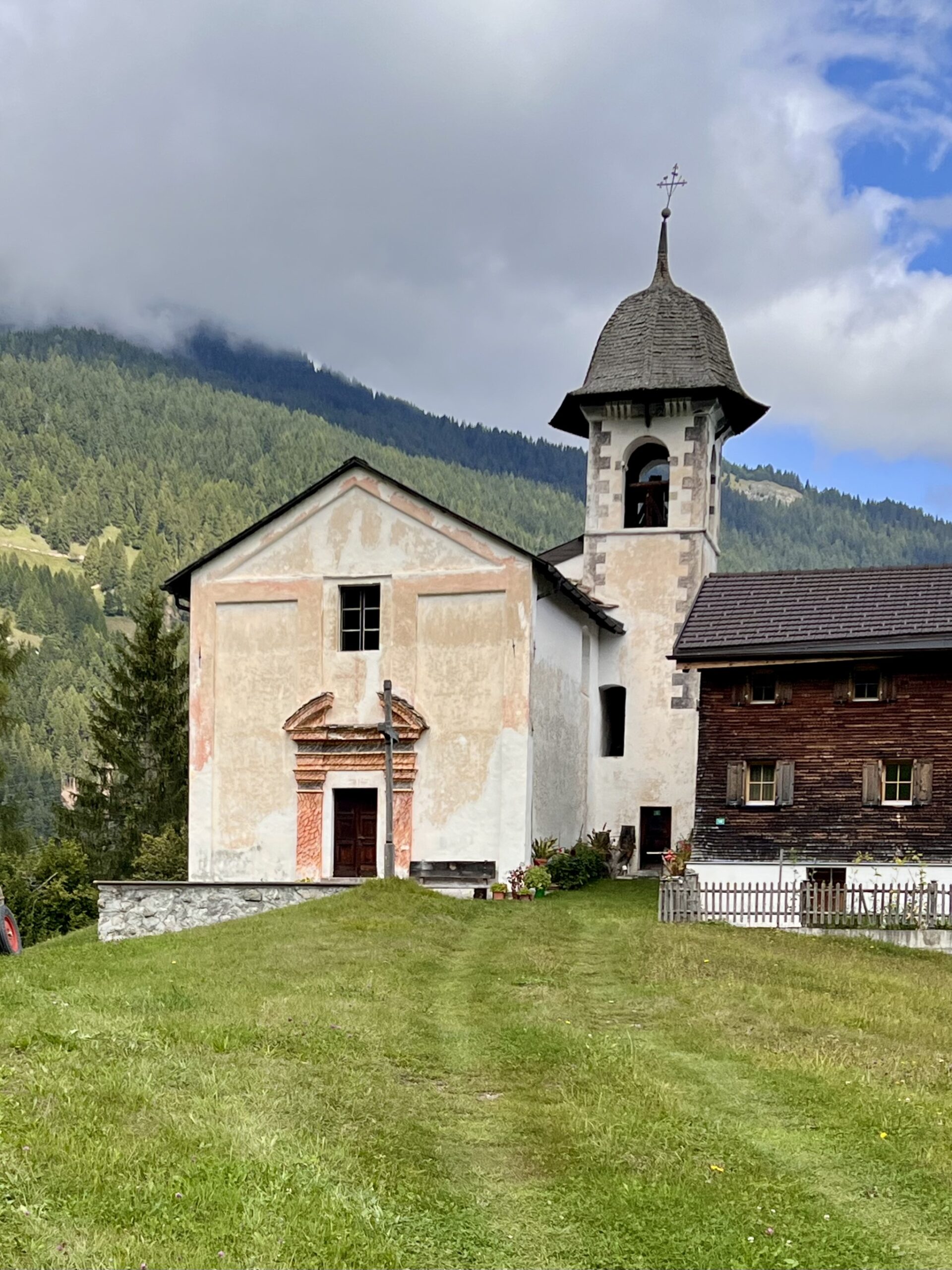
In 1979-1980, the exterior of the church is renovated.
Pilgrimage site
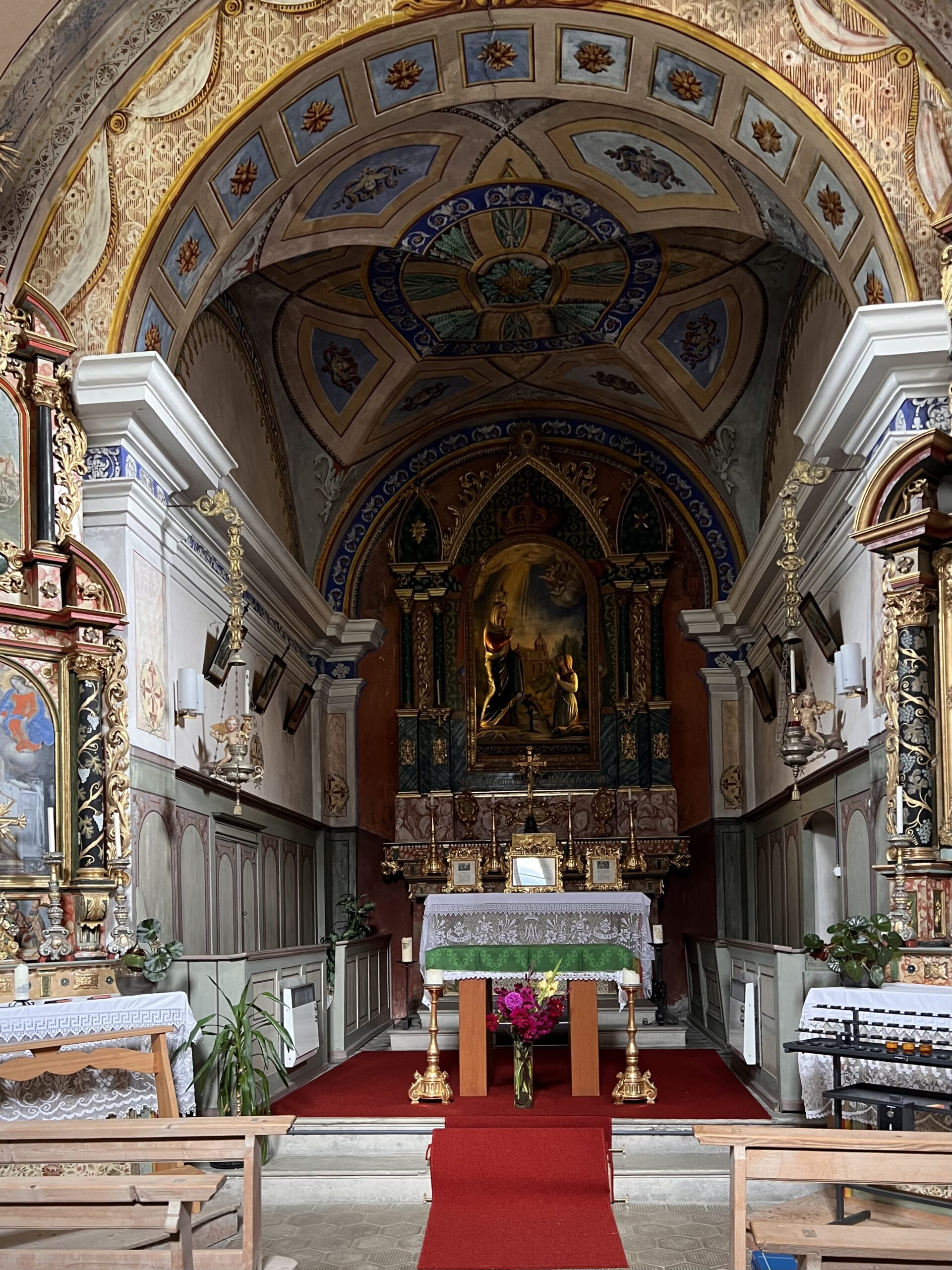
The small church of the pilgrimage site is located at an altitude of over 1100 metres, about 100 metres from a narrow road. The façade appears austere, but the interior is almost entirely painted and there are statues and paintings in this intimate space. This church is, according to visitors, one of the more beautiful pilgrimage sites in Switzerland.
The devotional image is a depiction of an apparition of Mary to a young man, who receives a request from Mary to build a church. The artwork also shows a church.
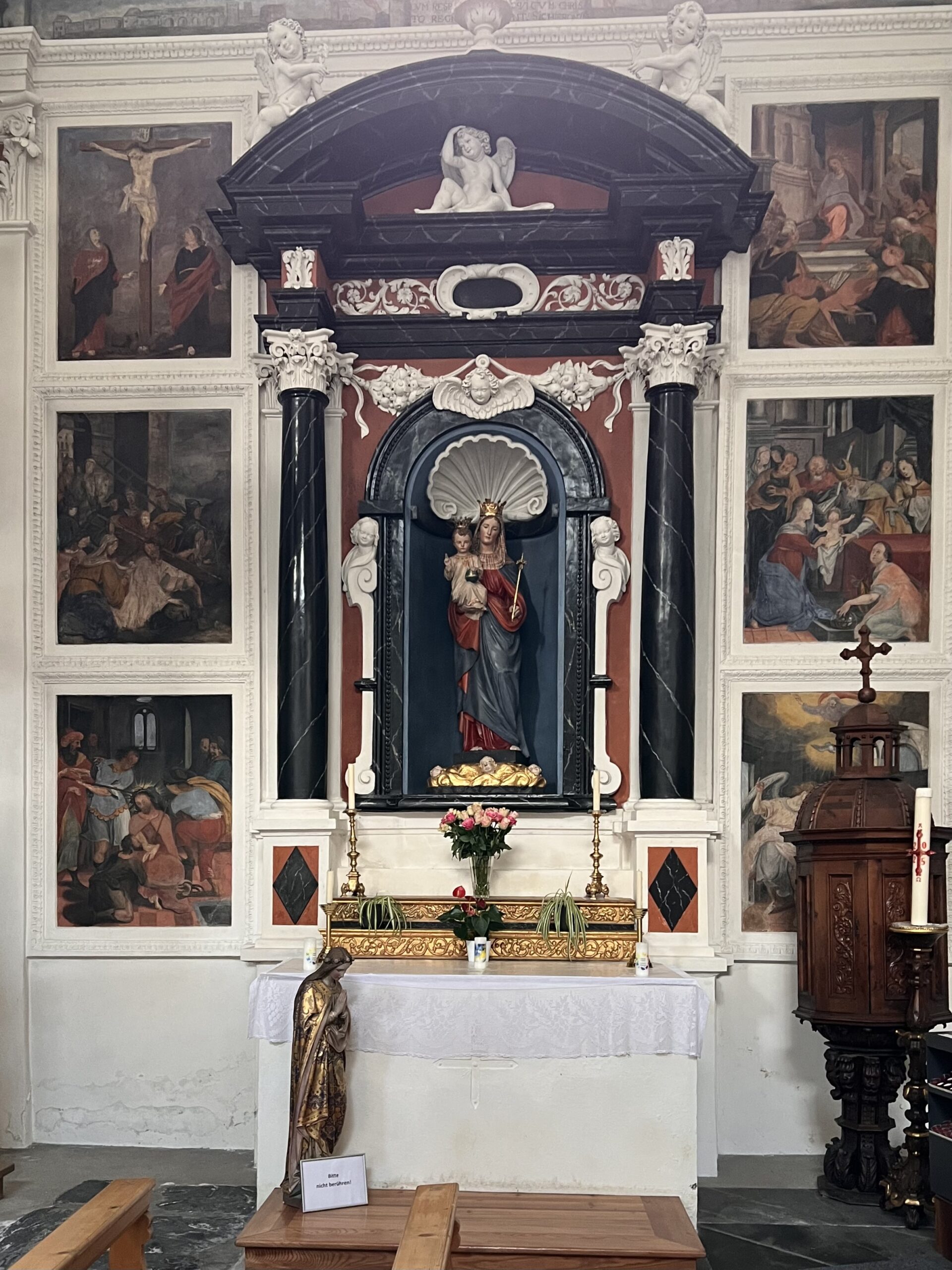
To the left of the high altar is a side altar dedicated to Saint Felix and below it are images of saints, including this one of Saint Nicholas.
Next to the pilgrimage church is a house that formerly served as a rectory.
The pilgrimage church is open daily.
ACCESSIBILITY
Obersolis is located above Solis in the canton of Graubünden, near the N29 road and the 1300-metre-long Solis Tunnel; a new connection to Obersolis. It is also possible to go to Obersolis via Tiefencastel.
Obersolis belongs to the municipality of Vaz/Obervaz.
Address: Solas Seura 14, Obersolis, 7450 Tiefencastel.
Experience
It’s an uphill climb to reach the pilgrimage church. At an altitude of over 1100 metres, I arrive at a narrow road that leads to the little church. There lies the pilgrimage church! A grassy field separates the road from the church, and across a green carpet, I walk towards the charming little church.
The exterior doesn't seem particularly special, but then I go inside, and it's as if I've arrived in paradise on Earth. What a splendour of colours in this rather small, intimate space. Once again I realise that smallness can be so grand.
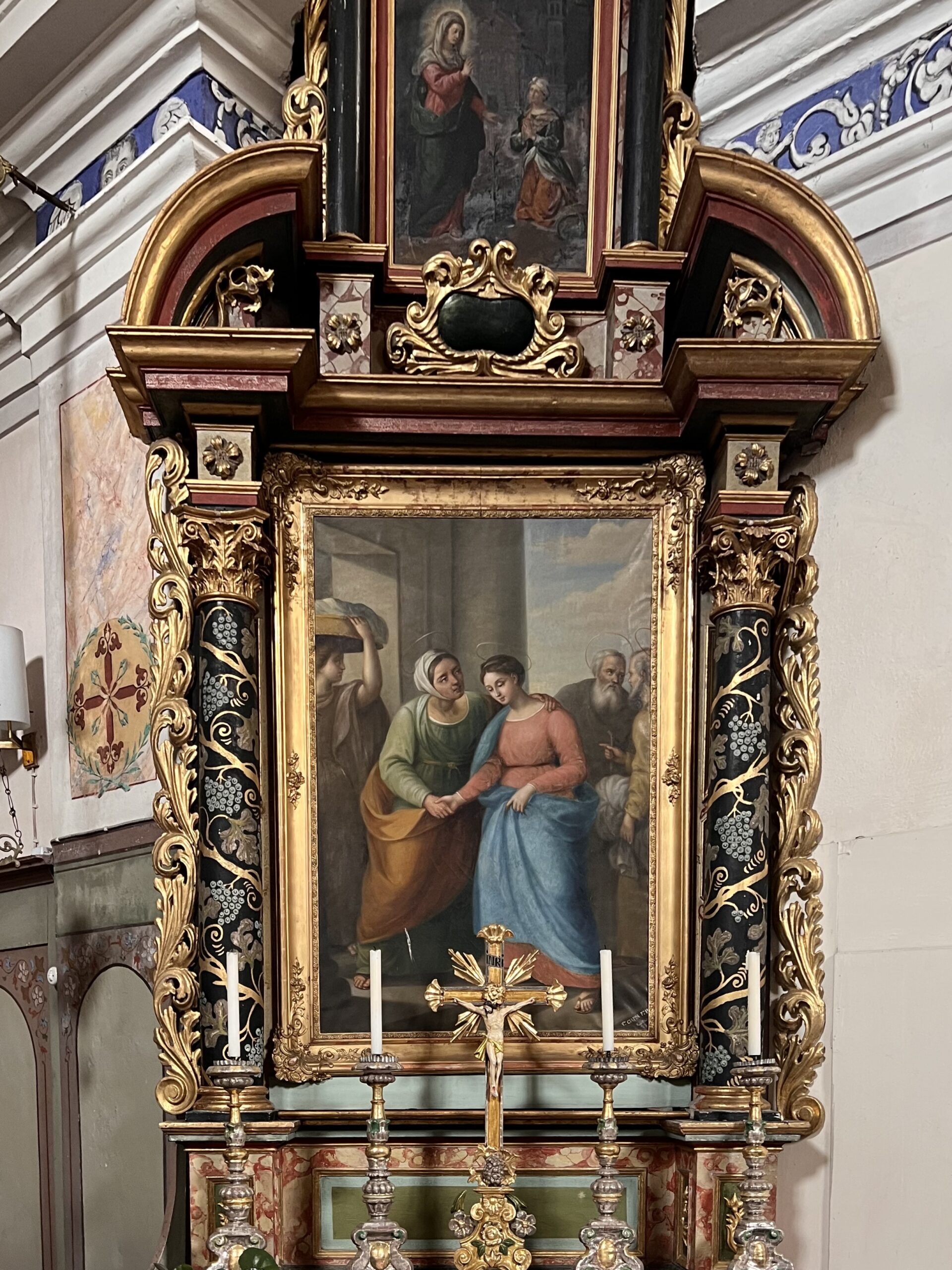
To the right, I see an altar of the Visitation of Mary; she is visiting her cousin Elizabeth. Both women are expecting. Two older men are depicted behind Mary and Elizabeth, and on the left, someone is carrying a parcel on their head. I stand looking at this artwork for quite some time, letting the scene sink in.
Next, I come to the high altar. This shows the crowned Mary appearing to a young man. Putti are on a cloud and a church is also visible. This is the depiction of the apparition, where Mary asks for a church to be built. The history of the origin of this pilgrimage site comes to mind.
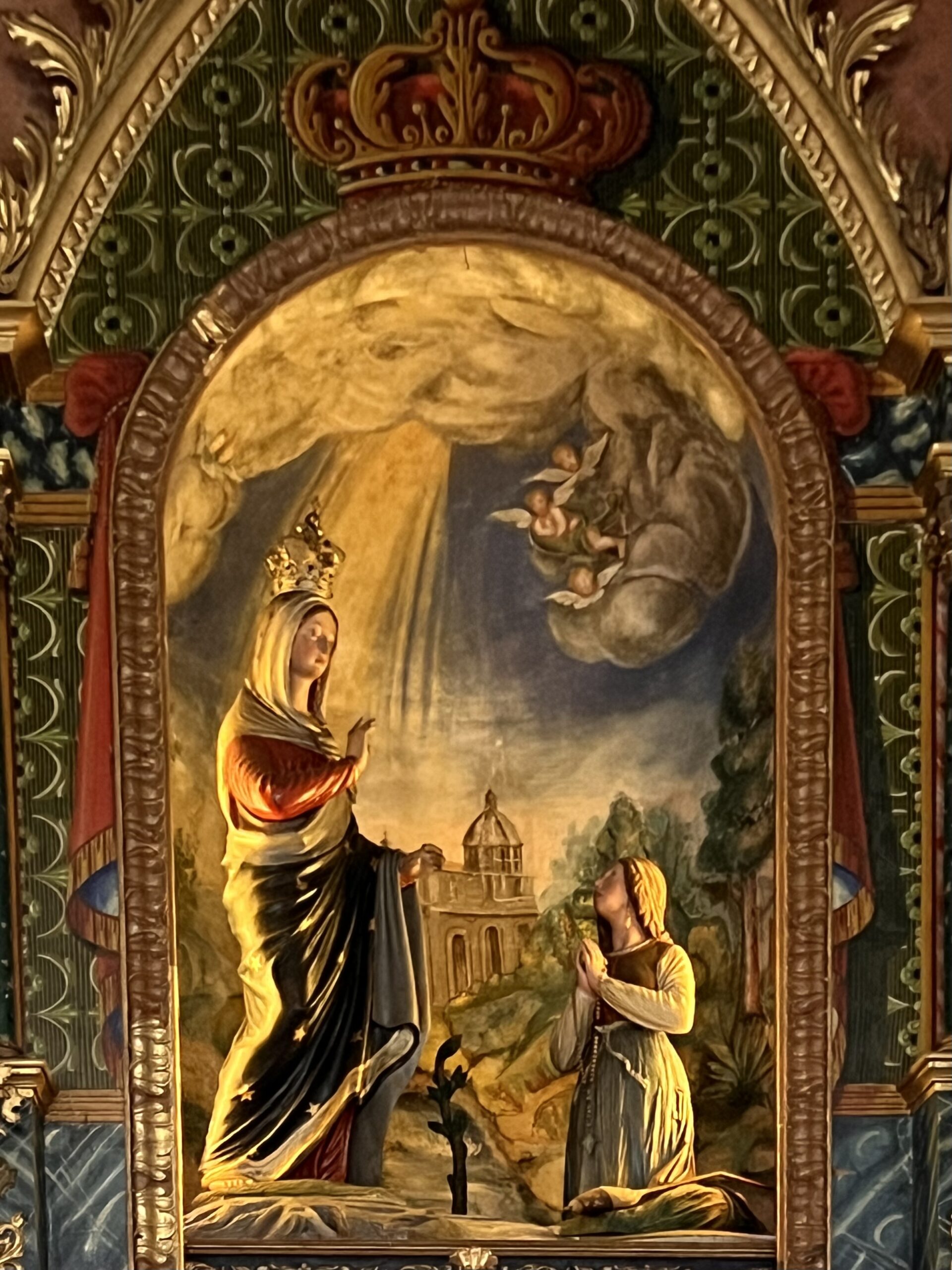
The back wall of the altar is entirely decorated. Below this is the Latin text: “Maria ei L’aveina de salit la Mumma de Gratia!” (A free translation of this would be: Mary and the wheat of the field, the Mother of Grace). There is another Latin text here, the words of which are in Dutch: “The church has taken this form through the care and work of Capuchin missionaries”, with the year 1853 below it.
On the left, I see an altar to Saint Felix with an image of Saint Nicholas below it. Then it's time to light candles and pray for the well-being of friends and good acquaintances, including a man undergoing cancer treatment. With newly lit candles, intentions are illuminated.
I leave the little church and walk across the lawn. I meet a woman there and we get talking about the church and the house next to it. Her mother-in-law now lives in the former parsonage. What a beautiful place to stay, with mountains wherever I look, and then to feel the presence of Mary.
Environment
In the region of Obersolis, there are many cycling and walking opportunities on roads that can reach heights of hundreds of metres.
From Tiefencastel to Obersolis is 10 km to the west. In Tiefencastel stands the parish church of St. Stephen (Stephanus). The parish church is first mentioned in 1345 and was thoroughly restored in 1519. The church suffered particularly from wars and was rebuilt by Capuchins between 1650 and 1663. The church is in Baroque style, features many statues, and numerous frescoes adorn the building. In a side chapel stands a large 19th-century statue of Mary. This Marian chapel is dedicated to Our Lady of the Rosary. The frescoes of the mysteries of the Rosary date from 1652 and were created by the Italian artist Giulio Andreotto (c.1632-c.1690). Following a major fire in 1890, the paintings were restored.
From Vaz/Obervaz to Obersolis is about 15 km going southwest.
Travelling from Thusis to Obersolis involves covering 15 km to the east.
Departing from Chur to arrive in Obersolis requires travelling 40 km to the south.
To leave the place of pilgrimage of Einsiedeln and arrive at that of Obersolis, one must travel 135 km to the southeast.
~~~

 Nederlands
  English (UK)
  Deutsch
  Français