History
In 1629, approximately 60 people died of the highly contagious plague in Peissenberg, including Bartholomäus Steinle/Stainl/Steindl (c. 1580–1628), a sculptor, woodcarver, and supervisor of the construction of the church dedicated to the Assumption of Mary near Weilheim.
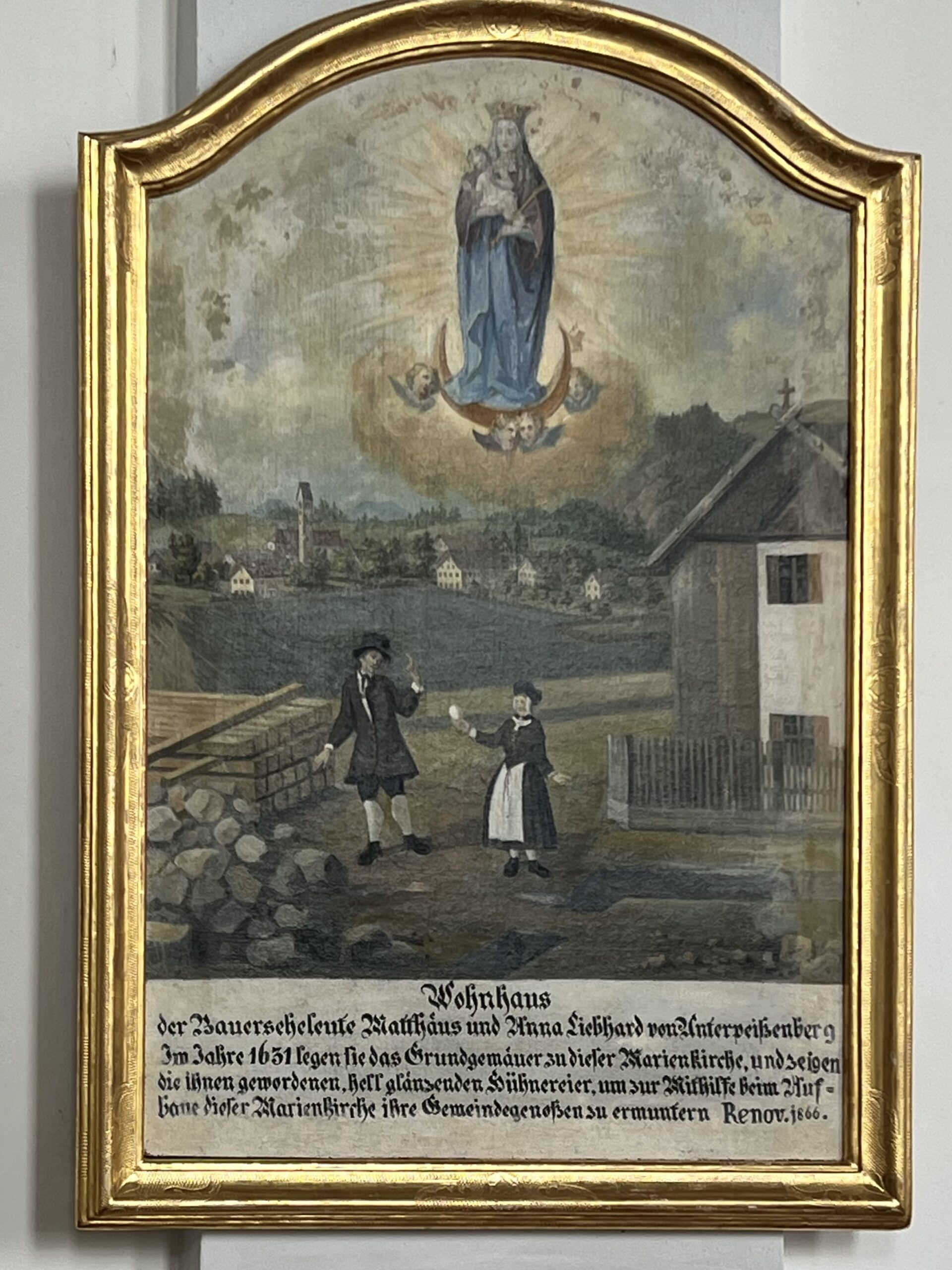
A stone chapel was built in 1631 for “Maria vom Siege” (“Our Lady of Victory”). This is still the official name, but it is commonly known as Maria Aich. The chapel is a donation. The name commemorates the victory of Christian forces over the Turks in the Battle of Lepanto on 7 October 1571. A late Gothic statue of Mary is placed in the chapel. The consecration took place in the autumn of 1631 by Sebastian Müller (1584-1644), auxiliary bishop of Augsburg (1631-1644). Miracles began to occur from the time the chapel was built. This eased the suffering of the population during the Thirty Years' War (1618-1648), a conflict between Catholic and Protestant states. People had high hopes for the miraculous events. In 1704, during the War of the Spanish Succession (1701-1715), fierce fighting raged between European nations, and the chapel was plundered and desecrated.
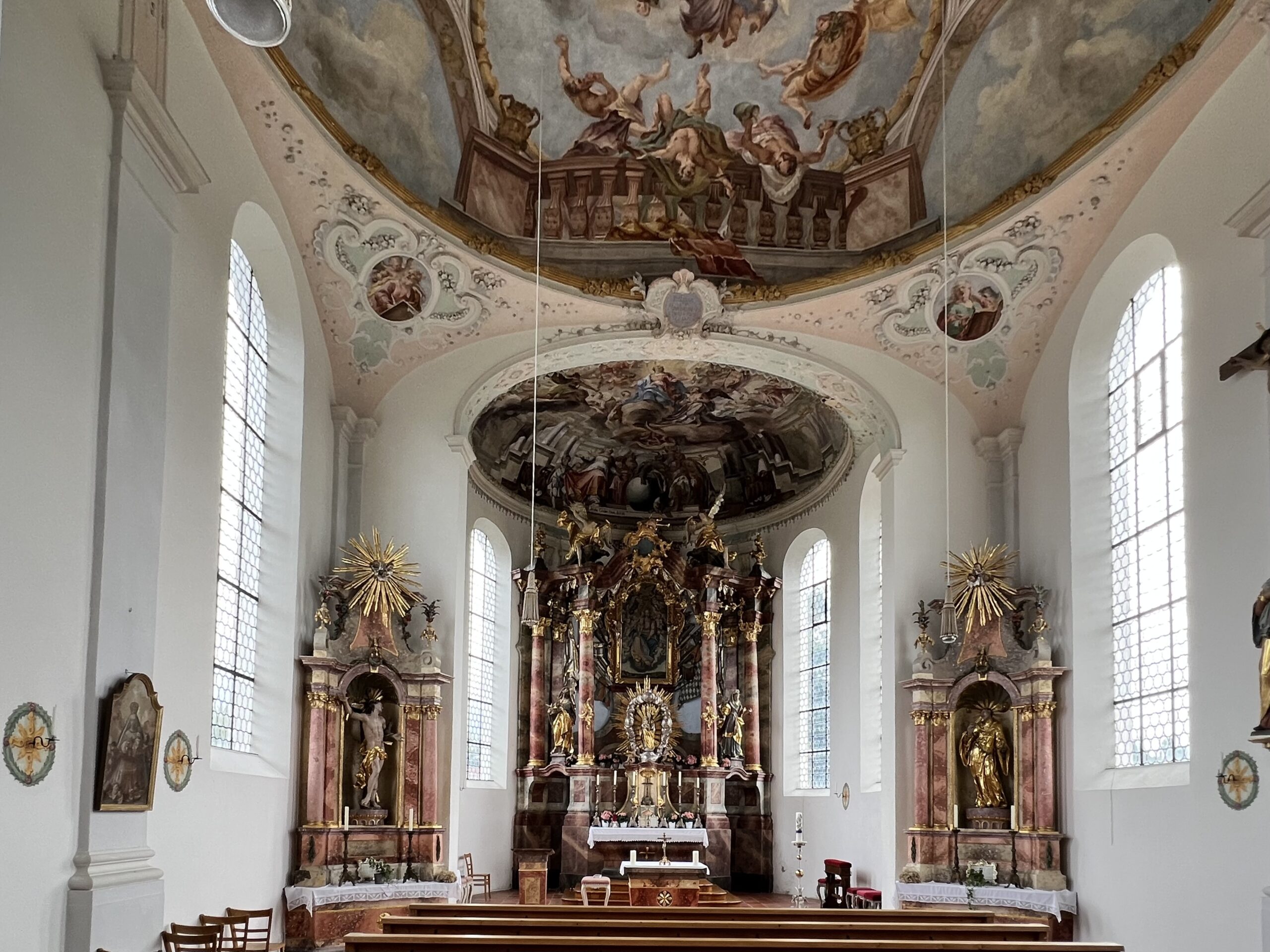
In 1731, the construction of a stone pilgrimage church began, as many pilgrims continued to come to pray to Mary and the existing chapel could only accommodate 60 visitors. Albert Oswald (1663-1744), abbot of Polling Monastery (1701-1744), made great efforts for the construction. The master builder and designer of the church was Josef Schmuzer/Joseph Schmutzer (1683-1752). He was also the decorator of the arches and pillars. The miraculous image comes from the demolished chapel from 1631. The effigies of Anna and Joachim, Mary's parents, are attributed to Franz Xaver Schmädl (1705-1777), a sculptor in the Rococo style. The statues on the side altars of Sebastian and Leonhard were created by Anton Sturm (1690-1757), a sculptor in the Baroque and Rococo styles. The church was completed in 1734, and its consecration took place on May 17 of that year. The ceiling frescoes of the nave and choir were created by Matthäus (Mathäus) Günther (1705-1788), a Bavarian painter and printmaker of the Baroque and Rococo styles. In 1777, he carried out restoration work. Matthäus Günther was born and raised a few kilometres from the church.
The high altar is from c. 1750 and the side altars were made in 1793.
In 1904, the pilgrimage church was renovated and extended. This was made possible by benefactors.
In 1966-1969 the pilgrimage church was thoroughly renovated and a new organ was installed.
Pilgrimage site
The word “Aich” is Old High German and means “Eiche” (oak). The pilgrimage site is located at almost 600 metres above sea level. The church is situated in the plain in front of the Peissenberg, which has a summit of 988 metres.
The Baroque church is dedicated to Mary of Victory. In popular parlance, the building's name is Maria Aich.
The white-plastered church is adorned with frescoes, paintings and sculptures.
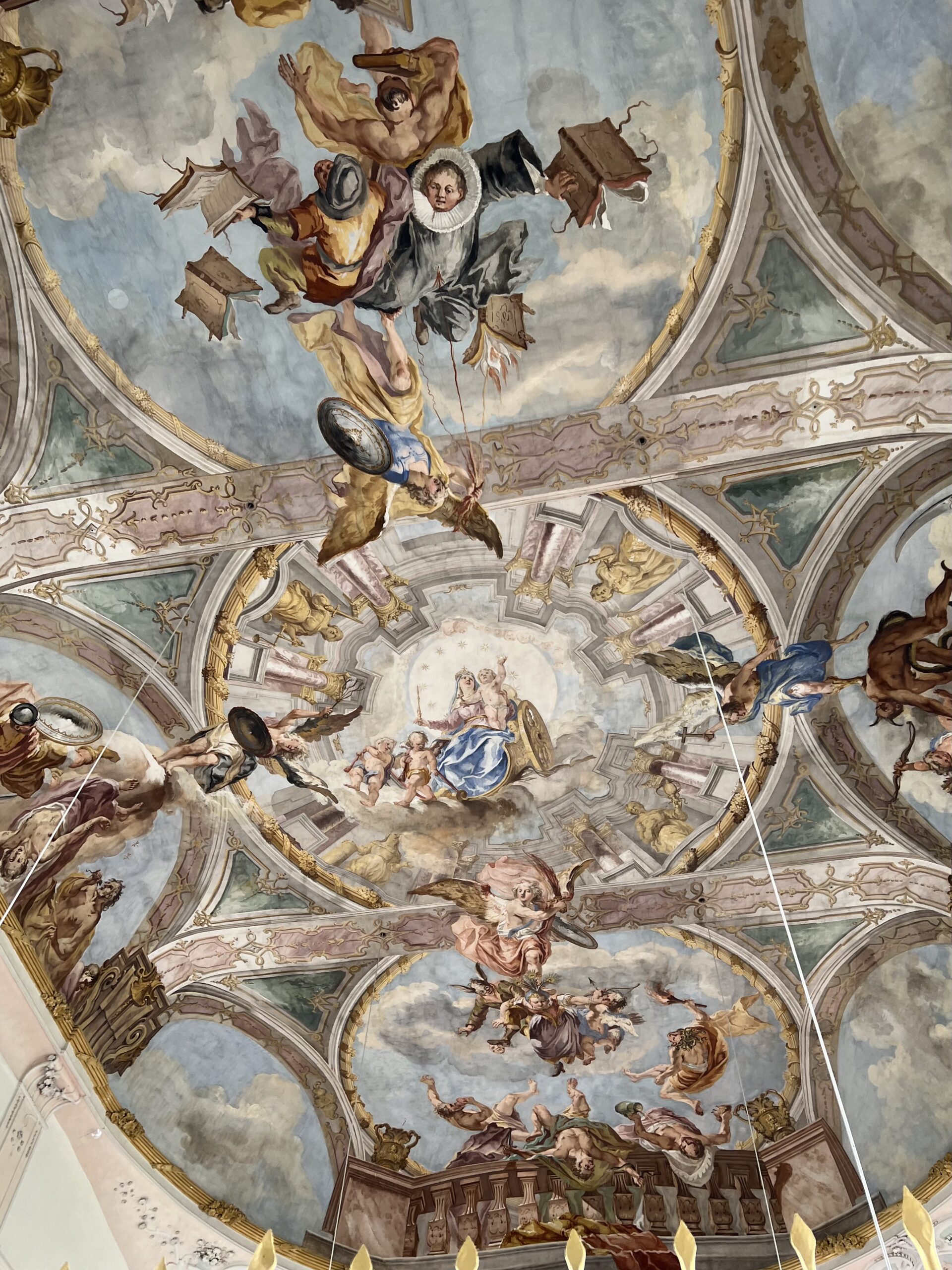
Painted on the ceiling of a dome is a depiction of “Maria vom Siege” (Mary of Victory). Also depicted is the battle between, on one side, the archangel and, on the other, slander, heresy, war, plague, sin, death, and the devil.
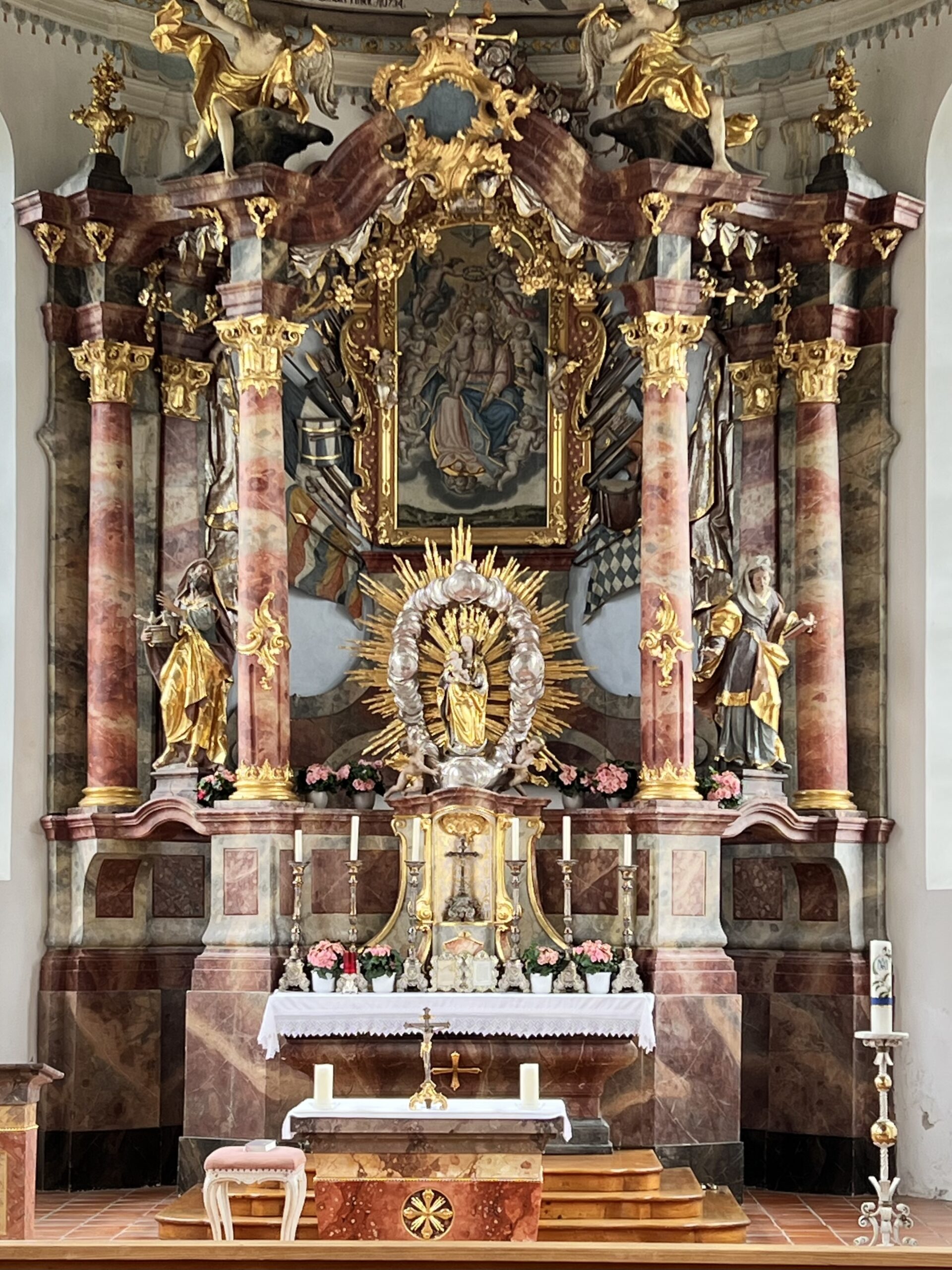
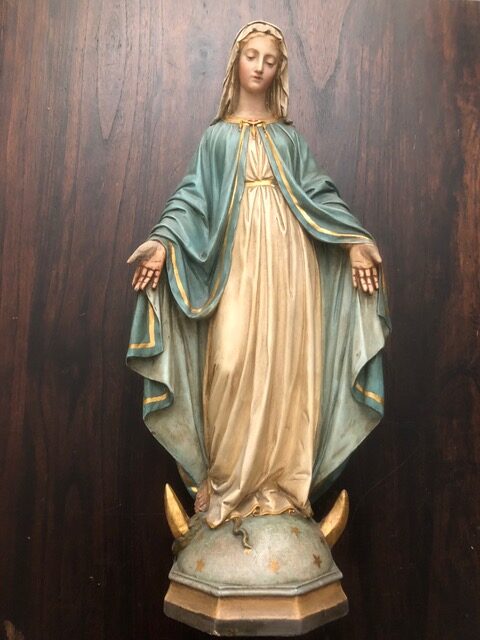
The high altar has four columns from c. 1650 and in the centre, Mary is depicted above the Peissenberg. Next to the columns are figures of Mary's parents, Anne and Joachim, and of sculptor Franz Xaver Schmädl/Franz Schmottel (1705-1777). On the tabernacle stands the late Gothic icon of grace of the Virgin Mary on a crescent moon. The statue dates from the early 16th century.
ACCESSIBILITY
Maria Aich lies a few kilometres east of Peissenberg.
Address: Aich 7, 82380 Peissenberg.
More information can be found by consulting www.peifo.de (parish of Peissenberg-Forst).
Experience
Upon entering the church, I am struck by the beauty of the interior. What a wealth of statues, paintings, and frescoes to admire here. This church displays art of the highest calibre. What craftsmanship!
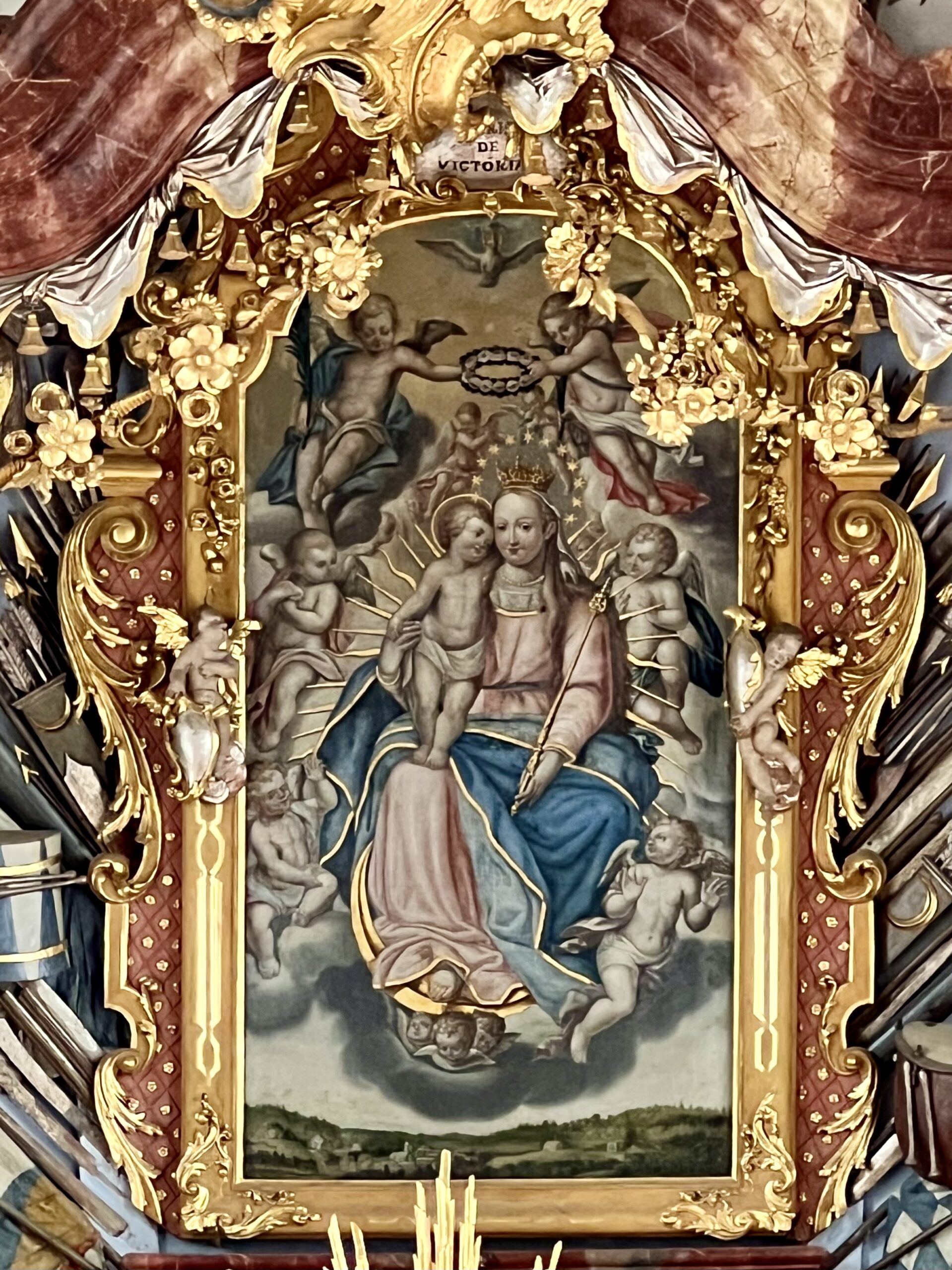
At the high altar, the miraculous image is centrally placed. What beauty with rays of gold on Our Lady!
I gaze in awe at the dome frescoes and see, among other things, the Coronation of Mary. Also on display is the veneration of Our Lady by the four continents, as they were known at the time in the mid-18th century.
In the pilgrimage church, I see many ex-votos, and among them are paintings that tell a story.
After the tour of the pilgrimage church, I take a seat on one of the pews. Then I think about the history of this sanctuary. After that, it's time to pray to Mary and hope that She can offer some support to a few well-known, good people.
I'll round off my visit to this pilgrimage site with a trip to the town of Peissenberg. There's a café/bookshop to relax in for a while, and then it's time to enjoy the beauty of the surroundings.
Environment
From Weilheim to Maria Aich is 10 km to the southwest.
Travelling from Kaufbeuren to Maria Aich requires travelling 55 km eastwards. The town of Kaufbeuren is known, among other things, for Anna Höß (1682-1744). In 1703, she entered the convent of the Franciscan nuns in Kaufbeuren and took the name Crescentia (the growing one). In 1710, she became porteress and also infirmarian. In 1717, Sister Höß was put in charge of the novices, and she became abbess in 1741. Throughout her life, she dedicated herself entirely to God and helped her neighbours. She received visions and provided spiritual guidance to many. In 1900, Anna Höß was beatified. On 25 November 2001, Anna Höß was canonised by John Paul II, Pope from 1978 to 2005 and born as Karol Józef Wojtyła (1920-2005).
Leaving Munich to get to Maria Aich means covering 62 km to the southwest.
From Rosenheim to Maria Aich, he has travelled 100 km westwards.
To get from the city of Augsburg to Maria Aich, you need to travel 94 km southwards.
~~~

 Nederlands
  English (UK)
  Deutsch
  Français