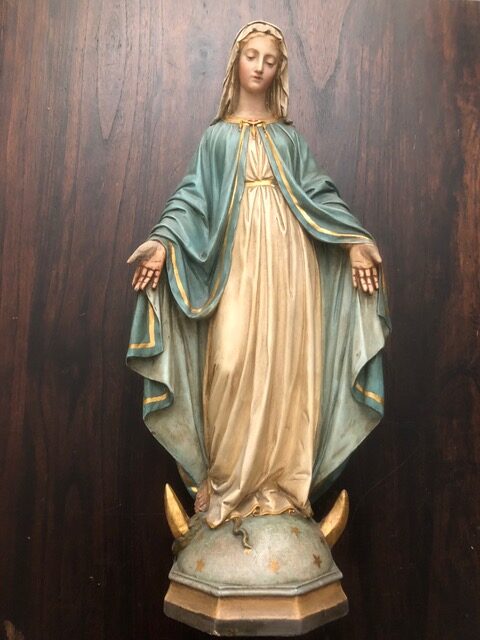
The solemnity of 15 August celebrates the Assumption of Mary. She has fallen asleep and been taken up to heaven, body and soul. Mary is the first of the faithful to experience the mystery of being taken up to heaven, body and soul. There, she has been enthroned as Queen of Heaven.
Mary has risen and been crowned by her Son. She resides in heaven, a place full of mystery for humans. It is humanity's great leap forwards. The journey to the moon, for example, pales into insignificance compared to that to paradise.
It is said that Mary died between AD 36 and 50. Other sources mention her death as occurring 3 to 15 years after the death of Christ. The place of her death is not certain. There are a few possibilities: it is possible that Mary died in Jerusalem on Mount Zion and was subsequently buried next to the Garden of Gethsemane in the Kidron Valley, at the foot of the Mount of Olives, where the tombs of Mary and Joseph are located, according to the Greek Orthodox Church. There is also a reference to the Church of the Dormition in Jerusalem on Mount Zion, which is attached to the Benedictine monastery. Another possible location for her death is Ephesus in Turkey, because Mary went there with the apostle John. Another possibility is that Mary died in Bethlehem, where she lived during the final years of her earthly existence. This reasoning is strong and credible to many. Therefore, nothing is known with certainty about the death and burial of Mary. As a result, it remains an open question whether Mary died before or after her Assumption. It is said that Mary died in the presence of the apostles and that these followers of Jesus saw Mary ascend into heaven. The apostle Thomas was absent at the Assumption. Shortly after her death, there was an empty tomb, which was confirmed by Saint Thomas/Tomas, who is also called Judas Thomas Didymus (“twin”). It is also written that, after seeing the empty tomb, the apostles concluded that Mary’s body had been taken up into heaven.
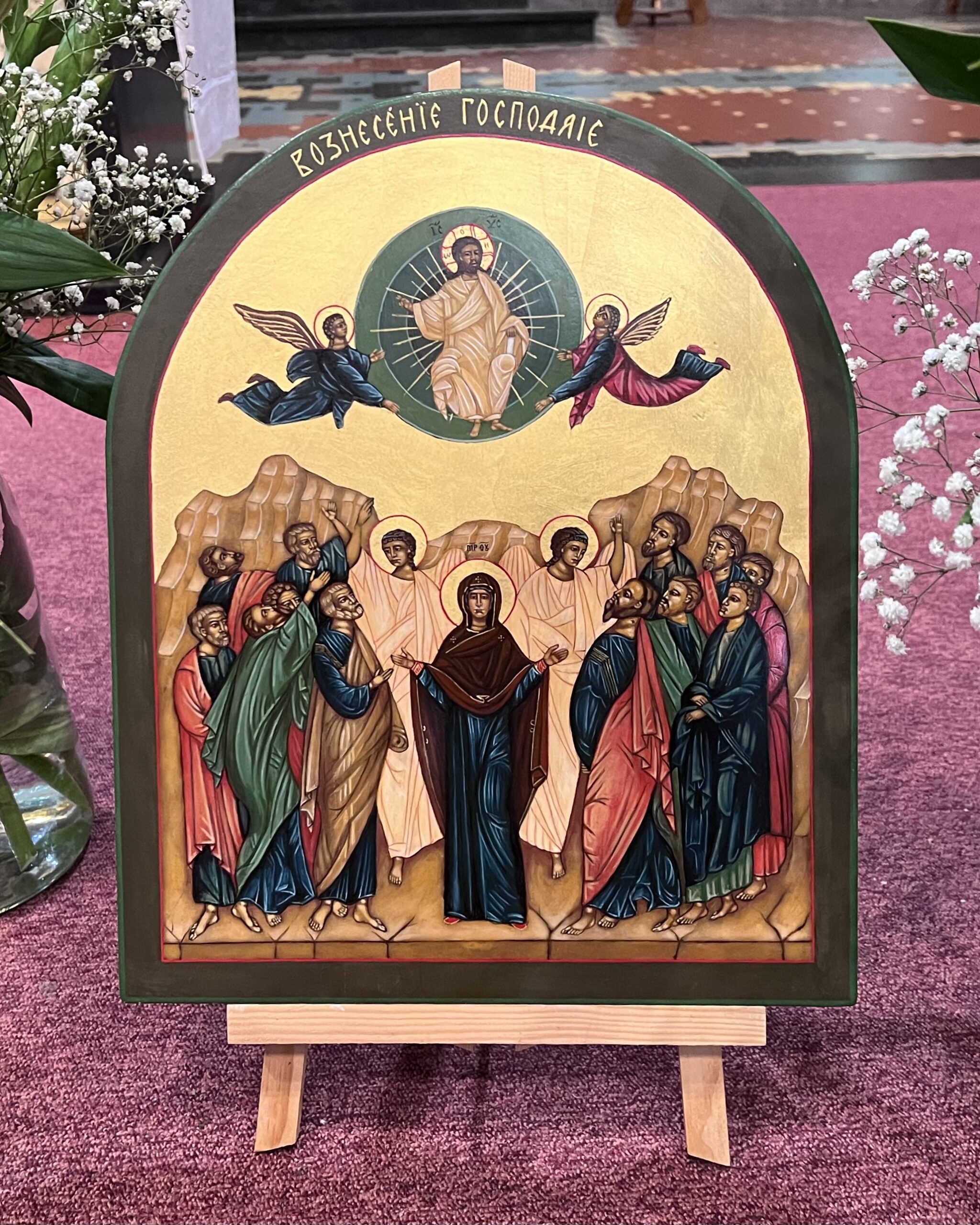
The belief that Mary was taken up body and soul into heaven has had a gradual progression in the Catholic Church. The feast of the Assumption is already mentioned in the year 450.
During the Council of Chalcedon in 451, the Assumption of Mary is also discussed. This council is convened by Flavius Marcianus (392-457), Eastern Roman Emperor (450-457). He and his wife Aelia Pulcheria (399-453), Empress (450-453), preside over the meetings. The emperor asks about the body of Mary. Juvenal, Bishop of Jerusalem (422-458), says that Mary died in the presence of the apostles and that her tomb was found empty. The location Chalcedon is a Greek port city in Bithynia and Anatolia. Now the name is Kadıköy and it lies on Turkish territory.
The celebration of the Ascension of Mary was established on 15 August by Emperor Flavius Mauricius Tiberius Augustus (539-602), known simply as Maurice, who ruled the Byzantine Empire from 582 to 602. The day of the celebration was decided in the year 582.
In the 7th century, the belief grew within the Catholic Church that Mary had been taken body and soul into heaven. Under Sergius I, Pope from 687 to 701, the Catholic Church also established the feast of the Assumption of Mary on 15 August. At that time, it was still referred to as the ”dormition of Mary” (“dormitio Mariae”). The commemoration of the “dormition of Mary” thus dates back to the 7th century. In the eighth century, the Catholic Church began to speak of the Assumption. Subsequently, the Assumption of Mary has been celebrated worldwide by the Catholic Church on 15 August.
During the First Vatican Council (1869-1870), some participants asked for the assumption of Mary into heaven to be elevated to a dogma. Because there was a difference of opinion among the high clergy in the Catholic Church, a decision took a long time in coming. It was Pius XII, pope from 1939 to 1958, born Eugenio Maria Giuseppe Giovanni Pacelli (1876-1958), who promulgated the dogma (“dogma fidei”) by emphasising that this applies to all the faithful. This took place on 1 November 1950, the Feast of All Saints. From that day onwards, the Assumption has been a point of faith for Catholics of the East and the West. The dogma was officially enshrined in the apostolic constitution, the most solemn document of the Catholic Church, “Munificentissimus Deus” (“the most bountiful God”). This states, among other things, that the Immaculate Mother of God, the ever-Virgin Mary, having completed the course of her earthly life, was assumed body and soul into heavenly glory. The Catholic Church maintains that God assumed Mary body and soul into heaven. As a result, her body was not subject to decay. This is the recognition of her immaculateness and of being the mother of the Son of God. This dogma is the official confirmation of the doctrine that the faithful had professed many centuries earlier. Consequently, this doctrine marks the end of a very long path in church history, which already began with the apostles. It was said even back then that Mary had gone to heaven. It is clear from the text of the dogma that Mary did not ascend to heaven by her own power, but was taken up into heaven by the help of God. This is in contrast to Jesus, who went to heaven by his own accord.
On 21 November 1964, during the Second Vatican Council, the document “Lumen Gentium” (“Light of the Nations”) was adopted. In section 59, the teaching is articulated: Finally, the Immaculate Virgin, preserved free from all stain of original sin, when she had completed the course of her earthly life, was assumed body and soul into heavenly glory, and by the Lord exalted as Queen of all things, that she might be more fully conformed to her Son, the Lord of lords, and conqueror of sin and death. This, therefore, is the Roman Catholic viewpoint. In short: Mary was taken, body and soul, into heaven. Her body is preserved from corruption in recognition of her Immaculate Conception and her Motherhood of the Son of God.
Instead of the Assumption of Mary, it is also referred to as Maria Hemelvaart and Onze-Lieve-Vrouw-Hemelvaart. This is not correct, because She was ascended to heaven by God. This means that Mary was taken to heaven by God. Thus, as a whole person, like her Son, she was taken up into heaven body and soul. This is according to the Roman Catholic Church.
In Orthodox Churches, the celebration is not on 15 August, but on 28 August. This difference of 13 days is due to the use of the Julian and Gregorian calendars. In Orthodox Churches, it is referred to as the “Dormition of the Mother of God”, and in the Old Catholic Church, the feast day is called the “Dormition of Saint Mary, Mother of God”. In these churches, the belief is that Mary’s dormition (Latin: “dormito”) was only her soul ascending to heaven. This dormition refers to her death on Earth. Eastern churches therefore do not speak of the Assumption of Mary. The concept of the “Dormition of the Mother of God” originated in the 5th century. This arose from the publication of apocryphal (attributed) texts from early Christianity, which were not included in the New Testament. Such writings include those of Pseudo-John the Theologian and Pseudo-Mileto of Sardes.
On 15 August, many celebrations and processions are held in honour of the Assumption of Mary.
In the Flemish region of Antwerp, the 15th of August is also celebrated as Mother's Day, because Mary is the Mother of everyone.
~~~

 Nederlands
  English (UK)
  Deutsch
  Français