Mechelen
History
The history of the pilgrimage site of Hanswijk, located in Mechelen, dates back to the year 988. Legend has it… A fully laden ship ran aground on the River Dijle, near the hamlet of Hanswijk, which lies outside the city walls of Mechelen. The skipper and crew wanted to free the ship, but to do so, the ship's cargo had to be unloaded. However, the boat could not be freed. Then, they also took the wooden statue of Mary, which was on the bow, off board, and only then did the ship float free again. This was seen as a miracle, as it was a sign that Our Lady had chosen this place as her dwelling and wished to be venerated here. The statue was placed in a chapel, and pilgrims immediately came to pray to Mary.
The Augustinian monks arrived in Hanswijk in 1203, after receiving permission from the chapter of Saint Rumbout.
In 1272, the plague raged in Mechelen and many died from the pandemic. The residents of Hanswijk wanted to help their neighbours in Mechelen and organised a procession with the miraculous image of Mary. They went as far as the gates of Mechelen. Then the main gate was opened. The image, carried by believers from Ganselijk, entered the city and soon the plague disappeared. In gratitude, a procession has been held every year since, which continues to this day.
In 1286, the city council of Mechelen asked the chapter of Saint Rombout to assign the shrine of Hanswijk to a religious order for the organisation of pilgrimages and the management of the chapel. There was also discussion about the construction of an adjoining monastery. The chosen order was the priory of Scholierendal in Zoutleeuw (1237-1796). The members of this organisation followed the rule of Saint Augustine. Saint Augustine of Hippo (354-430) issued the rule of life for a religious community founded by him, namely to live together in unity of spirit and heart. The name Scholierendal comes from the founders of the order, who called themselves scholars, and whose monastery was situated in a valley.
In the 14th century, a larger building replaces the chapel, as the number of pilgrims continues to increase.
Setbacks have occurred in the history of the church and the monastery. In 1516, the church suffered damage from lightning, and in 1542, the monastery, which is situated next to the church, exploded.
Through wars and the iconoclasm, the church and monastery are destroyed and plundered by Calvinists in 1546 and 1558. The statue of Mary is safely secured in time. For fear of invading Spaniards, the church is set on fire.
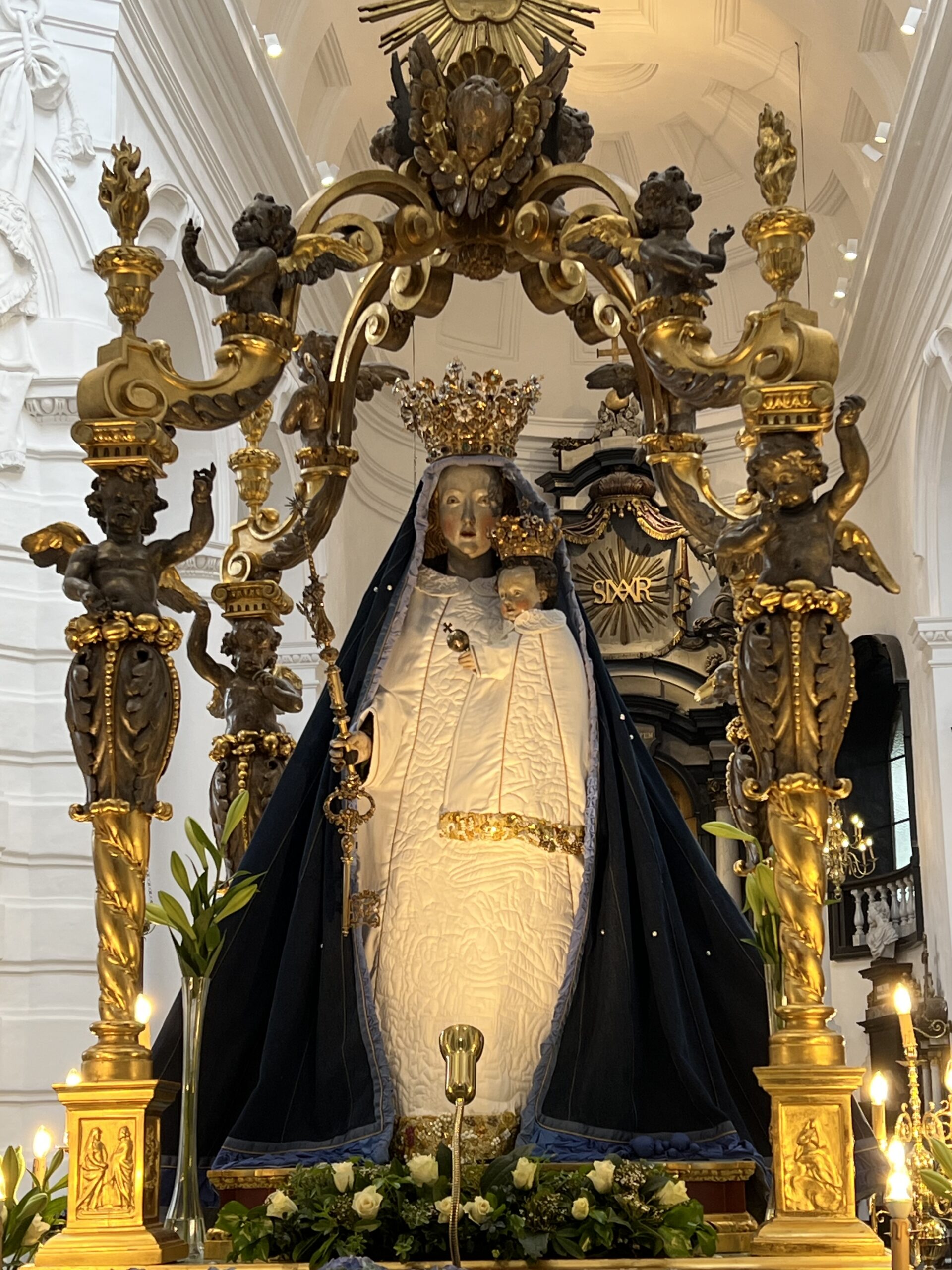
The archives of the basilica contain many testimonies of miraculous healings. The miraculous statue of Our Lady is made of polychromed walnut wood. The statue, made around 1590, shows Mary in a seated position and is 1.45 m tall. The infant Jesus is depicted on Mary's left arm, holding an apple in his right hand and a small globe in his left. Mary holds a sceptre with a key in her right hand. Our Lady has long, curly hair. The wooden, silver-plated and gilt throne on which Mary is seated dates from the last years of the 18th century.
Following the period of unrest, a new, Baroque church was built. The architectural plan was by the Mechelen architect and sculptor Lucas Faydherbe (1617-1697), a student of the renowned painter Peter Paul Rubens (1577-1640). Work began in 1663, and the church was put into use in 1678. The building has a dome that reaches up to 34 metres. This is the third church and current basilica where the statue is housed. This is a new effigy of Mary, as the old statue has disappeared. In 1737, the church was consecrated by Thomas Philippus d’Alsace (1679-1759), a member of a distinguished noble family, Archbishop of Mechelen (1716-1759) and Cardinal (1719-1759).
In 1783, Joseph II, Holy Roman Emperor (1765-1790), born Joseph Benedictus August Johann Anton Michael Adam (1741-1790), introduced measures against Catholics. The monks were forced to leave Hanswijk Monastery. Joseph II aimed to make the Church subordinate to the Emperor. In 1786, the church was transferred to local clergy.
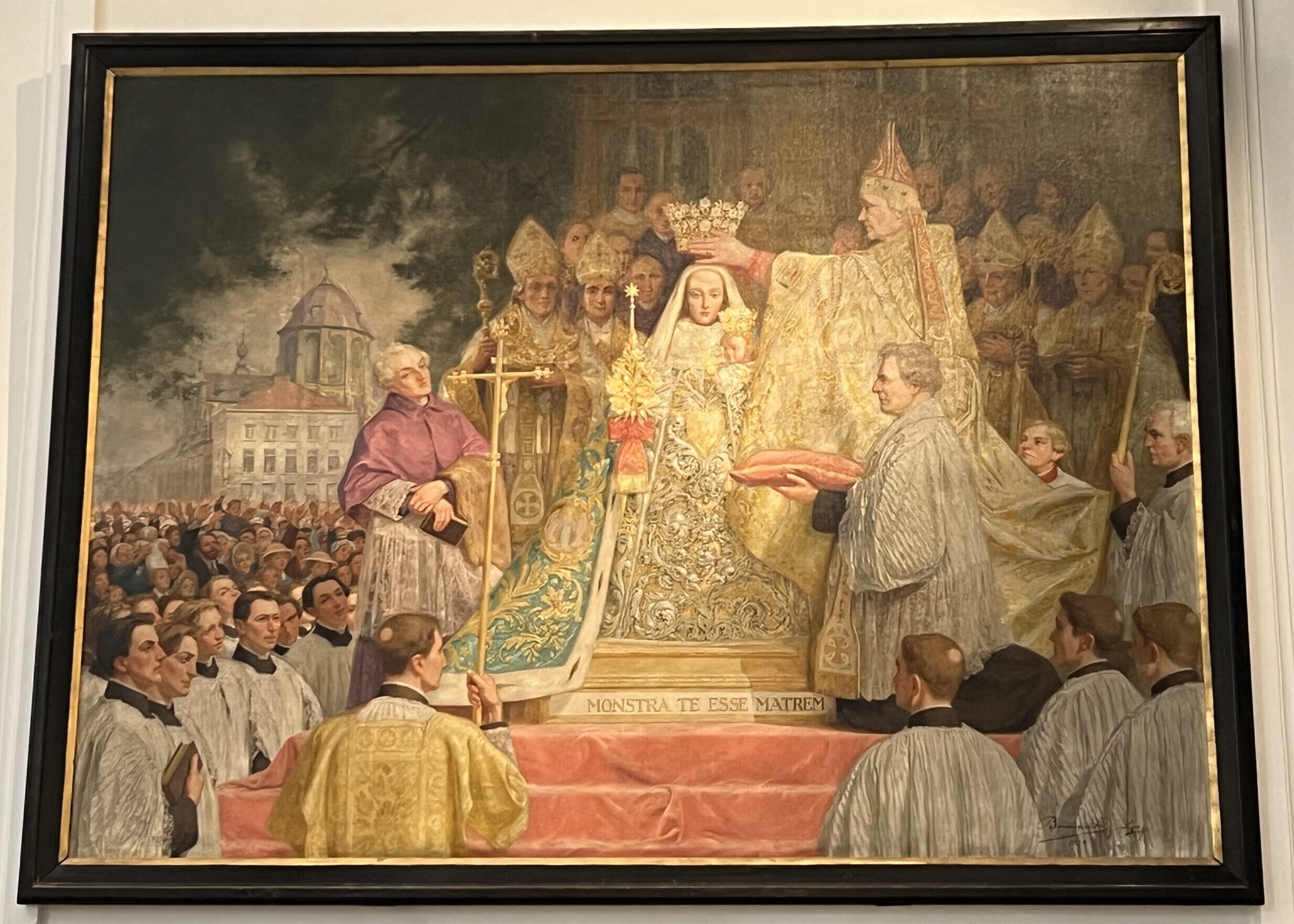
On 30 July 1876, the miraculous statue of Mary was crowned by Victor Augustin Isidore Dechamps (1810-1883), Archbishop of Mechelen (1867-1883). The golden crowns for Mary and Jesus are gifts from the people of Mechelen and contain over 500 brilliant-cut diamonds and precious stones. At the back of the basilica hangs a painting from 1926 commemorating the coronation.
In 1944, there was a heavy Allied bombing raid, but the church remained standing.
Many members of the Belgian royal family have visited the Marian statue of Hanswijk, including Louise-Marie of Orléans (1812-1850), Queen of the Belgians (1832-1850), Leopold II (1835-1909), King of the Belgians (1856-1909), with his wife Marie-Henriette Anne (1836-1902), Baudouin, Albert, Charles, Leopold, Axel, Marie, Gustave, Count of Hainaut (1930-1993), King of the Belgians (1951-1993) and Fabiola Mora y Aragón (1928-2014), Queen of the Belgians (1960-1993).
On 6 October 1987, the church was elevated to a basilica by John Paul II, Pope from 1978 to 2005, born Karol Józef Wojtyla (1920-2005).
The Basilica of Our Lady of Hanswijk was restored in the period 2013-2016.
Annually, on the Sunday before Pentecost, a procession, as thanks to Mary, processes through the centre of Mechelen and this originated during a plague epidemic in 1272, which Our Lady banished. The procession has over 1000 participants and several floats take part. Animals are also visible, such as a flock of sheep and many horses.
Pilgrimage site
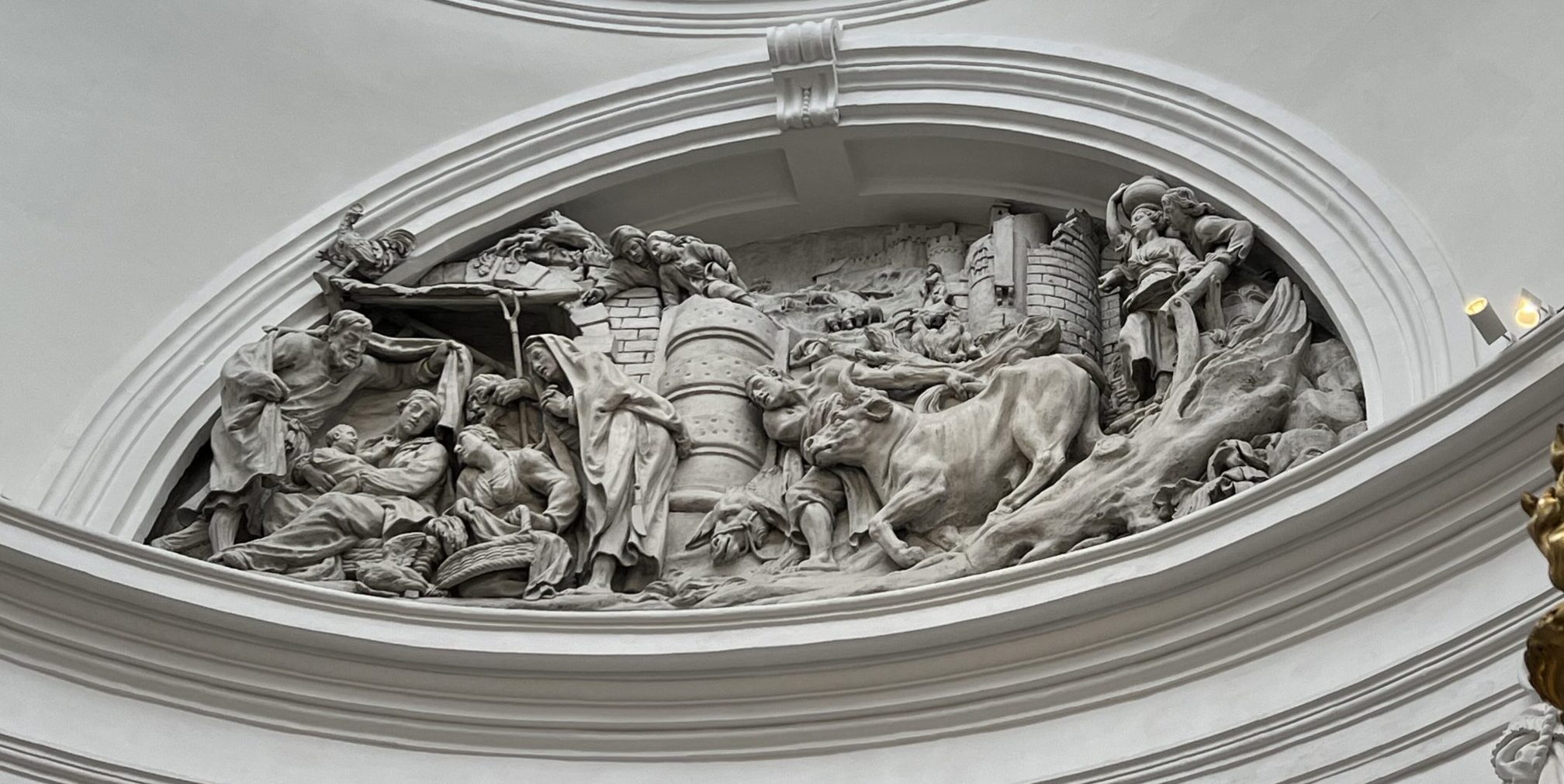
The architecture of the basilica is unique, as it is not only a Baroque church with three naves but also features a rotunda. This rotunda allows pilgrims to walk around the statue of Mary. In the dome, two large bas-reliefs are displayed, created by the Mechelen architect and sculptor Lucas Faydherbe (1617-1697). One of the shepherds is wearing pince-nez, and on the roof of the nativity scene, a rooster is depicted, which is a reference to Peter's later betrayal.
In the centre of the basilica is a wide rotunda, where four Church Fathers were depicted in 1729. The statues of Ambrose and Augustine are by Lucas Faydherbe. The Mechelen architect and sculptor Jan-Frans Boeckstuyns (c. 1650-1734), a pupil of Lucas Faydherbe, created the likenesses of Gregory and Jerome.
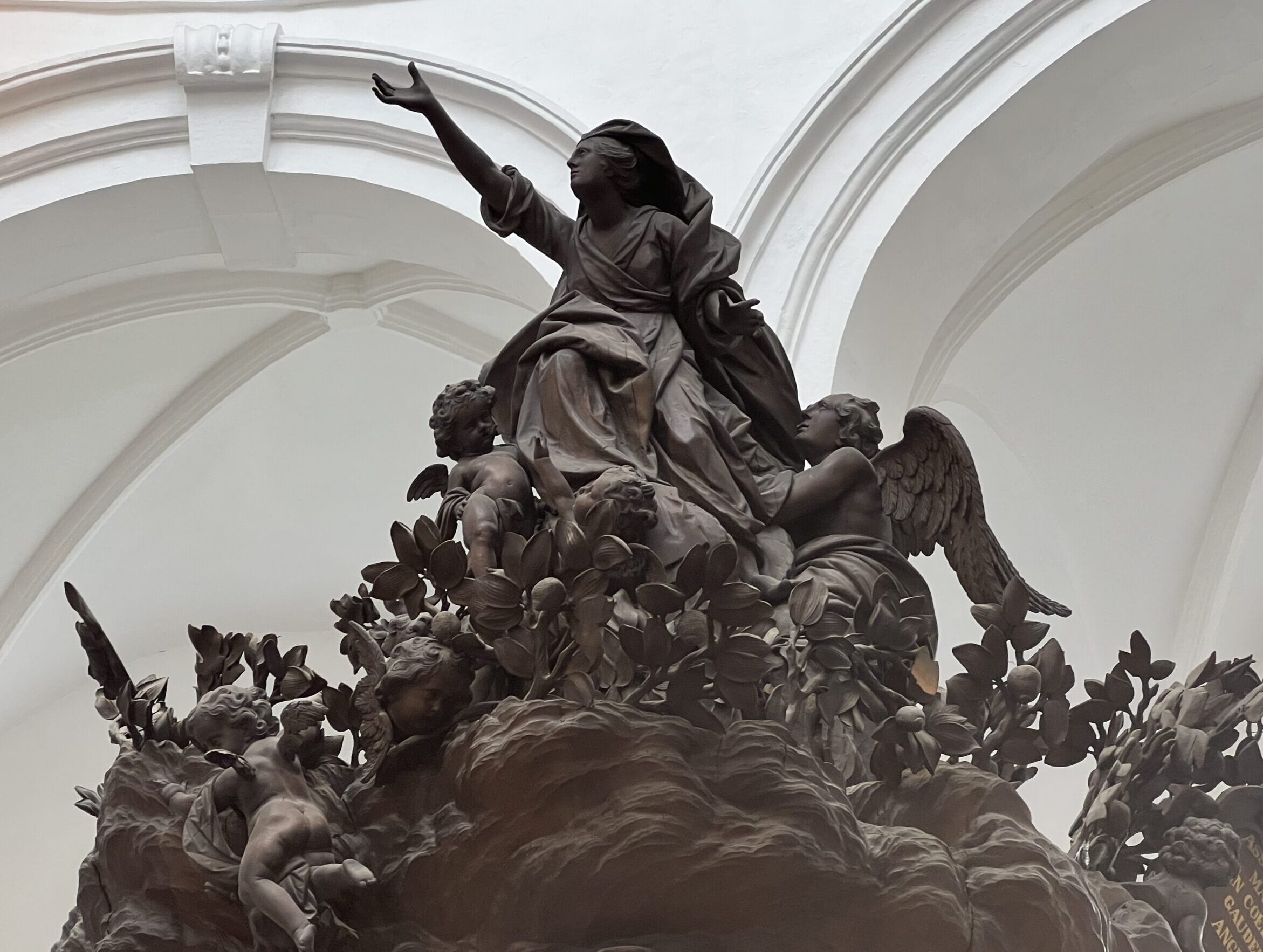
Beautiful woodwork also adorns the basilica, including a communion rail, confessionals, and an impressive pulpit. In 1746, Theodoor Verhaegen (1700-1759) from Mechelen crafted this oak pulpit. In 1747, the pulpit was consecrated by Thomas d’Hénin-Liétard d’Alsace (1679-1759), Archbishop of Mechelen (1716-1759).

The basilica has a tile floor pattern that marks a long path for pilgrims. The meaning is to persevere and not stray, as God guides people to the righteous path.
The crypt is well worth a visit and was extensively renovated in 1988.
The basilica is open daily.
ACCESSIBILITY
Mechelen is centrally located in Belgium, between the large cities of Antwerp and Brussels. The address of the basilica is:
Hanswijkstraat 71 – 2800 Mechelen.
Op www.hanswijkbasiliek.com up-to-date information can be found.
Experience
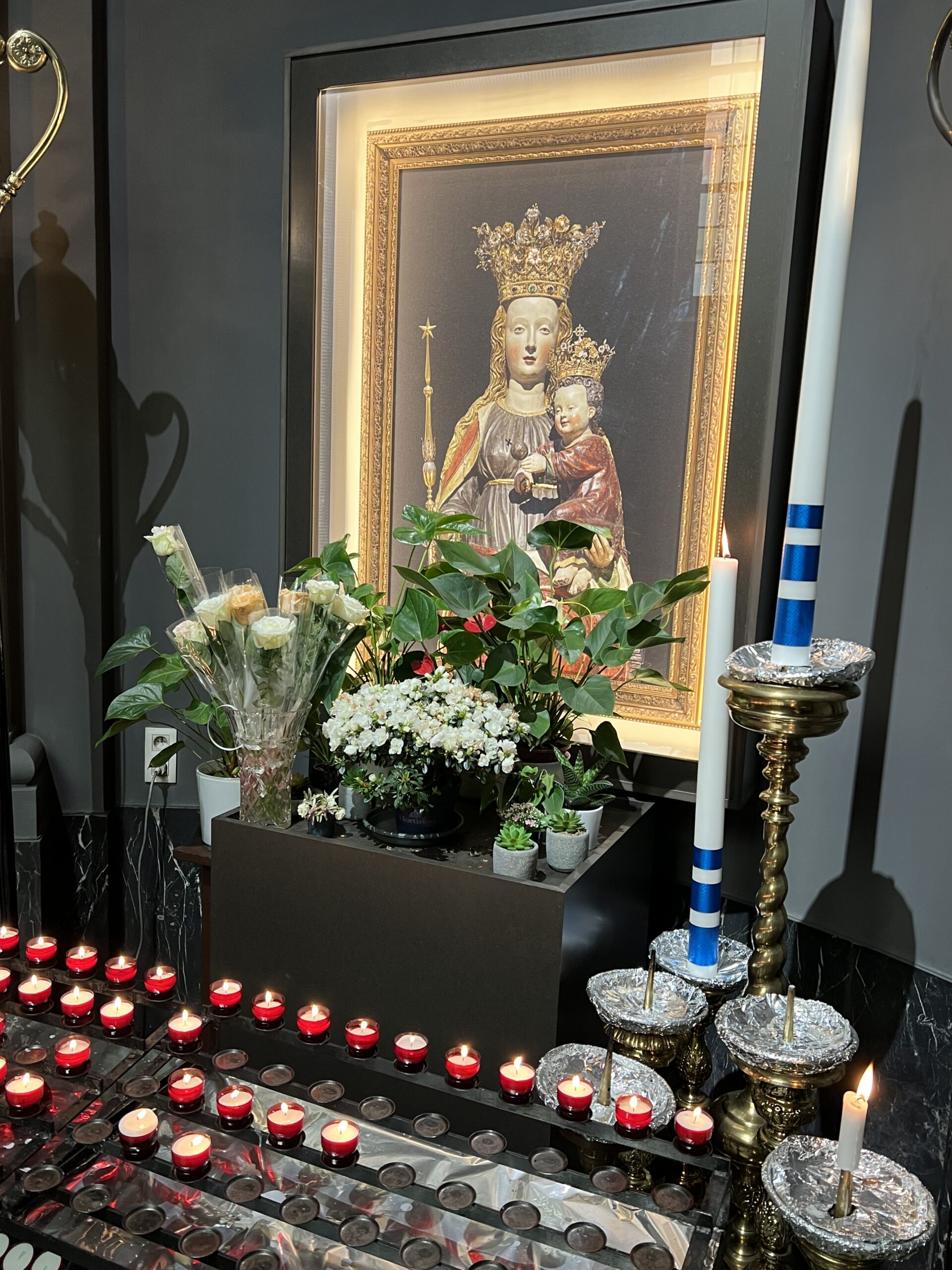
In Mechelen, I visit the Basilica of Our Lady of Hanswijk. In the Chapel of Our Lady, I see an image of Our Lady behind glass, and many candles are burning here. A few more lights are added, giving thanks to Mary for allowing me to visit and for a few friends who could still use some strength from the Mother of God.
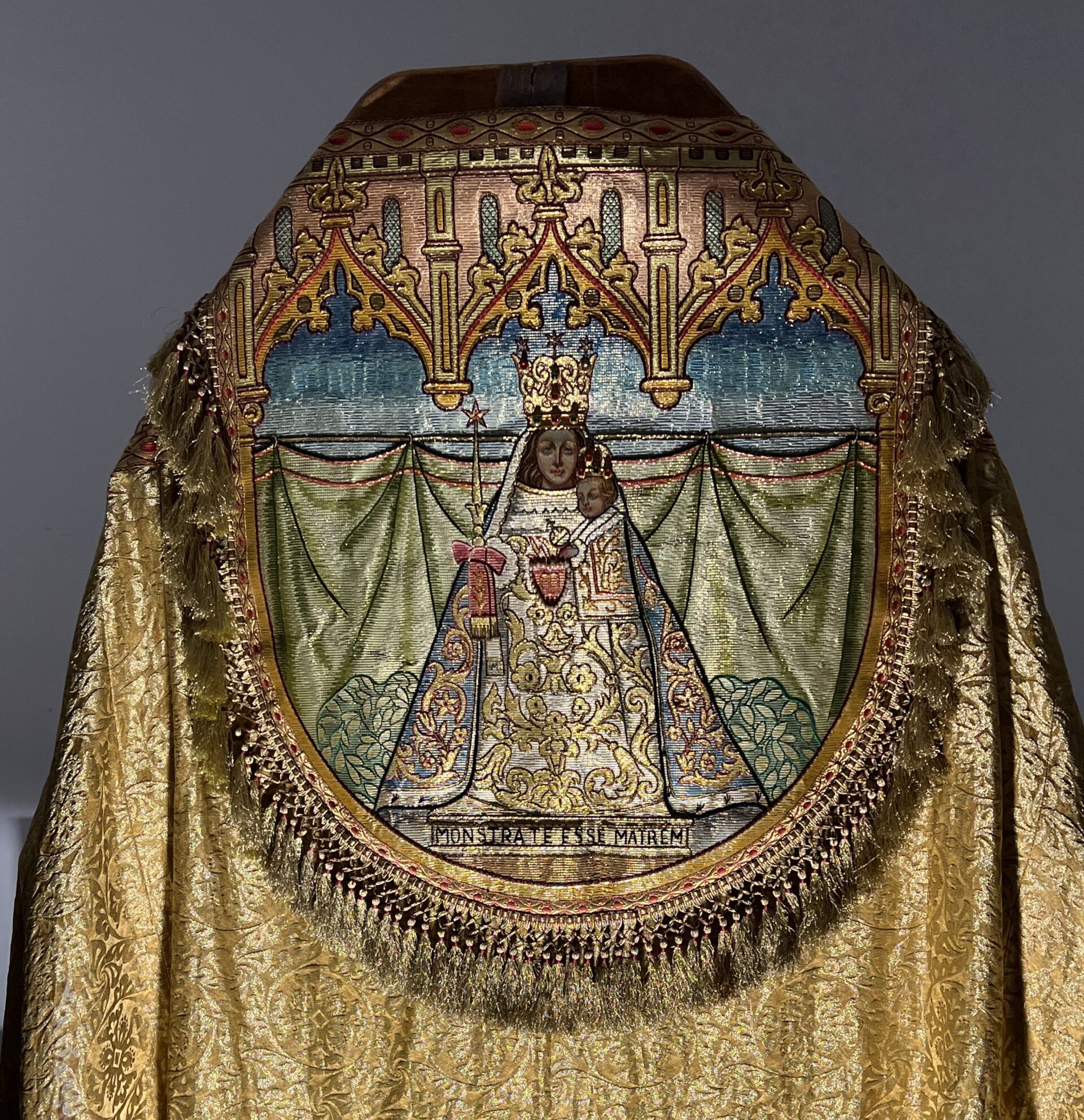
In the treasury, I see, well-protected behind thick glass, a cloth from the image of Our Lady of Hanswijk. There is also a chasuble with the likeness of Our Lady of Hanswijk.
In the middle of the basilica stands the statue of Our Lady of Hanswijk, surrounded by a profusion of flowers. The text “monstra te esse matrem” (show that you are a Mother) reminds me of the origin of the annual procession, which was first held in 1273. In 2023, the procession of Our Lady of Hanswijk will take place for the 750th year. For this anniversary, a new mantel and a new dress have been made for the statue of Mary. I am told that the new clothing for Mary was made by students from the fashion department of the Ursulinen Institute in Mechelen. Only a few of the makers have visited the basilica before, and the commission to make new clothing is an opportunity for them to get acquainted with the basilica and the statue of Mary. The white dress is trimmed with a band embroidered by the students, in which beads from old rosaries and jewellery, collected by the parish, have been incorporated. The mantel is made from old, unsold jeans and other reused fabrics.
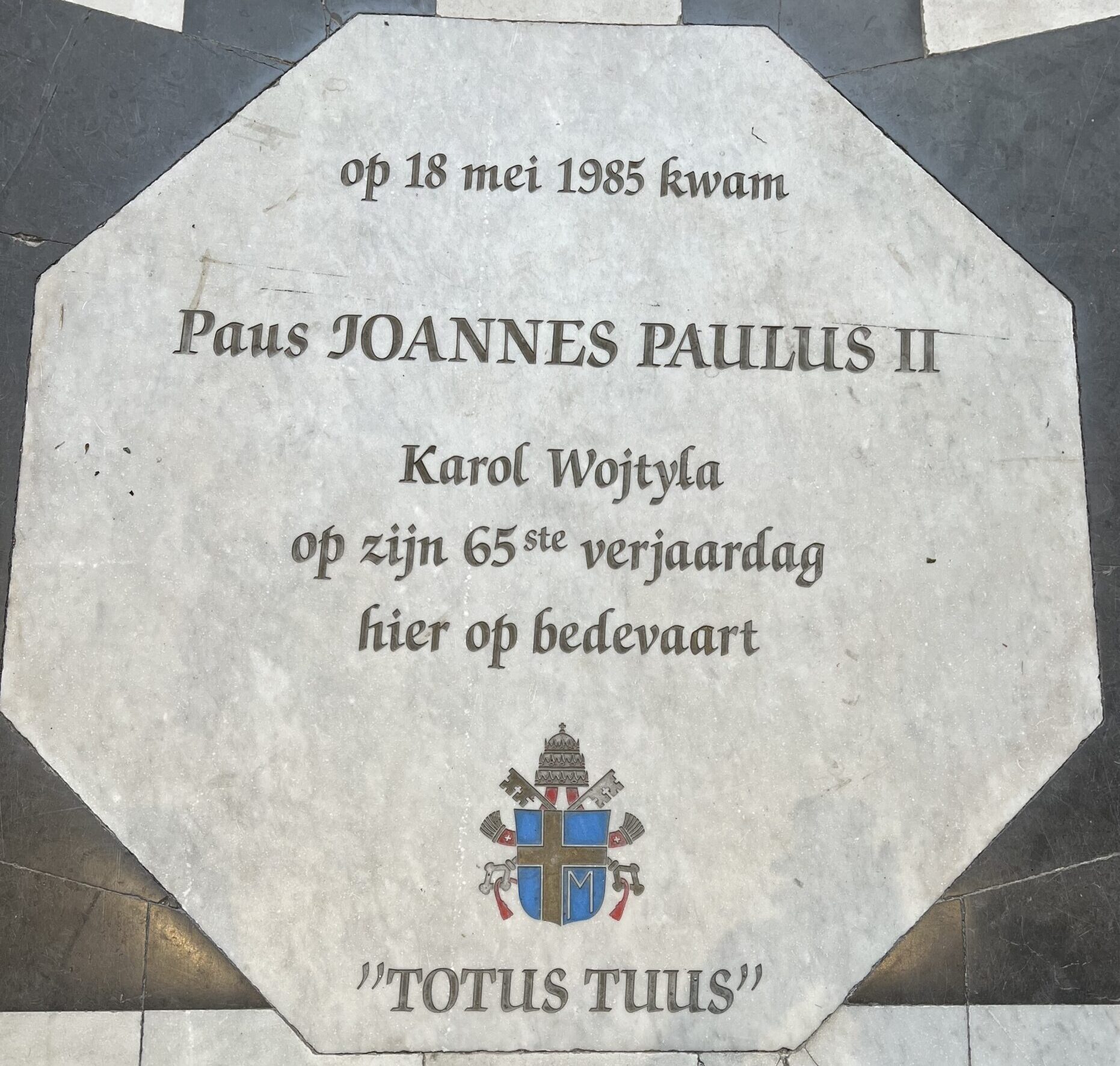
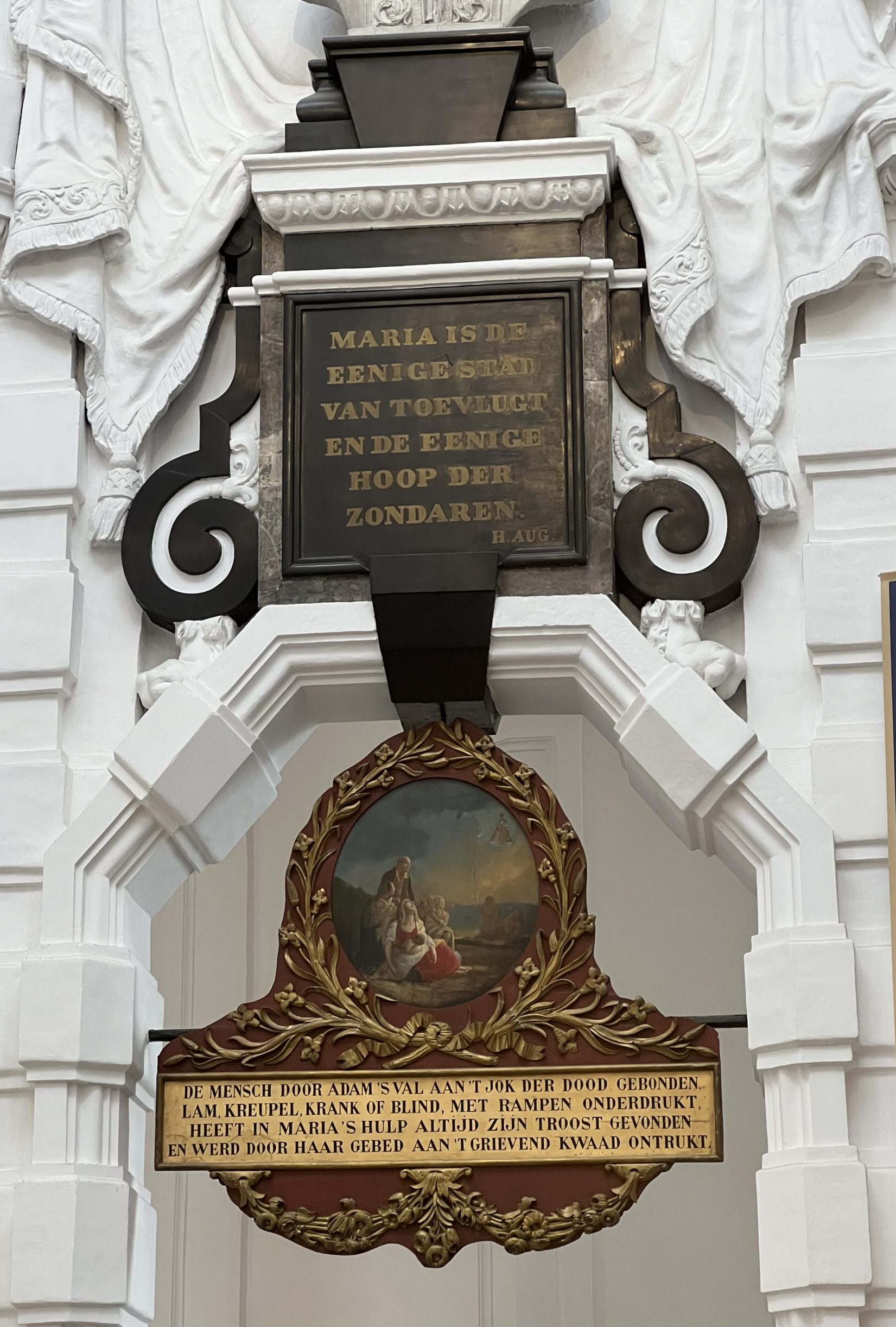
In the middle of the basilica, I see a large floor tile, which states that Pope John Paul II was here on his 65th birthday, 18 May 1985, to greet Our Lady of Hanswijk and to pray to Her.
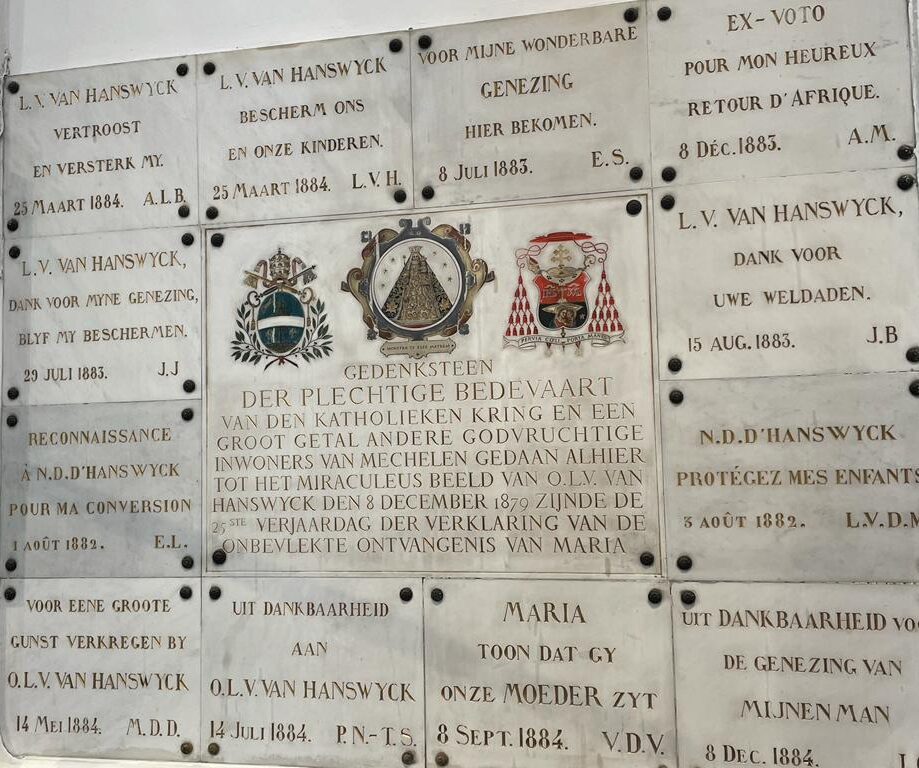
Many testimonials from believers have been affixed to the basilica's walls. All these plaques are made of white marble, and I understand that 344 proofs of gratitude have been affixed for overcoming an illness, having a baby, keeping a job, and cherishing a relationship.
Paintings, a pulpit with Our Lady and statues adorn the basilica. What a gem this is!
On the Sunday before Pentecost, I'm going to Mechelen again, because then the procession will go through the city centre.
Environment
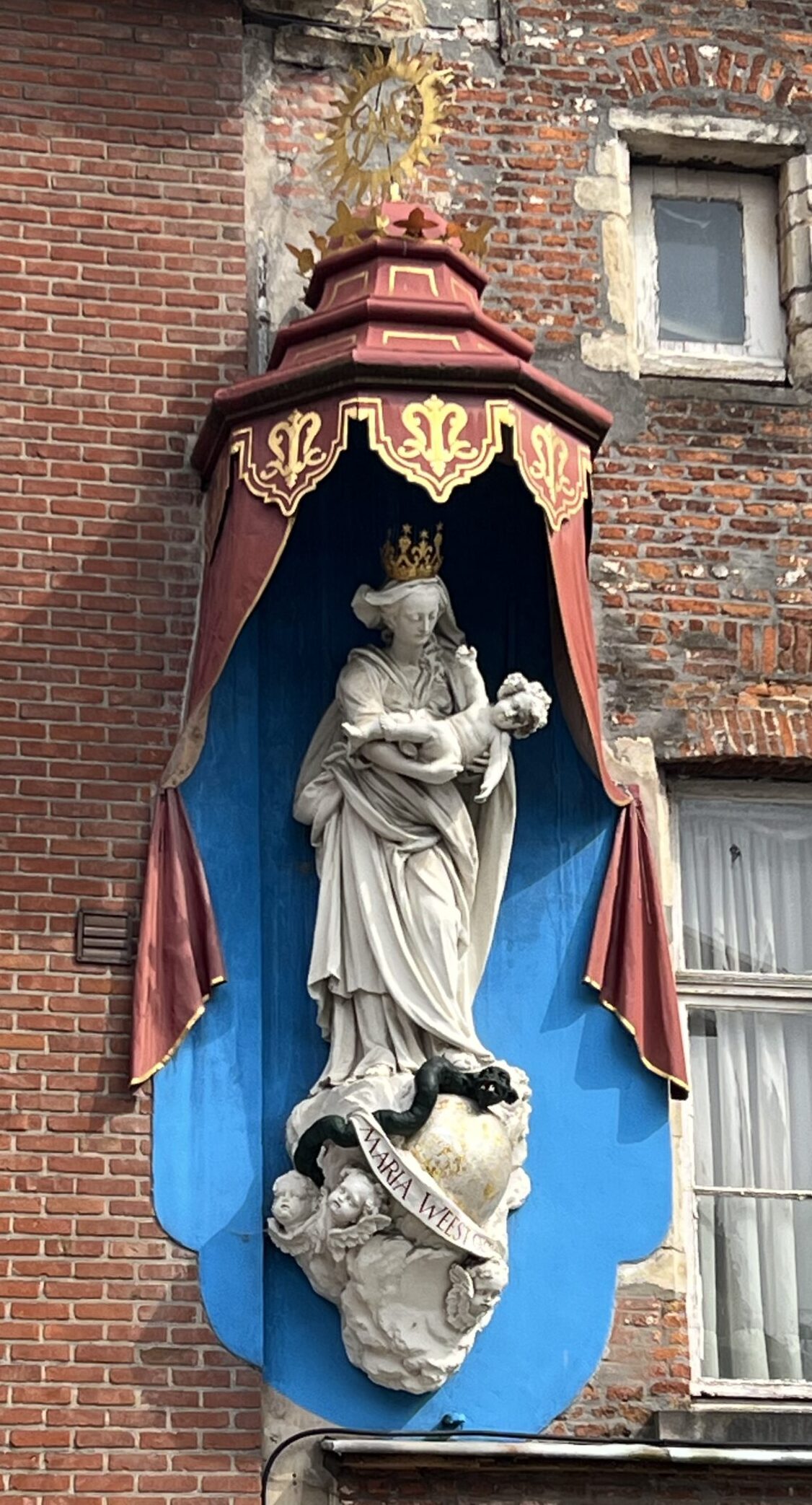
In Mechelen, there's more to see than the basilica, such as the cathedral and the historic city centre with many images of Mary. The town is situated between the large cities of Antwerp and Brussels, where there's much that is to be seen of Mary and art treasures can be admired in museums and churches.
~~~
