History
Margravine Marie Thérèse Thècle Joséphine de Nédoncel (1810-1887) is instrumental in shaping the grounds of the Oostakker pilgrimage site. She married Marquis Alphonse de Calonne de Courtebourne (1788-1857) in 1829.
In 1873, the marquise Marie-Thérèse de Courtebourne – de Nédouchel, who resided at the nearby castle Slotendries, where a hermit once lived, had the hermitage converted into an aquarium. One of the niches was made to accommodate a statue of Mary. Thus, the first grotto in honour of Our Lady of Lourdes outside of France was created. Local residents were granted permission by her to visit the grotto and pray there on Sundays and feast days. In 1873, the image of Mary was consecrated, this was only 15 years after Mary's apparitions in Lourdes to Bernadette Soubirous.
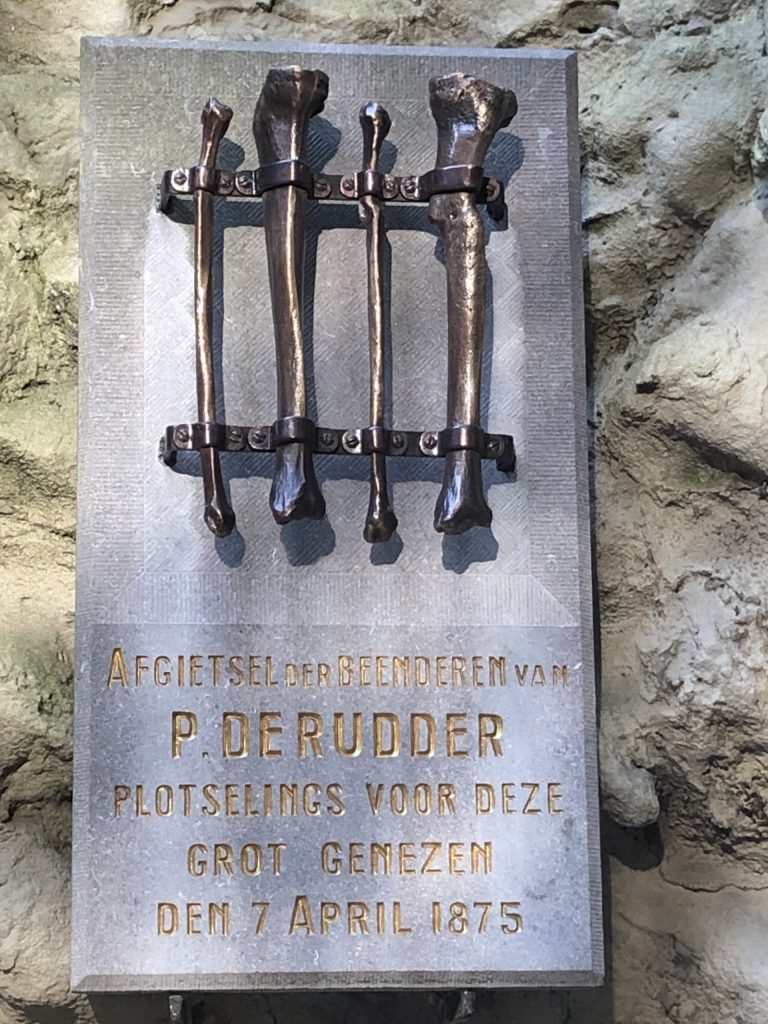
On 7 April 1875, a miracle occurs at the Lourdes grotto; Pieter De Rudder from Jabbeke is miraculously healed of an open leg fracture, which he sustained in 1868 from a falling tree. The leg was shattered and did not heal. The man arrived in Oostakker on crutches, hobbled to the Lourdes grotto and prayed. Suddenly, he could stand without crutches. The miracle had happened! It is remarkable that Pieter De Rudder was healed at a Lourdes grotto outside the French city of Lourdes and without Lourdes water. This leads to a large influx of visitors to the grotto. After all, people then realise they do not have to travel to faraway Lourdes in the south of France to be healed. After examining the leg, the healing was recognised as a miracle. The miracle is the 8th officially recognised healing by Lourdes. This announcement brings even more visitors to the pilgrimage site.
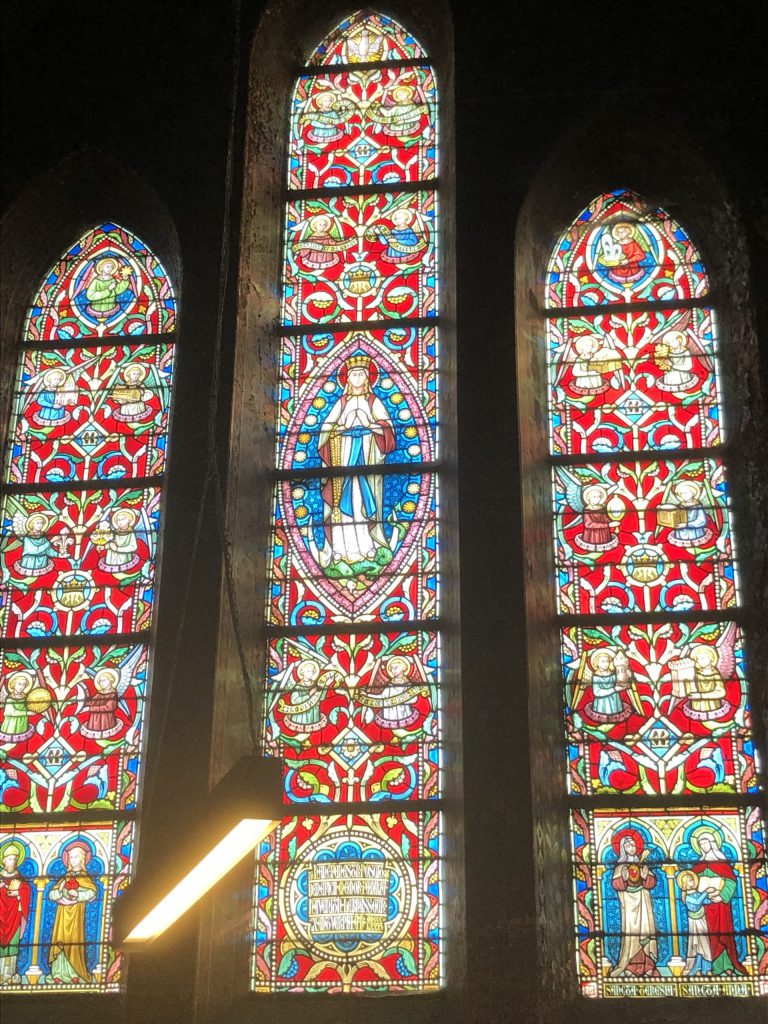
Due to the steady increase in the number of pilgrims, a church is being built next to the grotto. The Marquise de Courtebourne decides to entrust the management of the pilgrimage site to the Jesuit fathers. The design of the church is by the Ghent architect Emile/Honore Van Hoecke-Peeters (1837-1919), who also designed the grotto. Construction begins on 22 May 1875. The building is constructed in neo-Gothic style and is consecrated on 11 September 1877 by Vincenzo Vannutelli (1836-1930), nuncio in Belgium of Pius IX, Pope from 1846 to 1878 (Giovanni Maria Mastai-Ferretti, 1792-1878). The church is completed in 1887 and the interior is finished in 1888. Baron Jean-Baptiste Charles François De Bethune (1821-1894) was responsible for the decoration of the church.
In 1883, chapels of the Seven Sorrows of Mary were built, and in 1903, the buildings of the secrets of the rosary were added to the Marian shrine.
In 1908, Gustavus Josephus Waffelaert (1847-1931), Bishop of Bruges (1895-1931), recognised the miracle of Pieter De Rudder.
In 1913, 15 rosary chapels were made by Fernand Nisol (1868-1937) from Eeklo.
On 8 September 1918, shortly before the Armistice of the Great War (World War One, 1914-1918), a Monument of Supplication was erected at the basilica. This memorial was created by the Ghent sculptor Joseph Adrien Cornelis (Jozef) Cornelis (1873-1940). The accompanying text reads: “The people of Ghent firmly await peace through Mary's help and prayer’.
In 1924, during the 50th anniversary celebrations of the grotto, the neo-Gothic church was elevated to the status of a basilica by Pope Pius XI. The basilica is dedicated to Our Lady of the Immaculate Conception. The statue of Mary, which stands at the front of the basilica, was crowned in 1888. This took place on the orders of Leo XIII, Pope from 1878 to 1903 (Vincenzo Gioacchino Raffaele Luigi Pecci, 1810-1903).
In 1958, 100 years after the apparitions in Lourdes, the Ghent sculptor Albertus (Bert) Servaes (1909-1994) created an effigy of Saint Bernadette Soubirous for the pilgrimage site Oostakker-Lourdes. The Bernadette statue is made of white marble from Carrara, Italy. This effigy stands on a granite pedestal from the Mont des Espéluges, the mountain behind the Grotto at Lourdes. This pedestal was previously used as a cornerstone of the cornice of the baths next to the Grotto at Lourdes. On the side of this granite block is the French text “Allez boire à la fontaine et vous y laver”. In Dutch, this means “Go drink at the spring and wash yourself there”. The words come from Mary during the apparition to Bernadette at the Grotto on 25 February 1858.
Until 2002, Jesuits worked at the pilgrimage site.
In Oostakker on 9, 10 and 11 May 2025, the relics of Bernadette Soubirous, the visionary of Mary at Lourdes in 1858, will be present.
Pilgrimage site
The towering basilica is the dominant building on the Oostakker-Lourdes site. Behind the basilica, you can find information about the miraculously healed Pieter De Rudder.
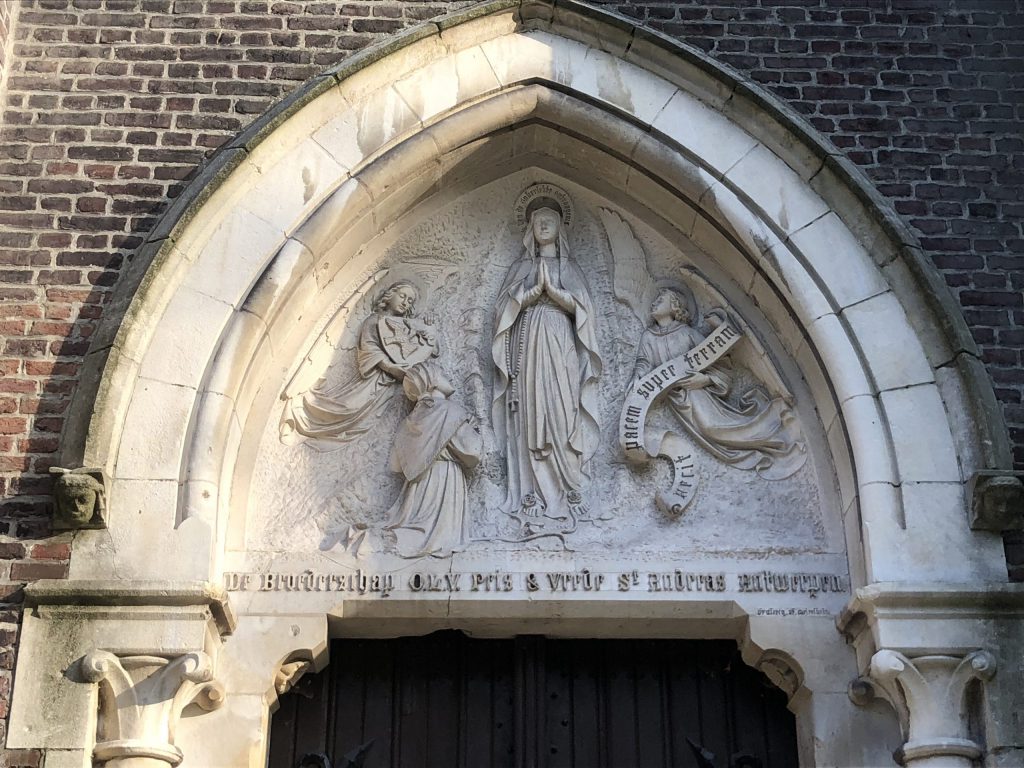
Above the main entrance to the basilica, a large relief dating from 1904 is mounted. It was created by the Antwerp sculptor Jan Gerrits. In the centre is Mary of the Immaculate Conception, as this church is dedicated to Her. Mary is flanked by two popes. To Her left is Pope Pius IX with an image of Lourdes in the background and to the right is Pope Pius X with a silhouette of Oostakker behind him.
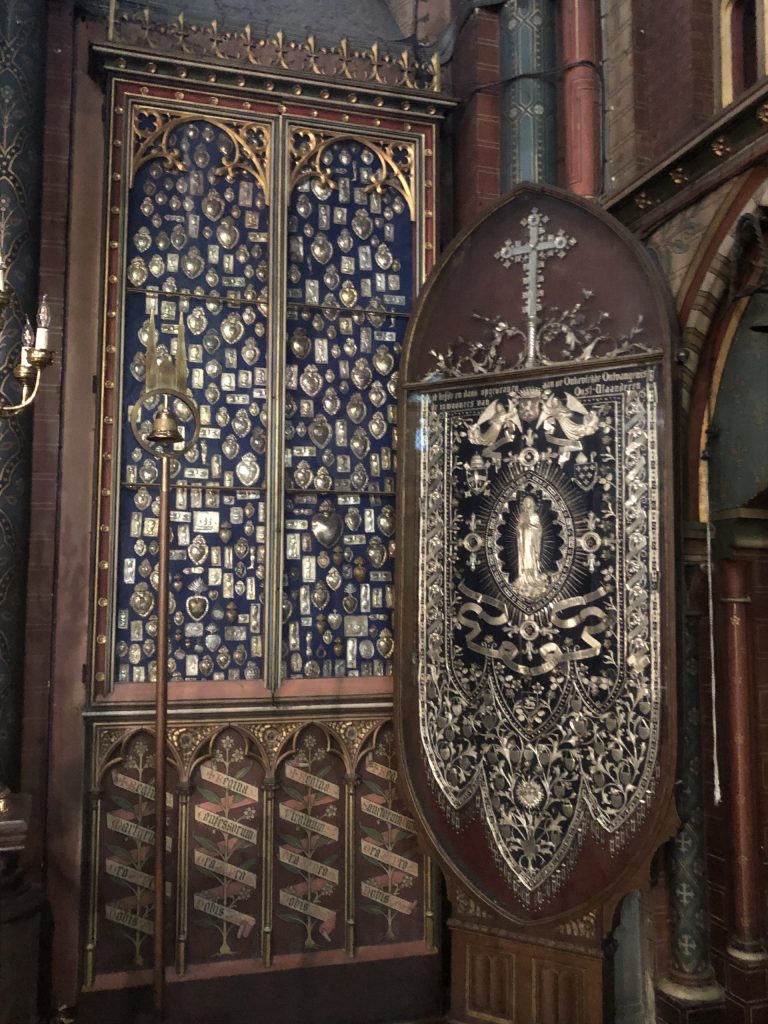
In the vestibule of the basilica, the walls are almost entirely covered with marble ex votos. Many testimonials of gratitude to Mary can be seen here.
Next, enter the basilica. The somewhat dark interior is entirely painted, and stars are decorated on the vaults.
A statue of Bernadette is also in this grand house of God, in the Bernadette Chapel. In 1958, to mark the centenary of the apparitions in Lourdes, France, a new statue of Bernadette was installed. It is carved from white marble from Carrara, Italy, and stands on a pedestal. The creator is sculptor Bert Servaes. Within the basilica, there is a relic of Saint Bernadette, as well as a stone from the Lourdes grotto.
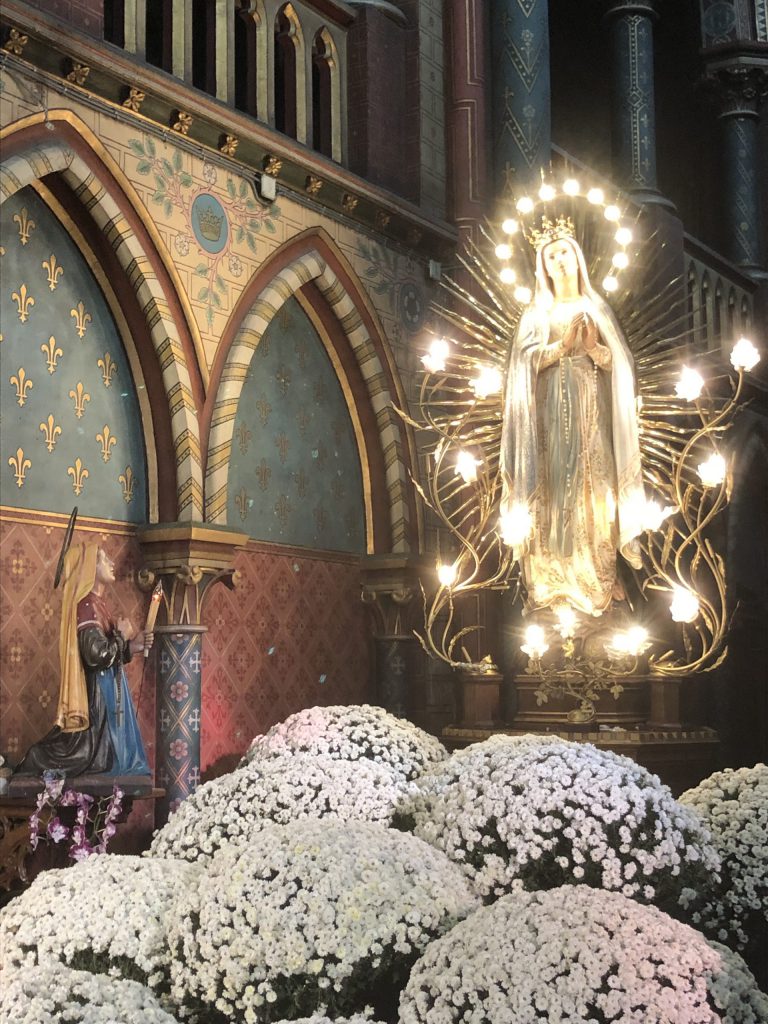
At the front of the basilica stands the large, crowned statue of Mary Immaculate Conception. The figure is 1.75 m tall and was made by the French sculpting company Froc-Rober (1855-1903). The statue was crowned on 5 August 1888 by Hendrik Karel Lambrecht (1848-1889), Bishop of Ghent (1888-1889).
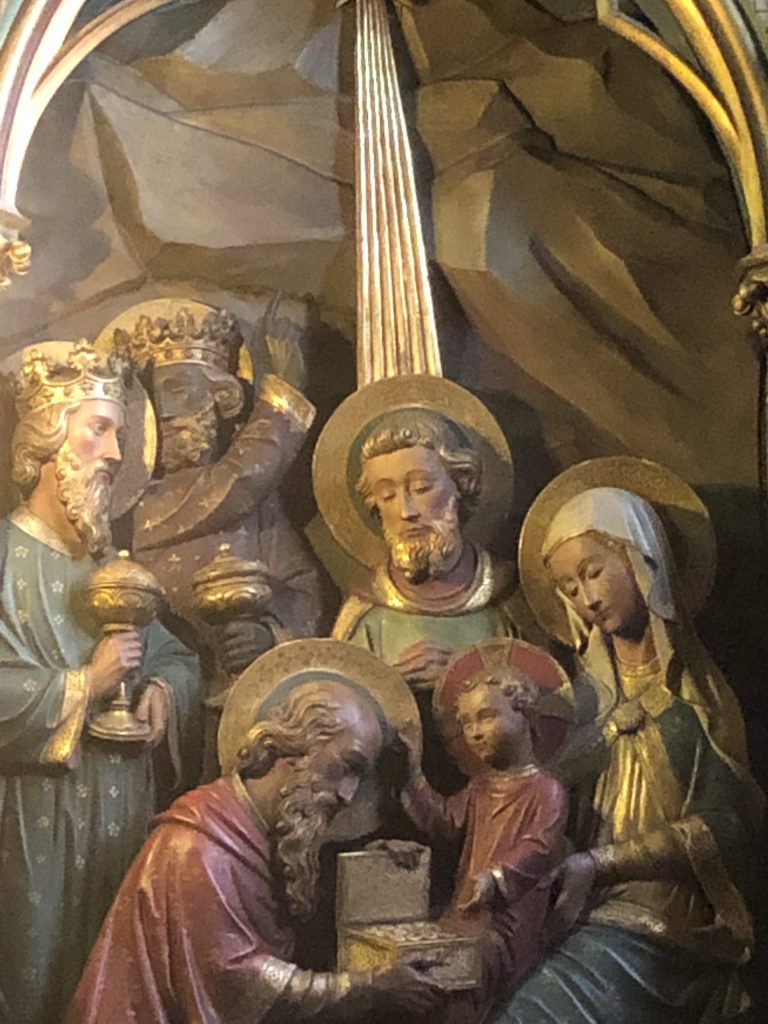
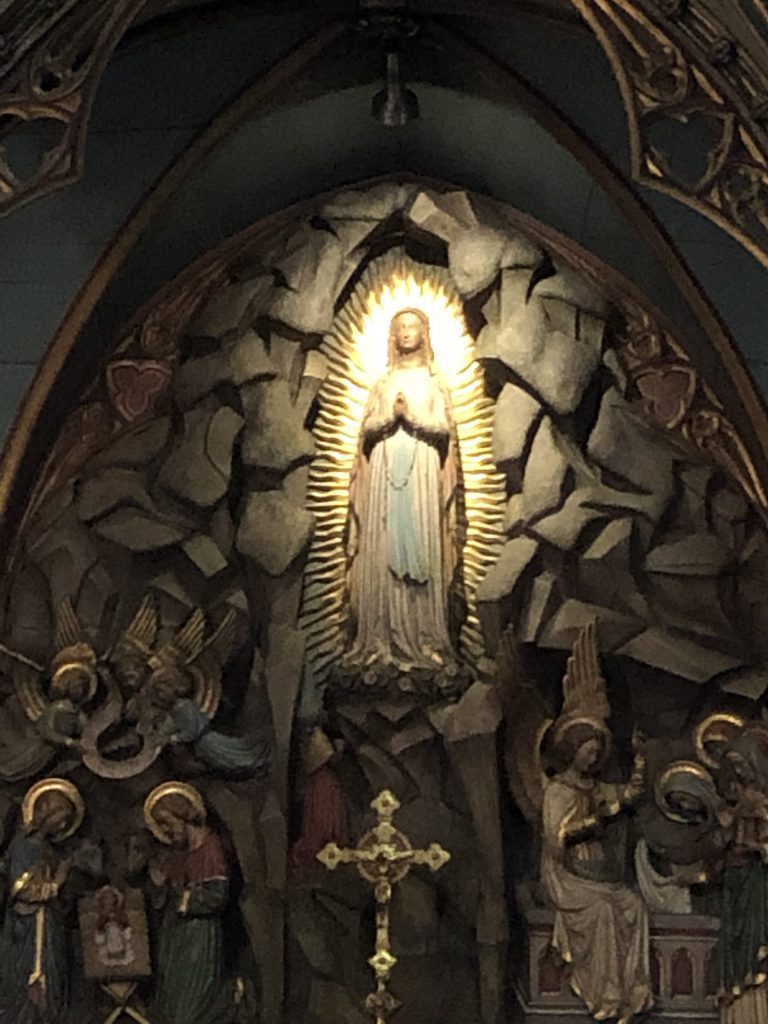
The altarpiece above the high altar, which is covered by a polychrome ciborium with 4 columns, depicts three grottos: the grotto of the Nativity of Jesus, the grotto of the Resurrection of Jesus, and the Grotto of Lourdes, where Our Lady appears to Bernadette Soubirous.
In the basilica, a Stations of the Cross can be followed with evocative scenes of Jesus' suffering. In the towers, there is a carillon with 49 bells. In 1954, these bent cones with clappers were made by Klokkengieterij Michiels.
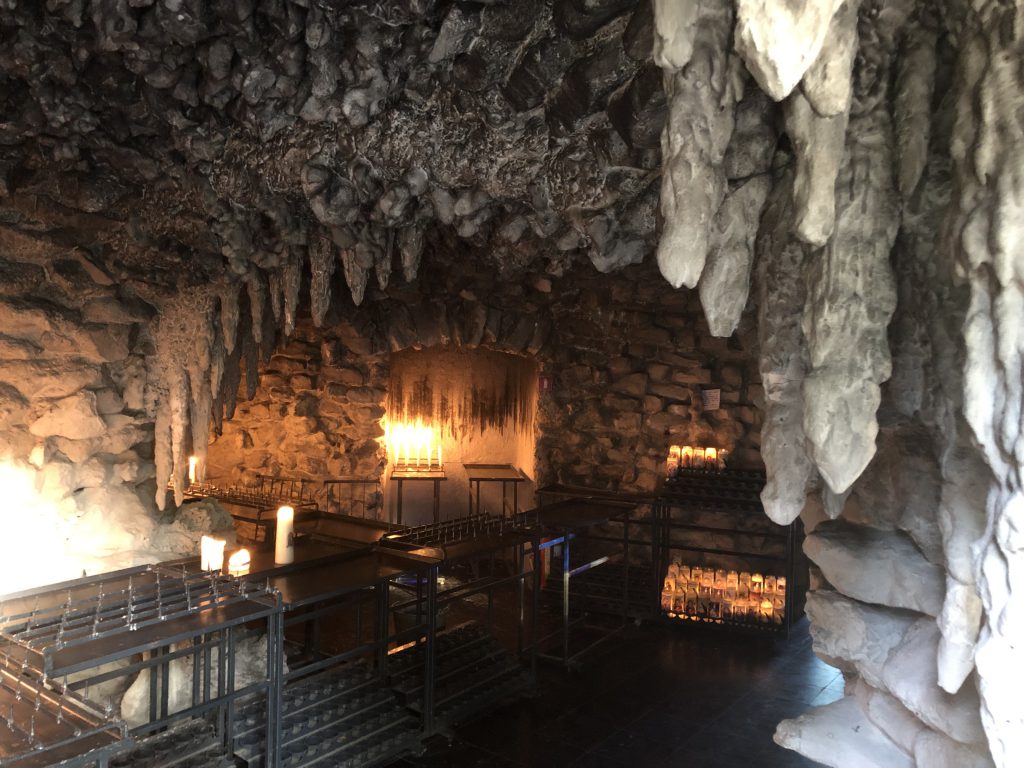
The grotto is a striking beacon due to the many burning candles. At the entrance, two bones refer to the miraculous healing of Pieter De Rudder. Mary is visibly present and there are more than 300 uncovered seats in front of the grotto. Pieter De Rudder's leg can be seen on two X-rays preserved in the office of the Marian shrine.
Within the grounds, two processions have been laid out. One procession is for the Seven Sorrows of Mary and the other prayer walk covers the fifteen mysteries of the Rosary. For devotional items, there is a shop next to the grotto. Statues, cards, candles, and other religious objects are available there.
Next to the basilica is the restaurant “Hotel De Lourdes”. This establishment has existed since 1876 and is frequented by many people after visiting Mary.
The basilica and the grotto are open all year round.
In the 21st century, Oostakker-Lourdes receives an average of 250,000 to 300,000 visitors per year.
ACCESSIBILITY
Oostakker is a sub-municipality of Ghent and is located near the port area on the right bank of the Ghent-Terneuzen Canal. From the Antwerp to Ghent motorway (A14), take the Destelbergen exit, follow the R4, then follow John Kennedylaan (N 424), Henri Farmanstraat, Motorstraat, and Lourdesstraat. Oostakker is also accessible via the A11.
Address: Oostakker-Lourdes, Onze-Lieve-Vrouwdreef 12, 9041 Oostakker.
More information is available at www.basiliekoostakker.be.
Experience
Upon arriving in Oostakker-Lourdes and reaching Onze-Lieve-Vrouwdreef, I first head to the grotto. At the entrance to the grotto, a plaque reminds me of the miraculous healing of Pieter De Rudder. After this wondrous event, visits to this grotto really took off. Here I am at the most famous replica of the Grotto of Lourdes! So many candles are burning here! In the grotto, I pray to Mary and thank her for the prosperous journey.
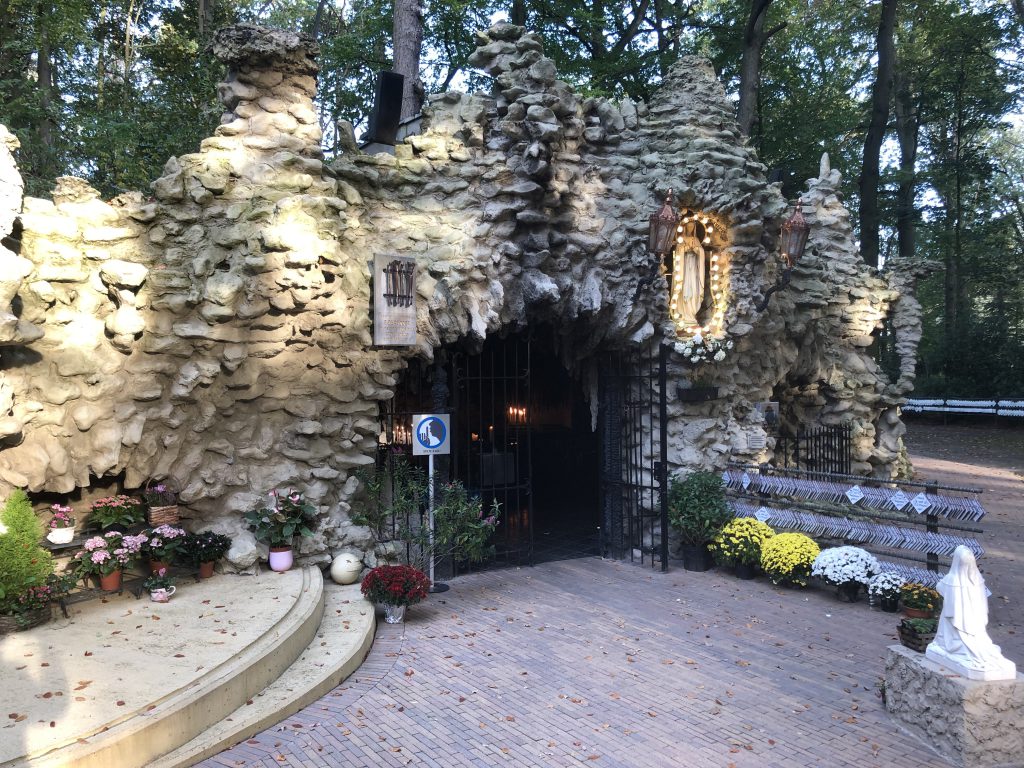
When I leave the cave, I notice lots of little signs of thanks. These show that Mary has been thanked a lot for a healing, a successful exam, a beautiful love, a good feeling, and more.
Next, I visit the basilica. In this large space, the crowned statue of Mary makes the greatest impression on me. How this statue illuminates the basilica! I pray in silence again.
I then continue my tour of this church building and arrive at the statue of Bernadette. My thoughts turn to her, and stories about her life in Lourdes, Bartrès and Nevers come to mind. I also pray here, and my words are about her strong will to help people.
After visiting the basilica, I'm going to the processions of the Seven Sorrows of Mary and those of the mysteries of the rosary. Finally, I'll go to the devotional shop. There's so much on display. I decide to buy something for a friend.
Environment

A beautiful Marian chapel stands in Lokeren; it is the Our Lady of the Head Chapel, located at Oude Heerweg and Karrestraat. The chapel is also called “Our Lady of the Head”. It is the chapel for the Bergendries district, also known as Kopwijk. The name “Kop” (Head) dates back to the 15th century. It is the shape of the landscape that gives rise to the name “Kop”. The ground of the chapel is slightly elevated between a wooded area and some meadows. It is a Neo-Gothic district chapel from 1899, built from bricks. The architect is Alphonse De Pauw (1867-1937). This chapel replaces an old chapel from the 16th century. The dimensions of the Kopkapel are 14 m deep and almost 7 m wide. On 7 May 1899, the consecration was performed by Antoon Stillemans (1832-1916), Bishop of Ghent (1890-1916). Approximately 12,000 interested parties were present.
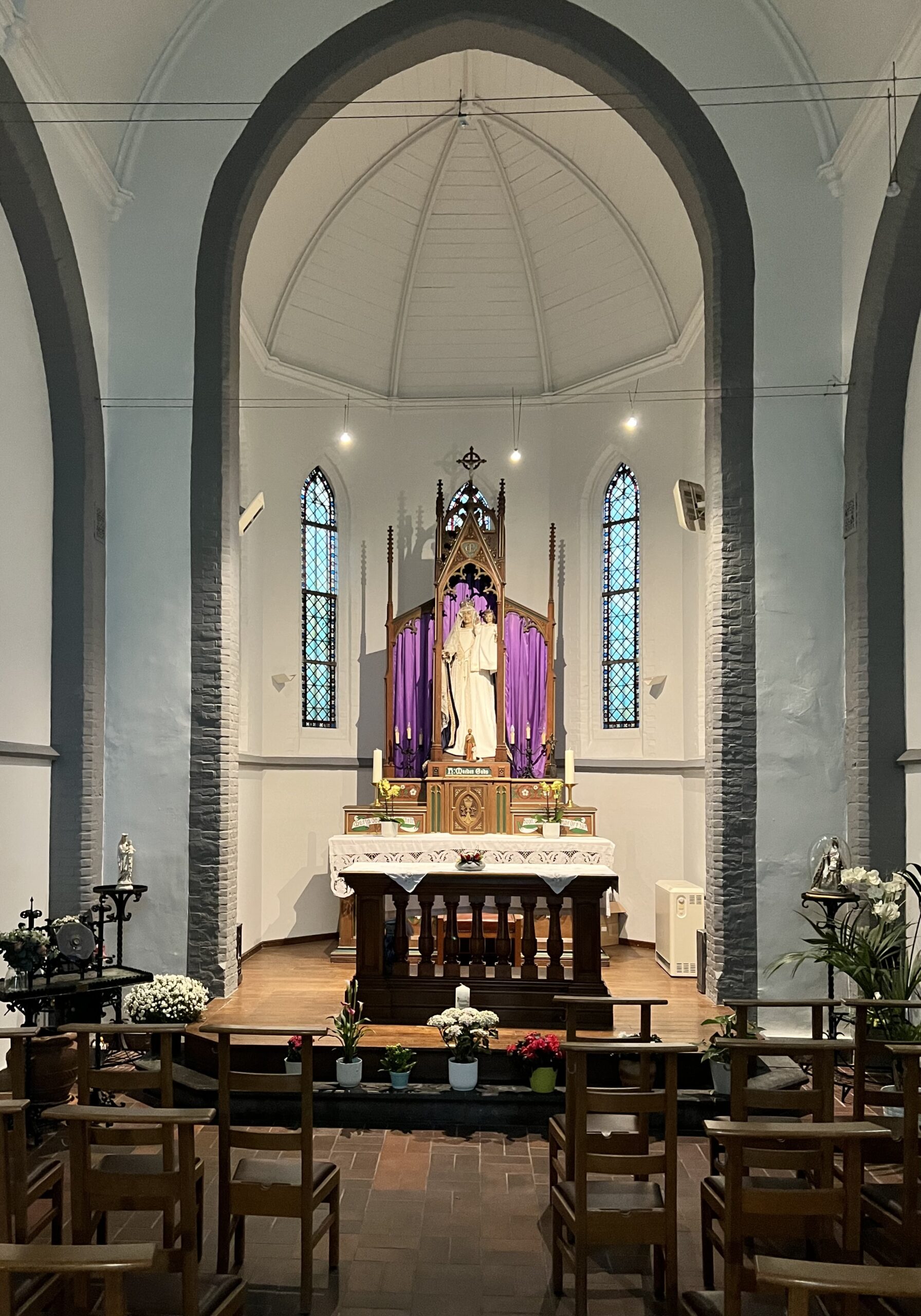
In the Neo-Gothic district chapel, you can see the Rosary stations by sculptor Aloïs De Beule (1861-1935). The chapel displays beautiful statues, including a large depiction of Mary and Child on the altar. Below it is the text “Mary, through your intercession, shows that you are our mother”.
The Kopkapel is visited by believers; among them are those seeking healing for their own heads or those of others. The beautifully situated chapel receives many visitors, and as a result, many candles are always burning.
From Lokeren, it's 21 km west to reach Oostakker-Lourdes.

~~~
