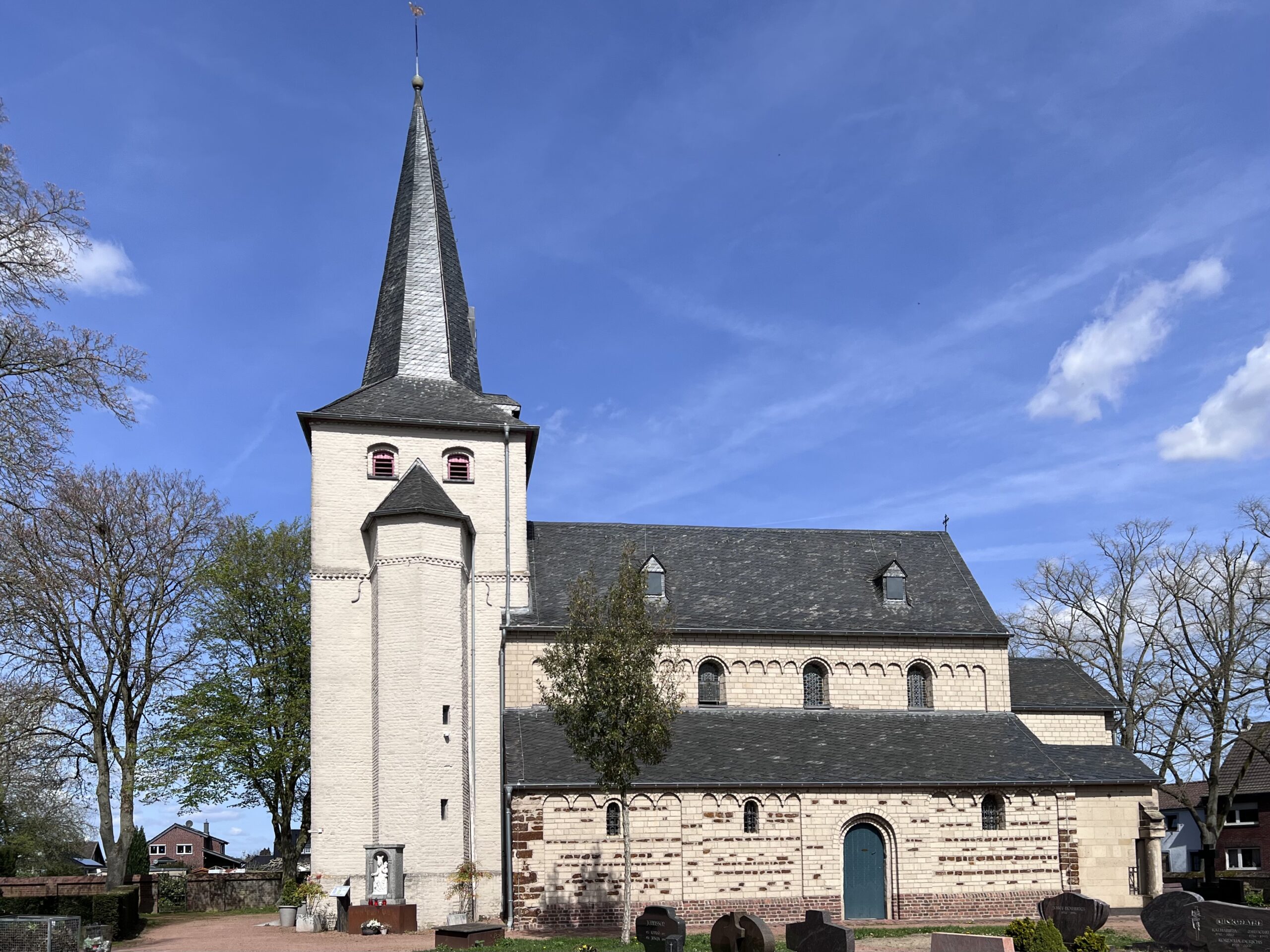
History
In 1196, Count Otto von Born (c. 1160-c. 1224) and his wife Petronella von Limburg (c. 1183-c. 1223) donated the land for the establishment of a Cistercian monastery.
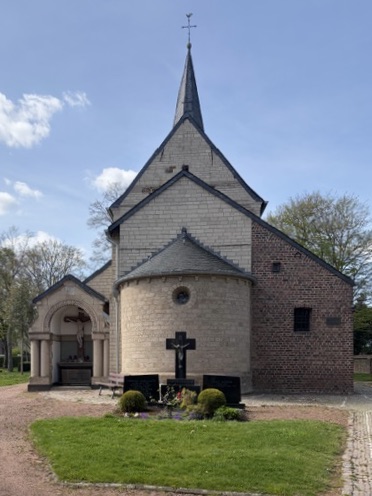
The pilgrimage church dates from 1198 and is partly made of tufa stone; a rock formed from volcanic ash and debris. The church was part of a Cistercian monastery.
In 1247, the monastery was moved to Dalheim. The church remained until 1571, and ownership of the buildings, including the church, passed to the parish of Ophoven. The monastery church then became the parish church.
The image of grace dates from 1350.
The Antwerp altarpiece, carved from oak, depicting the Assumption of Mary, dates from 1520 and arrived in Ophoven in 1699, as a gift from Dalheim Abbey; Ophoven's mother abbey.
The side altars of Joseph and Agatha date from 1550.
Since the 16th century, answered prayers have been documented.
A church bell dates from 1664.
Restoration and renovation in the period 1690-1720, including Rococo decorations of the altar. This work was carried out on the initiative of Abraham Zohren, pastor in Wassenberg-Ophoven (1690-1725), who is buried in the church.
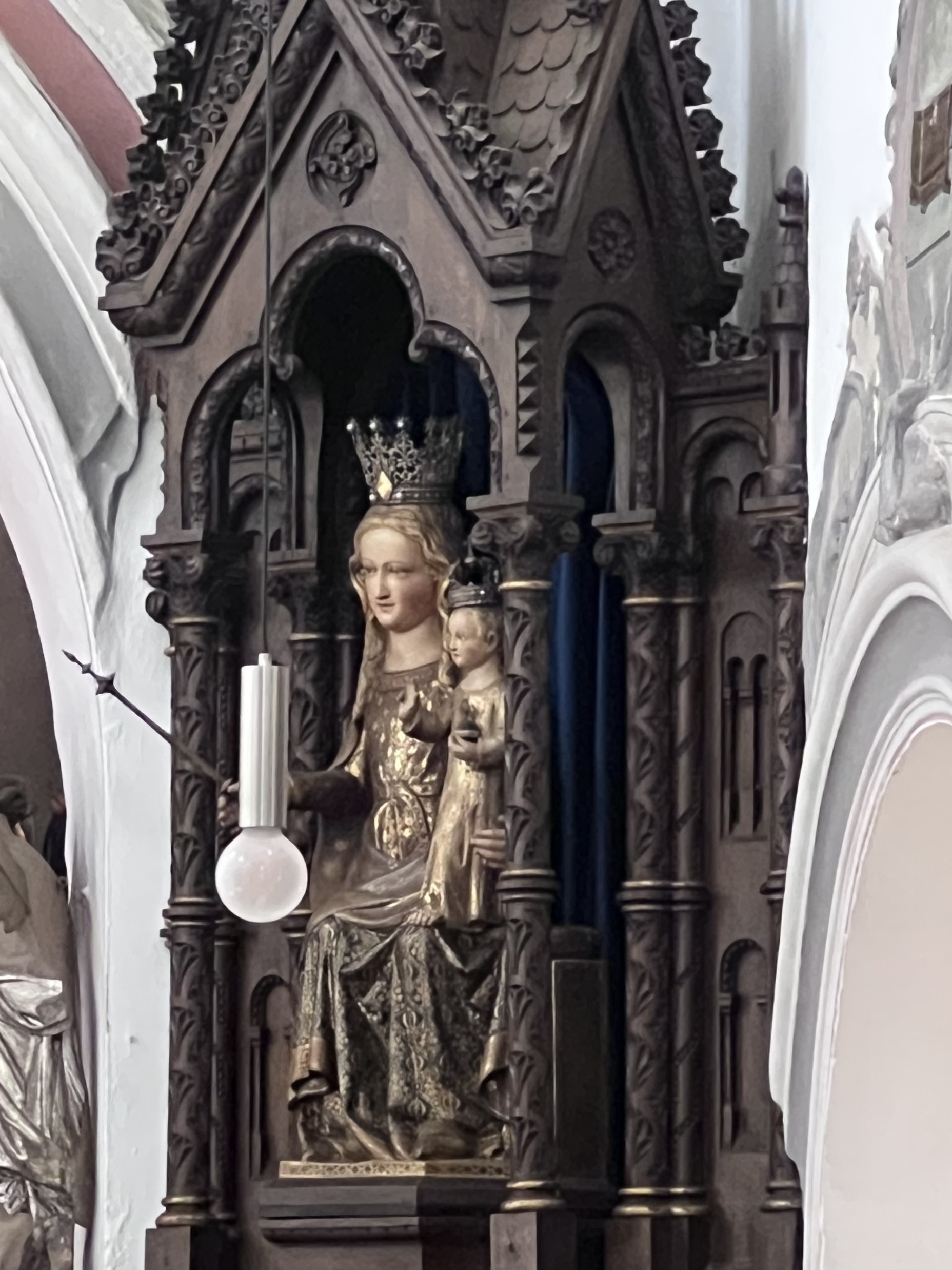
In the 18th century the building underwent a major restoration and was given a Baroque style. Changes were made in the church, such as symbols of Mary from the Old Testament: Tower of David, mysterious rose, golden house, gate of heaven and morning star. The devotional image “Mater Amabilis” (Loving Mother) is a “Kastenmadonna” (Madonna image in a cabinet) from around 1350.
The side altars were erected in 1750. The southern altar features an image of Saint Agatha, the second patron saint of the church. The northern altar holds a statue of Saint Joseph and the crying child Jesus. The Rococo pulpit dates from 1753.
The church is built in Neo-Gothic style, it is a three-nave cruciform church.
Pilgrimage site
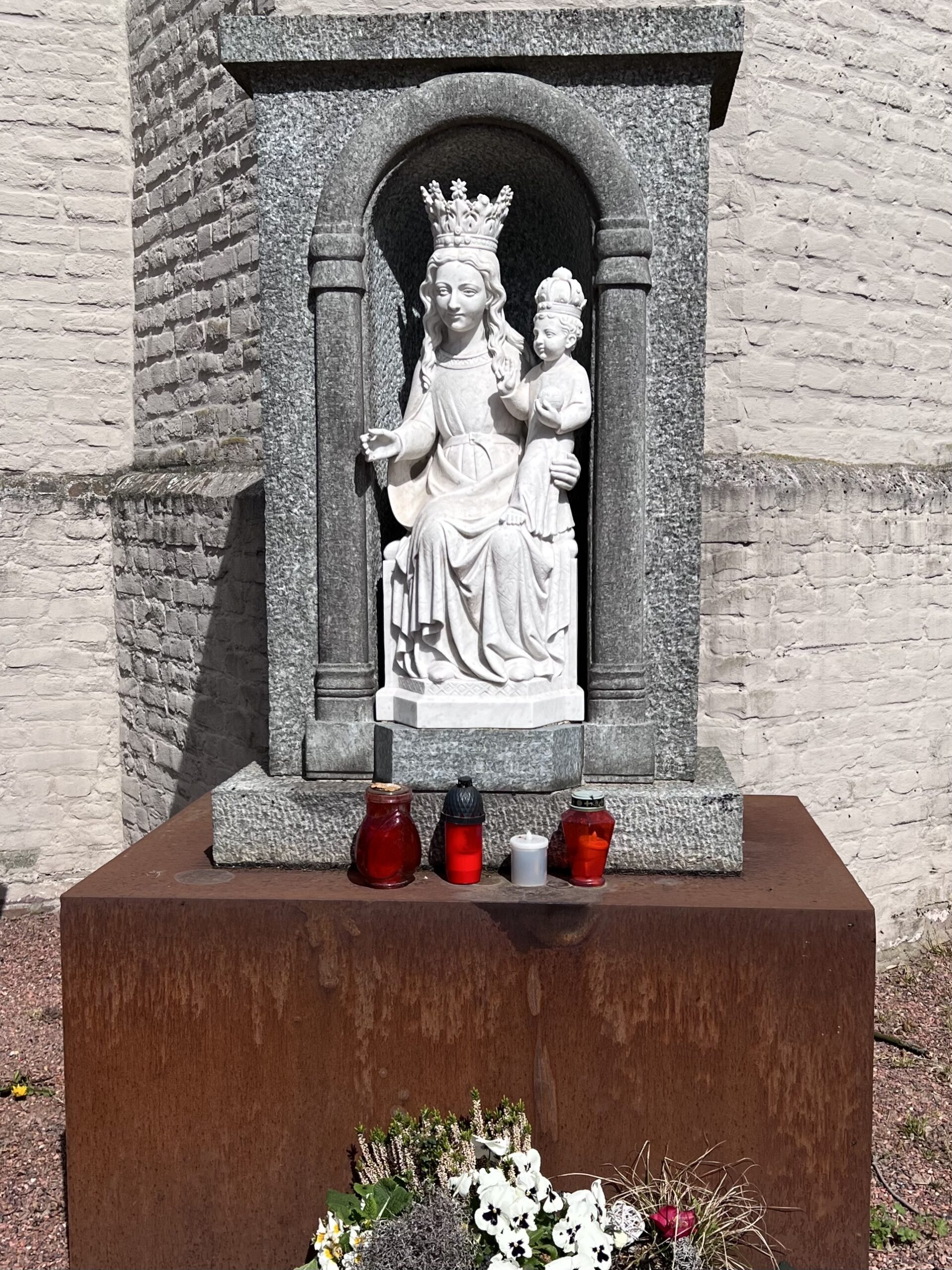
Next to the church and cemetery, in a niche, is a white depiction of Mary with Child, both are crowned. The seated Mary has her standing Child on her left upper leg, just like the shrine in the church.
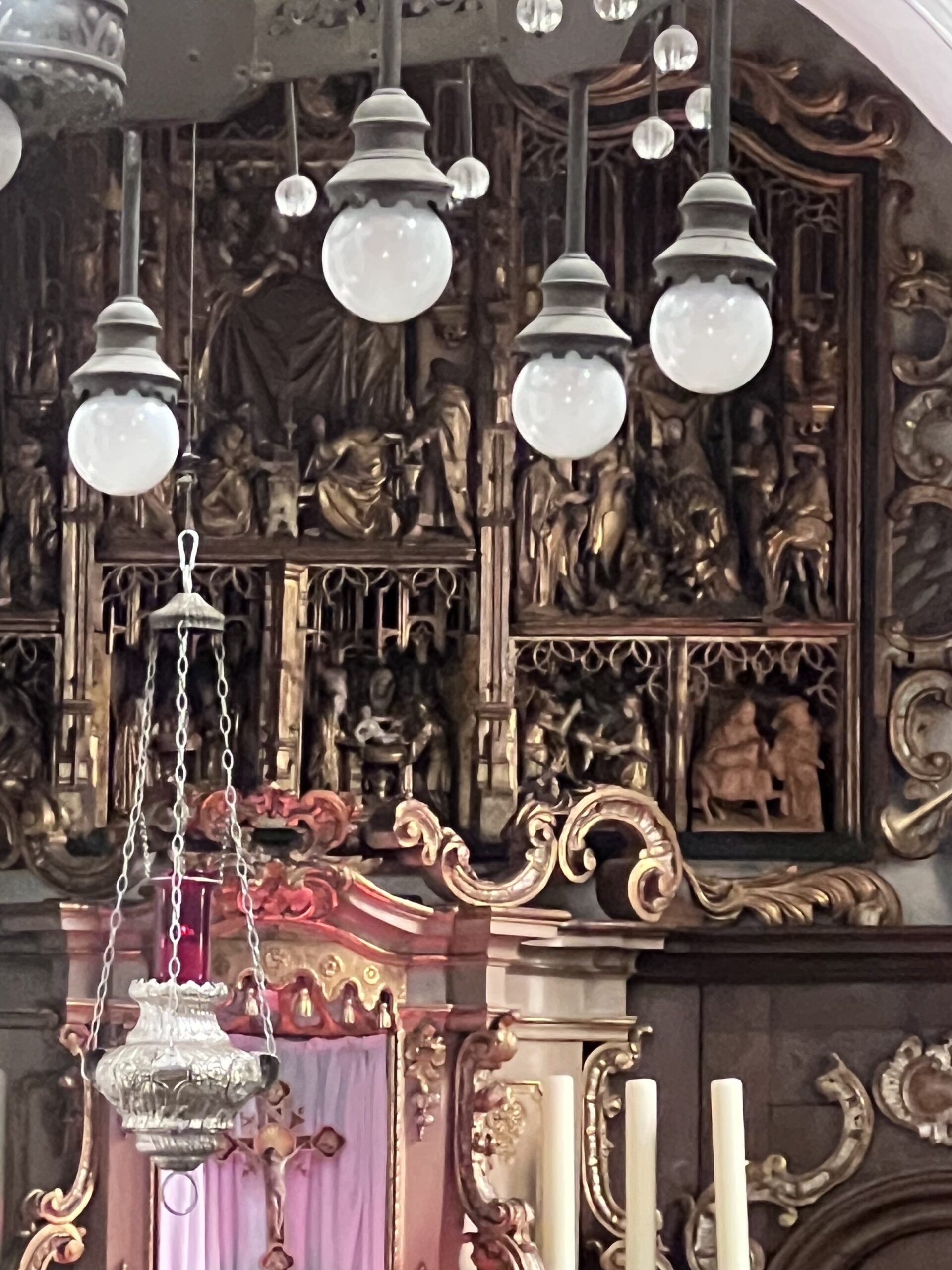
The Romanesque pilgrimage church is dedicated to “Sankt Mariä Himmelfahrt” (Assumption of Holy Mary). The altarpiece, carved from wood in Flemish Antwerp, stands above the altar, depicting more than 60 figures. The lower left shows phases from the life of Mary, including the Annunciation, Visitation with Elizabeth, Adoration of the Shepherds, Adoration of the Magi, Presentation of Jesus in the Temple, Circumcision of Jesus, Massacre of the Innocents in Bethlehem, Flight into Egypt, Death of Mary, Assumption into Heaven, and Coronation.
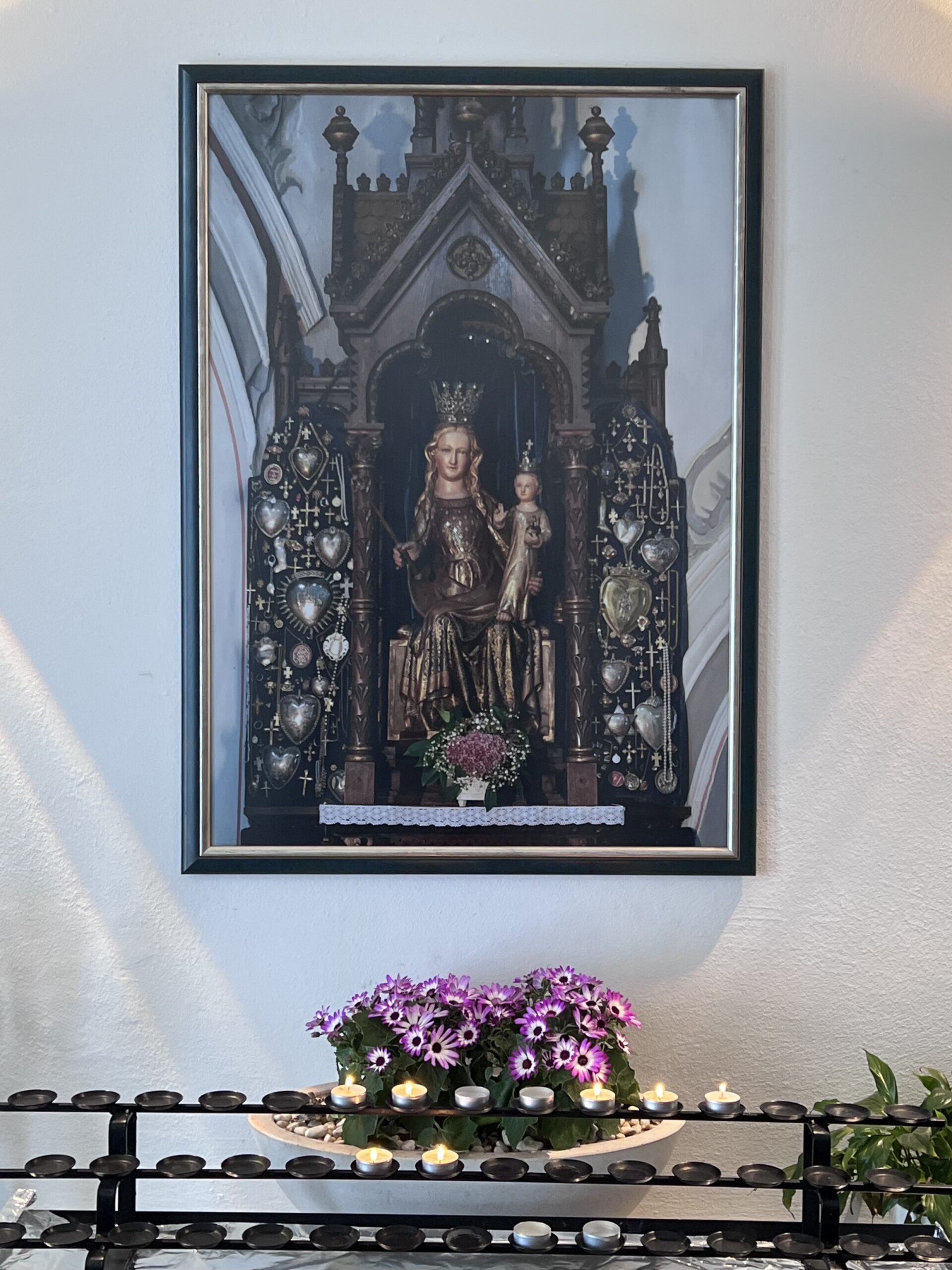
The devotional image from 1350 is called “die liebenswürdige Mutter von Ophoven” (the amiable Mother of Ophoven), and it stands to the right of the altar. It depicts Mary as Queen, with a crown and sceptre. The statue is an image of Mary and Child in a dark brown, decorated, small chapel-case. Both Mary and her Child are crowned. Here too, the seated Mary has her standing Child on her left thigh. In her right hand, she holds a sceptre.
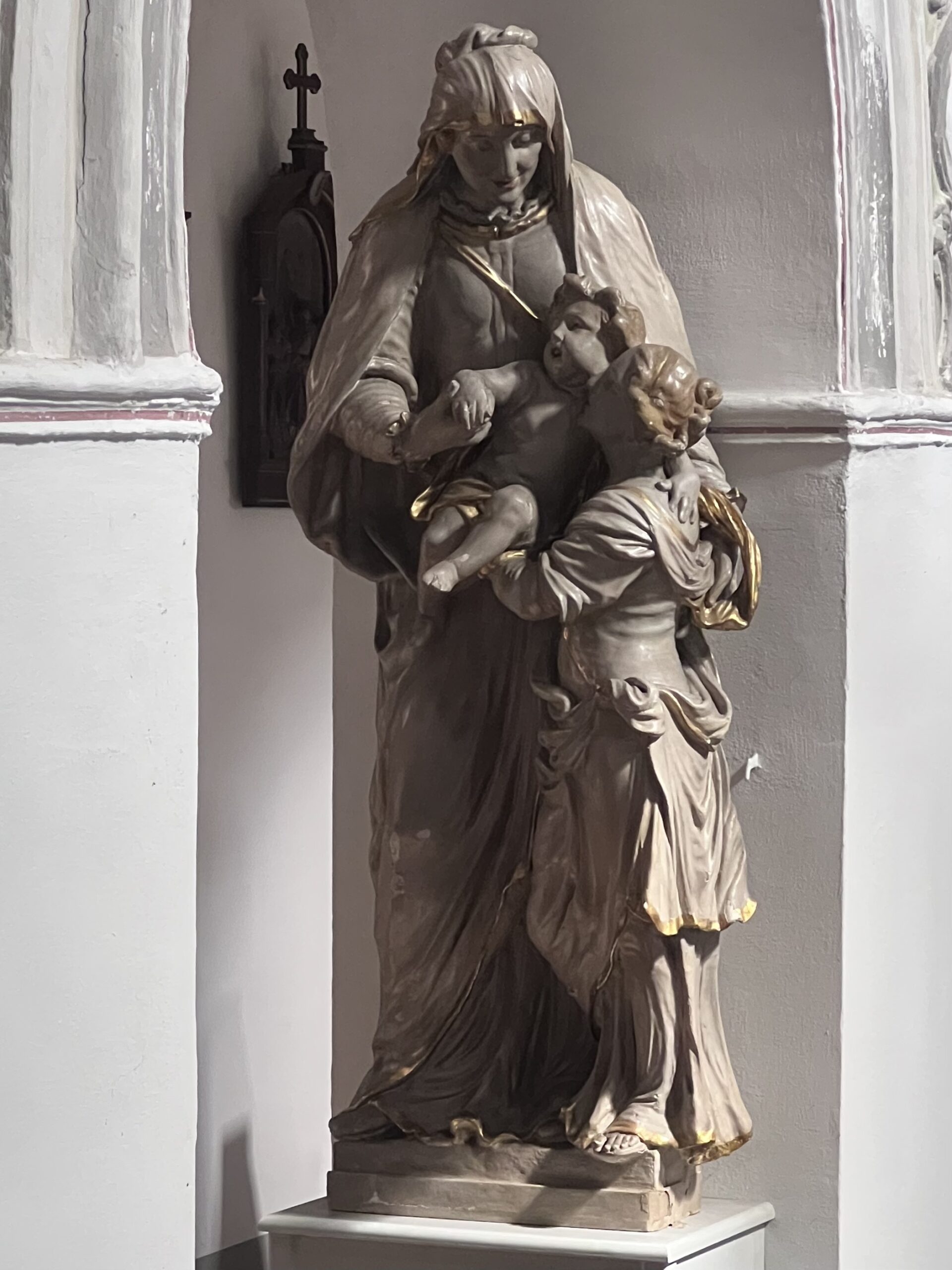
A depiction with a meaningful scene is the gathering of grandmother Anna, mother Mary, and child Jesus.
The church is the only Romanesque church north of the Alps with frescoes on its walls.
The church is open during services. However, the vestibule is open daily, allowing a view into the interior.
ACCESSIBILITY
Near the border with the Netherlands lies Ophoven and the pilgrimage church is located on the cemetery grounds.
Address: Marienstrasse 29, 41849 Ophoven/Wassenberg.
Current information can be found at www.stmarien-wassenberg.de.
Experience
At the entrance to the pilgrimage church, a large, framed photograph hangs on the wall of the devotional image of Mother and Child. Candles are lit here, and a few more lights are now being added. To that end, I am lighting candles for friends and good acquaintances who could use a little support from Mary.
The devotional image truly resembles an amiable Mother. I see the depiction of Mary and Child on the right-hand side of the altar. What a delightful statue this is!
A large statue on the left side of the church depicts Saint Anne, the Virgin Mary, and the child Jesus, dating from around 1420.
The pilgrimage church demonstrates that beauty is not found in the size of a building, but in the experience it evokes. Well, this is certainly the case here in Ophoven. I take a seat on a pew at the back of the church and let the beauty of this place sink in. Afterwards, it's time for a rosary by the shrine. To conclude, I walk around the pilgrimage church and at the rear, I come across a large cross and a chapel with a cross. What an impression this church makes on me!
Environment
In Dalheim, the Cistercian monastery disappeared during the secularisation (early 19th century). Now, a mill stands here, the Dalheimer Mühle. From Dalheim, on the border of Germany and the Netherlands, between the Dutch Vlodrop and the German Arsbeck, it is 20 km to the east to arrive in Ophoven.
To go from the historic site of Wassenberg to Ophoven is to travel 6 km to the west. Wassenberg has a medieval centre with an old city tower (Rosstor), old town hall, former Capuchin monastery, and parts of the old city walls. Walks can be made in and around Wassenberg, including a “Kleine Pilgerweg” (small pilgrimage route).
To get from the Dutch diocese city of Roermond to Ophoven, you need to travel 20 km to the southeast.
To go from the Dom city of Cologne to Ophoven requires covering 90 km westwards.
Leaving Aachen to get to Ophoven means going 58 km northwards.
To leave Mönchengladbach behind and arrive in Ophoven means travelling 45 km to the southwest.
Travelling from Düsseldorf to Ophoven is a journey of 65 km westwards.
~~~
