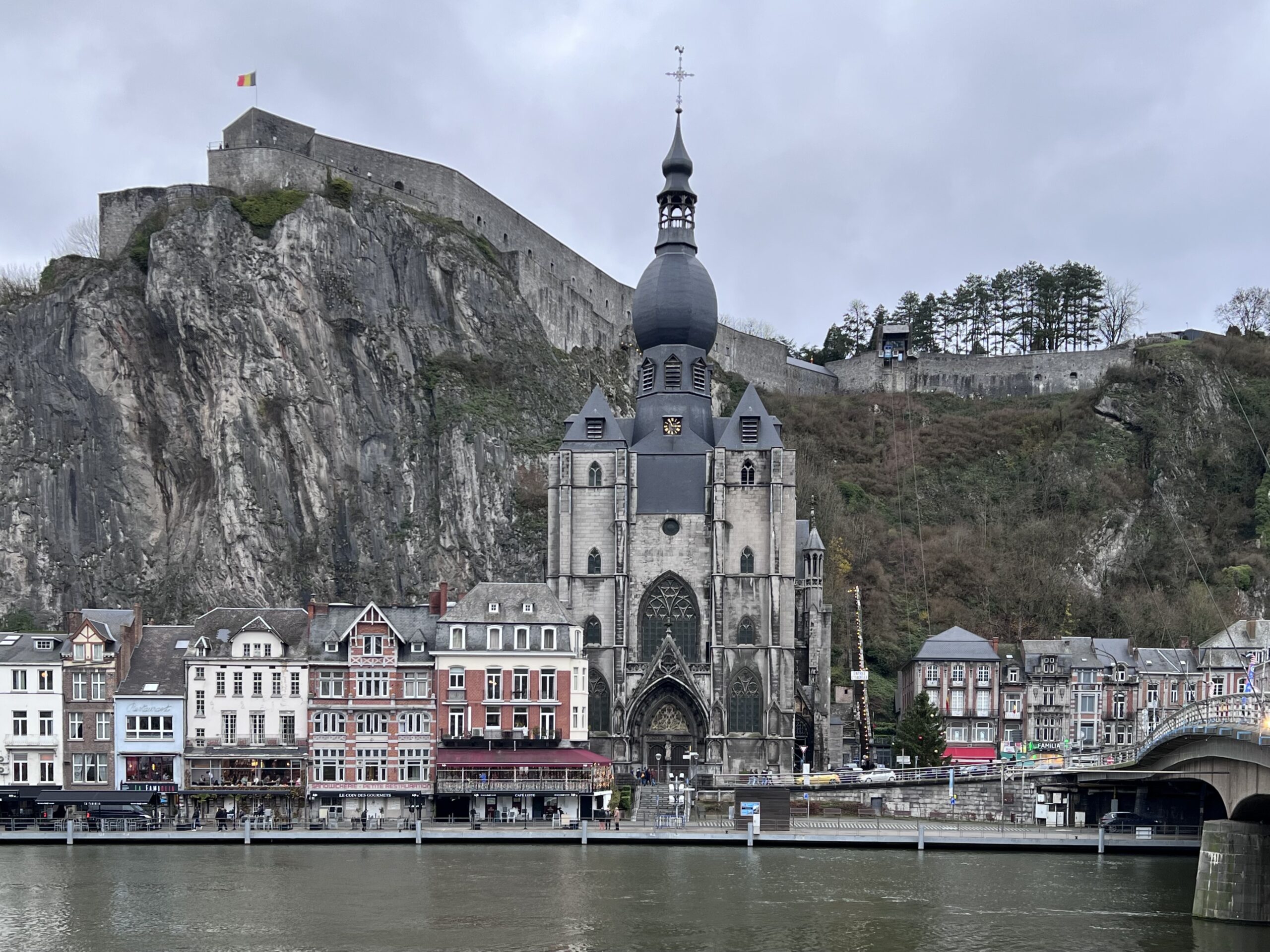
The Collegiate Church of Our Lady (Collegiale Onze-Lieve-Vrouwekerk) is a 13th-century Gothic monument built from local Dinant limestone. Construction began in 1227 and continued until the mid-14th century. The church's patron saint is Our Lady of the Assumption. To the right of the church is a 13th-century Romanesque portal. The Coronation of the Virgin can be seen in the vaults.
Above the chancel hangs the painting of Our Lady of the Assumption, dating from around 1700.
The western portal, on the pier, a section of wall between the bays, shows a Neo-Gothic statue of Mary.
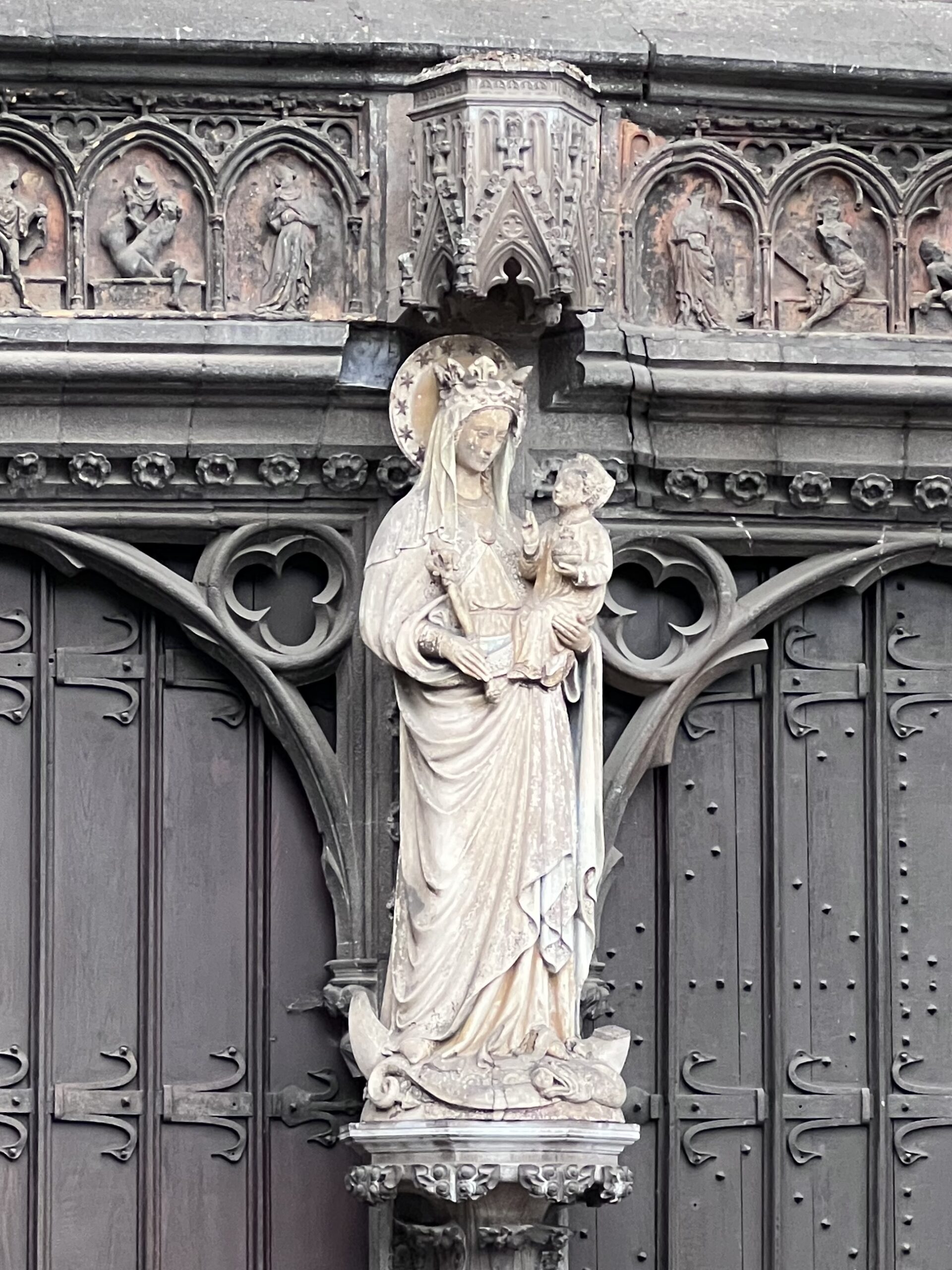
In the north portal is the last remnant of the 12th-century church. Here is the remainder of a weathered effigy of Mary with her child on her lap.
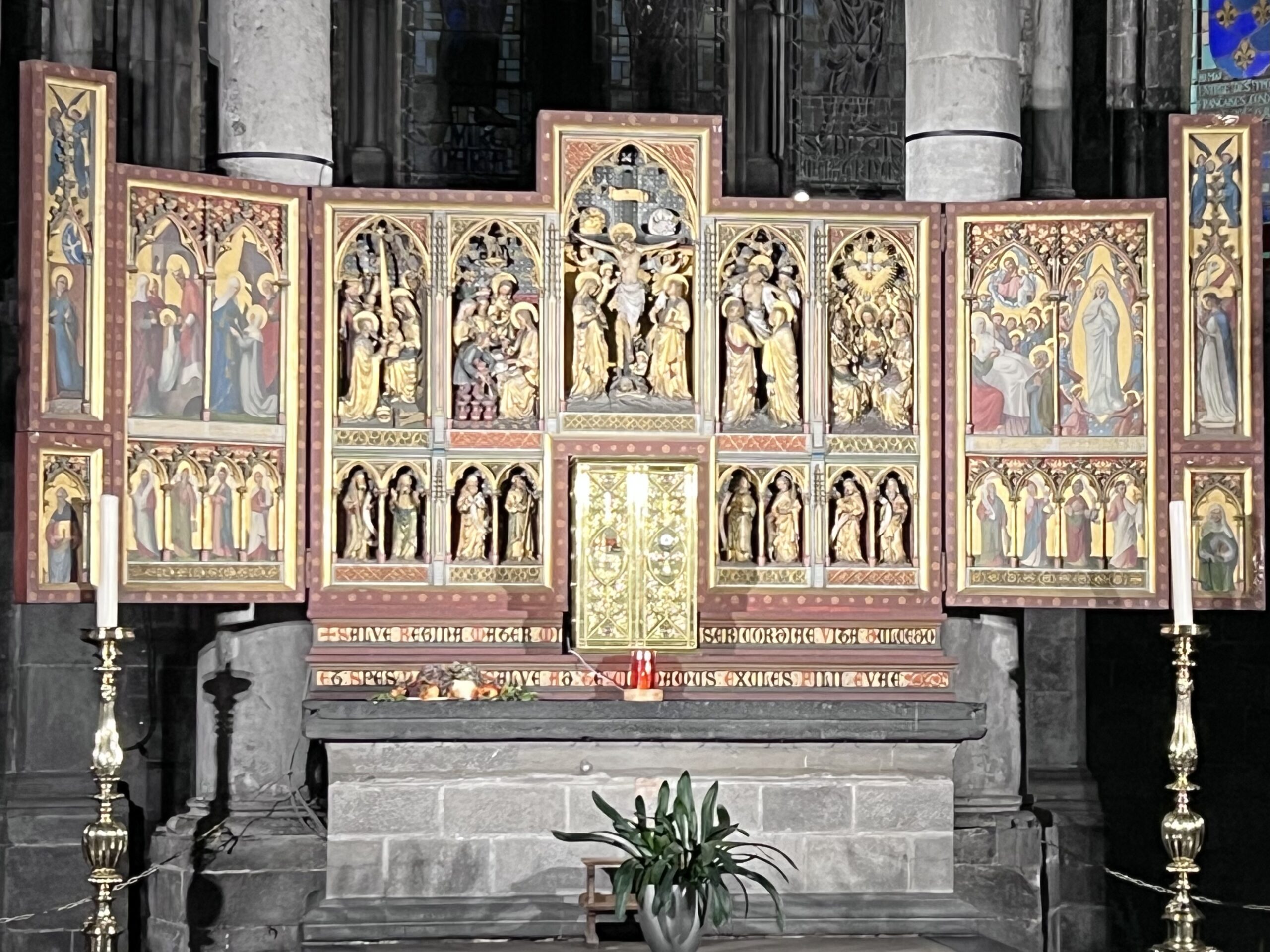
The altarpiece of the high altar dates from the second half of the 19th century. The design is by architect and pioneer of Neo-Gothicism in Belgium, Jean-Baptiste Charles François (Jean) Béthune (1821-1894). The sculpted parts come from the Bressers-Blanchaert workshop in Ghent. The canvases were created by the Liège-born painter Jules-Chrétien Charles Joseph-Henri (Jules) Helbig (1821-1906). Scenes from the life of Mary are depicted here.
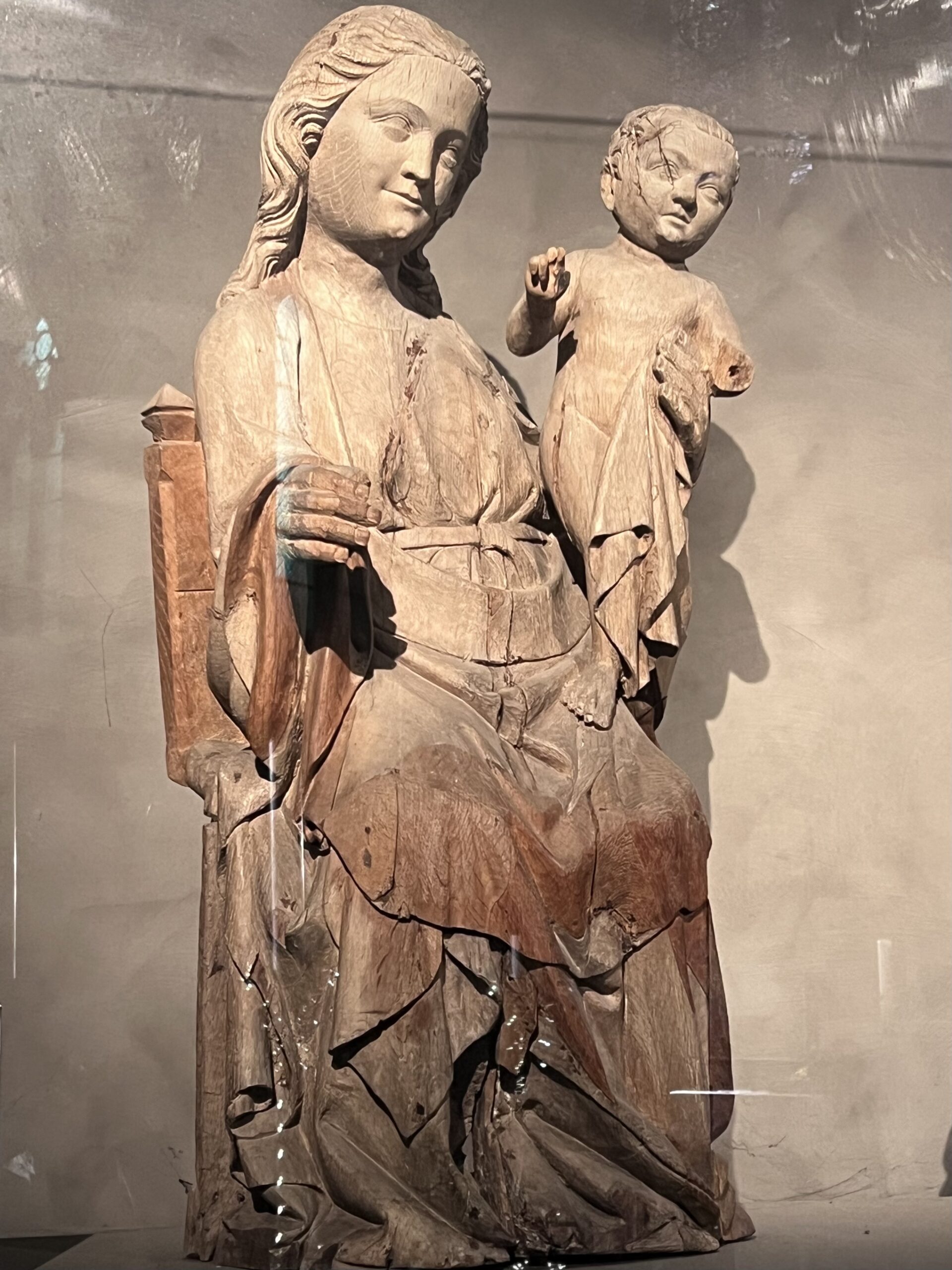
In the church there is also a wooden statue of the enthroned/seated Virgin and Child, made of oak, dating from the early 14th century.
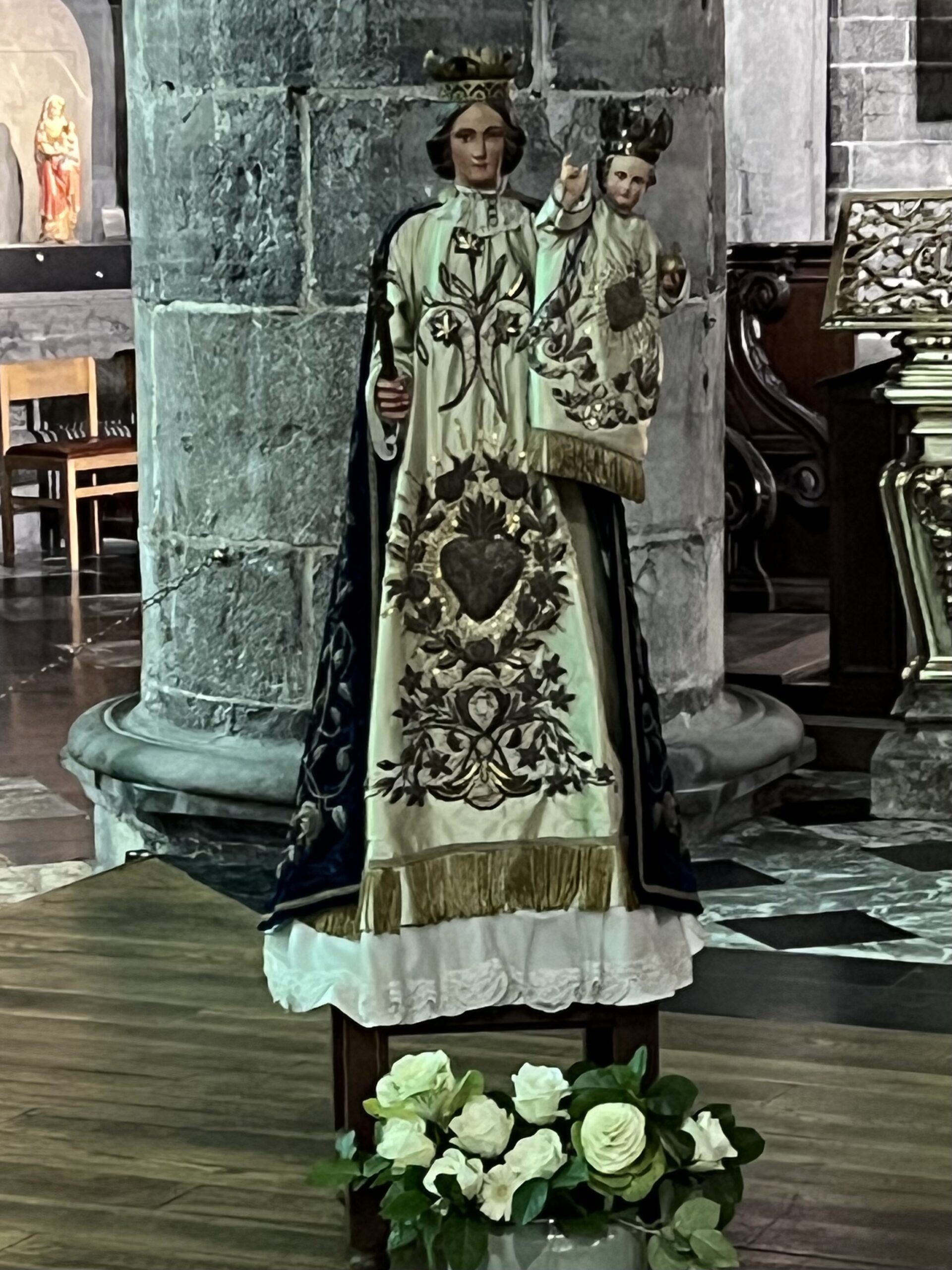
The church also houses a processional Madonna with Child. Both are regally dressed and crowned.
Particularly noteworthy in the church is the Marian stained-glass window, created in 1903 in the south aisle by the Ghent stained-glass artist Gustaaf Ludovicus Maria (Gustave) Ladon (1863-1942). The completion of this work marked the end of the church's restoration, which began in 1860. The stained-glass window is designed in the Gothic style of the 13th century and is arranged from left to right and from bottom to top. It depicts scenes from the Old Testament with references to Mary, and stages of the life of Our Lady. This stained-glass window shows that it was painted with light. The artwork is the largest Neo-Gothic stained-glass window in Europe.
In 1466, the town was completely destroyed by Burgundians led by Duke Charles the Bold (1433-1477), also known as the Reckless. The church also suffered greatly at that time.
The spherical clock tower was originally intended for the former aldermen's house on the bridge over the Maas. This sphere was placed on the church in 1566 because the roof was too heavy for the aldermen's house.
In 1914 (Great War/First World War, 1914-1918) Dinant is destroyed for the second time and the church also sustains a lot of damage.
Address: Place Reine Astrid 1, 5500 Dinant.
~~~

 Nederlands
  English (UK)
  Deutsch
  Français