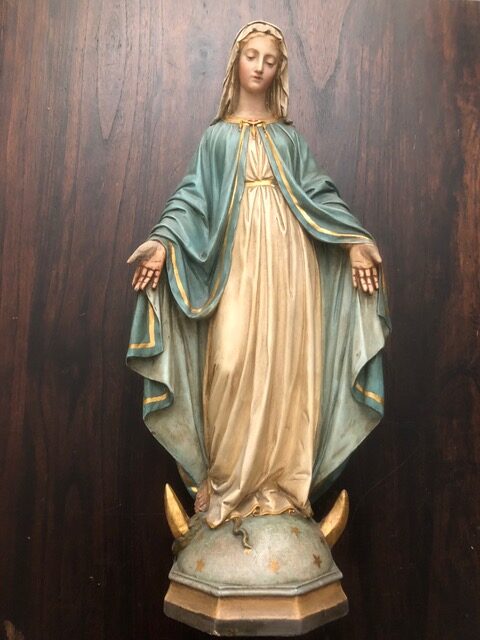
The word dogma comes from the Greek verb “dokein”, which means to establish firmly and then means a doctrine of faith. This doctrine is proclaimed by the Pope. Dogmas are found in various religions and are fundamental tenets of belief. A dogma of faith (Latin: dogma fidei) arises in a historical context and is changeable, as the interpretation of the situation can shift.
A dogma is changeable and is therefore completely different from dogmatism, where no discussion on a subject is permitted. Rigidity or negative connotations therefore do not suit a dogma. A dogma is thus not a doctrine of, for example, law.
In 1870, during the “First Vatican Council” (held between 8 December 1869 and 20 September 1870), the concept of dogma was established. The council's decree states that a dogma is a truth of God's revelation, as articulated by the Church, which must be believed. At this council, a dogma concerning papal infallibility was established.
There are four dogmas concerning Mary; these are four doctrines considered to be indisputable. The first dogma dates from 431 and declares that Mary is the Mother of God. In 649 came the second dogma, which states the perpetual virginity of Mary. The dogma of the Immaculate Conception of Mary was proclaimed on December 8, 1854, by Pius IX, Pope from 1846 to 1878. The fourth dogma is from 1950 and deals with the Assumption of Mary. This was made public by Pius XII, Pope during the period 1939-1958. It took many years before dogmas three and four were issued. Millions of petitions were sent to the Vatican, but resistance to new dogmas had long been strong among the high clergy. This is once again the case with a fifth dogma…
In 1915, a petition process was initiated to establish a fifth dogma, viewing Mary also as co-redeemer. Among the initiators was the Belgian Désiré-Joseph Mercier, archbishop during the period 1906-1926. The petition was submitted to Benedict XV, pope from 1914 to 1922. This was also done with the subsequent pontiff, Pius XI, pope from 1922 to 1939.
Remarkably, Mary appears to Ida Peerdeman (1905-1996) in Amsterdam and asks for the dogma of co-redemptrix, mediatrix, and advocate. Rome has not recognised the apparitions in Amsterdam.
Maximilian Kolbe (1894-1941), who died during the Second World War, showed himself to be a proponent of the fifth dogma. John Paul II, Pope from 1978 to 2005, spoke on multiple occasions about Mary as co-redeemer. Furthermore, the authoritative Arthur Burton Calkins (born 1945) has written on several occasions about the fifth dogma.
Francis, the current Pope, is not in favour of a fifth dogma. He states that there is no co-redeemer, as Christ is the sole redeemer. Perhaps the rapprochement with the Protestant church plays a role here, because in an ecumenical relationship there is no room for a new dogma, and the fourth dogma is already sensitive. It is then more than regrettable that Marian devotion may not receive new impetus with a fifth dogma.

 Nederlands
  English (UK)
  Deutsch
  Français