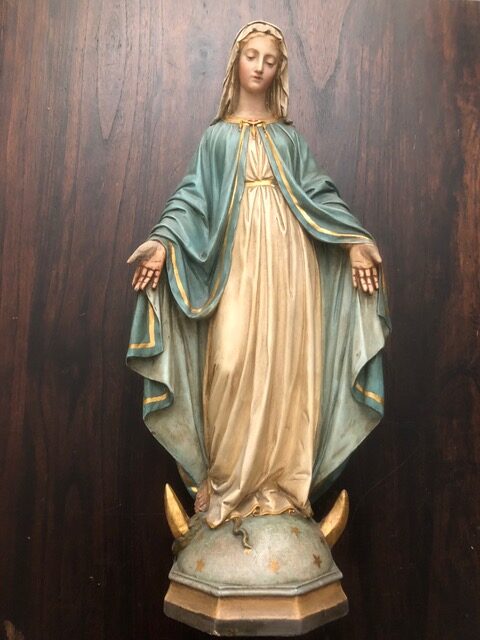
The most prayed, played, and sung Marian hymn is the “Ave Maria.” The text has an impressive history and many composers have uniquely shaped the song. The Ave Maria is therefore not only a liturgical text, but also intangible heritage, artistic impetus, and a spiritual source.
In the liturgy of the Catholic Church, the Ave Maria is included. Around 1.3 billion people worldwide pray the Ave Maria. The text developed in parts. The first part of the Ave Maria comes from the evangelist Luke (1:28), and he expresses in Latin what the Archangel Gabriel says to Mary when she is going to give birth to a child: “Ave Maria, gratia plena, Dominus tecum.”
The second part of the Ave Maria also comes from the Gospel of Luke (1:42), and he immortalises the words of Elizabeth, a cousin of Mary, when she receives a visit from Mary: “Benedicta tu in mulieribus, et benedictus fructus ventris tui Iesus.”
The third part comes from the Council of Ephesus in 431, where the position that Mary is the Mother of God was approved and accepted. This final part of the Ave Maria was only added to the prayer/song in the 16th century. The text reads: “Sancta Maria, Mater Dei, ora pro nobis, peccatoribus nunc et in hora mortis nostrae. Amen.” During the Council of Ephesus in 431, the Hail Mary therefore takes on a bit more form. The Hail Mary is then supplemented with “Holy Mary Mother of God, pray for us...” In 1568, this becomes the second part of the Hail Mary.
The complete text of the Ave Maria in Latin is:
“Hail Mary,
Full of grace.
The Lord be with you,
blessed art thou among women,
and blessed is the fruit of thy womb Jesus.
St Mary,
Mater Dei,
pray for us sinners,
now and at the hour of our death.
Amen.”
The Latin text translated into Dutch gives:
Hail, Mary,
full of grace.
The Lord be with you.
Blessed art thou amongst women,
and blessed is Jesus,
the fruit of Your womb.
Holy Mary,
Mother of God,
pray for us, sinners,
now and at the hour of our death.
Amen.”
Numerous composers have, each in their own original way, interpreted the Ave Maria. A selection is called for.
In 1483, Josquin des Prez (c. 1450-1521) composed the Latin “Ave Maria, virgo Serena” (Hail Mary, pure Virgin) with different imitation techniques per verse. He wrote the Ave Maria during his time in Milan. This composer, teacher, and singer from Hainaut was a musician during the Renaissance period.
Nicolas Gombert (c. 1495-c. 1560) composed his Ave Maria in 1539. Gombert was a Franco-Flemish composer from Lille.
The Austrian composer Franz Peter Schubert (1797-1828) made a significant contribution to music and, in addition, to the cult of the Ave Maria during his relatively short life. Through his inventiveness, the Ave Maria became even more widely known. Schubert based his work on the 1810 poem “Lady of the Lake” by Walter Scott (1771-1832). Scott was a poet and historical novelist. Schubert’s creation is a romanticised poem, set in the Scottish Highlands. The German translation of “Lady of the Lake” was undertaken by Adam Storck (1780-1822). This German historian and teacher created the text for the Ave Maria in 1825. It begins:
“Hail Mary! Virgin mild,
hear a maiden's plea,
From this rock, stark and wild,
May my prayer blow towards you,
We will sleep soundly until morning,
that people can still be so cruel.
O maiden, see the maiden's cares.
Oh Mother, hear a pleading child!
Ave Maria!”
De Franse componist Charles Gounod (1818-1893) schrijft een versie van het Latijnse gebed Ave Maria in 1859. Zijn Ave Maria heeft wortels bij de Duitse componist John Sebastian Bach (1685-1750). In 1722 maakt Bach het eerste deel van “Das Wohltemperierte Klavier” (goedgestemde piano). Gounod schrijft een melodie en voegt eraan toe de woorden van het gebed Ave Maria. De Engelse, veelzijdige zangeres Vicki Brown, geboren als Victoria Mary Haseman (1940-1991) geeft een van de beste vertolkingen van het Ave Maria van componist Charles Gounod.
Josef Anton Bruckner (1824–1896) was an Austrian composer and organist of the Romantic era. His 1861 version of the Ave Maria is his first major work. He also composed an Ave Maria in 1856 and 1882.
Edward Elgar (1857-1934) is a British composer and this self-taught musician created his Ave Maria in 1887.
Reinhold Wilhelm Kühnel (1859-1922), a composer and writer from Bohemian Sluknov (Schluckenau), now Czech territory, makes his music for the Ave Maria.
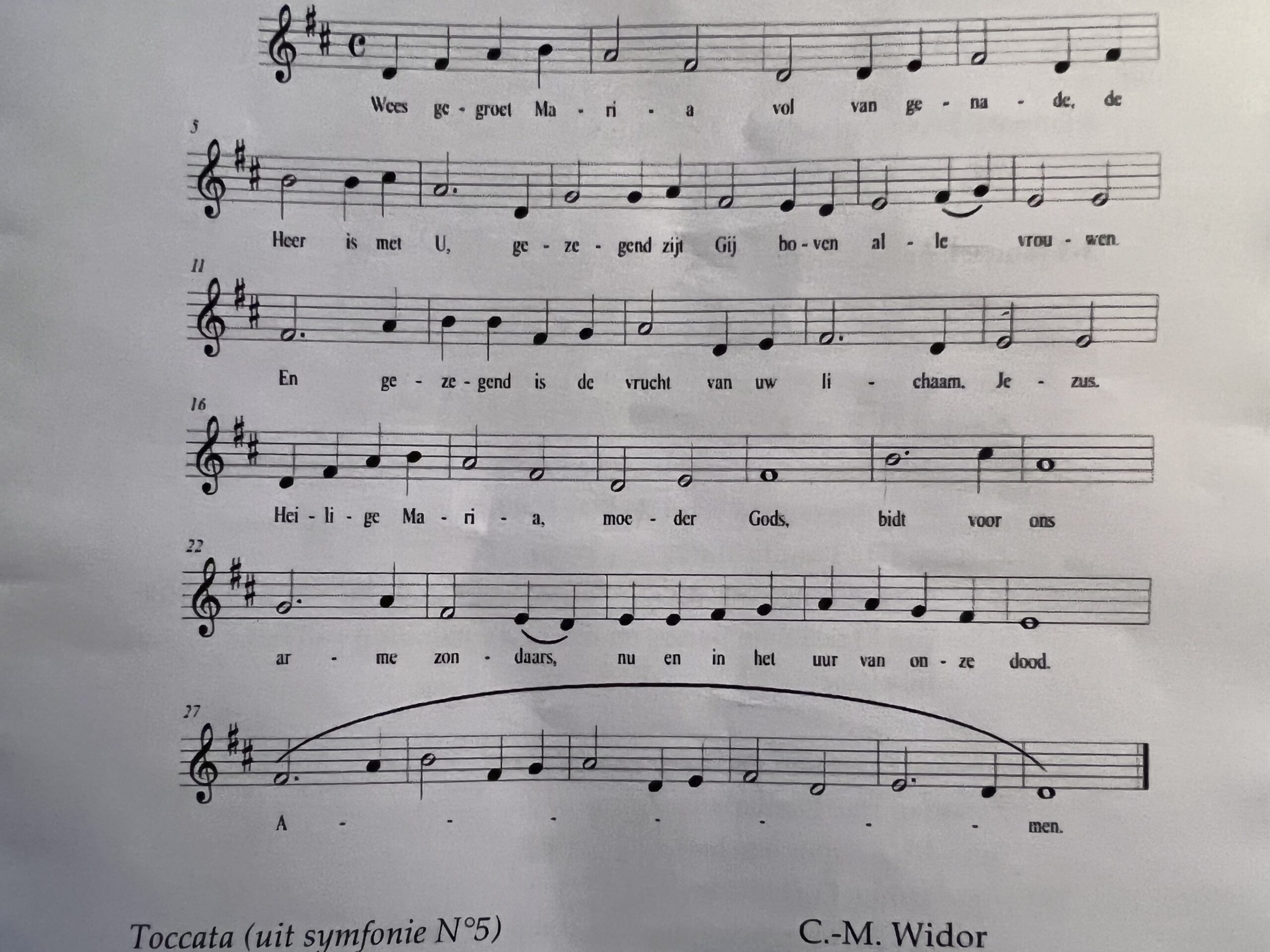
In 1919, Charles-Marie-Jean-Albert Widor (1844-1937) turned the Ave Maria into a toccata, a fantasy-like musical piece without a prescribed form, specifically for organ and piano. The text has been translated into Dutch.
The St Petersburg-born Igor Stravinsky (1882-1971) composed the Ave Maria in 1934 for mixed choir a cappella. It was intended for liturgical use in the Russian Orthodox Church. This Russian was naturalised as an American in 1945. In 1949, he set the Ave Maria to the Latin text.
The Russian composer, guitarist, and lutenist Vladimir Fyodorovich Vavilov (1925-1973) from Saint Petersburg composed the Ave Maria in 1970.
In 1975, the English Maria Parkinson (born 1956) made her Ave Maria (As I kneel before You), which is sung many times in the 21st century.
In 2025, Oliver Cerza (born 1967) will publish a work on the global use of the Ave Maria. He has researched that the Ave Maria is prayed and/or sung in no fewer than 406 languages and dialects.
~~~

 Nederlands
  English (UK)
  Deutsch
  Français