History
Marian devotion has existed in Halle since the 12th century. This was already the case before the arrival of her miraculous statue, which was found in a tree trunk, and a remnant of this tree stands in the crypt, beneath the presbytery.
The image of Mary was made around 1210 and its original provenance is unknown. In 1267, the Madonna statue was donated to the city and not to the church. The story goes that Elizabeth of Hungary/Elizabeth of Thuringia (1207-1231) had the effigy of Our Lady. Elizabeth married Louis IV (1200-1227), Landgrave of Thuringia (1217-1127), who was also known as the Saint. Elizabeth, who was canonised in 1235, gave the statue to her eldest daughter Sophia of Thuringia (1224-1275). In 1240, Sophia became the second wife of Henry II (1207-1248), Duke of Brabant (1235-1248), who was also known as Henry the Courteous. Sophia of Thuringia was Duchess of Brabant from 1240 until 1275. She passed the statue on to her sister-in-law, Matilda of Brabant (1200-1267). Matilda was the daughter of Henry I (1165-1235), Duke of Brabant (1183-1235), and Matilda of Boulogne (±1165-1210), Duchess of Brabant (1183-1210), who was also known as Matilda of Alsace and Matilda of Lorraine. Matilda of Brabant handed over statues of saints, including that of Our Lady, to her daughter Aleid of Holland / Aleida of Avesnes (1228-1284). She was instructed to donate the statue of Mary to the city of Halle, and this happened in 1267. As a result, many pilgrims came to Halle, and the city grew into a major pilgrimage site.
The procession with the image dates from before 1335, as in 1335, remission of punishments for sins committed was granted to participants in the procession. This is officially declared on 4 May 1335, with the archbishop and bishops present in Avignon. Avignon was then the residence of the Pope.
A Marian chapel already exists in Halle, and this predates the church. The church was built in the long period from 1341 to 1467 and is dedicated to Saint Martin of Tours, with the auxiliary patronesses Saint Catherine of Alexandria and Saint Gertrude of Nivelles. The larger church made it possible to receive the many pilgrims.
In 1344, the Brotherhood of Our Lady of Halle was established. The objectives of this organisation are to contribute to the preservation and promotion of Our Lady of Halle, through activities such as processions and pilgrimages.
Miraculous events are taking place at the shrine of Our Lady of Halle, with the first miracle occurring in 1389. Miracles such as a stillborn child coming back to life, a blind child suddenly being able to see, and a child drowning but regaining consciousness are happening.
The church was consecrated in 1409. This was done by Pierre d’Ailly (1351-1420), as Pierre V d’Ailly, Bishop of Cambrai (1396-1411).
In 1420, Martin V, pope from 1417-1431, signs a document. Martin V was born into an influential, noble family as Oddone Colonna (1368-1431). He chose the name Martin in honour of Saint Martin of Tours (c. 316-397), whose feast day is 11 November, the day he was elected pope.
A notable feature of the church is the octagonal baptistery, which dates from 1440.
A legend from 1489 tells how Our Lady of Halle catches cannonballs in her cloak to protect the town from the troops of Philip of Cleves (1459-1528), nobleman, commander and admiral of the Netherlands (1485-1488). Mary thus ensures the repelling of the attacks.
In 1520, Charles V (1500-1558) visits the church to thank Mary for his coronation as Holy Roman Emperor. He is King of the Romans and Emperor (1519-1556), and also, among other titles, Lord of the Netherlands (1506-1555), King of Aragon (1516-1556), Archduke of Austria (1519-1522), and for his entire youth, Duke of Luxembourg (1500-1506).
The basilica is the only one in Belgium to be honoured with a dedication from Henry VIII of England (1491-1547). He was, among other things, King of England (1509-1547) and King of Ireland (1541-1547). In 1534, he founded the Anglican Church.
A memorial stone in the basilica commemorates the siege of Halle by an army led by Olivier van den Tympel (1540-1603), Lord of Corbeke and an officer in the army of William of Orange (1553-1584). This took place on 9 and 10 July 1580 to drive out the Spanish, but the attacks failed.
Archduke Albert VII (1559-1621), Governor-General of the Southern Netherlands (1595-1598) and the Habsburg Netherlands (1598-1621), married Isabella of Spain (1566-1633) in 1599, who was Governor-General of the Southern Netherlands (1621-1633). They had significant influence on the organisation of the Catholic Church. In 1621, the Archdukes took over the administration of the pilgrimage from the clergy and transferred it to the Jesuits due to disturbances caused by the local clergy.
The pilgrimage site has suffered greatly from wars, the French Revolution (1789-1799), and in 1816 the Jesuits were expelled from Belgium. After the French Revolution, services were permitted again in 1801.
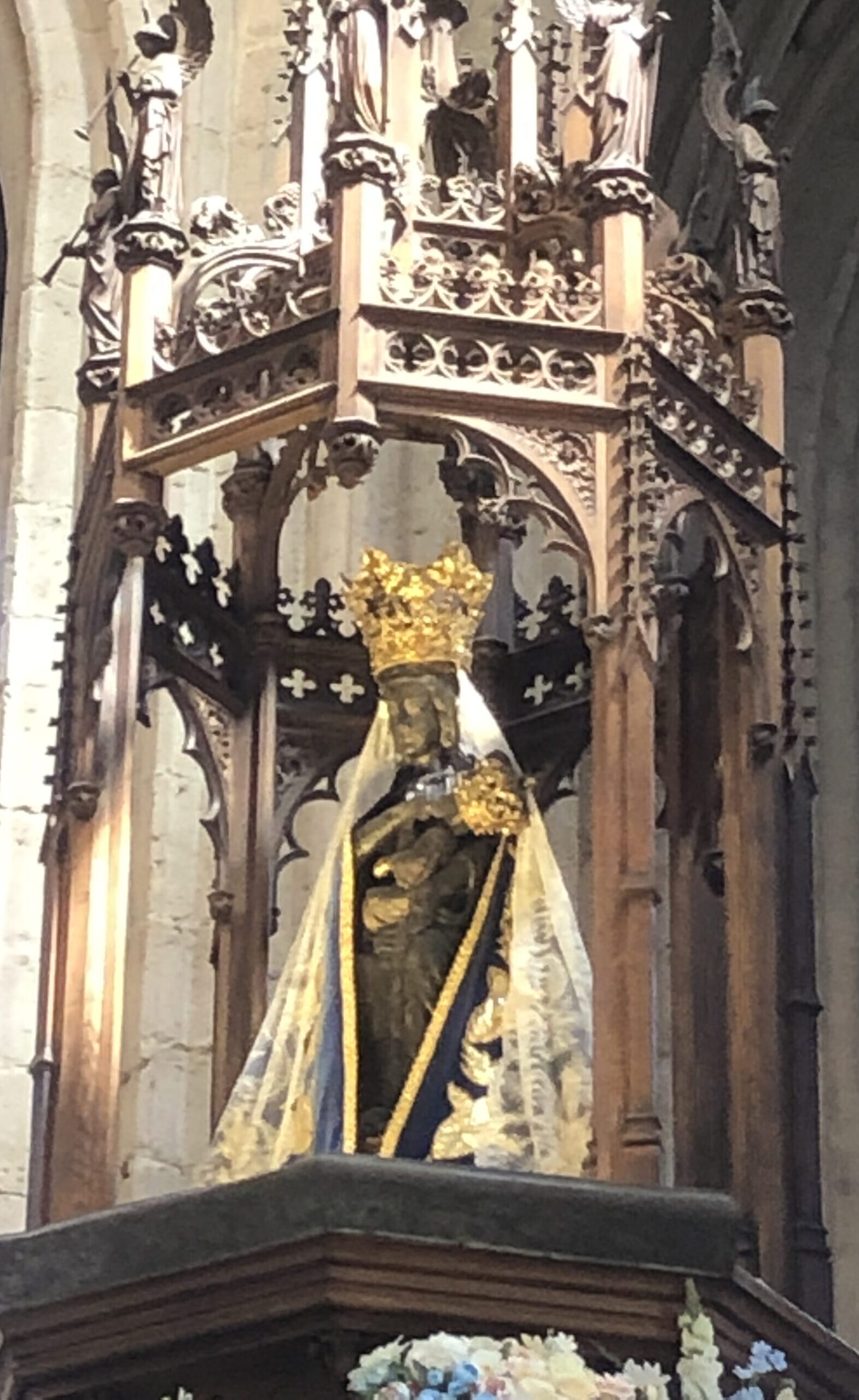
Since 1866, the image of Mary has been displayed in the high choir of the church. The image was crowned on 4 October 1874. This occurred after permission was granted by Pius IX, who was Pope between 1846 and 1878, born Giovanni Maria Mastai-Ferretti (1792-1878).
In 1933 the church became a listed building.
On 15 August 1946, the document elevating the church to the status of a basilica was signed. This was done by Pope Pius XII (1939-1958), born Eugenio Maria Giuseppe Giovanni Pacelli (1876-1958). Since then, the church has also been known as the Basilica of Our Lady.
Since 1959, the crypt has been set up as a museum. Among other things, it displays a Papal Bull from Avignon from 1335, in which bishops in Avignon, France, declare that indulgences are granted for participation in the procession. By being granted remission of punishment for sins, many people join the procession. The crypt also shows the Golden Book of the Brotherhood from 1344 and a document from Pope Martin V from 1420.
Mathilde d'Udeken d'Acoz (1973), later Queen of Belgium, married Philippe (Leopold, Lodewijk, Maria), Crown Prince of Belgium, on 4th December 1999. After the wedding ceremony, she presented the bridal bouquet to the Black Madonna of Halle. This was a significant gesture, as Our Lady of Halle is invoked for, among other things, pregnancy.
Pilgrimage site
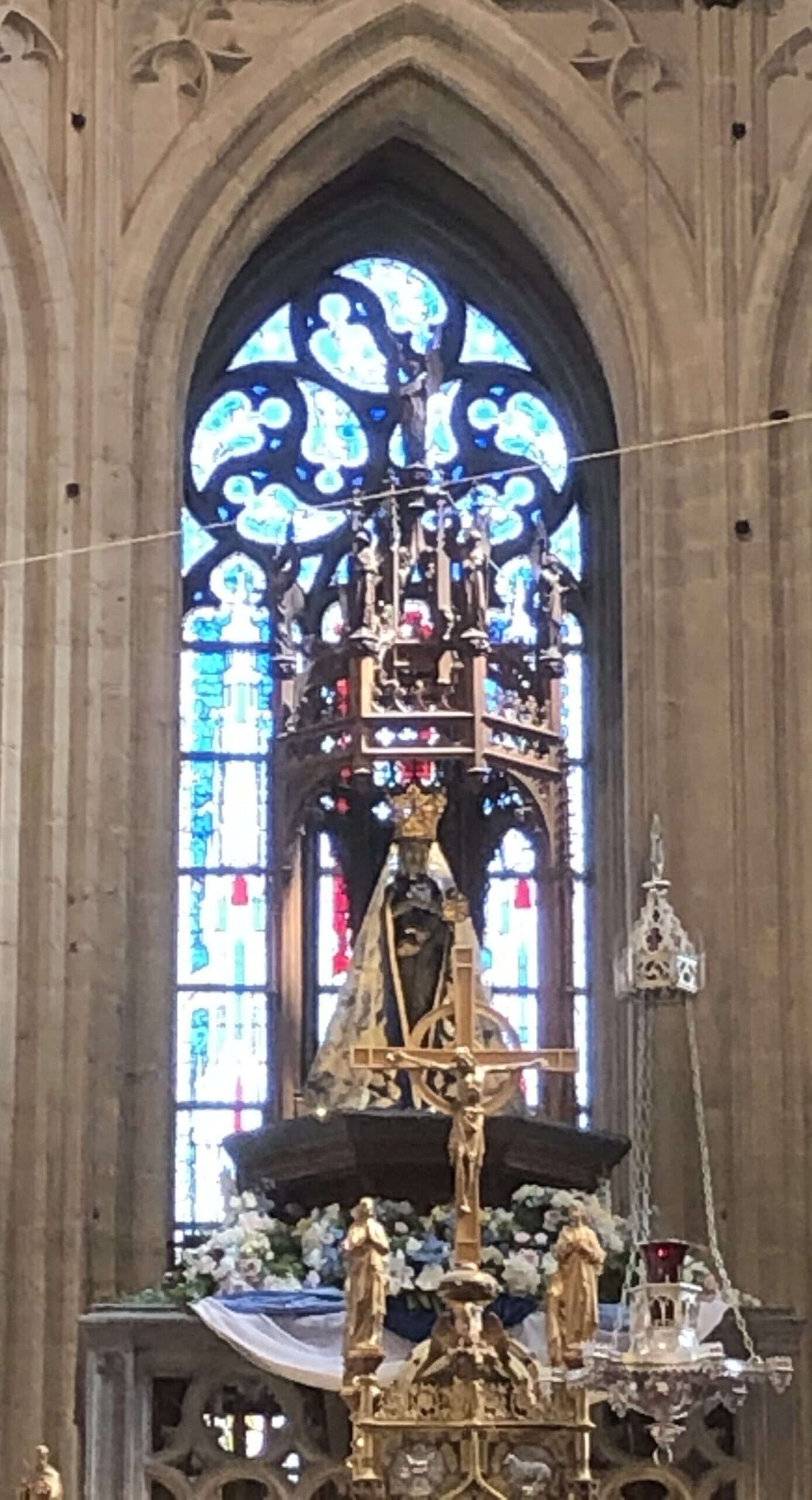
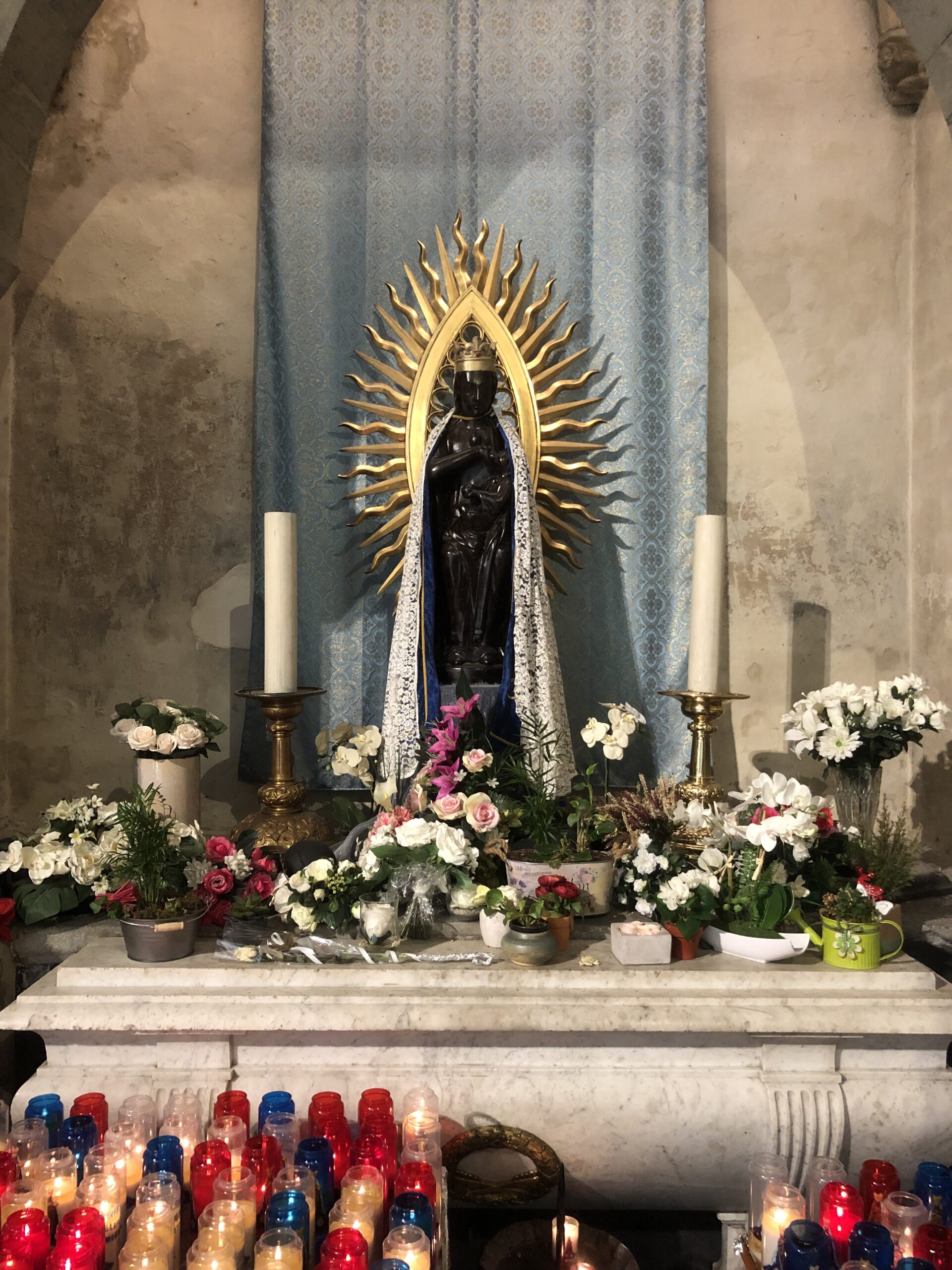
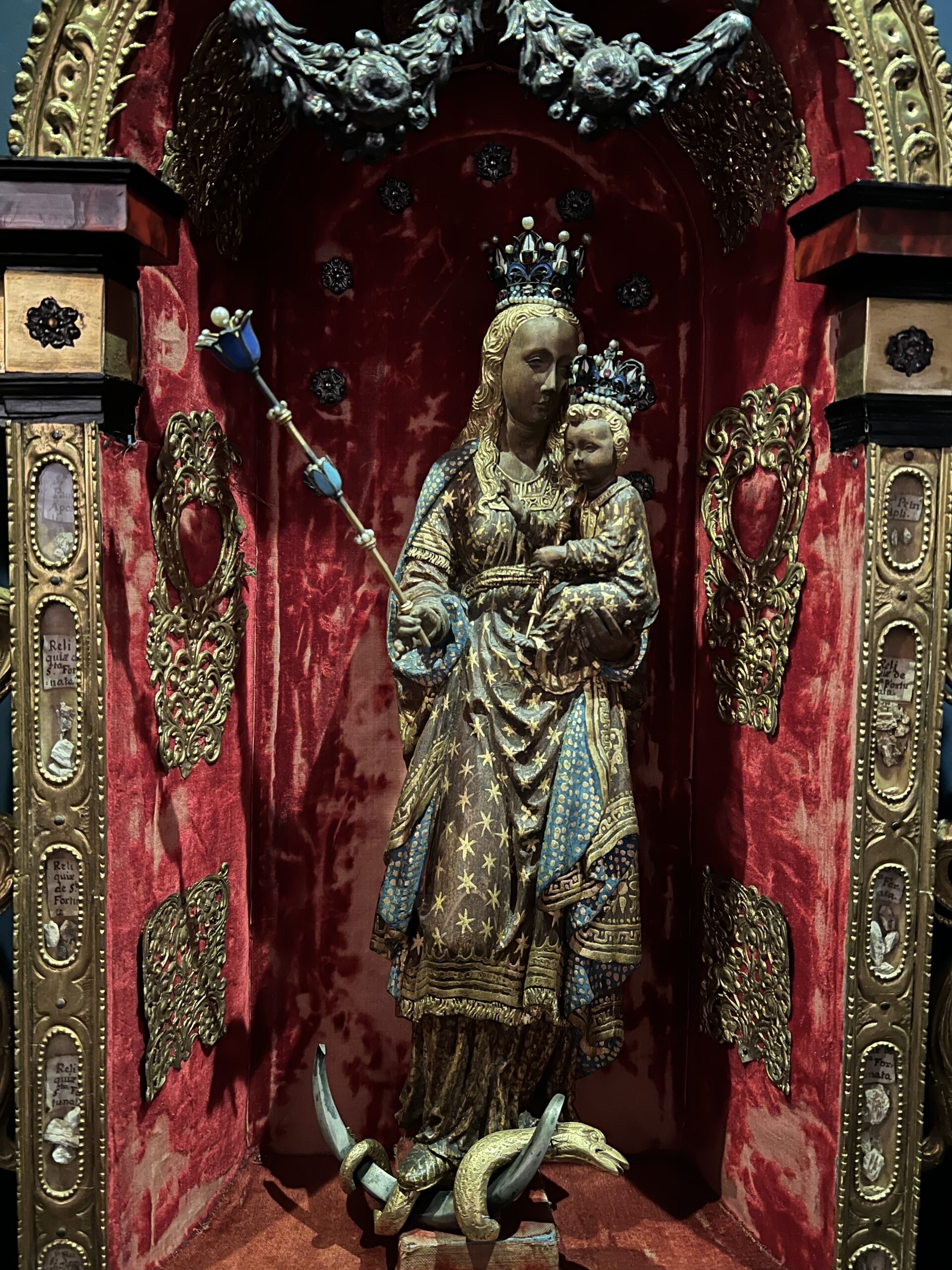
In the middle of the chancel stands the statue of Mary. This is a copy, as the original is kept in a hidden location for safety reasons. It is a dark statue and measures 95 cm. Mary's head and hands are made of wood, as are those of the infant Jesus. The clothing of Mary and Child is made of linen that has been worked with plaster. The faces are dark, making it a Black Madonna. The black colour is due to oxidised silver and/or the smoke from candles.
The Chapel of the Virgin Mary is located on the north side of the basilica, where the statue of grace once stood before it was placed in the high, large presbytery. After that, another image of Our Lady follows.
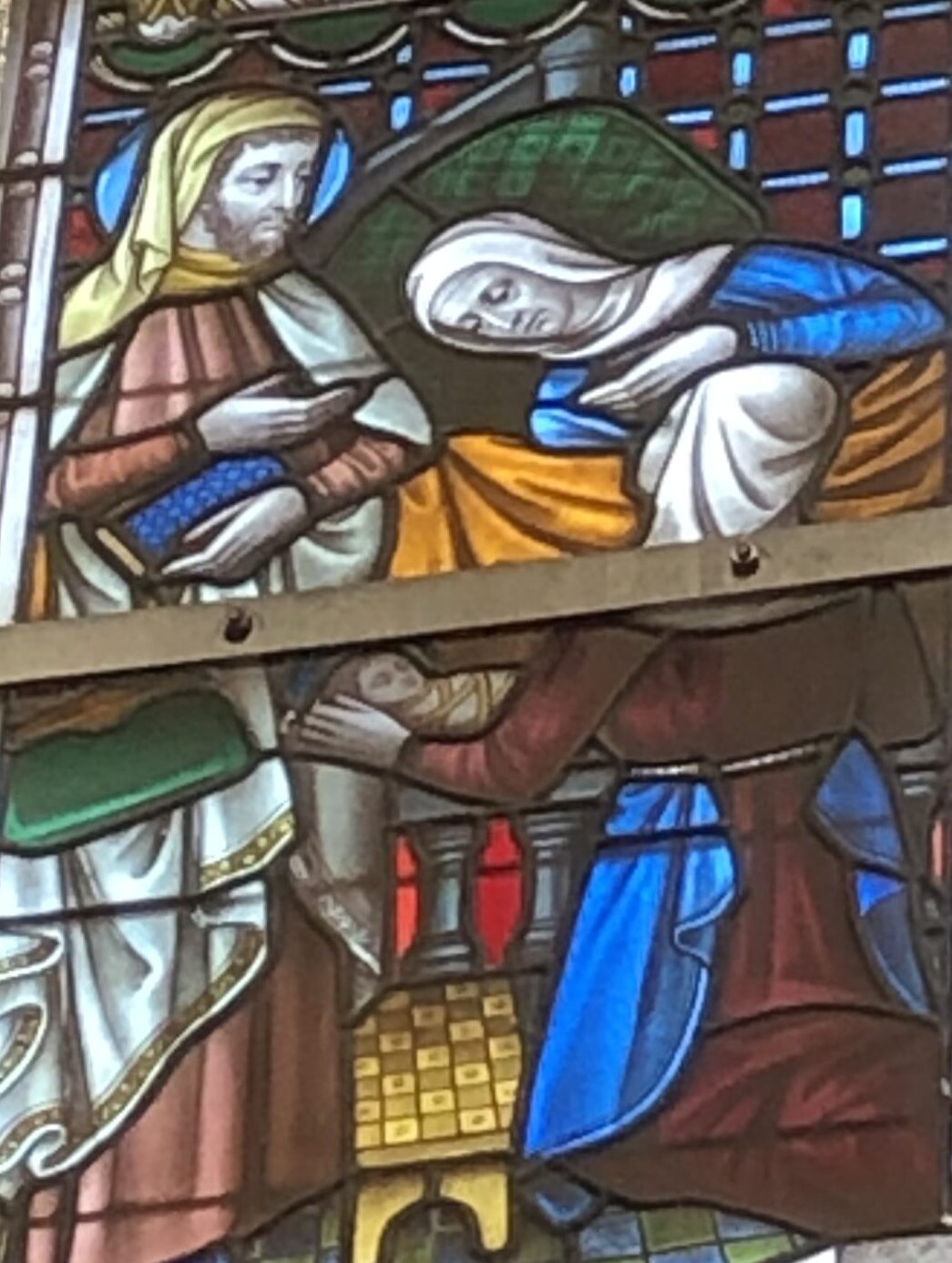
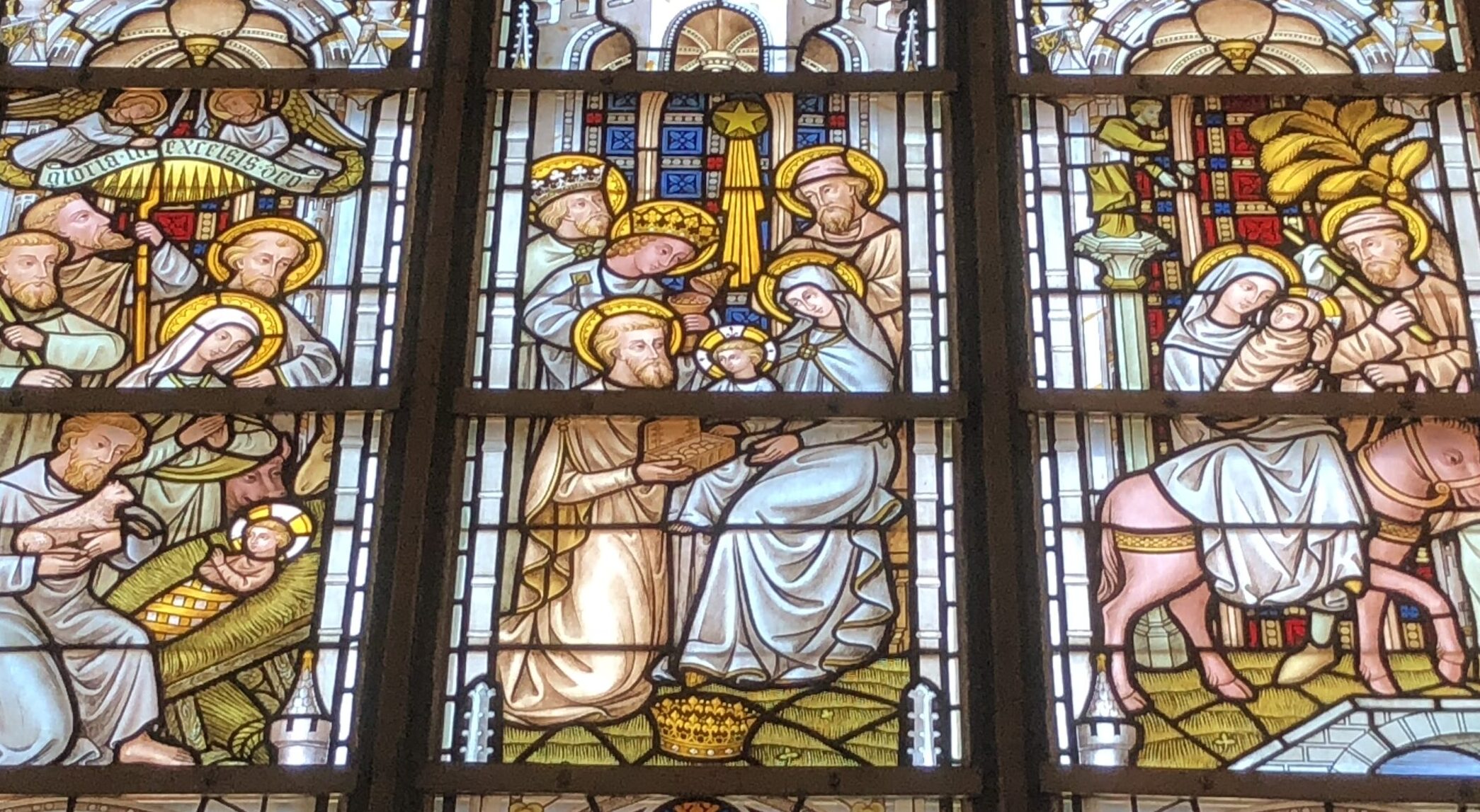
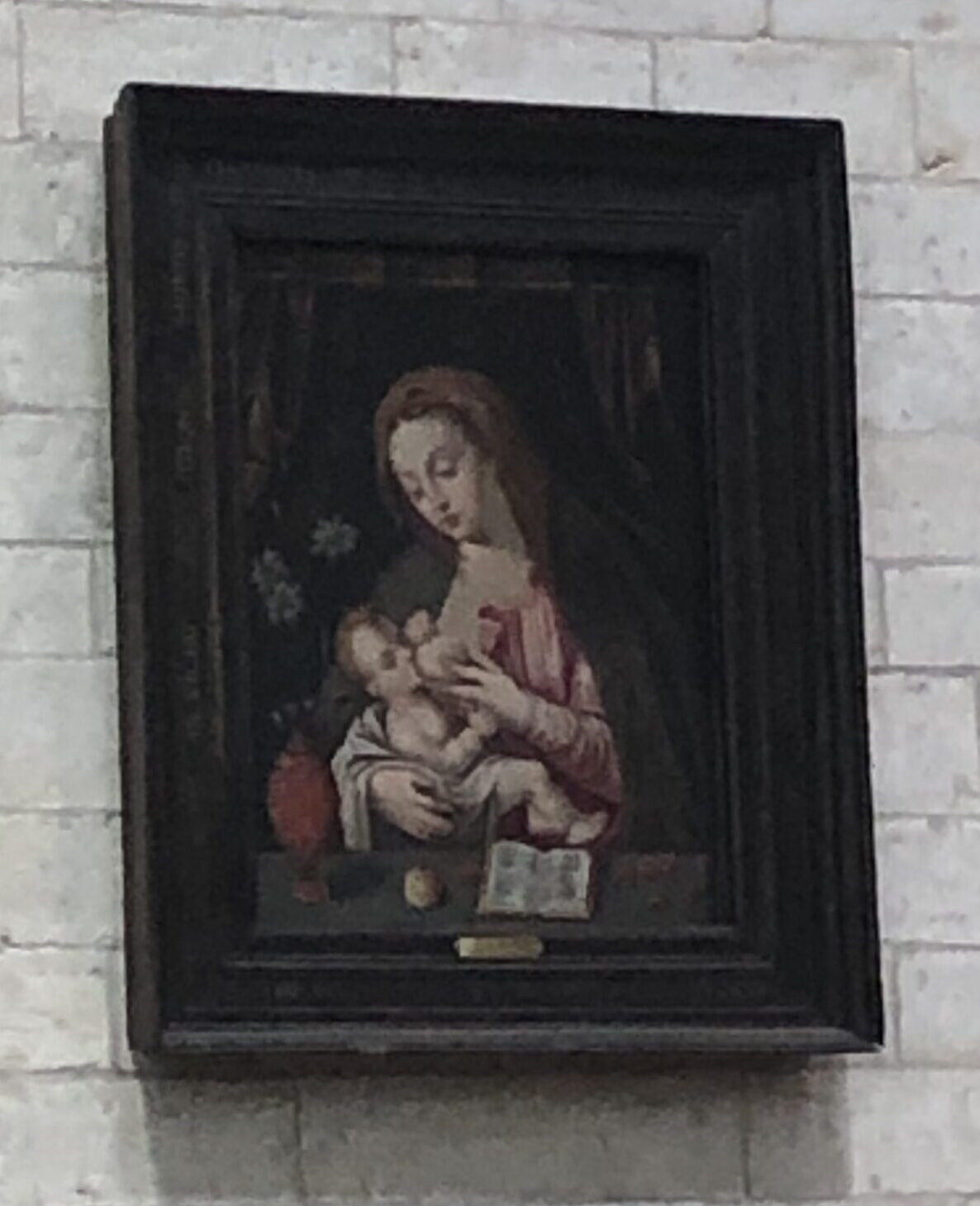
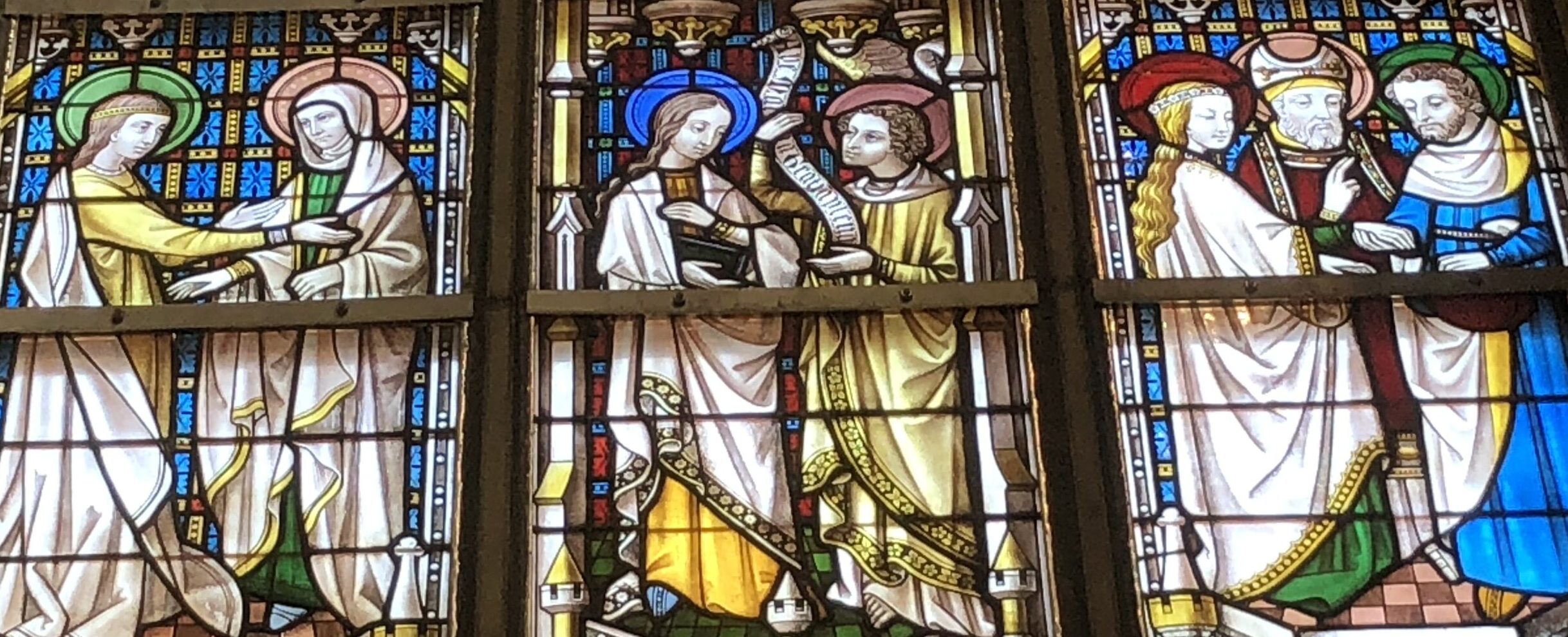
In the basilica, many colourful stained-glass windows can be seen. Some of these windows depict the history of the statue of Our Lady of Halle, including the arrival of the miraculous image in 1267, and were made in the period 1891-1908 by Ghent glazier Joseph Casier (1852-1925). Depicted are, among other things, Mary breastfeeding Jesus, some knights, the statue of Our Lady in procession, and the Archdukes Albert and Isabella of Austria.
In the basilica, there are 17th-century paintings depicting miracles attributed to Our Lady of Halle.
The crypt houses a portion of the trunk of the ancient tree, on which it is said a statue of the Virgin Mary hung in the 12th century. This tree lies beneath the presbytery, where the miraculous statue now stands.
The basilica is open daily.
ACCESSIBILITY
The shrine is located in St. Martin's Basilica, also known as Our Lady's Basilica. The address is:
Grote Markt 21, 1500 Halle.
You can find up-to-date information on www.kerkgroothalle.be.
Experience
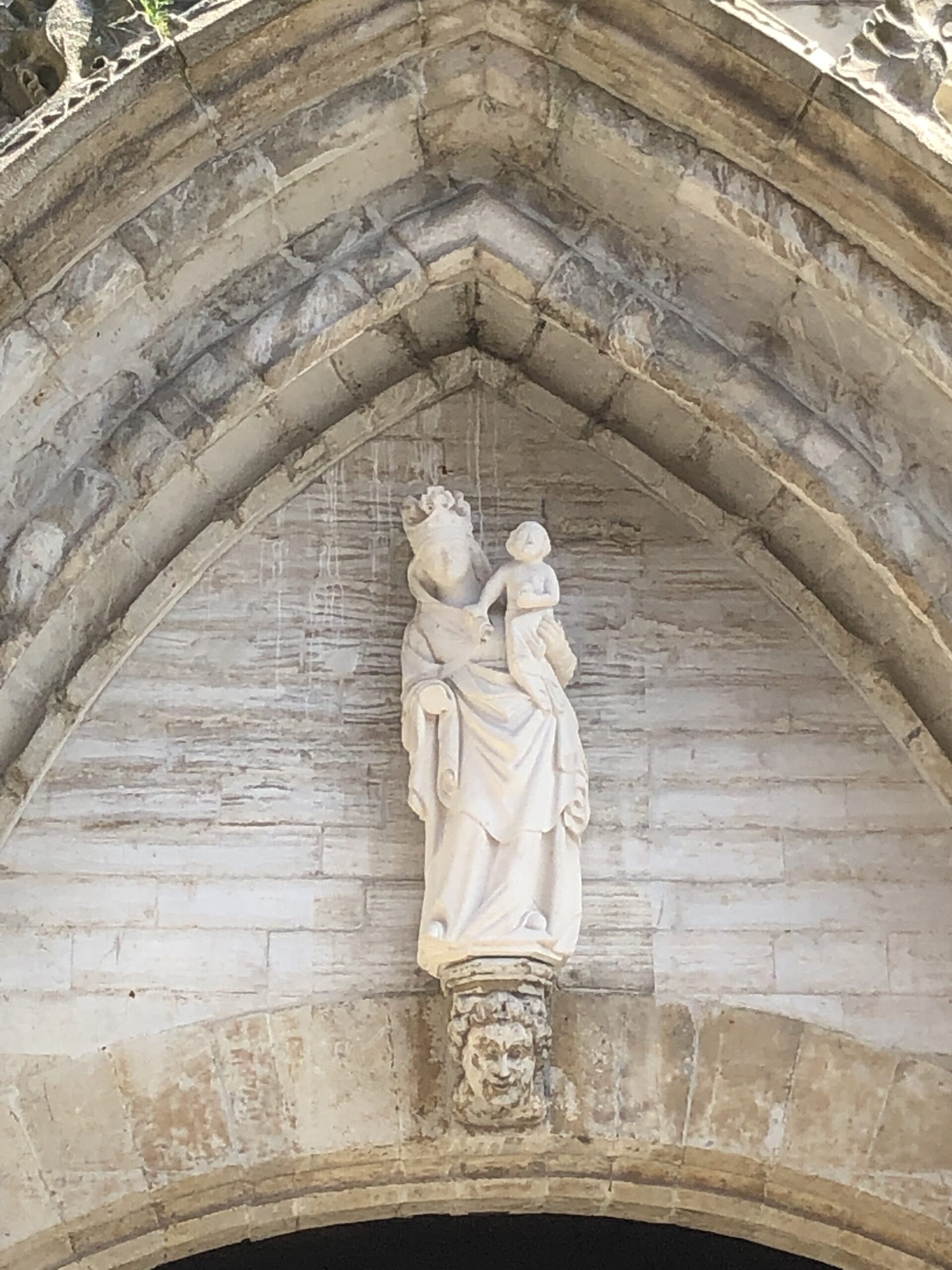
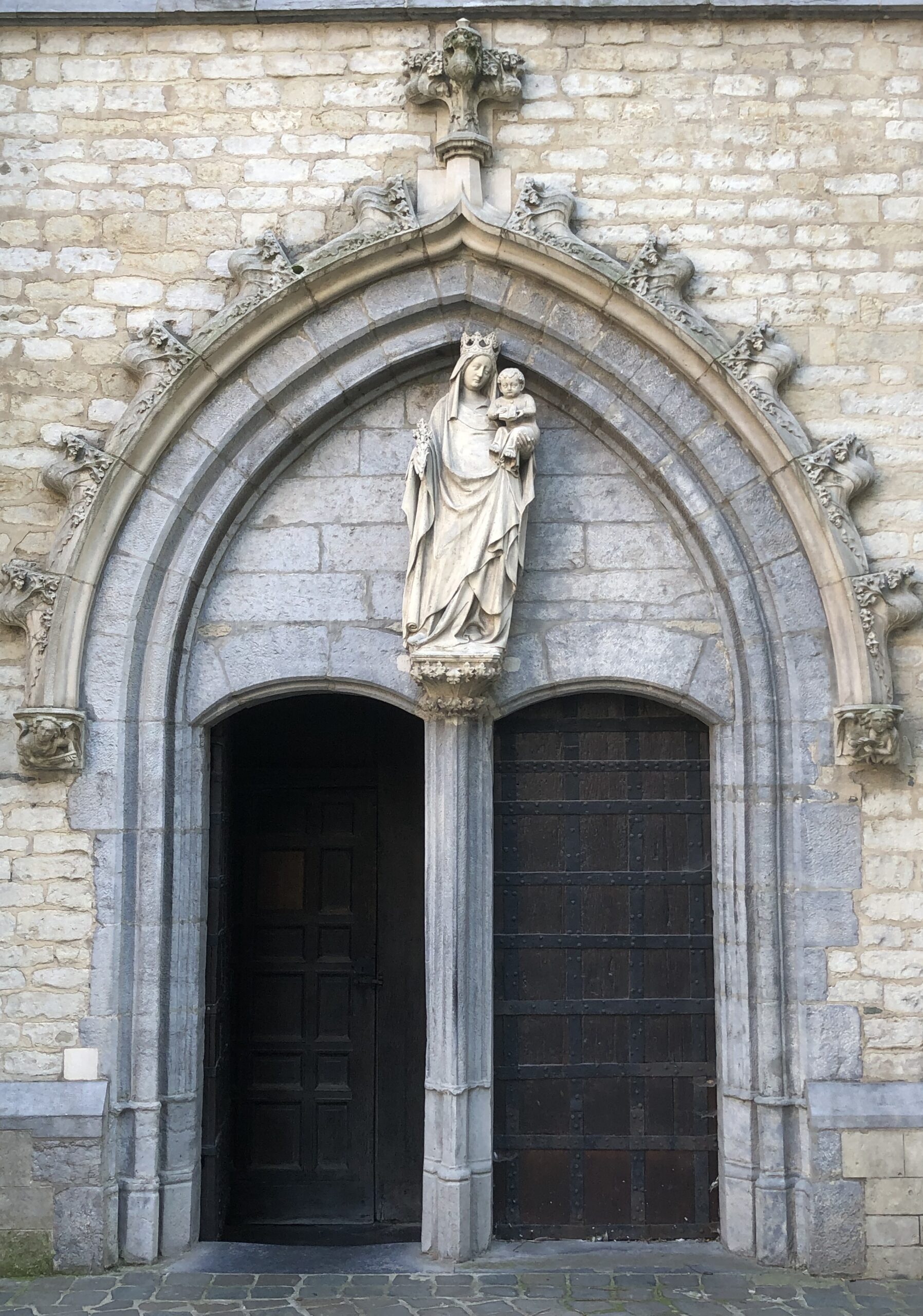
As I approach the basilica, I see an image of Our Lady above the gate.
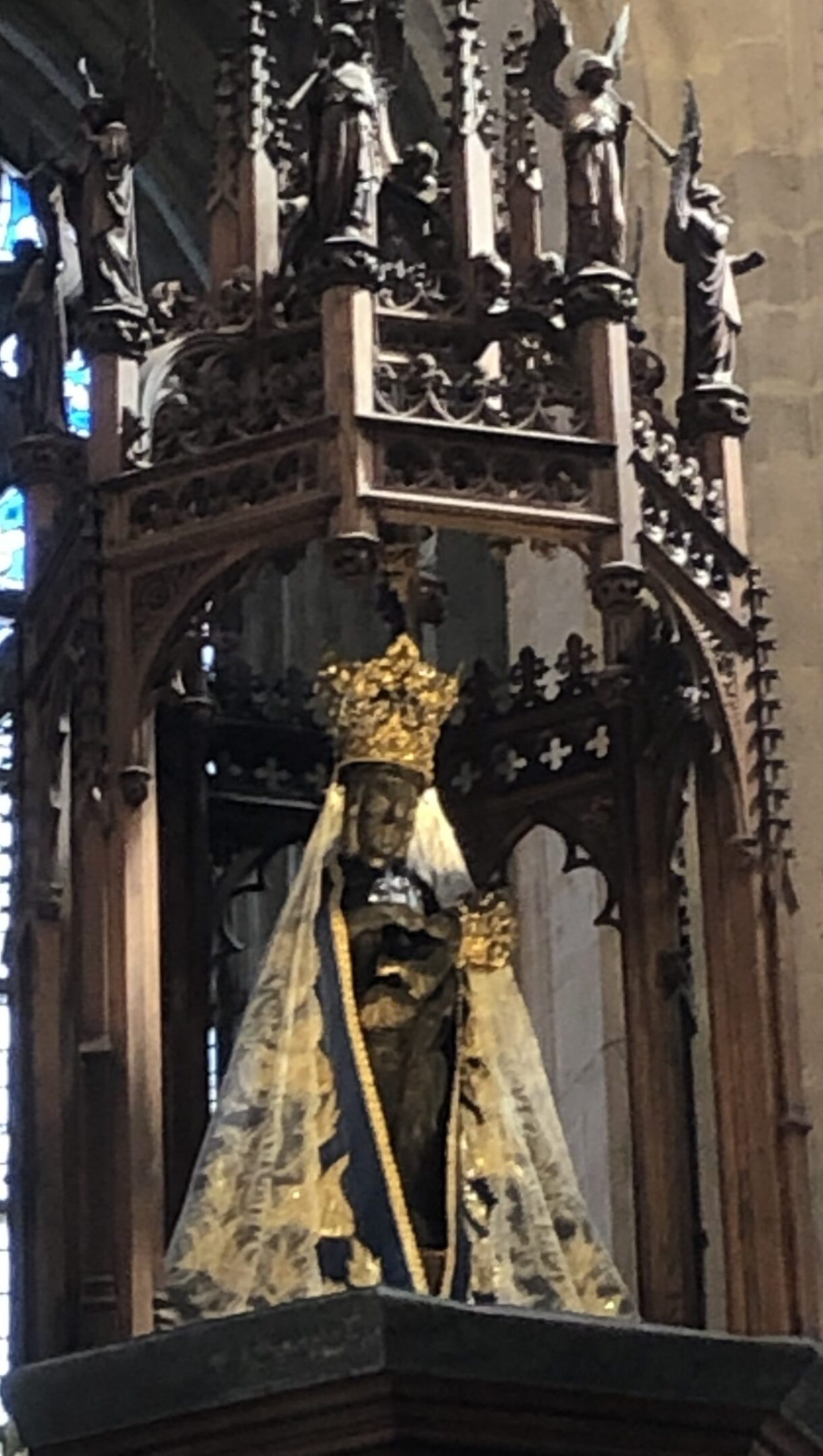
When I approach the devotional image, I see a seated Madonna with the Latin name “sedes sapientiae” which means “seat of wisdom”. Mary is also depicted as “Virgo lactans” and this Latin stands for “nursing Virgin”. Thus, Mary is shown seated and breastfeeding her Son.
Inside the basilica are more images of Mary, including a Pietà.
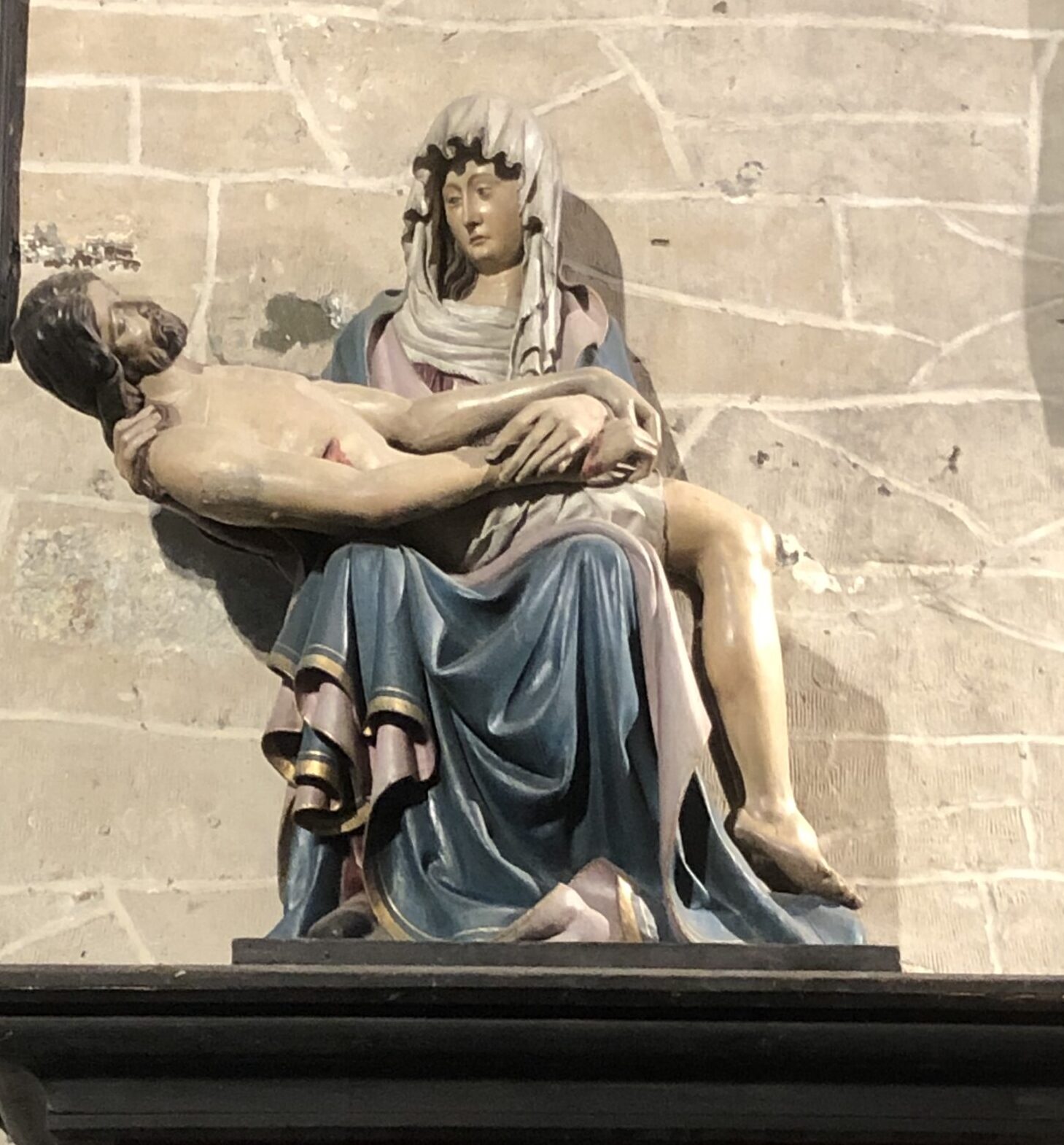
In the basilica there are also ex-votos, and these expressions of gratitude to Our Lady attest to the great honour bestowed upon the Mother of God.
I particularly like the many stained-glass windows, depicting Mary frequently.
Environment
For a visit to the capital, Brussels, it is only 20 km to travel. In Brussels, you can visit, among other things, the Grand Place and churches.
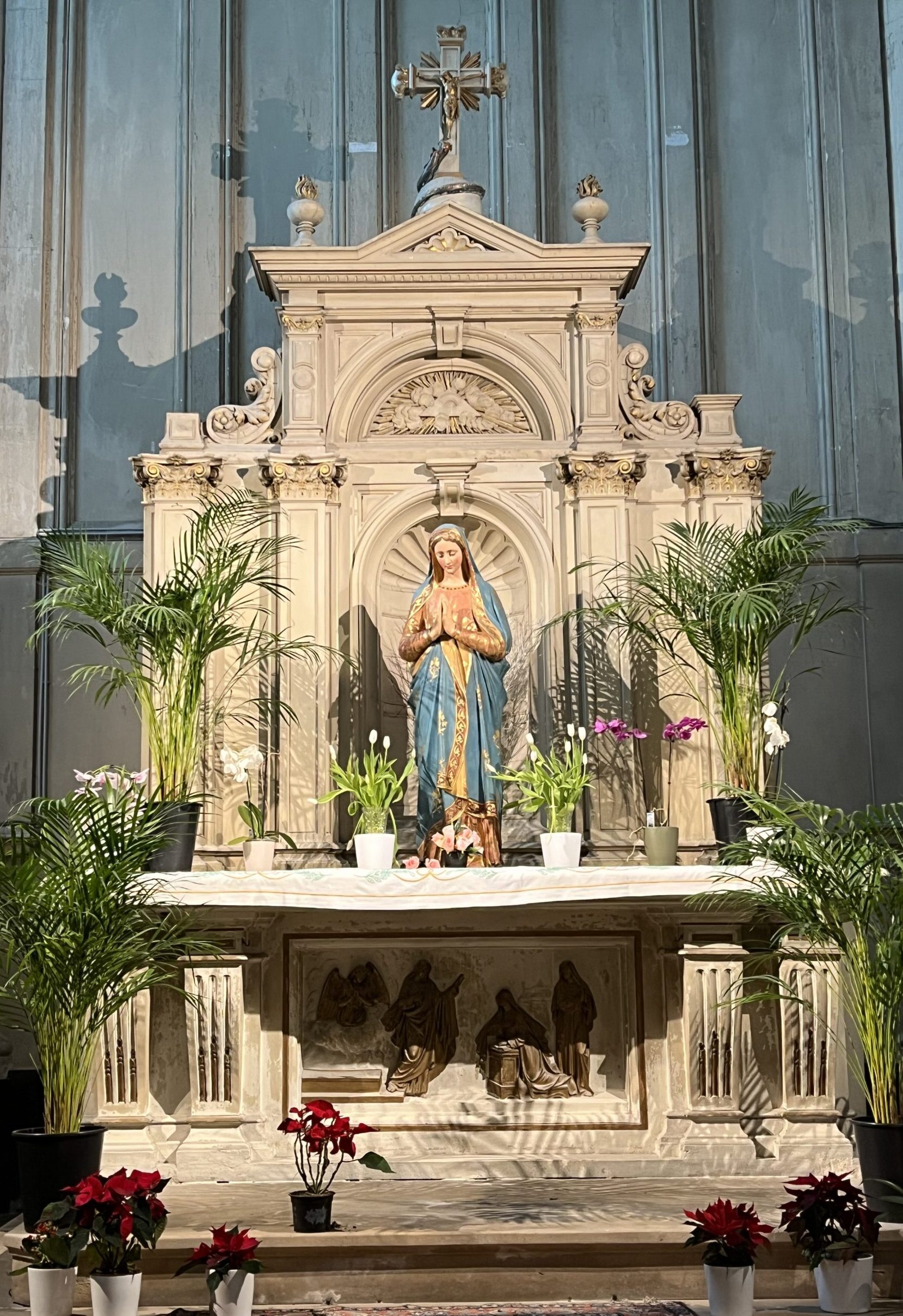
The Saint-Catherine's Church in Brussels is dedicated to Catherine of Alexandria (287-307). The baroque bell tower dates from 1629. Between 1854 and 1874, the church was built on the site of a former place of worship. The interior features, among other things, the 14th-century stone statue of the Black Madonna.
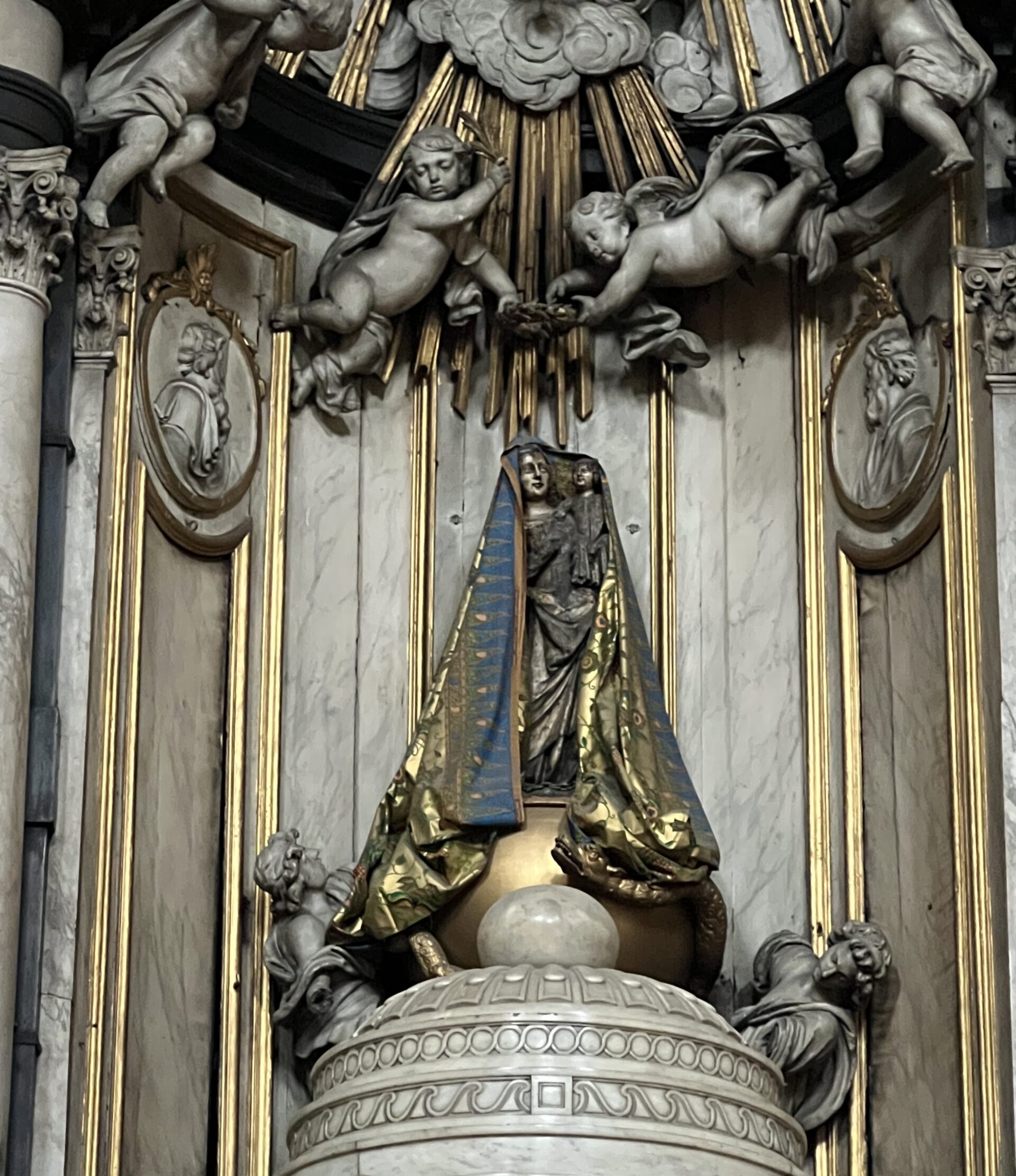
The Church of Our Lady of Perpetual Help is located on Kolenmarkt in Brussels and was completed in 1694. The Baroque building features a 14th-century oak statue of Mary in the choir, which has brought about miracles for believers. It is the image of Our Lady of Perpetual Help. In 1628, the image received the name Our Lady of Perpetual Help. In the niche above the main entrance, there is a statue of Mary from 1910.
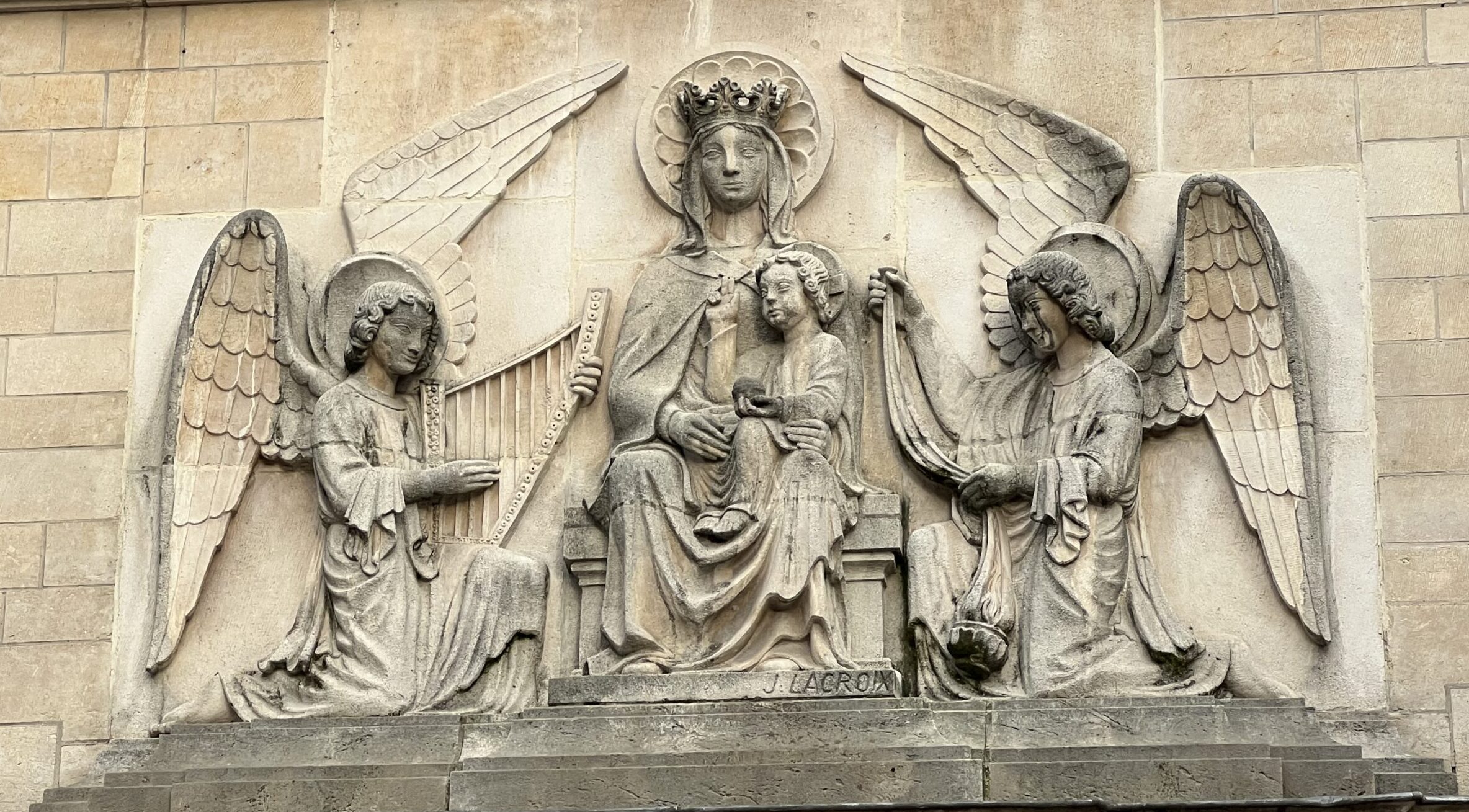
The Sint-Niklaaskerk is located on Brussels' Boterstraat and is dedicated to Saint Nicholas of Myra. He is the patron saint of, among others, merchants and students. The church is first mentioned in the 12th century. The building has been devastated multiple times by wars and adverse weather conditions. Outside, in addition to statues of Saint Nicholas, there is, among other things, a shrine to the Martyrs of Gorcum. A sculpture of Mary, Child, and angels adorns the entrance to the church. It is a work from the studio of Peter Paul Rubens (1577-1640).
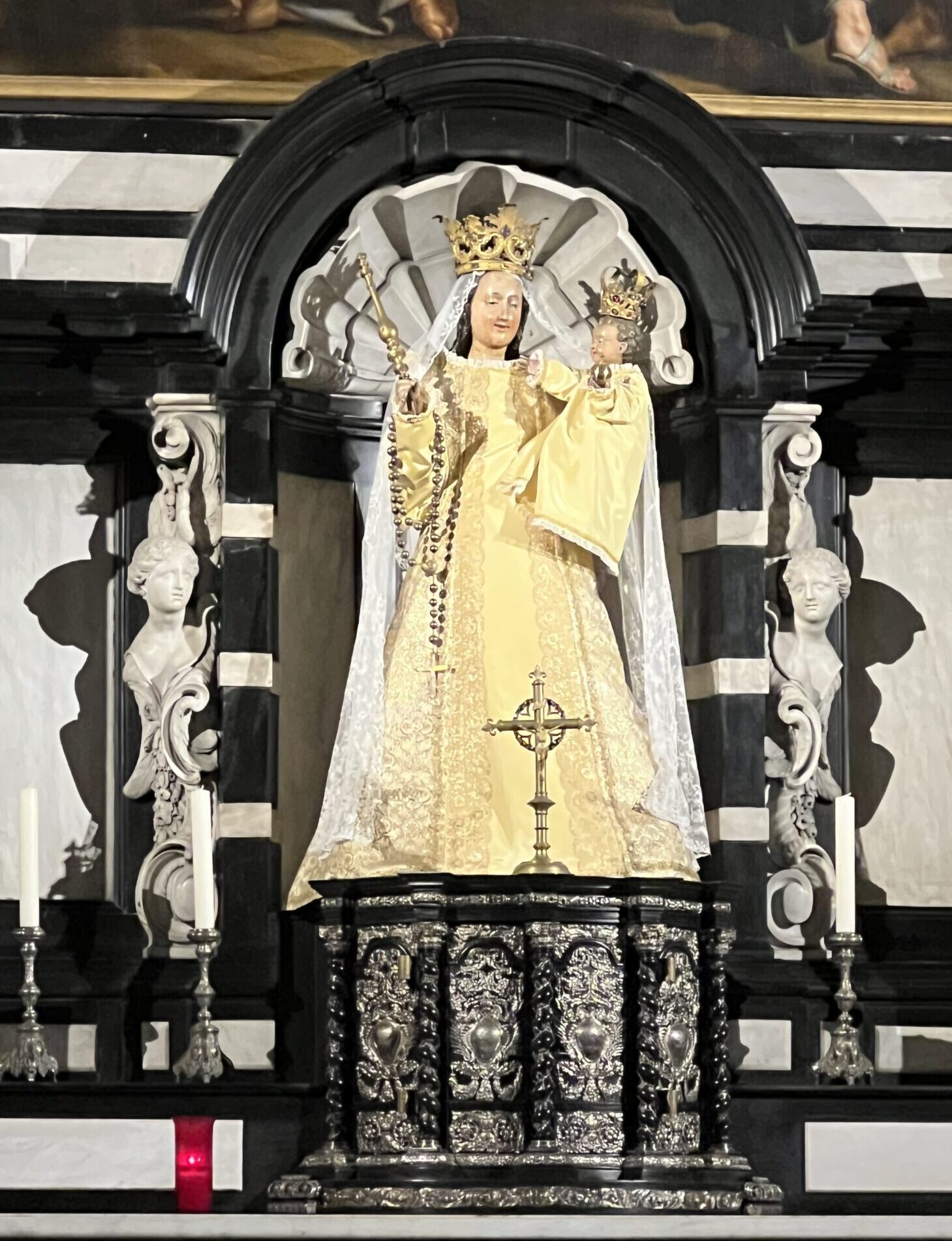
The Cathedral of Saint Michael and Saint Gudula is located on Parvis de Saint-Gilles in Brussels. The grand church was completed in 1519. Mary can be admired in the building. The cathedral contains many splendid tombs of distinguished individuals, such as those of Albert of Austria (1559-1621), his wife Isabella Clara Eugenia of Spain and Archduchess of Austria (1598-1621), and the painter Rogier van der Weyden (c. 1399-1464).
~~~

 Nederlands
  English (UK)
  Deutsch
  Français