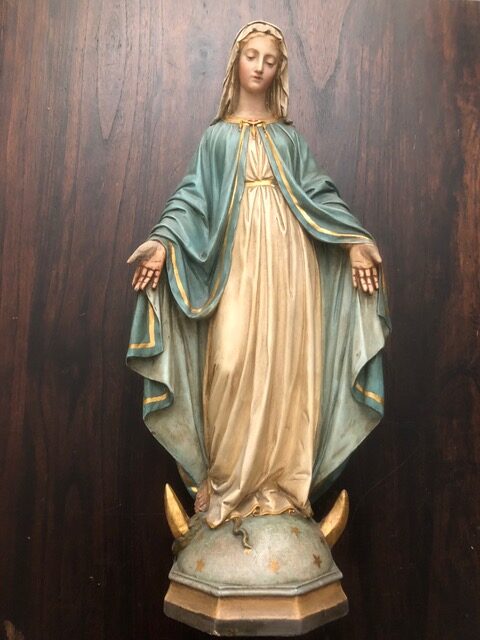
The word icon stands for image and likeness. An icon refers to Mary, Jesus, or another saint.
An icon is a form of religious painting, where a prayer is painted according to fixed rules. The painting of an icon is called writing. All figures, colours, and symbols in an icon have a meaning. The colour red stands for love, the colours blue and green refer to the earthly, orange signifies victory, and purple means conversion.
Icons are particularly placed in Eastern/Orthodox churches and are blessed. The base of an icon is wood, metal, or stone. This is covered with linen, and then chalk. Subsequently, the underlayer is painted, then the underdrawing is applied, and the phase after this is colouring.
Icons frequently depict Mary. These icons can be found in all countries of the world, particularly in churches, chapels, museums and in people's homes.
The icon of “Our Lady of Perpetual Succour” is most common in Western Europe.
Hodegetria
A common icon is the “Hodegetria”. In Greek, the name is “Odigitria” and means “guide”, “signpost”, “She who shows the way”. The title of the icon is derived from the name of the monastery “Hodegon” in Constantinople, where the icon is frequently venerated. In the Eastern Church, the feast of this icon is celebrated. In this icon, Mary is depicted from just below the shoulders. Her Child stands beside Her and is shown halfway. Mary carries her Son with her left arm. The Child blesses with his right hand, and his left arm is covered by clothing. The two do not look at each other. The face of the Mother of God is turned towards the visitor. She looks at the viewer with love and compassion. Her head tilts slightly to the left and just touches her Child. Her visible right hand points to the little Jesus. One story tells that the evangelist Luke painted the icon.
A legend relates to the icon. Mary appears to two blind men. Miraculously, She leads them to the icon. When the blind men arrive at the Mary icon, they find healing and can see. This is the origin of the name “Hodegetria”.
Our Lady of Kazan
The Hodegetria icon is a depiction of the Mother generally pointing to the Child. The Kazan icon (Our Lady of Kazan) is a specific, Russian variant. Kazan is the capital of the Russian Republic of Tatarstan.
The related icon of Hodegetria can be seen in many Russian churches and has a turbulent history. The icon has been venerated for many years, but it also has military significance. Twice the icon accompanied Russian troops in their battles against invaders. These took place in 1612 against forces from Poland and in 1812 against Napoleon's French armies. Both times the Russians triumphed, and the victories were attributed to the help of the Mother of God of Kazan.
Maria met three hands
A remarkable icon is Mary with three hands. The origin of this image dates back to a story about John of Damascus (676-749). He was a monk, priest, and theologian, and is considered a saint of the Eastern Church. John of Damascus is also called the last Greek Church Father. He wrote theological treatises on Christianity and went to the Mar Saba monastery in 735 to live as a monk. This monastery is located in the West Bank and was founded in 480 by Sabbas of Jerusalem (439-532). Due to false accusations, John of Damascus's right hand was severed. He then prayed to an icon of Mary to get his hand back so he could combat the opponents of religious images. His prayer was answered, and his hand grew back. This happened on 4 December 726, which is why his feast day falls on the fourth day of the twelfth month. This day is celebrated in both the Greek Orthodox Church and the Roman Catholic Church. As thanks to Mary, he added a third, silver hand to an icon of Her. This is therefore the only icon where Mary has three hands. This “Tricherousa” (three-handed) icon is highly revered in the countries of the Balkans and Russia.
Later, the icon is revered for asking for help for infertile women, so that they may conceive. The original artwork is housed in the Hilandar Monastery on Mount Athos in Greece and it is one of the most important icons of the Serbian Orthodox Church. This icon is double-sided, and on the reverse is an image of Saint Nicholas of Myra. In 1883, John of Damascus was recognised as a Doctor of the Church by the Roman Catholic Church.
Our Lady of Grace
Another icon is that of “Our Lady of Grace”. In the Bernadette church in Lourdes, there hangs a large icon depicting “Our Lady of Grace”. The original is located in the cathedral of Cambrai, France.
~~~

 Nederlands
  English (UK)
  Deutsch
  Français