~~~
History
The Piast dynasty is closely linked to the pilgrimage site. This family endowed the abbey in 1242 and established the family burial ground. The donation comes from Anna of Bohemia (c. 1201-1265) after the Battle of Legnica in 1241, where Christian troops took on the Mongols. Her husband died in this violence; Henry II of Poland (the Pious, c. 1196-1241), Duke of Silesia, Krakow, and High Duke of Poland (1238-1241).
A former church stood here, and it was built in 1292. The benefactor was Bolko I von Schweidnitz/Jauer (the Stern, 1253-1301), Duke of Jauer (1278-1301), Duke of Löwenberg (1286-1301), and he belonged to the Piast dynasty.
The former church building is plundered and destroyed by Hussites; Protestants, inspired by Johannes Hus (c. 1369-1415) in 1426. Many clergy are killed in the process. The statue of grace is timely placed under the floor of the sacristy. In 1463, the abbey is plundered again, this time by the men of George of Poděbrady (1420-1471), King of Bohemia (1458-1471) and a follower of Johannes Hus. There are also setbacks in the period 1474-1526 when there is war with the Turks, and in 1633 when Swedish troops come to plunder and destroy during the Thirty Years' War (1618-1648). In 1677, the monastery is once again destroyed by fire.
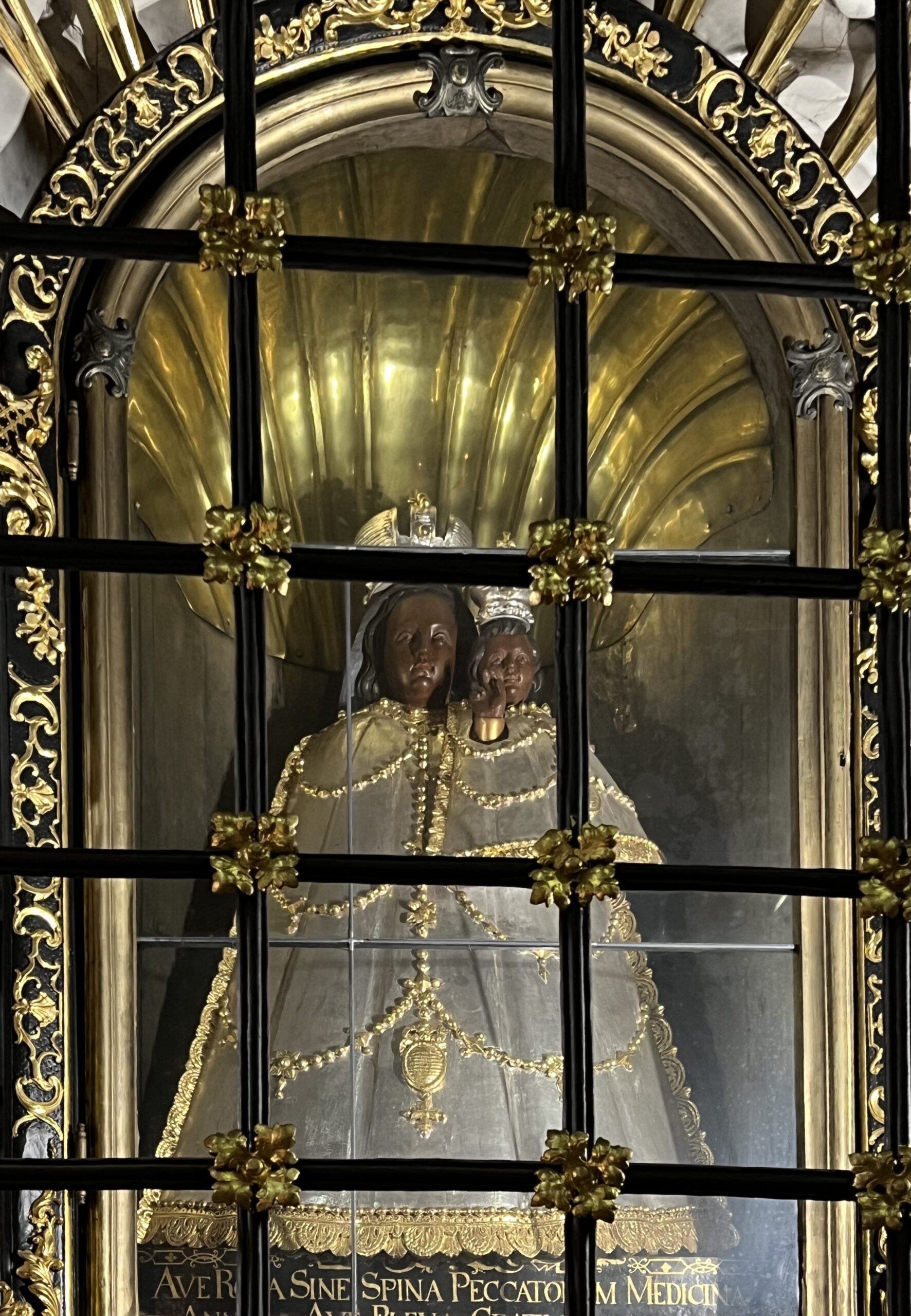
When the old church was renovated in 1622, a ray of light falling from the sacristy window onto the floor revealed a crack. Upon investigating beneath the floor, the miraculous icon was found. This icon was meticulously examined in 1996, revealing it to be the oldest painted image with a Marian theme in Poland created using tempera (permanent paint) on wood. The image exhibits Byzantine characteristics. The artwork dates to around 1250 and depicts the Virgin Mary as “Hodegetria” (She Who Shows the Way), pointing towards the pilgrims.
During the Counter-Reformation, the struggle against the Protestants, prosperity returned and the number of pilgrims increased. The power of the Catholic Church in Silesia grew again.
In the years 1690-1696, the St. Joseph's Church was built. In 1696, the Brotherhood of St. Joseph was founded here. Many works of art can be seen in this church, including works by Michael Leopold Lukas Willmann (1630-1706), a German Baroque painter, who is also called “the Silesian Rembrandt”.
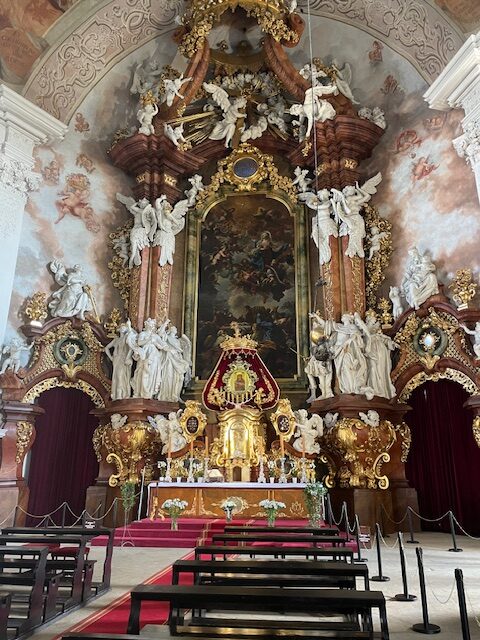
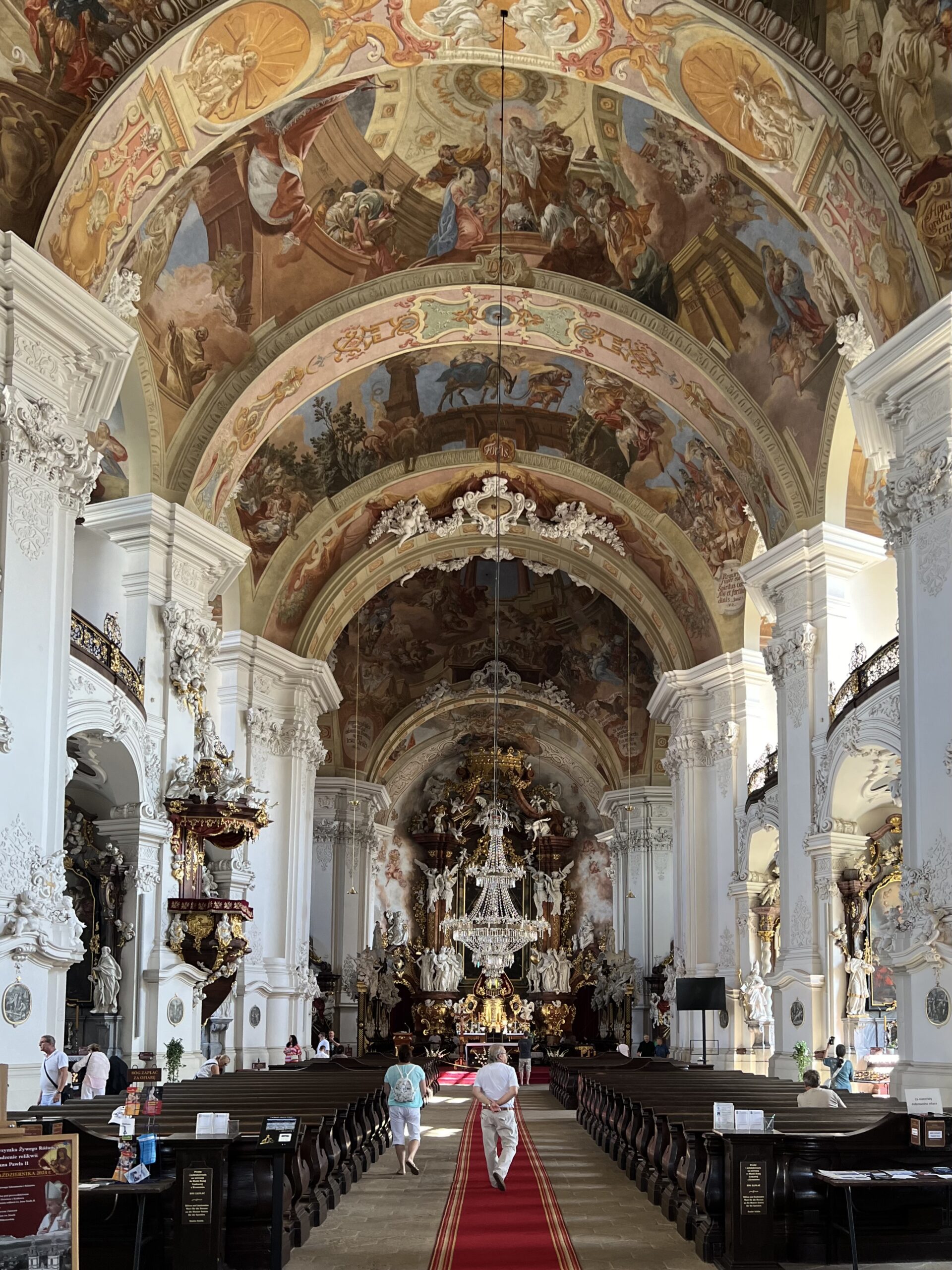
In 1727 the old monastery church was demolished and reconstruction began. The current church, dedicated to the Assumption of Mary, was built on the commission of Cistercians between 1728 and 1735 and is in the Baroque style. The builder and architect was Joseph Anton Jentsch (1698-1758). Sculptures are by Ferdinand Maximilian Brokoff (1688-1731) and Anton Dorazil (1695-1759) among others, and paintings are by Georg Wilhelm Neunhertz (1689-1749), also among others. The high altar was created by Ferdinand Maximilian Brokoff and features the painting of the Assumption of Mary. This artwork was made by the Baroque painter Peter Johann Brandl (1668-1735). The icon of the devotional image stands on the tabernacle. The church was consecrated on 3 July 1735.
In 1738, the Church of St. Mary Magdalene was built next to the Piast mausoleum.
The towers of the basilica are over 70 metres high.
The basilica also houses a Pietà from c. 1500.
The Calvary Mount was realised in the 17th century.
The Loretto Chapel is from 1728 and the Madonna statue dates from 1676, created by Georg Schrötter (1650-1717).
In 1810, the Prussians occupied the complex, and much was destroyed, including the valuable library.
Between 1919 and 1945, Benedictine monks resided in the monastery buildings and guided pilgrimages.
In 1940, the Nazis occupied the monastic domain and Jews from various regions were brought here. This continued until early 1945. As the German Benedictines had been expelled, Polish Benedictines arrived to lead the pilgrimage site.
On 2 June 1997, the coronation of the image of grace took place. This was done with papal crowns by John Paul II, Pope from 1978 to 2005, born in Wadowice, Poland, as Karol Józef Wojtyla (1920-2005).
Since 1998, the church has been a basilica.
In 2004, the monastery complex was inscribed as a UNESCO World Heritage site; United Nations Educational, Scientific and Cultural Organization.
Pilgrimage site
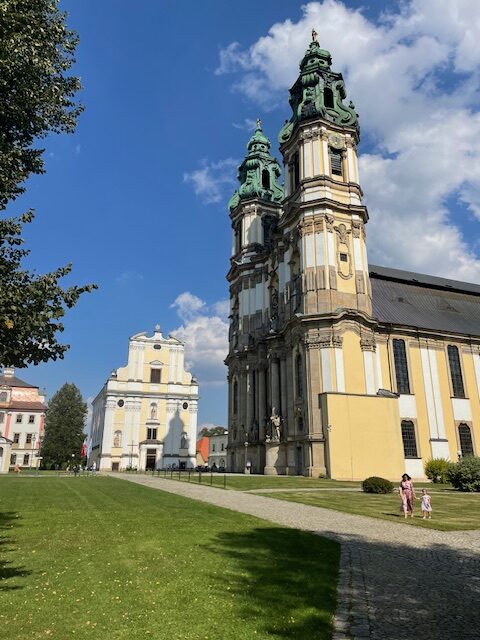
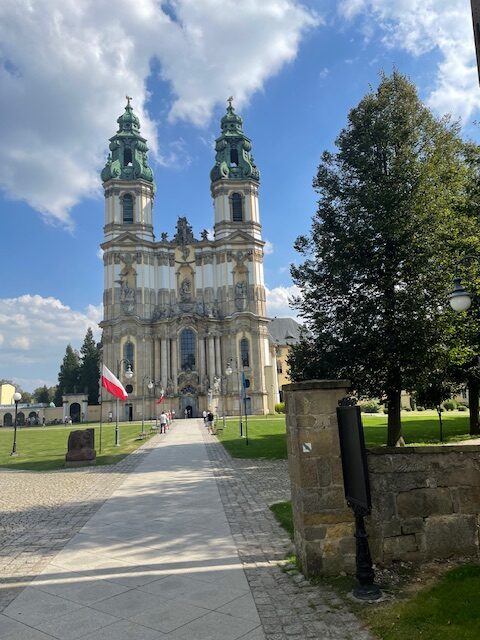
The pilgrimage site of Krzeszów/Grüssau is one of the most frequently visited Marian shrines in Lower Silesia and is located at an altitude of around 450 metres above sea level.
The basilica is dedicated to the Assumption of the Blessed Virgin Mary. In Polish, the church is called “Bazylika Najświętszej Marii Panny”. The basilica, with its extension housing the Piasten Mausoleum and the Church of St. Mary Magdalene, is approximately 120 metres long and 30 metres wide. The basilica has been adorned by many artists.
The main altar of the basilica displays the colourful painting of the Assumption of Mary, who is accompanied by angels on her heavenly journey. Above this altar, a real, large crown is mounted.
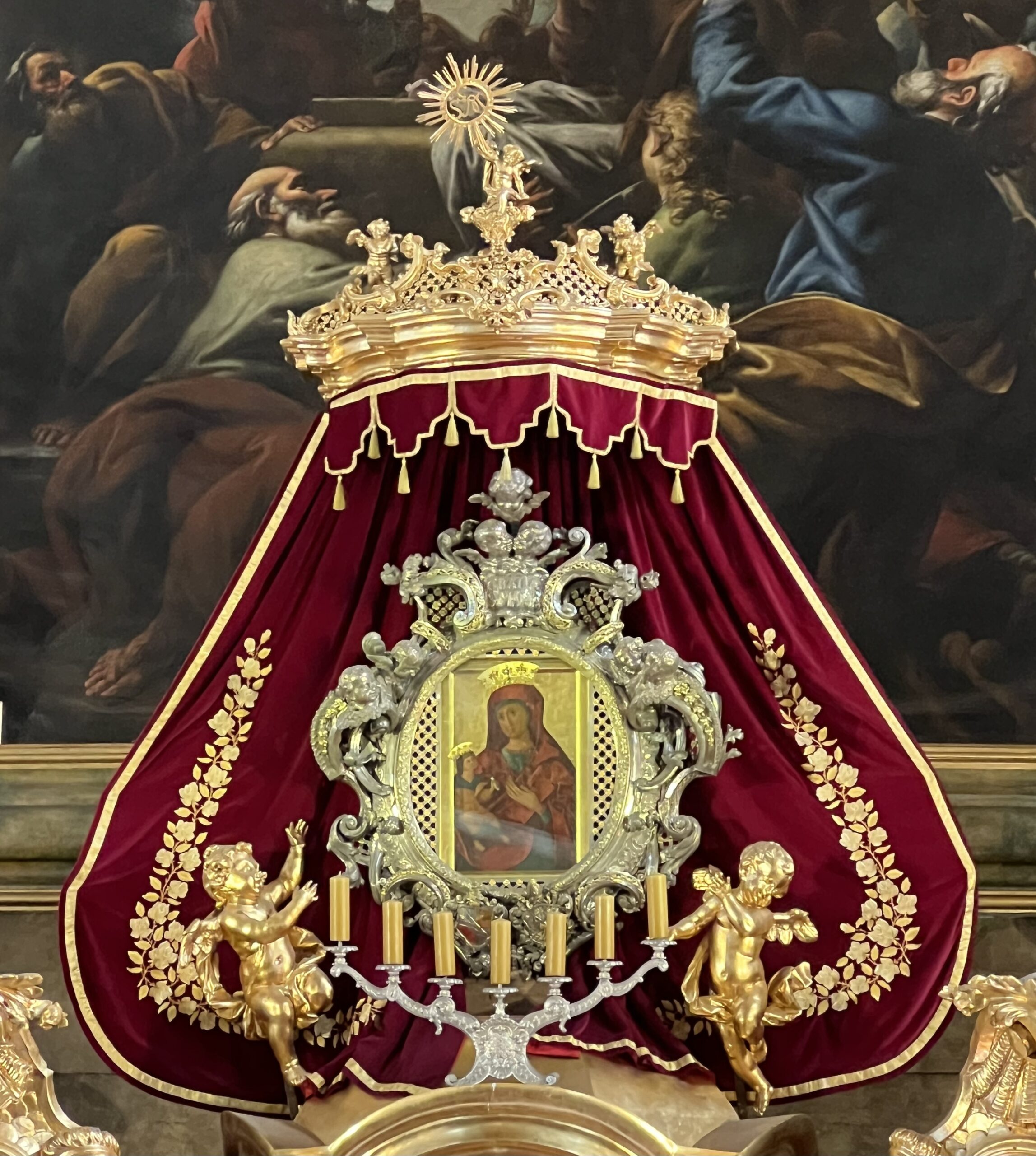
The icon of grace is titled “Mother of Graces”. It is the oldest painted icon in Poland. In her right hand, Mary holds her Child, who is looking at Her. The Lady's eyes are mercifully directed towards the visitor. For most visitors, the icon is the most important aspect of this pilgrimage site.
The pulpit was made in sections and completed in 1761. The late Baroque organ dates from 1732-1737 and was later converted and renovated. A remarkable statue of Mary stands by the organ; she is depicted with her hair cut short.
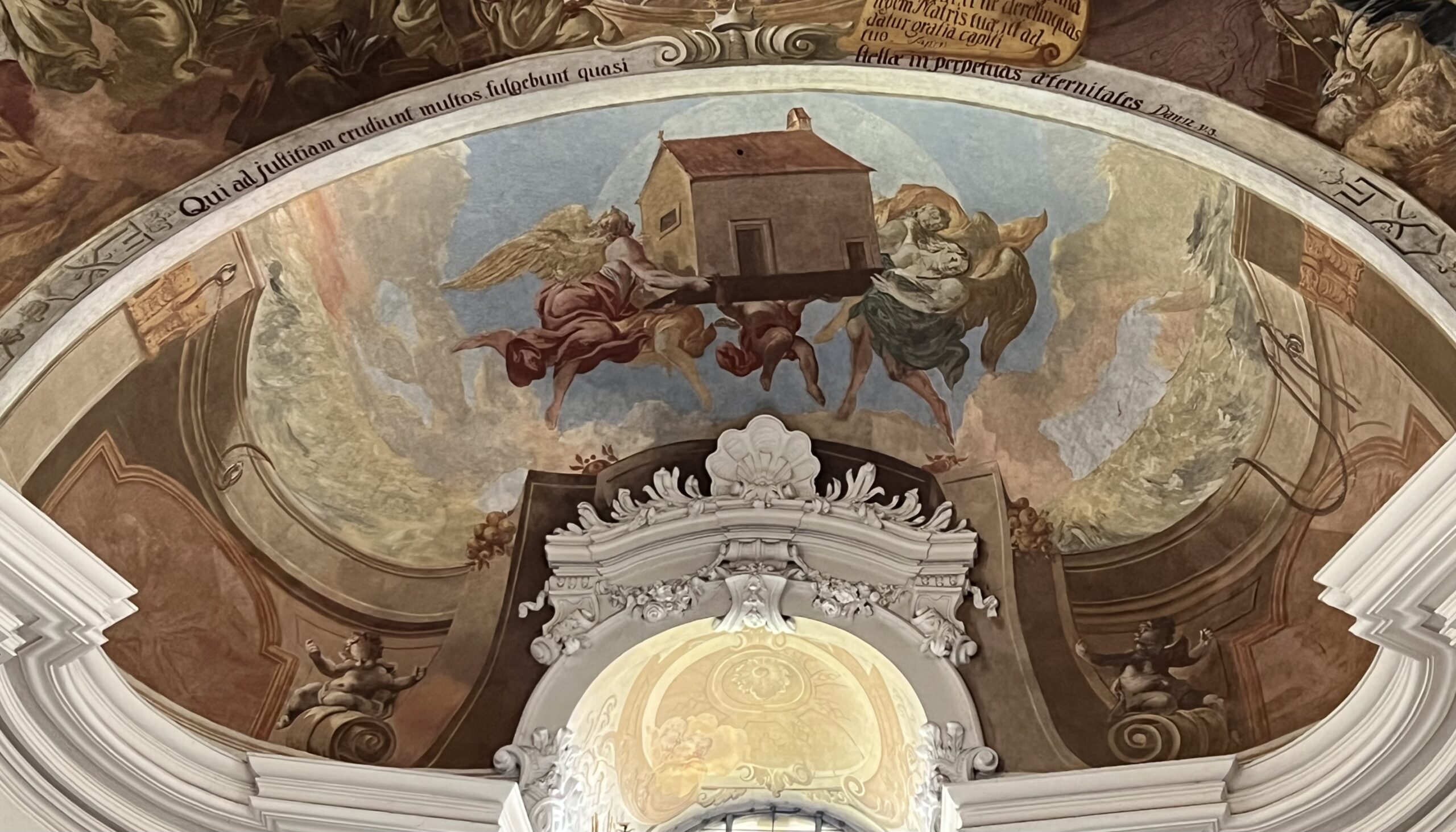
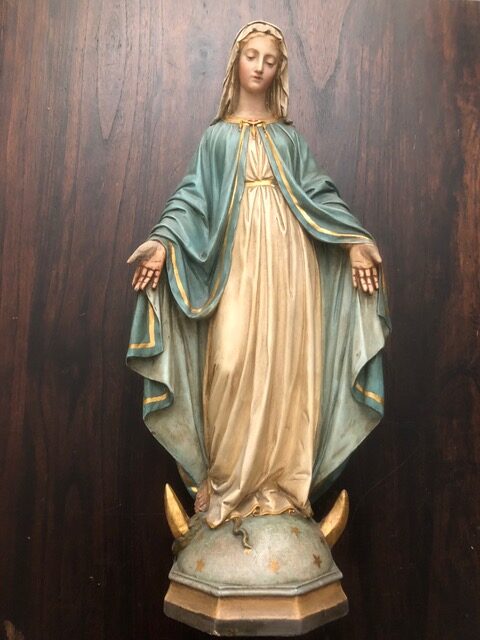
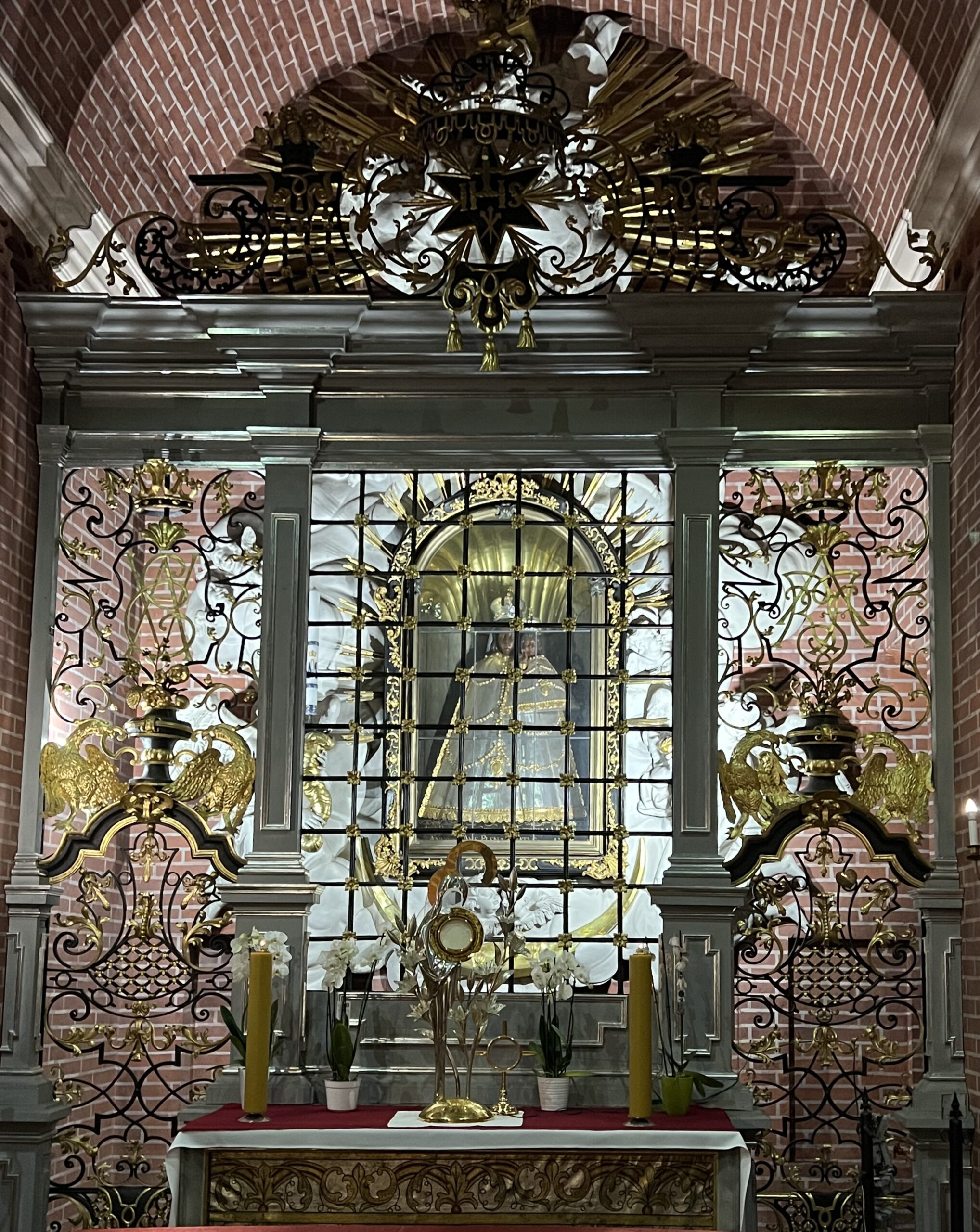
The Loreto Chapel can also be seen in the basilica, it was made in 1728 and built after the house of Nazareth. The statue, a replica of the Mother of God from the Italian Loreto, is from 1677.
In the basilica, there is also a chapel dedicated to Saint Nicholas.
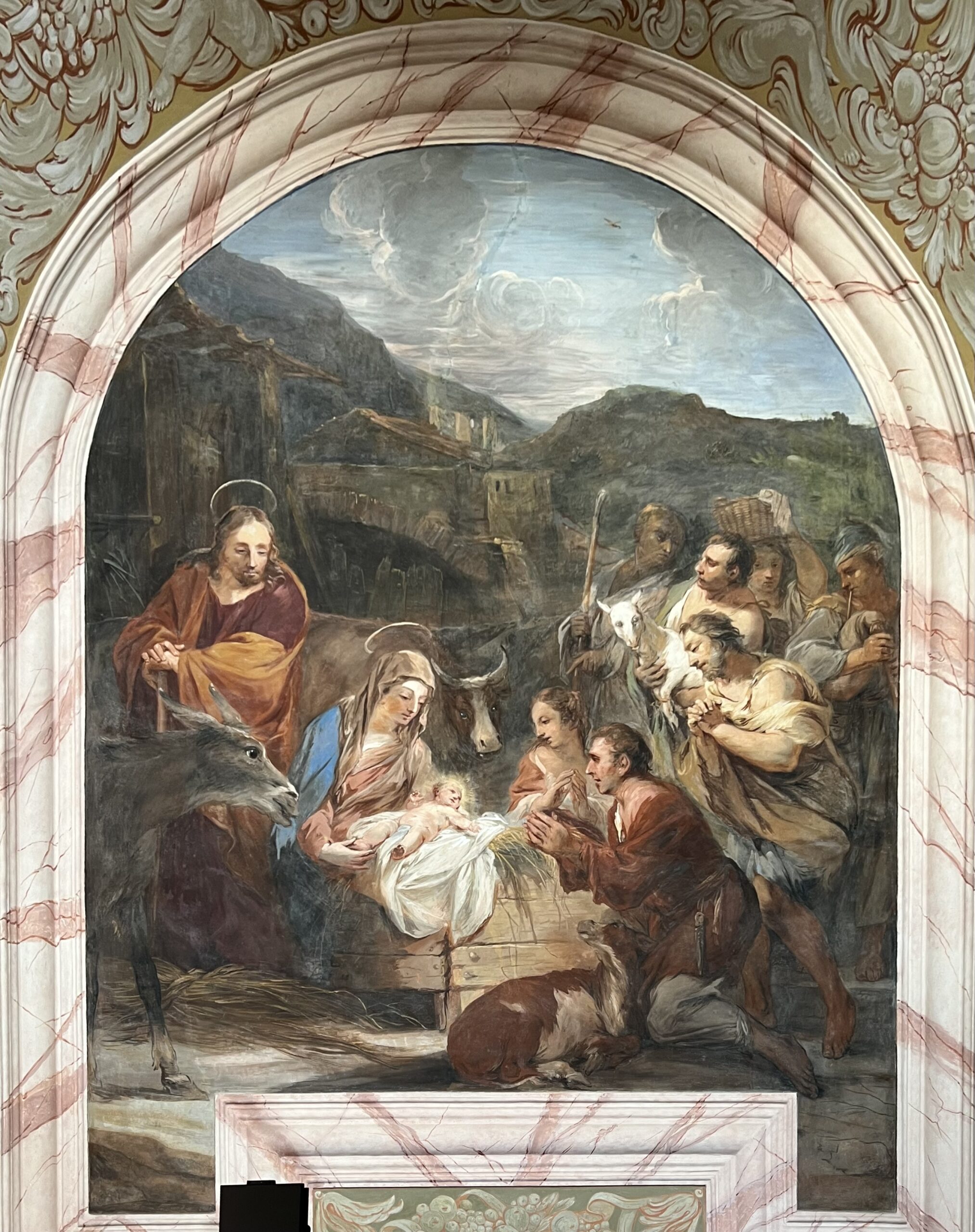
The large monastic complex also features St. Joseph's Church, the Piast Princes' Chapel, the Calvary, and the monastery building. St. Joseph's Church displays much art, including paintings and frescoes, such as the seven sorrows and seven joys of St. Joseph. The Princes' Chapel contains the sarcophagi of Piast family members, including those of Bolko I and II. This large chapel is adorned with many frescoes and statues. The figures on the sarcophagi date from the 14th century. The Calvary is extensive and has numerous stations and chapels. The monastery building was constructed in phases during the 17th and 18th centuries.
On the grounds near the basilica, next to St Joseph’s Church, stands a historic guesthouse. At an altitude of almost 600 metres lies St Anne’s Chapel, built between 1721 and 1722, which had fallen into disrepair and was rebuilt in 2011.
Approximately 2 kilometres from the town centre, “Bethlehem” has been built with chapels and a pavilion on the water.
The basilica at this major place of pilgrimage is open every day.
ACCESSIBILITY
The pilgrimage site of Krzeszów/Grüssau is located on the outskirts of the town in southwestern Poland, in the Lower Silesia region. The distance to the Czech Republic border is not far, and the city of Prague can be reached quite quickly.
Address: Plac Jana Pawła II 1, 58-405 Krzeszów.
More information can be found on the website www.opactwo.eu.
Experience
The basilica’s tall towers seem to be watching invitingly to see if any visitors are approaching. I am happy to accept this invitation. As I approach the basilica, a long, high wall immediately makes it clear to me that this is a large complex of buildings. What a vast expanse of religious, impressive abbey displays!
A Eucharist service is being held in the basilica, making a visit for general sightseeing inappropriate. Adjacent to the large church building are a restaurant and a shop selling devotional items, where tickets can also be purchased to enter St. Joseph's Church and the abbey grounds.
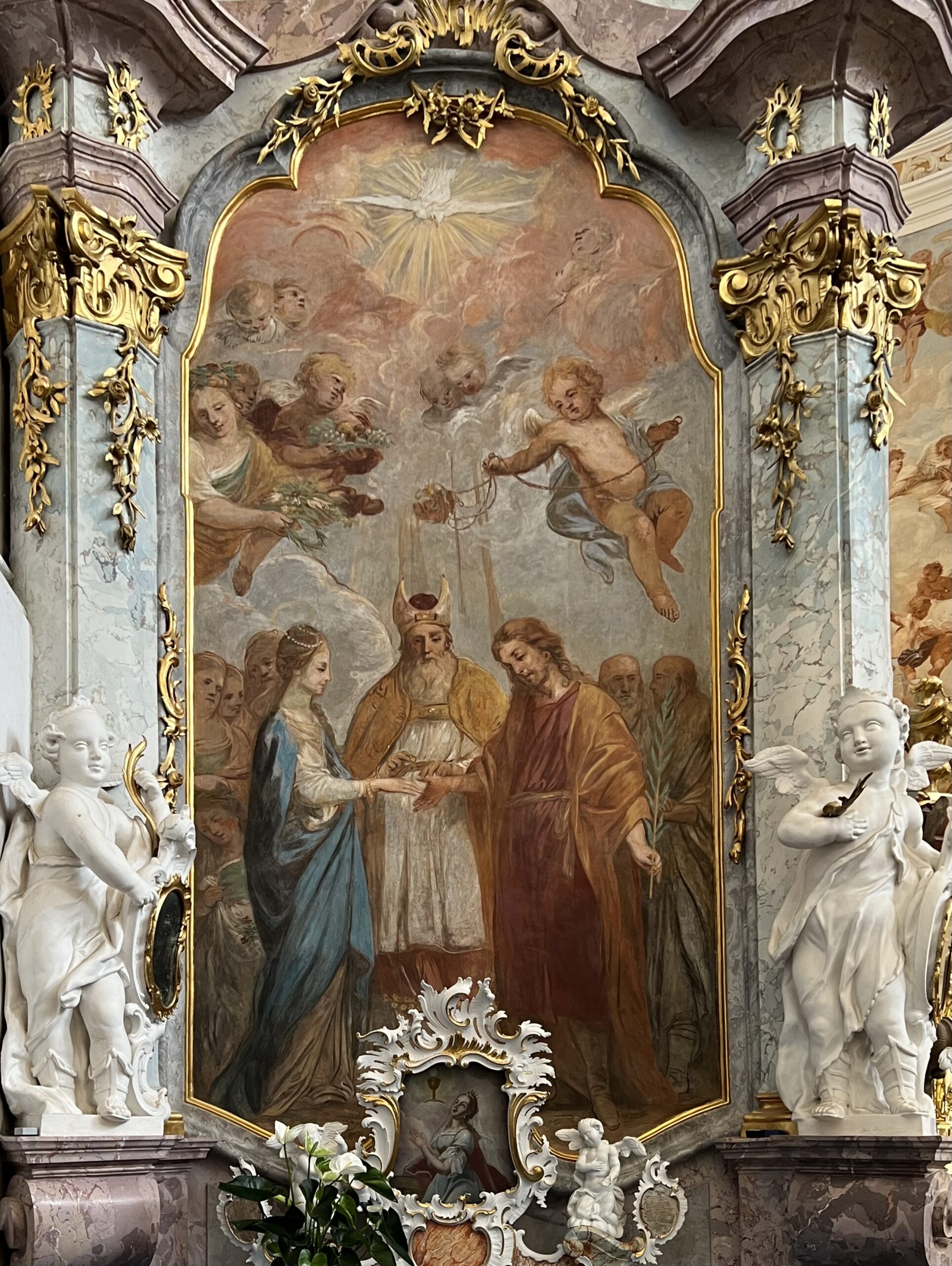
With a ticket, I can enter the church, which is named after Mary's husband, and see all sorts of painted scenes from the life of Joseph. I find works of art that also depict Mary particularly striking. A painting of a panorama with the three wise men in the choir also catches my eye, as does the painting of the wedding ceremony between Mary and Joseph. Many frescoes have been applied to the ceilings, forming an impressive display of colour! Joseph receives a lot of honour here. In this church, he is rightly given an upgrade.
After visiting St. Joseph's Church, I will go to the enclosed grounds next to the basilica. With the purchased ticket, I am allowed access to an extensive domain as a high, wrought-iron gate opens. I immediately enter a section of the monastery garden with a graveyard and statues of the crucifixion of Jesus. This is followed by a mausoleum, the chapel of Mary Magdalene, memorials of high-ranking nobles, and the monastery's cellar.
The monastery cellar is a large, underground, somewhat dark, high space. It feels like a special experience to come here. I see images of Mary, old stones and facades from centuries ago. This cellar has the characteristics of the eloquent history of religious life. You have to watch where you step, as the floor is uneven. A misstep here is undesirable. For many decades, many footsteps have been taken in this space, and now some more are added. After my underground stay, I visit the princes' chapel with sarcophagi, which is a large and grand mausoleum.
The next part of my visit is the basilica. Mass has finished, so I can go inside for a look around. Many others are touring the basilica alongside me. The church is dedicated to the Assumption of Mary, and I feel as though I’m in heaven. The basilica showcases the beauty of what artists conjure up with their talents. The painting of Mary’s Assumption into Heaven adorns the high altar. The miraculous image of Mary was crowned by the Polish Pope John Paul II. As I gaze at the miraculous image a little longer, I get the impression that Mary is speaking to me. Our gazes meet. She is my Mother! Here too I have a mystical experience. The miraculous image shows Mary holding Jesus. The Child looks at Her, but She does not look at Him, for Mary’s eyes are mercifully fixed upon the visitors. The frescoes in the basilica make me pause for a long time and look upwards. What splendour!
For years I've paid special attention to Loreto and I'm lucky, because in the basilica there is a Loreto Chapel. In front of the chapel entrance, I see the painting of the house of Nazareth being moved to Loreto by angels. Inside the chapel, there is a beautiful image of Mary. A thick railing protects Our Lady.
The last stop of my visit is the monastic buildings. I am examining them closely. What a wealth of beauty in Krzeszów/Grüssau! A gem to visit!
Environment
From the pilgrimage site of Wambierzyce/Albendorf to Krzeszów/Grüssau is 43 km to the northwest.
Travelling from Legnica to Krzeszów/Grüssau involves a 43 km journey in a south-westerly direction.
From Wrocław, it's a 102 km drive south-west to get to Krzeszów/Grüssau.
The distance from the Czech capital, Prague, to Krzeszów/Grüssau is 181 km to the northeast.
Posted: 10 February 2025
~~~

 Nederlands
  English (UK)
  Deutsch
  Français