History
The place and its surroundings have a long history. In Roman times, it was called Unicum. It then became Puy Notre-Dame and later Le Puy-en-Velay.
A remarkable event took place around the year 300. A widow was suffering from a high fever and saw an apparition of Mary. Our Lady told her to be carried to a hill. The woman was healed when she lay down on a large stone there. The sick woman did as Mary had said. She was carried up the hill, lay down on the stone, and was healed. Mary told the healed woman that She wanted a church built there. Subsequently, this stone was named the “Stone of Fever”. Another miracle then occurred. A deer emerged from the forest and, in the snow, by the “Stone of Fever,” drew the dimensions of a church to be built. This is highly remarkable because it took place in July, during the height of summer.
In the 5th century, another miracle occurs. A paralytic is healed. The wish to build a sanctuary to Mary is reiterated by the Apparition.
The miracles, such as at the “stone of the fever,” are causing a large increase in pilgrims to Mont Anis.
Around 430, following a trip to Rome, the bishop brought back a Roman senator and architect. Subsequently, the construction of the church, as requested by Mary, began.
In the 8th century, there was unrest; the church was destroyed and later rebuilt.
In 1051, Leo IX, who was Pope from 1049 to 1054, stated that Mary was nowhere more venerated than in Le Puy. This German Pope was born Bruno von Egisheim-Dagsburg (1002-1054).
The image of the Black Madonna was presented by Louis IX of France (1214-1270), known as the Saint, King of France (1226-1270) and Count of Artois (1226-1237), which borders West Flanders. The king does this as thanks for his safe return from the 7th Crusade (1248-1254) which he organised. He undertakes the campaign to recapture Jerusalem from the Muslims, who had already captured and plundered the city in 1244. This crusade turns out to be a great defeat for the French king and his men. The king ends up in prison and is released after a hefty ransom. Louis IX was canonised by Boniface VIII, Pope from 1294 to 1303, born Benedetto Gaetani (1235-1303).

The Great Church was built in 1729. The Black Madonna image is located in the cathedral. The sculpture stands on the main altar and is 72 cm high. The Black Madonna image was lost during the French Revolution (1789-1799). The current Madonna image in the cathedral is a copy of the original sculpture.
On 8 June 1856, the coronation of the effigy of the Black Madonna takes place. This is done in the name of Pius IX, Pope from 1846 to 1878, born as Giovanni Maria Mastei-Ferretti (1792-1878).
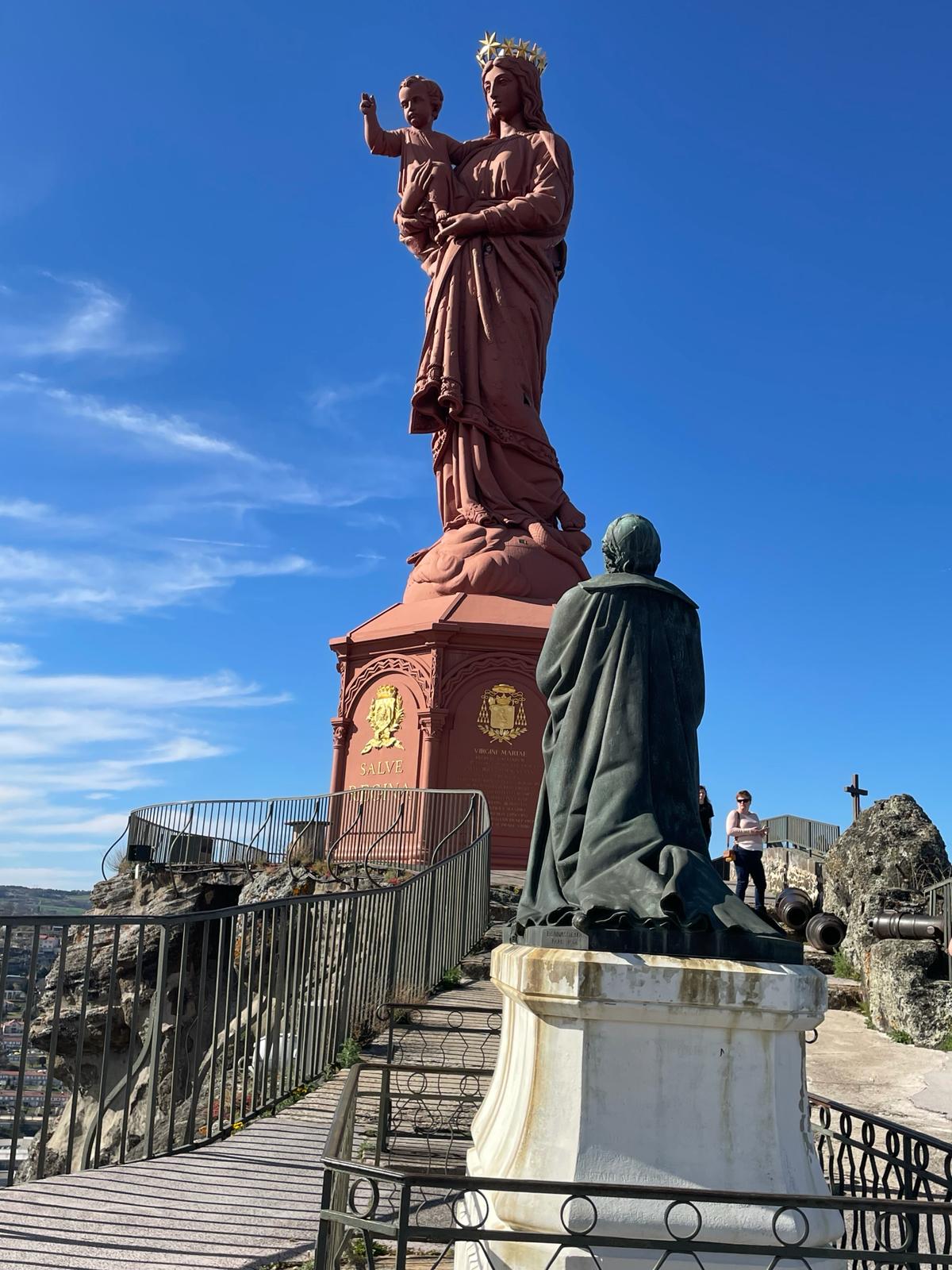
The large, red effigy on the Fourvière hill was created by sculptor Jean-Marie Bienaimé Bonnassieux (1810-1892). The statue of Mary is 16 metres high and, including the plinth, measures 22.70 metres. The statue, with its substructure, is not only large but also heavy, weighing 835 tonnes. The material used comes from 213 captured Russian cannons from the Battle of Sevastopol/Sebastopol. This took place in 1854-1855, where English and French armies inflicted a heavy defeat on the Russian naval base in Crimea on the Black Sea. On 12 September 1860, the large statue, which stands at a height of 132 metres, was consecrated, with 120,000 pilgrims present. The impressive effigy receives the name “Notre-Dame de France” (Our Lady of France). In 2012, the tall statue was restored.
Pilgrimage site

Le Puy-en-Velay is a town with a lower and upper section. The river Dolaizon flows through the town. Among the town's highlights are the cathedral with the effigy of Notre-Dame du Puy and the large, red statue of Our Lady. The place looks very charming and pilgrims arrive here daily.
The impressive church is built on the hill named Mont Anis. The cathedral is dedicated to “Notre-Dame du Puy-en-Velay“. Since 1998, the building has been on the UNESCO World Heritage List, which is short for ”United Nations Educational, Scientific and Cultural Organization". High above the main altar sits the Black Madonna. The original effigy dates from the 17th century, but it was lost and now a reproduction stands here.

The large statue of “Notre-Dame de France” (Our Lady of France) stands high on Corneille Hill. The effigy is located a short distance from the cathedral.
For many pilgrims, the city is the starting point for a pilgrimage, such as to Spain's Santiago de Compostela.
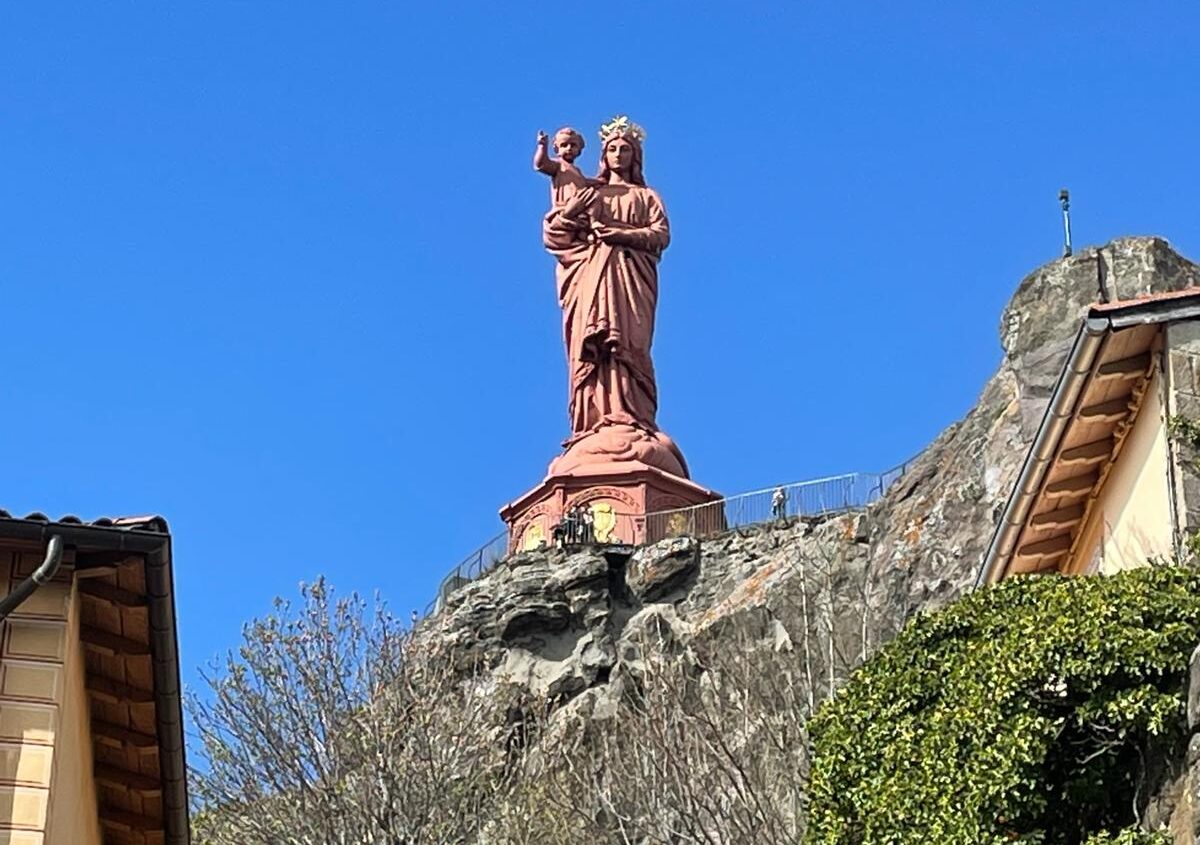
The Cathedral and effigy of Our Lady of France can be visited daily.
ACCESSIBILITY
Le Puy-en-Velay is located in the southeast of France, in the Auvergne-Rhône-Alpes region.
Addresses
Notre-Dame Cathedral, Rue de la Manecanterie 2, 43000 Le Puy-en-Velay.
Notre-Dame de France, Rue du Cloître, 43000 Le Puy-en-Velay.
More information can be obtained by visiting www.cathedraledupuy.org.
Experience

The large statue of Our Lady of France can be seen from kilometres away. Mary is holding Jesus on her right arm. The effigy is painted red for visibility.
On arriving in the city, I first visit the centre. When I'm in the old centre of Le Puy-en-Velay, I follow a road that goes reasonably steeply upwards. A little later I arrive at the cathedral and go up a wide, stone staircase. Then I reach the entrance of the old church and go inside. Immediately there is the encounter with the Black Madonna. It is greeting and praying. I take a seat in the cathedral and my thoughts turn to friends.
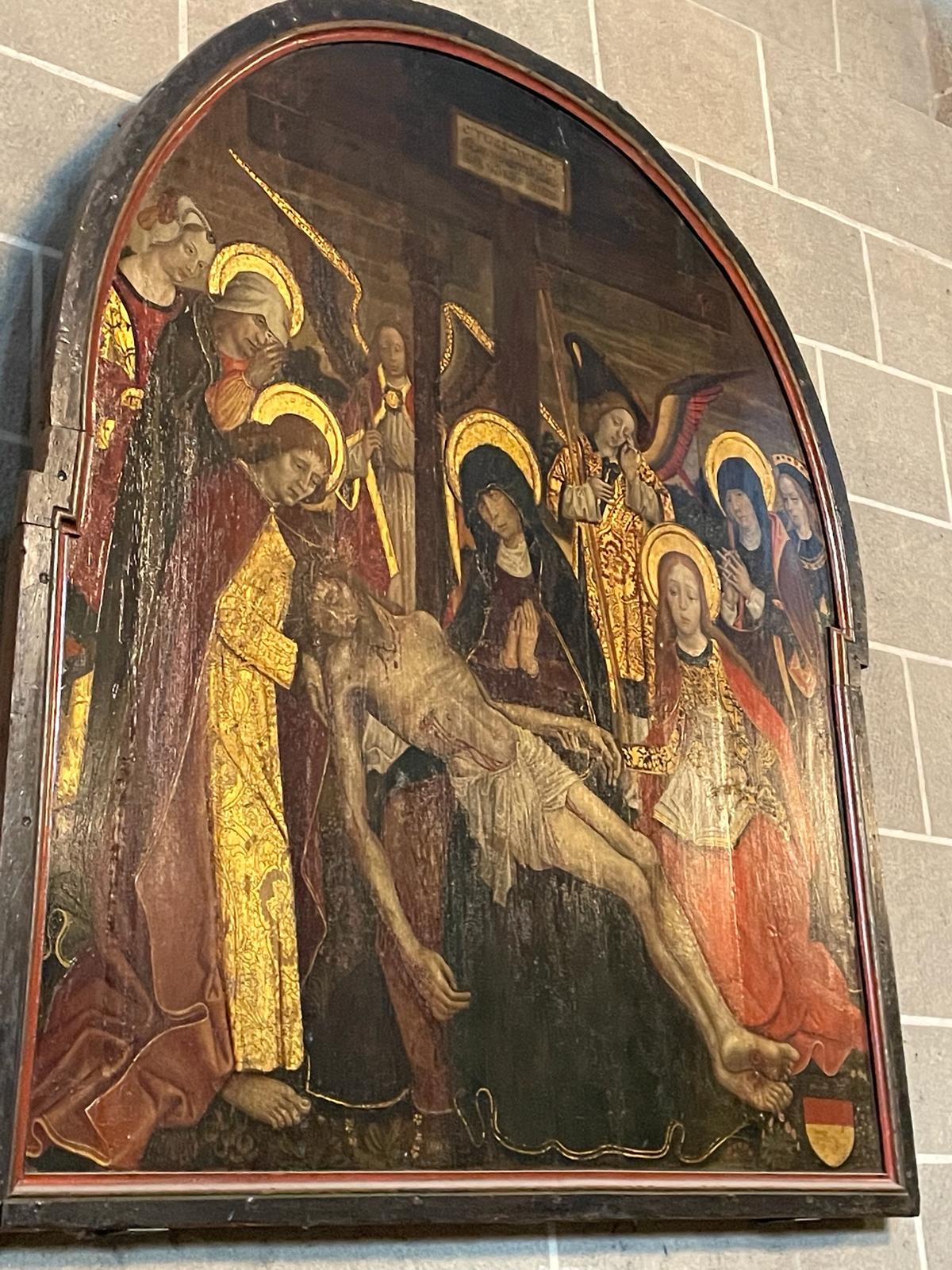
Afterwards, I take a walk around the somewhat dark church. This Romanesque cathedral has arcades, which are decorated with mosaics and diamonds. Large paintings also hang in the cathedral, attracting a lot of attention from visitors.
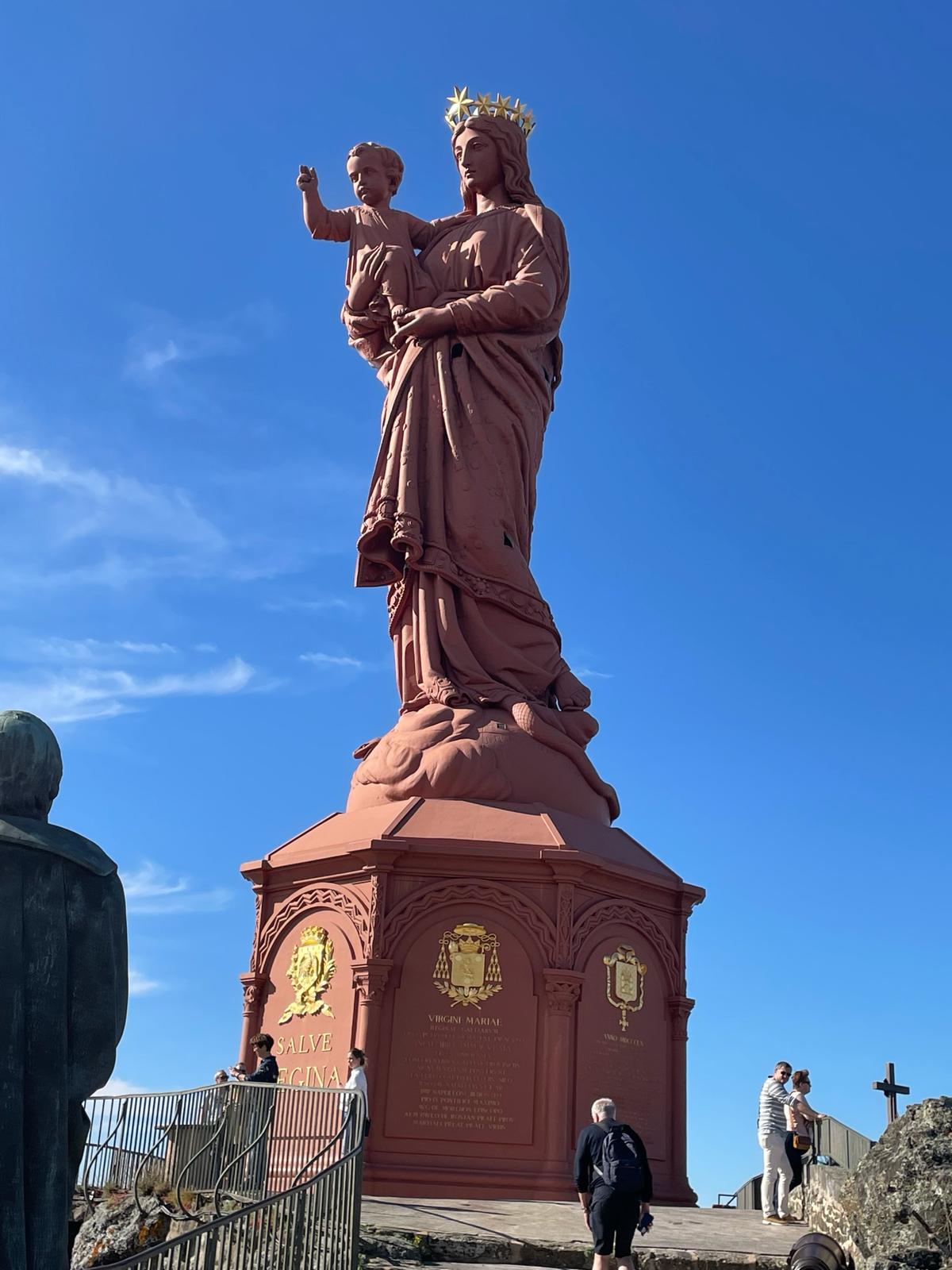
Near the cathedral stands the large, red statue of Notre-Dame de France. I'm heading there, as now is the chance to see this remarkable, large statue up close. After making my way along a steep path and climbing more than 100 steps, I arrive at the impressive statue. It's possible to go inside the statue, and that's quite an experience. I'm here amongst parts of old cannons. Inside the statue, you can behold the surroundings from an even greater height.
Environment
Of the major cities, Saint-Etienne is the closest to Le Puy-en-Velay at 76 km. The distance to Valence is 109 km, and for Lyon, it's 134 km. To visit Rodez, you need to travel 197 km.
Posted: 7 February 2024
Last modified: 5 July 2024
~~~

 Nederlands
  English (UK)
  Deutsch
  Français