~~~
History
Licheń is first mentioned through the discovery of a large stone cross in the 12th century. In Licheń stands a church dedicated to Saint Dorothy. In the 16th century, it was a wooden church, which was later replaced by a stone building. The shrine of the miraculous image has been in Licheń since 1836.
The origin of the sanctuary is based on two legends. They are apparitions of Our Lady in 1813 and 1850.
The first legend:
The first appearance of Mary takes place at the Battle of Leipzig, from 16 to 19 October 1813, in which Polish soldiers also participate and suffer enormous losses. It is a battle between several states which defeat Napoleon Bonaparte's (1769-1821) French army, Emperor of the French (1804-1815) and King of Italy (1805-1814). A soldier named Tomasz Klossowski (1780-1848), fighting with Napoleon's troops, is a blacksmith by profession and lies severely wounded on the battlefield. He holds a medallion with the image of Mary in his hand, invokes the Mother of God and asks Her for salvation, as he does not want to die on the battlefield. He sees the apparition of Mary, with a white eagle (symbol of Poland) on Her chest, wearing a red cloak, moving across the battlefield and She promises to save him. Mary obliges the wounded man to find Her image. After many years, the blacksmith succeeds in fulfilling the assignment. He finds the image 23 years later, in 1836, during a pilgrimage to the shrine of Częstochowa. The icon, whose image resembles the apparition on the battlefield, hangs on a tree in a small chapel. He takes the painting home to venerate it there for years. In 1844, he moves the painting about three kilometres further to a small chapel along a path near the Grabliński forest. Subsequently, many people pray there.
The second story:
In May 1850, Mary appeared in the forest of Grabliński. During the period 1850-1852, she appeared three times to a poor, grey-haired shepherd named Mikolaj Sikatka, choosing him as her messenger. Mary asked the man to ensure that people prayed, did penance, and converted, as then she could save them. The apparition also stated that most people were corrupt and that God would bring justice through epidemics and war. The apparition foretold times of more than one epidemic and instructed the man to take her image to a dignified place. This was achieved by building a wooden chapel. The painting dates from the early 19th century.
In 1852, Maria's prophecy comes true as a cholera epidemic strikes the region. People pray to Maria's image and do penance. Their prayers are answered, for they are protected by Maria. After this, the image is moved to the cemetery chapel and in 1857 to the parish church of Licheń, which is dedicated to Saint Dorothea. Here, by the miraculous image, more prayers are offered, and many miracles occur, leading to numerous people being healed and gaining strength.
The sanctuary is governed by the Marianists, a congregation founded on 24 October 1673 by Stanislaw (Jan) Papczyński (1631-1701). A “book of graces” is kept, recording the graces and specific miracles received.
During the Second World War (1939-1945), organist Boleslaw Lisowski (1920-2016) removed the statue from the church and hid it to prevent its destruction. In 1940, the Nazis arrived at the place of grace and took up residence in the church, presbytery, and other buildings. Publications, deeds, and books present were burned, and paintings, confessionals, and the organ were destroyed, as was the book of blessings. Frescoes disappeared under white lime. In March 1945, the statue reappeared and was placed in the church at Licheń. In Licheń, there is a memorial for 108 martyrs for all of Poland; they gave their lives for their faith during the time of persecution. Later, a special chapel on the ground floor was made for this purpose in the basilica.
In 1949, the Marianists arrived at the shrine to organise pilgrimages.
In 1965, the image of Mary was declared a "gracious image" by the Vatican as a recognised miraculous image of Licheń. Subsequently, the request was made to crown the image.
On 15 August 1967, the miraculous image was crowned by Stefan Wyszyński (1901-1981), Bishop of Lublin (1946-1948), Archbishop of Warsaw-Gniezno (1948-1981) and Cardinal (1953-1981). The crown came from the Pope. The Cardinal had previously experienced a miraculous healing in Licheń when he was suffering from an incurable disease.
On 14 August 1968, the chapel of the Fountain of Grace was consecrated. It is located in Licheń by the lake.
On 6 June 1999, the pilgrimage site was visited by John Paul II, Pope from 1978 to 2005 and born in Poland as Karol Józef Wojtyla (1920-2005). The Holy Father stayed for two nights and departed on 8 June 1999. He blessed the basilica under construction. Following this visit, a centre for aid was established at the pilgrimage site, which opened in 2000. Here, people suffering from addiction to alcohol, nicotine, and those afflicted with erotomania (delusional disorder of love) and anorexia would be treated.
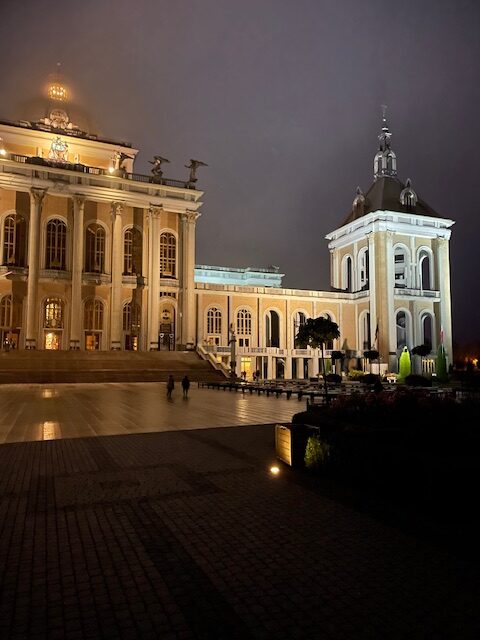
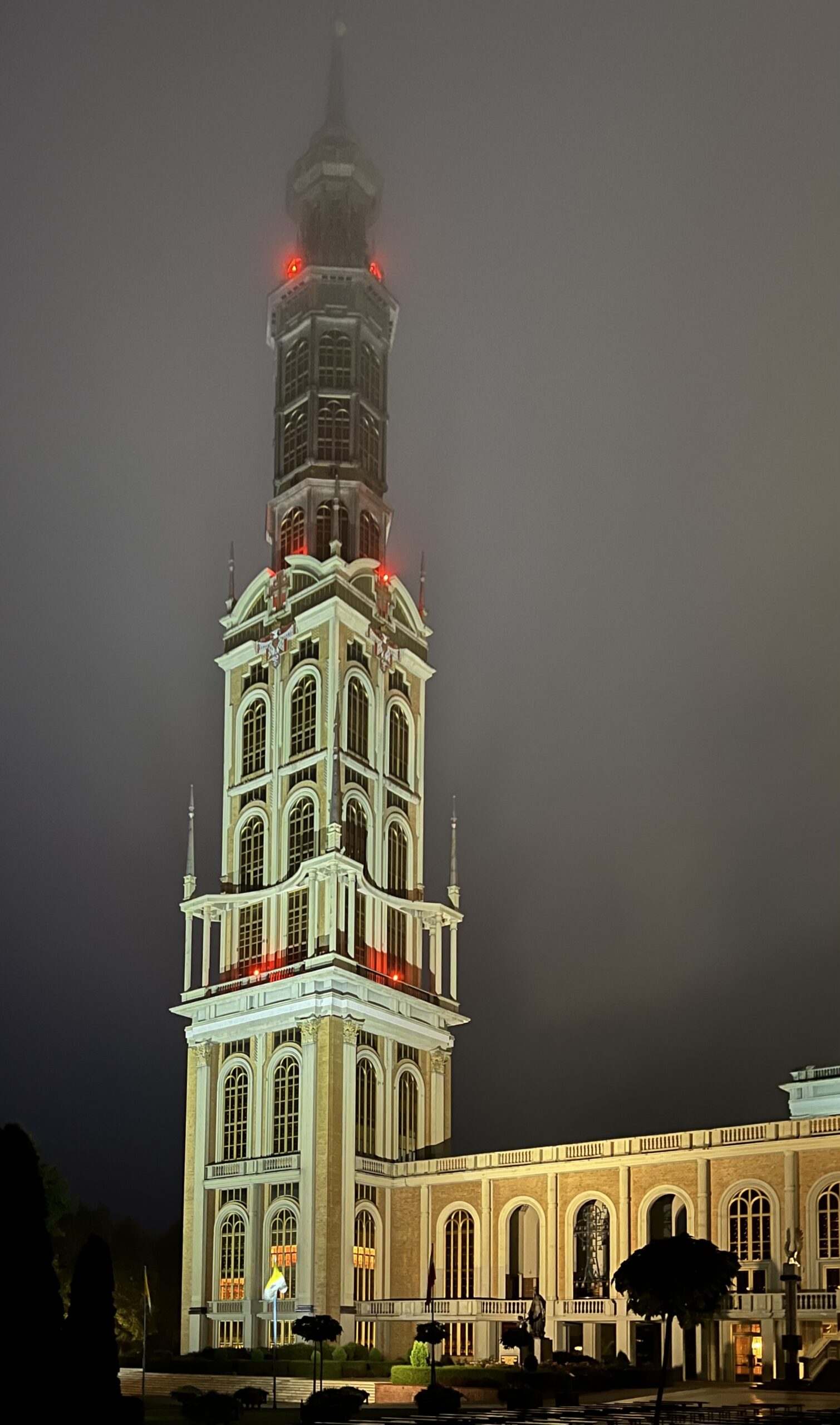
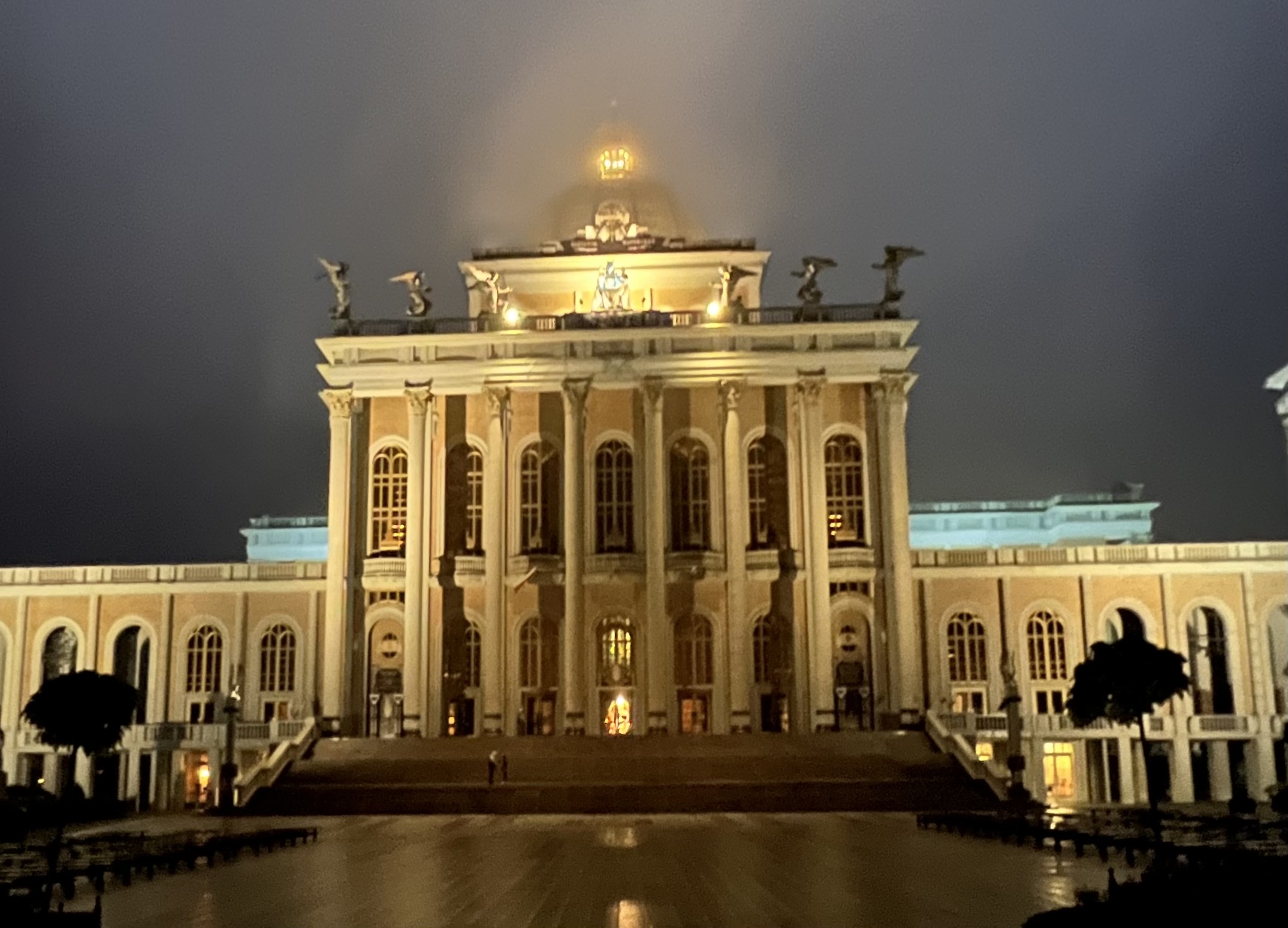
The construction of the large church began on 22 June 1994 and was completed in 2004. The design is by architect Barbara Bielecka (1931-2019). On 12 June 2004, the consecration of the enormous house of worship was performed by Józef Kowalczyk (born 1938), Apostolic Nuncio in Poland (1989-2010) and later Archbishop of Gniezno (2010-2014). The construction was made possible by numerous donations from pilgrims and support from the Polish government. The building is 120 metres long, its facade measures 162 metres in width, the height of the main nave is 44 metres, and the height of the tower with the cross reaches 141 metres.
In 2005, the great church was elevated to basilica status by Pope John Paul II.
On 2 July 2006, the miraculous image of Mary is moved from the Church of St. Dorothea to the new sanctuary and is given a prominent place in the basilica's high altar.
On 1 May 2012, the Rosary Path in the Grablinski Forest will be consecrated.
Pilgrimage site
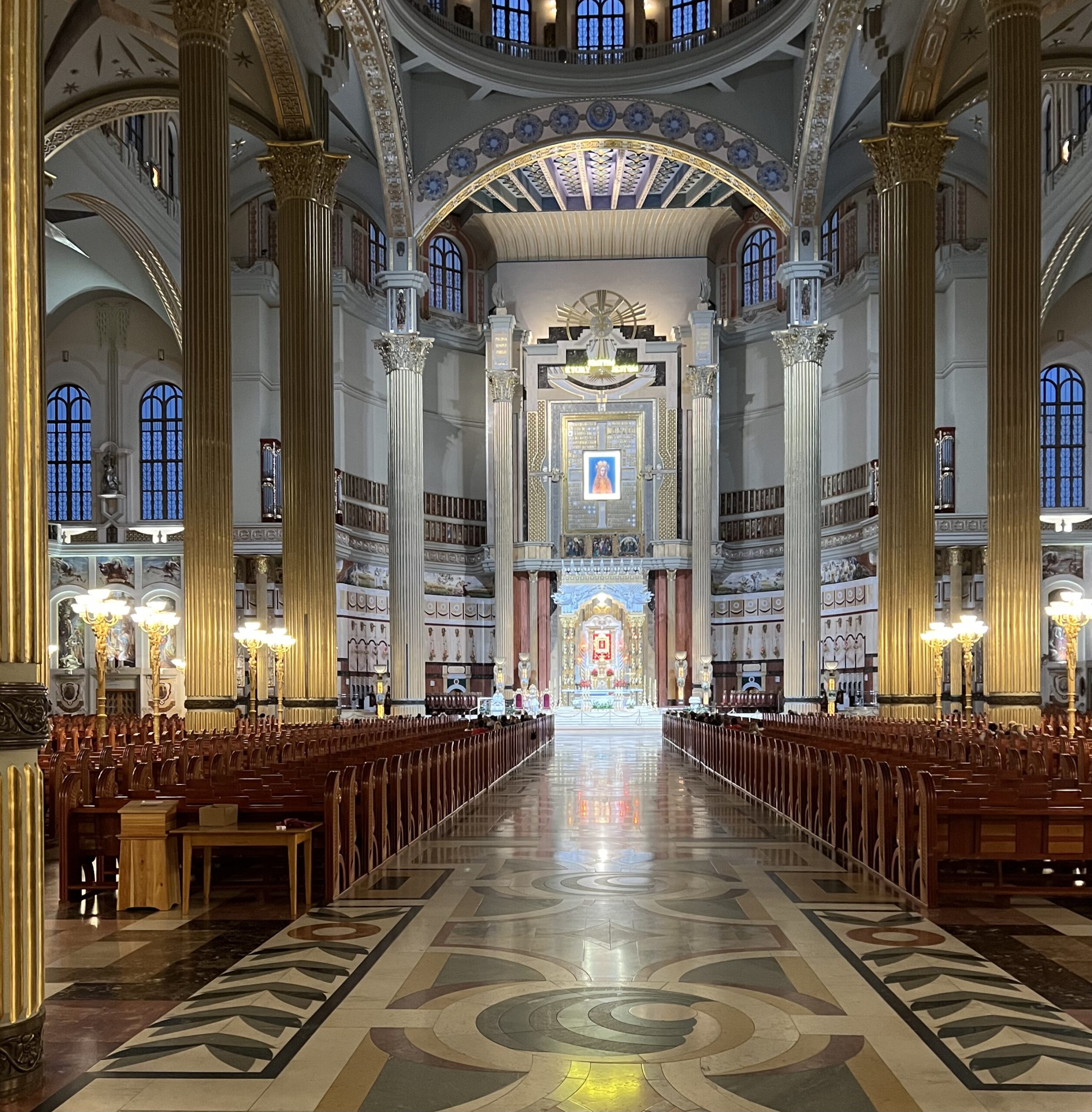
In the pilgrimage site of Licheń stands the largest church in Poland. The basilica has seating for around 7,000 visitors, with an additional 10,000 standing places. The house of worship features a golden dome in the Byzantine style. The sanctuary is named “Sanktuarium Matki Bozej Licheńskiej,” which translates to “Sanctuary of Our Lady of Licheń” in Dutch. It is striking that such an enormous church is located in a small village of approximately a thousand inhabitants. After Częstochowa, Licheń is one of the most visited Marian shrines in Poland.
The tower reaches towards the sky at 141 metres high. In front of the basilica is a square that can accommodate 100,000 visitors. A large effigy of Pope John Paul II has also been placed here.
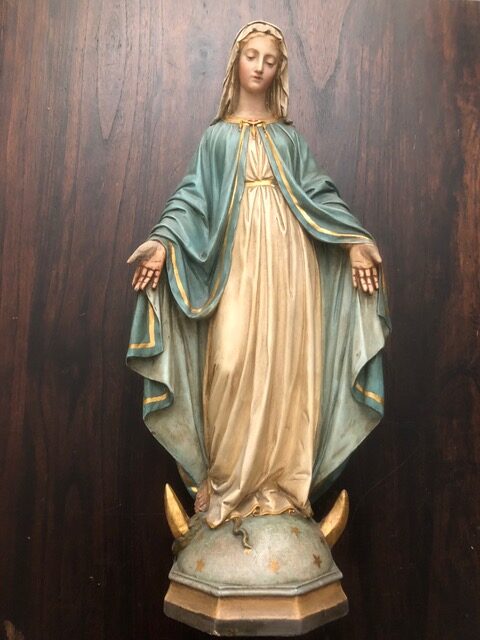
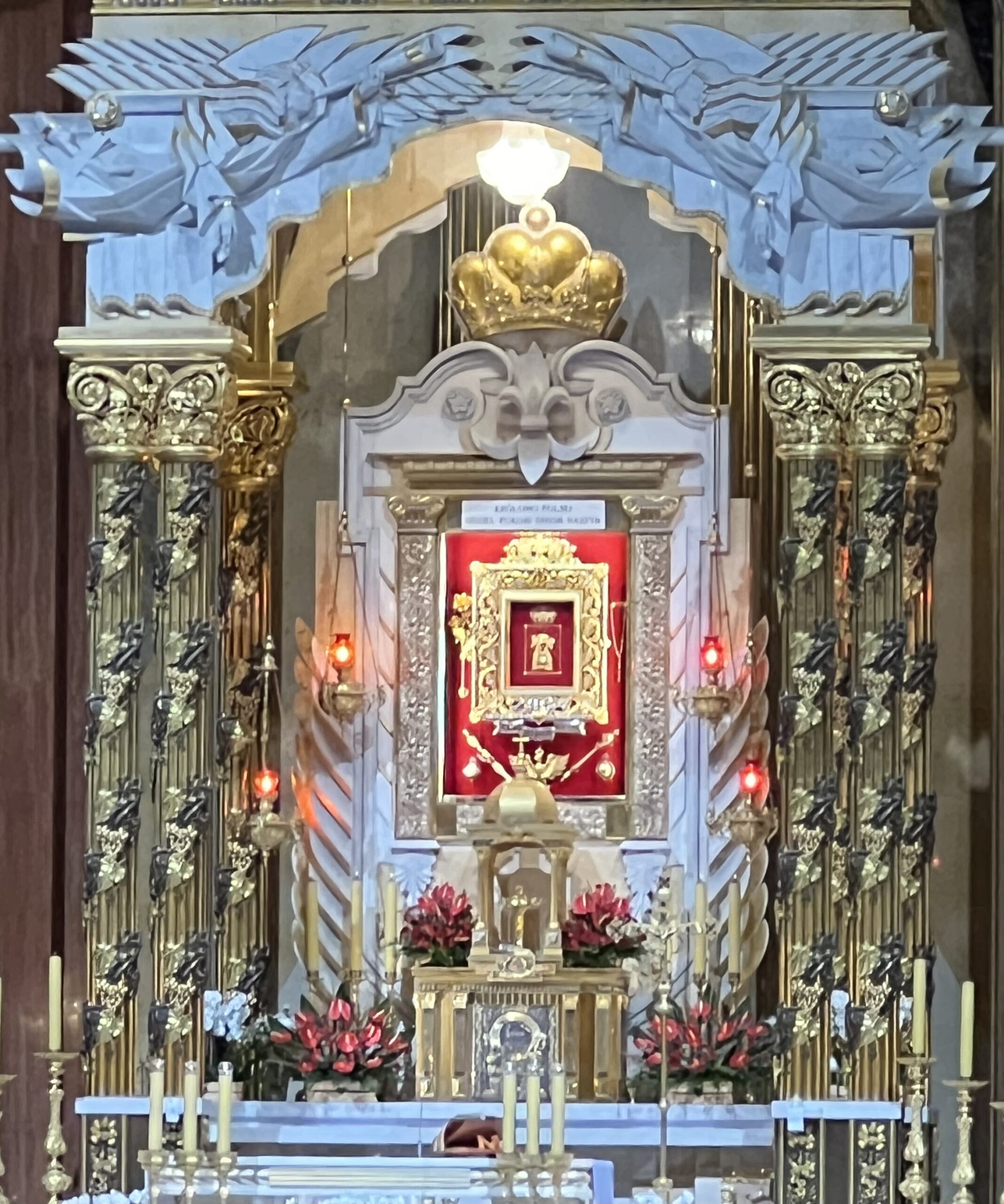
In the basilica, the altar houses the miracle image, referred to by pilgrims as the “Polish Queen of Sorrows”. Mary wears a crown on her head, presses a white eagle to her breast, and the symbols of her Son's suffering are depicted on her mantle. The image is small, measuring 15.5 cm in height and 9.5 cm in width. The effigy is painted with oil on a wooden panel. It is a half-figure with a head and arms; the face is turned slightly to the left, and the eyes are half-closed, cast downwards. The artist is unknown and is possibly Polish. It is believed that the effigy was created in the last quarter of the 18th century, likely as a copy of the miracle image from Rokitno. Gilded plants and flowers, as well as gemstones, are arranged around the image. A large crown is placed above the image of the crowned figure. Above Mary's head, an angel is depicted on each side. Above this artwork is inscribed “Queen of Poland, grant peace in our days”.
In the immense basilica, many paintings can be seen, on which Mary is also depicted.
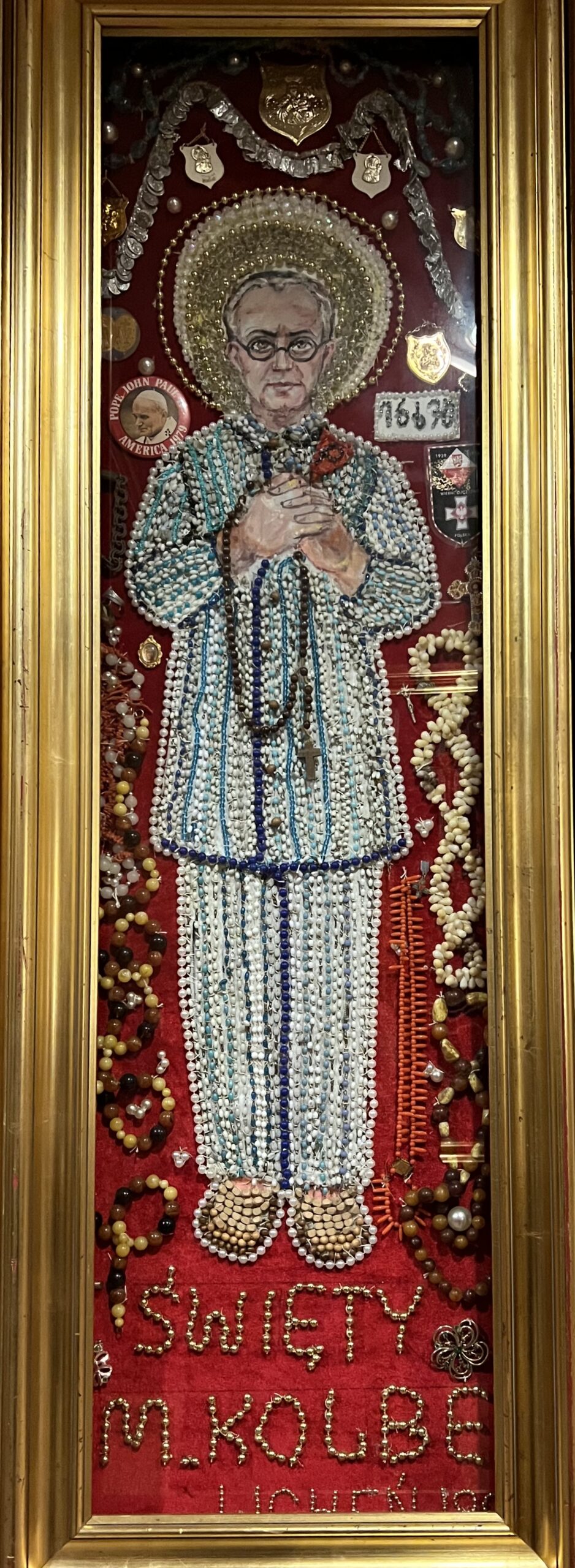
In a gallery of saints, special individuals are highlighted, such as Maximilian (Rajmund) Kolbe (1894-1941). He is especially beloved in Poland and is known as a Franciscan priest, convent superior, journalist, and martyr. In 1906, he received a vision of the Blessed Virgin Mary, after which he joined the Franciscans and took the name Maximilian Maria. He was killed in the Auschwitz concentration camp after voluntarily taking the place of a fellow prisoner condemned to death. Kolbe is the patron saint of drug addicts and the patron saint of journalists. He was canonised in 1982.
On the extensive grounds of the pilgrimage site stand two pilgrim houses, each capable of accommodating over 1,000 pilgrims, namely “Arka” and “Betlejem”.
Near Calvary, there is the Chapel of Mary, dedicated to the Immaculate Conception of Mary. This was done in 1990.
In the village of Licheń stands the Neo-Gothic Church of Saint Dorothea. There is also a Way of the Cross and a park with statues and chapels. In Grablin, two kilometres from Licheń, the Marian Walking Trail begins, which leads to the sanctuary.
The pilgrimage site receives around 1.5 million visitors annually and the Marian shrine is open daily.
ACCESSIBILITY
The pilgrimage site of Licheń is located near the town of Konin. The village of Licheń is part of the Slesin municipality.
Address: ul. Klasztorna 4, 62-563 Licheń.
More information can be found by consulting www.lichen.pl.
The pilgrims“ house ”Arka“ can be reached via www.arka.lichen.pl and that of ”Betlejem" has the website www.betlejem.lichen.pl.
Experience
Poland's largest basilica has a tall bell tower that can be seen from afar, measuring 141 metres in height including the cross. That is a more than respectable height.
If I want to enter the basilica, there are 33 steps to take, which refer to the number of earthly years of Jesus.
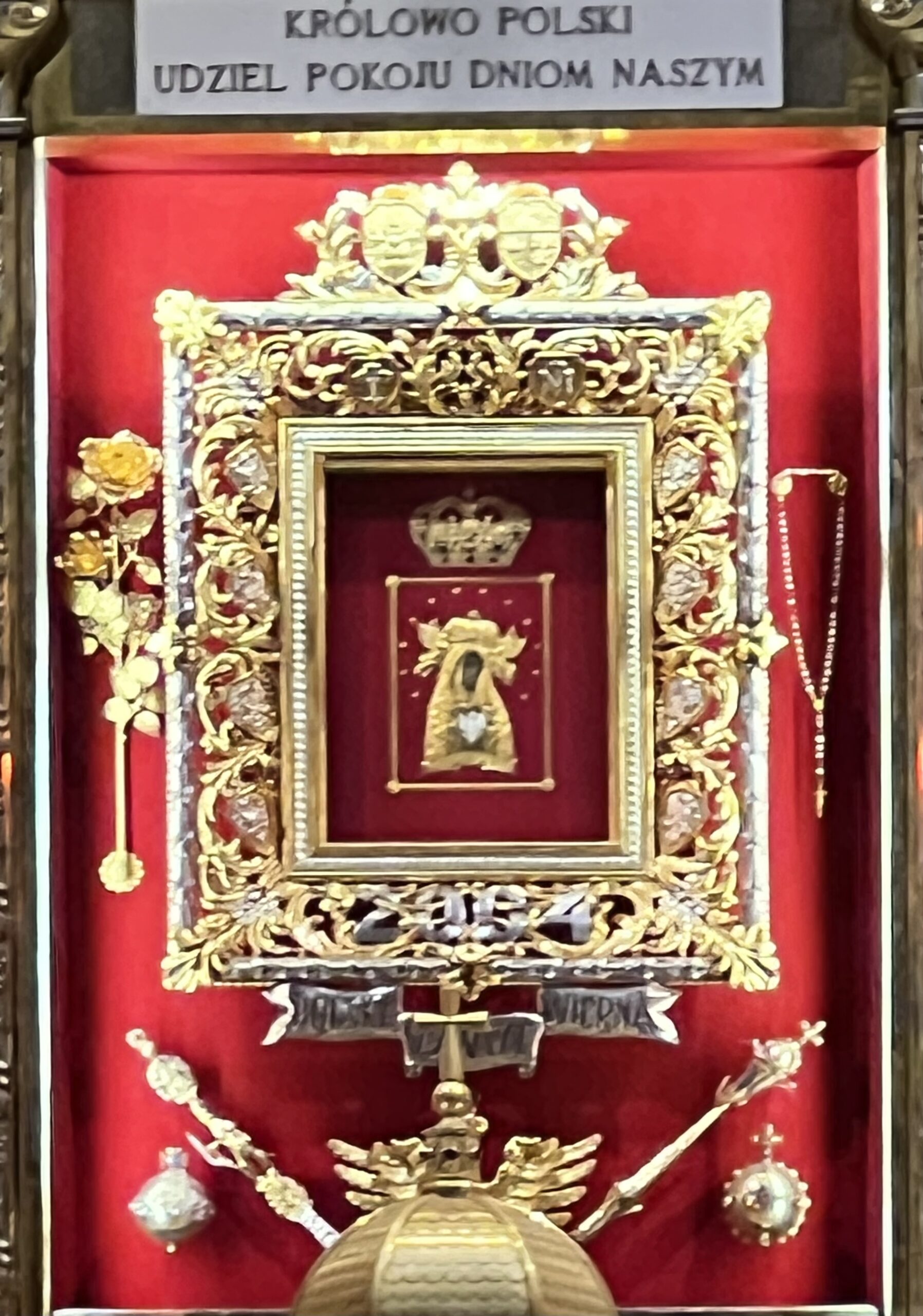
The sacred image stands on a large presbytery high up in the tabernacle with the Polish text “Polska zawsze wierna” beneath it, which means “Poland is always faithful” in Dutch.
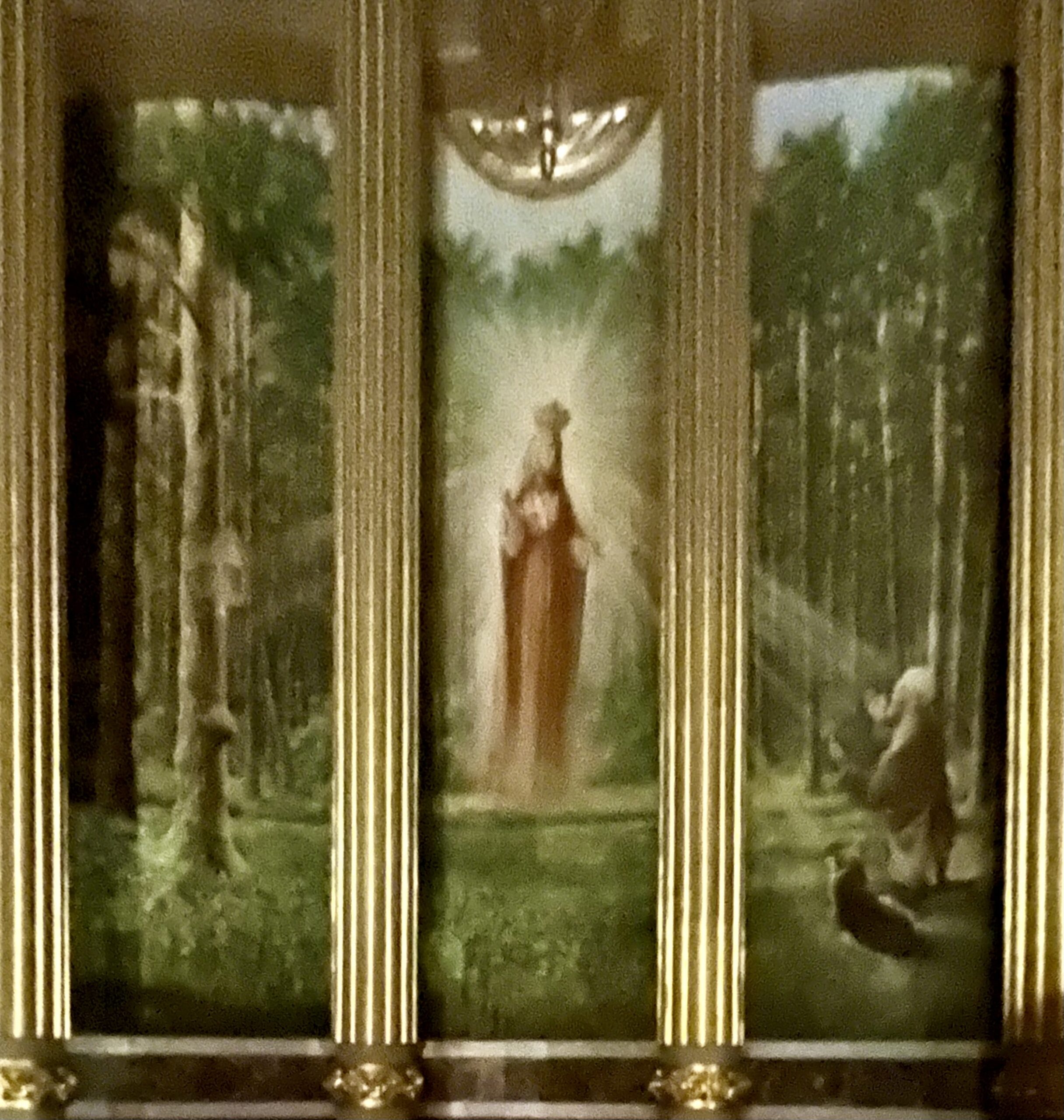
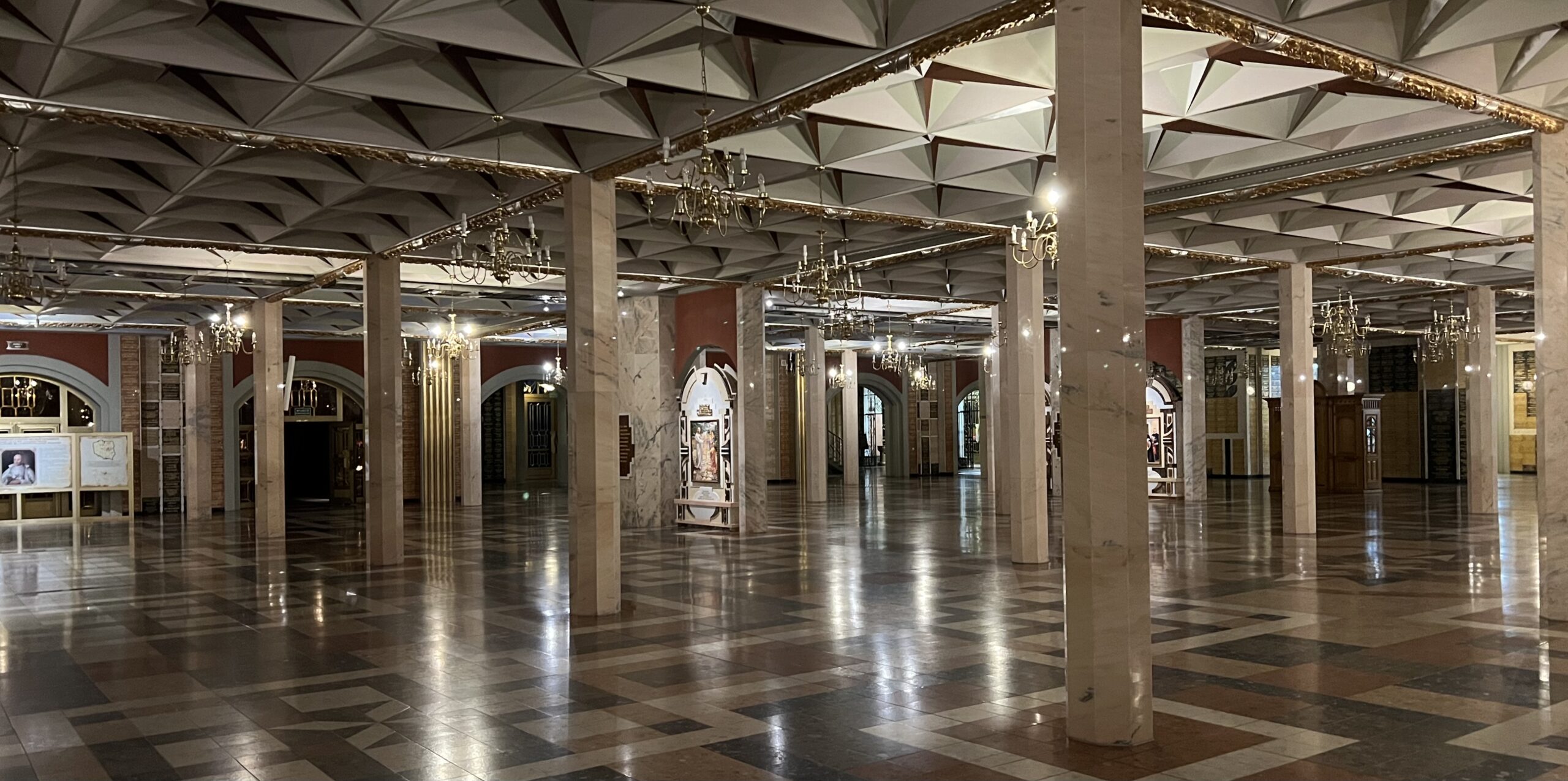
I am touring the enormous basilica, and during this grand tour, I frequently come across an image of Mary. I see paintings of the Annunciation, the visit of the Three Wise Men to Jesus, Mary, and Joseph, depictions of apparitions, and much more. I dedicate hours to appreciating the art here.
I am also visiting a gallery with many saints and pausing before the image of Maximilian Kolbe. What a driven and courageous man he is!
Suddenly, I notice that it's already dark outside, and then the basilica is deserted. Outside, I'm impressed by the illuminated tower and the wide façade of the basilica.
I also see a depiction of the Polish pope, John Paul II. There's so much to see here. Late in the evening, I'll go to the pilgrimage house Arka and take many impressions with me.
The visit to Licheń is so impressive!
Environment
From Poznań to Licheń is to travel 123 km to the east.
Travelling from Wrocław to Licheń means going 196 km in a north-westerly direction.
Leaving the Polish capital Warsaw and arriving in Licheń is a journey of 242 km to the west.
The journey from the German capital Berlin to Licheń involves travelling 386 km to the east.
Posted: 14 February 2025
~~~

 Nederlands
  English (UK)
  Deutsch
  Français