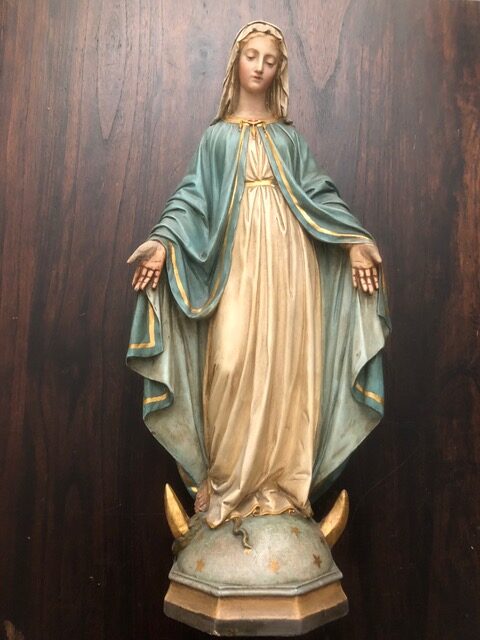
Anna and Joachim, the parents of Mary, are mentioned by apocryphal evangelists and first by James the Lesser/James the Younger (+62). In the 2nd century, this was written down in Greek. The names of Mary's parents do not appear in the New Testament. However, Anna does appear in the Quran.
Anna and Joachim are the parents of Mary according to the Anglican, Catholic, and Eastern Orthodox churches. Mary is the only child that Anna brings into the world.
According to Jacobus, Joachim is a devout, generous, and wealthy man, descended from the House of David. He is married to Anna, but the couple have no children. One day, Joachim goes to the temple again to sacrifice. This does not happen, as a priest sends him back, stating that he has not provided for offspring. Joachim is deeply affected by the incident and feels the need to withdraw. He goes into the desert and stays there for 40 days to fast. Anna is unaware of this and lives with the thought that her husband has perished. Anna realises she is a widow and will die childless. With these thoughts, she becomes very sad. Anna feels she cannot compare herself to others who are fertile. During her grief, an angel appears. This angel says that God has heard her prayers and that she will bear a child, of whom the whole world will later speak. Thereupon, Anna promises to dedicate her child to God. Thus, her child will serve God their whole life. Joachim also receives a visit from an angel and hears of his impending fatherhood. Nine months later, a girl is born who is named Mary. When Mary is three years old, her parents take their daughter to the temple and dedicate their child to God. Joachim and Anna present their daughter Mary to God in the temple. This is called the Presentation of Mary, with the annual commemoration on 21 November. Mary remains in the temple from the age of 3 to 12 years. Afterwards, Mary is married to Joseph and later gives birth to Jesus.
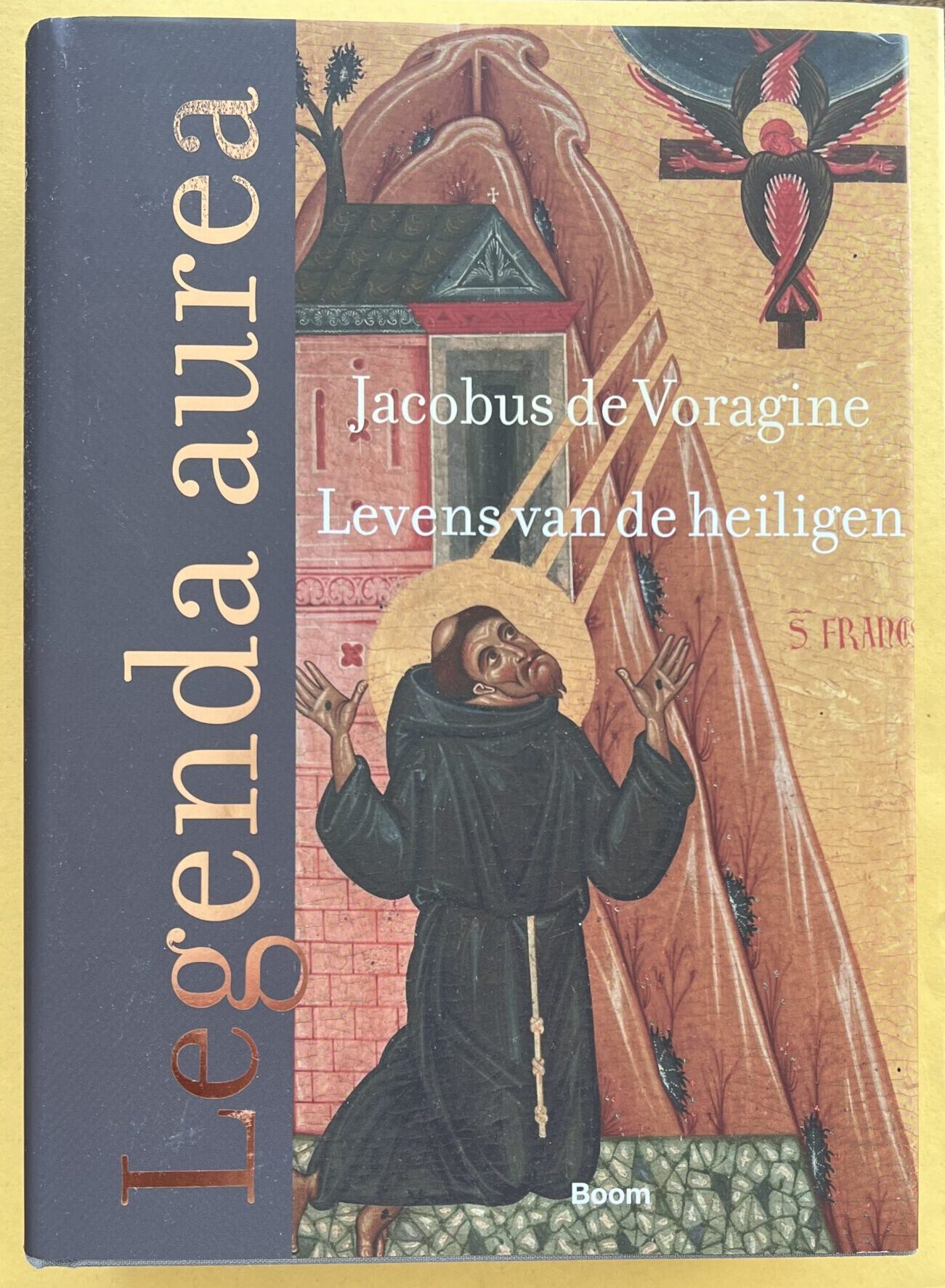
Jacobus de Voragine (c. 1226–1298) was a Dominican friar, Archbishop, Bishop of Genoa (1292–1298) and author of the “Legenda Aurea” (Golden Legends). In this extensive work, he describes the lives of saints and presents them as highly exemplary. Regarding Anne and Joachim, Jacobus de Voragine mentions, among other things, that they met after the visits of the angel. This occurred at the Golden Gate of Jerusalem, a scene later depicted by several artists. According to Jacobus de Voragine's work, Joachim dies, and Anne then remarries twice. In each marriage, Anne gives birth to a daughter, and each girl is named Mary. According to this source, Mary, the mother of Jesus, had two step-sisters. These half-sisters married and had children, and their sons later became apostles of Jesus. This is according to the “Legenda Aurea”.
In the Eastern Orthodox Church, Saint Anne has been venerated since the 6th century. In the Catholic Church, Anne, as the Mother of Mary, began to receive more attention around 1100.
In both sculpture and painting, Anne is very often depicted. The image representing three people, named Anne in Trinity, namely with Anne, Mary, and Jesus, has often been created.
The Catholic Church is far from enthusiastic about the story of Anne's three marriages. This Church believes that her eagerness to marry is accentuated. During the Council of Trent (1545-1563), the story of the three marriages (trinubium) is discredited and therefore relegated to the background. As a result, Anne loses her prominent place in art, where she was frequently depicted.
Saint Anne is the patron saint of numerous chapels, churches, schools, and hospitals.
Anne and Joachim are commemorated as saints on 26 July. The Catholic Church celebrates the Nativity of Mary on 8 September.

 Nederlands
  English (UK)
  Deutsch
  Français