MARIENFRIED
History
It is 13 May 1940, and the Second World War is increasing in scale. On this day, a special event takes place. It is Whit Monday… The 16-year-old Bärbel Reuss, like the day before, takes the same walk to and in the forest near Pfaffenhofen an der Roth. The day before, she prayed the rosary. Without noticing, Bärbel lost the rosary. She searches and searches, but cannot find the string of beads. Unfortunately, as she wants to pray the rosary. Suddenly a Woman joins her. The two women start talking. The Woman says to Bärbel, that She wants to pray another rosary with her. Bärbel is surprised that the Woman knows her thoughts. The Woman says that if Bärbel diligently prays this other rosary, she will get to know Her better. Bärbel agrees, and thereupon the Woman teaches her to pray “the Rosary of the Immaculate”. The Woman says that instead of the known rosary mysteries, other invocations are used. These invocations are:
By Your Immaculate Conception, save us!
Through Your Immaculate Conception, protect us!
Through Your Immaculate Conception, lead us!
-By Your Immaculate Conception, hallow us!
-By Your Immaculate Conception, guide us!
The Woman wants to pray this rosary for the fatherland with Bärbel. After praying together, the Woman leaves. She goes in another direction. This encounter leaves an unforgettable impression on Bärbel. She wants to meet the Woman again and get to know Her better. After the encounter with the Woman, Bärbel often prays the rosary of the Immaculate Conception. She keeps the encounter with the Woman to herself and shares her experience with no one. A few years later, after the Second World War, this continues in 1946...
Bärbel Reuss is friends with Anna and her brother Martin Humpf. Martin has been a pastor in Pfaffenhofen an der Roth since 1943. Anna supports him in his work. She is not only the housekeeper at the rectory but also a helper in pastoral care. From her youth, she has been a participant in the Schönstatt Movement. This organisation is a religious, apostolic movement which uses the image of the Triple, Miraculous Mother of God as its formative principle. Anna leads a girls' group there, and Bärbel Reuss is a member.
During a sermon in May 1944, Pastor Martin Humpf proposes making a vow. In view of the impending catastrophe of the war, he wishes to make a promise to Mary. If she protects the parish of Pfaffenhofen, a chapel will be built in gratitude. After all, the town of Pfaffenhofen is in great danger, as enemy aircraft fly over daily. Many retreating German soldiers pass through Pfaffenhofen on their way towards Berlin. The inhabitants of Pfaffenhofen do not feel safe during this period. Almost a year later, the Second World War ends and the town of Pfaffenhofen emerges from the war without major damage. For some time, the pastor has had a small shrine to Mary in mind. Building a chapel is therefore a wish. A statue stand is acquired and placed against a tree. The statue is the Mother of God of Schönstatt. Anna Humpf looks after this statue.
Then it becomes 1946...
In 1946, Mary appeared to 22-year-old Bärbel Reuss on three occasions: 25 April, 25 May, and 25 June.
On 25 April 1946, Pastor Martin Humpf, his sister Anna and Bärbel Reuss go into the woods in Pfaffenhofen. They pray the rosary and talk about the origin of shrines. The pastor says, among other things, that it is Mary who often gives a sign where a shrine desired by Her will be built. He expresses the wish that Anna, Bärbel and he receive such a sign. The pastor also says that he wants to build a chapel. They stop at the tree, by the side of the road, on which a small statue of Mary hangs. Suddenly Bärbel says: “Someone is calling me.” She goes into the bushes. She sees a woman. However, Martin and Anna Humpf see nothing. They do, however, hear Bärbel talking to someone. Brother and sister Humpf say to each other that Bärbel might be having a vision. The apparition speaks with Bärbel about a mysterious incident from six years ago, on Whit Monday. Bärbel asks the lady: “How do you know this?” The apparition says: “If I didn't have my veil on, you would know me.” The Lady also says: “The peace of Christ will be with all three of you and with everyone who prays here.” After this, the Lady disappears. Bärbel assumes that the others also saw and heard the Lady, but Martin and Anna deny this. Bärbel recounts what has just happened. Martin Humpf sees Bärbel's encounter as a hopeful sign. He now also knows for sure that this is where a chapel will be built.
On 12 May 1946, Whit Sunday, Bärbel tells Martin and Anna Humpf what she experienced on 13 May 1940. She recently met this woman again, on 25 April, on the edge of the forest. Pastor Martin Humpf's reaction is highly significant. He says that this woman is Our Lady.
The second apparition is on 25 May 1946. In the early morning, Bärbel Reuss is summoned by an angel to go to the place of the previous apparition on this day. This angel has visited Bärbel before, especially in the mornings, and has prayed with her. The angel has told Bärbel the intentions for which she must pray. The angel calls himself “the Angel of the Great Mediatrix of Graces”.
Later that day, Bärbel Reuss, Anna Humpf and her brother Martin go into the woods. They approach the image shrine. Suddenly, Bärbel sees the angel, who points her in a direction. She then sees the mysterious Woman standing there. The Woman is dressed entirely in white and has a cape on. This Woman has dark hair, with a parting in the middle. Her eyes are also dark. The Woman has a beautiful sparkle in her eyes and her whole face shows clarity, purity and goodness. The Woman says: “Yes, I am the Great Mediatrix of All Graces.” The Apparition says to Bärbel: “You must keep a secret. You cannot do anything with it now. Have patience. I will guide you. One day you will understand.”
To prove the reality of the apparition to Bärbel, the Lady asks her to go to Kellerberg. This is located between Pfaffenhofen and Beuren. She says, “There is a man in great distress. Go there and help him. This is a sign for you that you are not a victim of deception.” The Apparition also says, “Wherever people do not trust in my Immaculate Heart, the devil has power.”
With the second appearance, only Bärbel sees and hears the Woman. Anna and Martin Humpf see and hear nothing, although they do hear Bärbel speaking.
Bärbel goes to the place that the apparition indicated. She finds a man there who speaks broken German. Bärbel thinks he is an Italian or a Pole. The man calls himself Mario and appears completely disturbed. Bärbel notices that he is hiding something under his clothes. It turns out to be a cord. The man asks for help, and Bärbel leads him to the place of the apparition. Once there, the man understands what is wrong with him; he has let someone possess him. In the evening, some girls go to the statue. They come to the little statue and see a cord hanging from it.
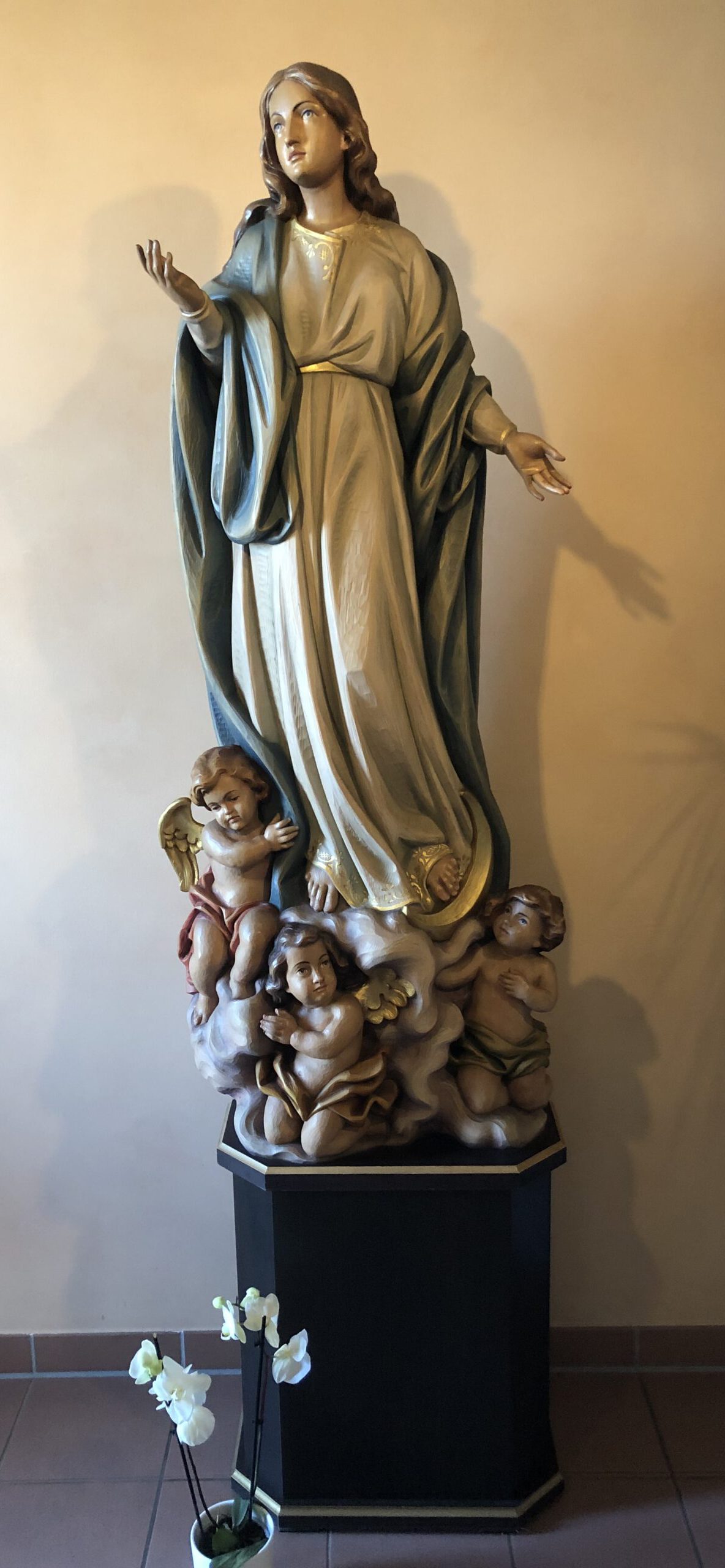
The last, third apparition in 1946, is on 25 June. Martin, Anna and Bärbel are at the site of the previous apparitions. Anna decorates the statue by the roadside. Suddenly, Bärbel sees the Apparition. Mary says, among other things: “I am the Great Mediatrix of Graces. I want people to know what I have said, word for word. You can remember it.” Bärbel asks Her which statue should be placed in the chapel. The Apparition refers to the statue by the bush by the roadside. She calls this: “The statue of the Triple, Miraculous Mother of Schönstatt.” She adds: “There has often been prayer and many sacrifices made at this statue in Schönstatt.”
The Apparition speaks unceasingly. Suddenly, a large host of angels is around Her. These angels wear long, white garments. They kneel, bow deeply and pray. According to Bärbel, the Apparition is more beautiful and radiant than in the previous month. Again, Martin and Anna do not see or hear the Apparition. They can only hear Bärbel speaking.
Maria has also said to Bärbel Reuss, among others:
“The world is consecrated to my Immaculate Heart. I desire that the world live out this consecration. Have boundless trust in my Immaculate Heart. Believe in my boundless power with my Son.”
“Where there is the greatest trust and where people learn that I can obtain everything from God, there I will bring peace. If people believe in my power, there will be peace. Through a star I will give a sign.”
“Pray the rosary. I am the Mediatrix of all graces. I wish to work in secret as the great Mediatrix of Grace.”
“Bring me many offerings; make your prayer an offering.”
The location of the apparitions is later called “Marienfried” (“Mary's Peace”). Indeed, Mary said at this place: “I reveal to you the peace of Christ.”
In 1944, the pastor made a promise that if Pfaffenhofen got through the war years without significant damage, a chapel would be built. In 1946, Mary said to Bärbel Reuss: “I have fulfilled your wish, now keep your promise!” In the spring of 1946, preparations for the construction of the chapel began. The building site was a gift from a benefactor. All the stones for the construction of the chapel came from the ruins of the mayor of Ulm's house. In 1947, the Marienfried Chapel was consecrated. This is the Chapel of Grace. In 1965, the large meadow to the east of the chapel also became a gift to the place of grace.
On 4 June 1970, a terrible sacrilege takes place with a brutal robbery in the sanctuary. Much is stolen from the chapel. This deals a great blow to the new centre of graces.
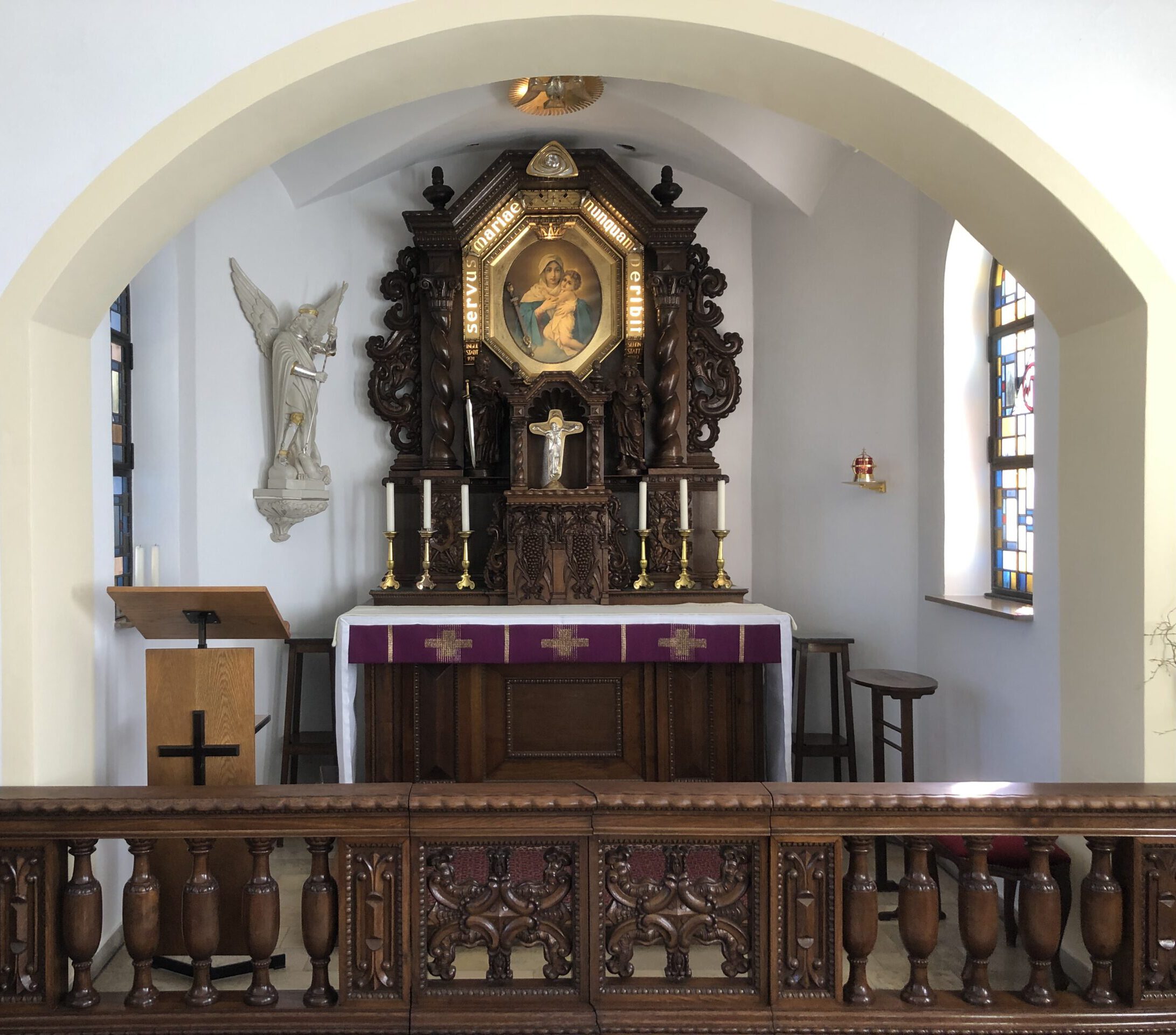
In 1971, a new altar is installed and the chapel at the choir is extended. The tabernacle resembles that of the shrine at Schönstatt.
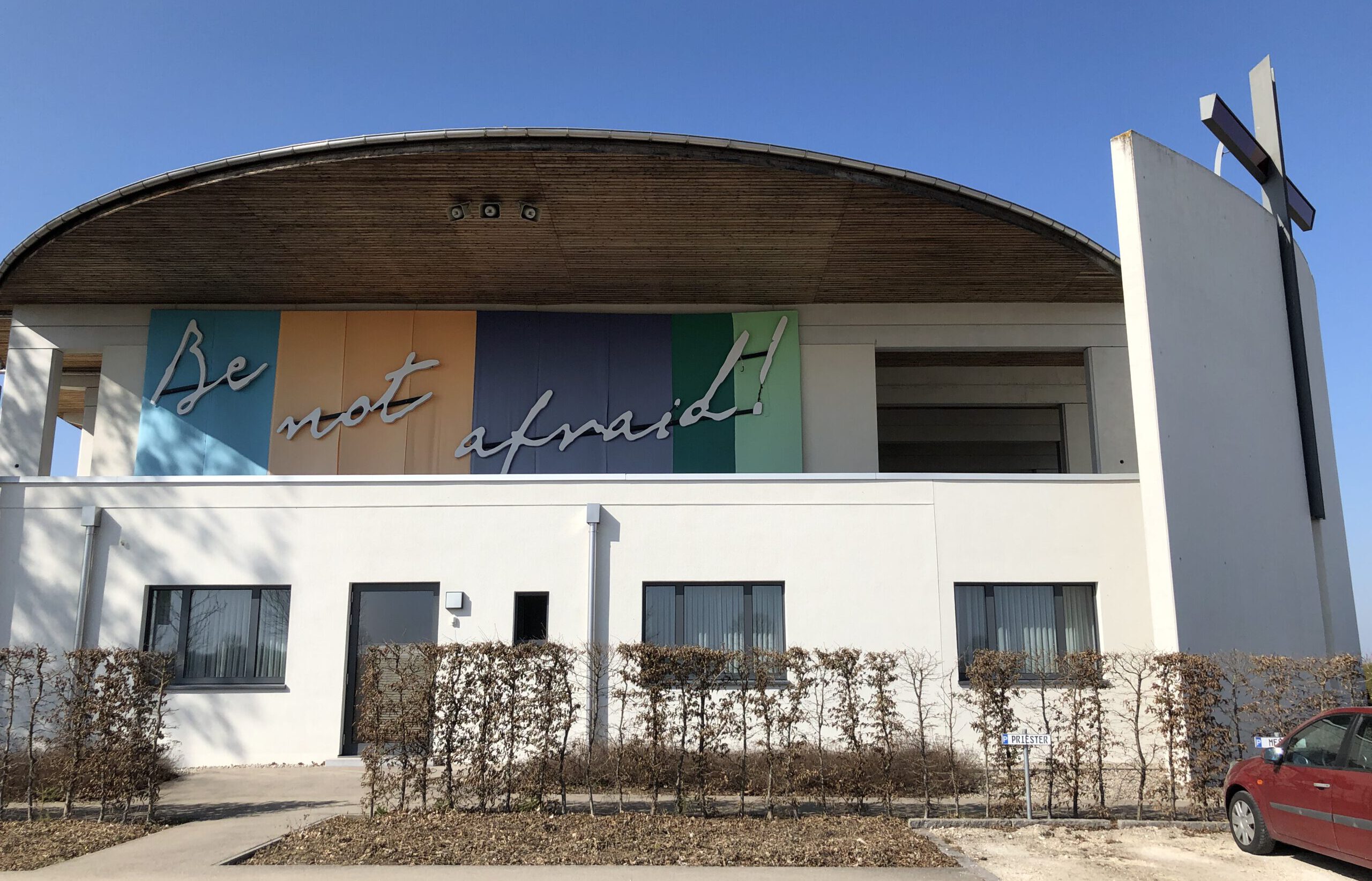
Due to the sustained growth of pilgrims, a church is built at the shrine in 1972. It is consecrated by Rudolf Schmid (1914-2012), Auxiliary Bishop of Augsburg (1972-1990). A year later, this new wooden church goes up in flames. The only thing left is a crucifix, found in the rubble. In 1974, a new place of worship stands on the site of the burned-out church. Construction begins that year on an inn for pilgrims. Construction also starts on a house for Father Martin Humpf, the spiritual leader of the shrine.
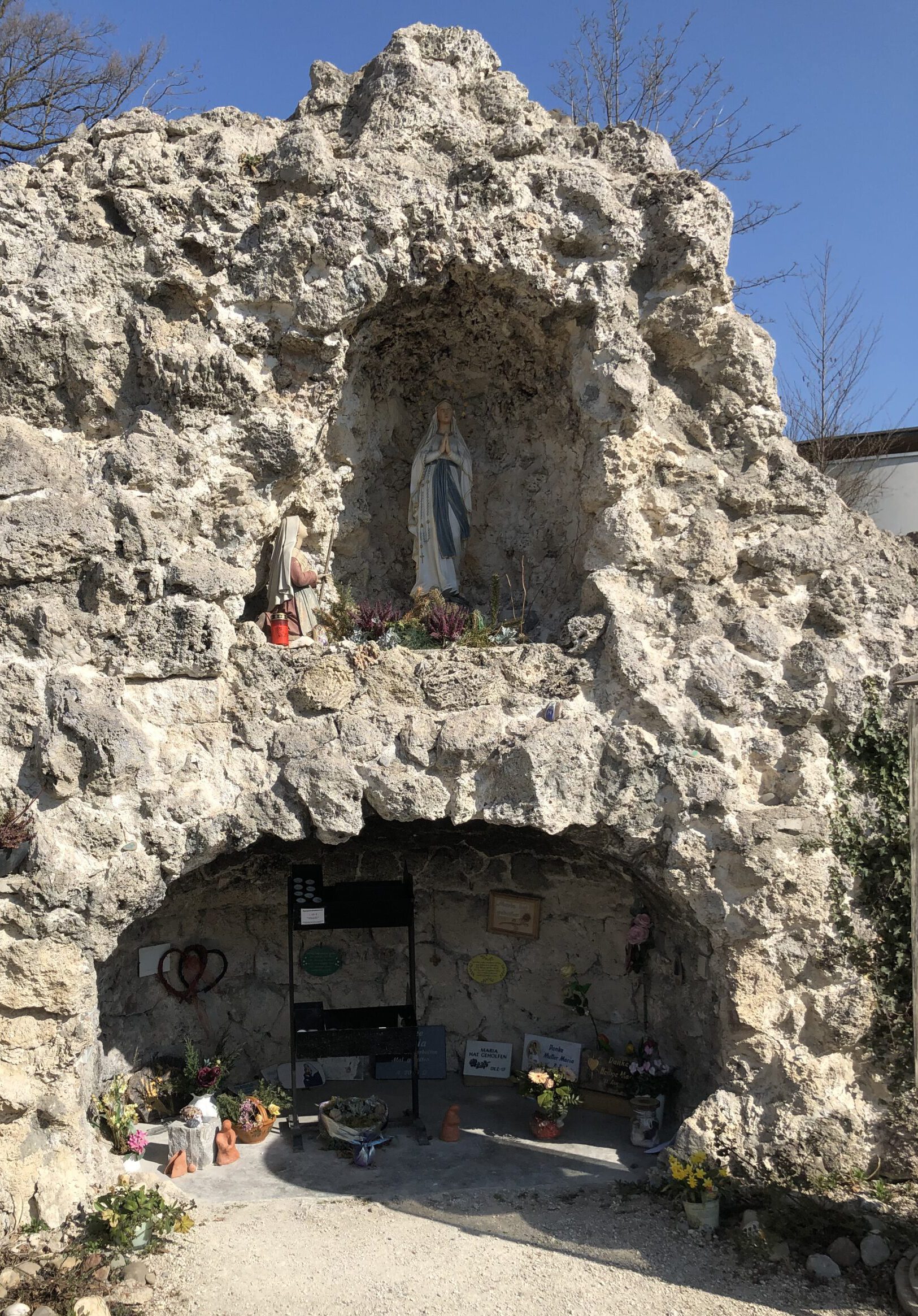
On the occasion of the 30th anniversary of Pastor Martin Humpf's war vow, a Lourdes grotto has been placed in a bomb crater. A Fatima chapel with the Fatima Madonna will also be placed. The consecration of this chapel will take place on 13th July 1975.
On 25 July 1976, Rudolf Graber (1903-1992), the Marian Bishop of Regensburg (1962-1982), came to Marienfried. This was on the occasion of the 30th anniversary of the apparitions. The bishop stated, among other things, that “Marienfried” is in agreement with the council and tradition.
In 1995, the bishop of the Diocese of Augsburg established Marienfried as an ecclesiastical institution and gave the place of worship the name “Maria, Mutter der Kirche” (“Mary, Mother of the Church”).
The altar of freedom on the meadow of the Prayer Place stood in the stadium in Augsburg during the great Day of Faith of the Holy Year 2000. It was consecrated here on 15 July 2000.
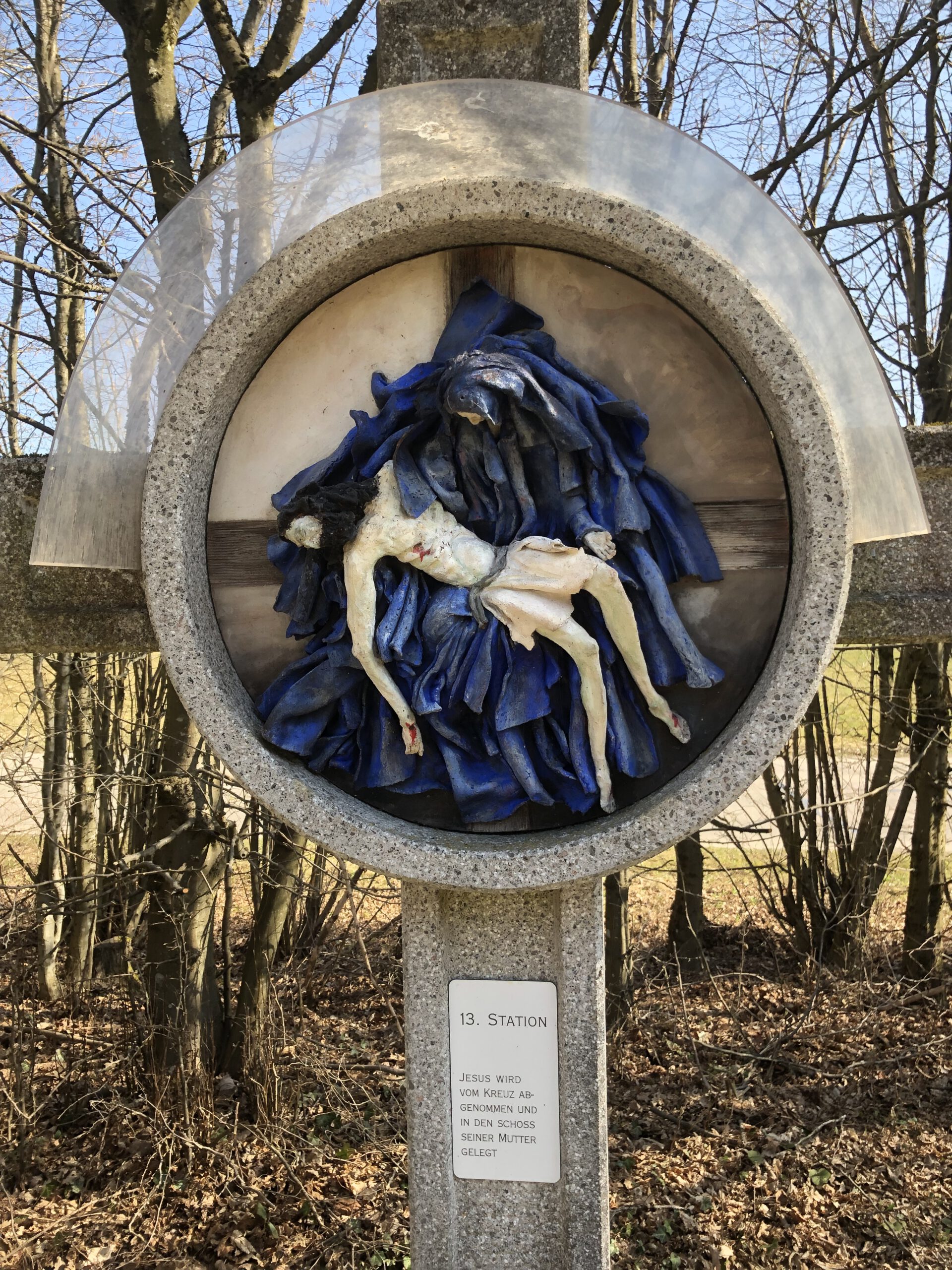
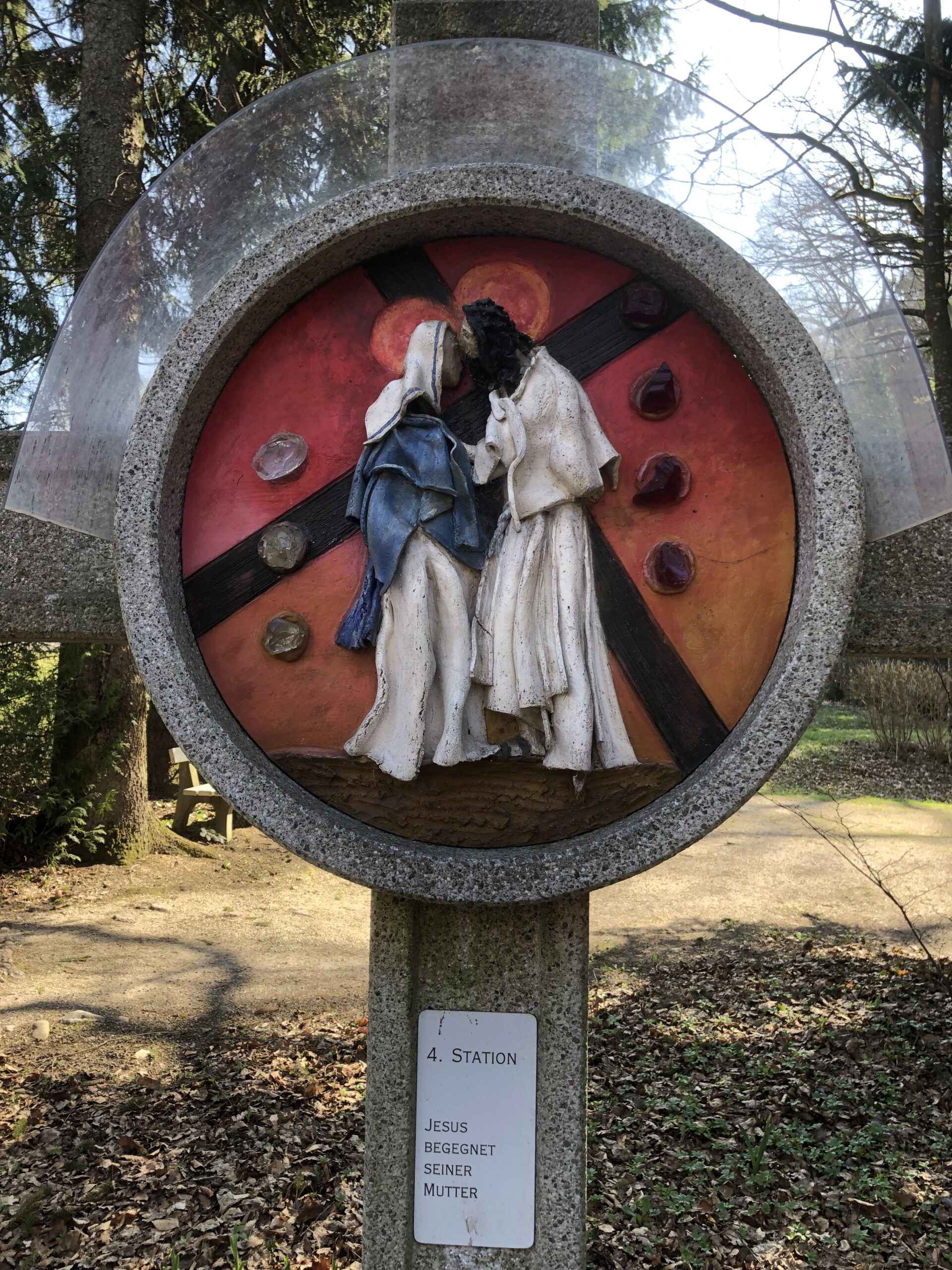
The Way of the Cross was constructed between 2001 and 2002 and consecrated on 13 September 2002. The terracotta images were made by Wolfgang Klein from Ellzee. Theo Krötzinger painted the images. Pilgrims donated the Stations of the Cross.
The Marienfried Church, “Mary, Mother of the Church,” underwent a thorough renovation in 2011 and was consecrated by the bishop. However, the apparitions in Marienfried have not been recognised by the Vatican in Rome. An important consideration is that recognition would jeopardise the ecumenical approach to the Protestant church.
Pilgrimage site
Marienfried belongs to the Diocese of Augsburg and the parish of Pfaffenhofen. Marienfried means “Mary's Peace”. The concept of peace was a great desire for people in 1946, shortly after the end of the Second World War.
The angel plays an important role in Marienfried. This is typical, as the angel is involved in Bärbel Reuss's life and also in Mary giving the messages. This angel appears to Bärbel several times. It is also the angel of the Mediatrix of All Graces, who instructs the seer to pray. He also tells her to pray for Father Angelicus, as he has great worries. However, Bärbel does not know who this person is. Her friend, Anna Humpf, makes it clear to her that this priest is Pope Pius XII and the feast day of his papal coronation is celebrated the following day.
The Grace Chapel of Marienfried rests on three pillars, namely
-the vow made to the Mother of God due to Marian piety to build a chapel,
-the attempt by the founders of Marienfried to dedicate the promised chapel to the Schönstatt shrine by making a covenant of love with the “Thrice Admirable Mother of Schönstatt.”,
-the messages of Marienfried, in relation to the Marian apparitions, to Bärbel Reuss in 1946.
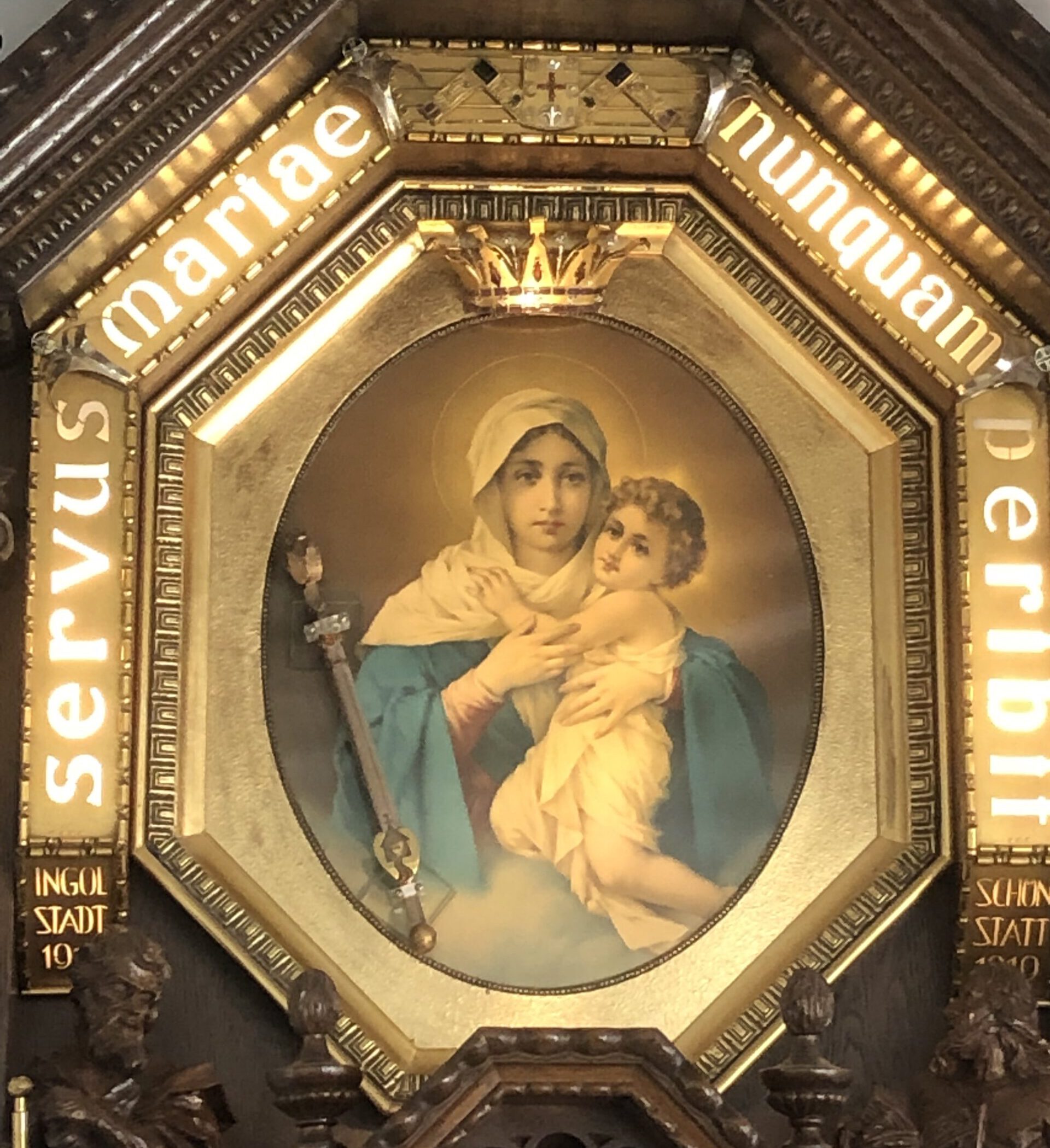
The connection between Marienfried and Schönstatt not only concerns the same image of grace, but also the spiritual relationship between both places. In Ingolstadt, Schönstatt and Marienfried, Mary is referred to as the “Mother Thrice Admirable”. The origin of this lies in Ingolstadt. There, in the 16th century, Father Jakob Rehm experiences an ecstasy. When Mary visits him, he learns that She prefers this title. The title is a reference to the Litany of Loreto, as it includes the invocation “Admirable Mother”, among others.
In the place of worship called Marienfried, you can visit a Fatima chapel and also a Lourdes grotto. In the Marienfriedhalle, many people can attend services. However, central to Marienfried is the chapel of grace.
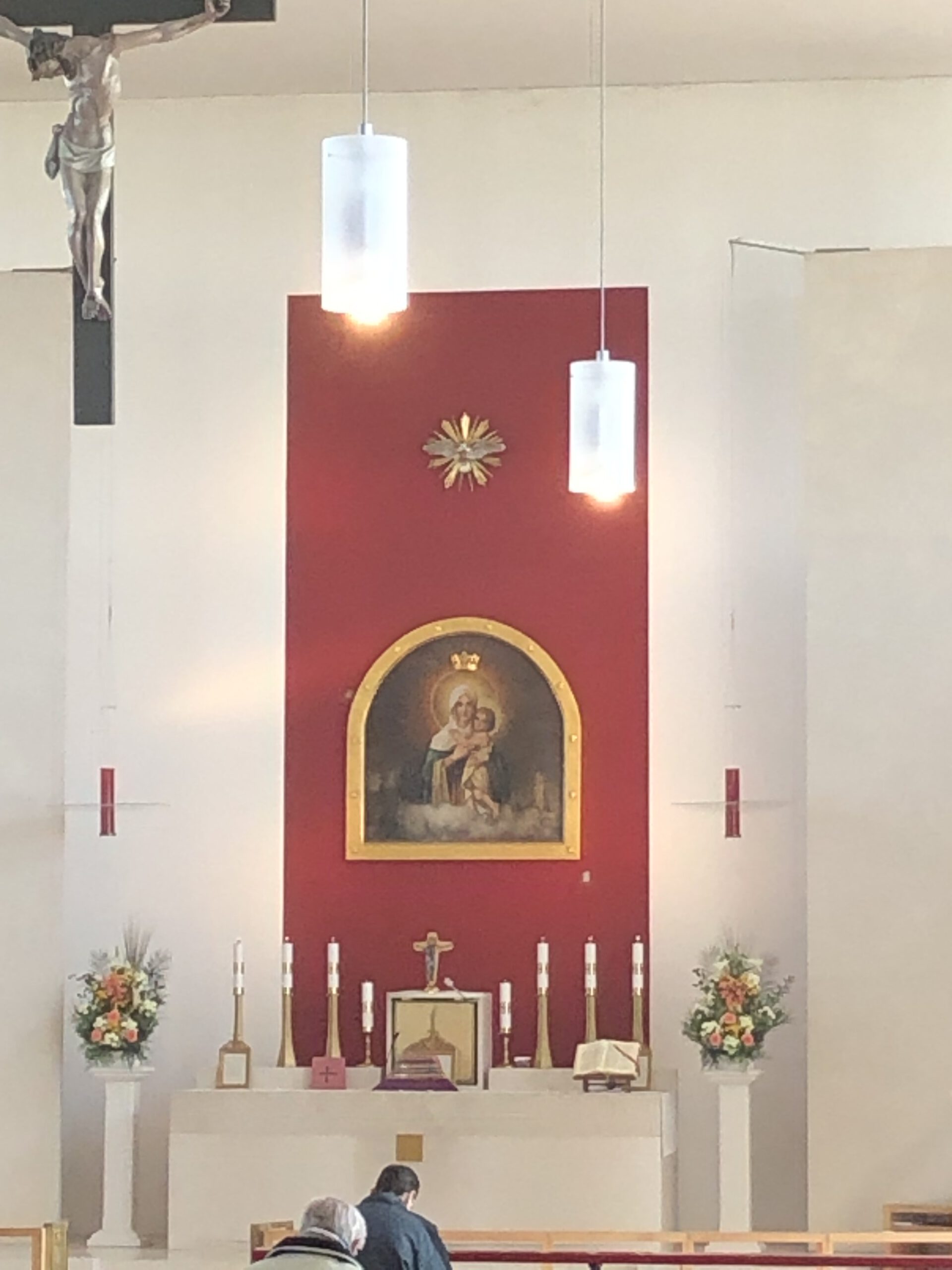
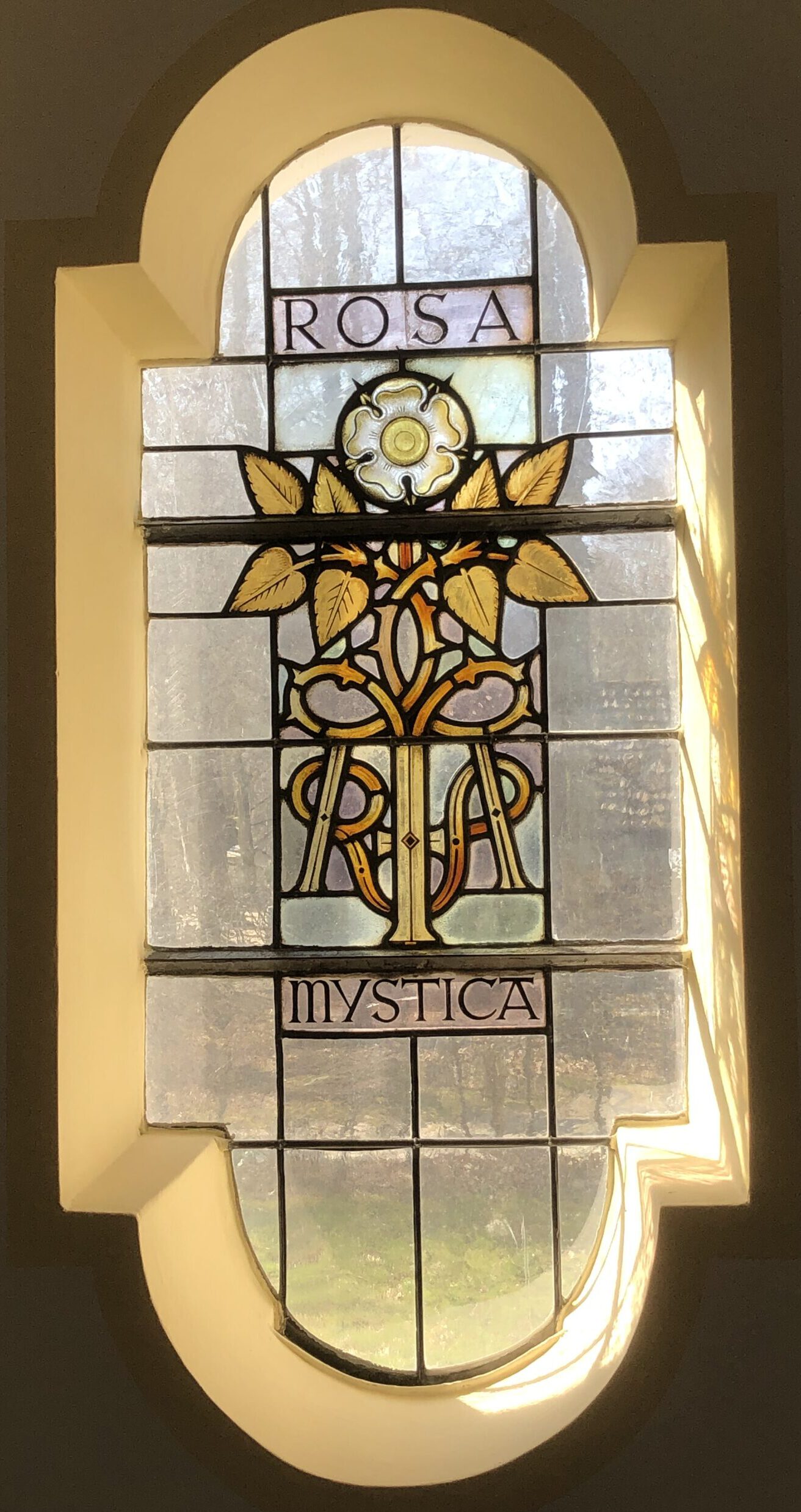
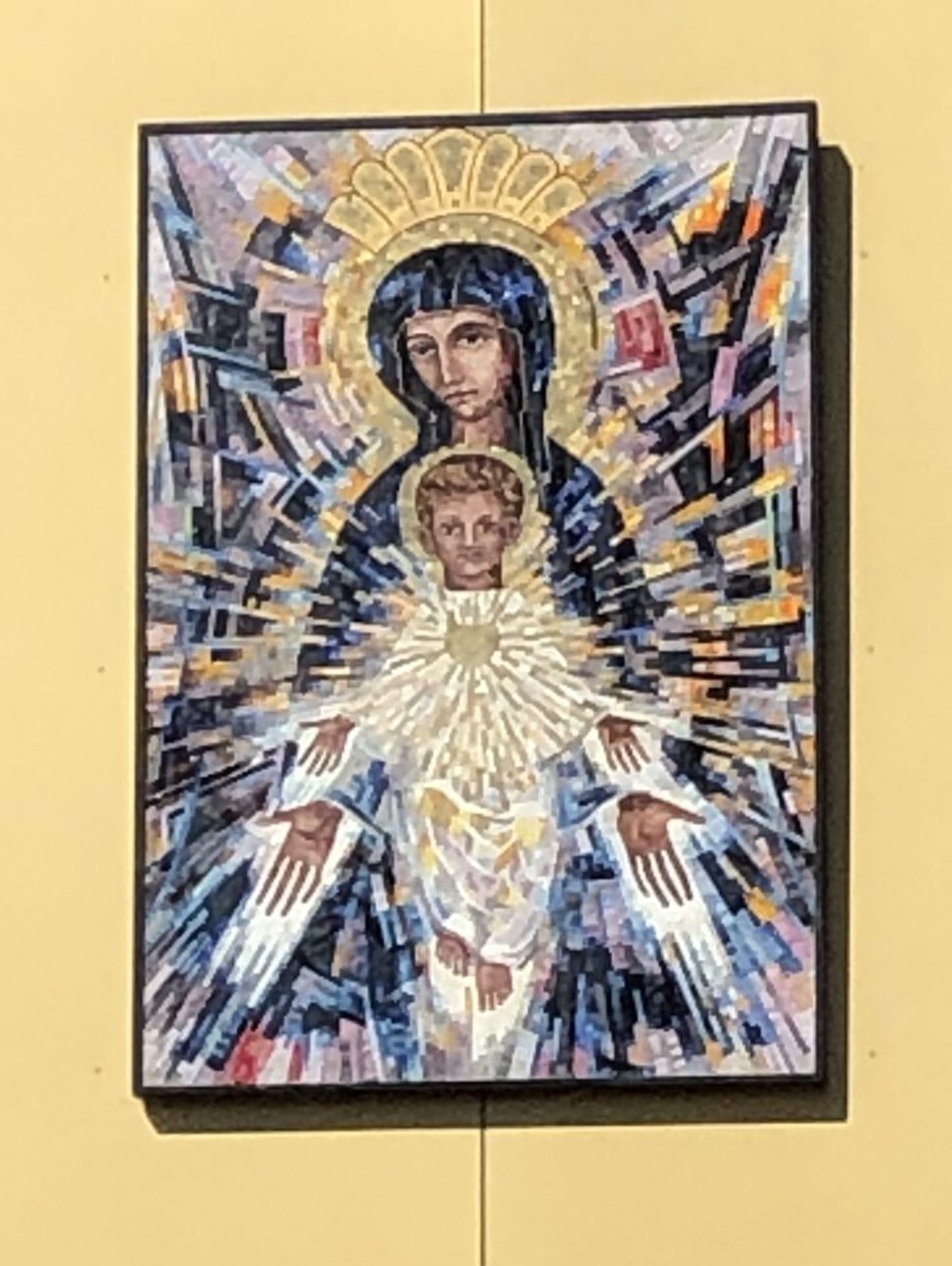
In the Marienfriedhalle, the altar bears the inscription “DESCENDAT MARIA UT FIAT GERMANIA”. Freely translated, this means “Descend, Mary, that Germany may become a holy land of Mary”. Also to be read on the altar is “ICH BIN DIE GROSSE GNADENVERMITTLERIN”, meaning “I am the Great Mediatrix of Graces”. The painting of the “Thrice Wonderful Mother” that hangs above the altar in the Marienfriedhalle was painted by Otto Rückert (1888-1959), who was a painter and teacher.
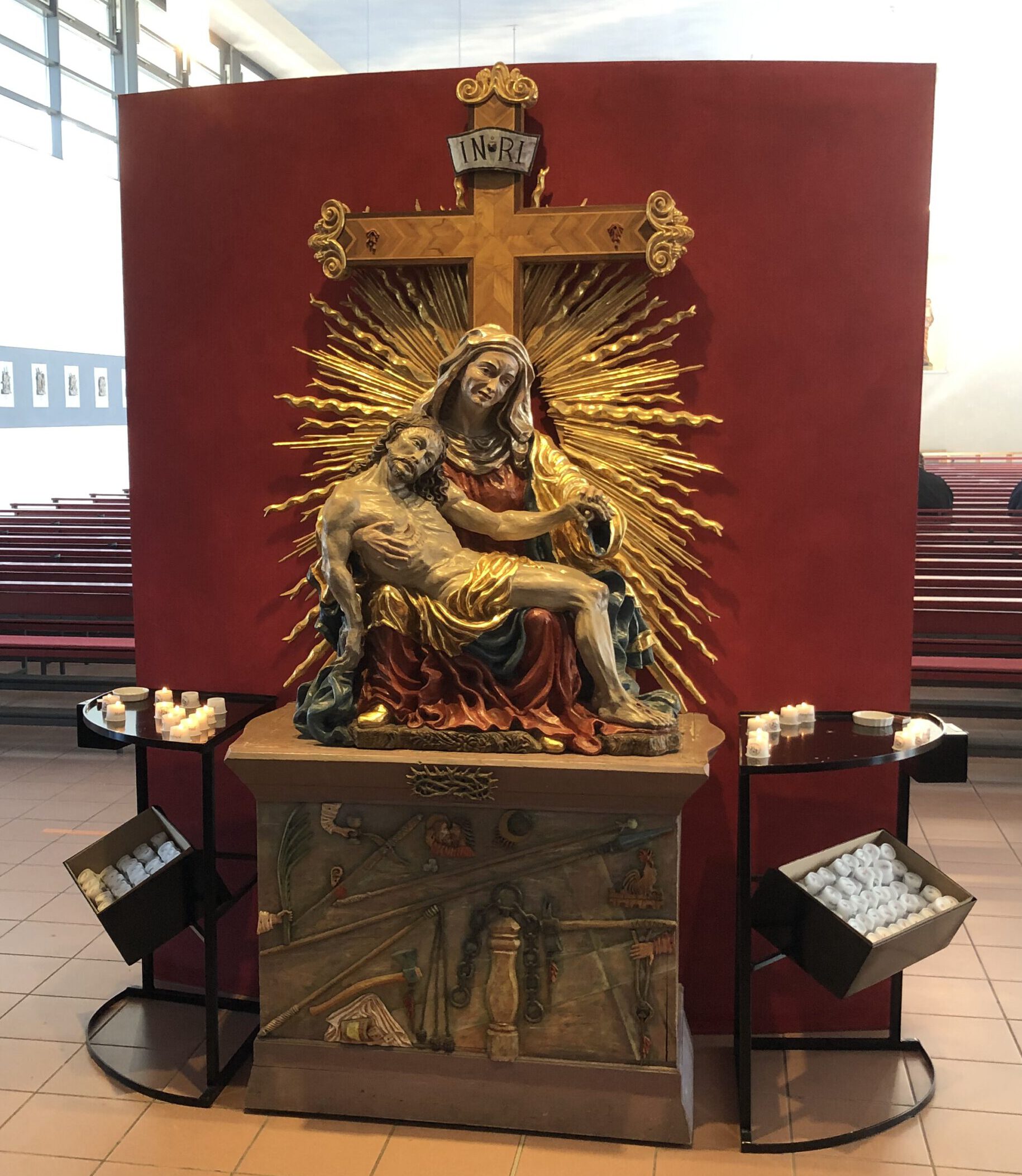
To the left of the “Gnadenkapelle” stands the image pole, with which the Marian development began here.
Over the years, interest in Marienfried has grown, with more and more pilgrims coming to worship there. The growing interest from believers is also due to the commitment of large Marian movements, such as Schönstatt, the Blue Army of Mary, the Legion of Mary, and the Fatima apostolate.

The apparitions in Marienfried have (still) not been recognised by the Catholic Church. A miracle is required as a criterion for the authenticity of the apparitions. In 1950, the ecclesiastical authorities banned Pastor Martin Humpf from communicating about the apparitions. For the residents of Pfaffenhofen, this was a true trial. This is reminiscent of Mary’s words to Bärbel Reuss: “There will come a time when you will stand entirely alone and be terribly slandered, because the devil knows how to blind people, so that even the best are misled.” So this is coming true! However, religious life in Pfaffenhofen is flourishing as never before. In the 20 years after the apparitions, there were no fewer than 20 vocations to the priesthood in the parish. After years, the restrictions imposed by the Church were lifted, and since 1966, the Eucharist has been allowed to be celebrated again in the chapel.
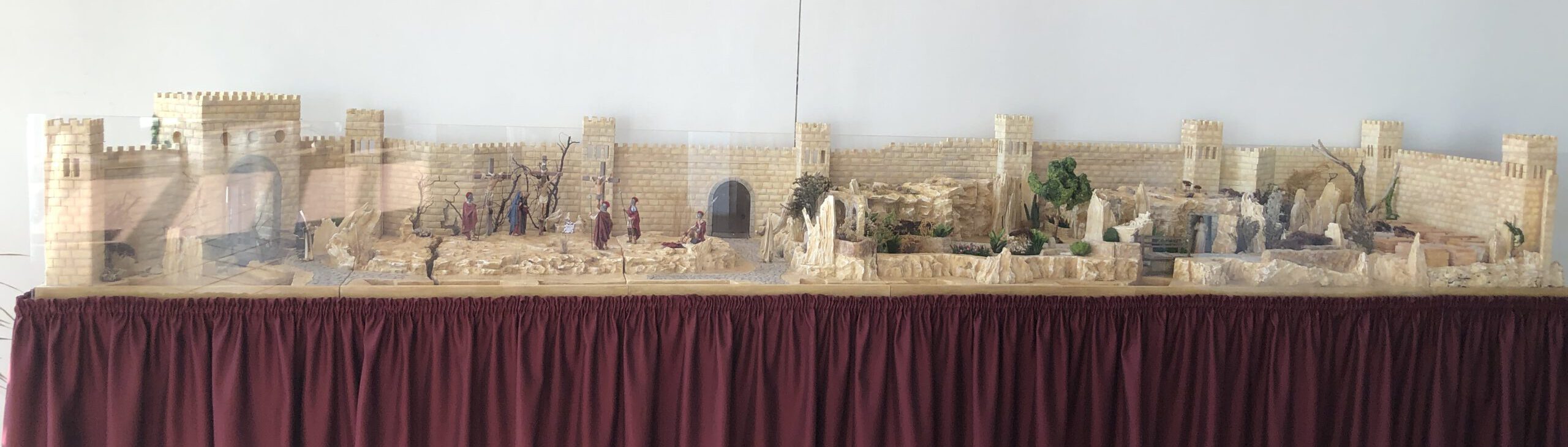
In the pilgrimage church at Marienfried stands a large Passion nativity scene, which takes visitors back to the most important events in the history of Christianity. Central to the display are the crucifixion and resurrection of Jesus, covering the period from Good Friday up to the morning of Easter. The scenes are displayed on a plateau of roughly 4 metres in width. The scenes were created by the “Krippenverein” from Friedrichshafen in just under 2 months. In the background of the display are parts of the city walls with towers of Jerusalem. The figures on the Way of the Cross were made by the Heide company from Gröden (South Tyrol), which was founded in 1970 by Heinrich Demetz. In 2012, he opened a museum of nativity scenes near his workshop.
In Marienfried, the miracle involves spiritual healing for pilgrims with the help of Mary. However, where there is doubt and rejection, Mary cannot work. Those who are full of faith in Her experience the miracle of this inner transformation. Through this, Mary's significance for the world and for the Catholic Church can be recognised.

The Shrine of Marienfried signifies a contemporary connection of devotion to Mary for many a pilgrim. It is one of the Marian shrines where the Mother of God is venerated in many ways. For pilgrims, Marienfried is a source of knowledge on how God, through Mary, gives messages. Thus, John Venancio, Bishop of Leiria-Fatima and international president of the Blue Army of Our Lady, has said that Marienfried is a message to the world.
To further highlight the importance of the apparitions in Marienfried, relationships can be indicated between Marienfried and other apparition sites:
There is a kinship between the apparitions in Marienfried to Bärbel Reuss and those in Paris in 1830 to Catherine Labouré. In both places, Mary speaks to a person with great devotion to Her. Both visionaries lost their mothers in their youth. Mary's help is spiritual in nature, both in Marienfried and Paris. It concerns the salvation of souls. Our Lady appears in Marienfried and Paris in the same way, with Her hands outstretched and rays emanating from them. These rays symbolise the graces which She directs to others who ask for them. In Paris, Mary asks that people wear the Miraculous Medal, and in Marienfried, that they pray the Immaculate Rosary. From this, it follows that Mary in Marienfried confirms what She said in Paris. Thus, Marienfried is the continuation of Paris.
Another relationship exists between the apparitions in Marienfried and those in La Salette. The Marian apparitions in Marienfried occurred exactly 100 years after those in La Salette, France (1846). In both Marienfried and La Salette, Mary laments that her children are abandoning Her. In both places, Mary's face is very sad.
-There is also a connection between the apparitions in Marienfried and this one in Lourdes. In Lourdes, Mary says that She is the Immaculate Conception and in Marienfried, She introduces the Immaculate Rosary. In Lourdes, Our Lady wants to help physically ill people and in Marienfried, mentally ill people.
There are also similarities between the apparitions in Marienfried and the Marian visitations in Fátima. The first Marian apparition in Fátima was in 1917, on 13th May. In Marienfried, the first visitation of Mary was in 1940, also on 13th May. Both in Marienfried and Fátima, Mary's apparitions are accompanied by visitations from an angel, during which prayers are offered to the Holy Trinity. In Fátima, Mary shows her wounded heart, and in Marienfried, she gives her heart to work for the salvation of souls. In Marienfried, the words of Mary in Fátima are further elaborated upon. In Marienfried and Fátima, Mary asks for the Saturdays to be kept holy for her. In Fátima, Portugal, Mary appears in the Cova da Iria (Valley of Peace), and in Germany, in Marienfried (Mary's Peace).
There is also a connection between the apparitions in Marienfried and the Marian visitations in Amsterdam. In Marienfried as well as in Amsterdam, Mary speaks about the fact that Germany must be saved. In Marienfried and Amsterdam, Mary speaks about infidelity to the faith. In Amsterdam, Mary first raises 3, then 4, and finally 5 fingers. In the third month, March, in 1945, the messages began in Amsterdam. In the fourth month, there was the first apparition in Marienfried, namely on 25 April 1946. On 5 May 1945, the 5th of the 5th month, the Second World War ended in the Netherlands. In Amsterdam, the messages are for all peoples, and this is also the case in Marienfried.
Based on the similarities between the Marian visitations in Marienfried and the apparitions in Paris, La Salette, Lourdes, Fatima, and Amsterdam, the conclusion can be drawn that Marienfried is one of the most important apparition sites of Mary.
ACCESSIBILITY
Marienfried is located near Pfaffenhofen an der Roth. The large towns of Augsburg and Ulm are situated nearby. On the A7 motorway, near Neu-Ulm, take the direction of Nersingen and exit at junction 121. Then, follow the road to Pfaffenhofen an der Roth.
Address: Marienfried Prayer Centre, Marienfriedstrasse 62, D-89284 Pfaffenhofen an der Roth.
Website: www.marienfried.de and you can read the necessary information here.
Experience
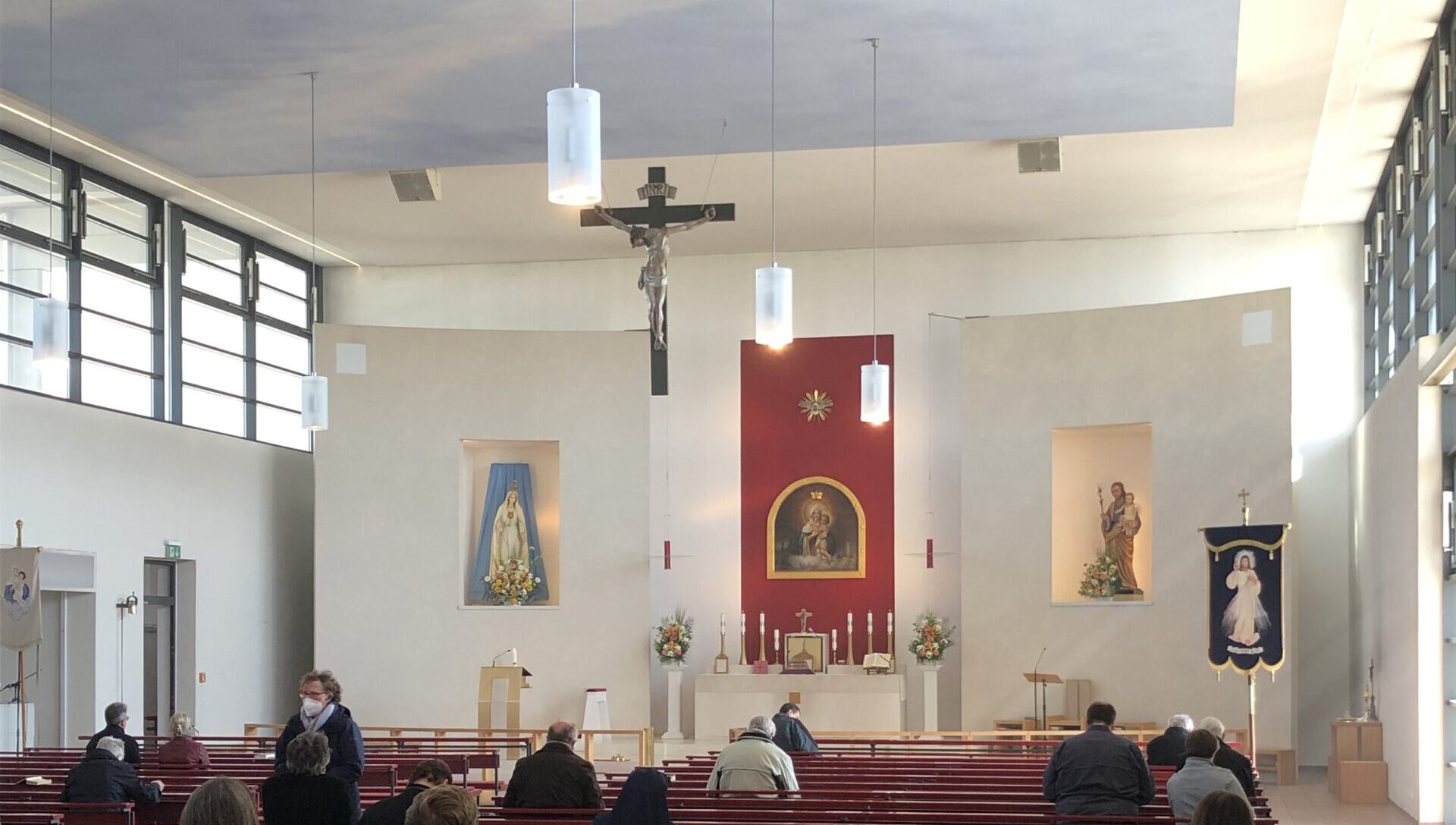
It is 15 August, the Feast of the Assumption of Mary, the great feast day of Our Lady. At 8.00 am, I will attend the Eucharist service in the church “Maria, Mutter der Kirche”. It is a church with bright colours and the ceiling is filled with light blue clouds. It feels like I am allowed to look at heaven. The house of God feels very modern and inviting. I learn that this church was consecrated in 2011. The many statues make the building warm and instantly familiar. The pews in this rather new church can accommodate about 700 visitors. I estimate that 100 seats are currently occupied. Among those present, I also notice a few nuns, dressed almost entirely in light grey, as only their shoes and jackets are black. I also see a pair of friars. They wear a black habit with a green cord. The name of this church is indeed typical: Mother of the Church. I interpret that as the Mother of everyone. She is therefore open to all people and everyone is welcome with her. For all there is hope that they have a heavenly Mother. For me, She is therefore the Mama of the highest value.
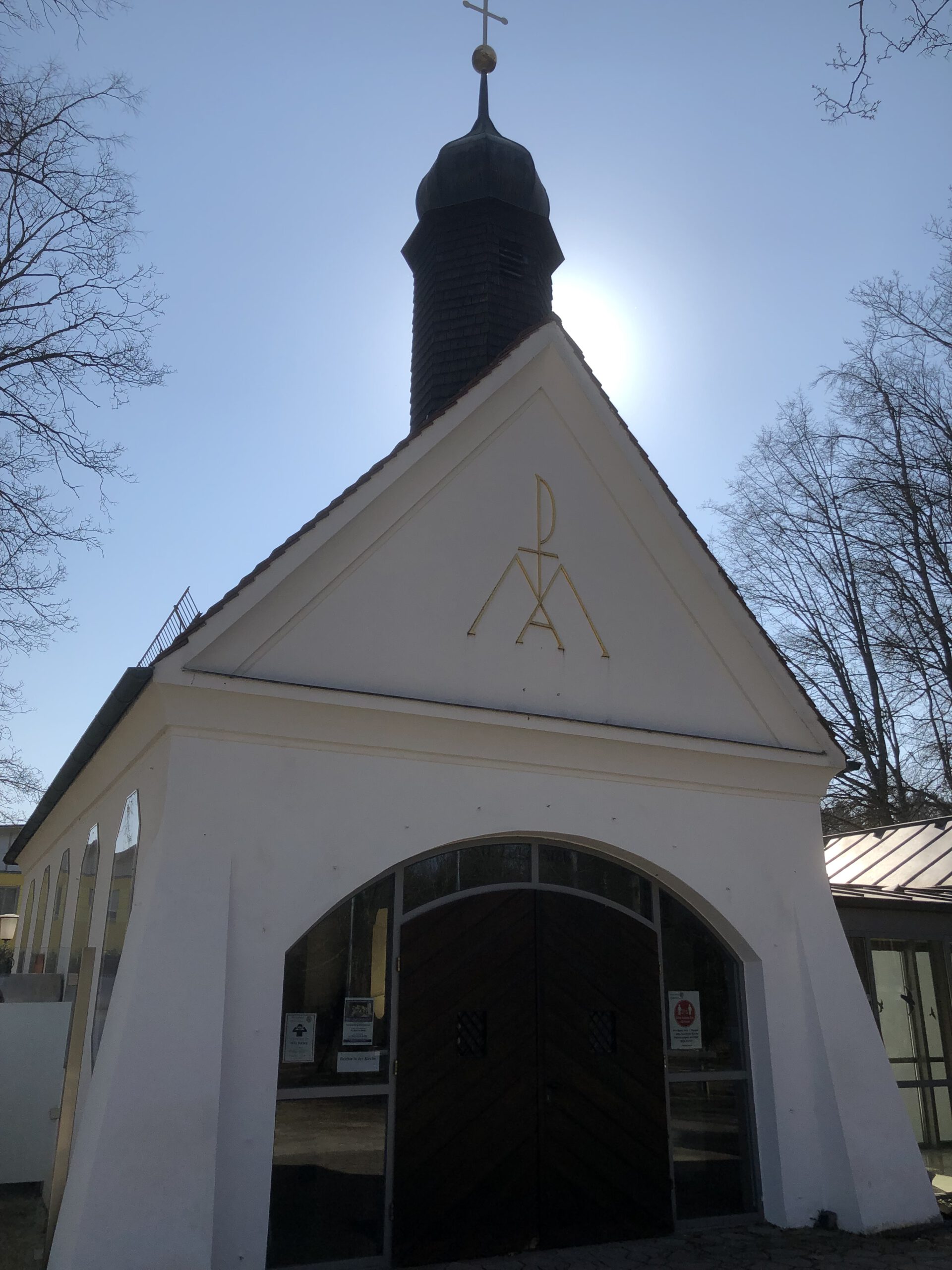
After Mass, I’ll visit the “Gnadenkapelle”, the Chapel of Grace. In front of the chapel stands a statue of Christ. Beneath the large crucifix is an image of Our Lady of La Salette. It seems that Mary wants to say with this that in Marienfried people are building a bridge to more easily grasp God’s Kingdom and are open to her Son. The chapel is the spiritual centre of Marienfried. I enter the chapel. Slowly I walk forward and reach the altar. I read the inscriptions: “Servus Mariae nunquam perbit”, Inglostadt 1914 – Schönstatt 1919″ and “Ich bin die Grosse Gnadenvermittlerin”.
After greeting Mary and thanking her for this day, I will take a seat at the back of the chapel. I'll let the impressions I've gained sink in. Then thoughts of loved ones come to mind, such as my deceased parents, my late aunt and good friends, with whom I share a lot. Then I'll pick up the rosary...
After visiting the Chapel of Grace, I want to do some shopping in the well-stocked shop with all sorts of religious products. There are many devotional items for sale, such as statues, books, candles, cards, and holy water fonts. I am purchasing two small books about the apparitions in Marienfried; one in English for my good friend Maria, and one for myself in German. I am also buying a few candles, a picture of Mary to hang on the wall, and two bronze plaques of Saint Nicholas. After all, as chairman, I am closely involved with the Saint Nicholas Society of the Netherlands.
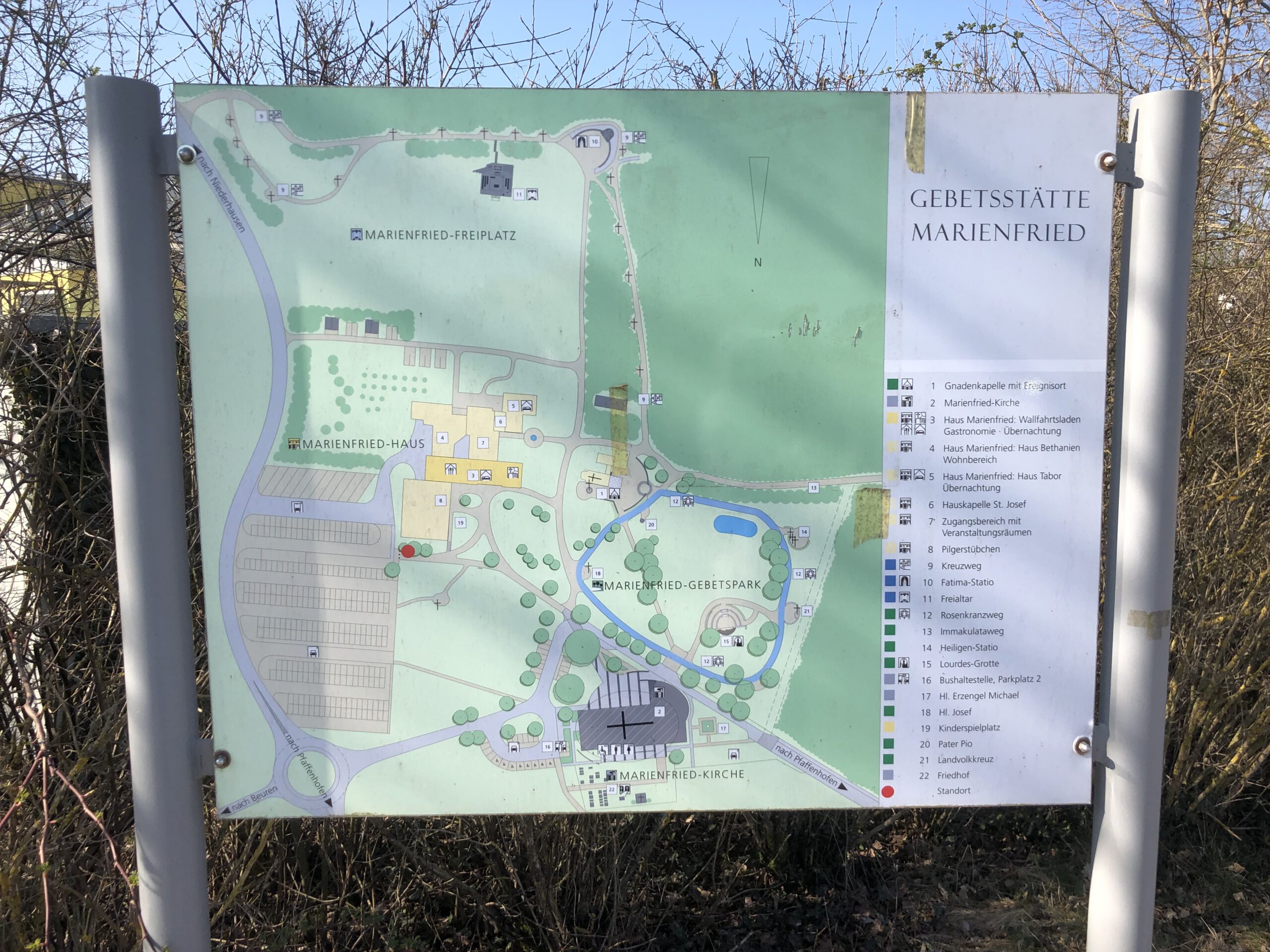
It's sunny weather with a nearly cloudless sky. I'm taking a walk through the prayer site (Gebetsstätte) and immediately encounter Padre Pio. The statue of him is about two metres high and stands in a small chapel. I read that this statue is a gift from someone from Belarus. Next, I come to a statue of St. Joseph, which has been incorporated into a tree trunk. I've learned that Joseph is the second patron of Marienfried. I read that this is not the first statue of Joseph. Here too, a thief has been taken in by the devil.
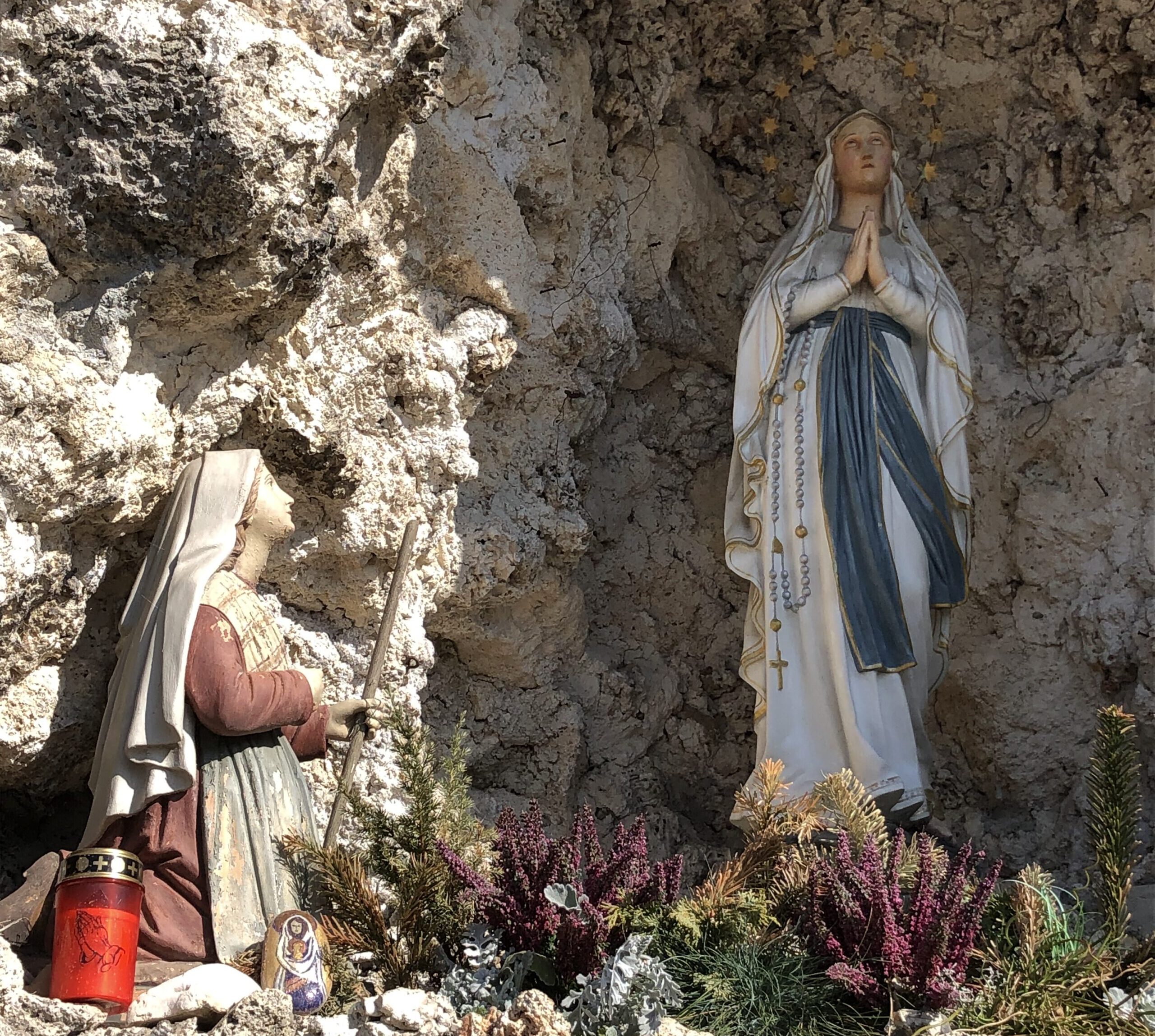
About 50 metres further, near the church, I see a Lourdes grotto. I've read that this grotto was built in the crater created about 30 years after a bombing in 1944. In the upper part of the grotto, space has been made for Mary and Bernadette. Below this are flowers and hanging plaques with thank-yous to Mary.

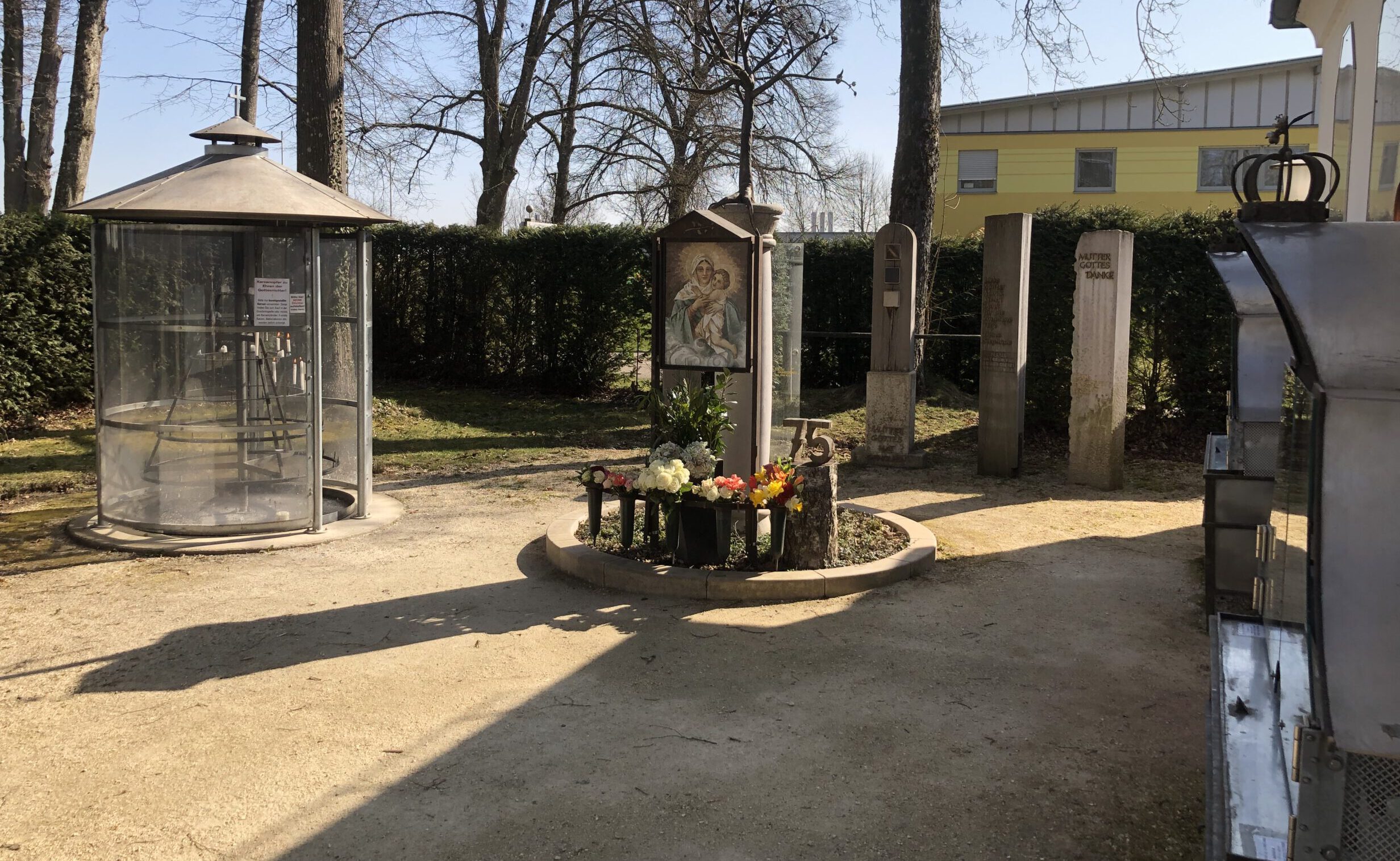
After the cave, I'm going to the “Rosenkranzweg” (Rosary Way). There are 15 statues to be seen, depicting the Rosary Basilica of Lourdes. In the long “Immakulata-Weg” (Immaculate Way), I see a sign stating that Bärbel Reuss, the seer, was here on Whit Monday 1940. She met the Lady here, with whom she prayed the “Immaculata Rosary”. I continue my walk and arrive at the Swiss “Gedenkstätte” (Memorial Site). This memorial site belongs to the Marian Women's and Mother's Movement of Switzerland. There are three images. In the centre is Mary with Child. Next to it is an image of Brother Klaus, as thanks for the vocations found here. The other image is of Father Rupert Mayer, in remembrance of the courageous “Apostle of Munich,” for speaking out for the right to freedom of the people and the Church in the Third Reich.
The Stations of the Cross have been laid out at the edge of the forest. The images of the Stations of the Cross are impressive, measuring over 2 by 2 metres. I find the stations full of emotion and great feeling. During the Stations of the Cross, I come across the “Freialtar”. This altar held an important place at the great Day of Faith in the Holy Year 2000 in Augsburg. After that, the large altar was transferred to Marienfried and rebuilt on a small hill about 5 metres high. In an open space at the edge of the forest, I come across the Fatima Grotto. This grotto was built by the Fatima Apostolate in 1994. The statue of Mary is life-size. To the left and right of this statue are statements from Our Lady, including “pray the rosary daily” and “in the end, my Immaculate Heart will triumph.” Then I think of the apparition in Fatima on 13 July 1917.

I am going back to the Shrine of Grace. To the right, next to the shrine, is a memorial stone for Father Josef Kentenich, the founder of the Schoenstatt Movement. To the left of this shrine is the spot where Mary appeared three times to Bärbel Reuss. Many votive plaques hang there with inscriptions such as “Mary has helped”, “Thank you Mary for your help”, and “The Mother of God has helped”. I light a candle and kneel at this spot, where many flowers have been laid. With the lighting of the candle, I have intentions for a good acquaintance who is struggling with their health and for my friends in the Netherlands.
The visit to Marienfried is important to me, as I place great value on the significance of the apparitions to Bärbel Reuss.
Environment
From Marienfried, it's 70 km east to visit the beautiful city of Augsburg.
AUGSBURG – ST. AFRA DIOCESAN MUSEUM
The “Diözesanmuseum St. Afra” is located at Kornhausgasse 3-5, next to the Cathedral, in the centre of Augsburg. The diocesan museum can also be reached via the Cathedral, by entering the somewhat dark cathedral cloister. Current information can be found at www.museum-st-afra.de.

The museum offers a wide variety of art treasures in some of its rooms, and Our Lady can be seen in sculptures and on paintings. In addition, the museum houses the former, Romanesque, bronze door of the Cathedral from the 11th century. Furthermore, items of Augsburger silver, vestments of Saint Ulrich, and relics are on display, among other things.
In 2000, after a thorough renovation, the museum reopened. Part of the exhibition space features a glass structure, while an older section belongs to the Cathedral. At the back of the museum is a hall where the original foundations of the Cathedral have been made visible.
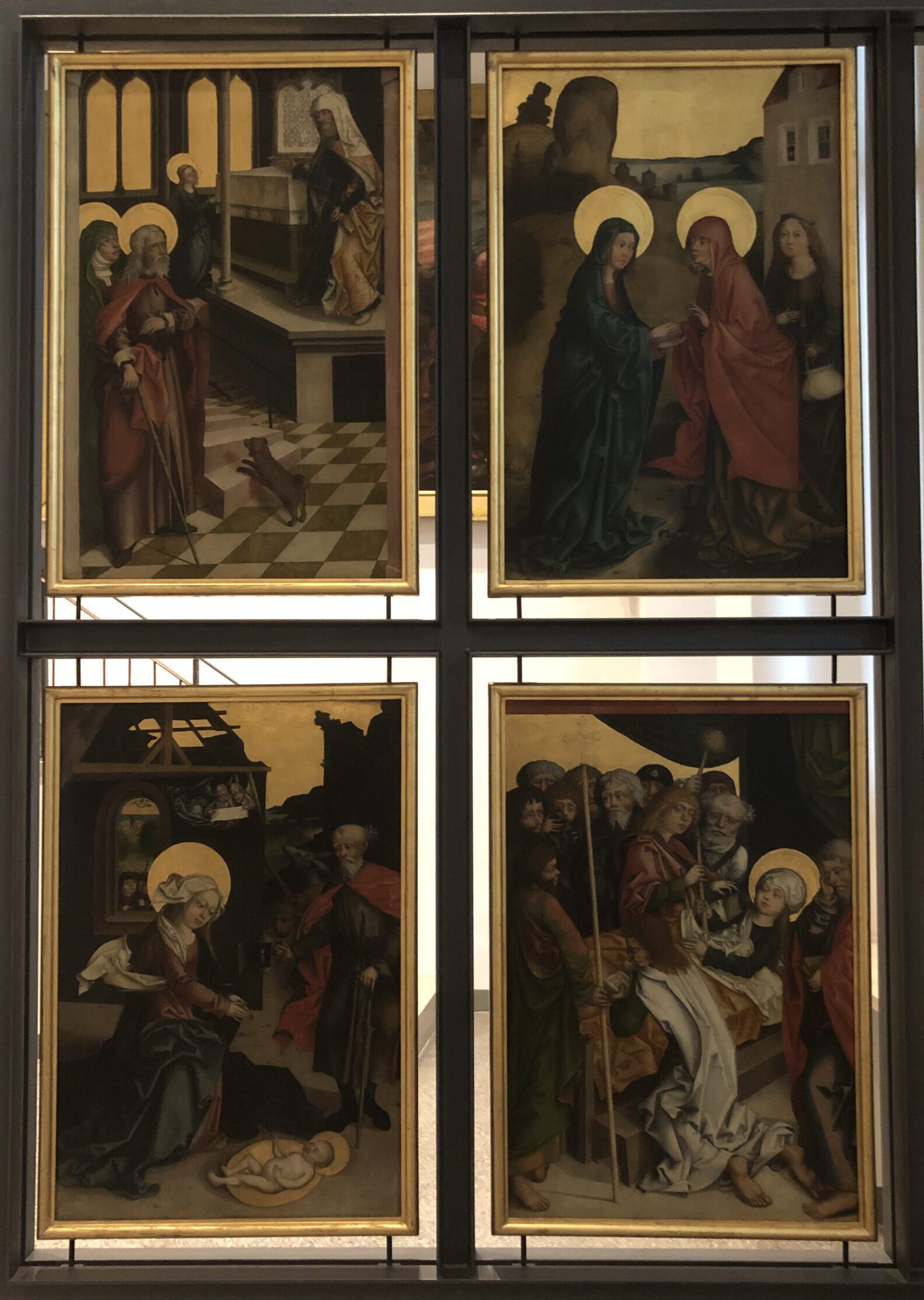
A double-sided, wooden altarpiece (c. 1490) is colourfully painted with, on one side, depictions from the life of Mary and, on the other, phases of the life of Saint Nicholas. The four painted panels of Mary concern her presentation in the Temple, the Visitation, the birth of Jesus, and her death.
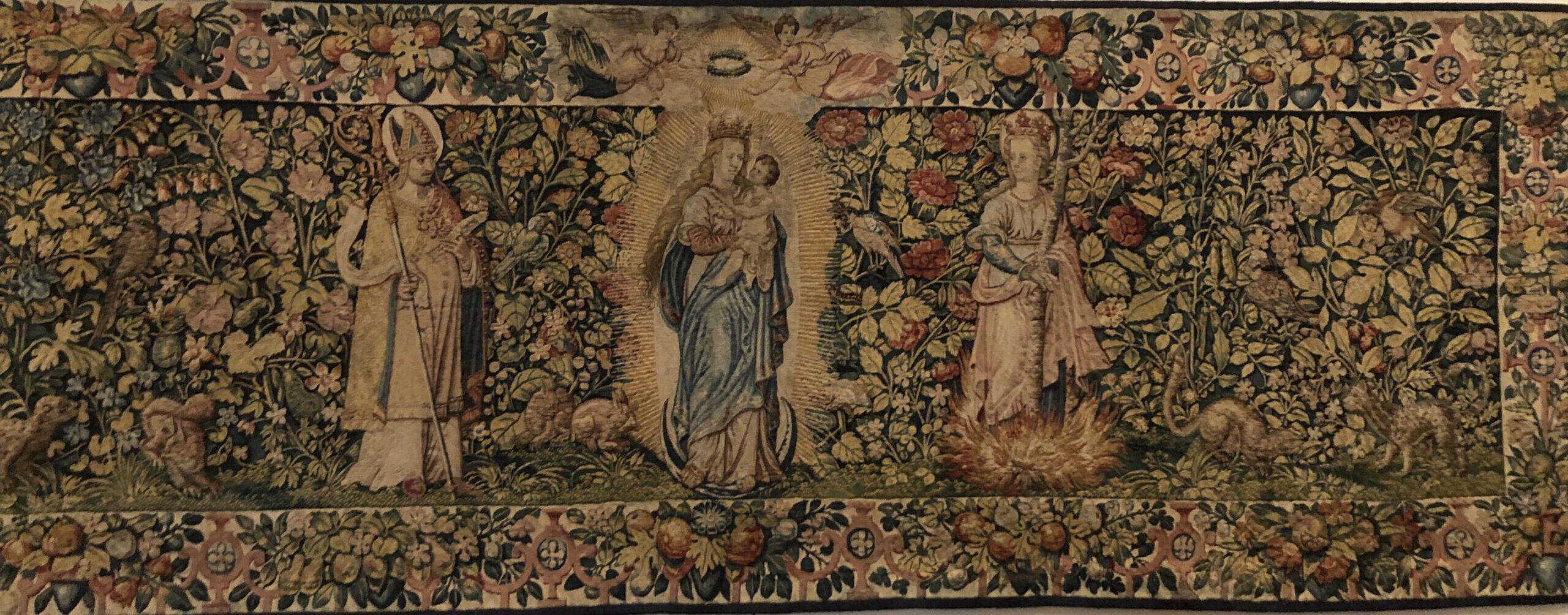
A Brussels tapestry of wool and silk (c.1580) with colourful floral motifs displays images of Afra and Ulrich, the patron saints of the diocese, as well as Mary as the patroness of the Cathedral.
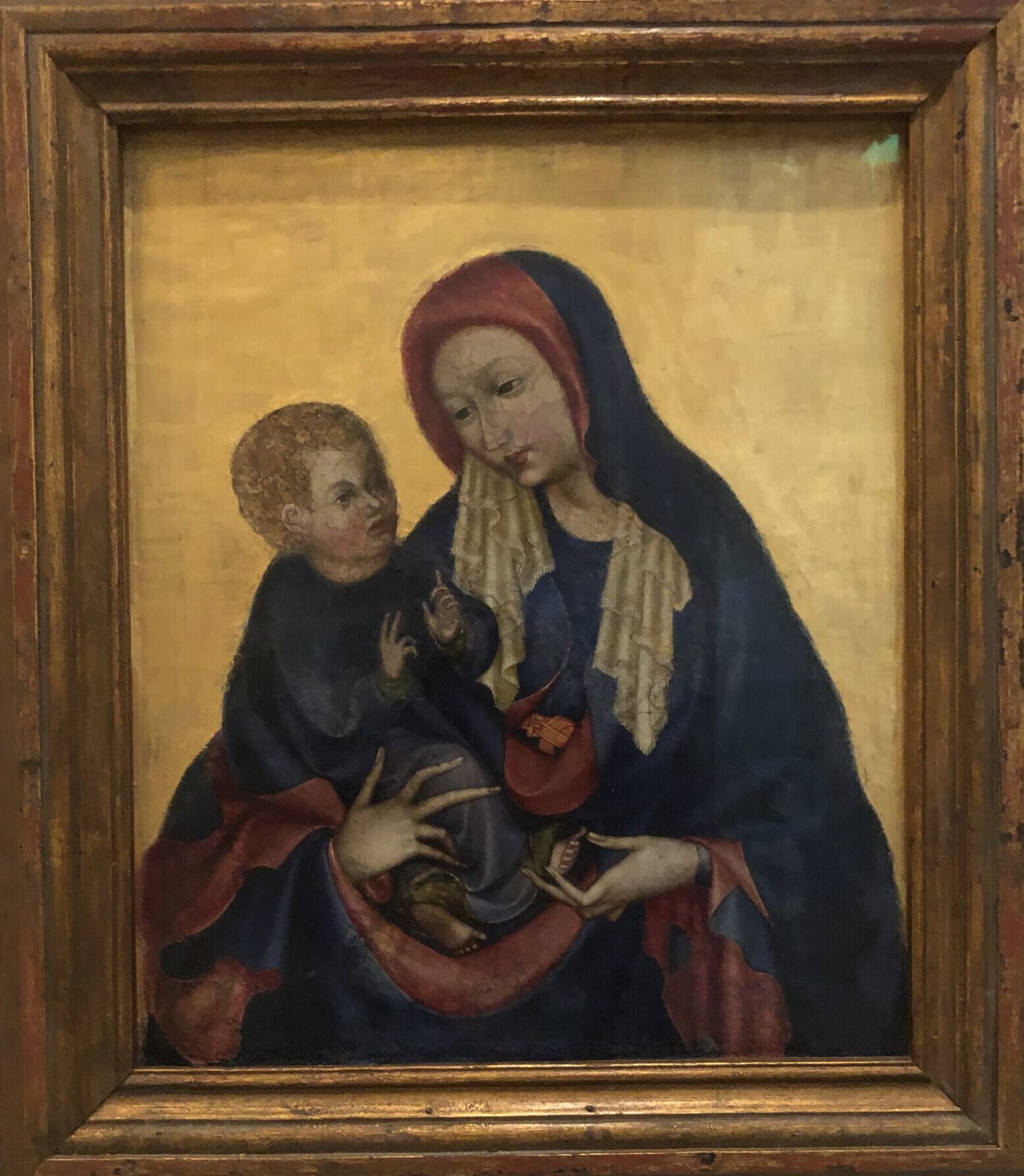
The “Beautiful Madonna” (c. 1400) is a Bohemian painting on wood. The depiction of "the Beautiful Madonna" comes from the Cathedral.
Four wooden, dark brown panels show, among other things, images of Mary.
A painting “Battle of Lechfeld” (“Schlacht auf dem Lechfeld”) from 955 is made of oil on canvas (c. 1696). It shows an important fact from Ulrich's life. An angel has given Ulrich a cross to triumph over the Hungarians. Mary is depicted above the fighters.
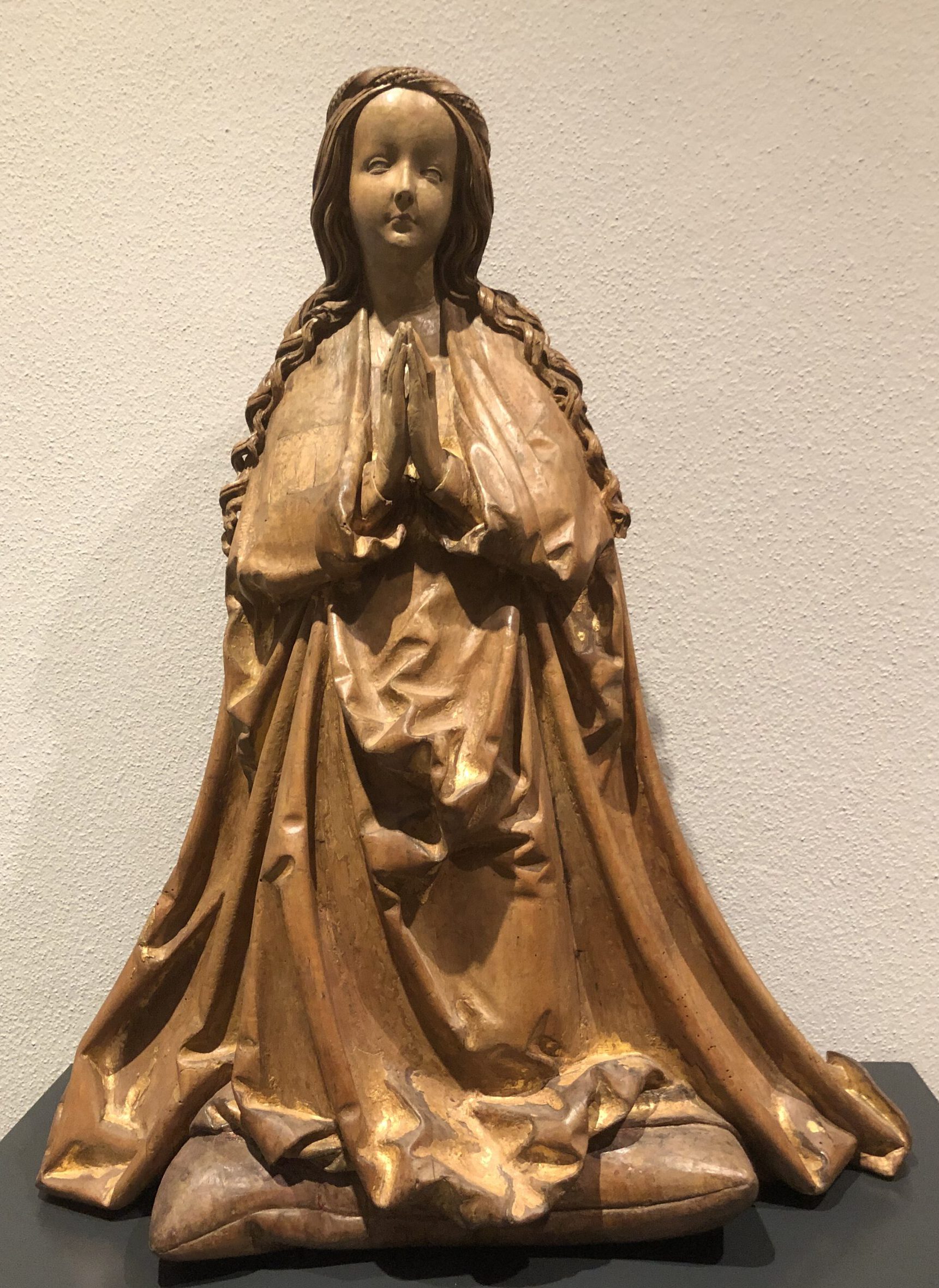
A work of art from around 1540 depicts an image of Mary, created by the German sculptor Jörg Lederer (c.1470-c.1550) from Kaufbeuren. Mary is kneeling on a cushion and praying. It is painted on lime wood and gilded.
Part of a diptych painted on softwood by Leonhard Beck (c. 1480-1542) from Augsburg. It is a Thomas Fackler diptych from around 1520. The right panel depicts Mary with Child and two angels. Next to them is Saint Elizabeth of Thuringia giving a beggar to drink. At Mary's feet kneels the founder, Elisabeth Fackler, with her coat of arms.
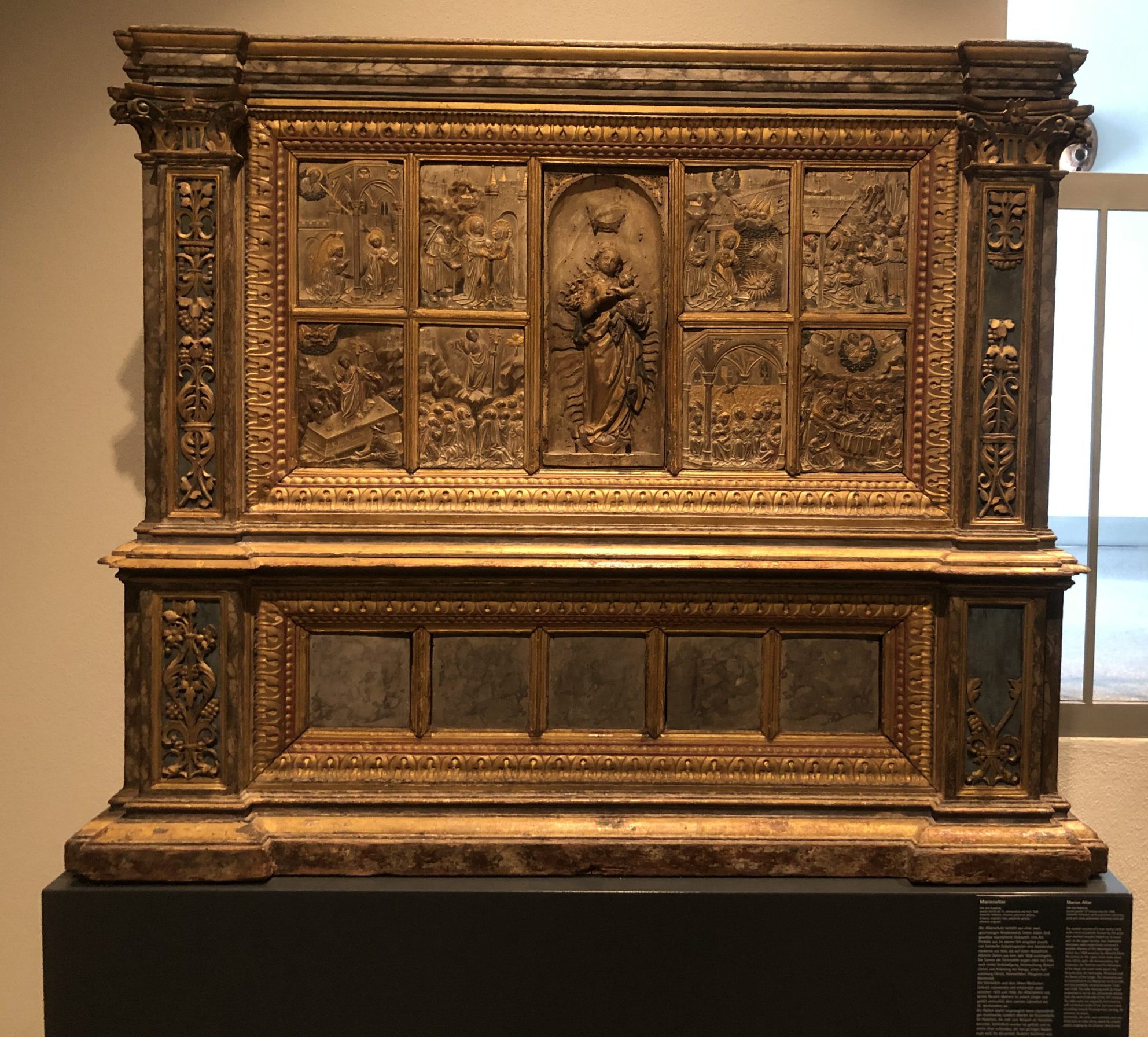
A Mary altar from around 1540 is made of wood, limestone, partially gilded and polychromed. The Madonna is made of wood. The images on the altarpiece, from top left to right, show the Annunciation, Visitation, Nativity of Jesus, Adoration of the Magi, Resurrection of Jesus, Ascension, Pentecost, and Dormition of Mary.
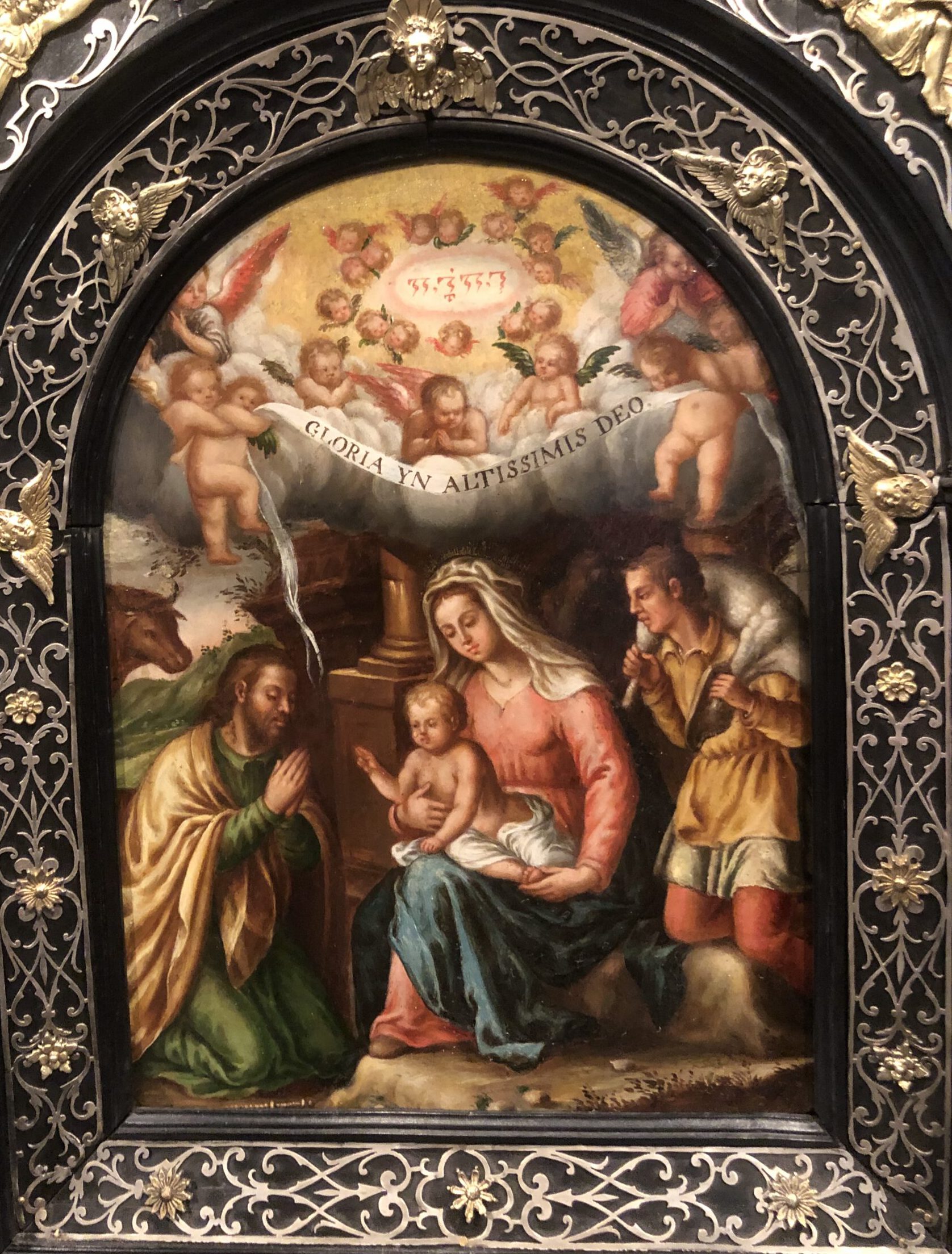
A reliquary altar (c. 1630) is by painter Johann Matthias Kager (c. 1575-1634), silversmith Jeremias II Flicker (c. 1610-1647) or sculptor Tobias Zeiler (+1666). It is made of oil paint, copper, silver and wood. The Adoration of the Shepherds is depicted.
A casket from around 1315 is made of iron, oak, tempera, and metal. The casket, with depictions of Mary among others, is a gift of love in courtly circles.
AUGSBURG – CATHEDRAL
The Cathedral has a long history and its oldest parts date back to the 11th century. The Romanesque-Gothic cathedral has two entrances, which are decorated with many figures. The south portal or Maria portal dates from the 14th century and the central pillar shows Mary. In the three-storey tympanum, the triangular pediment shows phases from the life of Our Lady.
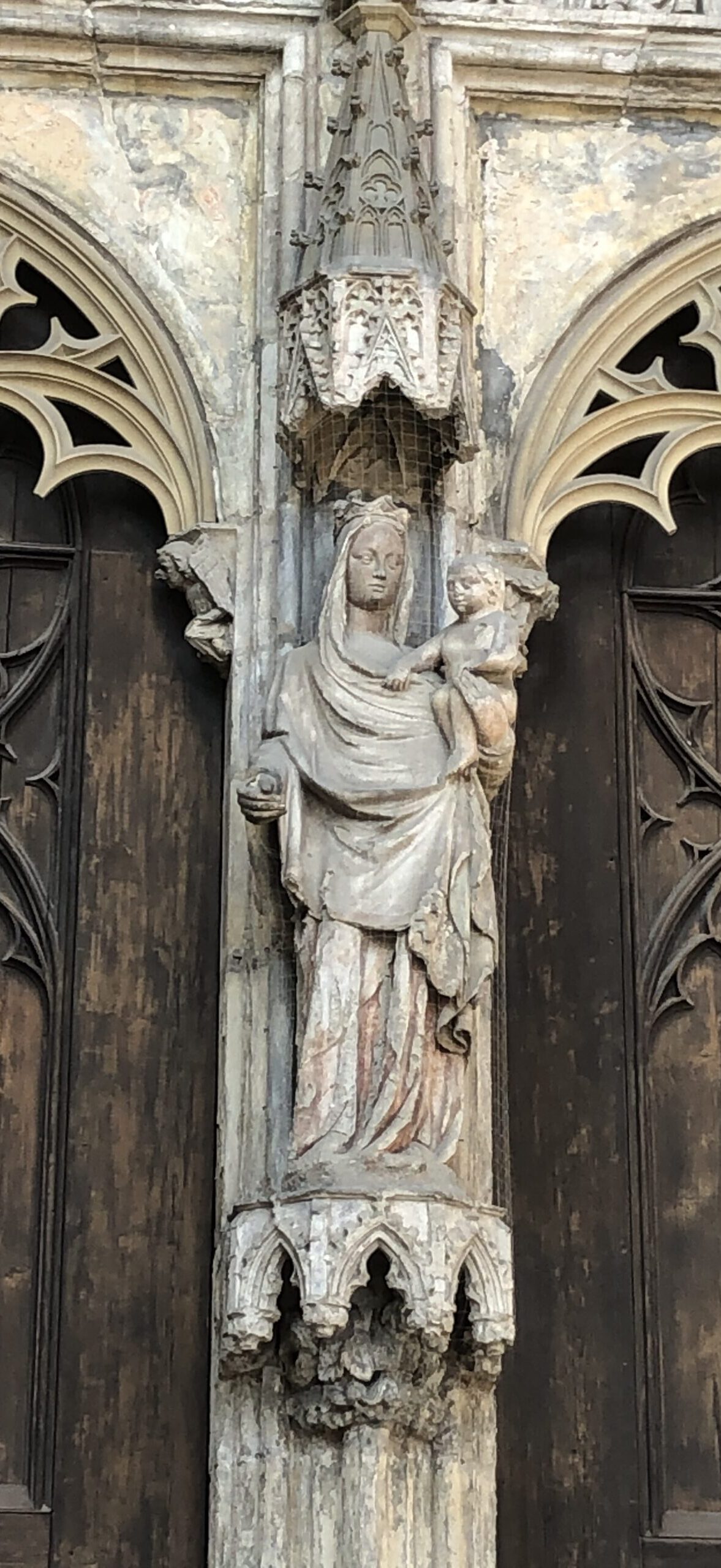
The Cathedral has the oldest stained-glass windows in the world, frescoes, panel paintings, and a crypt.
Late Gothic stained-glass windows (c. 1480) by Peter Hemmel von Andlau (c. 1420-1506) depict scenes from the life of Mary.

Our Lady is frequently depicted in the cathedral. In the north aisle is the impressive Marian chapel (1721), adorned with frescoes and stucco. The frescoes are by the Augsburg painter Johann Georg Bergmüller (1688-1762).
In the cathedral are several panels depicting scenes from the life of Mary (1493-1494). These were made by Jörg Stocker (c. 1461-c. 1527) from Ulm and Hans Holbein the Elder (c. 1460-1524) from Augsburg.
In the Cathedral, Ulrich von Augsburg (890-973), bishop and counsellor to the emperor, is interred.
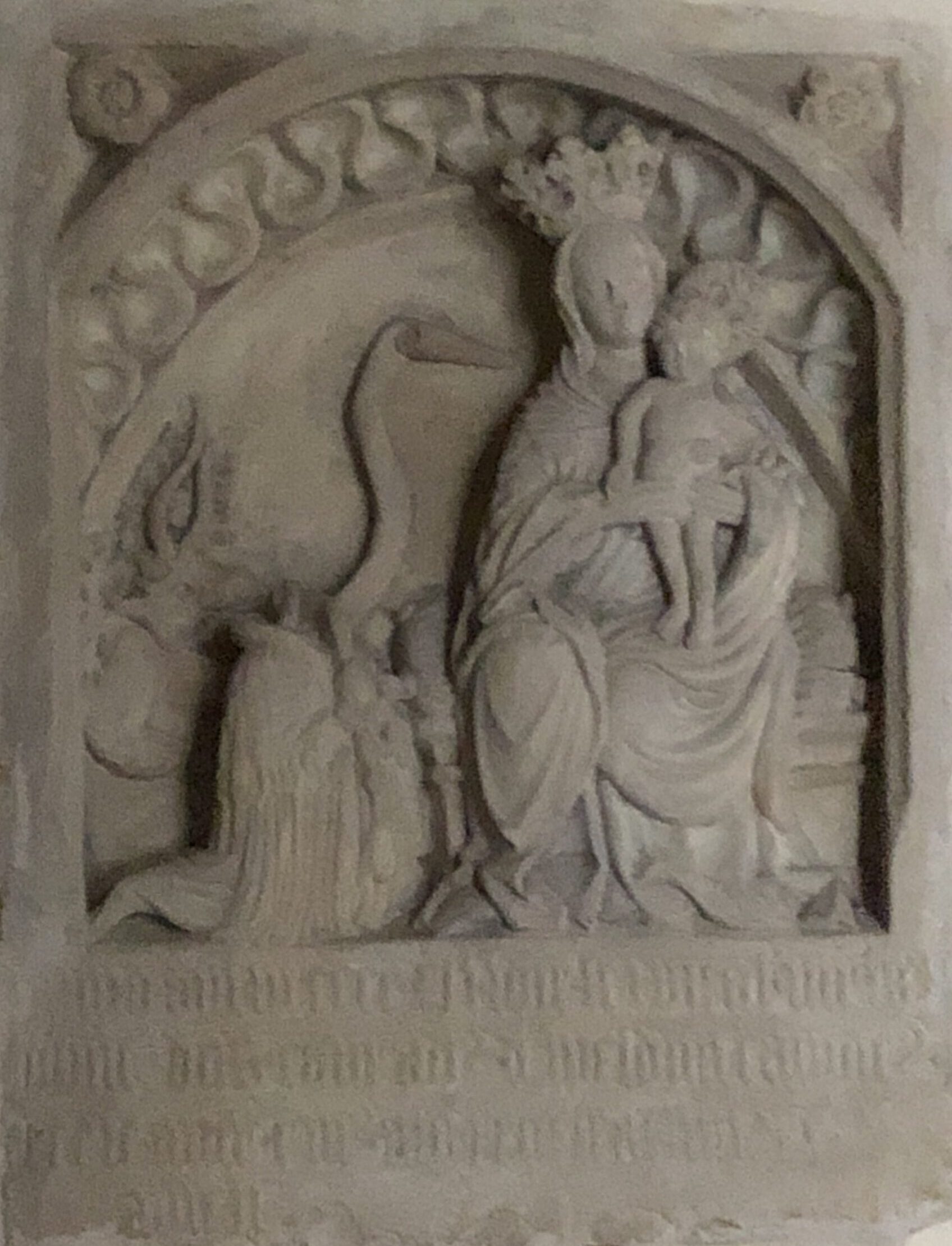
The Wolfgang Chapel displays an altar with images of, among others, Mary, the patron saint of the Diocese of Augsburg, and was created in 1554 by the Augsburg portrait painter Christoph Amberger (c. 1505-1562).
The cloister, which leads to the episcopal museum, contains over 400 gravestones and commemorative plaques.
AUGSBURG – ST. ULRICH AND ST. AFRA BASILICA
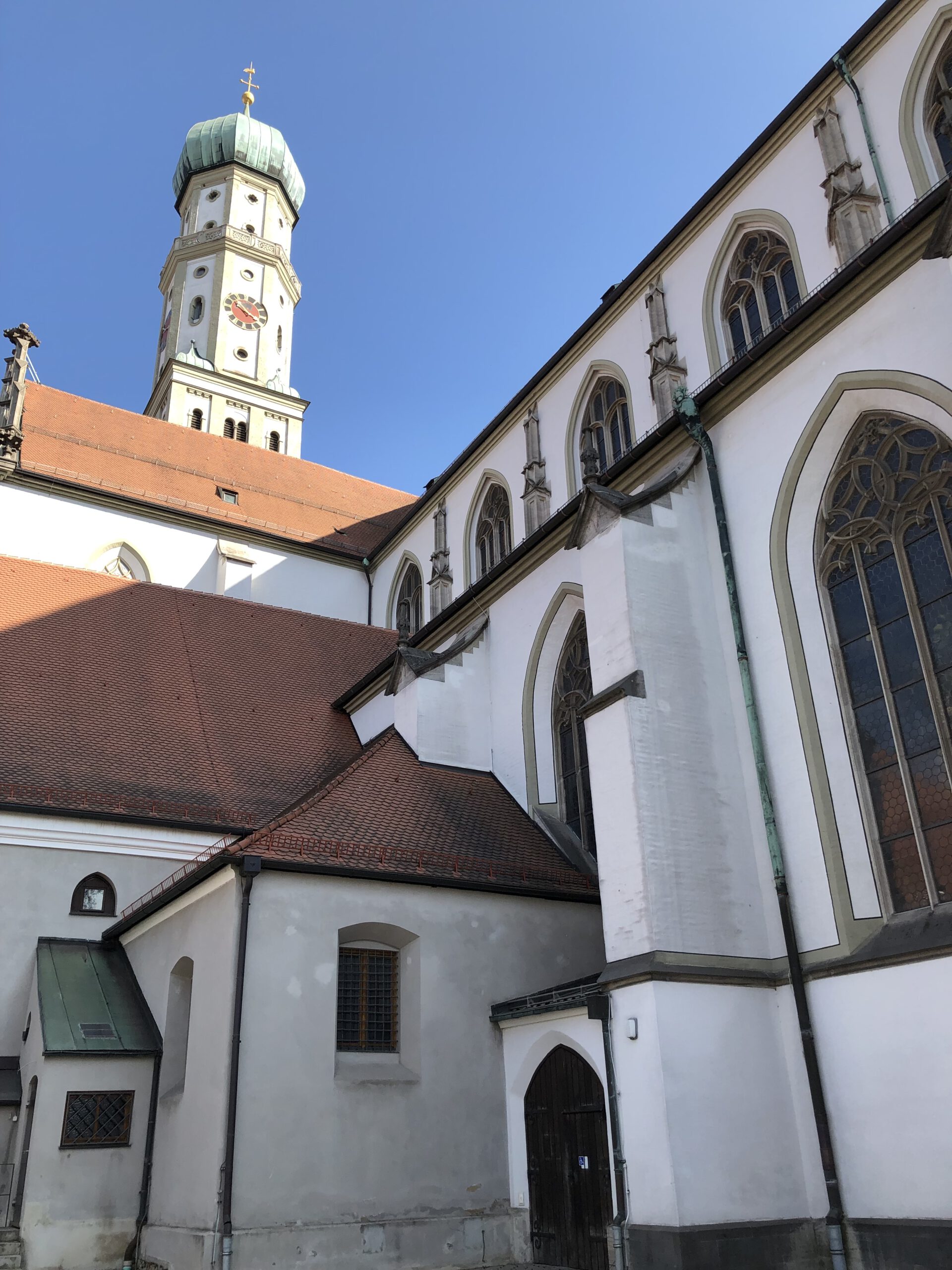
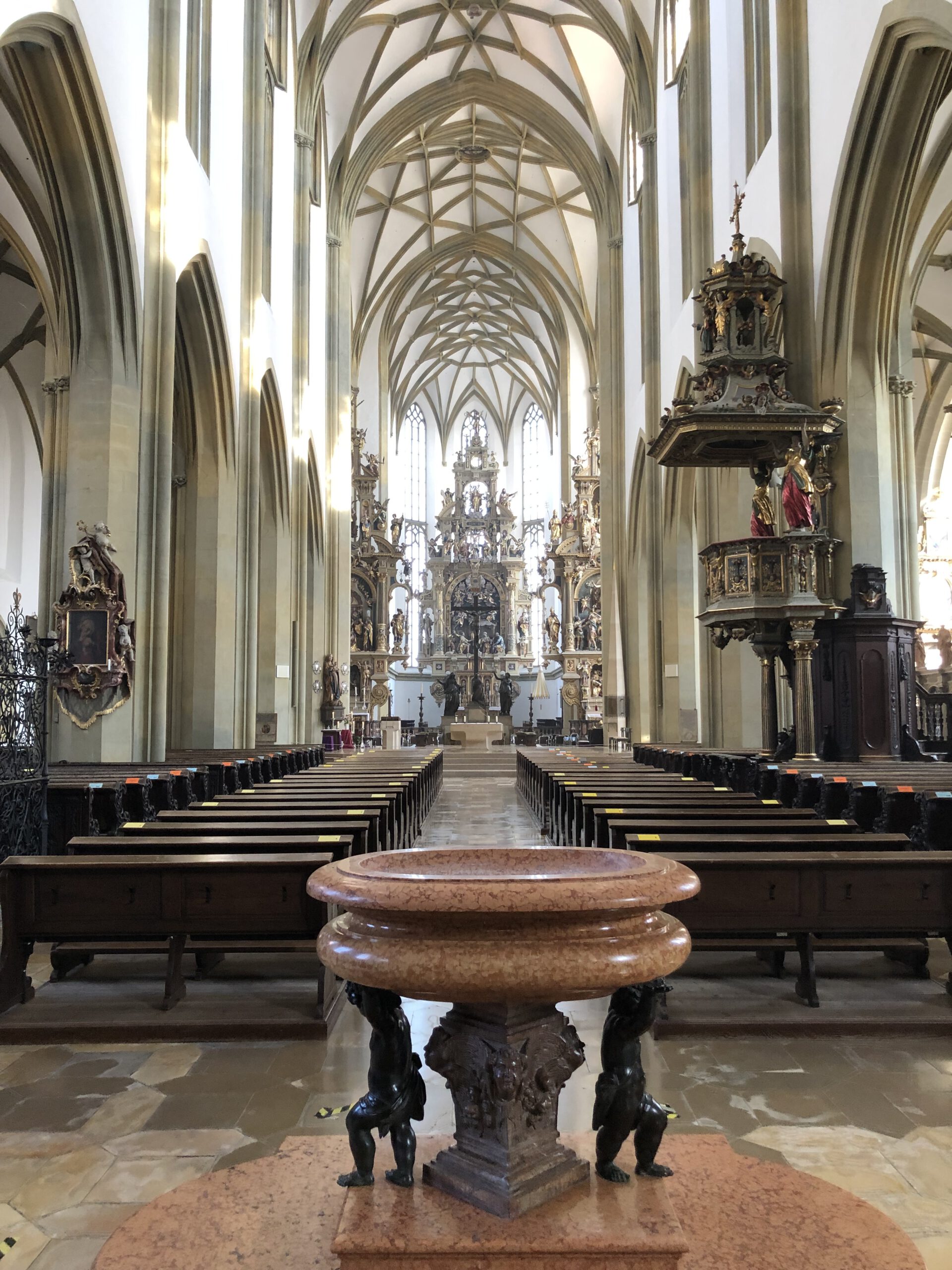
On Ulrichplatz stands the imposing Catholic Basilica, dedicated to St. Ulrich and St. Afra. It is a late Gothic structure with large Baroque altars and chapels. The Protestant Church of St. Ulrich is built against the Basilica.
Construction of the current basilica began in 1467, on the very site where a place of worship had stood previously. The basilica contains the tombs of Saint Ulrich and Saint Afra. In addition, there are numerous images of the Mother of God.
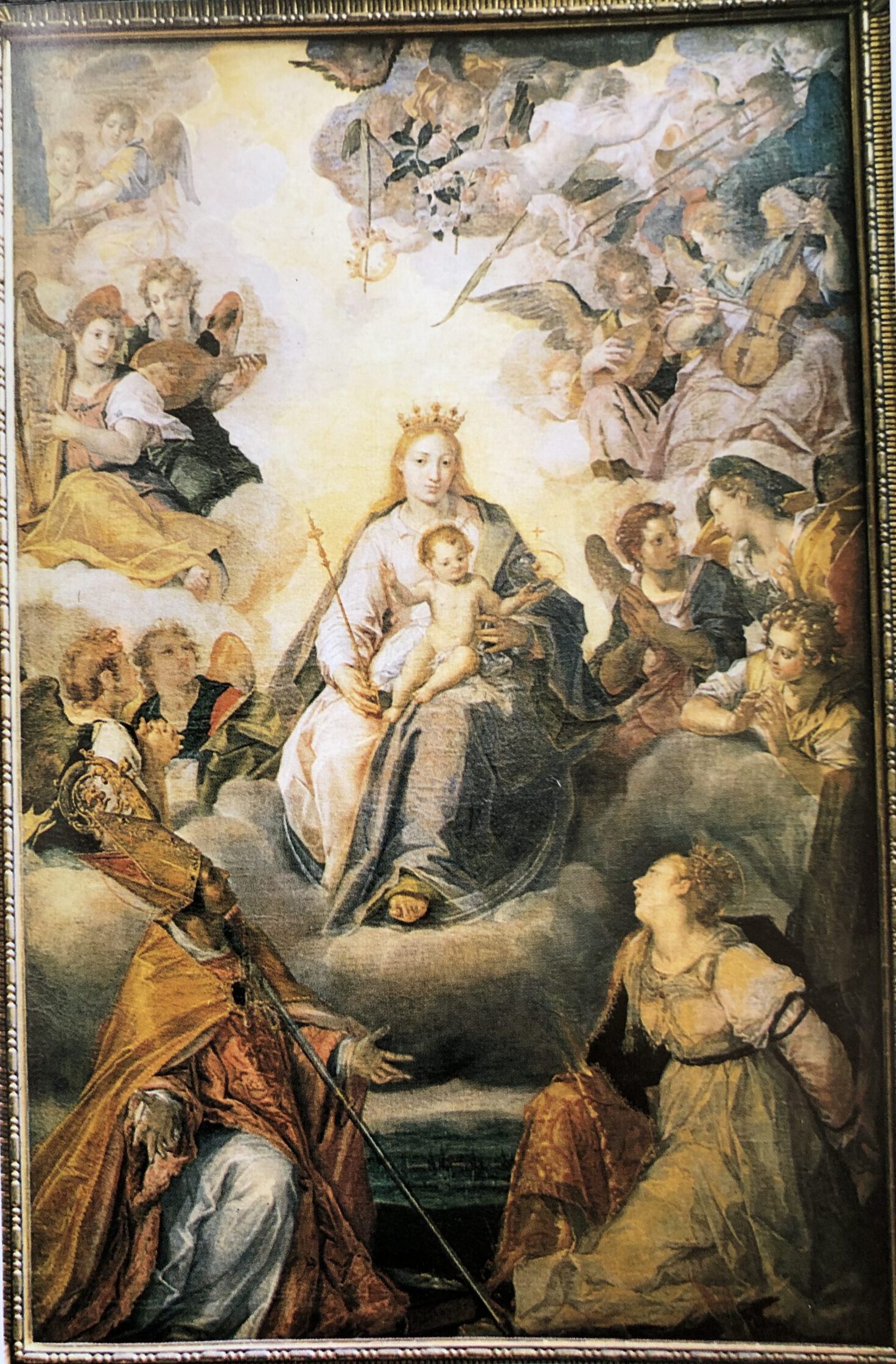
In the St. George's Chapel, the altarpiece is a painting featuring, among others, the crowned Mary, Child, and angels. It was created between 1587 and 1594 by court painters Christoph Schwarz (c.1545-1592) and Peter Candid (c.1548-1628), also known as Peter de Witte. The commission for the artwork was given in 1585 by Octavian Secundus Fugger (1549-1600) of the influential Fugger trading family.
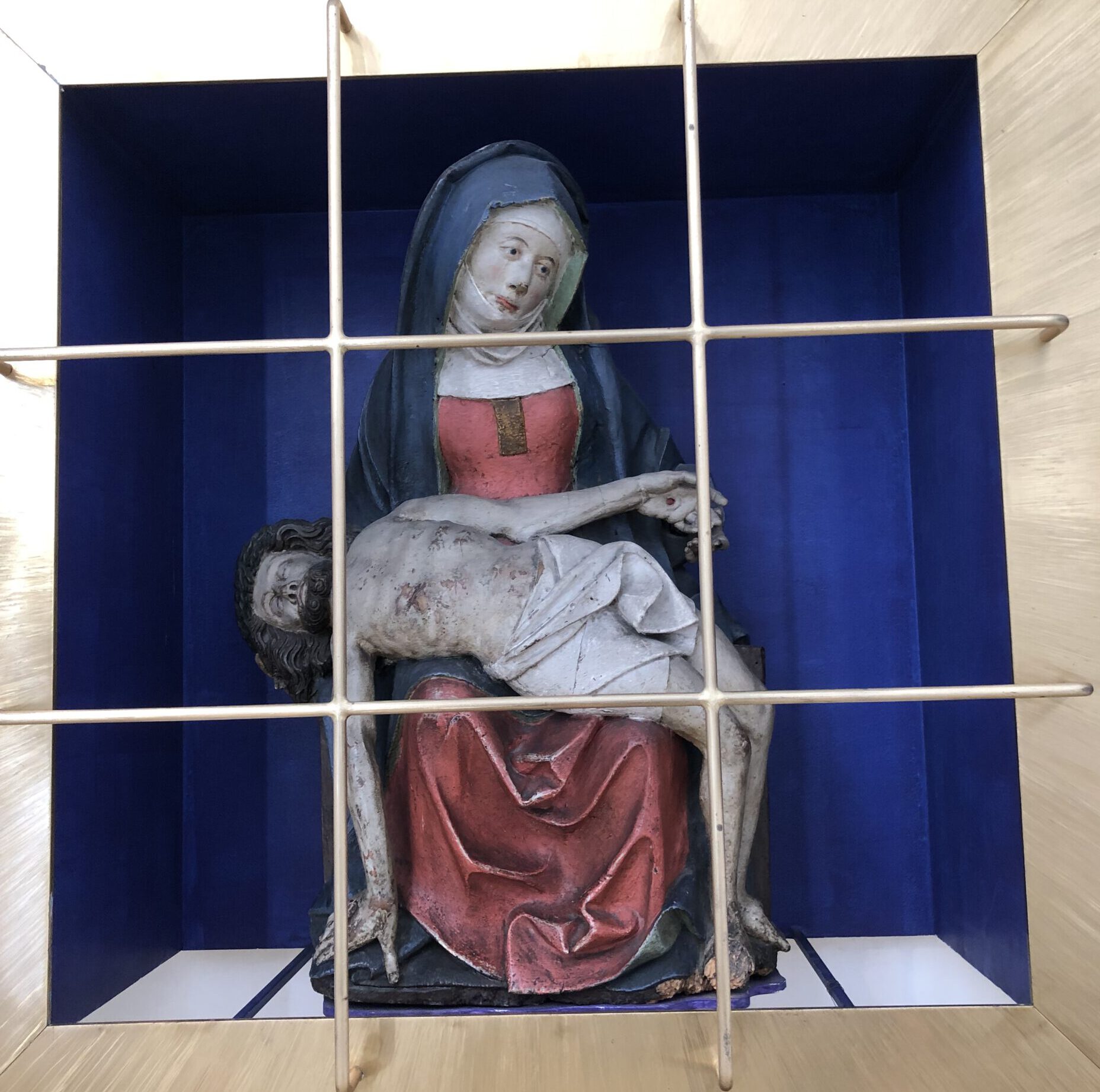
The Pietà Chapel displays a late Gothic statue of a grieving Mary with the body of her Son on her lap. The image has a golden, round frame and was created at the end of the 20th century by sculptor Friedrich Koller (1931).
The high main altar dates from 1604/1606 and depicts the adoration of the newborn Jesus by shepherds. Above this is the coronation of Mary.
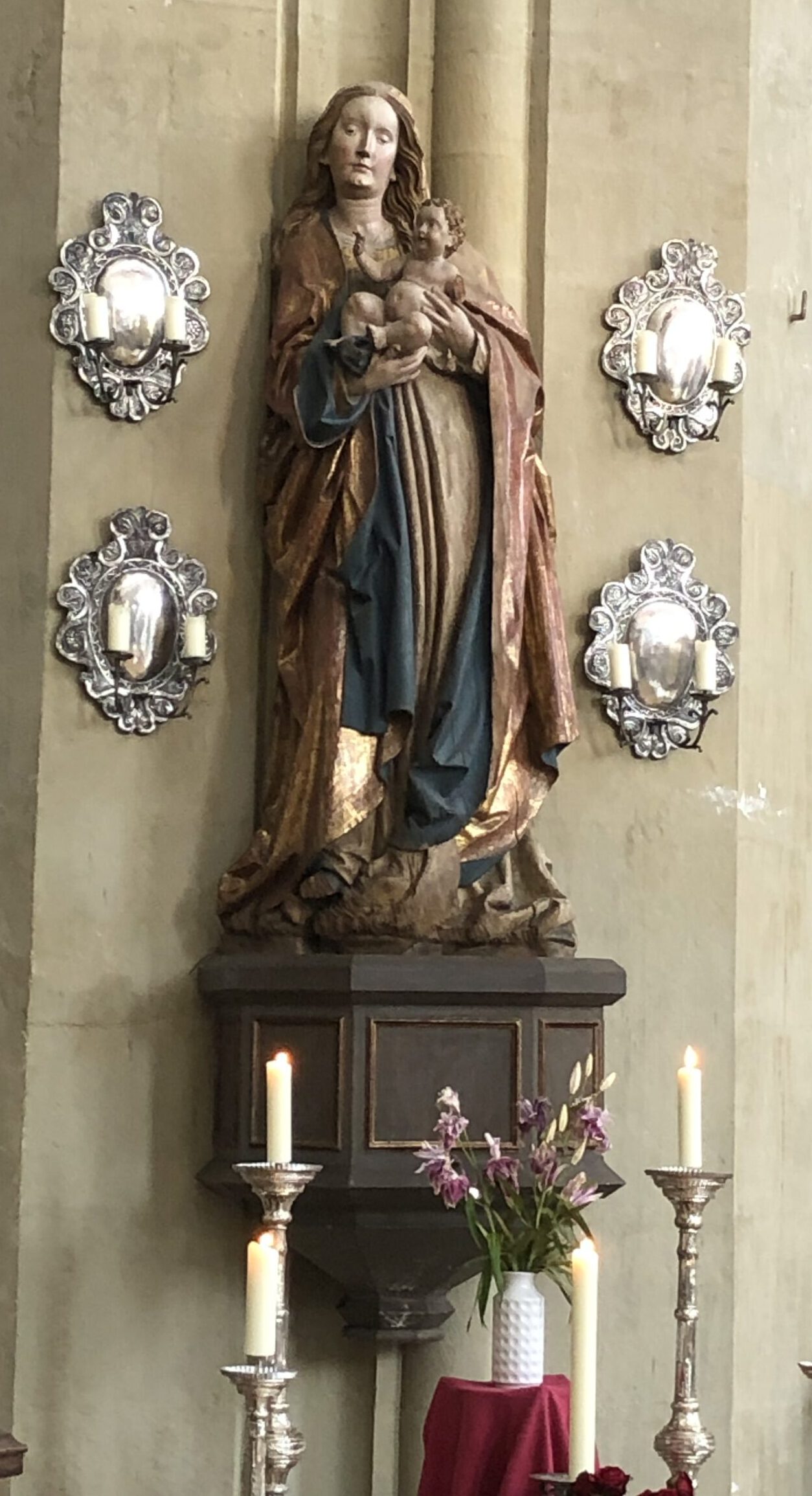
Against a wide pillar stands a more than life-size statue of the Mother of God and Jesus as a naked baby. This is one of the few Gothic statues to have survived the destruction during the Iconoclastic Fury. The statue was made around 1495 by Gregor Erhart (c. 1465-1540).
In the Benedictus Chapel hangs a painting by Peter Candid. It depicts Mary with Child and Saints Benedict and Francis.
In the choir stalls, amongst other things, is the Annunciation to Mary, a work from 1608 by Hans (Johann) Rottenhammer (1564-1625).
The Chapel of Bartholomew displays an altar with a painting of the Coronation of Mary. It was created around 1596 by Hans von Aachen (1552-1615). Also hanging in this chapel is an icon of Mary with Child (1597).
The Maria Hulp statue is placed against a pillar. It is in the Rococo style and was placed in the basilica in 1762.
~~~

 Nederlands
  English (UK)
  Deutsch
  Français