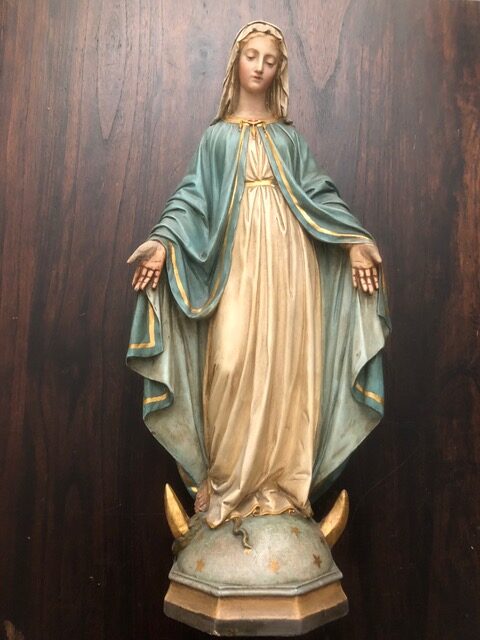
May is the month of Maia. The name “May” is derived from the Greek goddess “Maia”. In Greek mythology, “Maia” is the eldest, most beautiful, and most shy of the Pleiades, the seven nymphs, seven daughters of Atlas and Pleione. The original meaning of “Maia” is mother. Later, “Maia” acquired the meaning of “midwife”.
The Greek mother goddess “Maia” was worshipped by the Romans to make nature bloom again. The Romans named the spring month “Maius”. On the first day of May, they celebrated the festival of the goddess Bona Dea (Good Goddess), who was later identified with the Greek goddess Maia. At the beginning of May, the Romans celebrated the multi-day blossom festival called Floralia.
In Latin, “Maius” is related to both “Maior,” meaning greater, and “Maiestas,” meaning dignity, splendour, and sublimity.
In the Middle Ages, the custom of dedicating the month of May to Mary originated in Italy. The Archbishop of Milan, Carolus Borromeus (1538-1584), organised prayer meetings for Mary in the Milanese Cathedral during the month of May throughout his tenure from 1560-1584. Many faithful came to pray there because the plague severely threatened their health. After Milan, other places followed suit, praying extensively to Mary during the month of May.
The month of May being dedicated to Mary also occurs in music and poetry. In 1691, “Mirantischen Mayen-Pfeiff” by Laurentius von Schnüffis (1633-1702), born Johann Martin von Schnüffis, was published. He was first a singer, actor, and in 1665 became a Capuchin friar and preacher of the late Baroque period, composer, and lyric poet. In his “Mirantischen Mayen-Pfeiff,” the image of spring is attributed to Mary, and She is celebrated as a symbol of spring full of grace after a winter of corruption. In this, Mary is sung of as the Heavenly Queen.
Giuseppe Maria Saporiti (1691-1767), Archbishop of Genoa, Italy (1746-1767), made a recommendation in 1747 for the faithful to pay attention to Mary in their homes during the month of May. In 1784, the entire month of May saw public devotion to Mary in the church of the Camillians (caregivers of the sick) in Ferrara, Italy. A further development occurred in the Italian capital, Rome, where in 1813, around 20 churches held celebrations for Mary in May. The May observance of devotion to Our Lady spread from Italy to Switzerland, France, Belgium, Germany, Austria, and the Netherlands, among other countries. This European expansion of the May devotion to Mary was, to a significant extent, due to the French Jesuit Pierre Doré (1733-1816), who had experienced the Italian May devotion to Mary.
In the Catholic Church, May is celebrated as the Month of Mary. Celebrating the Month of Mary can be seen as a powerful means of achieving peace and justice. Pope Paul VI, who was Pope from 1963 to 1978 and was born in 1897 as Giovanni Battista Enrico Antonio Maria Montini, expressed this in an encyclical. This papal document is called “Mense Maio” (Latin for “The Month of May”) and dates from 29 April 1975. The subtitle of this encyclical is “concerning the prayer for peace during the month of May”. This papal letter calls for prayer to Mary to encourage prayer for peace during May.
Another tradition in May is the planting of a maypole in many places. This also refers to spring and blossoming in peace with a good feeling.
Many parishes give extra attention to devotion to Mary during the month of May. This involves praying the rosary, placing extra flowers at statues of Mary, lighting more candles at images of Mary, holding processions in honour of Mary and going on pilgrimage to Marian shrines.

 Nederlands
  English (UK)
  Deutsch
  Français