History
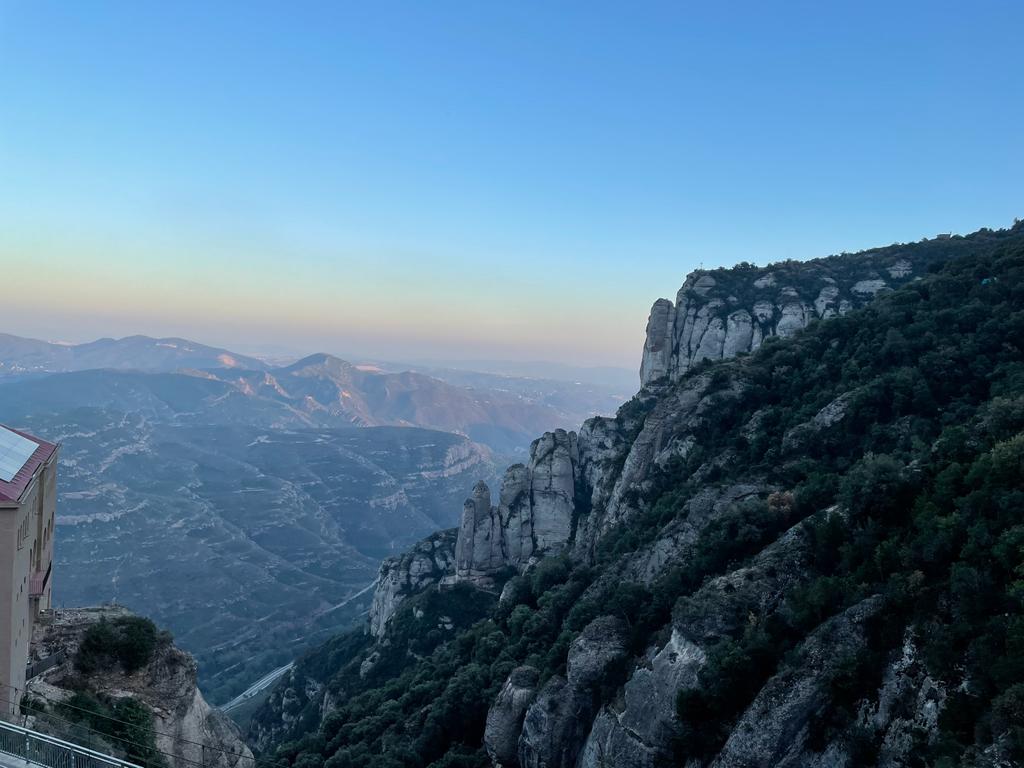
The name Montserrat means “sawed mountain” and this wonderfully beautiful natural phenomenon can be viewed from Montserrat and the surrounding region. The mountain massif was formed many millions of years ago and covers an area of 10 km in length and 5 km in width. The highest point of the mountain range is the summit of Sant Jeroni at 1236 metres. Since 1987, this area has been a protected natural park.
The first signs of a hermit's existence date back to the 7th century. The first mention of Montserrat is from the year 888, when Guifré el Pilós, also known as Wilfred the Hairy (c.840-897) Count of Barcelona (878-897), described lands belonging to the monastery of Ripoll, including the church of Montserrat on a mountain.
The earliest information of pilgrims present dates back to the year 942. Abbot Cesari, founder of the Monastery of Saint Cecilia of Montserrat, was already active there. Oliba of Cerdanya (971–1046), abbot of Ripoll (1008–1046) and bishop of Vic (1018–1046), sent monks to Montserrat in 1025 and came into conflict with supporters of Abbot Cesari. Their dispute concerned ownership of Montserrat mountain.
The statue of Our Lady is characterised by its Romanesque style, and is painted and gilded. It dates from the end of the 12th century. In local parlance, the image is known as “La Moreneta” (“the Brunette”). The monastery flourished in the 13th century. In 1409, the veneration of the Black Madonna became the centre of religion in Catalonia.
In 1811, soldiers of Napoleon set fire to the monastery and plundered the building. A year later, explosives were used to destroy the monastery. This happened during the bloody Peninsular War (1808-1814) between the Spanish, Portuguese and British on one side, and French troops led by Napoleon Bonaparte (1769-1821) on the other. The revered statue of Mary was damaged and restored.
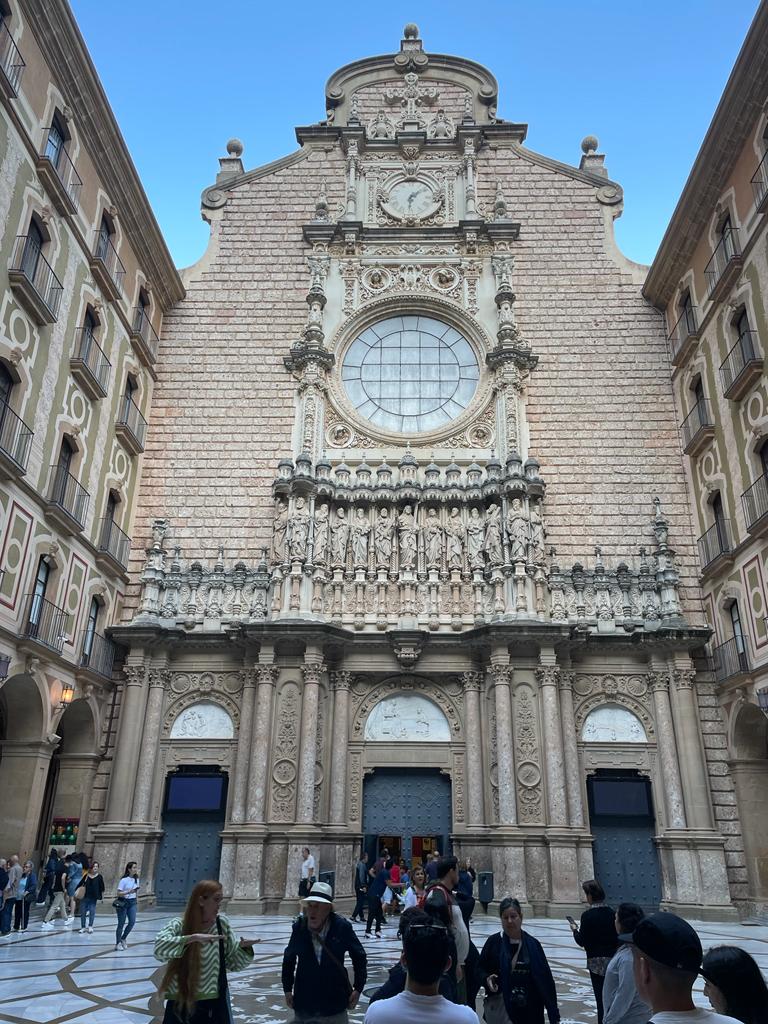
The basilica's portal dates from the end of the 12th century. Major work on the current basilica began in 1560 and concluded with the church's consecration in 1592. The building is over 68 metres long, 21 metres wide and 33 metres high. Chapels have been arranged along both sides of the interior, including those of the Holy Family and the Immaculate Conception. The current facade of the basilica was consecrated in 1901. The architect is Francisco de Paula del Villar y Carmona (1860-1926), who continued the work on the basilica from his father.
In 1881, the church obtained the honorary title of basilica. This was approved by Leo XII, Pope from 1878 to 1903 (Vincenzo Gioacchino Raffaele Luigi Pecci, 1810-1903).
During the Spanish Civil War (1936-1939), more than 20 monks are murdered in Montserrat.
On 27 April 1947, the enthronement of Our Lady of Montserrat (Catalan: la Mare de Déu de Montserrat) on a silver throne, paid for by sympathisers.
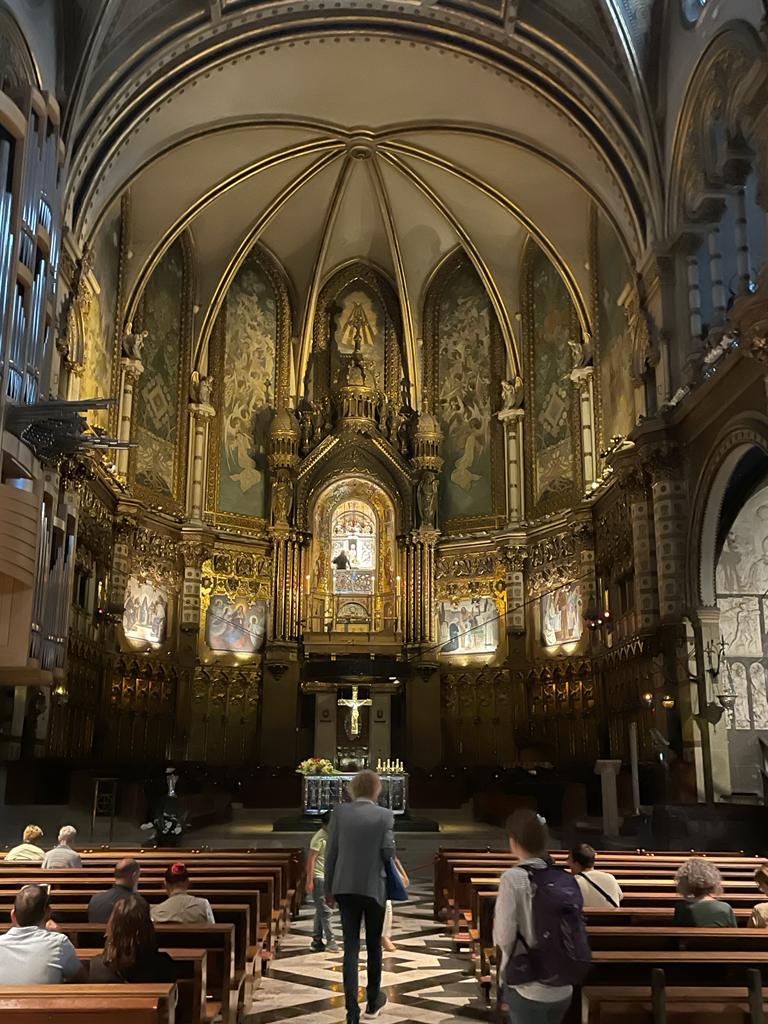
In 1952, the interior of the basilica was renovated.
On 7 November 1982, John Paul II (Karol Józef Wojtyla, 1920-2005), Pope from 1978 to 2005, paid a pilgrimage visit to Montserrat.
In the period 1991 – 1996, the basilica was restored on the outside and inside.
In 2025 Montserrat will celebrate its 1000th anniversary.
Pilgrimage site
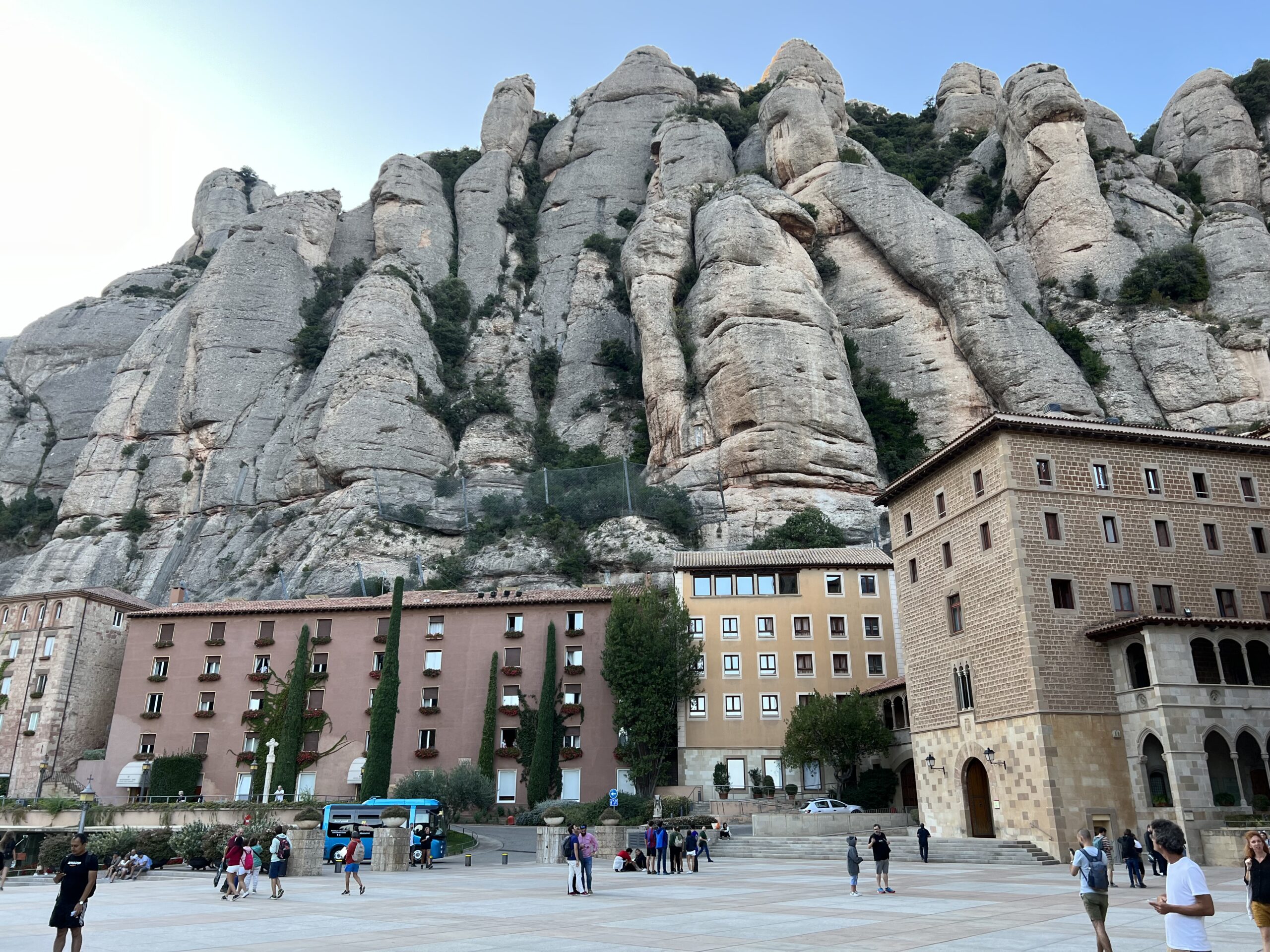
Montserrat belongs to the municipality of Monistrol de Montsenet. The monastery of Montserrat (Catalan: Monastir de Montserrat) has existed for centuries and is located 720 m above sea level.
The pilgrimage site can also be reached by rail, this is the “cremallera de Montserrat”; it is a rack railway. By using this, the sometimes lengthy search for a (paid) parking space can be avoided. A cable car also takes visitors to the high-lying pilgrimage site. On busy days, one can expect to wait for hours by car before a paid parking space becomes available.
Montserrat offers not only a basilica, but also, among other things, chapels, a Holy Grotto, a monastery, a viacrucis, a library, a museum, restaurants and hotels.
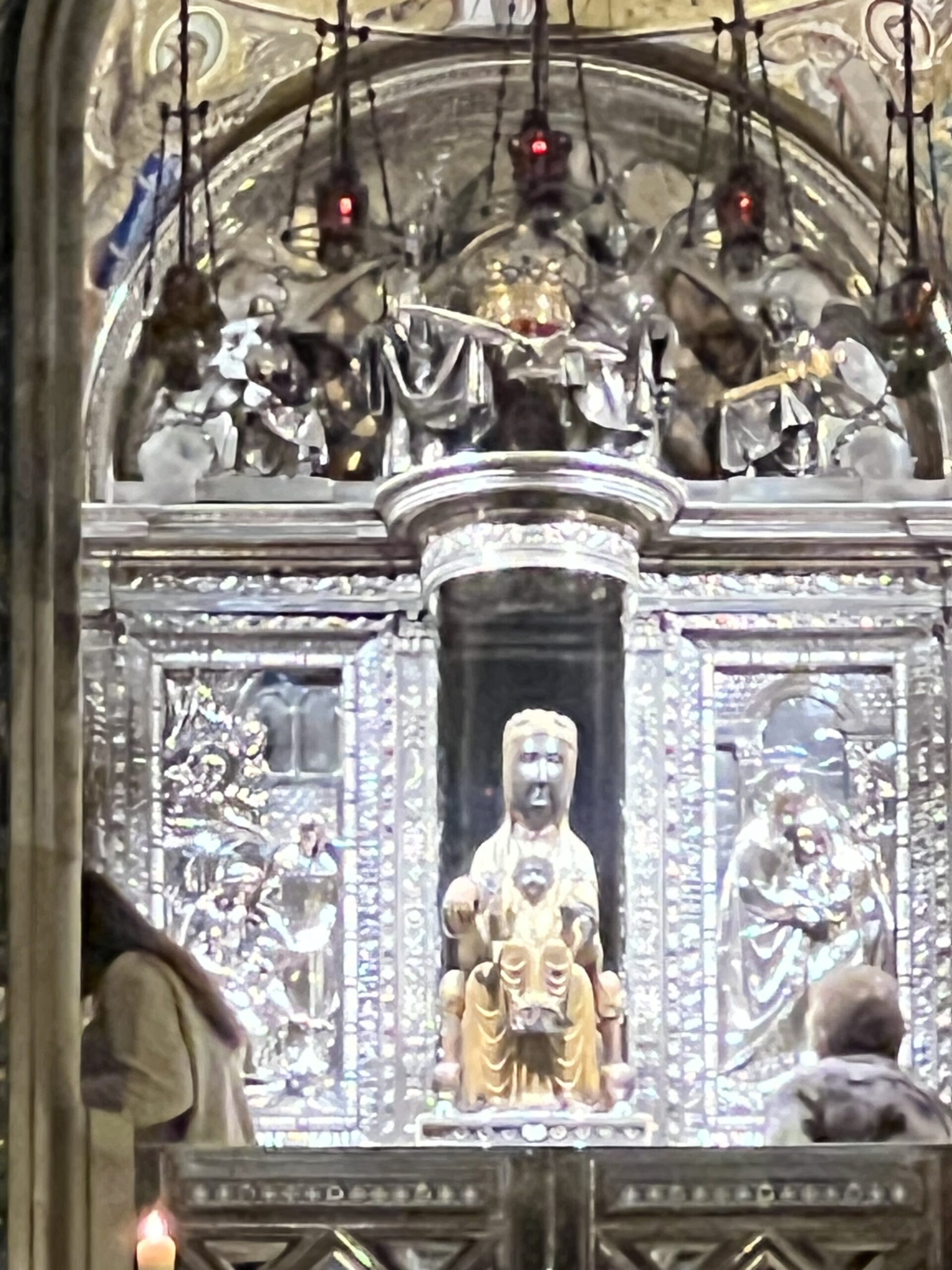
In the basilica, the Black Madonna can be visited and many pilgrims pray at the effigy. Mary is depicted seated with the child Jesus on her lap. It is a throned, seated Madonna. Mother and Child look magnificent. The colour of the face and hands is black, which is due to centuries of oxidation of the white lead paint and the smoke from the large number of candles and oil lamps. In her right hand, Mary holds a globe, and with her left hand, she protects her Child. The child Jesus blesses with his right hand, and in his left hand, he holds a pineapple. The necks of Mother and Child are adorned with a brooch. Mary is wearing shoes, and the Child is barefoot. Jesus wears a long robe.
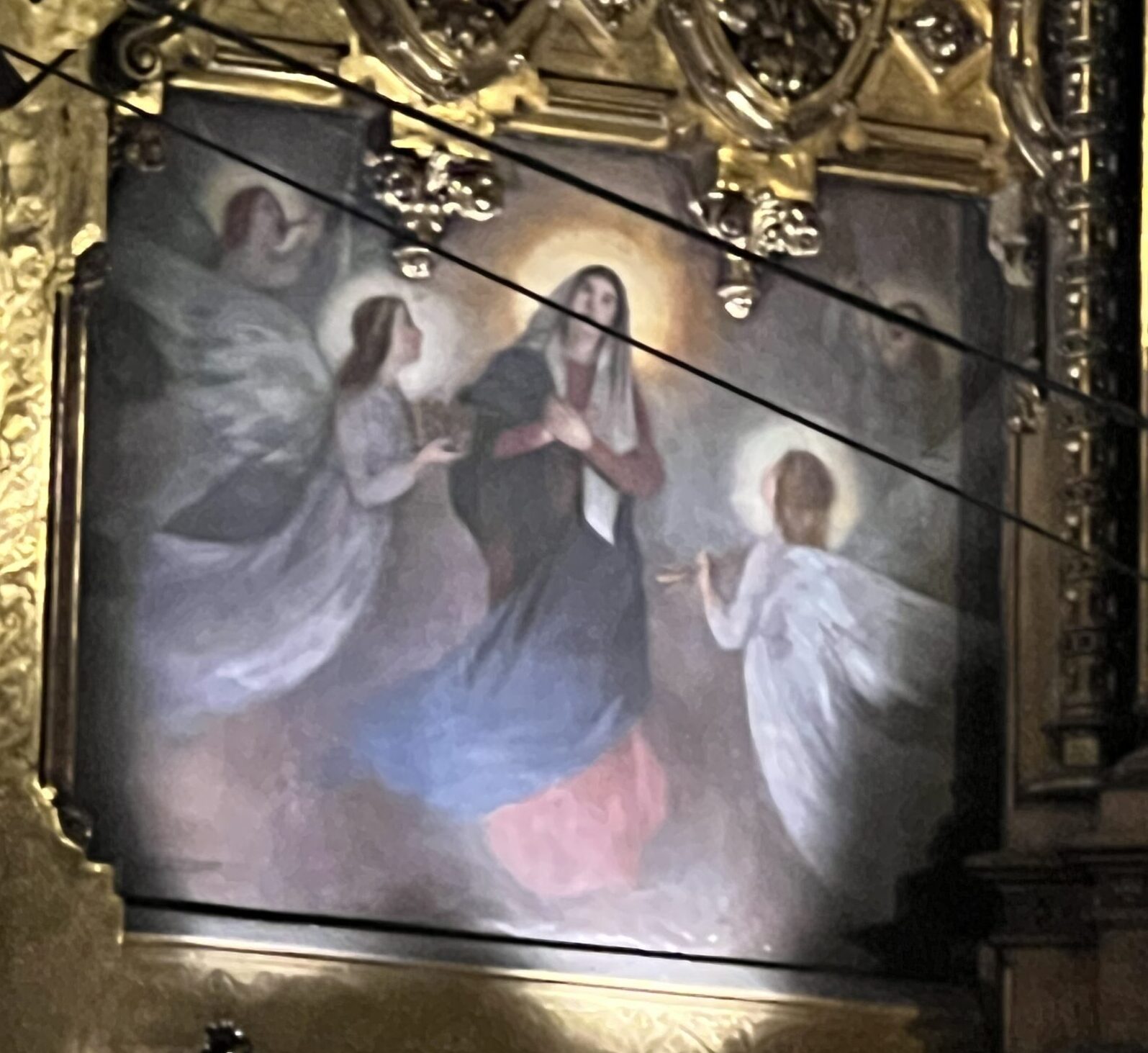
High above the presbytery, a striking stained-glass rose window is visible, depicting the Coronation of the Virgin by the Holy Trinity. The actual crown is housed in the Museum of Montserrat. The presbytery also features paintings, including beautiful works by Joan Llimona i Bruguera (1860-1926), namely the Birth of the Virgin and the Presentation of the Virgin, and the impressive work The Assumption of the Virgin by Lluis Graner i Arrufí (1863-1929).
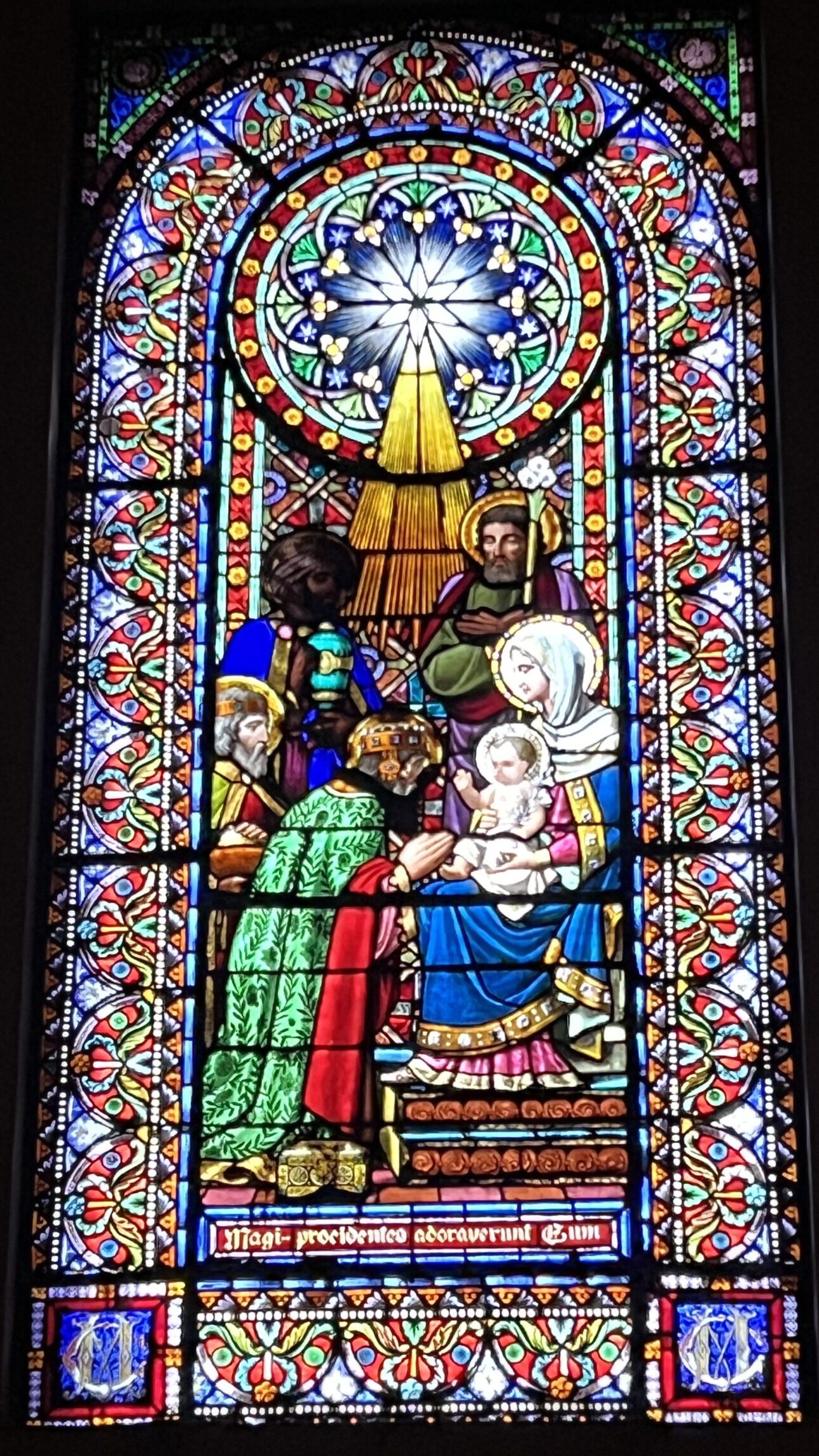
The basilica features many stained-glass windows depicting the Virgin Mary.
The basilica and museum are open daily.
Visitors should be aware that there is little to do in the pilgrimage site in the evenings.
ACCESSIBILITY
Montserrat lies to the northwest of Barcelona.
The address of the Montserrat monastery is 08199, Montserrat.
You can find current information on www.abadiamontserrat.cat.
Experience
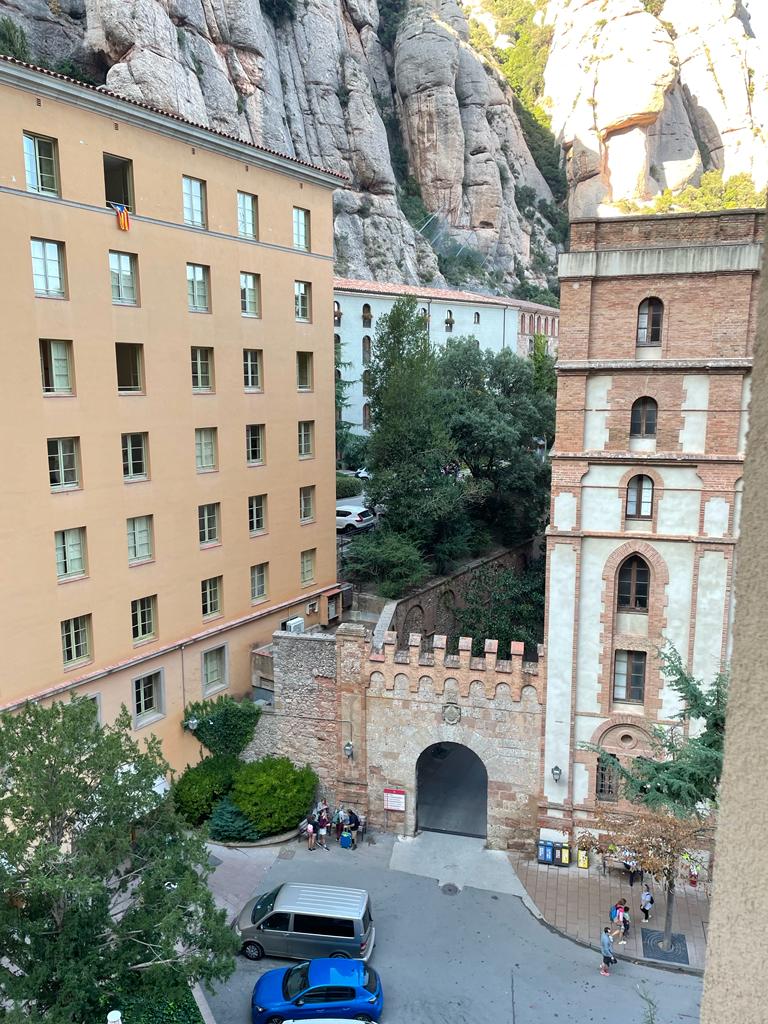
The pilgrimage site of Montserrat is a familiar place to me, as I have been there several times. I prefer to stay in a room at the pilgrimage site.
After visiting Montserrat several times, I am increasingly convinced that for me, the most relevant part of the pilgrimage site is the Holy Grotto (Santa Cova).
To visit the Holy Grotto, I take the mountain train which starts at an altitude of 705 metres. A strong cable keeps it at the correct speed. In 5 minutes, this remarkable mode of transport has brought pilgrims to a station situated more than 100 metres lower down. It is then time to disembark and follow the Rosary Way. The route has 15 stations for brief pauses. This path follows a sloping track of around 600 metres over large, flat stones that have surely felt many thousands of feet.
When I arrive at the Holy Grotto, I see dozens of candles burning, making the temperature in the space tropical. The ancient Grotto with the statue of Our Lady immediately captures the visitor's attention. Mary stands here, having appeared in this very spot in the year 880. The legend further tells that as darkness fell, shepherds suddenly saw a bright light and heard heavenly singing. These signs point to a place on Mount Montserrat. They tell their experience to a priest, who then informs the bishop of the vision. The high-ranking clergyman and many villagers go to the place of the apparition. The beam of light came from a cave, beneath a rock, where the figure of Mary appeared and a statue stood. Based on this event, the statue of Mary is taken to the city of Manresa. Then a new miracle occurs… Upon reaching a plateau, well-protected from the wind, the statue can no longer be moved. Mary’s immobility is a sign to everyone that She wishes to be venerated here. This becomes the Sanctuary of Montserrat.
The Holy Grotto is for me not only a testament to history, but also to deep devotion. This Grotto is the most significant place of the pilgrimage site.
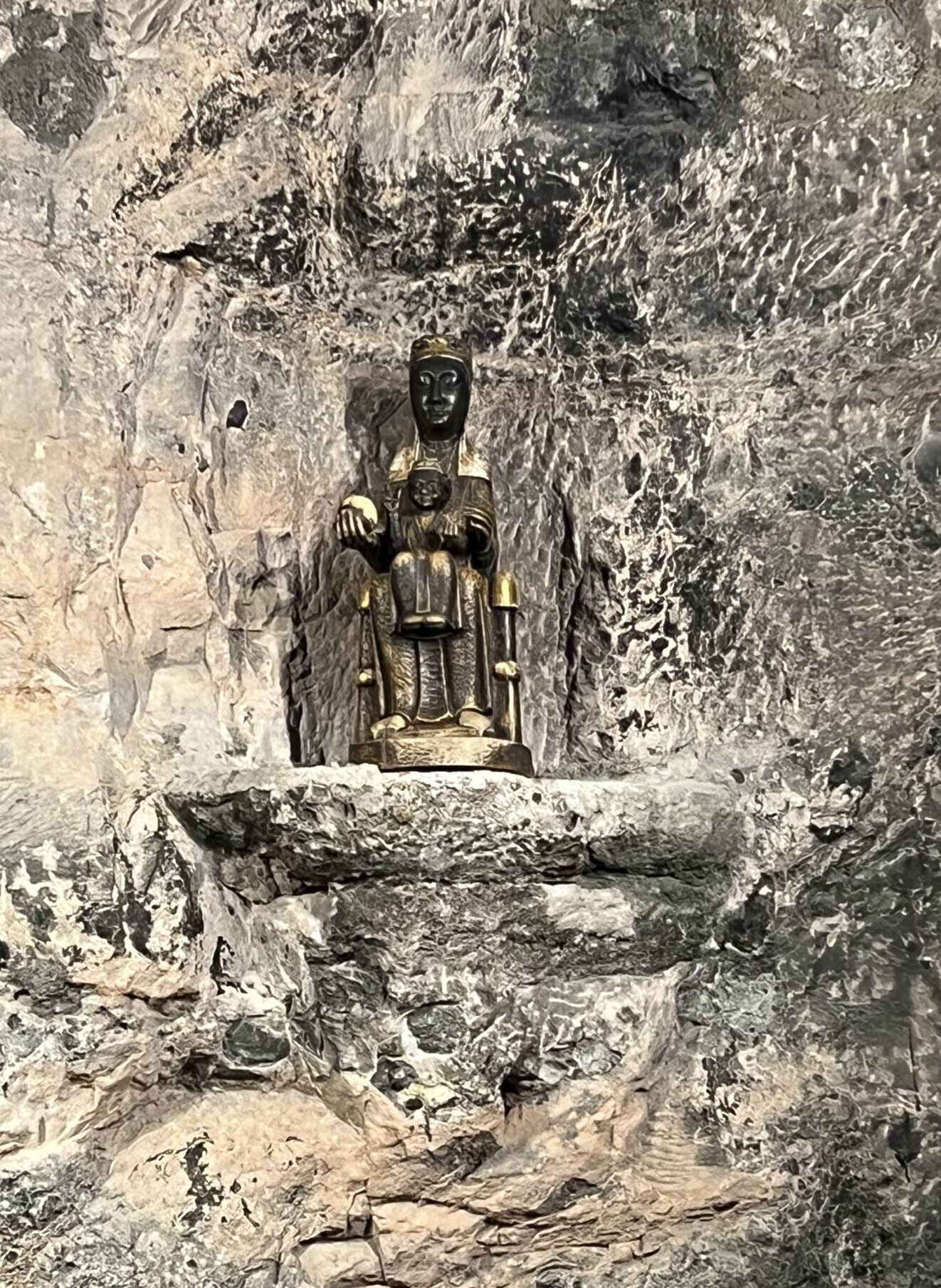
After the Holy Grotto, one proceeds to the basilica. The dark statue of Mary stands high above the choir.
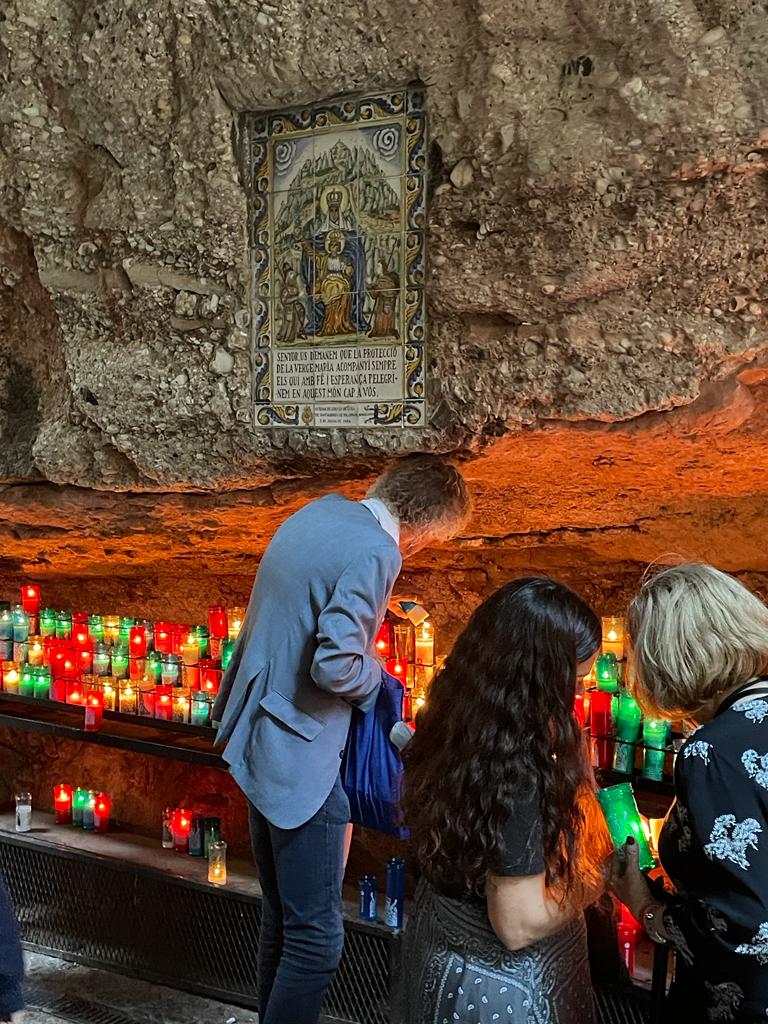
The corridor with the burning candles is long, approximately 50 metres. There are certainly more than a thousand candles lit here, which creates a very colourful sight. Lighting a candle here increases devotion to Mary.
In the basilica, I find a prayer card and the text reads in Dutch:
“Prayer
God, who gives all good things,
this chosen mountain glorifies
through the special veneration of the Mother
of your own Son, who is Christ,
bestow on us from Christ, via
the ever spotless
Virgin Mother Mary the mighty help.
Amen.”
In recent years, I've seen things change here in Montserrat. It's still a popular destination, the image of Mary is still held in very high regard in the basilica and many candles are lit here. That presents a familiar sight. However, there's now a charge to visit certain areas, and the prices, as I've heard from others too, are certainly not to be considered low. The basilica is free to enter after 6:00 PM, as a rosary prayer begins then. In the evenings, there's not much to do; the basilica and the Grotto are closed, as are the restaurants. The many hotel guests have nowhere to go, and this stands in stark contrast to life in Spain, where evening life only begins after 8:00 PM.
Environment
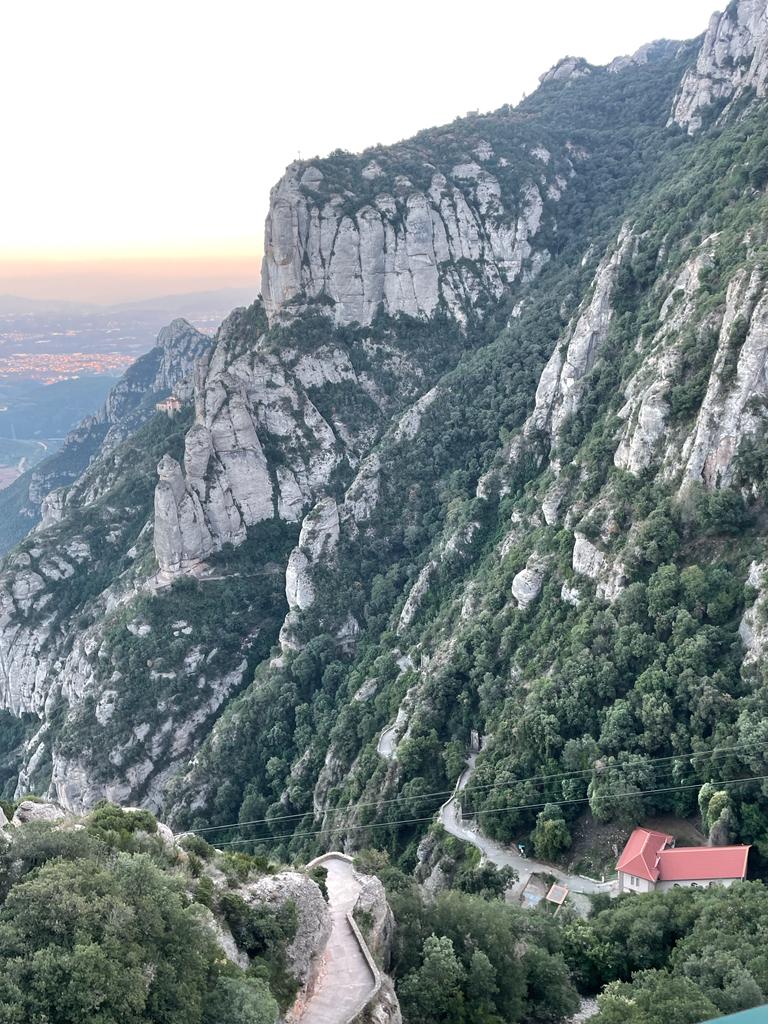
Around Montserrat, there are many walks and cycle rides to be made to witness the flora and fauna, and there are also places to visit in the vicinity.
The world city of Barcelona is only 50 km from Montserrat, and it's about a 60 km drive to visit the historic centre of Vic.
The pilgrimage site of Nuria is located about 115 km further north.
~~~

 Nederlands
  English (UK)
  Deutsch
  Français