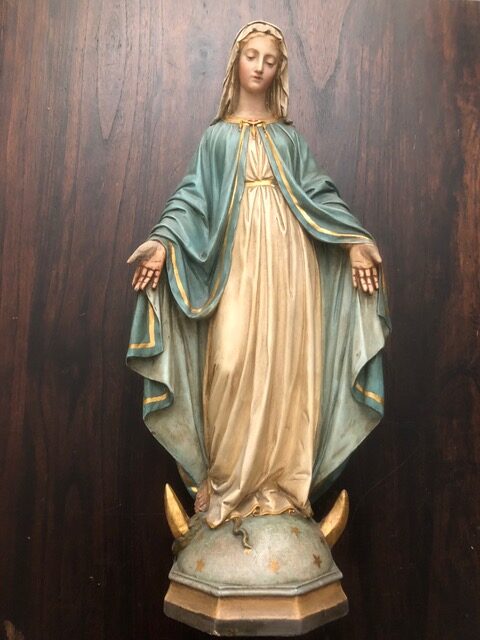
The Servants of Mary belong to the organisation with the Latin name “Ordo Servorum Mariae, OSM” (“Order of the Servants of Mary”), a Catholic mendicant order. This order is also called “Servi Beatissimae Mariae Virginis, SBMV” (“Servants of the Blessed Virgin Mary”).
On 15 August 1233, the order was founded in the Italian city of Florence. The founders are seven young noblemen who had received a vision of Our Lady.
The order is a Pontifical Theological Academy, where Mariology is studied. Their aim is not only theological study but also the formation of spirituality and believers. The organisation is affiliated with the Roman Curia and therefore has ecclesiastical approval; papal approbation. In 1249 and 1252, Innocent IV, Pope during the period 1243-1254, born Sinibaldo dei Fieschi (c. 1195-1254), officially gave his approval to the Order of the Servants.
The members of the order follow the “Rule of Saint Augustine”, which was drawn up by Augustine of Hippo/Aurelius Augustinus Hipponensis (354-430). This rule states: “Live together in harmony, united in mind and heart, on the way to God. For isn't that precisely why you have come to live together?”
The order was founded by 7 people of good standing. They are the holy founders of the Servites. These 7 noble Florentines receive an apparition of Mary. The Virgin Mary asks them to leave the world they live in. The young men obey this request and, after founding the order, go on to spread devotion to Mary.
The feast day of the 7 founders of the order is 17 February. This is the death anniversary of the longest-living of the founders, Alessio de Falconieri (1200-1310), who thus reached the age of 110. The other members are:
Giovanni di Bunagiunta (also called Bonajuncta), d. 1257
Buonfiglio dei Monaldi (also called “Bonfilius“), +1262
-Bartolomeo degli Amidei (also known as Amadeus, Amideus), d.1265
-Benedetto dell’ Antéla (also known as Manettus), +1268
-Ricoverino dei Lippi – Uggocioni (also called Hugo), +1282
-Gherardino of Sostegno, died 1282.
The 7 founders, with their order, give a clear response to the growing materialistic mindset and the sharp decline of religious meaning in worldly Florence. The wealthy, noble initiators give away their possessions and give up their affluent lifestyle. They withdraw to a residential house. A little later, they go to live as hermits on Monte Senario in Vaglia, near Florence. There they begin to serve Mary.
~~~

 Nederlands
  English (UK)
  Deutsch
  Français