History
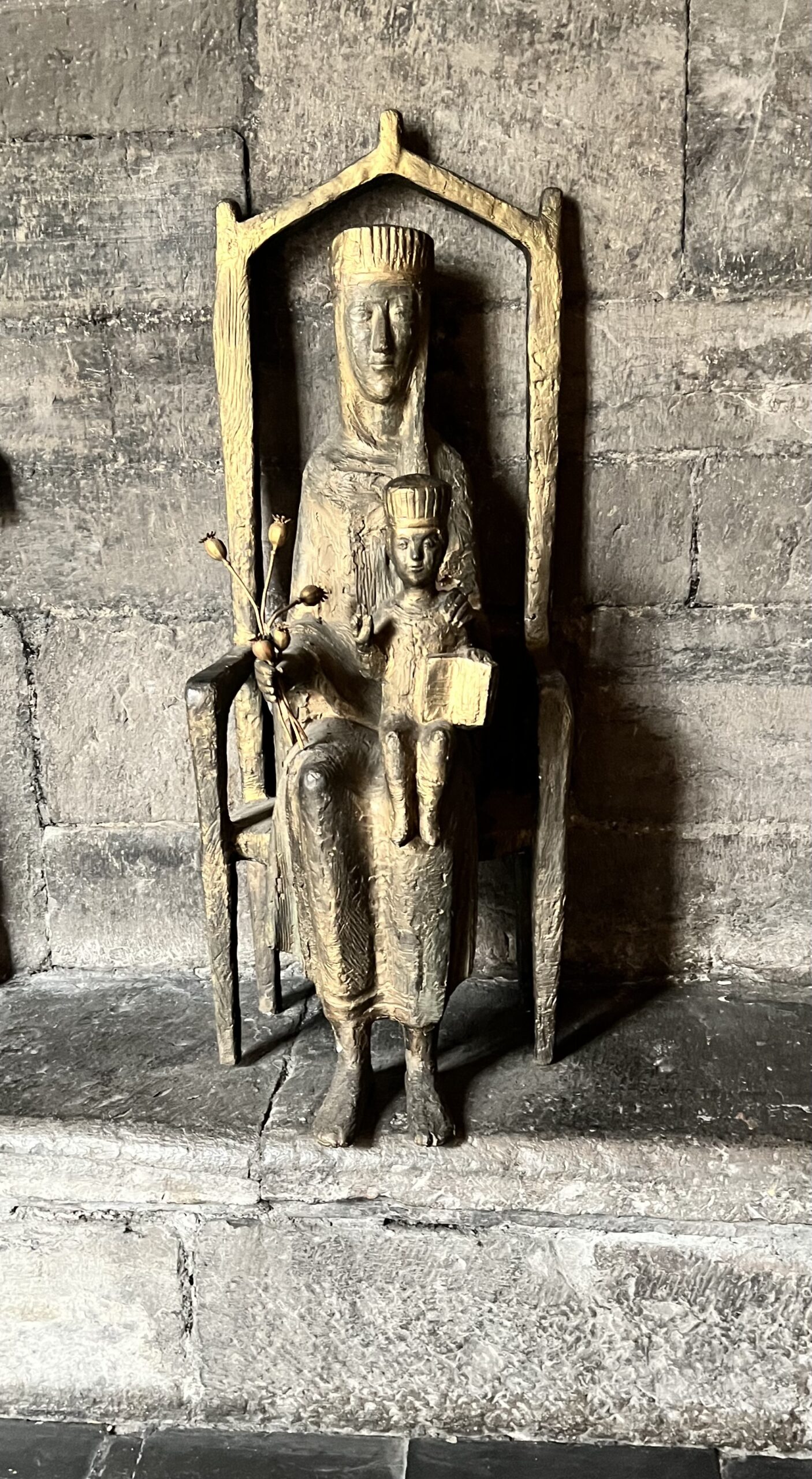
The popular devotion to Mary in Maastricht is centuries old. This veneration predates the arrival of the current statue, the Star of the Sea, in Maastricht. This icon is not the first image of Mary to be venerated there. ,
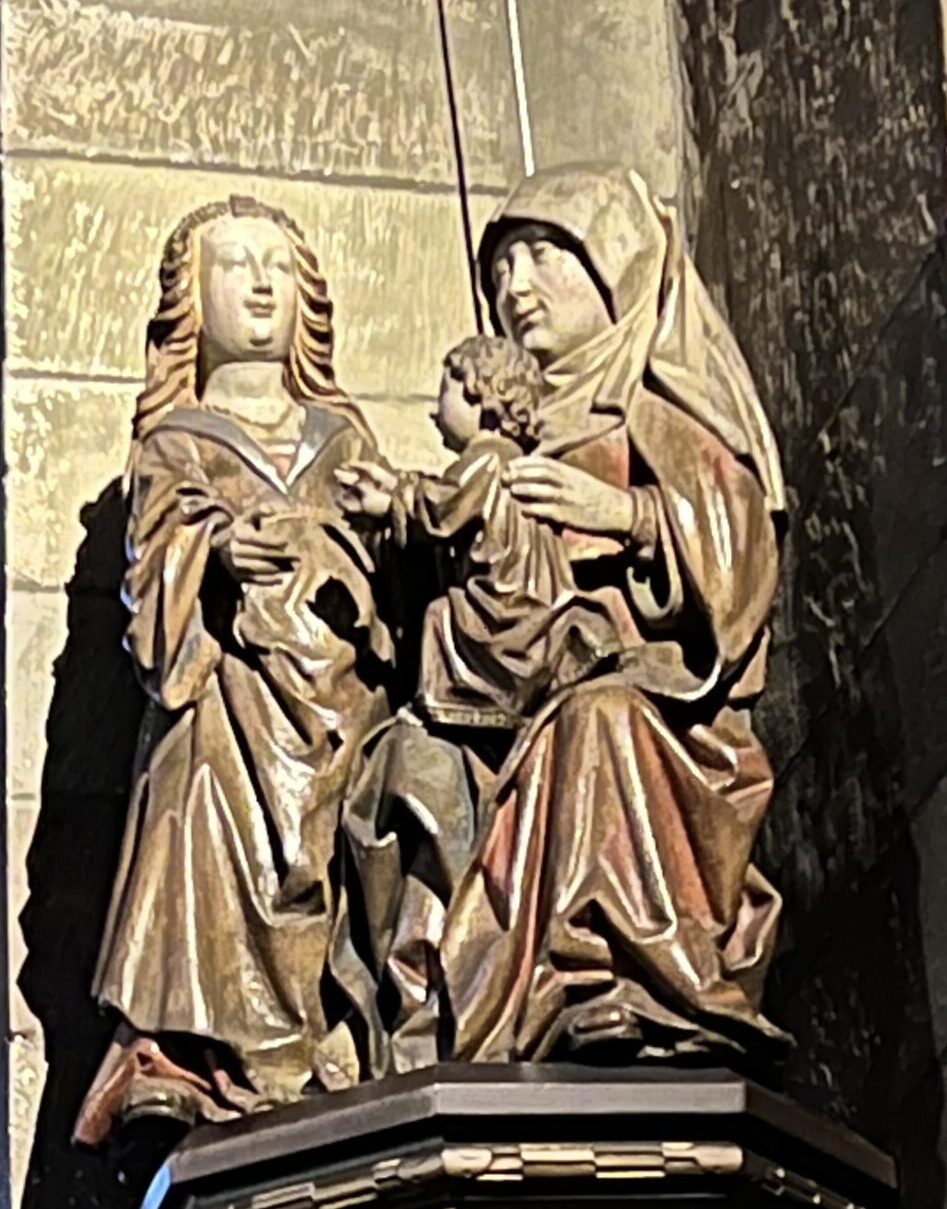
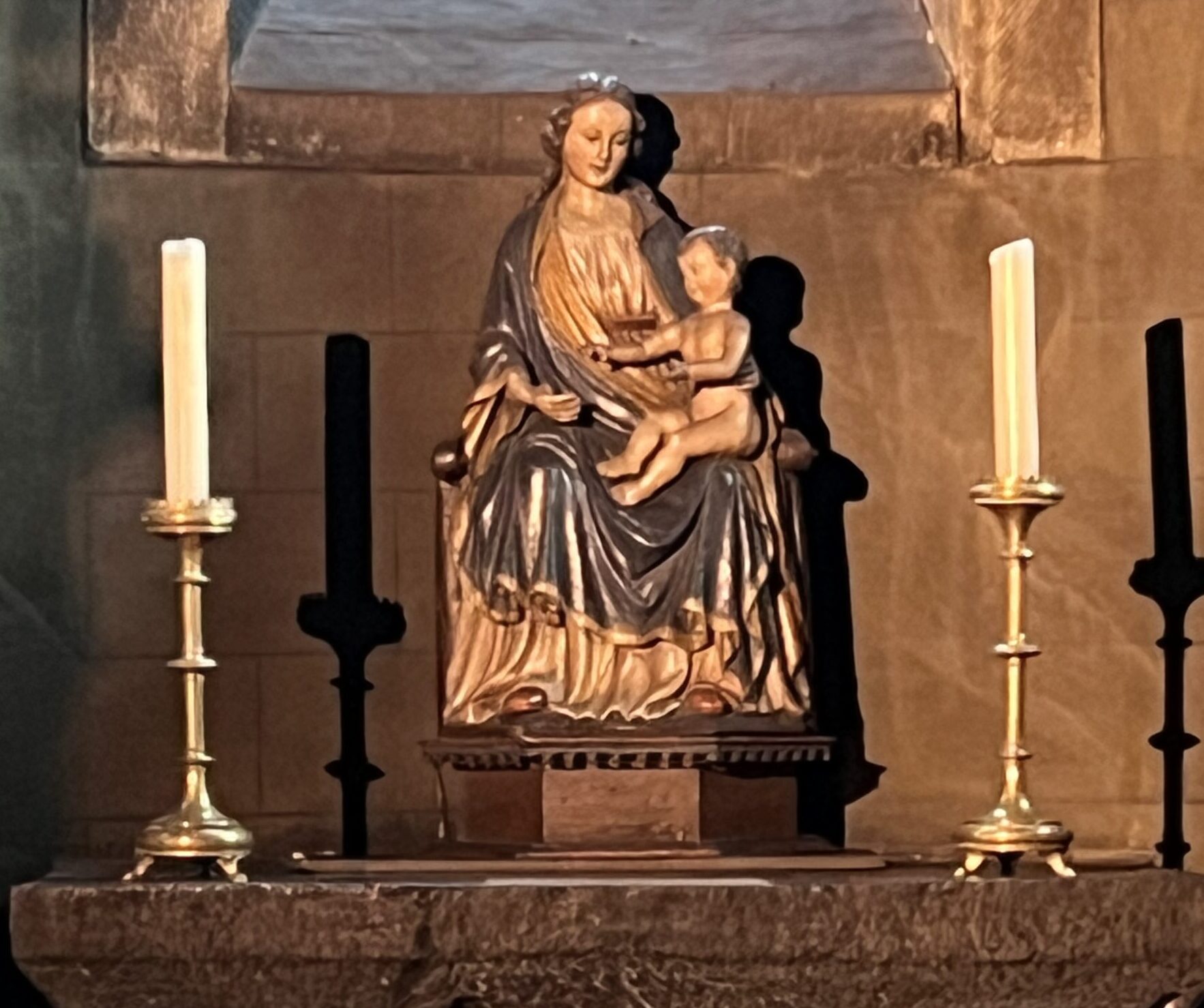
The statue of Mary, Star of the Sea (Latin: Stella Maris), has a turbulent history. The wooden, polychrome statue is of German origin and was made around 1410. It is a depiction of the “Beautiful Madonna”. How the statue came from Germany to Maastricht is not clear. One possibility is that Maastricht tanners, who were devotees of Mary, brought the image with them from Southeast Germany on a business trip. Many statues of Mary were made in this region. Nicolas de Harlay (c. 1472 – 1474), also known as Nikolaus van Harlaer, donated it to the Friars Minor, who were great devotees of Mary, in 1470. He did this, at an advanced age, upon entering the order of the friars in Maastricht. The statue was therefore once intended for placement in the chapel of the Friars Minor monastery on Pieterstraat.

Numerous miracles have occurred at the image. In the second half of the 16th century, a mute and crippled girl is healed, another girl overcomes a fatal illness, a toddler born mute suddenly regains her speech, and a paralysed woman makes a full recovery. Many more healings followed in the first half of the 16th century.
At the end of the 17th century, the image is given the name “Star of the Sea” (Stella Maris); an old title of honour for Mary.
During wars, anti-Catholic occupiers, and relocations of religious communities, the statue of Mary has been brought to safety on several occasions. In 1639, the Friars Minor were forced to leave Maastricht by the Protestant rulers. The statue was protected, among others, by the sisters in Wyck and the Slavante monastery on St. Pietersberg. The statue also came to Visé to the Libot family, which happened in December 1639. Mrs. Libot was seriously ill, and when the statue of Mary arrived in their home, she was immediately cured. In 1640, the statue went to the Friars Minor monastery in Tongeren, where it remained hidden for over 5 years. In 1646, the statue of Our Lady found a place in the monastery church. Miracles also occurred there at the statue.
The statue was moved several times, and in 1675 it came from Tongeren to the Sint-Servaaskerk in Maastricht. Afterwards, the image was transferred to the Sint-Jacobskapel, which stood at the corner of Sint-Jacobsstraat and Bredestraat at the time. The Sint-Jacobskapel was demolished in 1803. The statue also stood in the then Sint-Nicolaaskerk. In 1678, the Protestants regained control of the city. The consequence of this was that the friars and the statue of Mary disappeared. In 1680, the statue returned and found a place in the chapel on Sint-Pieterstraat. The next stop for the statue of Mary was the new monastery of the friars in Maastricht.
In 1796, the French revolutionaries decreed that all churches and monasteries were to be abolished. The statue of Mary then disappeared, as it had been taken to safety. On 31 March 1804, the renowned statue arrived at the Church of Saint Nicholas in Maastricht.
After several wanderings, the statue returned to Maastricht in 1837. On 10 October 1837, the statue of Star of the Sea was moved from the Sint-Nicolaaskerk to a side chapel of the old chapter church of Onze-Lieve-Vrouw. On this day, the church was reconsecrated, after approximately 50 years of desacralisation. The placement of the statue took place after the French occupation and restoration of the church. This building is later also referred to as the Basilica of Our Lady, in the Maastricht dialect this is “Slevrouwe” and the official name is “Basiliek van Onze-Lieve-Vrouw-Tenhemelopneming”.
In 1865, the Franciscans wanted the "Star of the Sea" statue back, as they considered themselves the owners of the effigy. The dispute over the place of the devotional statue escalated. Eventually, Joannes Augustinus Paredis (1795-1886), Bishop of Roermond (1853-1866), had to intervene. He compelled the Maastricht Franciscans to relinquish their claim to the devotional image. Consequently, the effigy remained in Maastricht. The reason given was that believers saw the "Star of the Sea" statue as indispensable. Subsequently, a place had to be found for the statue, making it freely accessible to visitors.
The statue of Mary previously stood in the north transept of the basilica, but that will not be its new location. The Mérode Chapel, which was built onto the basilica, has been chosen. In 1903, the statue was moved to the Mérode Chapel, where it can still be admired today. The placement in the Mérode Chapel only took place after architect Petrus Josephus Hubertus (Pierre) Cuypers (1827-1921) created a design and the chapel was altered. The statue stands on a Neo-Gothic altar and is always surrounded by flowers and candles. The altarpiece was created in 1904 by the Langenberg Workshop from Goch. It depicts the Annunciation, the Adoration of the Shepherds, the Adoration of the Magi, and the Coronation of Mary. Ex-votos are attached to the side walls of the chapel.
Significantly, wherever the image of Our Lady appears, there are always inexplicable healings, leading to the image being increasingly venerated.
In 1906, the Brotherhood of Our Lady was formed from two fraternities. Since 1938, the official name has been the Brotherhood of Our Lady, Star of the Sea. This organisation promotes Marian devotion. During processions, the members of the brotherhood escort the statue of Mary.
On 15 August 1912, the statue of Our Lady, Star of the Sea was crowned by Josephus Hubertus Drehmanns (1843-1913), Bishop of Roermond from 1900 to 1913. The statue was crowned with the permission of Pope Pius X (1903-1914), Giuseppe Melchiorre Sarto (1835-1914).
On 20 February 1933, the church was elevated to basilica by Pius XI, Pope from 1922-1939 and born Ambrogio Damiano Achille Ratti (1857-1939).
In 1960, stained-glass windows were installed in the Merode Chapel. These are the work of Franciscus, Gerardus, Antonius (Frans) Slijpen (1923-1994) from Maastricht. He was a versatile artist, working as a sculptor, teacher, glazier, mosaic artist, and painter.
The statue of Mary in the Merode Chapel has a wardrobe of several cloaks. The red cloak was funded in 1976 from donations by people from Maastricht. On 2nd February 1978, this cloak was presented to the Star of the Sea.
The treasury, which is adjacent to the basilica, was refitted in 2023-2024.
Pilgrimage site
The Basilica of Our Lady of the Assumption is a large, Romanesque church. The house of worship is listed on the national heritage list. The current church is the Roman Catholic parish church and formerly the collegiate church. Within the large church building are two crypts and an extensive treasury.
In Maastricht, 10 October is the feast day of Our Lady Star of the Sea. Star of the Sea is the patron saint of Maastricht.
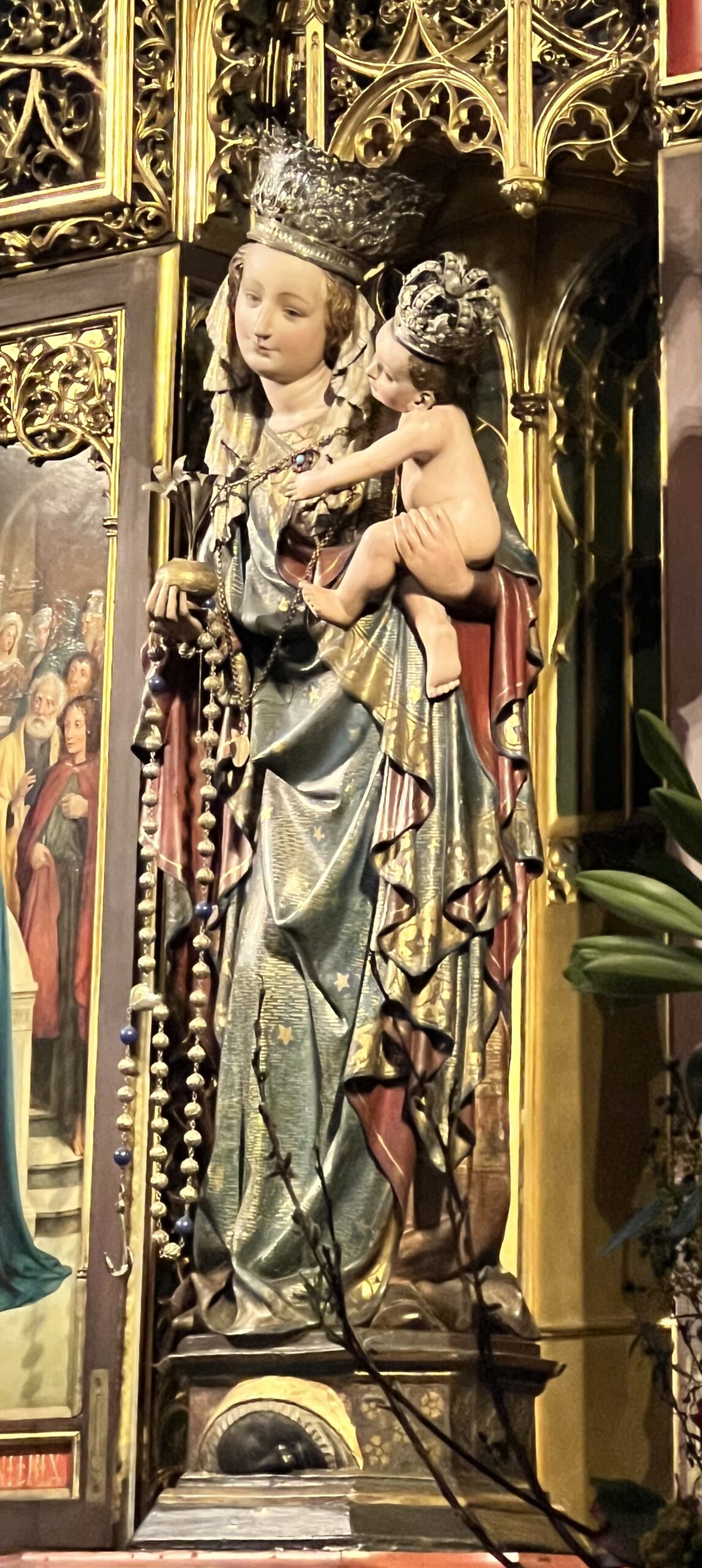
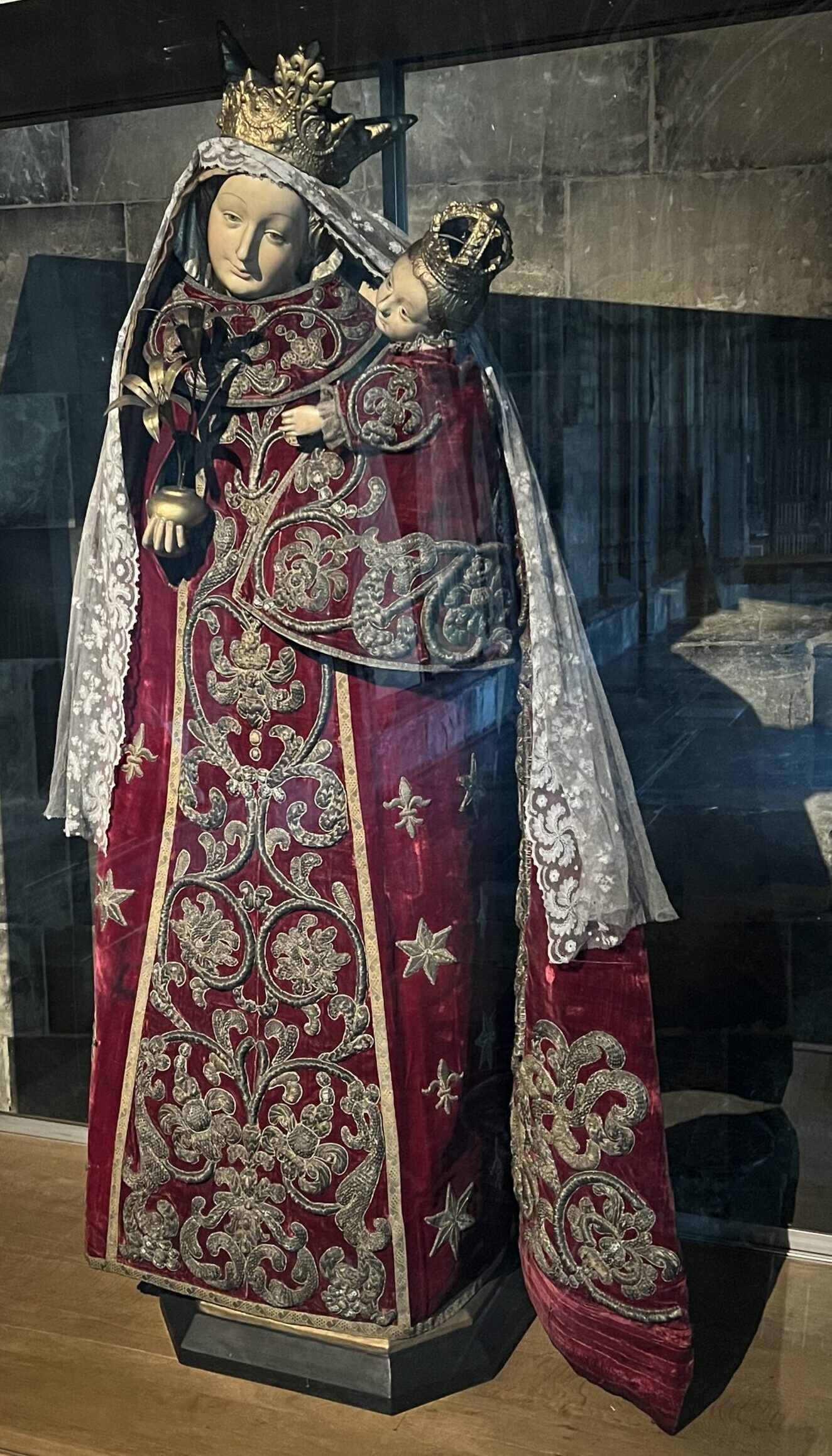
In the Mérode Chapel, the effigy of Our Lady is displayed behind glass on a Neo-Gothic altar. Flowers are laid on and around the altar, and votive offerings can be seen. On a pew in front of the statue of Mary, Star of the Sea, visitors can sit, kneel, and pray. The designation of the statue as “Star of the Sea” can be attributed to the praying and reverent seafaring men and skippers from Maastricht. The statue is crowned. Throughout the year, it is adorned with various richly decorated mantles. This chapel always has visitors, and candles are always burning. The statue of Mary is 110 centimetres high, measuring 130 centimetres in total with its octagonal base. The standing statue is carved from a single piece of wood. On her bent left arm, Mary carries her seated Child, who also rests on her hip. Her Son has placed his right arm around his Mother’s neck. Mary wears a long, flowing robe and a loose-fitting mantle. Her head and shoulders are covered with a veil. Mary's left leg is positioned straight down, her left foot is turned slightly outward, and a shoe is visible. Her right leg is placed slightly forward, and the knee is bent very slightly. Mary's upper body is held back slightly and leans somewhat to the right. Her head is bowed slightly to the left and forwards. Mary's right hand holds a small vase with a sprig of lilies. Mary's face shows full cheeks, a broad forehead, a rounded chin, and a straight nose. The eye slits are made narrow, and Mary's gaze is directed downwards. Proportionally, she has a somewhat wide mouth with slightly downturned corners, giving her face a friendly appearance. Her hair is visible at the temples. It is noteworthy that neither Mary nor the Child looks at the other.
The 1704 station mantle of Our Lady Star of the Sea is made of red velvet. The mantle consists of four separate parts. The back panel is decorated with silver thread embroidery of floral garlands. The sides of the mantle have four hexagonal stars and four French lilies. The hem is made of gold galloon and this ribbon is prominently attached. The double front panels have floral garlands of silver thread. The side panel has an opening for the child's arms. The collar is shaped like a half-moon.
During processions, the statue is carried around. Every year, on 10 October, a procession is held with the statue “Stella Maris”. The procession has been intangible heritage since Whit Monday 2023.
The chapel and the basilica are open daily.
ACCESSIBILITY
In the centre of Maastricht, the Basilica of Our Lady of the Assumption stands at Onze-Lieve-Vrouweplein 9. The basilica is located between the River Maas and the Vrijthof.
Up-to-date information can be found at www.sterre-der-zee.nl.
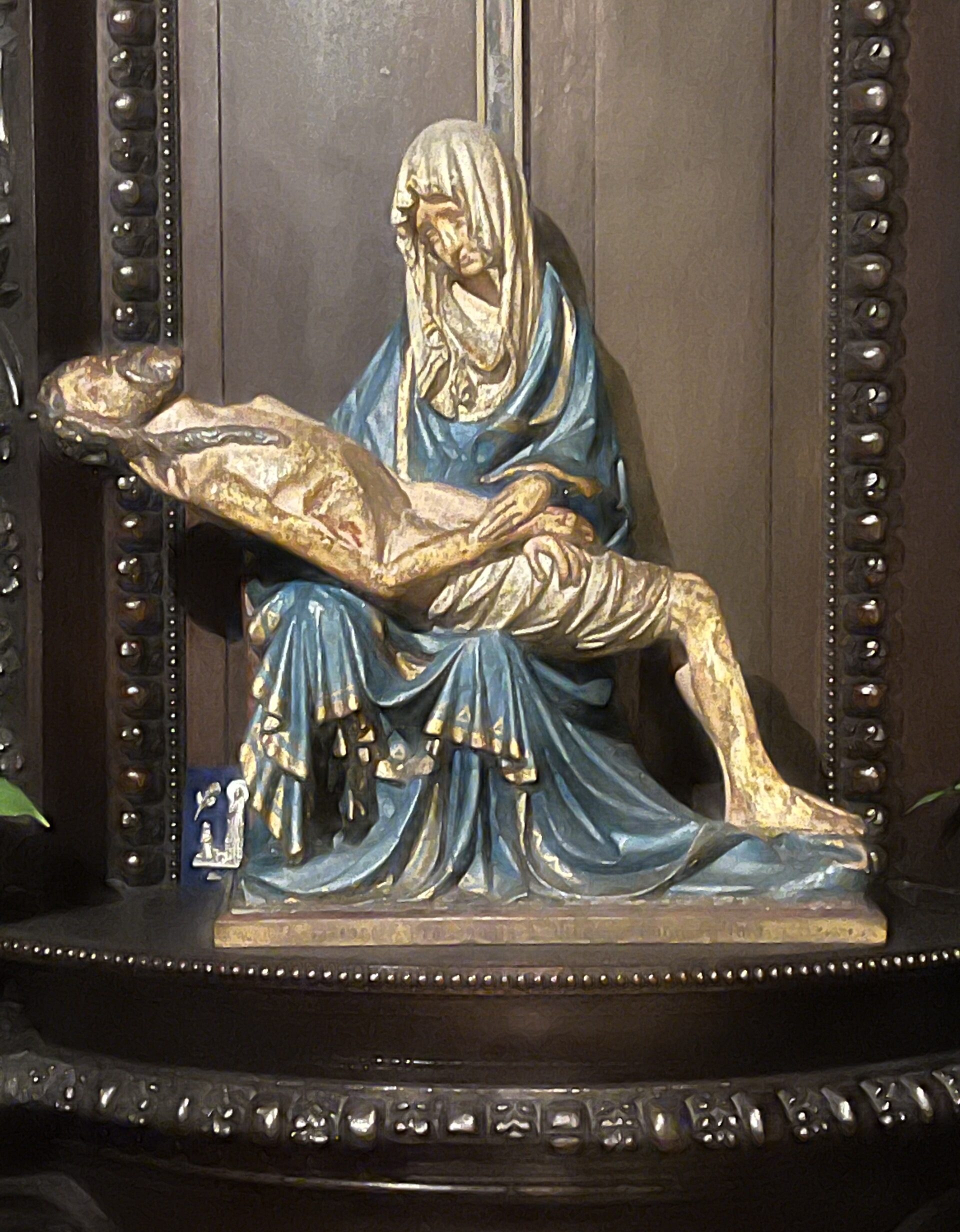
Experience
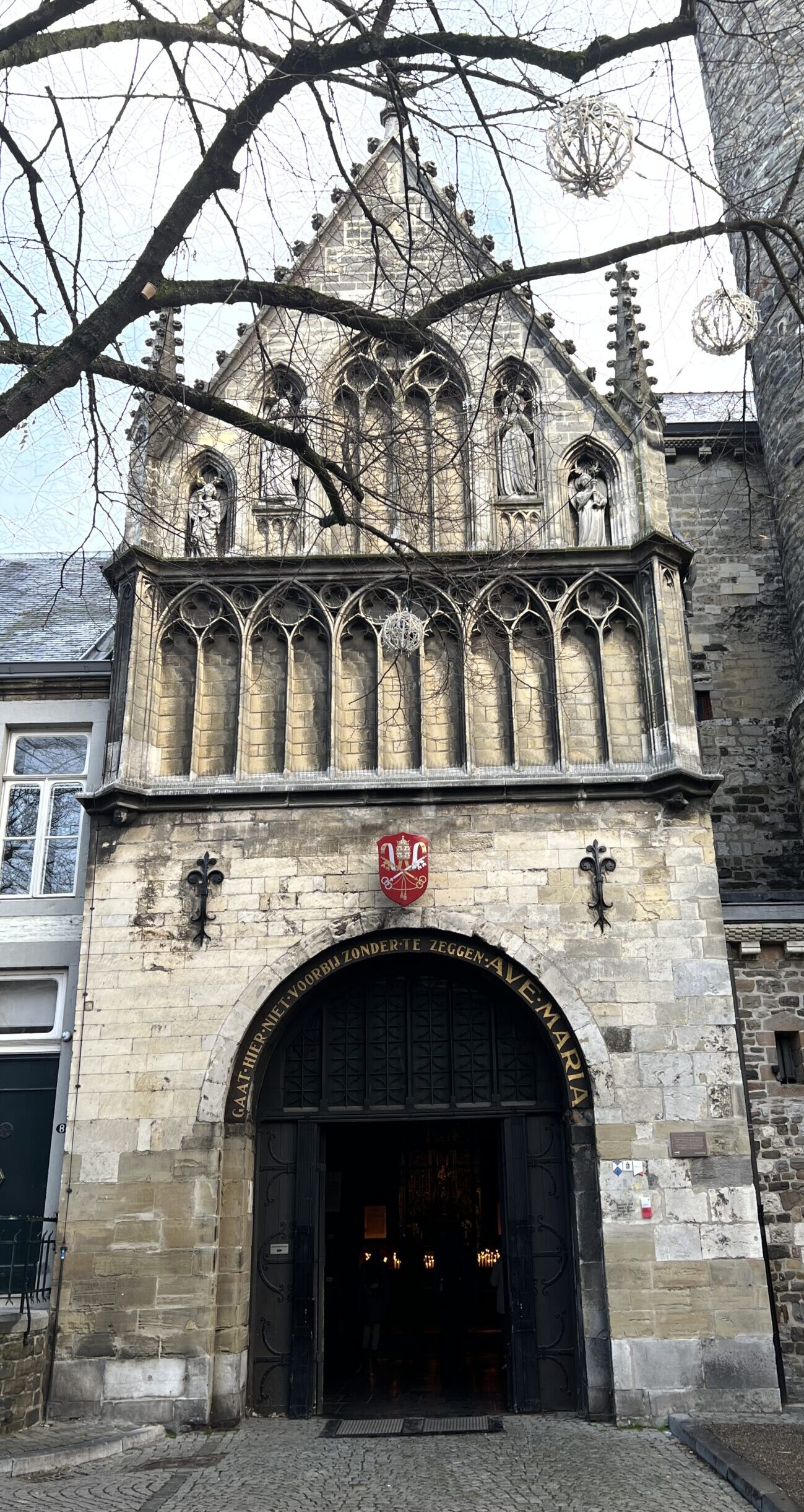
For the Chapel of Star of the Sea, the gateway invites you in. In the arch above the high entrance reads the text “do not pass by here without saying AVE MARIA”. So I do.
At the entrance to the basilica is the Star of the Sea chapel, located to the left of the main entrance of the impressive basilica. In the vestibule, visitors can light a candle. The chapel, named the Merode Chapel, is built alongside the Our Lady Basilica, attracts many visitors daily, and hundreds of candles are lit in front of the impressive statue of Mary. The Marian chapel feels rather dark to me. Today I am at the statue of Mary. I light a few small candles and with difficulty find space for them. So many candles are burning here in front of Mary.
The standing Virgin Mary holds the Child on her left arm. I understand that the Child is naked in the original situation. He reaches out his hand towards a fruit that Mary holds in her right hand. Mary and Child are dressed differently throughout the year.
After visiting Our Lady, I will leave the basilica and enter the corridor towards the treasury. Devotional items are sold there. Here I will buy some gifts for good people in my circle of friends.

After that, I go further into the basilica, seeing, among other things, a large statue of a militant Saint Nicholas. A visit to the treasury museum concludes my tour of this beautiful building. When visiting Maastricht, its chapel and basilica are definitely worth seeing.

Environment
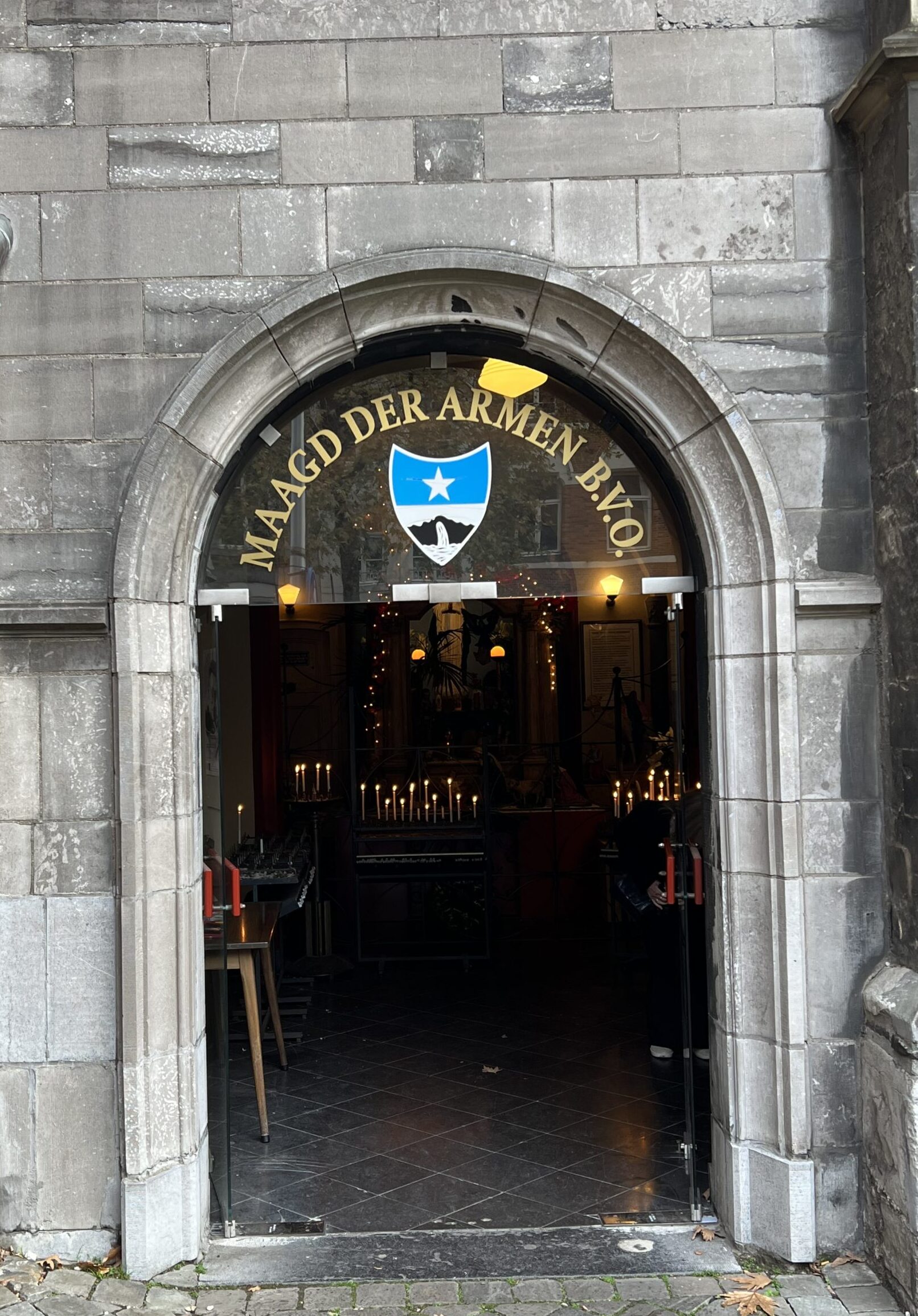
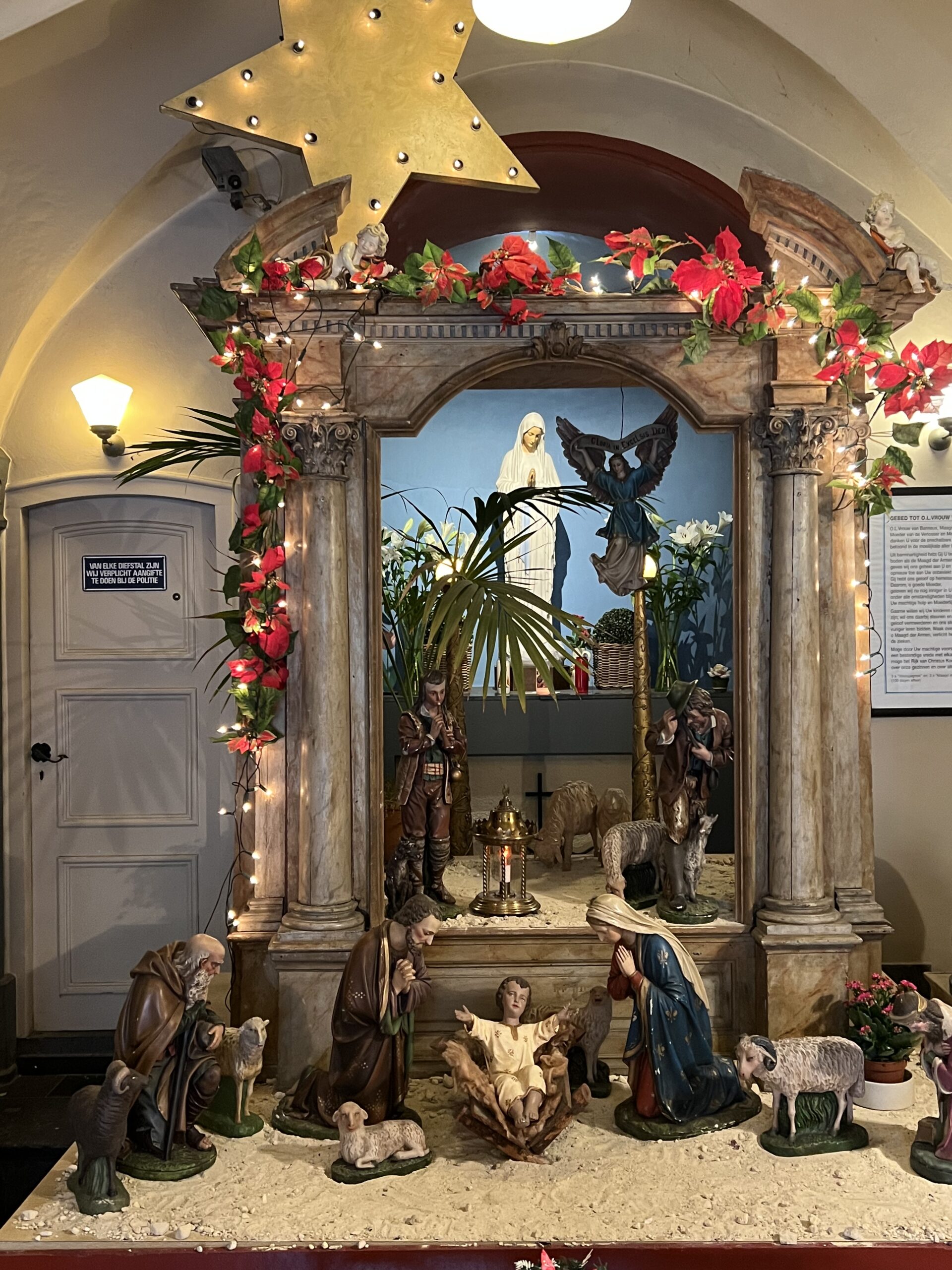
In Maastricht, next to the Matthias Church, at Boschstraat 99, lies the Maagd der Armen chapel, which has a direct connection to the Belgian pilgrimage site of Banneux. The first Banneux chapel arrived in Maastricht's Boschstraat in 1952. The chapel's design is by architect Alphons Jean Nicolas Boosten (1893-1951) from Maastricht. The initiative is a sign of devotion to the apparitions of Our Lady of Banneux in 1933. On 15 August 1952, the chapel was consecrated by Joseph Hubert Guillaume Lemmens (1884-1960), Bishop of Roermond (1932-1957). From that day on, Mary's message in Banneux has also been spread in the centre of Maastricht.
In 1994, the chapel was vandalised. It took several years before the chapel was restored to its former glory. On 1 April 2008, the space was consecrated again. This happened after the image of Mary was consecrated in Banneux on the same day.
Tens of thousands visit the Mary Chapel annually, a gem in the city centre.

Residents of Boschstraat have installed a statue of Our Lady of Banneux, with a plaque underneath, inscribed with the text “erected out of gratitude by the Boschstraat residents 8-9-1946”. It is a memorial of gratitude to Mary for the suffering that the residents were spared during the Second World War in this part of the south of Limburg.
A statue of Mary adorns a niche on the corner of Mariastraat/Merriejestraot next to a bilingual street sign. It is a reference to the former chapel of ”Maria Ten Oever" (Mary at the Shore).

In the vicinity of Maastricht, Valkenburg and Liège are certainly worth visiting.
Posted: 6 July 2022
Last updated: 23 March 2025
~~~

 Nederlands
  English (UK)
  Deutsch
  Français