History
Around the year 1000, there were hermits in the area of Monte Baldo, the mountain where the current sanctuary is located. They were connected to a monastery in Verona and stayed there until the end of the 12th century.
Where the church now stands, there was once a monastery with a chapel, dating from the 13th century. This 6-metre long chapel is dedicated to Saint Mary of Monte Baldo.
In 1425, German monks took over the organisation of the shrine and they did so until 1630. The devotional image was created in 1432 and remained here due to the arrival of the Knights of Malta of Saint John. They kept the shrine until its dissolution by a decree of Napoleon in 1806. Their possessions were confiscated by the state.
In 1522, a legend is told which forms the basis of the current sanctuary. The revered statue, a Pietà, miraculously arrives in Spiazzi from the Greek island of Rhodes. This occurs after the invasion of Rhodes by Muslims with an army of 40,000 soldiers led by Sultan Suleiman I (1494-1566, also known as Suleiman the Magnificent, Sultan of the Ottoman Empire). Mountain dwellers are convinced that angels transported the Pietà. The effigy, dedicated to the sorrowful Mother, becomes the symbol to venerate, and thus this sanctuary is born. The statue is a donation, and the date of its transfer and the donor are unknown. The statue arrives here in 1522, when this area is not only impassable but also unreachable and uninhabitable. Some mountain dwellers, living a little further away, see a light in the night. They decide to go and see where the light is coming from and hear music in the deep valley. They rig up a large sail on a basket and a few step into the basket, which is lowered. Then they see the statue, with Mary and Jesus on her lap, surrounded by light. Subsequently, the mountain dwellers decide to take the statue with them and place it in a makeshift chapel. The next morning, the statue has disappeared. The search for the statue begins, and eventually, they find the effigy in the place where the statue was seen the day before. Again, the statue is placed in the chapel, and the following morning it is once more missing. This time too, the people find the statue in its original location. Then they understand that Our Lady wants the statue there, among the mountains. A chapel is built at the place where it was found, and the effigy is given its permanent location there. Some time later, some knights of the Order of Malta see the Pietà and recognise it from their time on the island of Rhodes. It disappeared from there and was brought here by angels. Thus, this sanctuary begins…
Over the many years, the sanctuary has suffered from war on multiple occasions. Buildings are damaged and closed. However, the resilience is enormous, and the pilgrimage site is always restored and expanded.
In 1490, a new, larger church was built on top of the existing one. In the 16th and 17th centuries, the access routes to the sanctuary were renovated. Then came a long staircase with many hundreds of steps. After additional stair work, the number of steps from the valley to the pilgrimage church at an altitude of 774 metres exceeded 1,700.
In 1625, construction began on an even larger church, which was built 4 metres above the old one. The works were completed in 1685. This church remained until 1898.
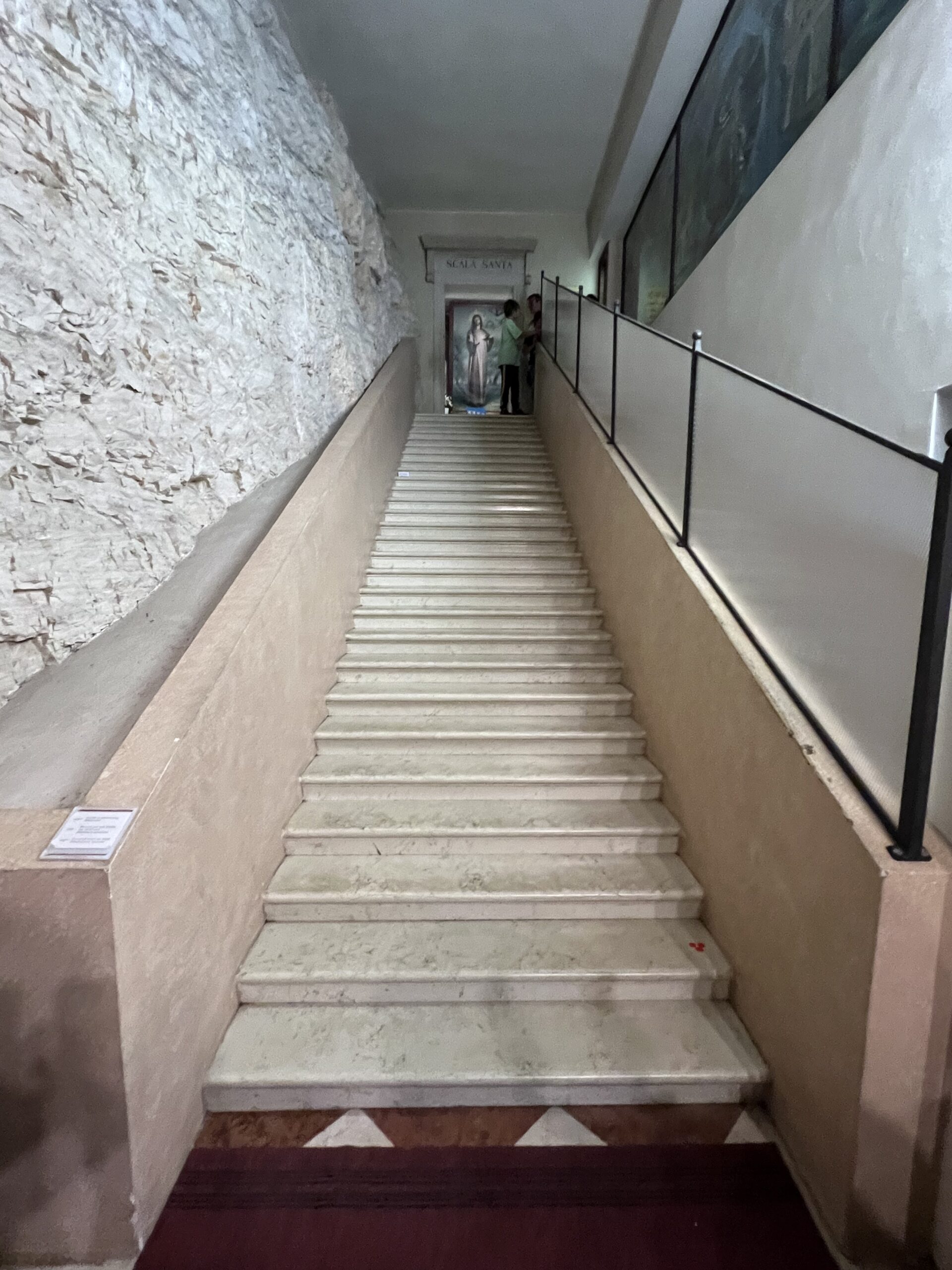
Between 1823 and 1829, the Holy Staircase is constructed. In 1823, a huge boulder breaks loose and destroys the Holy Staircase and the rectory, killing the sanctuary's rector. As a result, the place of grace is closed for two years. During this period, some works are carried out. The Holy Staircase is not restored until 1875.
In 1893, Giuseppe Melchiorre Sarto (1835-1914), Cardinal and Patriarch of Venice (1893-1903), paid a visit. He would later become Pope Pius X (1903-1914). During this period, the church was enlarged and a new facade was added, as the number of pilgrims continued to increase. The works were completed on 17 September 1899, and on that day, the coronation of the *pietà*, the statue of grace, took place. In 1922, a tunnel was dug into the mountain, which made access to the sanctuary easier.
A small hospital is built in 1926. This is intended to receive pilgrims. Later, its purpose changes and it becomes accommodation for pilgrims, in short, a hotel with a restaurant.
In 1975, the church, apart from the facade and the tower, was largely demolished to create a larger and more stable structure against the mountain. On 4 June 1978, the restored church was consecrated by Giuseppe Carraro (1899-1980), Bishop of Verona (1958-1978).
During the sanctuary's existence, tens of thousands of pilgrims come to it, including senior clergy, such as bishops, and many nobles visit frequently.
In 1982, the church was elevated to the status of a basilica. Approval for this was granted by John Paul II, Pope from 1978-2005, born Karol Józef Wojtyla (1920-2005). This Pope visited the sanctuary on 17 April 1988.
Pilgrimage site
Spiazzi is situated at an altitude of approximately 770 metres above sea level and is about 18 km from the town of Garda on the Great Lake. The Monte Baldo mountain range forms a crown around the pilgrimage site, hence the name “Madonna della Corona” (Our Lady of the Crown). Pilgrims reach the sanctuary by following a path or staircase from places such as Spiazzi. It is also possible to reach the sanctuary via an old pilgrimage path from Brentino Belluno. This involves following the Strada Santuario with a steep staircase of many hundreds of steps. Some speak of 1,700 steps… Taking this route means overcoming an altitude difference of 600 metres, which takes the average walker 60 minutes.
Bronze statues have been placed both in the church and along the access road.
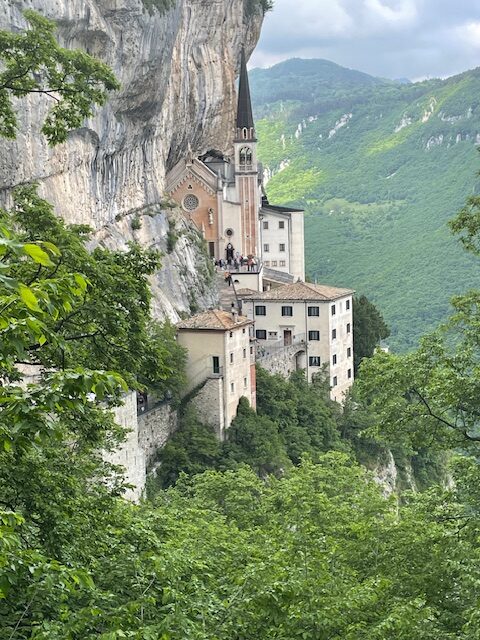
“Santuario della Madonna della Corona” (Sanctuary of Our Lady of the Crown) is situated against a rock face on the east side of Monte Baldo with a wide view of the valley.
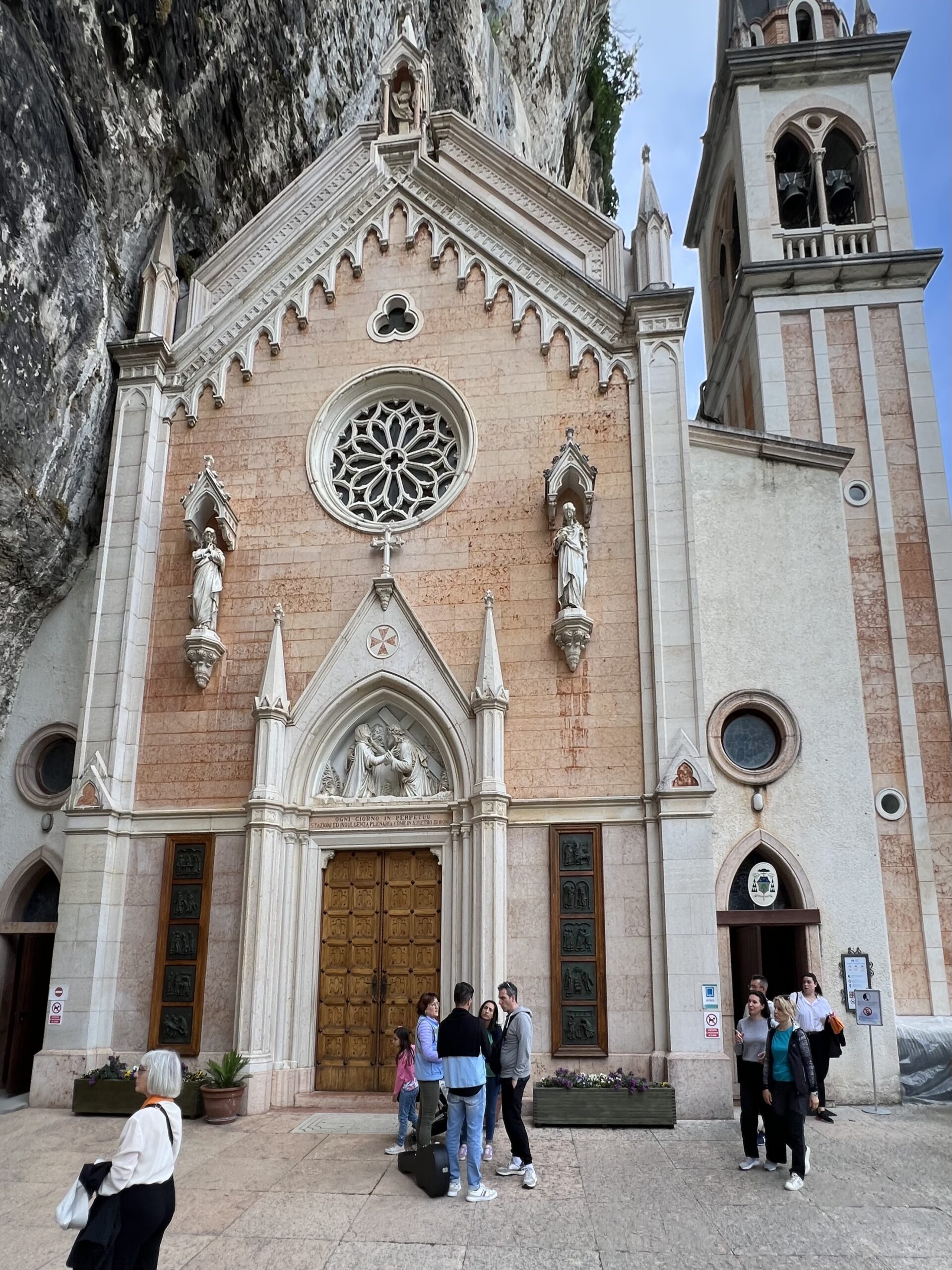
The front of the basilica gleams with a somewhat orange-like facade. The tower impresses with a spire that reaches up to 33 metres.
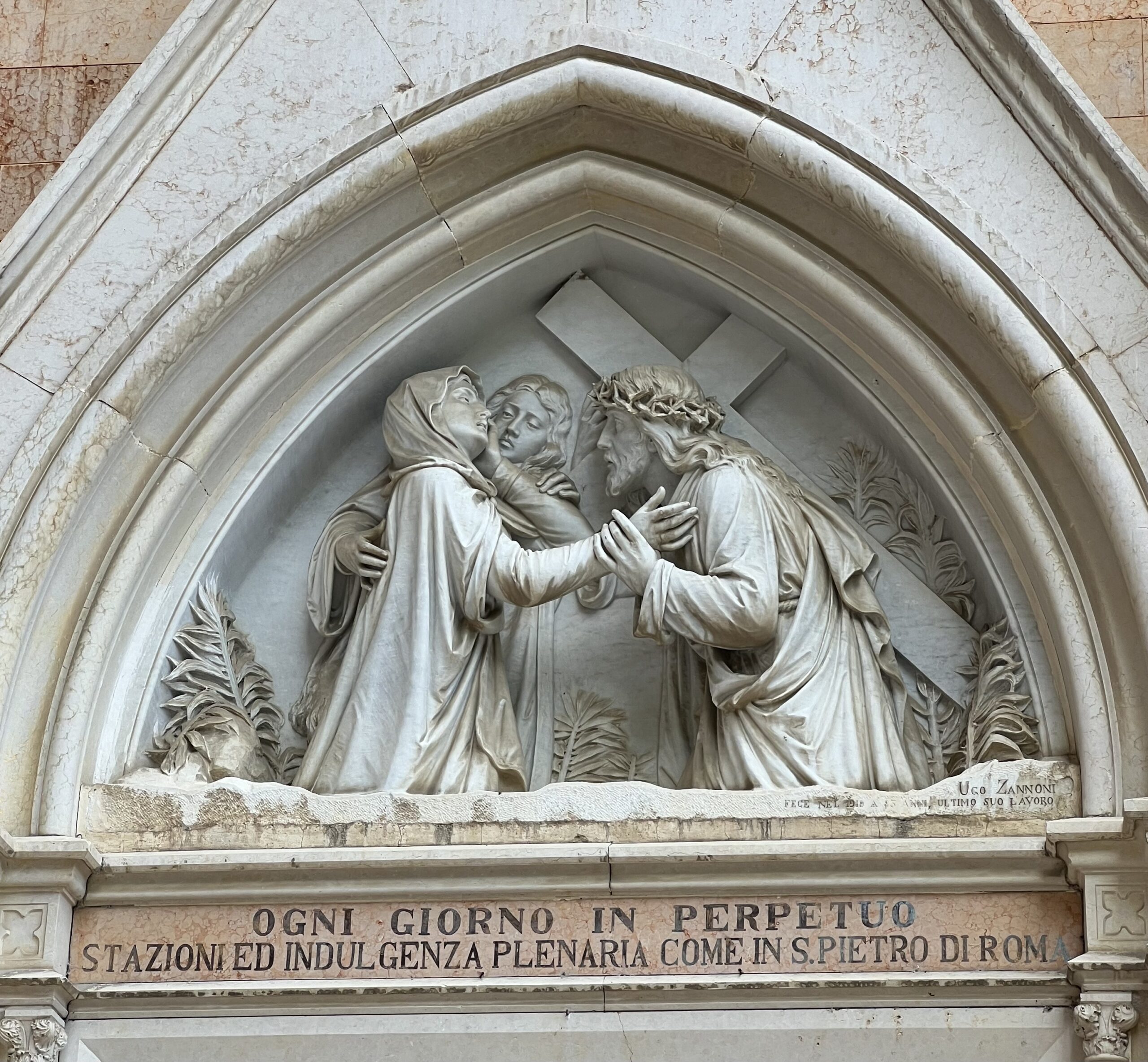
In the church, there are numerous sculptures made of white Carrara marble, and many works of art were created by the sculptor Ugo Zannoni (1836-1919) from Verona. In the early 20th century, he produced, amongst other works, the effigies of John the Baptist and of the Mater Dolorosa. His workshop also produced the large statues of the Way of the Cross. His final work is the Meeting of Christ with his Mother from 1919.
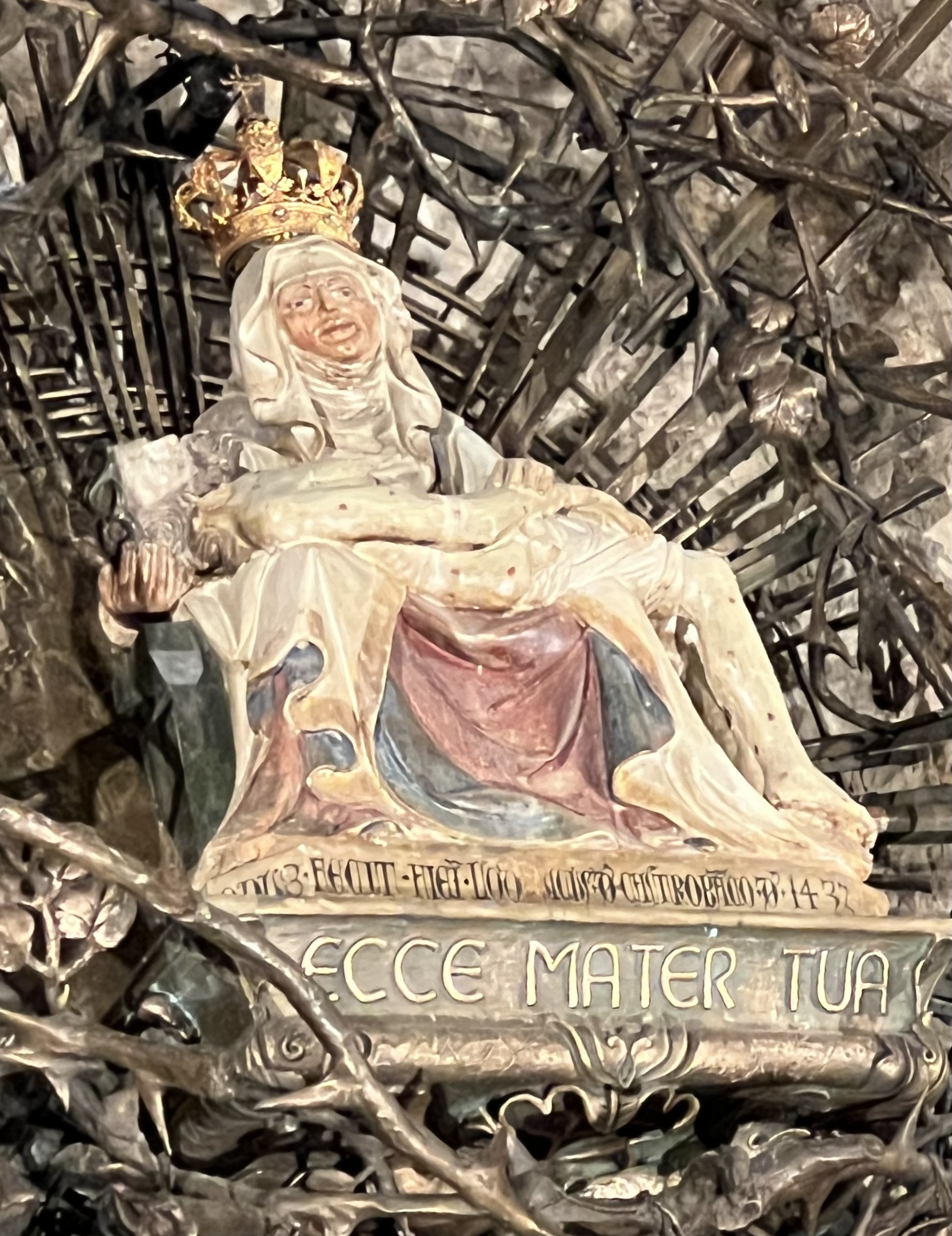
The stone statue of grace, the “Madonna della Corona”, is 70 cm high, 56 cm wide and 25 cm deep. The Vesper statue stands on the high altar on a plinth with the inscription “HOC OPUS FECIT FIERI LODOVICUS D CASTROBARCO D 1432”. This Latin translates to “This work was made by Ludovicus Castrobarco in 1432”.
In the basilica, the right-hand wall is adorned with 14th-century frescoes of Mary. Many ex-votos can also be seen as thanks to Mary. The oldest expression of gratitude dates from the year 1547. An expression of gratitude also comes from the painter Antonio Balestra (1666-1740) from Verona. In 1724, he created the oil painting “Christ at the Pillar”.
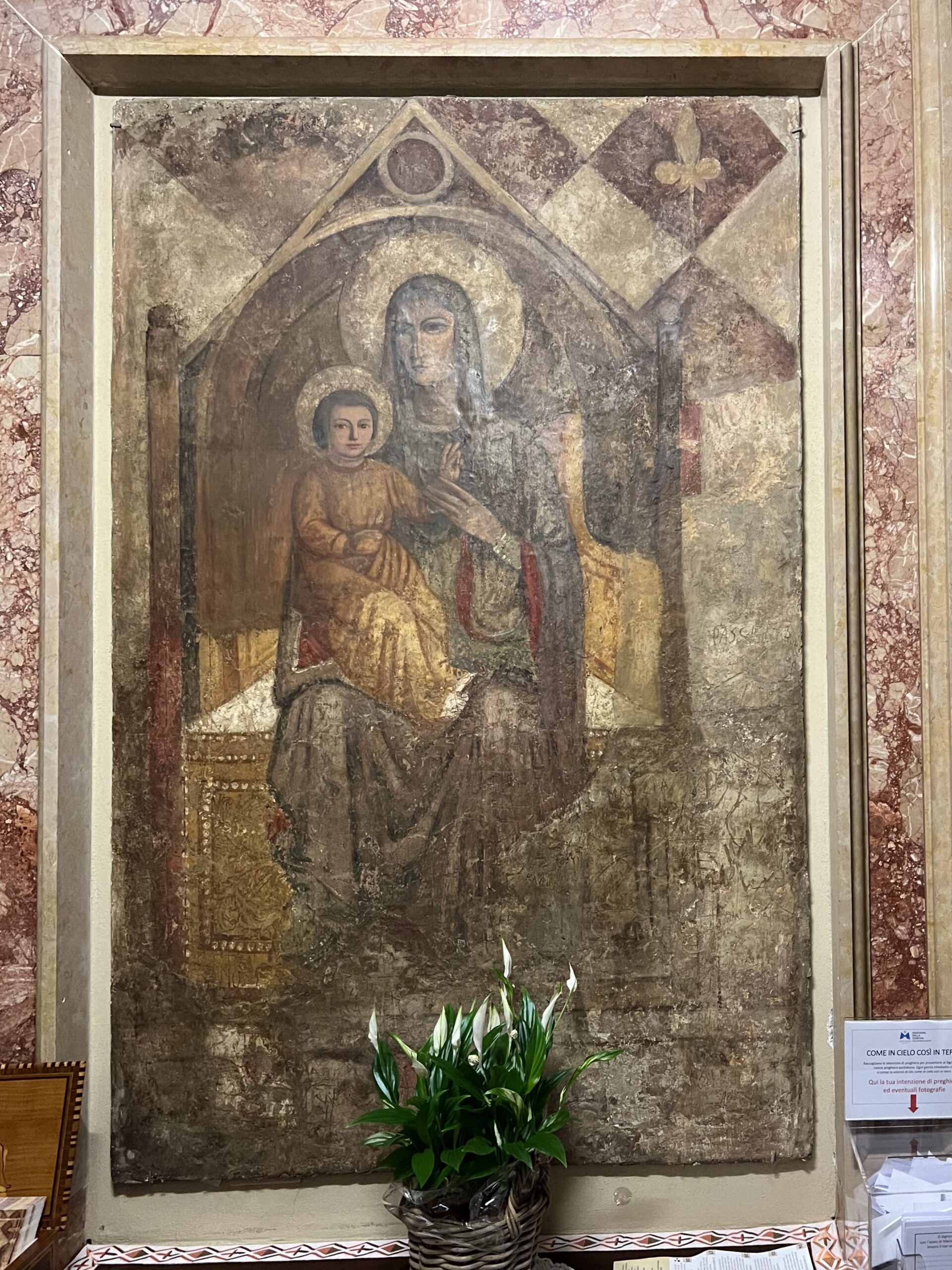
In the sanctuary, there is a very old painting of the Mother and Child. It is the oldest image of the sanctuary. The artwork is attributed to an unknown maker from the 8th century.
The pilgrimage site also features the Holy Staircase (La Scala Santa). It is a replica staircase, which Jesus walked up in the palace of governor Pontius Pilate in Jerusalem. Pilate (+39) was the Roman prefect of, among other places, Judaea (26-36). Saint Helena (±248-329), mother of the Roman Emperor Constantine the Great (±273-337), brought the 28 steps of the staircase to Rome in the year 326, and a copy stands in Spiazzi.
Thousands of people from many countries visit the pilgrimage site every year. The sanctuary is open daily.
ACCESSIBILITY
Spiazzi is located in the province of Verona, near the eastern side of Lake Garda.
A fairly easy way to reach the pilgrimage site is via a path or staircase from Spiazzi. It takes about 15 minutes to walk to the Marian shrine. There's also a bus that goes quite close to the pilgrimage site.
Address: Via Santuario 1, 37020 Ferrara di Monte Baldo, Spiazzi.
Current information can be found at www.madonnadellacorona.it.
Experience
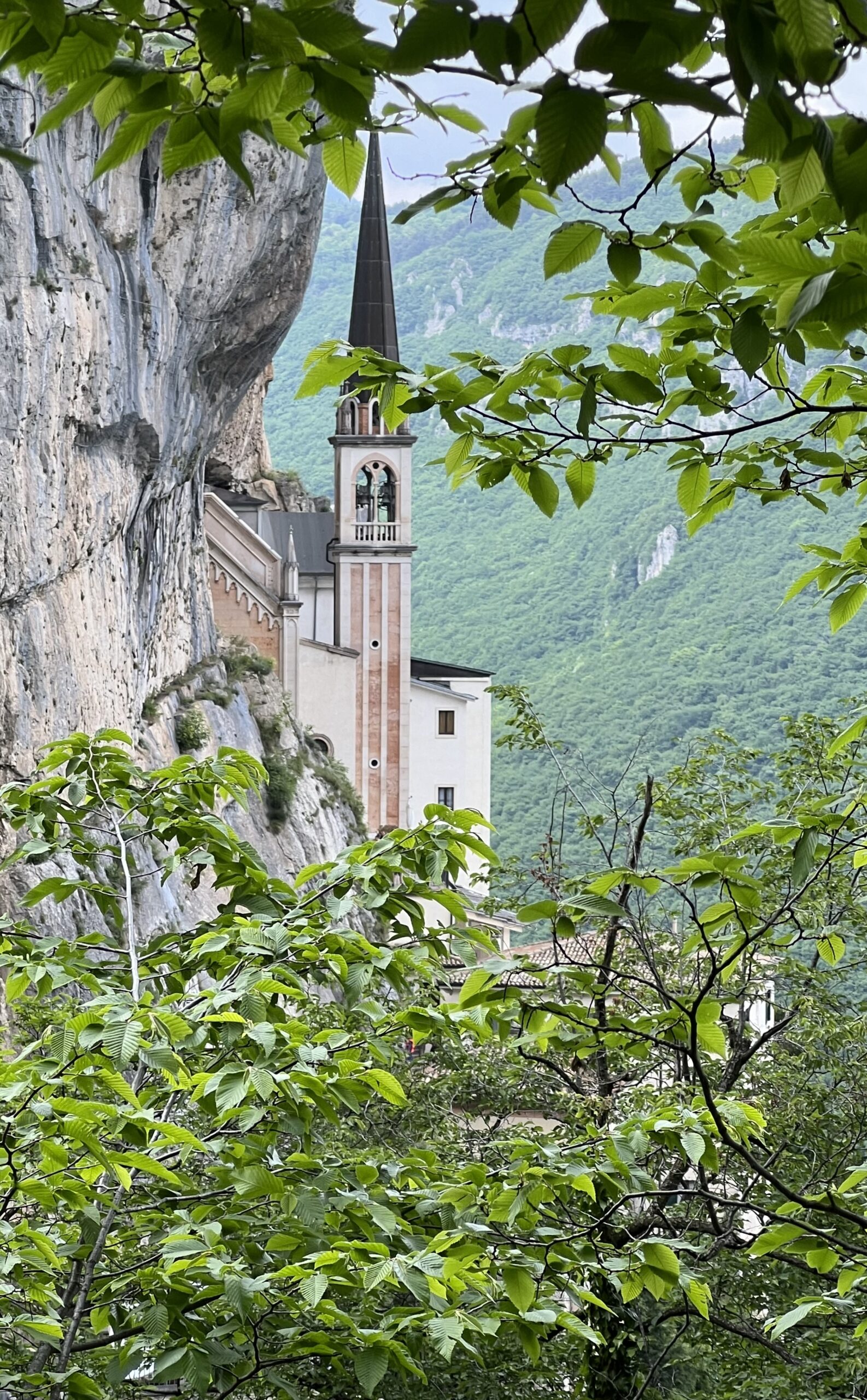
A few kilometres from Lake Garda lies the inviting village of Spiazzi, where the pilgrimage site has found a very striking location.
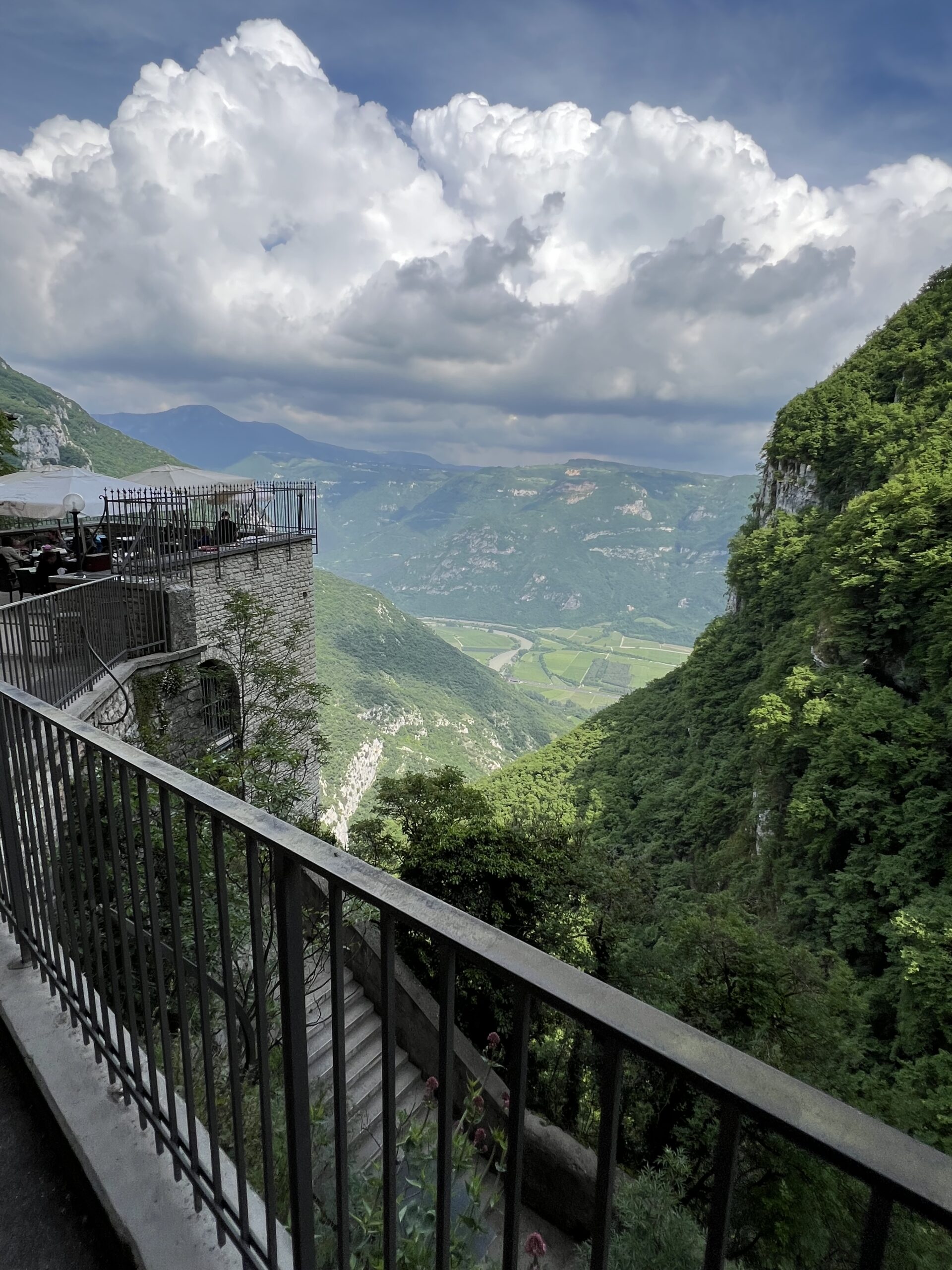
From the village, it is a steep path downhill or many hundreds of steps to take to the sanctuary situated at a lower level. Many descend with me to reach Our Lady. Along the way, visitors pass grand scenes from the life of Jesus. Suddenly, the church is visible between the tall trees. The buildings seem to be plastered against the mountainside here. This offers a unique view.
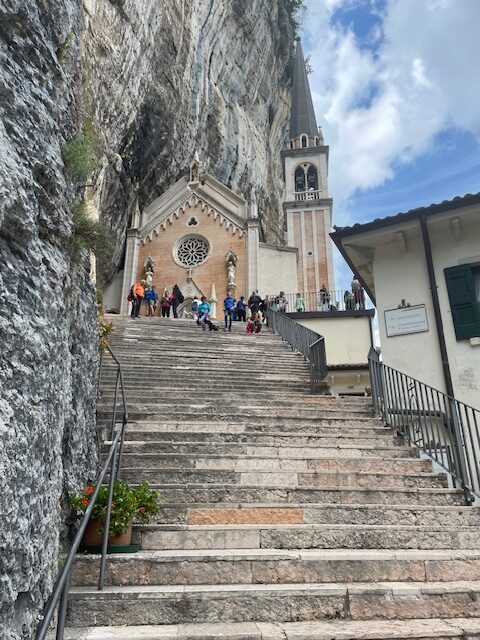
The pilgrimage site welcomes pilgrims and the curious via a dark passageway, which leads to the square with the church. At the end of the sinister passage is a shop selling religious articles. There is also a room with ex-votos and a forecourt where many pilgrims are waiting to enter the pilgrimage church.
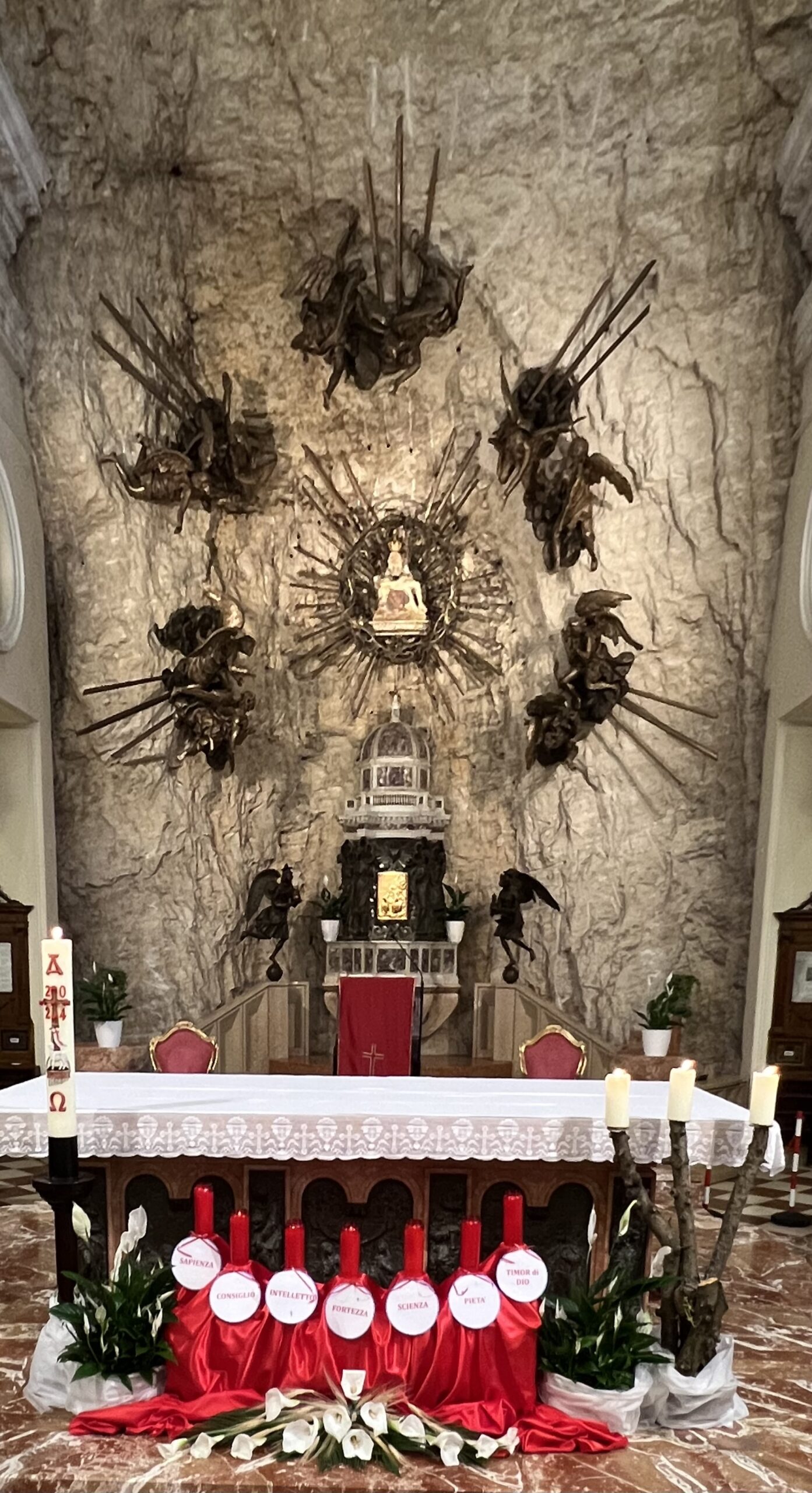
A Eucharist service is taking place in the church and the minister is giving a long sermon. Not everyone wants to listen to this, as some step out. After mustering some patience, the service is over and visitors are able to view the space properly. The devotional image hangs high on the wall behind the choir. The central depiction is small. In my opinion, it looks grand.
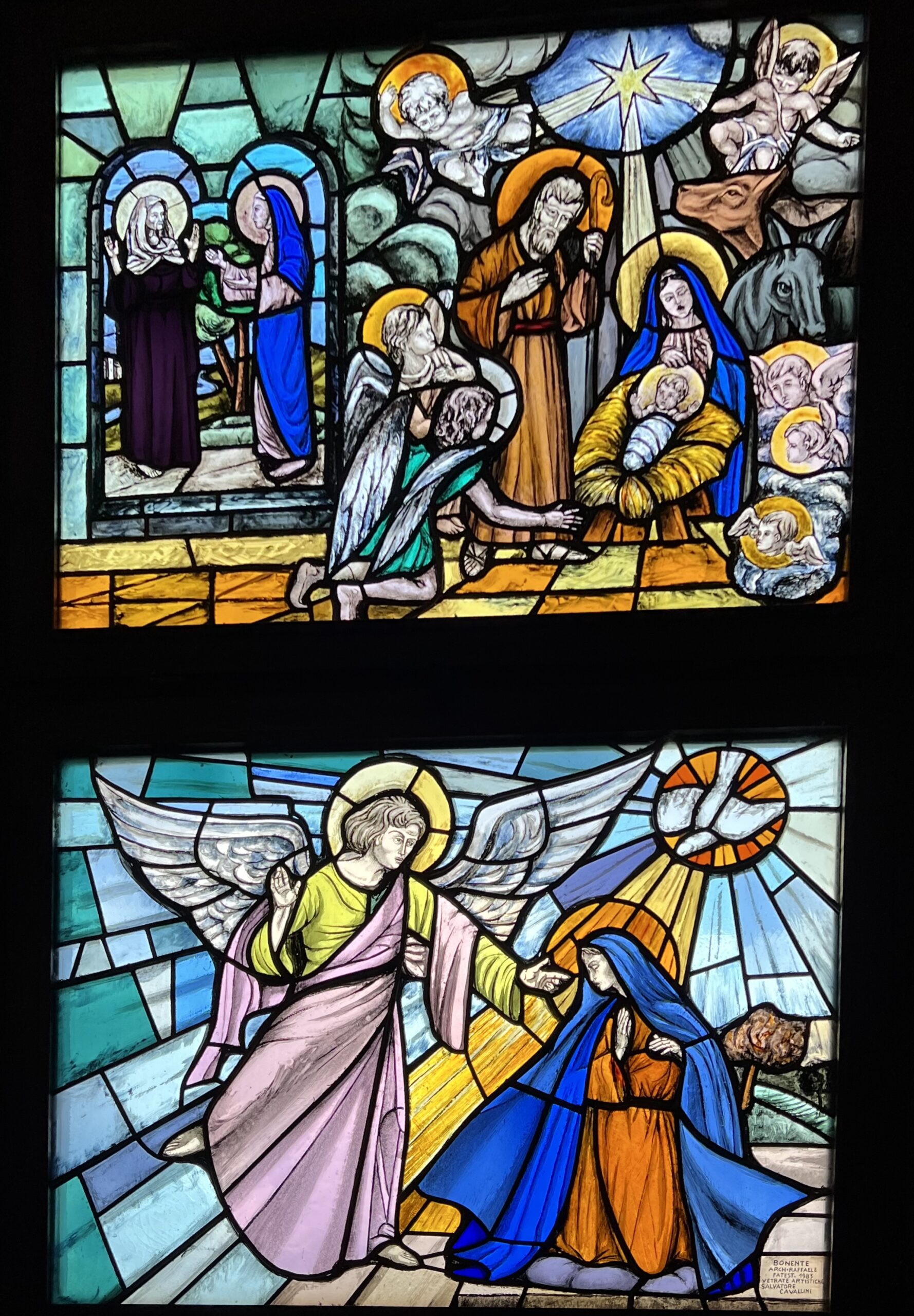
Stained-glass windows have been installed in the church and many ex-votos hang on the wall by unknown artists. The oldest expression of gratitude dates back to 1547.
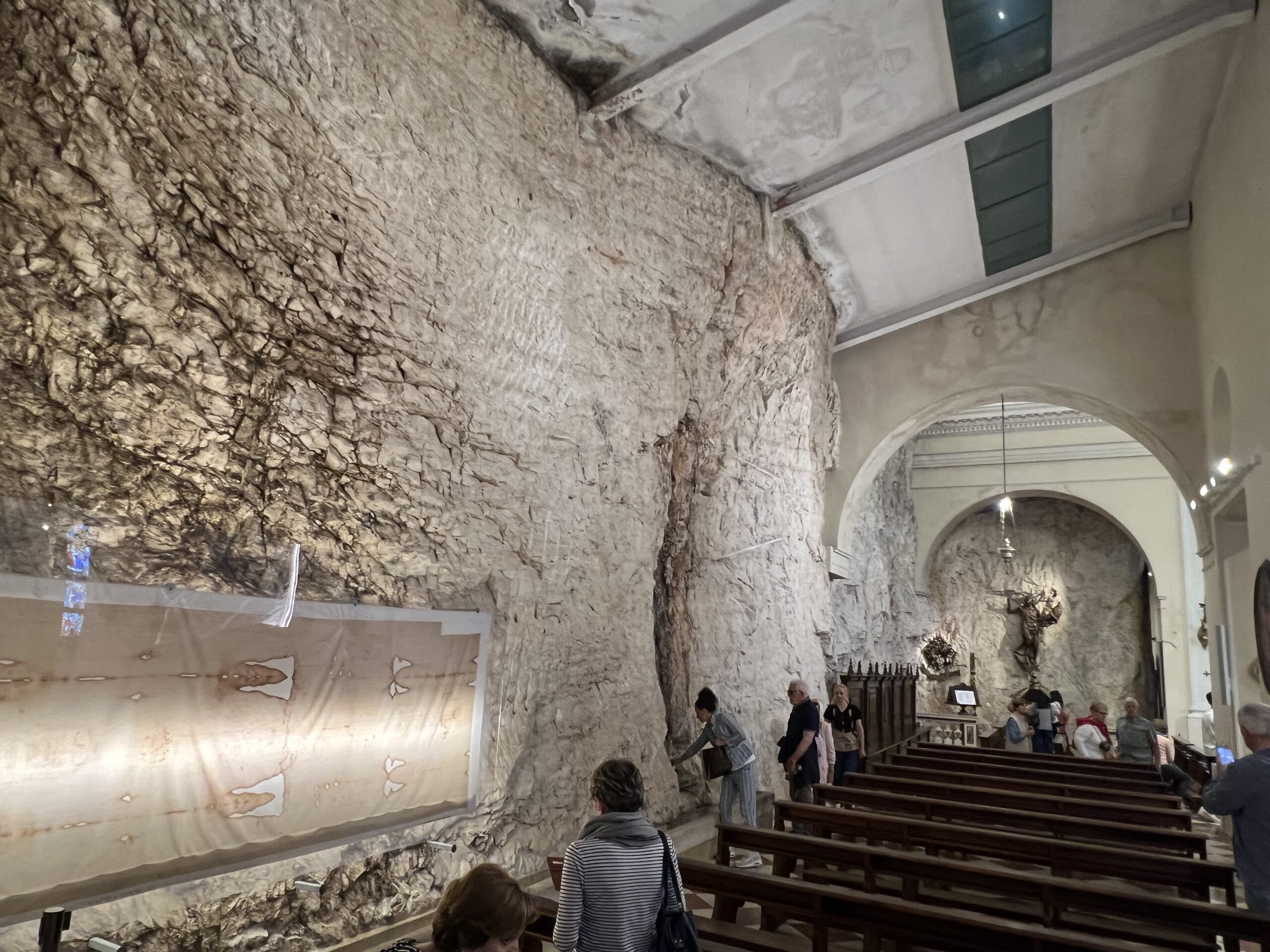
The wall of the church is a large rock and so the mountain enters the church. What an architectural masterpiece, I say to myself. To realise this complex here is more than craftsmanship! Many people in the church look at the mountain face. It can now be clearly seen that the church has been built on and against an imposing rock. Spiazzi has a sanctuary that stands like a rock.
Environment
In the Spiazzi region, there are many walks and cycle tours to be made.
It is 45 km north of the historic city of Verona to reach Spiazzi. The distance from tourist town Garda to Spiazzi is 18 km to the northeast. From the city of Rovereto, the distance to cover is 64 km south. From the pilgrimage site of Montichiari to Spiazzi is 65 km to the northeast.
Posted: 3 June 2024
~~~

 Nederlands
  English (UK)
  Deutsch
  Français