In churches, chapels and on façades, the image of “Our Lady of Perpetual Help” appears frequently. “Our Lady of Perpetual Help” is a title of Mary. This honorific title refers to the well-known Byzantine icon named “Our Lady of Perpetual Help”.
The artwork of Our Lady of Perpetual Help features a golden background and depicts Mary wearing a dark red undergarment, a deep blue cloak and a veil. This veil reveals a star on her forehead. A small section of the green headband is also visible. Mary’s face shows calmness and strength, with a touch of sadness and compassion. She shows some emotion, for much is going on within her. In the top left of the icon, the Archangel Michael is depicted. The angel carries a chalice, from which emerge a lance and a staff with a sponge. These are the attributes associated with the crucifixion of Jesus. Above the angel, his initials are visible. In the top right-hand corner of the painting, the Archangel Gabriel is depicted. This angel holds four nails and a triple cross: a papal cross with three crossbars. Above this image, Gabriel’s initials are inscribed. Just above Jesus’ left shoulder are the initials of Jesus Christ. There are also initials above the Mother of God. The letters above the two archangels, Jesus and Mary, are Greek inscriptions. Our Lady holds her Son on her left arm. The infant Jesus wears a green robe, a red belt and a yellow cloak. He is looking at the archangel Gabriel. It is noteworthy that one sandal is loose. This is a reference to a statement by his cousin John the Baptist. John once said that he was not worthy to untie the sandal of Jesus. There are other explanations for the loose sandal. The Child looks on with utter dismay at the objects held by the archangel Gabriel. Jesus clings tenderly to his Mother and has placed both hands in her right hand. The image evokes thoughts of his coming suffering. The Child turns to his Mother to be comforted. Another explanation is that Our Lady is startled by the archangels’ messages concerning the impending suffering of her Son. This causes a startled movement, causing Jesus’ sandal to slip off his foot.
The colours of the icon have meaning. The golden background refers to glory and happiness in heaven. The red of Mary's robe signifies love. The blue of Our Lady's mantle means faith and trust. The green of Jesus' robe stands for divinity and hope. The brown of Jesus' mantle symbolises humanity with the colour of the earth. The archangels are depicted with their robes in the green colour for hope and the red hue of love.
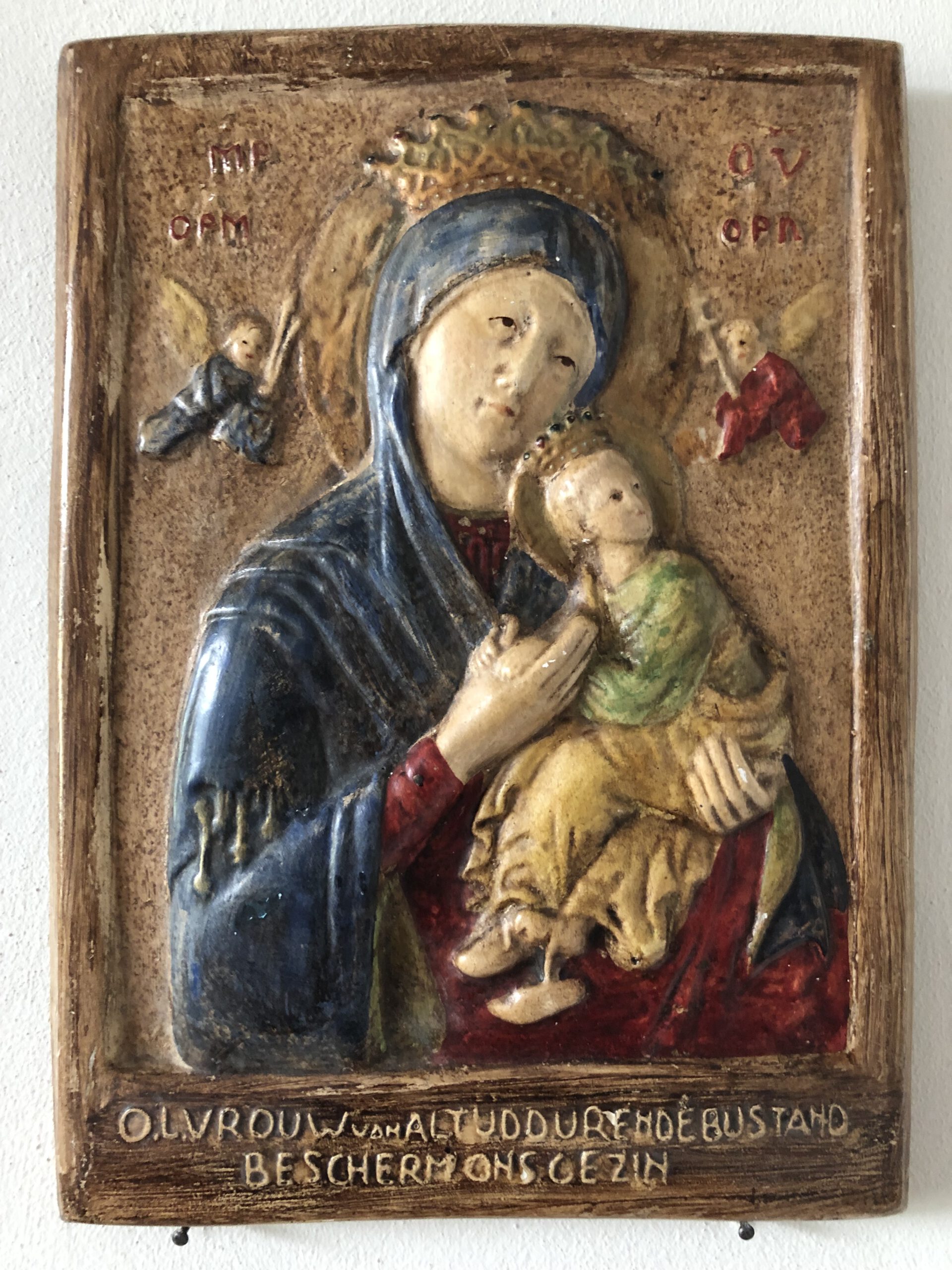
On many images of Our Lady of Perpetual Succour, Mary and Jesus are depicted crowned. However, these crowns are not part of the original icon. The headdresses were added later, in 1867. The Vatican expressed the wish to crown the images of Mary and Jesus. The crowning was done by montage after they had been blessed. The headdresses are made of gold and set with jewels. The crowns were removed for the restoration of the icon in 1994. The Redemptorists have indicated that they wish to preserve the icon in its original state, meaning without the two crowns. The crowned image thus existed from 1867 until 1994, for a period of 127 years.
The icon goes from the island of Crete to Rome. The original, Byzantine icon of “Our Lady of Perpetual Help” has been in Rome since the 15th century. The current location of the artwork is the church of the Most Holy Redeemer and Saint Alphonsus (Santissimo Redentore e Sant’Alfonso) on Via Merulana, which was built between 1855 and 1859. Alfonso Maria de’Liguori (1696-1787) is the founder of the Congregation of the Most Holy Redeemer. This church is the mother church of the Congregation of the Most Holy Redeemer, namely the “Congregatio Sanctissimi Redemptoris” (C.S.R.). Within this congregation, devotion to Our Lady of Perpetual Help is very strong.
The Redemptorists have distributed millions of images of the icon worldwide. This was done at the request of Pius IX, Pope from 1846-1878, born Giovanni Maria Mastai-Ferretti (1792-1878). It is the most famous painted or sculpted image in the world. People experience help and comfort from Mary, among other things, from the icon. The image is very popular with Catholics and the icon is present in many homes. In the Eastern Orthodox Church (Orthodox Catholic Church) the image is known by the name Theotokos of the Passion; God-bearer of the Passion. In the Russian Orthodox Church, the icon is also popular and is called “Strasdnaia” there.
In 1992 the original icon was examined for restoration. It was then established that the wood dated from the 14th century. An art historical analysis revealed that the painting was applied in the 18th century. The conclusion was that the 18th-century icon is a copy of the revered 14th-century icon.
The image of Our Lady of Perpetual Help inspires confidence and aims to bring peace. Especially in difficult times, the likeness is a means for believers to ask for help.
The image of Our Lady of Perpetual Succour in a church or chapel is often accompanied by the text of a prayer. Besides a prayer, there is also a litany and a novena to Our Lady of Perpetual Succour.
Our Lady has on several occasions expressed her predilection for the well-known painting. She has said that her favour will always accompany the image.
In the Catholic Church, the annual commemoration of Our Lady of Perpetual Help is on 27 June. In the Orthodox Church, the commemoration takes place twice a year, on 30 April and the 6th Sunday of their Easter; the Sunday of the man born blind.

 Nederlands
  English (UK)
  Deutsch
  Français