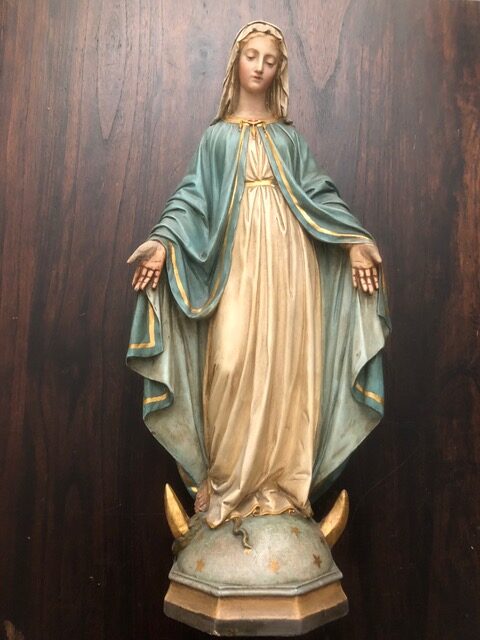
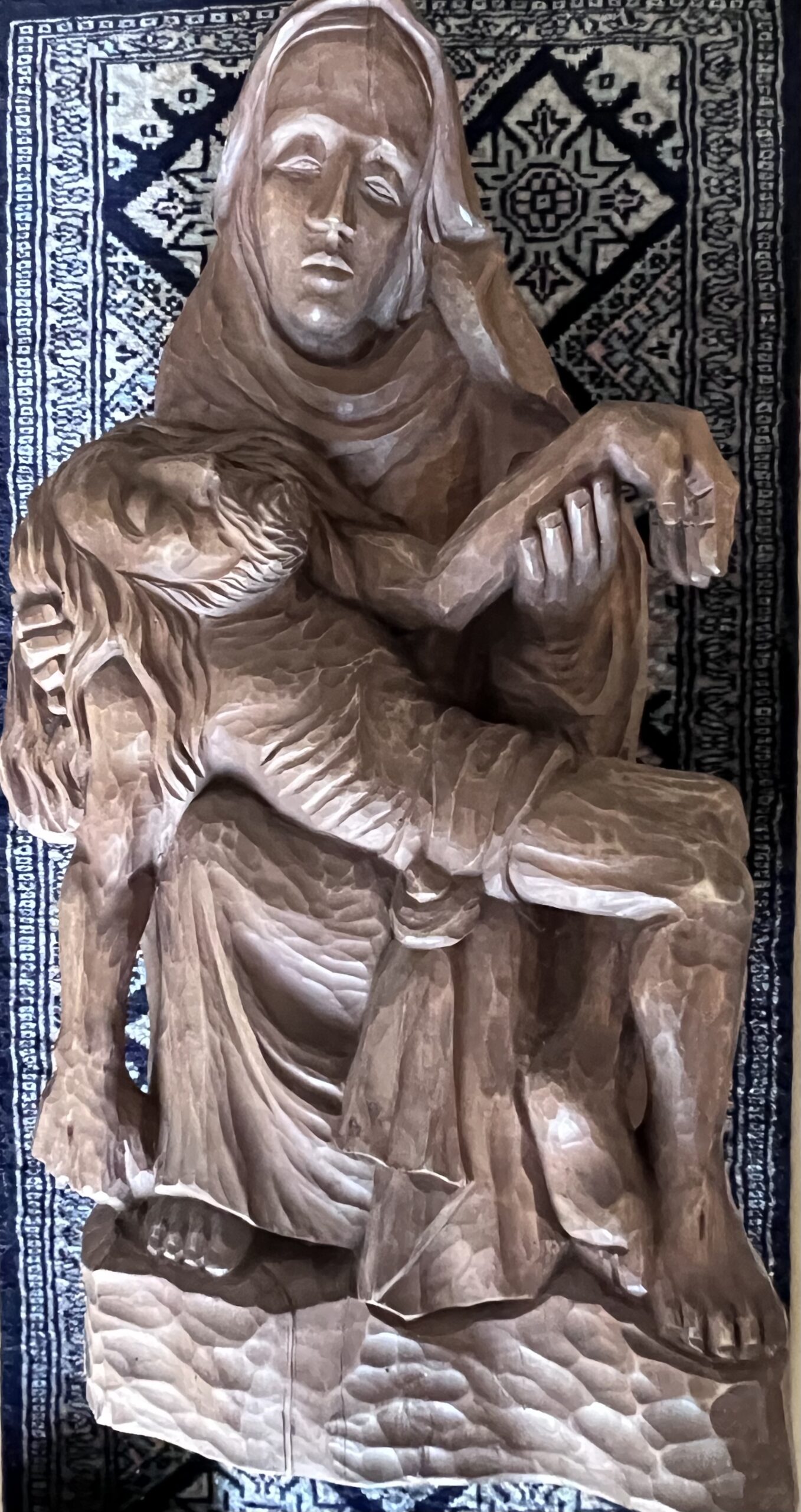
A Pietà is an artistic representation of Mary holding her dead Son on her lap. The word Pietà is of Italian origin (pietà) and is also known as a Vesperbild in German. The word Pietà stands for compassion and piety. The Pietà theme originated in the 13th/14th century in Germany and Spain and subsequently spread worldwide.
A widely viewed and admired image of a Pietà is this one by Michelangelo, which stands in St. Peter's Basilica in Rome. Michelangelo's full name was Michelangelo di Lodovico Buonarroti Simoni (1475-1564). What is striking about this Pietà is that it is Michelangelo's only signed creation. He did this to make it clear that he was the creator of the artwork. Michelangelo's sculpture is made of white marble. Michelangelo received the commission in 1498 from Jean Bilhères de Lagraulas (c. 1430-1499), French cardinal (1493-1499).

Many artists have created a depiction of the deceased Christ or Pietà, such as the Italian sculptor Donatello (1386-1466), the Italian painter Giovanni Bellini (1430-1516) and the artist El Greco, originally from the island of Crete, whose full name was Domenikos Theotokopoulos (1541-1614).
The image of Jesus on Mary's lap experiences a peak in the 17th and 18th centuries. The Pietà is then a continuation of the Stations of the Cross, showing Jesus being taken down from the cross and laid in his Mother's lap.
~~~

 Nederlands
  English (UK)
  Deutsch
  Français