MORESNET – CHAPELLE
History
Politically, Moresnet has experienced a turbulent period. As Neutral Moresnet, it was an undivided, small territory of 344 hectares. This lasted from 1816 to 1920. After Napoleon's defeat at Waterloo, the area, which had an important zinc mine, became a point of contention between Prussia and the Kingdom of the Netherlands. This resulted in it becoming a neutral territory. On 10 January 1920, the Treaty of Versailles, signed on 28 June 1919, came into effect, assigning Neutral Moresnet, “The Undivided Territory of Moresnet”, to Belgium. In these turbulent times, German Franciscans found a safe haven in Moresnet.
In 1747, Peter Arnold Frank (1741-1801) is six years old. He is the sixth of seven children. The boy hides in a barn because the ground is shaking from an earthquake. He is very anxious and trembles constantly. Ever since, he continues to suffer from epileptic seizures and never recovers. In 1750, the ill Peter Arnold Frank asks Katharina Klein to bring him a figurine of Mary from Aachen. Katharina gives Peter Arnold the figurine. Every day, he prays at home before the shrine. However, the epileptic seizures do not disappear. Later in 1750, he brings the figurine of Mary to a nearby wood. He builds a small wooden house and places the figurine inside it by a small oak tree. The boy prays fervently by the little tree and is freed from his epileptic seizures. This news spreads quickly, and many people begin to venerate Mary by the little oak tree.
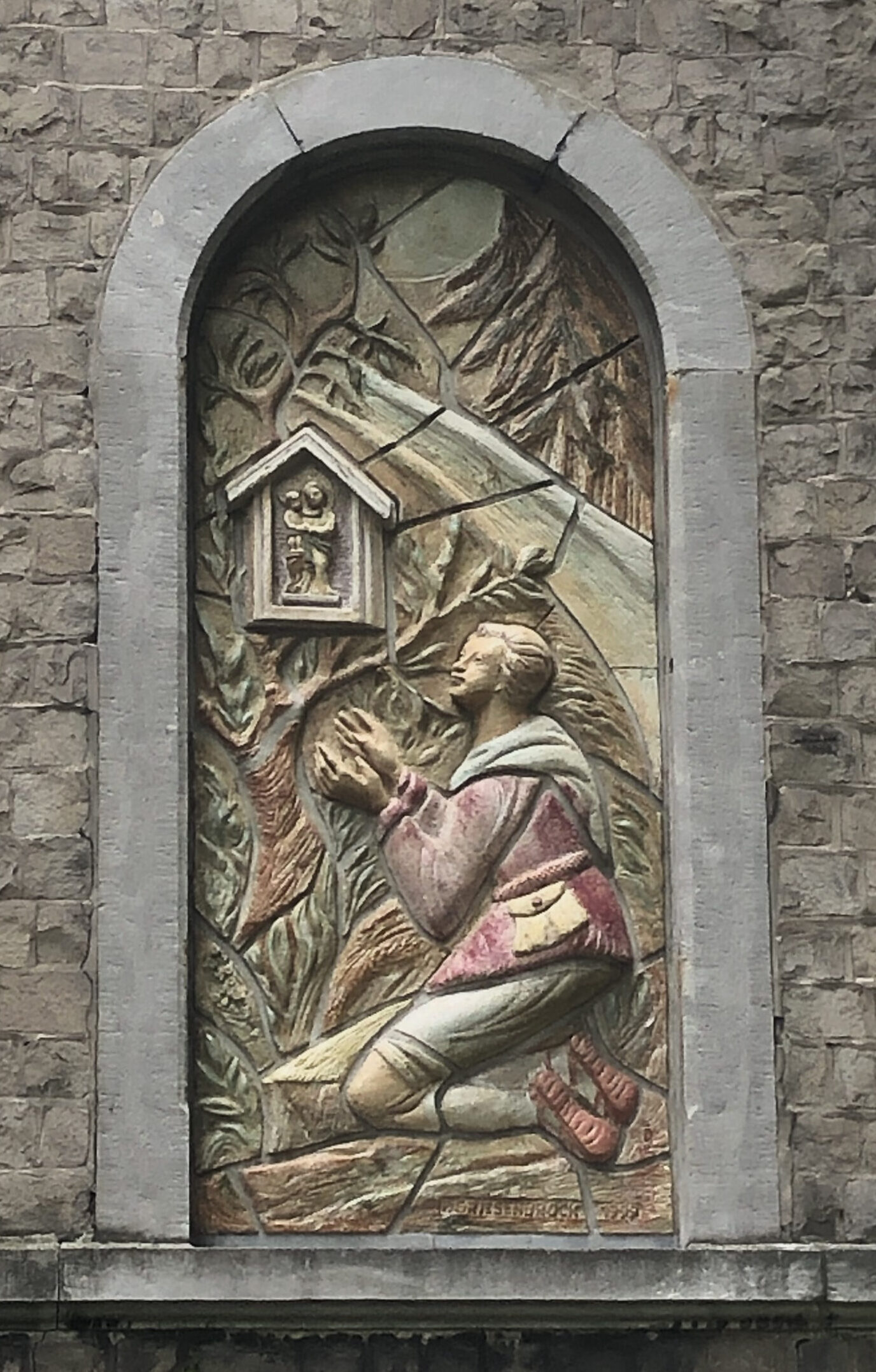
Peter Arnold Frank hides the devotional image in a chest when French troops arrive in Moresnet. After French rule, the chest turns out to be empty; the statue is already in its familiar place by the oak tree.
At the end of the 18th century, there was an infectious cattle disease on several occasions. Many farming families came to the devotional image to pray and ask Mary for help. The cattle disease was a disaster for the population, as people lived by cattle farming. In 1771, members of farming families went with Peter Arnold Frank to the statue of Mary in the oak tree and prayed there a great deal. Subsequently, the cattle disease disappeared. This made the image by the oak tree even more famous.
In the early stages of the French Revolution (1789-1799), the expression of faith is severely restricted. Pilgrimages to Moresnet do not take place. This is definitively halted when Napoleon Bonaparte (1789-1821) restores peace in 1799.
In 1797, there was again a contagious cattle disease, and this too disappeared after much prayer before the statue of Mary. Following this, pilgrims came in very large numbers to Moresnet in procession. The pilgrimages increased again after Napoleon Bonaparte came to power in France and granted people the freedom to profess their faith.
Moresnet is established as a separate territory in 1816 following the fall of Napoleon, as new national borders are set between Prussia (now Germany) and the United Kingdom of the Netherlands (present-day Netherlands and Belgium). This causes disagreement because the border runs through an important zinc mine. The decision is then made that this site (Vieille-Montagne) will not belong to either country, and a new, neutral nation is founded, namely Moresnet. This is officially recorded on 26 June 1816 with the signing of the (border) Treaty of Aachen. Moresnet then exists as a distinct country between 1816 and 1920. From 1920 onwards, after the First World War when new borders are established, it becomes part of the Belgian province of Liège.
Interest in the statuette in Moresnet is growing ever larger. A plan for a stone chapel is being drawn up. Construction will begin once the third transmissible livestock disease has disappeared. In 1823, the chapel is built to accommodate the influx of pilgrims. The statuette will be placed in this chapel.
In 1829, the first grand procession is held.
In 1831, Marian devotion was permitted in the chapel by Belgian ecclesiastical authority. The chapel was enlarged, as more and more pilgrims came to venerate the miraculous image. In 1831, the chapel was consecrated. A hermit took care of the pilgrims, and his hermitage was located next to the current monastery.
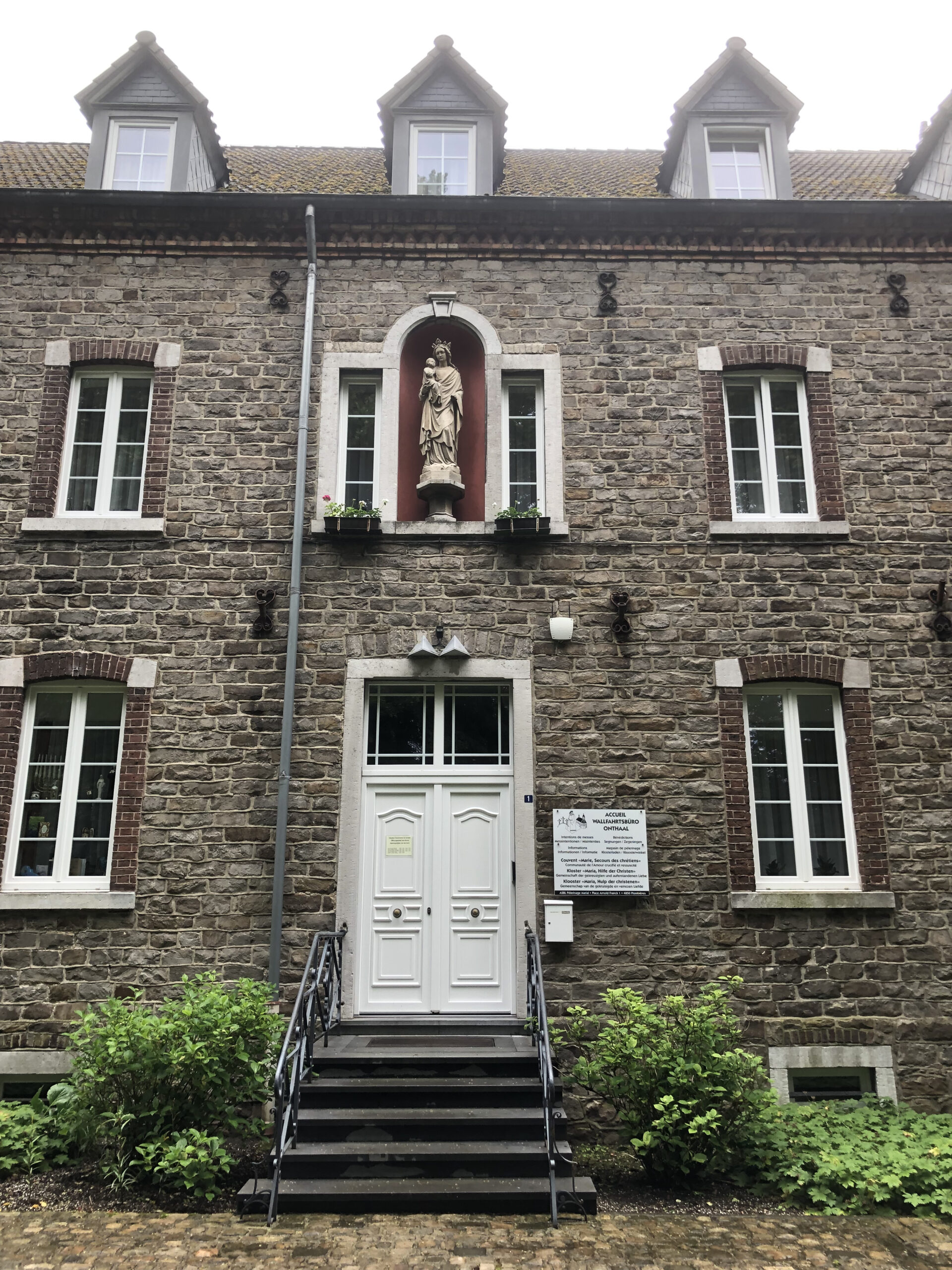
Due to the “Kulturkampf”, the struggle between the Roman Catholic Church and the state of Prussia, the Franciscan convent in Aachen is dissolved. As a result, the Franciscan nuns come to Moresnet to find accommodation. This happens in 1875 on the initiative of Franziska Schervier (1819-1876), the founder of the Congregation of the Poor Sisters of Saint Francis in 1845. At the request of Théodore Alexis Joseph de Montpellier (1807-1879), Bishop of Liège (1852-1879), the Franciscan friars are to manage the chapel.
The chapel becomes too small for the reception of the many pilgrims and is demolished in 1879. A larger house of worship is built in its place, and that is the current church on Rue de la Chapelle.
In 1895, Johannes de Ruiter, the later chairman of the Marian pilgrimage site, conceived the plan to erect a Stations of the Cross next to the chapel of grace. Subsequently, land was purchased and exchanged, acquiring a sufficiently large plot of about 3.5 hectares. Construction of the Stations of the Cross began in 1898. Stones were quarried on the site where the Stations of the Cross would be built. These stones were used to construct the surrounding walls of the Stations of the Cross and those of the cloister garden. The vaults of the stations were made with stones from Vaals. First, the 12th station, the grotto, was realised. It is the crucifixion group with Jesus, Mary, John, and Mary Magdalene. The artwork is by sculptor Lambert Piedboeuf from Aachen. In 1899, there was a shortage of funds, and the Stations of the Cross could not be fully completed. A few years later, progress resumed, and in 1902, the not yet entirely finished Stations of the Cross were consecrated. A year later, the 12th station was enlarged and extended with the Centurion and two criminals. In 1904, all stations were ready. Most of the station depictions are about one and a half metres high and a metre wide.
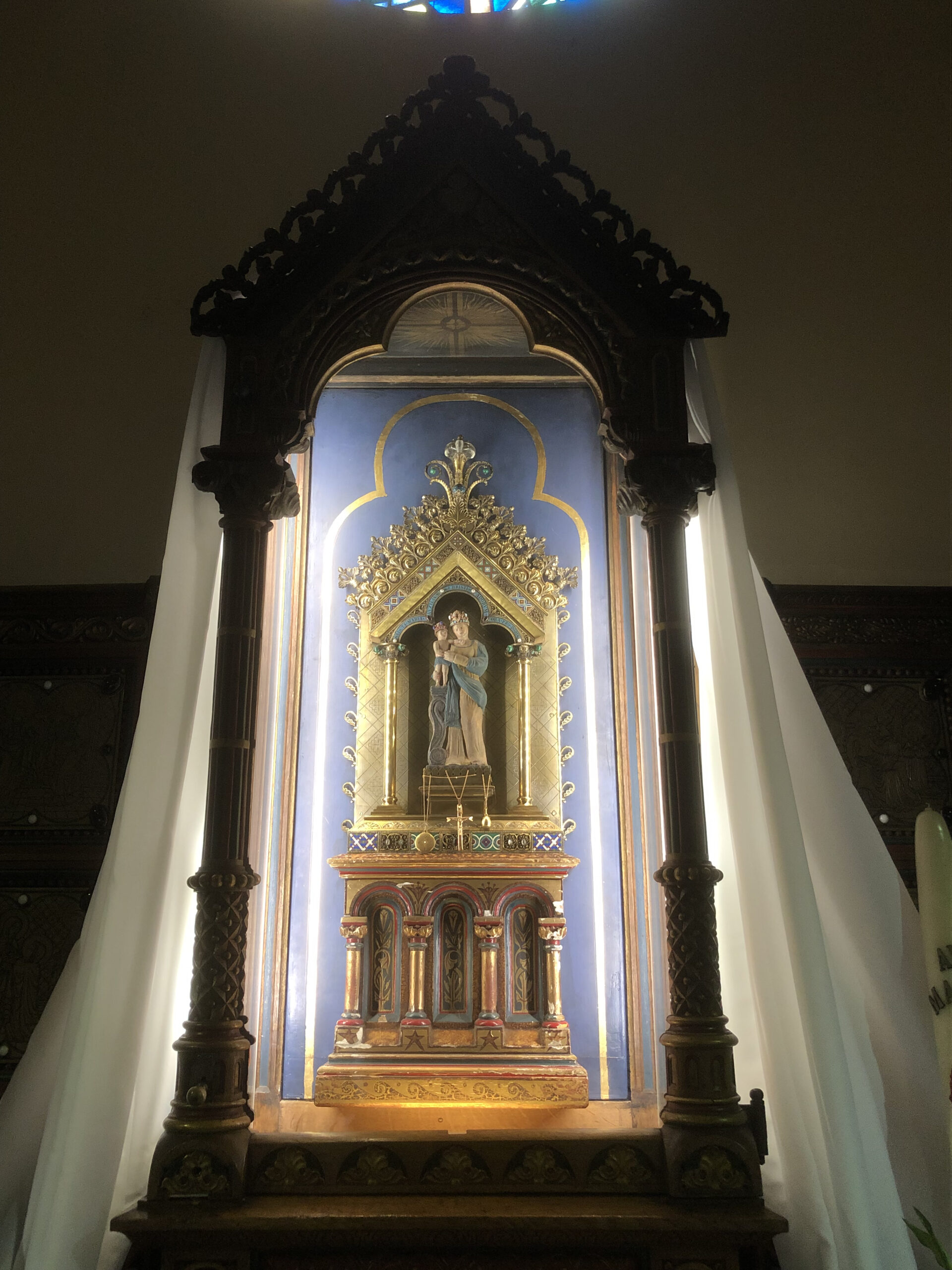
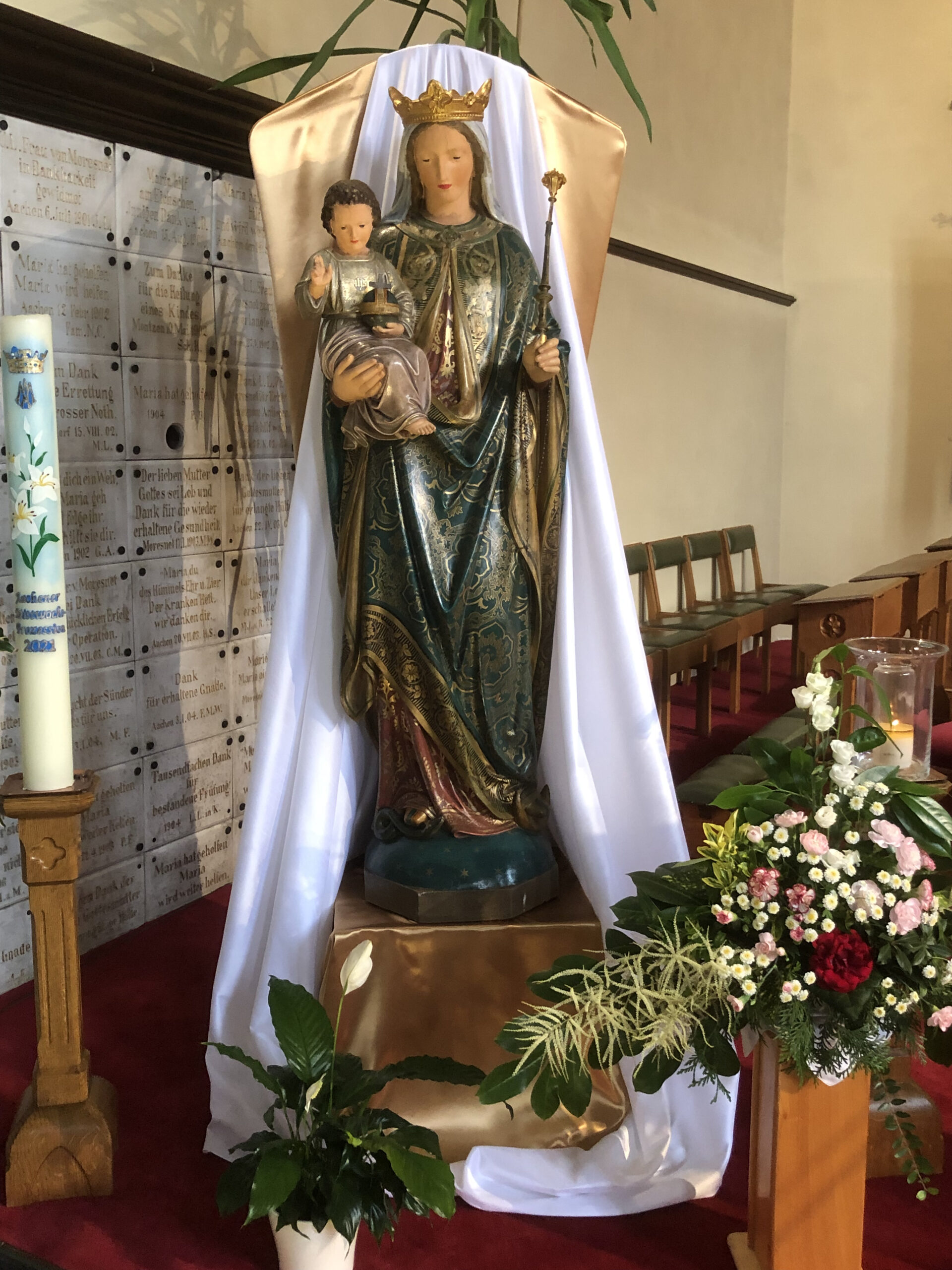
A new chapel of grace was built in 1991. The foundation stone for the Mary Chapel was laid on 2 February 1991 (Feast of the Presentation of the Lord). The chapel was consecrated on 8 September of that year (Feast of the Nativity of Mary). In 1992, the statue of grace was moved to the new chapel, to the right of the church. The statue originates from Aachen.
Pilgrimage site
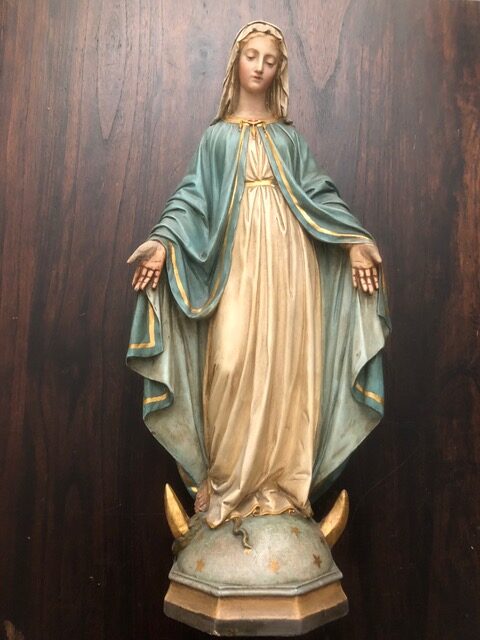
In the Marian pilgrimage site of Moresnet-Chapelle stands the miraculous image “Mary, Help of Christians”, also called “Mary, Refuge of Christians”. The small statue of Mary dates from 1750 and is made of terracotta. It is 24 cm high and has a small crown from 1823.
The patron saint's feast day is on 24 May. This statue is also called “Eichschen” or “Eikschen” because it once stood against the trunk of an oak tree. The pilgrimage site is also called Our Lady of the Little Oak because the statue of Mary is placed in an oak tree. This is done by the boy Peter Arnold Frank, who has great devotion to Mary.

The pilgrimage church stands on a through road and is 35 metres long and 12 metres wide. The ribbed vaults meet in the centre in a boss with the letter “M” for Mary. The high altar is made on the raised presbytery. Above this are Mary and John under the cross.
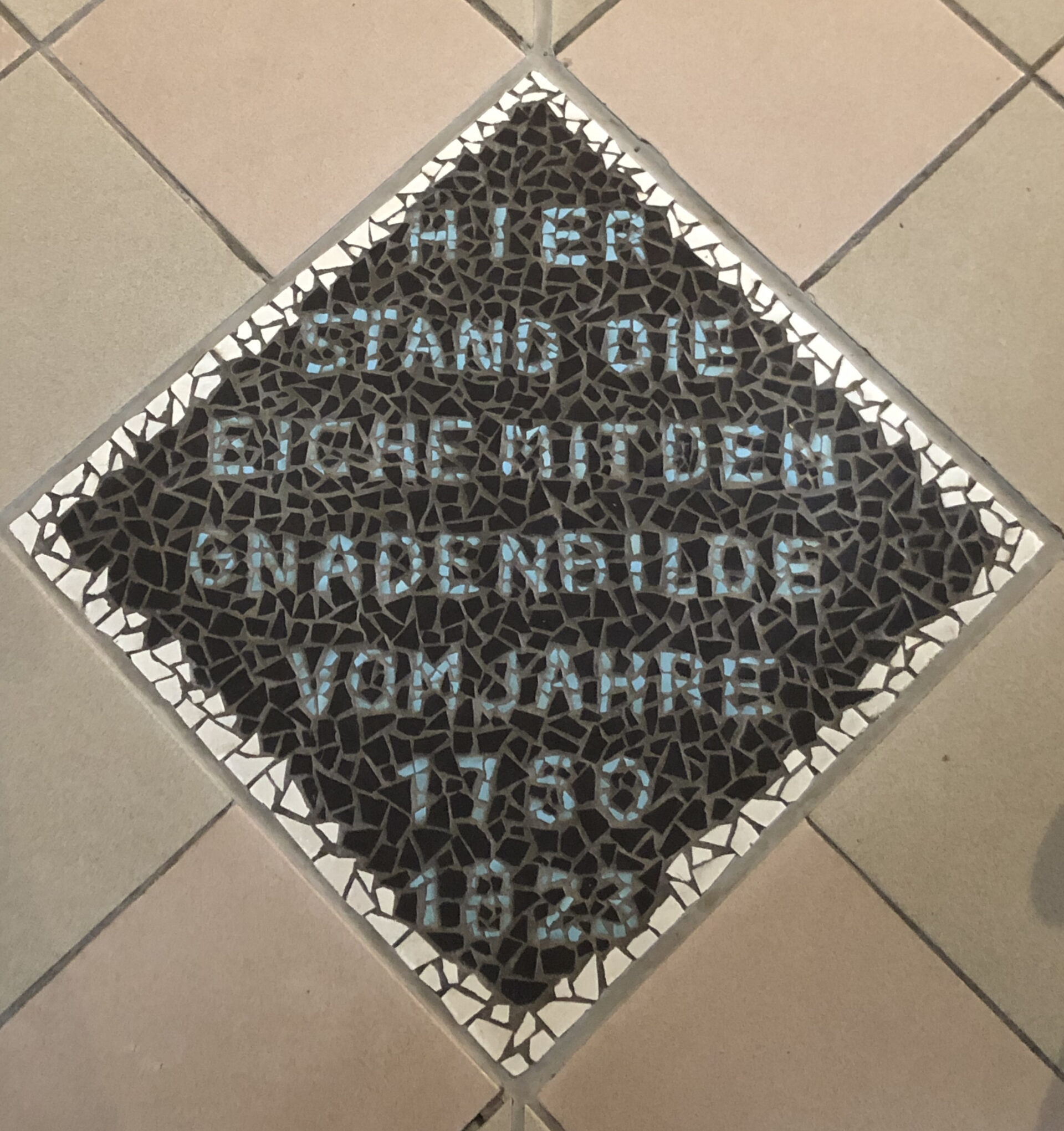
In the middle of the ship is an inscription, indicating where the old oak once stood.
Marble votive tablets are affixed to the side walls of the chapel. In the central aisle lies a stone and the mosaic work makes it clear that the oak tree with the statue of grace stood here from 1750 to 1823.
The new chapel of grace, built in 1991 and fitted out in 1992, has alcoves where candles are lit. In the centre of the altar of grace, the devotional image of Our Lady of Moresnet stands within a shrine. The statuette, 24 centimetres tall, dates from 1750 and is made of terracotta.
Theška also worth visiting is the Stations of the Cross, with very beautiful, impressive stations. The route is situated next to the church and was created by the Franciscans, being completed in the early 20th century. Behind the 12th station, the friary cemetery has been established. Here also lies the initiator of the Stations of the Cross, Father Johannes de Ruiter.
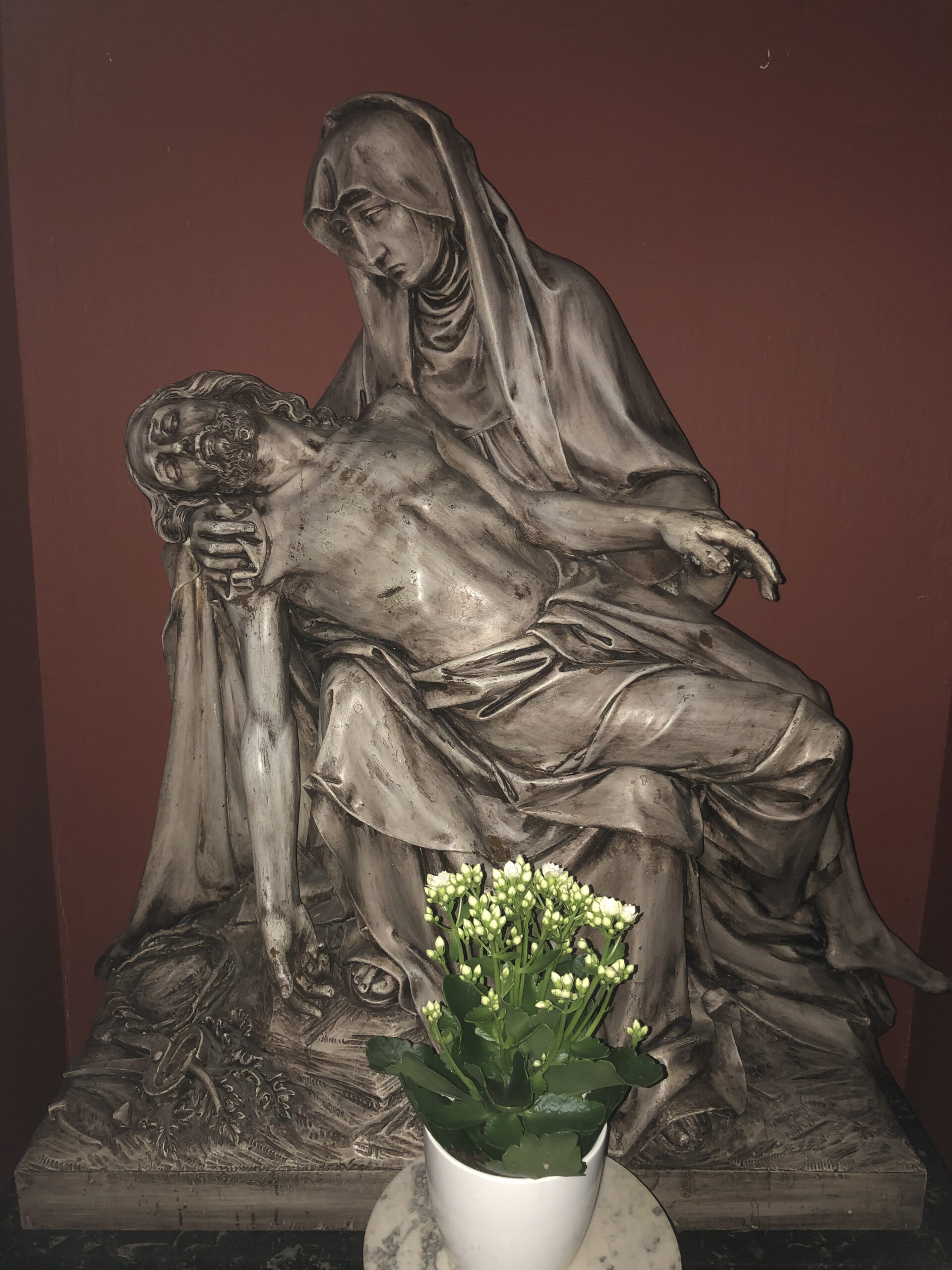
The pilgrimage site is mainly visited by German speakers.
The church and the chapel are open every day.
ACCESSIBILITY
Moresnet-Chapelle lies just below the Dutch/German border in Belgium, directly below the three-country point of Vaals in Limburg. Moresnet-Chapelle is situated on the road from Vaals to Kelmis in the hamlet of Eischen.
Address: Franciscan Monastery Moresnet Our Lady of Refuge, Place Arnold Frank 1, B-4850 Moresnet.
Website: www.moresnet-chapelle.com and the necessary information can be read here.
Experience
In the Chapel of Grace, next to the altar, I see two colourful windows. One depicts the Annunciation, the Angelic Salutation, and the other the Coronation of Mary. The miraculous image, originating from Aachen in Germany, stands magnificently in a shrine in the centre of the altar. Mary and the little Jesus wear a small halo crown. Mary lovingly holds Jesus's right hand. Beneath the miraculous image, I see a depiction of the small oak tree with the miraculous image. This is how it all began… The deeply devout Peter Arnold Frank is also depicted here. Furthermore, two cows can be seen, and these animals are a reminder of the serious cattle diseases which caused much damage to farming families. Then I see images from the life of Mary. What a particularly meaningful Chapel of Grace this is!
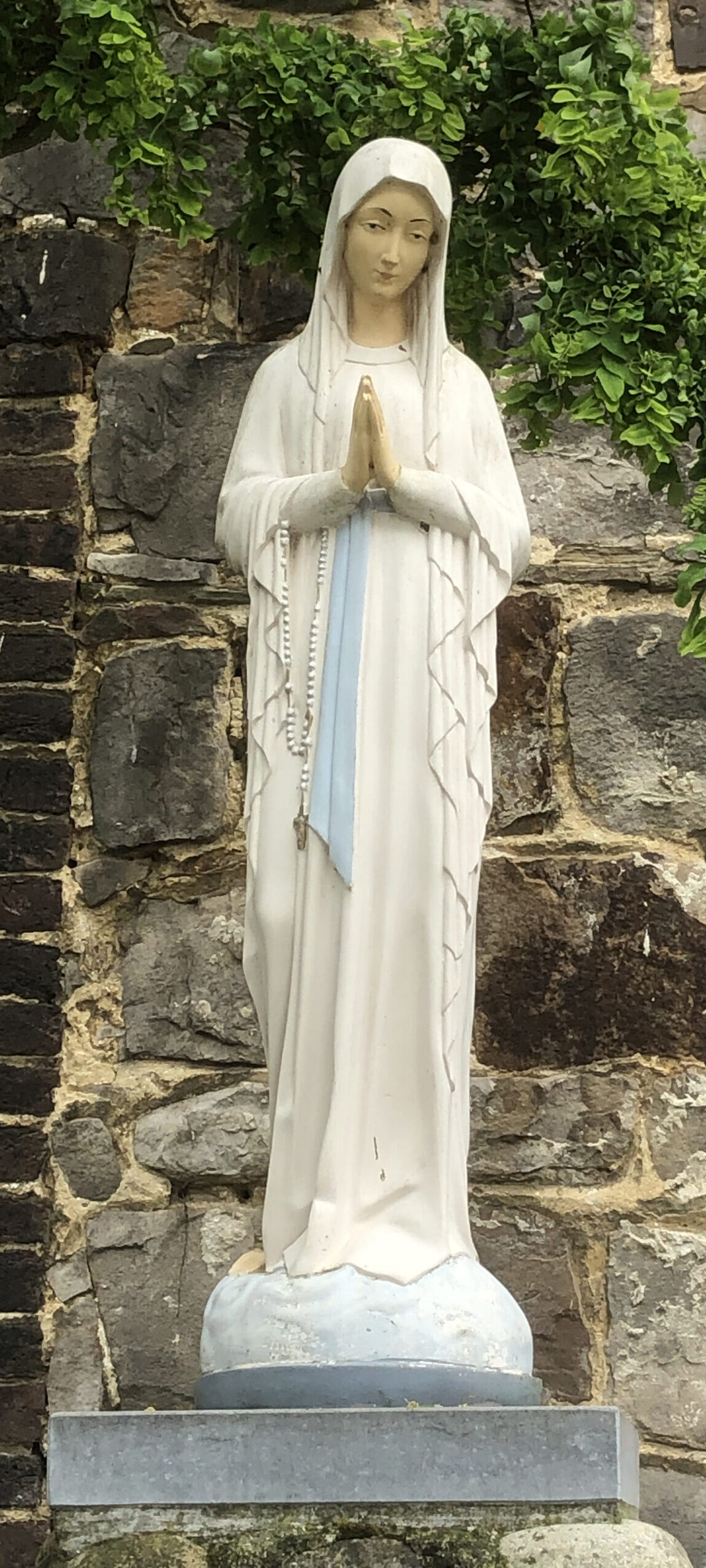
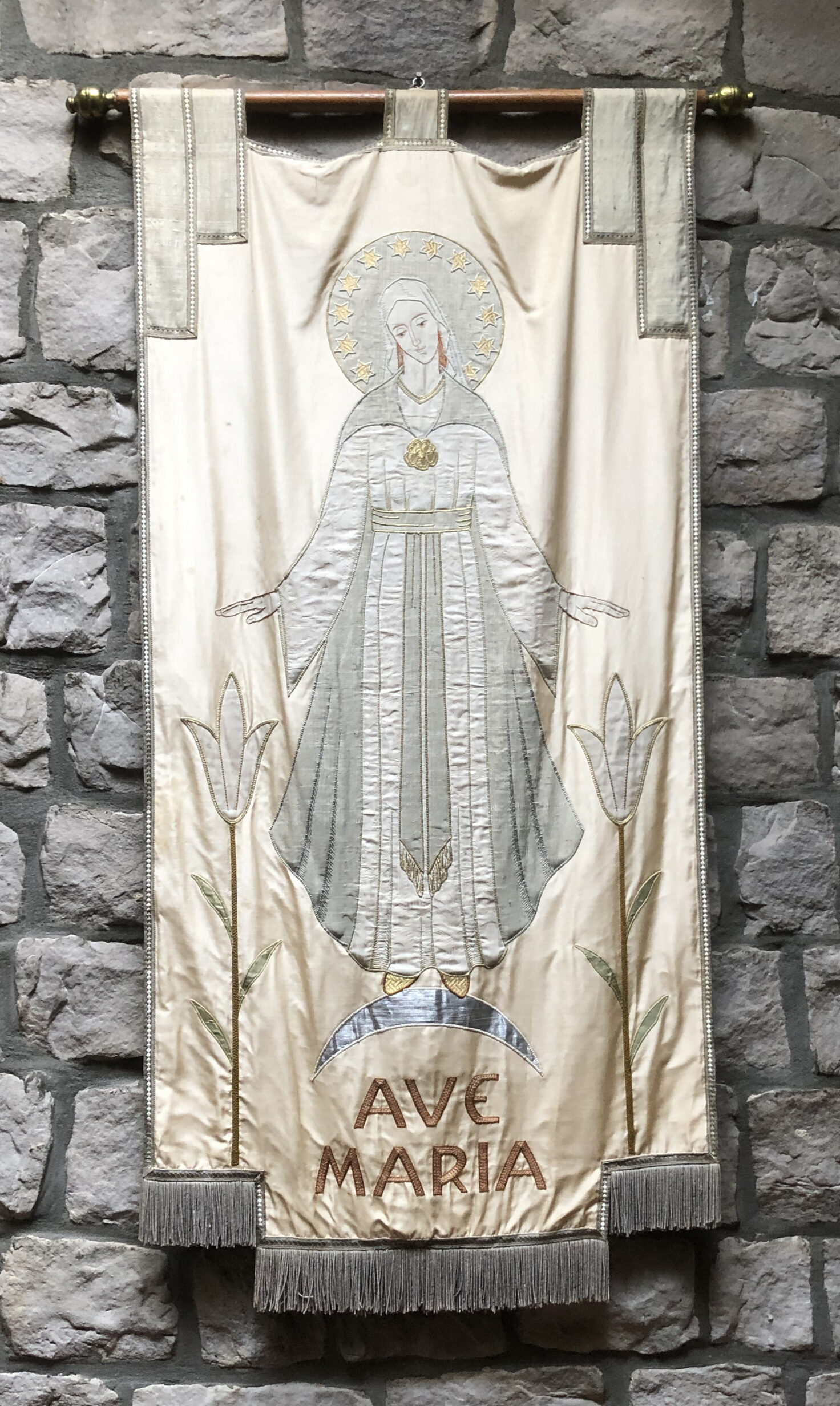
On the corner of Foyer Jean Arnolds, there is a Banneux statue of Mary. Banneux is not far from here either.

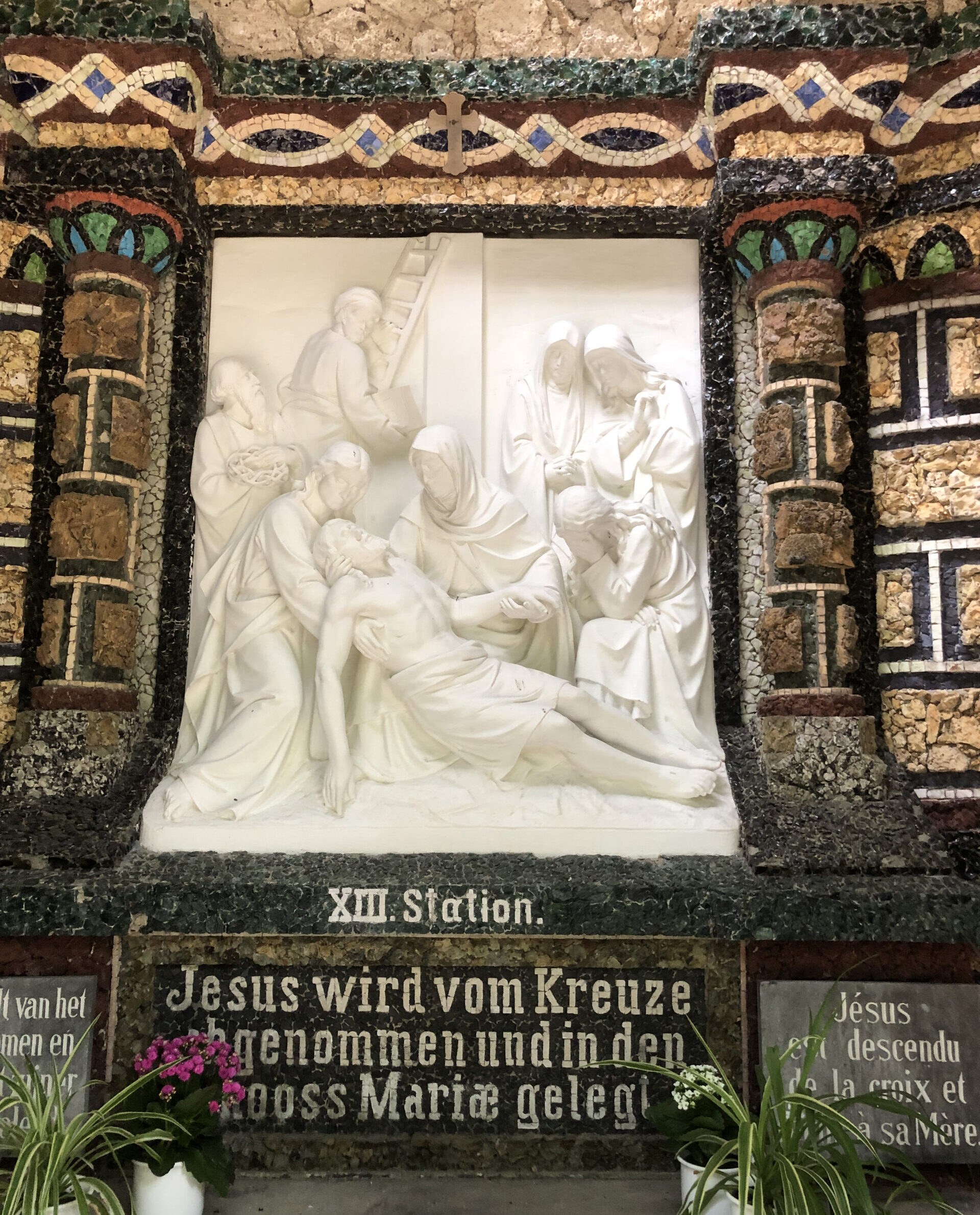
The Way of the Cross in Moresnet-Chapelle makes a profound impression on me. I consider all the stations to be true works of art. It is truly a great gift that all the funds for the stations are donations. I stand for a long time reflecting on each part of the Way of the Cross, wondering if any depicted passion surpasses that of Moresnet-Chapelle. The totality of the stations feels to me like a stay in a gigantic cathedral with an impressive Way of the Cross. I find the choice to incorporate each image into a grotto with a grille as a separation to be particularly characteristic. Symbols are incorporated into each artwork. Because the stations lie along a slightly curved route, there is always a surprise in discovering the next station of the cross. At the 11th station, “Jesus is nailed to the cross,” I see references to Jesus' miracles in the grille. The letters IHS (Jesus Hominum Salvator) are also incorporated into it.
The 12th station stands on an constructed hill and this compels me to pause for a little longer. It is the highest point of the entire Way of the Cross. Here, the grotto is wider than the other structures. In front of the grotto is a stone altar, and a Eucharist celebration can take place here. Imposingly, high above the grotto, the crucifixion scene is depicted. Three crosses; for two criminals and Jesus in the middle. In addition, there are four sculptures of Mary, Mary Magdalene, John, and the Centurion. Mary stands there sadly with raised, folded hands. This Way of the Cross makes me intensely feel the suffering of Jesus and Mary.

In the shop full of devotional items, behind the church, I see many objects, such as booklets, prints, rosaries and more. Suddenly my eye falls on a booklet titled “Moresnet Le Calvaire”. This souvenir album contains a series of images of the Stations of the Cross. The photos are in black and white and were taken shortly after the completion of the Stations of the Cross. Seeing the photos fascinates me once again by the mountain with its many stations. It is a true Golgotha of Jesus' suffering.

The visit to Moresnet-Chapelle is more than worth it.
Posted: 7 May 2020.
Last modified: 4 November 2024.
~~~

 Nederlands
  English (UK)
  Deutsch
  Français