History
In the year 1638, King Louis XIII (1601-1643) declared that France was dedicated to Mary. During this period, the 30 Years“ War (1618-1648) raged between Catholic and Reformed states, and there was much unrest in the Kingdom of France. At this time, Benoîte Rencurel (1647-1718) lived in the small village of St. Etienne d’Avançon, near Laus. Laus means ”lake" in the dialect and is a hamlet of about 100 inhabitants. In 1640, the residents had built a small chapel dedicated to the Assumption of Mary. Benoîte was a shepherdess and grew up in a poor, Catholic family. Her father died when she was 7 years old. This plunged the family further into poverty, and there was not enough money to pay off debts. This meant that the unschooled children of the Rencurel family had to work to earn an income, to live on, and to pay off the debts.
One day in the spring of 1664, Benoîte Rencurel, then 16 years old, was praying the rosary. Suddenly, an old man dressed as a bishop approached her. This person claimed to be Maurice, after whom a nearby chapel was named. He told her to go to the valley of St. Etienne to meet the Mother of God. The next day, Benoîte took her flock to the valley indicated by the man, known as “Vallon des Fours” (Valley of the Lime Kilns), where plaster was made. Benoîte came upon a small cave and saw “a Lady of great beauty.” The woman held a baby in her arms and was surrounded by rays of light. Benoîte wanted to know what brought “the Lady” here. However, the beautiful woman merely smiled. The following days, “the Lady” appeared again, but smiled and remained silent. In May 1664, Benoîte was in the chapel of Notre-Dame-des-Fours, and “the Lady” appeared to her. Two months later, “the Lady” spoke to Benoîte for the first time. She would teach the teenager and prepare her for future tasks. “The Lady” made this clear to Benoîte and would take her time. The core mission was to convert sinners by praying, making sacrifices, and reading people’s souls in order to purify them.
It becomes known that Benoîte is to be visited by “the Lady”. The girl is accused of lying, but there are also those who believe her. The Catholic lawyer and king's prosecutor of Avançon, François Grimaud (1620-1703), initiates an investigation into the events concerning Benoîte Rencurel. After thorough investigation, the conclusion is reached that Benoîte is neither a fraud nor a deceiver, nor is she mentally disturbed. She did not ask “the Lady” to reveal herself. However, at the prosecutor's request, Benoîte does tell “the Lady” that everyone wonders if she is the Mother of God. In response, “the Lady” tells her that she is Mary, the Mother of Jesus, and adds that she will not be seen for some time. This happens on 29 August 1664, the feast day of the beheading of John the Baptist. This makes Benoîte sad and worried.
A month after her announcement, September 1664, Mary reappears to Benoîte. This happens on the other side of the valley in Pindreau. The Virgin Mary says that in the future She will only be seen in the chapel at Laus. Benoîte does not know Laus, the place where a small Marian chapel was built in 1640. Mary tells the girl that She wants a large church to be built in Laus and a place for priests. This church is to be dedicated to her Son and Herself. It is the place where many sinners will repent. In the following months, Benoîte visits the small chapel in Laus. Due to these events, the number of visitors to Laus increases more and more.
In 1665, the apparitions were declared authentic by the Archdeacon of Gap, Pierre Gaillard (1621-1715), Vicar-General of the Diocese of Gap. However, Laus belongs to the Diocese of Embrun. This diocese established an investigative committee. Benoîte answered the questions posed in a simple and calm manner. Her words conveyed conviction and determination, even when she was pressured by interrogators and asked for a sign of the apparition. For this, Mary arranged for a woman in Laus to be healed, who had been suffering from leg pain for years. Specialists had declared the pain incurable. The woman, Catharine Vial, stayed for hours in the chapel and one day she was able to move her legs. Following this, more miracles occurred in the small chapel.
In 1665, Maria asked Benoîte to tell sick pilgrims to take oil from the lamp in the chapel and apply it to their afflicted areas. The sick were healed by using the oil.
In the autumn of 1666, construction of the church began, and it was completed in 1669. The church was built over the chapel. During its construction, a particularly sweet scent was noticed. This scent can still be smelled in the church to this day. On the day of the church's consecration, Benoîte Rencurel joined the Third Order of Saint Dominic.
Benoîte Rencurel continues to disseminate the messages of Mary. She does this to the sick and to priests. She also addresses abuses within the Church, which earns her enemies. In messages to Benoîte, Mary also speaks of reconciliation, both with oneself, with Jesus, and with others.
Jesus also appears to Benoîte to share her worries and suffering. The shepherdess suffers a great deal, partly due to stigmata, which refer to the wounds of Jesus from the crucifixion.
The village of Laus and Benoîte Rencurel also suffer from supporters of Jansenism; the opponents of the Pope. Public worship in Laus is therefore banned, and Benoîte is placed under house arrest. Later, pilgrims return to Laus, and the apparitions cease.
Jean Peytieu (1640-1689), chaplain in Laus and doctor of theology, provides an accurate and convincing account of the events of Benoîte Rencurel in Laus. He drew up a report for the Bishop of Embrun in 1671. Pierre Gaillard (1621-1715), priest, theologian, and vicar-general of the diocese of Gap, also wrote about the history of the events in Laus during the period 1647-1712.
In 1692, unrest in Europe increases. Laus also does not escape the threat of war. The most valuable possessions in Laus are brought to safety by temporarily hiding them in the city of Marseille. Upon the return of the goods, clerics had been appointed who were hostile towards the apparitions.
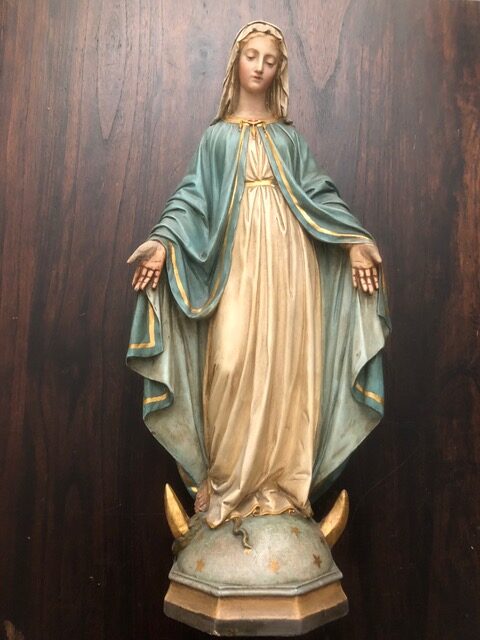
The crowned statue of Mary and Child from 1716 is made of marble from Carrara, Italy. It stands in the chapel of the apparitions (“La Chapelle de Bon Rencontre”), by the tomb of the seer Benoîte Rencurel.
On Christmas Day 1718, Benoîte Rencurel is physically unwell. She is weak and has a high fever. Suddenly, Mary appears, and a delightful scent fills the room. On 28th December 1718, the feast day of the Holy Innocents, Benoîte Rencurel dies at the age of 71. She is then surrounded by priests from the sanctuary.
The statue of Mary in the church of Laus is crowned on 23 May 1855, after obtaining permission from Pope Pius IX (1846-1878).
On 18th March 1894, the church of Laus was elevated to basilica. Pope Leo XIII (1878-1903) upgraded the church to “Basilique mineure”.
On 4 May 2008, Jean-Michel di Falco Léandri (born 1941), Bishop of Gap (2003-2017), officially recognised the authenticity of the apparitions at Laus. Also present at this ceremony was the papal nuncio, Archbishop Fortunato Baldelli (1935-2012). This official recognition had been a long time coming, as the diocese believed that approval had already been granted in the past. In 2003, the Vatican had communicated about this to the diocese. Recognition is necessary for the beatification of Benoîte Rencurel.
In 2009, Benoîte Rencurel was declared venerable by Pope Benedict XVI (2005-2013). This paves the way for beatification.
In 2012, the commission was given for the construction of a new pilgrimage church, next to the basilica, with a capacity of 2500 people.
Pilgrimage site
The Sanctuary of “Notre-Dame du Laus” is beautifully situated about 15 kilometres from Gap, on the southern side of the Alps. For 54 years (1664-1718), Mary appeared to Benoîte Rencurel at least once a month. This is the longest period ever recorded in the history of apparitions of Mary.
To the right of the main entrance, a plaque reads that the church was built between 1666 and 1669 at the request of Maria. The small basilica is a dark building, with only a few windows. The many burning candles and a few spotlights provide some additional light. In the centre of the basilica's altar stands the crowned statue of Maria. Our Lady holds her crowned Son in her left hand. Beneath Maria are four golden saints, including Catharina. Behind the altar are a statue of Maria and a votive chapel. On both sides of the building, stones slabs bear tokens of gratitude. In the “Chapelle de Bon Rencontre”, Benoîte Rencurel experienced apparitions of Maria.
The tombstone of Benoîte is also located in the basilica. Next to it is a large bowl containing oil. Pilgrims still recognise the oil's healing properties, and have done so since 1665.
In the basilica hangs a large painting, which depicts the recognition of the apparitions. Countless people are depicted there, including many clergymen.
From the sanctuary, several walks can be made to special places, such as Pindreau (almost 1 hour), Vallon des Fours (approx. 3 hours), Rozenkapel (approx. 2 hours), Col de l’Ange (approx. 1.5 hours), Saint-Etienne-le-Laus (approx. 2 hours) and the Chapel of the Precious Blood (approx. 0.5 hours).
The Sanctuary of Laus is visited by over 150,000 people annually. It is, after Lourdes, the most popular Marian pilgrimage site in France.
ACCESSIBILITY
The Sanctuary of Laus is located south of the French Alps, about 20 kilometres from Gap and close to the Gap – Briançon road. Laus belongs to the diocese of Embrun.
Address: Sanctuaire de Notre-Dame du Laus, 758 Grande Rue, 05130 St. Etienne le Laus.
Current information can be read on www.sanctuaire-notredamedulaus.com.
Experience
If I take the road to Briançon from Gap, after a few kilometres there is the turn-off for the sanctuary. After about 10 kilometres, the road with many bends climbs considerably. As you approach your destination, there are crucifixes on the right and left of the road, each with a flag behind it. Upon arrival, I am at an altitude of about 900 metres and park the car. First, to the basilica…
In the basilica, I am impressed by large paintings measuring some 3 by 2 metres, depicting episodes from Benoîte's life. Stained-glass windows are fitted above the paintings.
Then it is time to attend a Eucharist service. Traditionally, this concludes with a prayer to Mary. Afterwards, I visit the new, large church space, which can accommodate 2,500 visitors. I take a seat and imagine what it is like here when all the seats are occupied.
During the visit to Laus, I will go to the room where Benoîte died on 28th December 1718. Behind a glass wall stands a wooden bedstead. Against the wall, a painting can be seen, depicting an apparition of Mary to Benoîte. Next to the deathbed are three stools. I take a seat on one and look at the bed where the visionary died. I hear that, shortly before dying, she blessed priests. I also notice a large fireplace, which is as black as soot.
About 300 metres from the sanctuary, I visit the Chapel of the Precious Blood (“Chapelle du Précieux Sang”). A large cross hangs in this chapel. At the foot of this cross, Benoîte had visions of Jesus. The old, wooden cross is entirely protected by a glass cross which forms one whole with gilded iron.
Seeing the Chapel of Our Lady of Sorrows (“Chapelle de Notre-Dame des Sept Douleurs”) requires a walk of approximately 2 kilometres. The chapel has stood here on a plateau since 1848. The summit is situated at a Stations of the Cross. In the chapel, I see a cross with Jesus and a small statue of Mary.
Throughout the day, the temperature rises considerably, exceeding 30 degrees Celsius. That is normal here in the month of August. Given the heat, I decide to go to the summit of the Col de l'Ange early the next morning.
It’s quarter to six and I’m setting off. The route is only 1.5 kilometres long. However, the gradient is quite steep, with a gradient of at least 20 per cent. There are crosses lining the path. After about 400 metres, I realise why there are so many benches here. I make use of more than one bench and feel my asthma flaring up. This walk is going to take a bit longer than I first thought. I carry on at a very slow pace.
Arriving at the summit, I see statues of Mary and an angel. This is a place to pray, rest, and enjoy. A little later, I turn around and take in the view, which is postcard-perfect. In the valley below lies the shrine. I feel like I'm in heaven here, even though it's only at an altitude of 1100 metres. I thank Mary for allowing me to be here and place a pebble by her statue. Hundreds of pebbles lie by the statue, as well as flowers, rosaries, and notes for the Virgin Mary. Benoîte prayed and experienced apparitions here.
The Monument Pindreau is also on my list of places to visit. It is the site where apparitions have occurred. It's about 3 kilometres from the sanctuary. The next morning, just after 6 am, I put on my workout clothes and trainers. I walk a lot and jog only a little. Along the way, I see stations of the apparitions, Pope Francis, and texts from the Gospel. Arriving at Pindreau, I see statues on a raised area of large boulders. Mary and Benoîte are depicted there. It feels particularly special to stand at this apparition site. A panoramic view is an added gift for the visitor. Further on, I can see Saint-Etienne-le-Laus and on a sign, near the statues, I read where Benoîte was born and baptised. A little later, I return to the sanctuary. Upon arrival, I take a shower and go to the basilica to attend a service.
Posted 17 June 2022
~~~

 Nederlands
  English (UK)
  Deutsch
  Français