History
The apparitions of Mary to Catherine Labouré (1806-1876) have made the French capital, Paris, a popular pilgrimage site.
Catherine Labouré was born on 2 May 1806 in the village of Fain-les-Moutiers in the Burgundy region. She grew up in a large, poor farming family with her father Pierre Labouré and mother Magdalène Gontard, who came from a reasonably well-off family. Prayer was a part of daily life there. At the age of 9, she lost her mother, who was worn out by the hard farm life and 17 pregnancies, of which 10 children survived. This caused Catherine to feel a lack of motherly love and she was overcome with grief. Catherine took refuge in Mary and embraced an image of Our Lady. She asked Mary to replace her recently deceased mother. Catherine saw Mary as her mother. Subsequently, she began to help more than ever with household chores.
Later, father Pierre Labouré sent his two youngest children, 9-year-old Catherine and the two-year-younger Tonine, to his sister in Saint Remy. The two sisters went to work in a wealthy family. Because they started working at a young age, Catherine and Tonine did not attend school. The eldest child of the Labouré family, Marie-Louise, took on the role of mother. Two years later, the two sisters returned to the farm. Their father desperately needed Catherine on the farm. She was given the task of looking after her father's hundreds of pigeons. She also had to clean the stable and house, maintain the garden, and prepare meals in the kitchen. Through all this work, Catherine began to replace her elder sister, as Marie-Louise left for the convent of the “Daughters of Charity”.
Catherine wants to go to the convent, but she cannot read or write. On Marie-Louise's advice, she must make an effort to educate herself, otherwise she will never be able to go to the convent. Her father does not like Catherine leaving for the convent, as there is a lot to be done on the farm and her eldest daughter has already gone to the convent. Catherine leaves for Châtillon to live with a cousin. This woman runs a small school to complete children's education with reading, writing, and arithmetic. However, there is a poor relationship between Catherine and her older cousin, who looks down on the farmer's daughter. Catherine loses her self-confidence and decides to return to the farm. She has barely learned to read, write, and do arithmetic.
One night in 1825, Catherine Labouré has a dream of a visit from an old priest. She dreams she is in the church at Fain-les-Moutiers and sees the priest celebrating Mass. A little later, she dreams the same thing. He beckons to her and says, among other things, that it is good to care for the sick and that God has plans for her. Catherine does not recognise the man. She shares her dream with the parish priest, who thinks that the old priest might be Saint Vincent de Paul (1581-1660). He founded the Daughters of Charity and organised charitable activities. The parish priest's suspicion is later confirmed for Catherine when she visits the convent of the Daughters of Charity and, to her great surprise, sees a portrait on the wall of the old priest from her dream.
In 1828, Catherine speaks with her father about her calling to join a convent. Her younger sister, Tonine, is then 20 years old and can take over the work on the farm. However, her father does not allow her to enter the convent, as his eldest daughter has already gone to the Daughters of Charity. Pierre Labouré sends Catherine to his son Charles, who has an eatery in Paris. Charles has recently lost his wife and can use Catherine's help. Catherine leaves the farm to go to her older brother. She never returns to her birth village and never sees the farm again. Charles sees that Catherine is not happy in the restaurant; she has a different calling. In 1829, her brother remarries and Catherine is allowed to leave. Marie-Louise, Catherine's older sister, advises her to return to Châtillon to improve her French. An older brother has married her niece from the small school. Catherine takes the step to want to learn more. This brother talks with father Pierre Labouré to exchange thoughts with him about Catherine's calling.
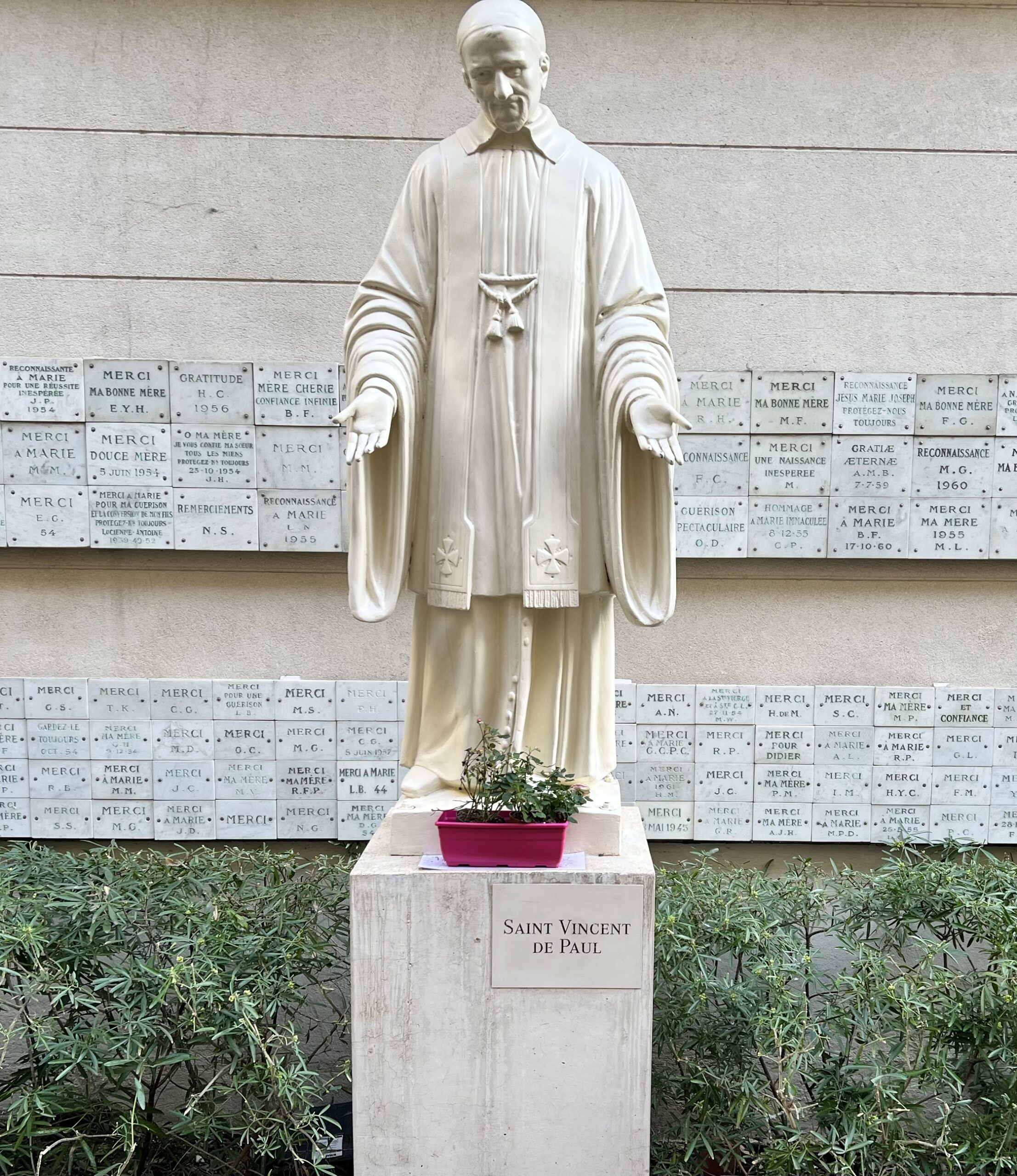
In 1830, Catherine received her father's permission to enter the convent. Some time later, Catherine went to a house of the Daughters of Charity to speak with the Mother Superior about her future. In the parlour, the farmer's daughter saw a painting. She recognised the old priest from a dream she'd had a few years prior. The Mother Superior told her that the man in the painting was Saint Vincent de Paul, the co-founder of the Daughters of Charity.
On 22 January 1830, Catherine went to Châtillon-sur-Seine. She entered the Hospice of Charity and then began her postulancy. This is a probationary period of several months to see if she was suitable to enter the convent. Catherine brought no dowry, and due to this, it was remarkable that she was admitted as a postulant.
After three months as a postulant, Catherine is sent to the convent in Rue du Bac, Paris, on 21 April 1830. Here, her novitiate with the Sisters of Charity begins. She learns to read and write better, works hard, and the Mother Superior is pleased. The postulant period is a probationary period for a sister to be permanently admitted to the convent if successful. Catherine Labouré is now with the Daughters of Charity. A great wish has been fulfilled. A few days after arriving at the convent, Catherine has dreams and visions again.
The Congregation of the Daughters of Charity of Saint Vincent de Paul, or “Daughters of Charity” for short, was founded in 1633 by Vincent de Paul (1581-1660) and Louise Legras-de-Marillac (1591-1660). This organisation grew over the years into a worldwide community of apostolic life in the Catholic Church. The members of the congregation pay special attention to caring for the poor. The sisters wear a cornette, which is a pointed, white headdress. In 1964, this headdress was replaced by a light blue headscarf. Vincent de Paul also founded the mission congregation “Lazarists”, named after the Mother House of St. Lazare in Paris. He also started an association of women from the bourgeoisie to comfort the poor and the sick. The “Daughters of Charity” emerged from this in 1633.
Four days after her arrival at the convent, the relics of Saint Vincent de Paul are transferred in Paris. The body is in a silver reliquary. The relics come from Notre-Dame in Paris and are taken to the Saint-Lazare chapel of the Lazarists on Rue de Sèvres, near Rue du Bac. It appears that the remains are still almost entirely intact. Catherine witnesses the transfer of the relics.
A week later, Catherine has a vision and sees the heart of Saint Vincent in three forms on three consecutive days. The first time, the heart has a light colour that radiates calm, innocence, and peace. The second day, the heart's colour is fiery red as a sign of charity. The third day, the heart is dark red, which causes Catherine sadness.
When Catherine Labouré had been at the convent in Rue du Bac for about three months, she began to see apparitions of Mary. The first apparition was on the night of 18 to 19 July 1830 and took place in the chapel, which was built in 1815.
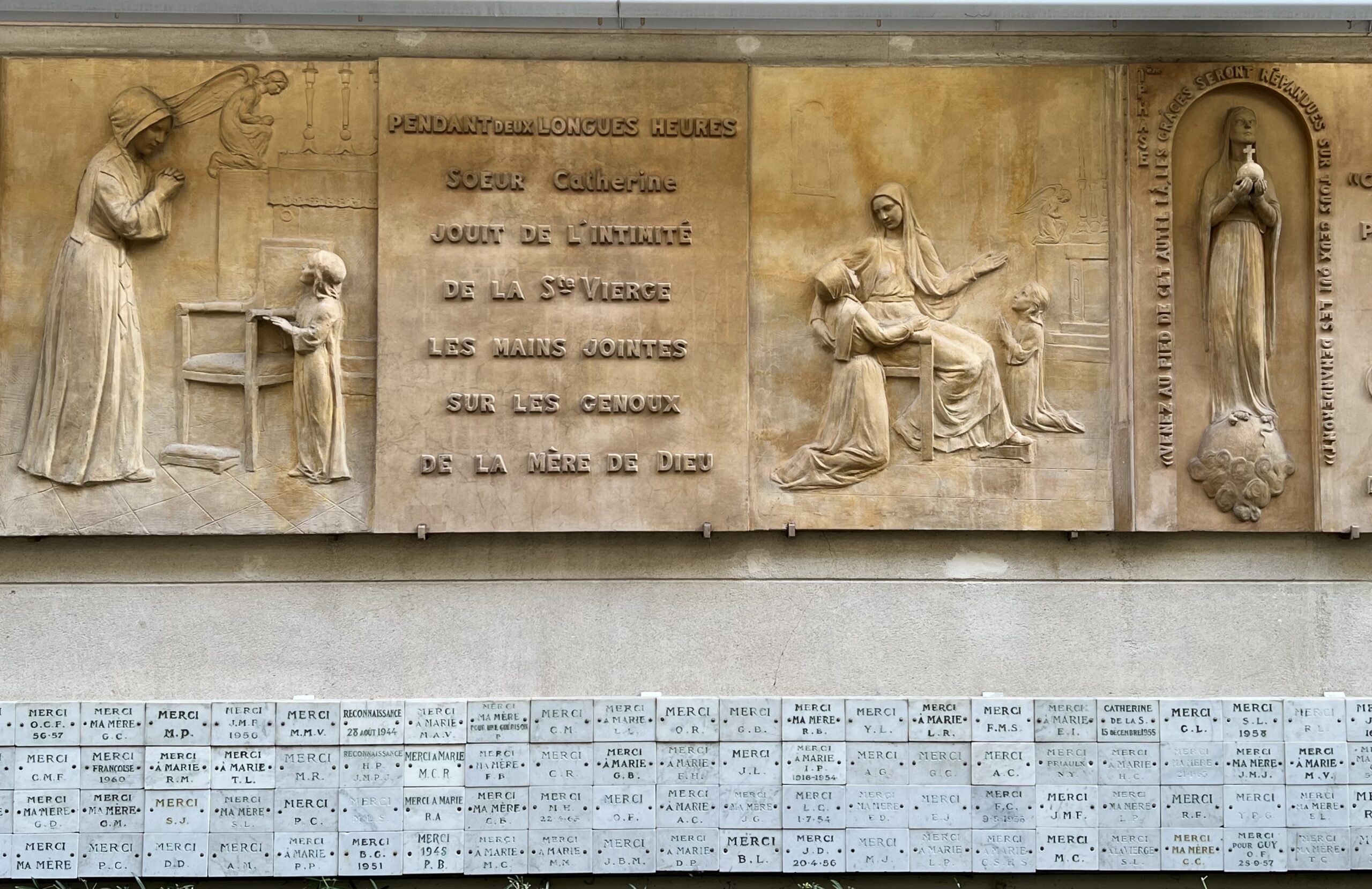
On 18 July 1830, on the eve of the feast day of Saint Vincent de Paul, Catherine, like the other sisters, received a small piece of fabric from the rochet, or white chasuble, of this remarkable holy man. She swallowed a small piece of the fabric. Catherine did this to obtain grace and to be granted a vision of the Blessed Virgin. Half an hour before midnight, she heard a voice calling her. She awoke to find a child of about five years old, dressed in white, standing by her bed. This child was her guardian angel and was radiating light. The little angel directs her to the chapel, because the Blessed Virgin is waiting for her there. Catherine enters the chapel and sees the space filled with radiant light; all the candles and lamps are lit. The little angel leads her to the director’s seat in the chancel. There Catherine kneels. The little angel says: ”The Blessed Virgin is coming. Here She is.’ Then Mary appears. The Mother of God is wearing a blue cloak and a white veil. Mary takes her seat. Kneeling, Catherine is close to the feet of the Blessed Virgin and places her hands on Mary’s knees. A two-hour conversation begins. Mary speaks, among other things, of a mission from God for Catherine, the coming difficulties, approaching hard times, contempt for Jesus and the reopening of her Son’s side. As she speaks, Mary looks very sad. Her sorrow stems from the many abuses. The congregations of the Lazarists and the Daughters of Charity must be reformed. Mary says that the rules must be observed. The Virgin Mary instructs Catherine to convey this to the one who is to lead her. This is not the superior, but Mary explains that he will become so. He must do everything in his power to ensure the rules are followed. Catherine must tell him this in Her name. The community, as a community of religious, will flourish and expand. Mary tells Catherine that great dangers are coming, that she will suffer greatly and be contradicted, but that She is with her. Catherine must have faith in Her. The visionary also hears that there will be casualties among the clergy of Paris. The archbishop will die and much blood will be shed. This prophecy of Mary comes true. On 24 May 1871, the Archbishop of Paris, Monsignor Darboy, is shot.
Other predictions by Maria also come true. There's a recession in France from 1846 to 1848. A revolution breaks out in France in 1848. After that, there's a cholera epidemic. In 1870, French Emperor Napoleon III declares war on Prussia. However, the Prussians are strong, defeat the French, and arrive victoriously in Paris. In the French capital, there's a civil uprising, and the houses of worship suffer. The Sisters of Charity flee Paris.
Later, Catherine remarked that her first meeting with Maria was the happiest moment of her life.
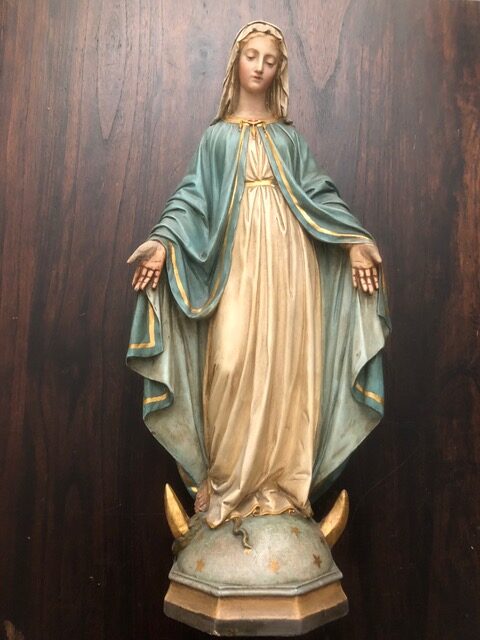
On 27 November 1830, Mary appears for the second time to Catherine Labouré. The Mother of God is dressed in a light red robe with wide sleeves. She wears a long veil with lace from above her forehead to her feet. Her face is uncovered. Her hair is golden and her face reminds Catherine of a woman of about 40 years old. Mary smiles at Catherine but shows sadness and often looks upwards. The Apparition stands on a globe, which represents the earth with the kingdom of the devil, which she is conquering. In both hands, she holds a smaller globe with a small cross on it. Some time later, this globe disappears. Mary wears rings with shining gemstones, from which colourful rays emerge. These beams of light represent symbols of grace. The rays fall in droplets onto the globe. Around Mary, the words form: “O Mary, conceived without sin, pray for us who have recourse to you.” Catherine then sees the letter “M”, above it a cross, and below it two hearts. One heart is Jesus’ and is crowned with thorns. The other heart is Mary’s and is pierced by a sword. The Holy Virgin tells Catherine that she must have a medal struck according to this design. Those who wear the medal will receive great graces. These pardons will be abundant for those who wear it with confidence. This shows that God’s mission to Catherine is about a medal. The Sister of the Daughters of Charity passes on the message to make a medal to her confessor, Father Lazarist Jean-Marie Aladel. However, he does not act on it.
After the second apparition, Mary returns very briefly to Catherine five more times, and each time She repeats the instruction to come with the requested medal.
Not yet a month after the second, lengthy apparition, Catherine sees Mary again for an extended meeting. The Blessed Virgin stands once more on a globe, and a serpent writhes beneath her feet. Mary appears displeased that the instruction to create a medal has not yet been fulfilled. Catherine relays this to her confessor, Father Jean-Marie Aladel (c. 1800-1865). The priest then makes contact with the Archbishop of Paris, Monseigneur Hyacinthe-Louis De Quélen (1778-1839), Archbishop of Paris (1821-1839). He speaks to the high-ranking clergyman about the medal. However, he does not mention Catherine's name. Jean-Marie Aladel then prepares a report which is sent to the bishop.
On 5 February 1831, Sister Catherine Labouré began working at the d’Enghien nursing home. She started by assisting in the kitchen and later cared for elderly men, dressing them and feeding them. It was daily, monotonous work. She was no longer living in the convent in Rue du Bac but in the one in Reuilly. This convent is located at Rue de Reuilly 77 in Paris, which is near the nursing home.
Only in May 1832 did Father Jean-Marie Aladel receive permission from the Archbishop to have the medal made. The firm of Vachette in Paris was asked to make the medals. A little later that year, the 20,000 medals ordered were ready. Adrien-Jean-Maximilien Vachette (1753-1839) was responsible for the production of the Miraculous Medals. The first medals that Vachette made in 1832 were of copper and were 2.25 cm in height. Later, medals were made outside of Paris because the requested quantity was too much for one company.
When a cholera epidemic, originating from Eastern Europe, broke out in Paris in March 1832, the Sisters of Charity began distributing the first medals. The epidemic lasted from 26 March to the end of June 1832, and during this period, nearly 20,000 people died from the infectious disease. On 30 June 1832, 1500 medals were delivered, and the sisters of the Daughters of Charity distributed them among the affected people in Paris. The epidemic immediately subsided, and there were reports of miracles. Many infected people recovered from the epidemic through the power of the medal. Catherine's confessor recorded all the miraculous events, and by the end of 1834, 220 miraculous healings were known. Archbishop Hyacinthe-Louis De Quélen, impressed by the extraordinary events, became a great promoter of the Miraculous Medal. Pope Gregory XVI, who reigned from 1831 to 1846 and was born Bartolomeo Alberto Cappellari (1765-1846), also received and distributed medals.
In 1836, the Roman Catholic Church began an investigation into the history of the medal and the visions of Catherine Labouré. Catherine did not participate in this, as Mary had instructed her to only speak about it with her confessor. The ecclesiastical investigation yielded no evidence of fraud or fantasy. As a result, the apparitions were considered credible.
After millions of medals have been distributed, many conversions and healings take place. Protections are also felt through the medal. Several miracles are attributed to the medal. Based on this information, the Archbishop of Paris states that henceforth it can be referred to as the “Miraculous Medal”. Other names for the “Miraculous Medal” are “Medal of the Immaculate Conception”, “Miraculous Medal” and “Wonder-working Medal”.
The “Miraculous Medal” is the most widely distributed medal in the world. It has an oval frame. On the front is Mary on a globe with her arms spread slightly, and rays emanating from her hands. On the outside is the text: “O Mary, conceived without sin, pray for us who have recourse to thee.” The reverse of the image shows the letter “M” in the centre with a cross through it, and below that the heart of Jesus surrounded by thorns, and that of Mary pierced by a sword. Around this whole are 12 stars. Sales of the medals have been a great success since the 1930s, with 6 million copies distributed in Europe within 2 years. In 1836, 15 million medals were made and distributed. By 1842, the number had risen to 100 million copies, which were distributed all over the world. The words “O Mary, conceived without sin, pray for us who have recourse to thee” have therefore been prayed countless times. Countless healings and conversions have been reported through the action of the Miraculous Medal.
In 1854, following persistent urging from high-ranking clergy, Pope Pius IX introduced the dogma of the Immaculate Conception of Mary.
In 1857, her sister Tonine's daughter, her niece Marie-Antoinette, also arrived at the Hôpital d’Enghien on Rue de Reuilly in Paris.
When Catherine learns in 1858 of the apparitions of Mary to Bernadette in Lourdes, she says that this is the same Woman whom she herself had the privilege of meeting. Catherine Labouré and Bernadette Soubirous worked together to make Mary, the Immaculate Conception, known throughout the world.
Father Aladel does not provide an image of Mary holding a globe. Later, Superior Dufès, after a long conversation with Catherine, does provide one. This happens in 1876, but Catherine is disappointed with the result.
For many years, Catherine was a nurse at the d'Enghien retirement home on Rue de Reuilly in Paris. In her later years, she became a concierge at the main entrance of the Enghien complex. She does not speak there about the apparitions of Mary to her, because she wishes to remain unknown. Catherine says: “I was merely an instrument. The most blessed, Our Lady, did not appear to me. If She chose me, who is so ignorant, it is only so that one should not doubt Her.”
In 1876, Catherine's strength waned and she felt the end approaching. Mary released her from the secret she was to keep. Her confessor was no longer there and as such, that duty had fallen to Sister Jeanne Dufès, Superior of Reuilly and Enghien. Catherine told her of the apparitions. On 31 December 1876, Catherine died at the age of 70 from a combination of asthma, heart problems, and narrowing of the blood vessels. On 3 January 1877, the remains were interred in the crypt, beneath the chapel, in Rue de Reuilly. After her death, it became known that she was the nun to whom the Blessed Virgin had revealed the Miraculous Medal.
Catherine is exhumed 56 years after her death. This takes place on 21 March 1933 and is related to her beatification. Before Catherine is beatified, a miracle occurs. A paralysed child approaches the coffin, touches it, and is healed! A thorough examination is carried out on the mortal remains of the visionary. This reveals that Catherine's body is fully intact and her limbs are supple. This is very remarkable after more than 50 years. A doctor lifts her eyelids, is astonished, and says: “After so many years, the eyes that saw Mary are still as blue as they were when she lived.” Following this examination, the mortal remains are transferred to the mother house of the Daughters of Charity on the Rue du Bac. On 28 May 1933, Catherine is beatified by Pope Pius XI. Some 50,000 witnesses are present, including 8,000 children in white veils, wearing the Miraculous Medal. Catherine is placed in a glass shrine in the chapel on the Rue du Bac, the Chapelle de la Médaille Miraculeuse. On 27 July 1947, Catherine Labouré is canonised by Pope Pius XII. The interest again is enormous, with more than 10,000 children in white veils attending.
In 1980, Pope John Paul II visited the convent on Rue du Bac.
The apparitions in Paris and the canonisation of Catherine Labouré have been fiercely debated, particularly by clergy and theologians. A warm advocate for the apparitions of Mary is René Laurentin. He conducted a multi-year investigation into the apparitions in Paris between 1972 and 1980. Laurentin has demonstrated, among other things, that the “Memoirs of Father Coste”, a Lazarist, were not detrimental to the sanctity of Catherine Labouré or the essential nature of the apparitions of Mary in Rue du Bac.
The closeness of heaven is emphasised in the apparitions in Paris. Mary restores confidence after the secularisation of France.
Catherine Labouré's feast day is 28 November, the day after the commemoration of the “Miraculous Medal”. Catherine is often depicted with doves; she is the patron saint of pigeon fanciers. This is due to her care for around 700 pigeons on her father's farm.
Pilgrimage site
The shrine of the apparitions to Catherine Labouré is located on Rue du Bac, in the centre of Paris, in the Saint-Germain-des-Prés district. The street Rue du Bac is more than one kilometre long and leads to the river Seine. This is by the Pont Royal bridge. In the past, there was a ferry service here. The word “Bac” means ferry.
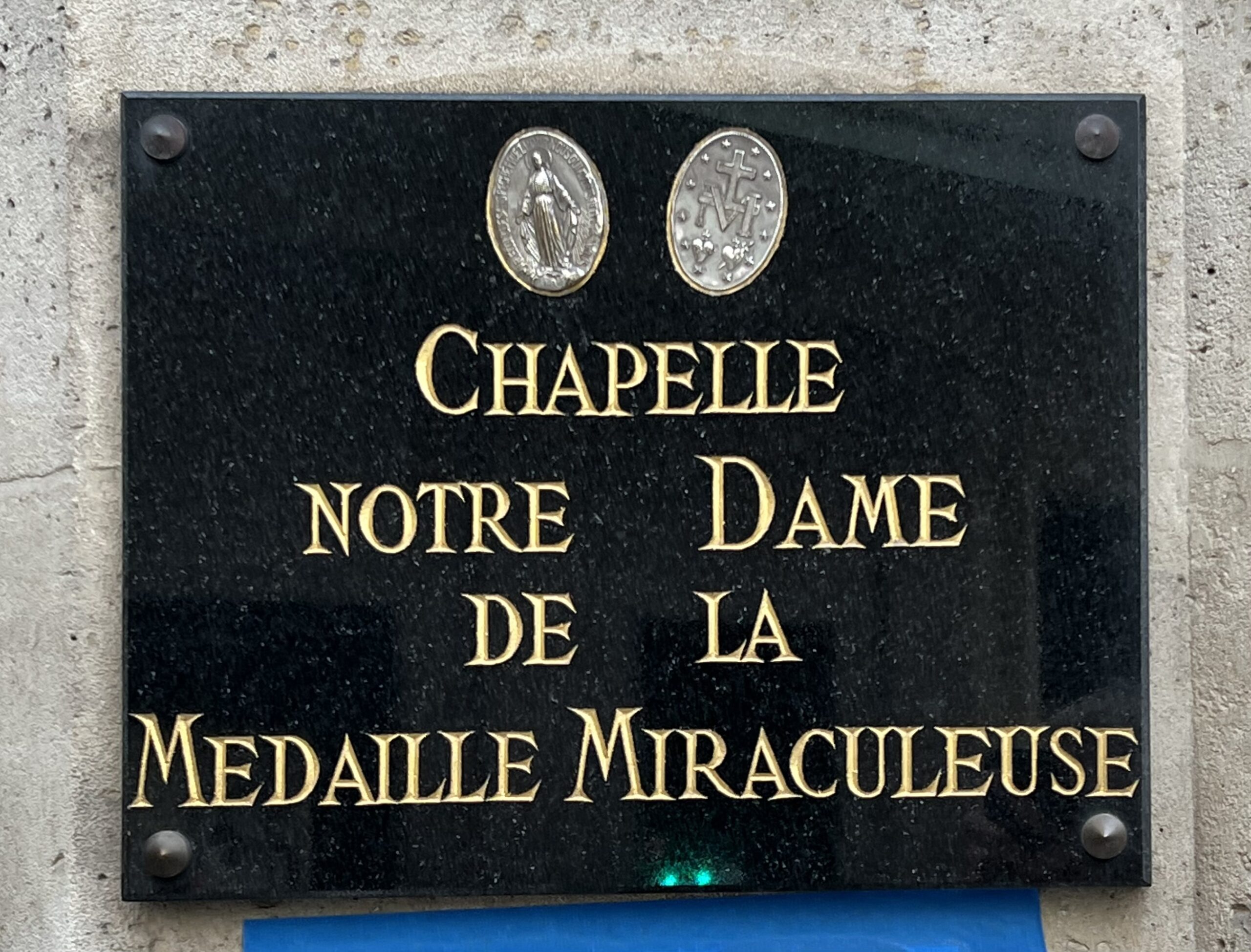
In the Rue du Bac stand grand townhouses, many smaller businesses and some impressive retail concerns. On the Rue du Bac stands the convent of the “Daughters of Charity” of Vincent de Paul. A hotel first stood on this spot, and in 1815 the convent's chapel was built.
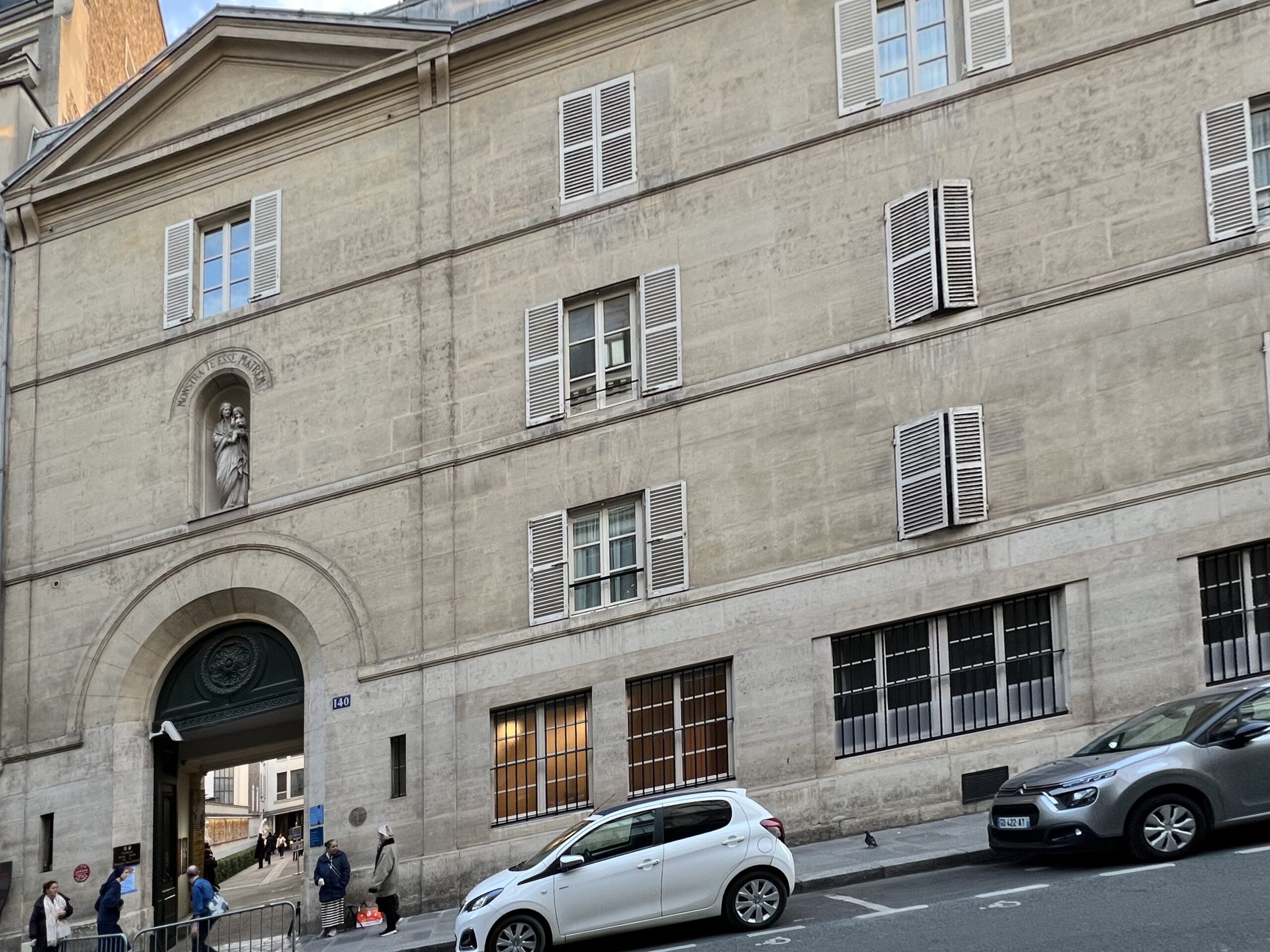
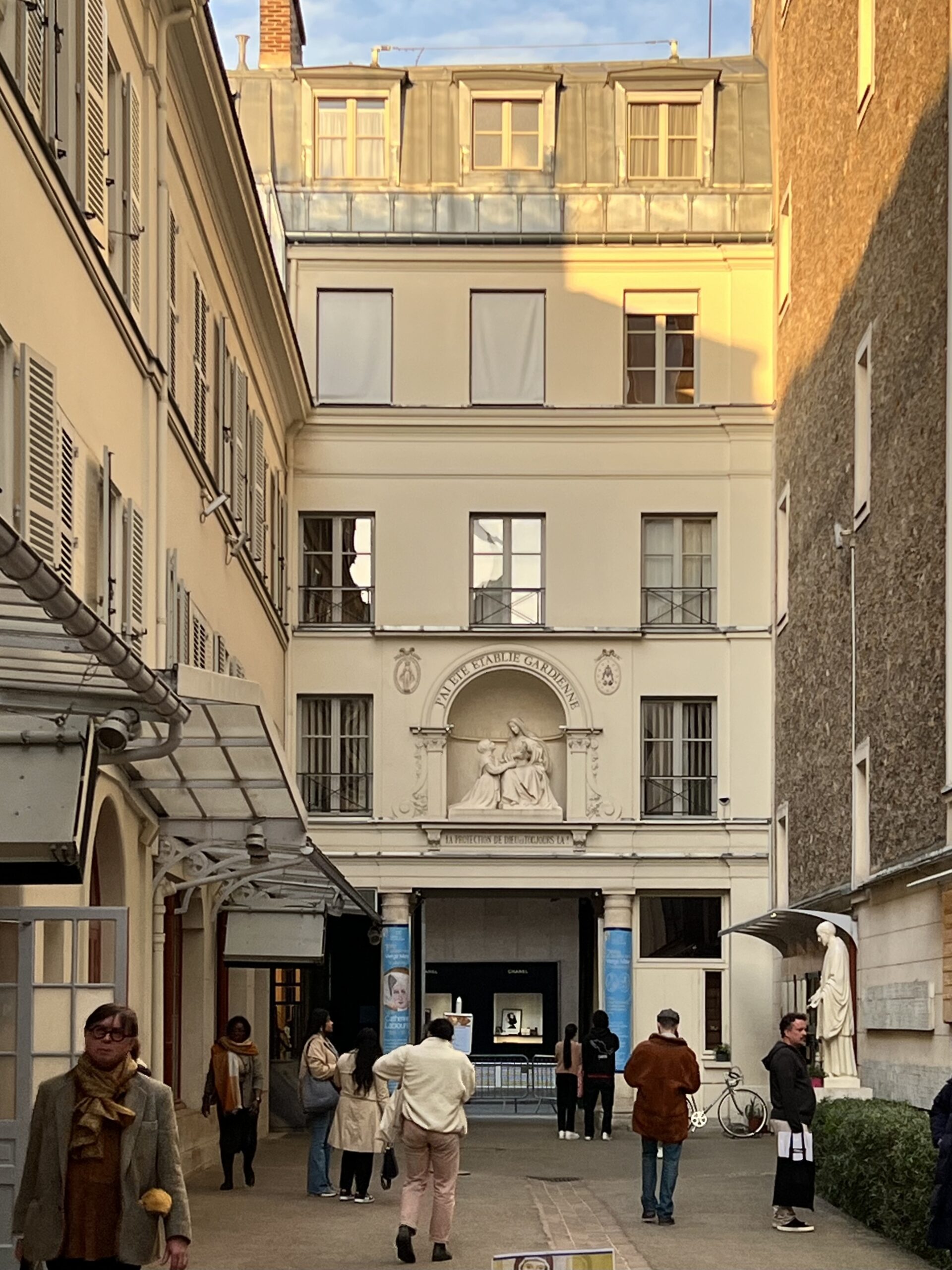
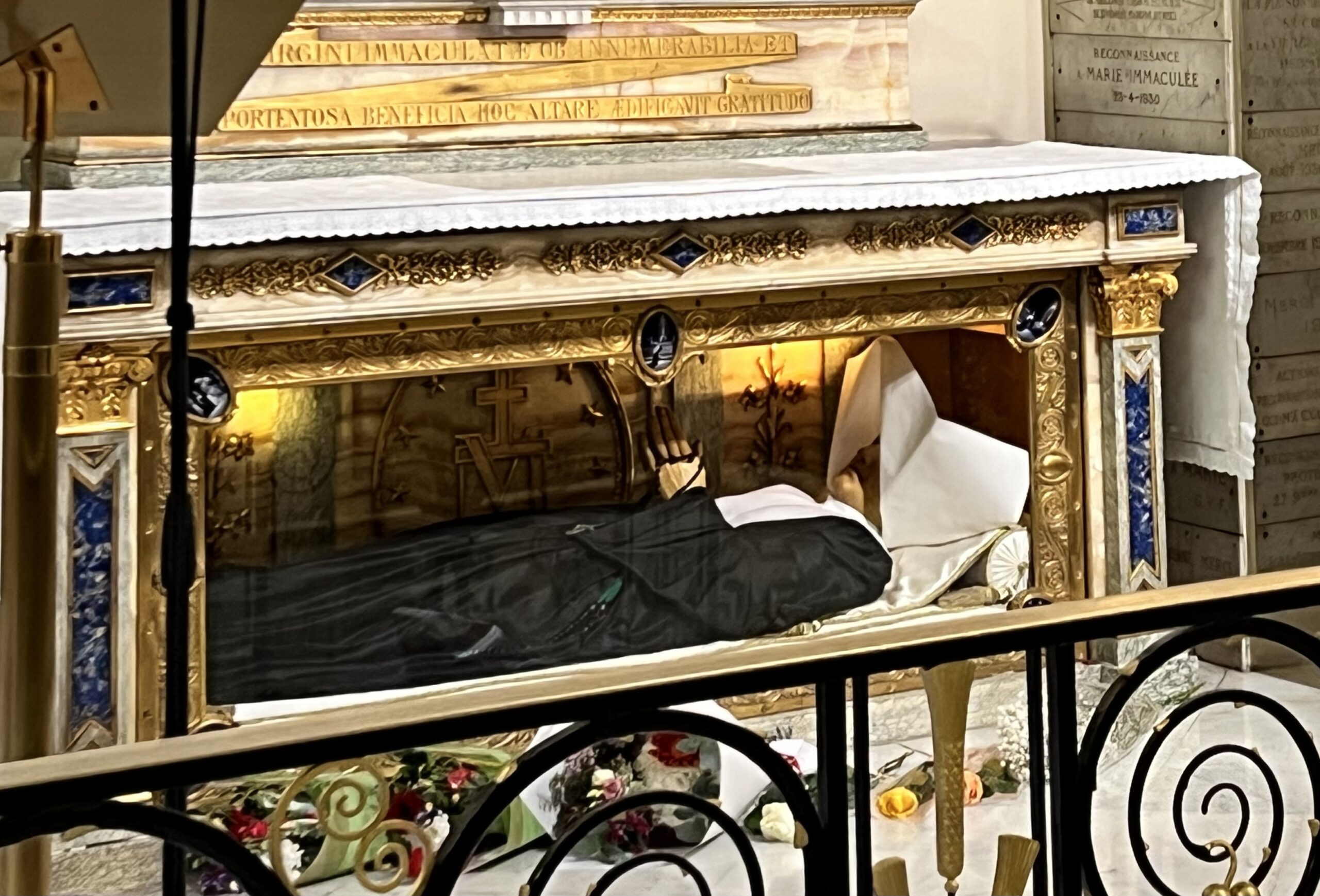
Above the gate leading to the convent is a statue of Mary with Child, greeting visitors. Above this is the text “MONSTRA TE ESSE MATREM”, or “SHOW YOURSELF TO BE A MOTHER”. Within this complex is the chapel of “Our Lady of the Miraculous Medal”. In this large and high chapel lies the body of Catherine Labouré. She rests in a glass reliquary, clearly visible to the many visitors. The transparent coffin is to the right of the main altar. As Catherine lies there, she was exhumed in 1933. Catherine displays her well-preserved body and is dressed according to the standards of the “Daughters of Charity” at the time.
In the chapel of the convent, Louise Legras-de-Merillac (1591-1660), co-foundress of the Daughters of Charity and faithful collaborator of Vincent de Paul (1581-1660), is lying in state. Next to the glass shrine is the altar of Saint Vincent, containing the preserved heart of the founder of the Daughters of Charity congregation. A little further to the right stands the seat in which Mary sat during the apparition. It was in this place that the Immaculate Conception had a long conversation with Catherine Labouré on the night of 18th to 19th July 1830.
The chapel of the convent on Rue du Bac receives over one million visitors annually.
ACCESSIBILITY
The Rue du Bac is located in the centre of Paris. The street borders the Boulevard Saint-Germain and Boulevard Raspail, close to the River Seine. There is also a Rue du Bac metro station. The Rue du Bac meets the Seine at the Quai Anatole France and Quai Voltaire.
Address: 140 Rue du Bac, 75340 Paris, Cedex 07.
Website: www.chapellenotredamedelamedaillemiraculeuse.com and here is the necessary information to be found.
Experience
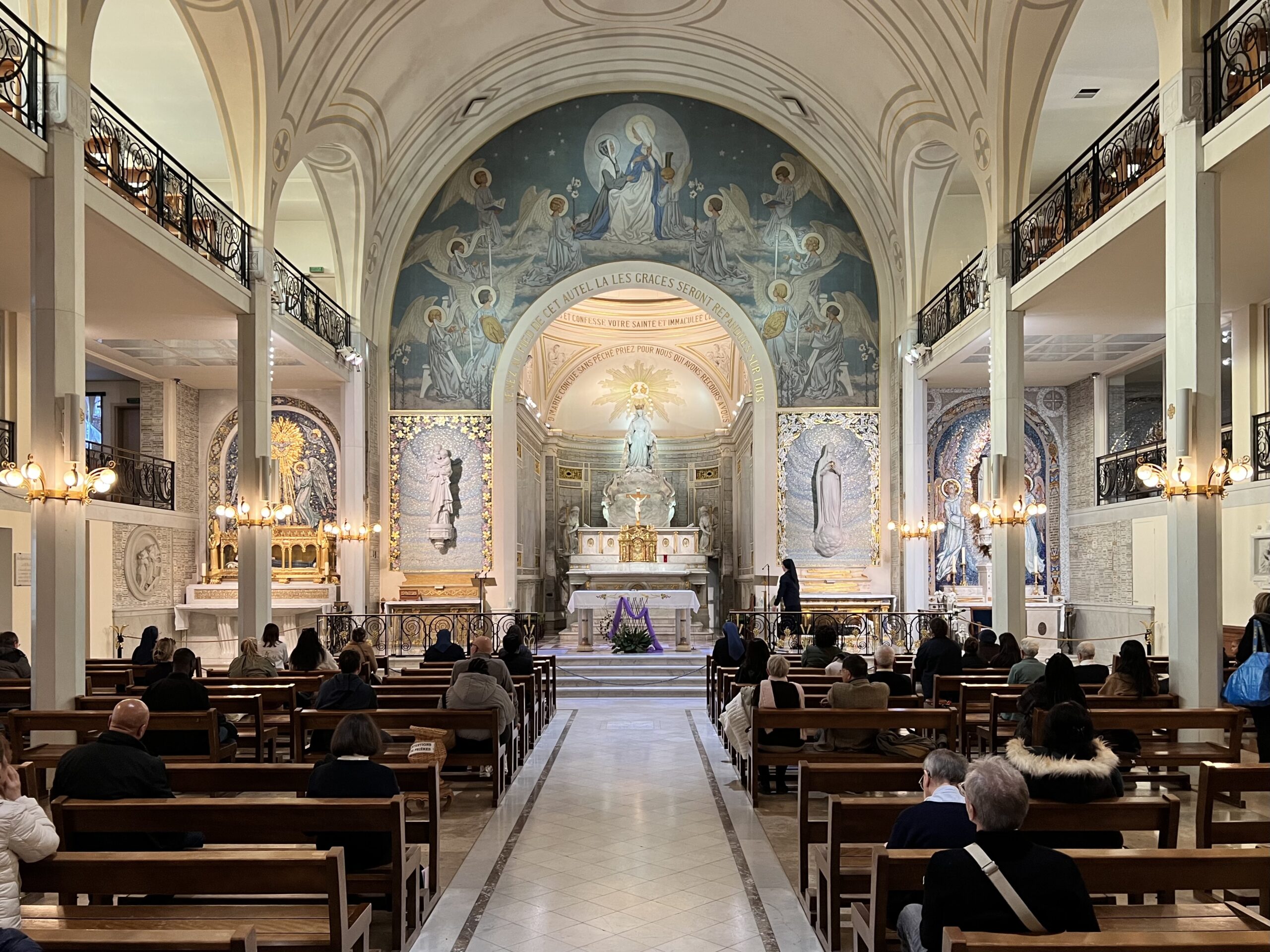
In Paris, I am visiting Rue du Bac. At number 140 is the large convent and also the renowned chapel. In the significant chapel, I will attend a Eucharist service in French with friends. The large chapel is almost full with people praying, giving thanks, and singing. This means the many wooden benches are nearly entirely occupied by around 700 attendees. On the second-floor gallery, there are still a few places available. I think these are for the guests from the Netherlands.
In the distance, I see the altar and also the chapel where Catherine Labouré lies in repose in a glass shrine. In 1830, a vision of Mary occurred twice in that place.
After the celebration, I go downstairs and, after a bit of a wait, reach the glass coffin next to the altar. The back wall of the shrine shows a large image of the Miraculous Medal. The saint has been lying here for many years. Her hands are raised. These large hands belong to a peasant daughter and have done a lot of work. Catherine is wearing a huge, white veil which refers to the sister's clothing of the 19th century. Visitors continuously kneel before her shrine. They make the sign of the cross and pray to Saint Catherine Labouré. I notice the beauty of her face. How lively Catherine appears lying there in silence.
After a few dozen visitors shift from their kneeling posture and stand up again, some space becomes available in front of the eye-catching glass coffin. I shuffle forward and position myself directly in front of the saintly sister. I become quiet inside.
My thoughts turn to the eventful life of Catherine Labouré. The relationship between Mother Superior Jeanne Dufès and Catherine, in particular, comes to mind again. The visionary is hurt by her superior. Dufès doesn't think much of Catherine or the apparitions. However, the sister uses more than just common sense, as she does not confront her superior. Nor does she withdraw with her inner wounds. Catherine deliberately, shortly after receiving gross insults, humbly approaches the Mother Superior. She asks permission for something that is almost useless. In doing so, Catherine restores the relationship between herself and the head of the convent. She proves to herself and her superior that there is no trace of hatred or envy in her. Catherine does this after she has commendably put aside her pride. Catherine goes even further in her relationship with the Mother Superior, as she entrusts her most intimate secrets to Dufès. The result is that the Mother Superior gains a different perspective on Catherine. Jeanne Dufès fully supports Catherine's apparitions. What a turnaround!
Next to the shrine of Catherine Labouré stands a blue upholstered wooden chair. A chain keeps those who would come too close at bay. When Mary visited Catherine, she sat on this chair. How would that chair feel? That remains an unanswered question for me. Mary only sat on it once…
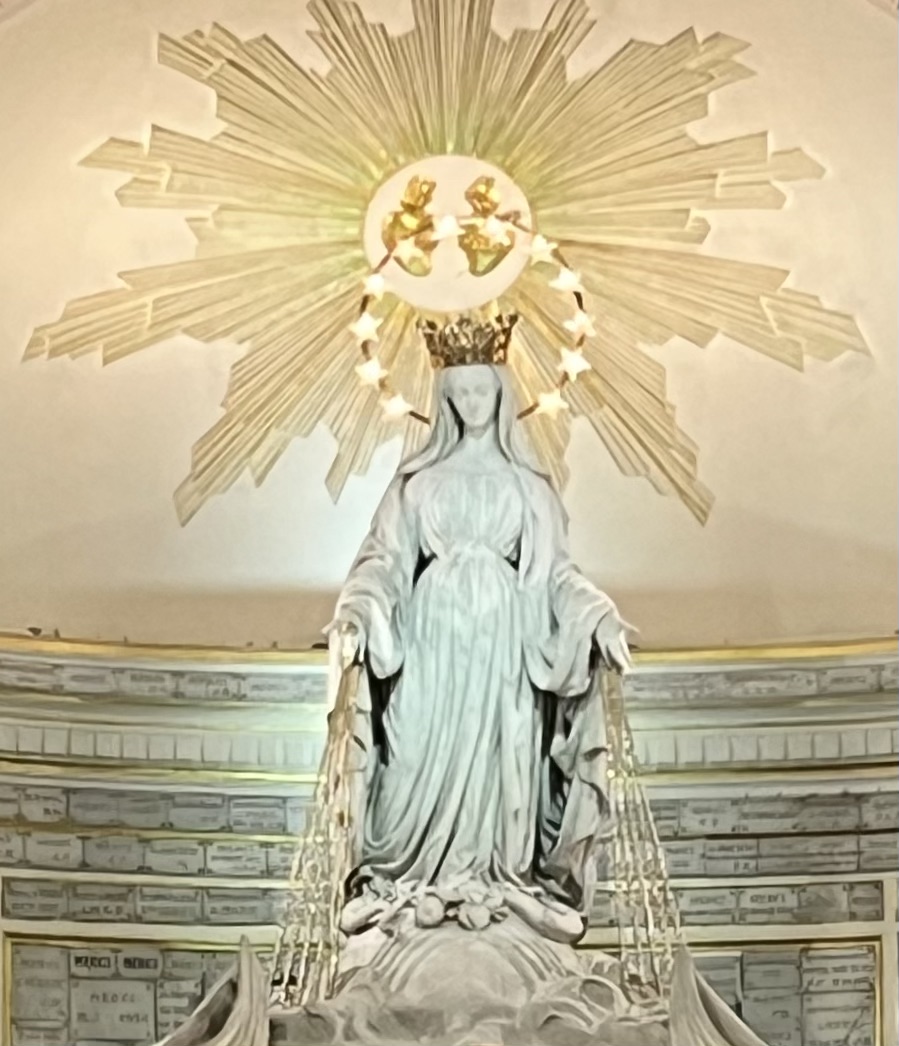
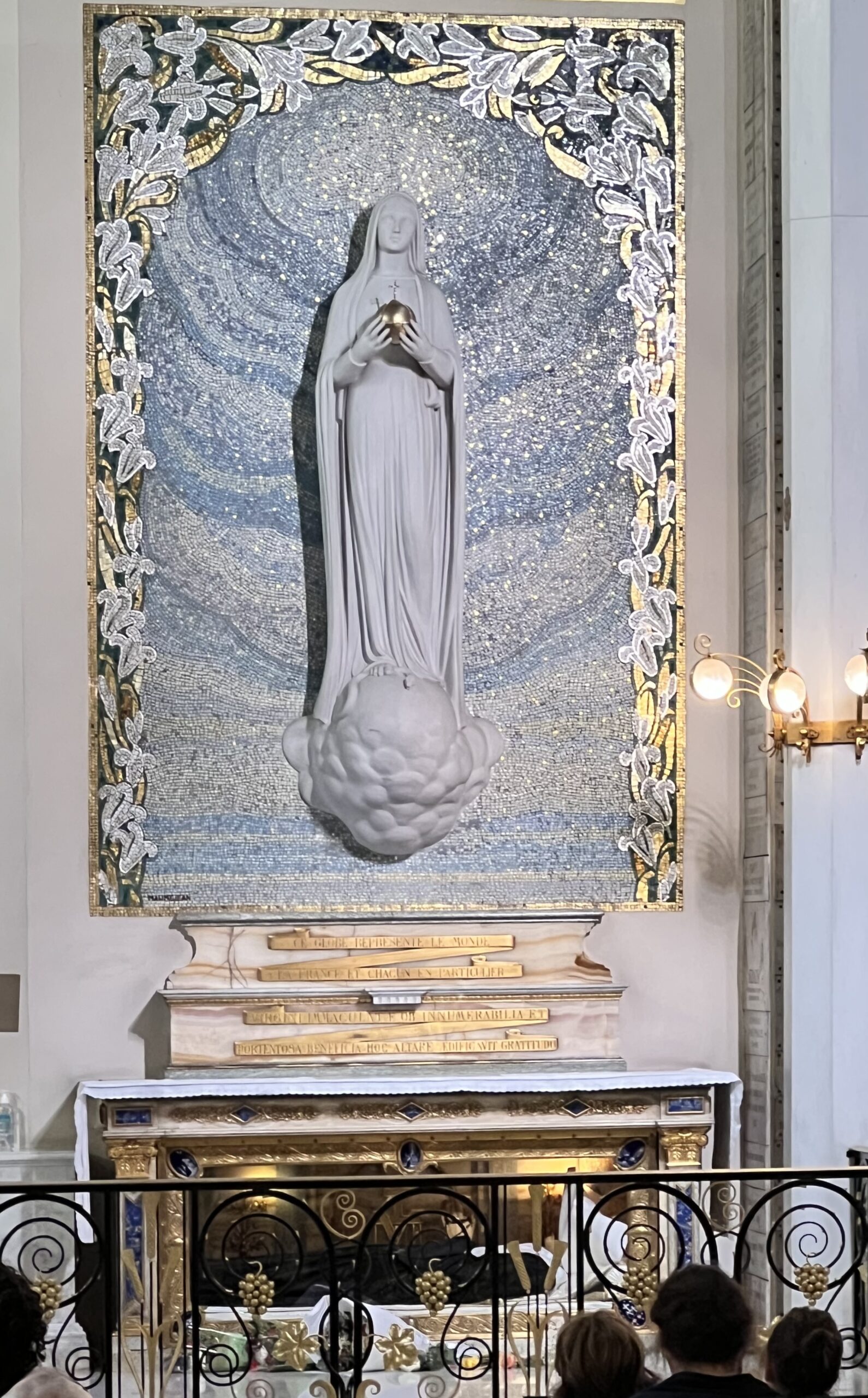
The altar I find, in one word, “impressive”! A white statue of Mary dominates the scene. Twelve shining stars surround her head. Behind Mary, two golden hearts are visible. These are surrounded by golden rays.
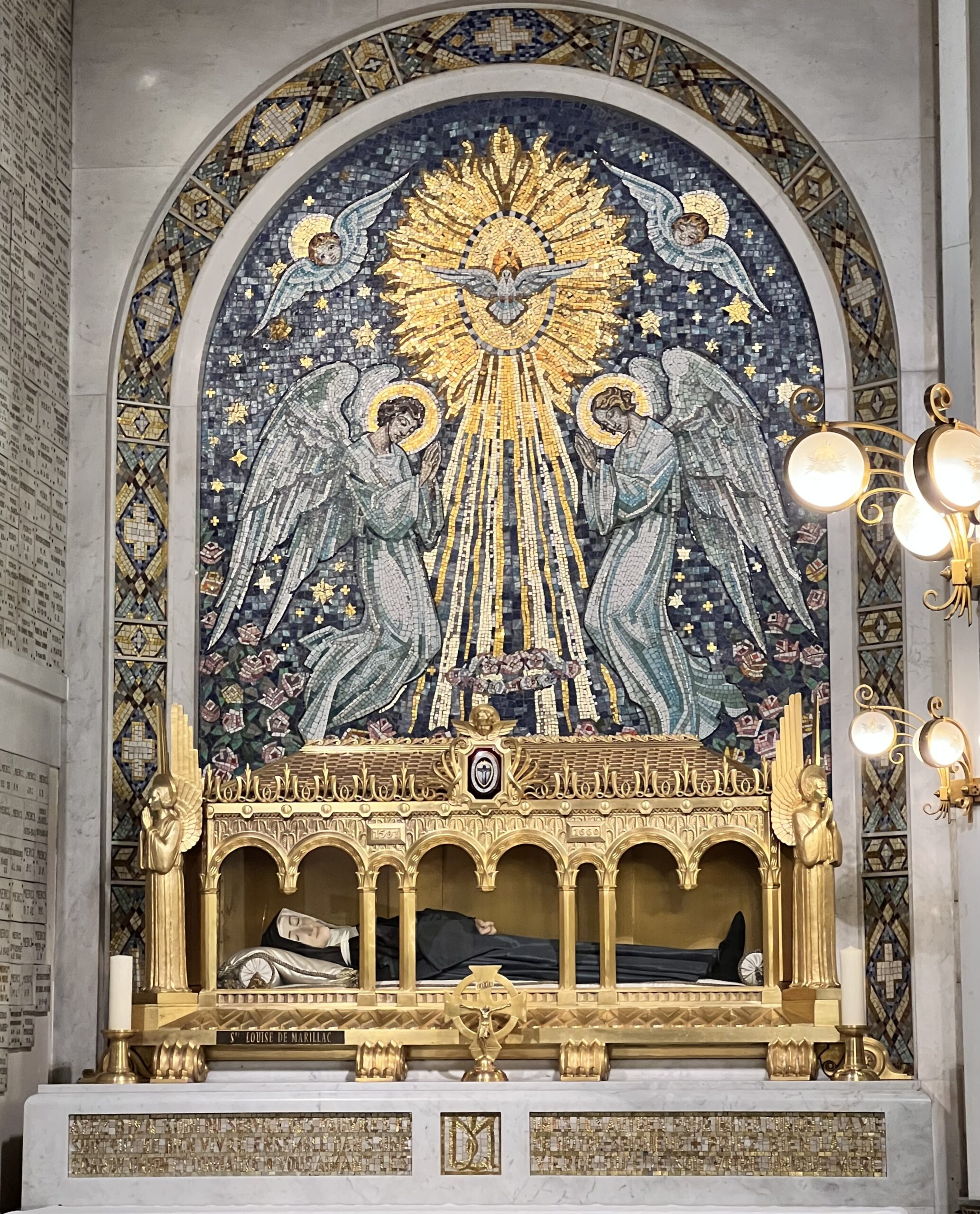
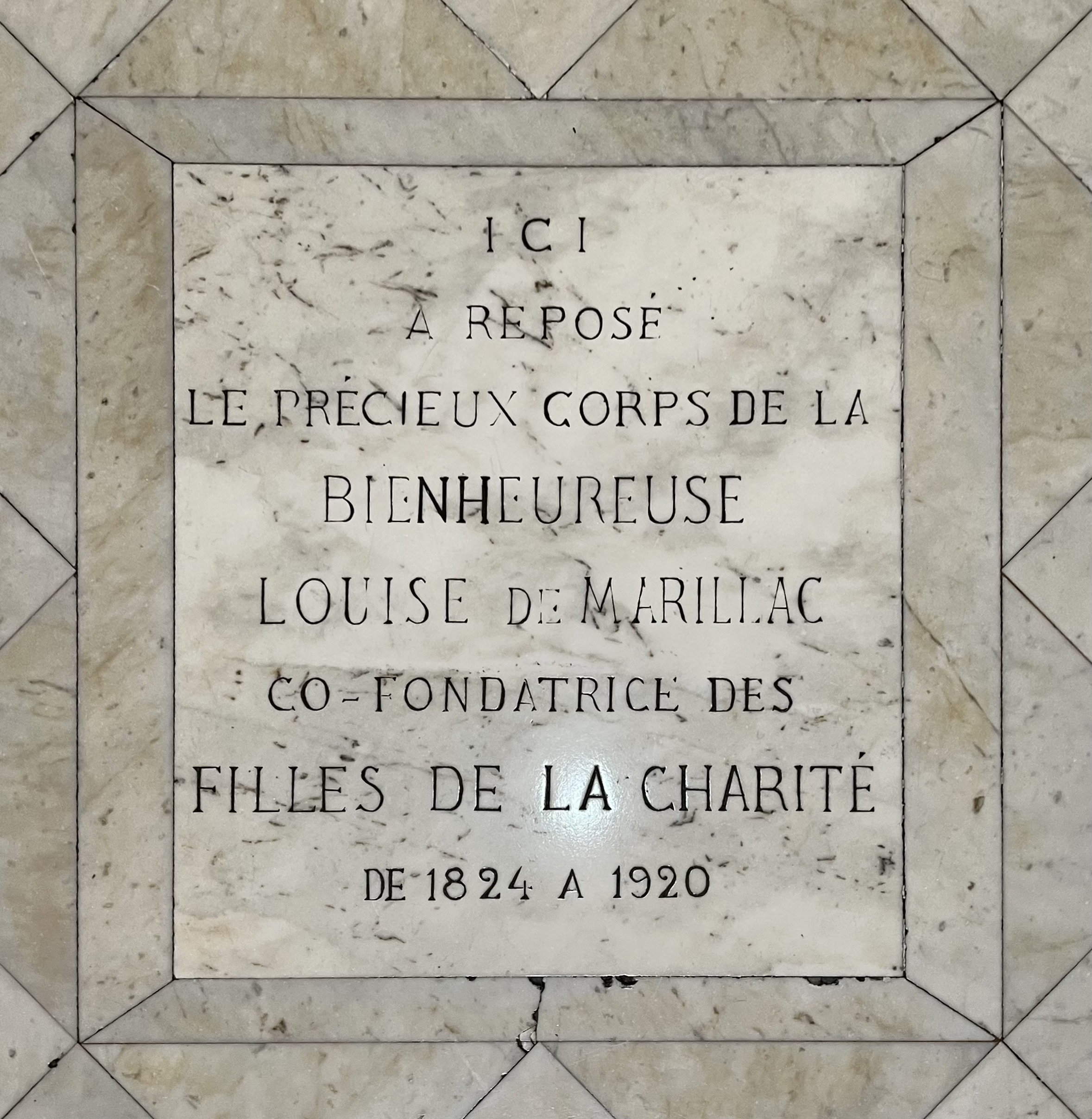
On the other side of the altar is another glass shrine. Here lies Sainte Louise de Marillac, who lived from 1591 to 1660. She was one of the co-founders of the “Daughters of Charity”. “A woman of initiative”, comes to mind. In the centre aisle of the chapel, just in front of the altar, lies a large white stone. What does it say? I go over to it and read: “ici a reposé le précieux corps de la Bienheureuse Louise de Marillac co-fondatrice des Filles de la Charité”. So here lay the precious body of Blessed Louise de Marillac, co-foundress of the Daughters of Charity.
As a reminder of your visit here, I'm going to the devotionalia shop. There, I'll buy some medals to make friends and acquaintances happy. The text on the miraculous medals is in French. In Dutch, the words mean: “Come to the foot of this altar, there graces will be granted to everyone. O Mary, conceived without sin, pray for us who have recourse to thee.”
I feel the miraculous medal in my pocket. I cherish this medal...
Environment
In Paris, there is another place of pilgrimage to Mary, namely Our Lady of Victories. This is located on the other side of the Seine, a few kilometres from the shrine in Rue du Bac.
Furthermore, Paris's tourist attractions are worth visiting, such as Montmartre, the Louvre, the Eiffel Tower, and so on.
The pilgrimage site of Valenciennes is also well worth visiting. To get to Valenciennes, it's a journey of 210 km to the north.
~~~

 Nederlands
  English (UK)
  Deutsch
  Français