History
In French Brittany, the seer of Our Lady is Jeanne-Louise Ramonet. She is a farmer's daughter and first saw the light of day on 7 October 1910 in Kerizinen, a tiny village of just a few houses and farms, near Plounévez-Lochrist. October 7th is the feast day of Our Lady of the Most Holy Rosary. This title for Mary later becomes of great importance in her life. Jeanne-Louise is the 4th of 9 children. In her youth, she suffers from poor health. In 1936, Jeanne-Louise goes on a pilgrimage to Lourdes and upon her return, it is found that she has been partially healed. After the death of her parents, she takes over the farm and works there very hard every day. She does this until 1970. From that year, she opts for intense devotion and prays for hours each day, including the rosary. Jeanne-Louise dies on 19 February 1995 at the age of 84. She is buried in the cemetery of Plounévez-Lochrist.
Jeanne-Louise Ramonet had no fewer than 71 apparitions or visions between 15 September 1938 and 1 October 1965.
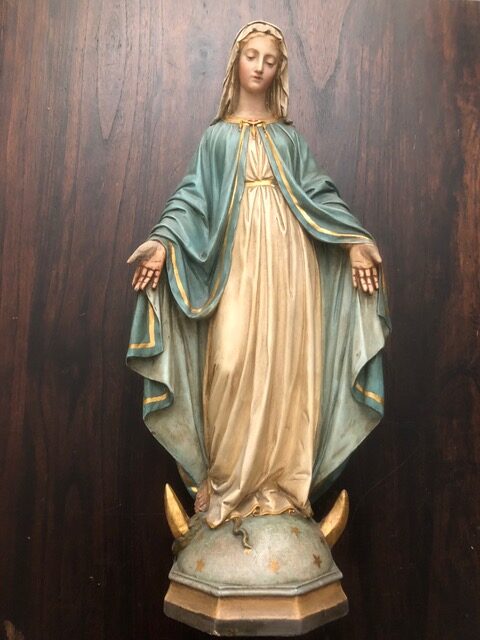
On 15 September 1938, Jeanne-Louise Ramonet is in the field with her two cows, near the farm. Suddenly, she sees a ball of light a few metres above the ground. A young woman appears, approximately 17 years old, quite tall and indescribably beautiful. The woman's eyes and dress are blue. The woman's hair is covered with a white veil. This woman has a white rosary on her arm and says to Jeanne-Louise that she will return often in the coming years. The woman says that a new war is brewing. Later, this turns out to be the Second World War. With each apparition, Jeanne-Louise falls to her knees and is in ecstasy for the duration of the visit. The first apparition takes place on 15 September, the feast of Our Lady of Sorrows.
On 7 October 1939, there is the second apparition. The Lady tells Jeanne-Louise that she must inform her confessor of her experiences. Only on 5 October 1947 are the apparitions made public. From this, it can be concluded that Jeanne-Louise does not quickly gain the trust of higher-ranking clergy.
On 2 October 1940, the Apparition states that the war will last a long time.
During an apparition in 1940, the Lady states that she is the Mother of Christ. She desires to be venerated and invoked in Kerizinen under the name “Our Lady of the Most Holy Rosary”. In that year, Mary also says that Jeanne-Louise will suffer greatly.
On 5th May 1941, Our Lady states that Russia will soon intervene in the war. She asks for much prayer for Russia, as the country's government is hostile to the Church. If there is not enough prayer, communism will dominate the post-war period and cause great harm to the Church, Our Lady tells Jeanne-Louise.
Since 1943, Jeanne-Louise Ramonet has been noting down the messages from the apparitions on the advice of her confessor.
In 1949, the first healing takes place in Kerizinen. It concerns Pauline le Goff from neighbouring Lanhouarneau. Pilgrims place a statue of Mary at the site of the apparitions. In that year, Mary promises that a spring will emerge. This is discovered on 13 July 1952, not far from the site of the apparitions. On 9 December 1949, Mary makes it clear to Jeanne-Louise Ramonet that a chapel must be built. She also tells Jeanne-Louise that she must inform the Pope about Her bodily assumption into heaven. At the end of 1949, a small, glass house is built. This is done as thanks for a healing, which is attributed to Our Lady of Kerizinen.
On 13 July 1952, a spring suddenly appears. In the period 1953-1954, it happens four times that a dancing sun is observed. This is reminiscent of the sun miracle of 13 October 1917 in Fátima.
Since 15 August 1954, Our Lady has always appeared crowned. In that year, She appeared on the roof of the little prayer house. During an apparition, Mary weeps.
In 1955, there was a shower of rose petals at the site of the apparitions. From 1 October 1955, Jesus with the Sacred Heart began to appear, often accompanied by Mary. Their hearts are joined together. On 10 December 1955, Mary, who often appeared to Jeanne-Louise, issued a call that She, Our Lady of the Most Holy Rosary, desired the Rosary to be prayed for the Church, the world, and pilgrims.
In 1956, a small chapel was built in Kerizinen. This was done on private initiative. In the same year, a statue of Our Lady of the Holy Rosary was also placed there. On 12 October 1956, the Bishop of Quimper prohibited people from going to the site of the apparitions.
A special image appeared in 1958, namely the apparition of the united hearts of Jesus and Mary. This image gained renown in many countries.
In 1961, there was an apparition at the seer's house.
In 1962, Jesus appears with the Sacred Heart. There will be 10 apparitions over 10 days. Jesus speaks, among other things, about his suffering and his Mother.
On 1st October 1965, it was the day of the final apparition. Jesus and Mary appeared together. Our Lady said, among other things, that the Rosary prayer resists the forces of the devil that threaten people.
Both in 1956 and 1961, Bishop André-Pierre-François Fauvel (1902-1983) issued a decree prohibiting people from going to Kerizinen. The alleged apparitions and messages at Kerizinen were not approved by him. His successor, Francis Barbu (1914-1991), acted against the supposed apparitions in 1973 and 1975. He forbade priests and religious from going to Kerizinen. The bishop also did not permit devotion or veneration. However, members of the Association of Friends of Kerizinen, founded in 1972, were not discouraged and planned to build a large chapel. To this end, the organisation launched a campaign to raise the necessary funds. In May 1975, the plan to build a new, large chapel was revealed.
Our Lady has spoken on several occasions in Kerizinen about her desire for organised pilgrimages and for the lifting of the episcopal ban.
In 1969, the attitude of the Catholic Church changed, as the Vicariate in Rome gave approval to the prayer of consecration to the two united hearts of Jesus and Mary.
In 1973, a medal of the united hearts of Jesus and Mary was struck.
Construction of a large oratory to the prayer house began in 1976. In 1978, the large building was solemnly consecrated, with more than 12,000 people witnessing the event. The construction was made possible by the considerable efforts of the Association of Friends of Kerizinen.
In 1977, the group “Children of Mary of Kerizinen” was formed.
In 1978, the statue of the “United Hearts of Jesus and Mary” was erected.
The apparitions at Kerizinen have not been approved by the Holy See in Rome. However, this does not prevent many believers from going on pilgrimage to Kerizinen and finding comfort and strength there with Mary.
Pilgrimage site
In Kerizinen, from 1938 to 1965, there were 71 apparitions or visions of Mary and/or Jesus to Jeanne-Louise Ramonet. The apparitions took place in a field near her home, where the large oratory was later built. The oratory can seat around 1000 people.
In the small prayer house within the large oratory, there is a statue of Mary. She is surrounded by a luminous halo and white flowers. Crutches hang in the prayer house, as Mary has performed miracles here. Countless plaques with expressions of gratitude are attached to the walls of the small building.
In the oratory, many people pray, and numerous candles provide light. On both long sides, stained-glass works are installed, with the colours blue and red dominating.
What is particularly special in Kerizinen is the image of Jesus and Mary, with their hearts connected to one another. This makes Kerizinen unique.
Pilgrims visiting Kerizinen also go to the spring. Numerous graces have been obtained there. Special powers are attributed to the water from the spring.
ACCESSIBILITY
Kerizinen is located in the French region of Brittany, between the larger towns of Brest and Morlaix, near Lanhouarneau.
The address of the place of worship is:
Oratory of Kerizinen, F 29430 Plounévez-Lochrist.
This is also the address for the “Maison de Marie Kerizinen” and for the friends “Les Amis de Kerizinen”.
Website: www.kerizinen.com, which also features current events.
Experience
When I arrive at the hamlet of Kerizinen, I notice the large building, which is called the oratory. In front of the structure is a square and to its left, the cottage where Jeanne-Louise Ramonet lived with her mother, father, four sisters and four brothers. I go to the humble dwelling and see, near the front door, a dark patch where a ball of fire struck the earth. The apparitions to Jeanne-Louise also led to other, very special events. I enter the cottage and immediately notice the limited space. Did 11 people live here? There was barely room inside to eat together.
Next, I will go to the impressive oratory. In the large room there are hundreds of chairs, and what strikes me most is the small building where apparitions have taken place. At the top of this small prayer room, I read the words “PRIÈRE – PÉNITENCE – CONFIANCE,” and these significant words stand for prayer, penance, and trust. Beneath the three words, I see “PAIX,” which means peace. In the oratory, I participate in the praying of the rosary in French. The rosary is given a very prominent place here, as Mary wanted to be invoked here as Our Lady of the Most Holy Rosary.
The oratorio was later realised over the small building. Behind the small building, I see a large stained-glass work with a dove at the very top, symbolising the Holy Spirit. I also notice a large, wooden statue with Jesus and Mary. Mary and her Son are connected with hearts. This is very special. I can't remember seeing such an image in another Marian shrine. I light a candle there, and a few prayers to Mary follow.
Next, it is necessary to examine the various banners carefully, such as those of Saint Gabriel and Saint Philomena. A banner with the text “Notre Dame du Très Saint-Rosaire” impresses me. I also see a banner with the inscription “Ireland – Kerizinen, Jubilee 2000”.
In the grand oratorio I linger a little longer on the many stained-glass windows and this also applies to the very well-kept depictions of the Stations of the Cross. How meaningful this oratorio is to me.
I am leaving the large house of prayer and going to the side of the building. There is an overview exhibition of the apparitions in Kerizinen. Then I walk a little further and arrive at the spring. I descend about ten steps and I see the taps from which spring water flows. I go down a few more steps and arrive at the spring. I drink some water there. Then I go to the car to get some empty bottles. Back at the spring, I fill the water containers.
A visit to the religious gift shop is the next part of the pilgrimage programme. Many religious products are displayed here. I buy a few things, as well as some booklets about the apparitions. The friendly shop assistant gives me a duplicated, German-language leaflet about the apparitions as a gift. Finally, I buy some cards and candles and return to the oratory to say goodbye to Mary here.
After having gained many impressions, I am returning home with precious memories.
Posted: 19 November 2020
Last modified: 23 August 2022
~~~

 Nederlands
  English (UK)
  Deutsch
  Français