History
On 19 September 1846, a “beautiful Lady” appeared to two children, Maximin Giraud, aged 11, and Mélanie Calvat, aged 14. The children were herding some cows on an alpine pasture at La Salette, at an altitude of over 1800 metres. Suddenly, they saw a magnificent Lady, surrounded by light. This light emanated from a crucifix with a hammer and pincers. The crucifix hung around the Lady's neck. This Lady wore chains, and the children saw roses on Her. The “beautiful Lady” was seated, weeping, with her hands covering her face. Shortly afterwards, She stood up and spoke to the children at length. She did this in French and in dialect. However, “the Lady” was weeping constantly. A little later, “the Lady” ascended a steep path and disappeared into the light.
The “beautiful Lady” turns out to be Our Lady. Mary says, among other things: “Come closer, my children, do not be afraid. I am here to bring you great news.”
“If my people do not wish to submit, I shall be forced to let go of my Son's arm. It is so heavy and so oppressive that I can no longer hold it back. How long I have suffered for you! If I wish my Son not to leave you, I am compelled to beg Him ceaselessly.”
This is a signal that the end of good times is near.
“I have given you six days to work. I have reserved the seventh day for myself, and you do not want to grant me this day. That is what makes the arm of my Son so heavy.”
This is about neglecting one's Sunday duties.
“Those who drive the cars cannot speak without using my Son's Name. This is the second, that my Son's arm finds so heavy.”
This concerns the mocking of Jesus, primarily through a great deal of swearing.
“Peace is disturbed by a monster. This monster will come at the end of the 19th or the beginning of the 20th century.”
Later, this turns out to be the war between France and Germany in 1870-1871, and then the First World War (1914-1918).
“If the harvest rots, then that is only your fault. I showed you last year with the potatoes; you took no notice of it; when you find any that are spoiled, you curse and invoke the name of my Son. The harvests will rot even more, and by Christmas there will be no more potatoes.” The context of the apparition emphasises the real situation of the agrarian population; Mary speaks of a potato disease.
By Christmas 1846, there were indeed no potatoes left in the region of La Salette.
“If you have grain, you must not sow it. Everything you sow will be eaten by animals and what grows from it will turn to dust when you thresh it.”
“There will be a great famine. Before this arrives, small children under the age of seven will be seized by a shudder and die in the hands of those holding them. The others will do penance by suffering hunger. The nuts will turn bad and the grapes will rot. If the people repent, the stones and rocks will turn into corn and the potatoes will lie sown in the fields.”
In 1847, there was a major agricultural crisis. A disease affected the grapevines, the corn harvest failed, as did that of nuts. Crises in culture, trade, industry, and politics followed. In 1851, the nuts were rotten again. Mass famine repeated itself in 1851 and 1856. Many children died, and cholera claimed many victims in 1854.
“Pray a lot, both in the morning and evening. Go to mass on Sundays. However, only a few older women do that.’
“Well now, my children, make it known to all my people.”
The two seers have completed this mission.
All of Mary's prophecies in La Salette have come true!
In La Salette, Mary gave several messages to the two children. At their core, the messages to Mélanie Calvat and Maximin Giraud urged people to convert and reconcile with God.
Not long after the apparition was announced, pilgrims began arriving from France and other countries to La Salette. In the region of La Salette, a revival of Christian life began to emerge.
Maria confided a secret separately to each of the two children. The secrets entrusted to the two seers were put into writing in 1851. This was done under ecclesiastical supervision and this information was handed over to Pope Pius IX. Shortly thereafter, and almost simultaneously with the completion of an extensive investigation, the apparition at La Salette was recognised by the Church.
An extensive investigation has been conducted into the true circumstances of the apparition. Exactly five years after the apparition, the investigation into the events with “the lady” has been concluded. On 19 September 1851, the Bishop of Grenoble, Mgr. Philibert de Bruillard, judged that the apparition of Our Lady was based on grounds of truth and that people could believe it. This judgment was publicly communicated after permission was granted from Rome.
In 1852, Bishop Philibert de Brouillard announced that a shrine would be built on the mountain of La Salette. He also stated that a new order, the “Missionaries of Our Lady of La Salette,” would be established.
In 1872, the National Pilgrimages were established in La Salette. Thousands of pilgrims visit the shrine in the French Alps annually. Among them are many clergymen, writers, and individuals who are later canonised. Visitors include Don Bosco, the Curé of Ars (Jean-Baptiste-Marie Vianney), Pierre-Julien Eymard, and Jean-Léon Le Prévost.
In 1930, the female branch of the missionaries was founded, namely “the Missionary Sisters of Our Lady of La Salette”. The congregation of the Salettinians owe their name to Our Lady of La Salette. The community (community of religious) of priests and sisters, who are attached to the sanctuary, becomes a world-class religious congregation. The members of this congregation have taken vows and live according to rules approved by the Pope. The members of the association are the missionaries and sisters of La Salette.
The “Association of Pilgrims of La Salette”, A.P.S., was founded in 1962 by the Diocese of Grenoble. This organisation is responsible for the material and spiritual interests of the participants on pilgrimages.
The visionaries in La Salette…
Maximin Giraud was born in Corps on 26 August 1835 and died there on 1 March 1875. He experienced a tumultuous life. His mother died when he was not yet 18 months old. His father remarried, but Maximin received little affection from his stepmother. He received no schooling, as the family was poor, and Maximin began working at a very young age. In the three years following the apparition, he lost his half-brother, stepmother, and father. He was placed under guardianship and held many jobs. For instance, he spent six months with the Zouaves, went to work and live in Paris, and later returned to Corps. He led an unsettled life, always in poverty. He died in his birthplace at the age of 39, without publicly revealing the secret of Mary.
Mélanie Calvat was born on 7 November 1831 in Corps and died on 14 December 1904 in Altamura, Italy. Like Maximin, she spent her early years in a poor family, did not attend school, and began working as a young girl. Later, she lived in various congregations. She was a postulant for a probationary period of a few months before the novitiate. Then she became a novice. For her, it remained largely a life in convents. Mélanie suffered from delusions, created an imagined past, and expressed prophetic deceptions. She claimed to have visions of Jesus. She went to England with an English priest and stayed for 6 years at the Carmel convent in Darlington. Subsequently, she went to the Sisters of Charity in Marseille, France. In France, Mélanie lived in several other places, and also visited Greece and Italy. As a nun, her name was “Sister Mary of the Cross,” and she was also known as the “Shepherdess of La Salette” of the Third Order of Saint Dominic. Regarding the secret entrusted to her by Mary, Mélanie said that there would be attacks on the Pope and that the faith would be in serious decline. Years after her death in 1904, she was exhumed on 19 September (!) 1918. Her body was then still completely intact. The remains were taken to the church of Antoniao. This occurred at night due to the prevailing Spanish flu. On 19 September (!) 1919, she was laid to her final rest. Mélanie lay in state in the church dedicated to the Immaculate Conception in Altamura, near Bari, which is the location of Saint Nicholas.
Pilgrimage site
La Salette belongs to the municipality of La Salette-Falavaux in Dauphiné, department of Isère and belongs to the diocese of Grenoble. Pilgrims can come on pilgrimage to La Salette almost all year round. There are many overnight accommodation options in the sanctuary; around 600 beds are available. There is also dining capacity for hundreds of visitors.
In the sanctuary, the church stands at the centre with statues of Our Lady of La Salette.
In front of the church are statues depicting the apparition with the two seers.
Close to the statues of Mary there is a water spring. This is located at the site of the apparition in 1846. Immediately after the visit of Our Lady, this spring began to give a lot of water, and this continues to this day. Unexplained healings have occurred through the water of the spring. For instance, the blind have regained their sight, and people with intestinal ailments have been cured by drinking the healing water.
Near the shrine of La Salette stands a large statue of Saint Philomena. She is the inspirer of the National Pilgrimage. The statue commemorates the 25th anniversary (1872-1897) of the French National Pilgrimage.
The museum of the Sanctuary of Our Lady of La Salette displays the eventful history of La Salette. This museum features, among other things: the stone on which Mary sat, portraits of the two visionaries, testimonies from the two children, photographs of the construction phases of the sanctuary, tools used in its construction, engravings depicting the story of the apparition, a letter of recognition of the apparition, artworks donated by pilgrims, testimonials of gratitude from pilgrims, and the dissemination of the messages of La Salette.
ACCESSIBILITY
La Salette is located in the French Alps at an altitude of 1800 metres. From Gap or Grenoble, follow the Route de Napoléon (N85) and leave this road at Corps. From the town of Corps, it is approximately 14 kilometres uphill and then the sanctuary is reached.
Address: Sanctuaire de Notre Dame de la Salette, F 38970 La Salette, France.
Website: www.villes-sanctuaires.com and this provides the necessary information.
Experience
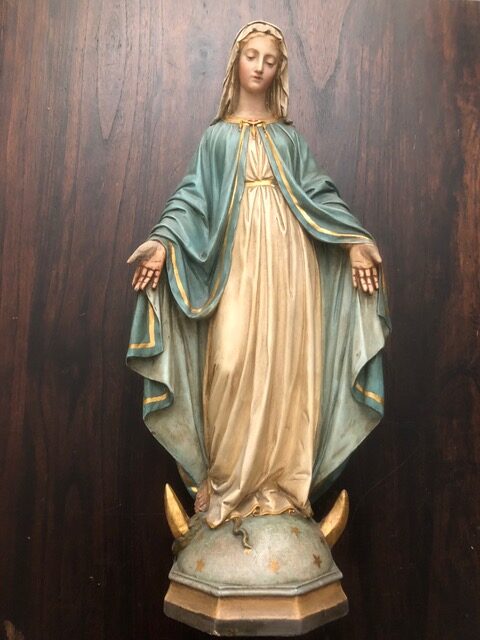
I have had the privilege of visiting La Salette on several occasions. In the following I will share some impressions of my deeply moving experiences, because in La Salette, it is the weeping Mary that one encounters. On 19 September 1846, 12 years before the apparitions in Lourdes, a beautiful Lady appeared in a white gown with a gold-yellow apron. She wore a small crown adorned with diamonds. The apparition had white shoes, around which roses were attached. A blue mantle, edged with roses, hung over her shoulders. The Lady also wore a heavy necklace. Around her neck hung a large cross with a hammer and pincers on the crossbeam. The hammer represents striking each other, and the pincers are for liberation, as with Jesus on the cross.
I'm driving from Corps to La Salette, which is 14 kilometres further on and situated at a high altitude. As the clouds draw nearer, the landscape becomes sparser, and I no longer see any large trees. After a winding, steep road, I reach the Marian pilgrimage site of La Salette, situated at an altitude of approximately 1800 metres on the Route Napoléon between Gap and Grenoble. Impressive buildings such as the basilica, prayer rooms, and a hotel with 600 beds stand on this high plateau. The view is heavenly. It's busy, with many Italians, a large group of Poles, and numerous French people. Fortunately, there's still a small room available for me.
I attend Eucharist services in French, Italian, and Polish. In the evening, I join a large group to walk in procession into the mountains. Many lights wind their way along mountain paths. It is a solemn walk with singing. I look at the mountain peaks, which reach over 2200 metres. This gives me a mystical experience among the Alpine giants.
In the sanctuary, I see several large statues of Mary. One statue particularly impresses me; I see Mary seated and very sad with her hands in front of her face. Another statue is of a standing Mary, looking upwards, while the two visionaries from September 19, 1846, stand nearby.
In the basilica, a large, unusual cross has been placed on the altar. A hammer is attached above one of Jesus' arms, and slightly above the other arm, I can see a pair of pliers. I hear that the cross dates from the second half of the 19th century. Behind the cross, two golden statues stand against the wall. These figures show Saint Anne giving instructions to Mary. High up in the choir, there is a white statue of Mary, larger than life-size. Many stained-glass windows can also be seen. Both in daylight and with the lights on, these windows are very colourful. The windows tell a great deal about the history of Jesus. I look around further and feel very inspired in this space.
At the back of the basilica, I light a few candles. For many, I have an intention, accompanied by a little light. Then I kneel, and my thoughts turn to some friends who are currently carrying a heavy burden. A little later, I leave the basilica with thoughts of dear loved ones. It feels like a great gift to be allowed to be here.
In Corps stands the birth house of Mélanie Calvat, one of the two visionaries. I want to go there. I definitely think a visit to the house is worthwhile, that is my thought. The house is hidden away in an alley and makes a rather wretched, but endearing impression on me. I enter the house and immediately find myself in the spacious room, which takes up almost the entire house. There are photographs of Mélanie at a young and very advanced age. Books about her and photographs of her are available, as well as those of the Marian apparition of La Salette. I am glad to have seen this house and can now form a slightly better picture of her.
Next, I go to the church of Corps. To enter the old church, I have to stoop. The church door is not designed for my height of 1.93 metres. Inside this small house of God, two typical statues of Mary of La Salette catch my eye. One large statue depicts Mary appearing to the two seers. The other image is that of a weeping Mary. I have a smaller version of this depiction, as well as a stained-glass window. When I see Mary sitting there, weeping, my thoughts turn to the song “So Sad” by The Everly Brothers. Don Everly sings: “We used to have good times together, but now I feel them slip away. It makes me cry …” Mary’s good feelings are also gone. She is sad …
I am going back to the sanctuary and there I meet a German. We strike up a conversation and it is quite fitting, as both he and I visit Marian pilgrimage sites. He tells me he is reading a book about spirituality. We talk at length about feelings regarding our faith in Mary, and also about experiencing faith. It is a profound, engaging conversation about the meaning we attribute to pilgrimage sites. His experience concerning Mary and the historical site of the apparition bring him here.
In La Salette, I went up the hill, and after letting my legs do a bit of climbing, I arrived at a large, white cross. I was at the top of the hill, directly opposite the basilica. Another walk takes you to the cemetery, where people who worked here are buried. In a separate building, next to the chapel, lie the deceased missionaries of La Salette. The chapel was first located on the Esplanade, but was relocated in 1865 to its current site. Inside the chapel, there is a large, white statue of Our Lady of La Salette. In front of the statue lies a white rose. A prayer is fitting here.
Next, I go down and arrive at the sanctuary. I see sheep feasting on Alpine fodder. A stone falls...
The other day at 7:00 AM, the church bells rang, and half an hour later I was in the dining hall for breakfast. With two slices of bread, a croissant, jam, tea, and orange juice, I was set for a while. With these provisions, I went to a table where a dark-skinned man was sitting. He is of Vietnamese origin and, like me, has been here before. He tells me he has been living in France for about 30 years. The French had a lot of influence in Vietnam, he says. That's why he found his new homeland in France. He says he works a bit in his brother's restaurant in Lyon and helps out in a church, being almost 40 years old. The man, like me, writes books and is very interested in the apparition at La Salette.
Later that day, I see him sitting in the basilica. He sees me too. We nod to each other. Perhaps, like me, he has the good and valuable feeling of being close to Mary here. When I go back to La Salette two years later, I get in touch with him and this leads to a new meeting with conversations about La Salette.
I also enjoyed the nature in and around La Salette...
It's 9.00 am. I go into the restaurant and order tea at the bar. Afterwards, I take a seat by the window, where there is a view of the clouds. Outside, everything is white. The visibility is at most ten metres. This feels like being on the way to heaven. If this is the case, I'm already well on my way, as the sanctuary is at 1,800 metres. However, it's not busy on this route, as I am alone here. Perhaps the route to heaven is also a journey to be undertaken solo.
After about five minutes, the green tea has steeped. I take a sip and look outside. Visibility has improved somewhat; the eyes can see a few tens of metres. I am still the only guest in the restaurant. Many people are not present for this natural phenomenon and do not want to witness clouds moving away.
I look out again and the mountains become a little more visible at my height. I enjoy the view and only later notice that more visitors have arrived. The sun announces itself and the sunbeams make the clouds disappear even more.
Just over an hour later, the alpine world is clear. The mountains have shed their cloak of clouds. The view stretches for miles. I look up. The sky is blue. The road to heaven has disappeared. So, God doesn't need me yet...
During another stay in La Salette, I head to the summit of Mount Le Gargas, where a cross stands at 2,208 metres above sea level. From the sanctuary, it is a climb of 438 metres over a distance of barely 2.5 kilometres, giving an average gradient of no less than 17.51%! In the morning, the rain prevents me from leaving the sanctuary. Rain means getting wet. The result is often catching a chill, and then my lungs come under attack. In recent years, I’ve let such challenges wash away. So, when it rains, I don’t go out in the rain.
In the early afternoon, it clears up. The sun breaks through. The cross on the mountain has driven away the clouds and I set off for the mountain hike. A sign indicates that the route takes one hour and a quarter to reach the altitude of over 2200 metres. I begin with high spirits. However, as I go higher, my pace slows down. Not that my legs are seizing up, but my breathing becomes more difficult with each bend. My pace is at the level of a shuffling old person with a walker. A little later, even this speed is too much for me. It's more and more about stopping and catching my breath. Will I make it to the top...?
The mountain path is getting steeper and my progress slower. Before each bend, it seems I'm almost there. However, appearances can be deceiving. Could this be the devil's deception? A little higher up the mountain, I meet two women. I ask what it's like at the top, but they don't know. After all, they haven't reached it. I hear the excuse that there are too many stones on the path.
I continue along the road for a while. Then I am forced to stop. The thin air offers my wheezing lungs little oxygen. Yes, that's asthma, what I was born with. What now? Continue or go back? I spend at least five minutes gasping for air. It's praying to Mary and repeating the Hail Marys. The summit must be nearby. Onwards! I urge myself on and step forward. Suddenly, clouds approach. The sun hides and I am in the clouds. I feel drops, but that isn't sweat from me. It's tears from the clouds. The dripping turns to rain and the temperature drops. The cross on the summit is now invisible through the clouds. I look down and there too, only clouds. If this is heaven, I don't want to go there.
I take another step forward and slip twice in quick succession on a section of less than 10 metres. The path is slippery. Keep going, Jan! I'll make it to the top. I reach the summit and I'm at an altitude of 2208 metres. I'm standing at the cross, which looks so big here and so small down below. I'll enjoy it for a moment, being at the cross, with many rocks and clouds everywhere.
After a quarter of an hour, I'll go back. The wheezing lungs warn me against too fast a pace. The indicated time is well exceeded, as I need more than double the time. However, time doesn't bother me, as it's not a speed walk anyway. Soaked to the skin, I come down and go to the statue of Mary. I tell her about my journey and that I have accomplished it. It was possible through the strength received from Her. Now to the Basilica of La Salette to light a candle. Thank you, Mary!
~~~

 Nederlands
  English (UK)
  Deutsch
  Français