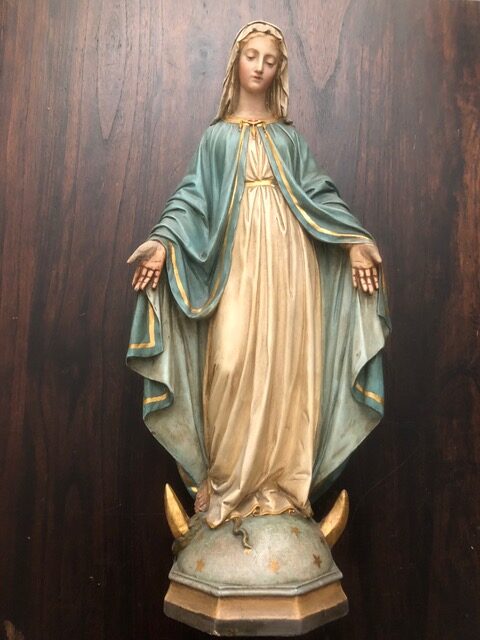
History

Bernadette Soubirous was born in Lourdes on 7 January 1844. The Soubirous family enjoyed a reasonable degree of prosperity due to their work in the water mill. However, industrial development in the mid-19th century had consequences for the milling profession, among others. Furthermore, the government distributed free flour to combat famine among the population in the south of France. Ultimately, these events proved disastrous for the traditional miller. Father Soubirous earned less and less from the mill, and he also gave a great deal away to the poor. Later, he lost an eye, became unemployed, was falsely accused of theft, and spent some time in prison. Because of all this, it was difficult to make ends meet. Poverty struck hard. In 1855, the mill business went bankrupt, and the family had to leave the mill.
Bernadette Soubirous has poor health. She suffers from asthma, among other things, which makes her frequently ill. She also contracts cholera and tuberculosis. Bernadette goes to nearby Bartrès to live with acquaintances. She stays with the Laguës family for a time. Bernadette was also fed here as a baby.
The Soubirous family, due to poverty, cannot afford to spend money on a house. Eventually, a former, disused, small prison becomes their residence. Towards the end of 1857, the family is therefore staying in the “cachot”. A few months later, Bernadette returns to her family in Lourdes.
Bernadette experiences what it is like to live in poverty, to have fragile health, to struggle at school, to be underdeveloped and to be considered socially inferior. These characteristics give Maria the opportunity to make her voice heard through Bernadette.
In 1858, Mary appeared 18 times to Bernadette Soubirous in Lourdes. The dates of Our Lady's visits are: in February on the 11th, 14th, 18th, 19th, 20th, 21st, 23rd, 24th, 25th, 27th, and 28th; in March on the 1st, 2nd, 3rd, 4th, and 25th; on April 7th; and for the last time on July 16th, 1858.
On 11 February 1858, Bernadette went with two girls, her sister Toinette and her friend Jeanne Abadie, to the river Gave de Pau to collect wood for the stove for cooking and heating. She heard a rustling sound, but the leaves on the trees were not moving. To cross the river, Bernadette took off her shoes and, after taking careful steps, reached the other bank. Bernadette arrived at the Grotto and heard the rustling sound again. She looked at the Grotto and saw a beautiful Lady dressed in white with a blue sash. On each foot, the apparition had a yellow rose. The roses were the same colour as the rosary in the Lady's hands. Bernadette rubbed her eyes, thinking she was mistaken. The Lady made the sign of the cross. Bernadette tried to imitate it with a trembling hand but could not bring her hand to her forehead. Her right arm seemed paralysed. A little later, she managed it and Bernadette began to pray the rosary, as she always carried it with her. The Lady let the beads slide slowly through her fingers, but her lips did not move. When Bernadette had finished praying the rosary, the Lady beckoned her to come closer, but she dared not. Suddenly, the Lady disappeared. She then asked her two companions if they had seen anything. The other two girls had seen and heard nothing. Only Bernadette was a witness to the apparition. She later reported this apparition to Father Charles Ferdinand Gondrand (born in 1824), who was attached to the monastery at Bétharram. He met Bernadette during a retreat in Lourdes in September 1860 and asked her to write down the event. On 28 May 1861, Bernadette put her memories on paper, but the letter sent to Gondrand in Betharram was returned to her. The Father was no longer there. When Bernadette died in Nevers, she still had this letter in her possession.

Bernadette refers to the apparition as “Aquero” in the local dialect, meaning “that one there”.
On 13 February 1858, Bernadette tells her confessor, Chaplain Bertrand-Marie Pomian (1822-1893), what happened to her two days prior. Bernadette has great trust in Pomian. Pomian has been a chaplain in the parish of Lourdes since 1851 and, from 1857, was attached to the local hospice as an almoner.
The second apparition is on 14 February 1858. Bernadette feels an urge and haste to go to the Grotto. After a few Hail Marys, she again sees the beautiful Lady with a rosary on her arm and sprinkles holy water in the direction of the Apparition. The Lady smiles and bows her head as Bernadette wishes to sprinkle Her further. The Lady makes the sign of the cross. Bernadette continues to pray the rosary and the Lady disappears.
On 18th February 1858, the third apparition occurred. Bernadette was not alone, as many interested people had also come to the Grotto. The Lady smiled and spoke for the first time. On people's advice, Bernadette had taken paper, pen and ink with her to ask the Lady to write down what She was asking. Bernadette was informed that what She told did not need to be written down. She asked Bernadette to come for two weeks. Bernadette replied that she would comply. The Lady said that She did not promise to make Bernadette happy in this world, but in the other. Complying with the Apparition's request was not easy for Bernadette, as the local authorities were absolutely uncooperative, and there were people who began to express reservations about what Bernadette was experiencing.
On 19 February 1858, the fourth apparition takes place. Bernadette finds the Lady as beautiful as ever. The Apparition says nothing.
The fifth apparition takes place on 20th February 1858. The Lady smiles at Bernadette.
The next day, 21 February 1858, is the sixth apparition to Bernadette.
After a day of not seeing an apparition, the Lady appears on 23 February 1858. This is the seventh apparition at the Grotto.
On 24 February 1858, there is the 8th apparition. Bernadette is sad and “the Lady” says in the local dialect: “Penance! Penance! Penance! Pray to God for the conversion of sinners.” Bernadette sees that the Lady's lips do not move and that the beads of the rosary slide through her hands. Bernadette kisses the ground as a sign of penance.
The ninth apparition occurs on 25 February 1858. The Apparition tells Bernadette to go to the spring and wash herself there. The girl sees no spring and goes to the river Gave de Pau to drink and wash herself. The Lady beckons her and points to the Grotto. At the back of the space, she finds a bit of muddy water and scratches further in the ground. The dirty water becomes clearer and Bernadette drinks from it. Afterwards, the Lady has her eat some herbs by the spring. Then the Apparition is gone.
During the tenth apparition on 27 February 1858, Bernadette washes herself with water from the spring, and the lady again has her eat some herbs.
The eleventh apparition is on 28 February 1858 and the 12th apparition takes place on 1 March.
”The Lady“ says on 2 March 1858, which is the 13th apparition, to her: ”Go and tell the priests to build a chapel here and that one must come there in procession.“ During an apparition, the Lady also says: ”Go and drink from the spring and wash yourself there.“ The Lady disappears and Bernadette goes to chaplain Pomian again and tells him what ”the Lady" told her earlier that day. He asks Bernadette if he may tell the priest, Dominique Peyramale (1811-1877), who was active in Lourdes between 1855 and 1877, about her experiences. Bernadette agrees. The priest reacts far from enthusiastically to what he is told. He wants to know from whom Bernadette receives the messages. Finding this out is Bernadette's task.
The fourteenth appearance is on 3 March 1858. At the Grotto, Bernadette prays the rosary. Then the Lady appears and Bernadette asks Her what the priest, who wants to know the lady's name, has instructed her to ask: “Who are you?” The Lady smiles and remains silent. After the visit to the Grotto, Bernadette tells the priest that she has passed on his message but has not received an answer from the lady. Thereupon, the priest says that she is fooling him and should not go to the Grotto anymore.
On 25 March 1858, the Lady says who She is: “I am the Immaculate Conception.” She then directs her eyes to heaven and brings her folded hands to chest height. These are the last words Bernadette hears from Her. After the apparition, Bernadette immediately goes to the parish priest, repeating on the way the words the Lady spoke in dialect, which she did not understand. The priest asks if she is certain of the words and then believes that Our Lady has been at the Grotto.
Another special event takes place on 7 April 1858, during the 17th apparition. Bernadette is holding a lit candle. The flame touches her hands, but she feels nothing of the heat. There is no trace of burning.
The last apparition is on 16 July 1858. Bernadette is opposite the Grotto, on the other side of the Gave de Pau river. She says the Apparition has never been so beautiful.
Bernadette Soubirous visits Pastor Peyremale several times. However, at first, he is not receptive to her stories and displays a surly attitude. The pastor does, however, receive young people from more affluent circles in a friendly manner. On her first visit to Pastor Peyremale, she is accompanied by two aunts. Bernadette experiences a traumatic event as she has not been able to recall the exact words of the Apparition concerning the procession requested by Our Lady. The pastor reacts negatively, and this affects Bernadette deeply, revealing her vulnerability. Bernadette encounters further opposition; villagers claim she is not right in the head and is highly imaginative. Later, she faces accusations of seeking attention and exploiting the situation. Bernadette remains steadfast in her experiences, is sincere, and no one can make her doubt.
On 16 July 1858, the last apparition in Lourdes occurred for Bernadette Soubirous. It is the feast day of Our Lady of Mount Carmel. The authorities have blocked access to the Grotto. This forces Bernadette to go to the other side of the River Gave de Pau to see the apparition over the barrier. During this apparition, Mary is silent; it is a temporary farewell in silence. Bernadette says she has never seen Our Lady so beautiful.
Mary appears to Bernadette 18 times in Lourdes. During the apparitions, it becomes increasingly crowded, as many interested parties and curious onlookers want to see what is happening. They also want to witness what Bernadette does at the Grotto when an apparition takes place. When Bernadette makes the sign of the cross, thousands of eyes are fixed upon her. The apparitions generate interest in Bernadette among many people, and this places pressure on her and the Soubirous family. The parish priest of Lourdes deems it more advisable to protect Bernadette. Thus, she comes to reside with the Sisters of Charity in the small, local hospital.
The texts of Our Lady, spoken in the local dialect, were not immediately recorded. Interpreting Mary's words requires a thorough knowledge of the 1858 context of Bernadette, the inhabitants of the town of Lourdes, other involved parties, and the political situation. Bernadette is interrogated and is the victim of tricks and deception by Jacomet, the police commissioner. Much third-party investigation brings clarity to what Bernadette experienced at the Grotto.
Remarkably, the apparitions at Lourdes by the Grotto of Massabielle were recognised by Catherine Labouré, to whom Mary appeared in Paris. Catherine says: “She is the same one!” Don Bosco also recognised the apparitions, and this long before the Church acknowledged them.
During the period of the apparitions, pilgrims come to the grotto at Lourdes. The town then has about four thousand inhabitants. For the first time, people come specifically to the grotto at Lourdes from the town itself, the region, further afield in France, and also a few from abroad. They come alone or with family members and/or friends. These are individual pilgrimages during the period 1858-1862. Only after the authenticity of the apparitions of Mary was proclaimed do group pilgrimages begin. First, groups from Lourdes arrive, and later from the surrounding area of the nascent pilgrimage site.
Bertrand-Sévère Laurence (1790-1870), Bishop of Tarbes (1845-1870), met Bernadette Soubirous for the first time on 5th February 1860. An investigation into the authenticity of the apparitions was underway at the time. Almost two years later, on 18th January 1862, an official publication was issued by the Bishop of Tarbes, Laurence, in which he recognised the supernatural nature of the apparitions of Mary at Lourdes. The bishop revealed his approval of the authenticity of the apparitions because believers, in particular, had received signs from Our Lady. This provided a huge boost to the fame of Lourdes, and the number of pilgrims increased considerably. The declaration of the authenticity of the apparitions led to organised group pilgrimages in addition to individual ones. On 25th July 1864, the first organised group pilgrimage from outside Lourdes took place. The pilgrims came as an organised group from Loubajac, which is located 7 kilometres north-west of Lourdes.
~~~
Hospice in Lourdes.
The hospice (hospitium) in Lourdes is situated on a hill where the roads to Pau and Tarbes intersect. In 1834, the hospice in Lourdes was founded by the Sisters of Charity and Christian Instruction of Nevers. In the time of Bernadette Soubirous, it was a nursing home where the poor and sick were cared for by the Sisters of Nevers. It was in the chapel of the hospice that Bernadette received her First Communion on 3 June 1858. On 15 July 1860, Bernadette Soubirous was admitted to the hospice in Lourdes. The reason for this was to protect her from the many curious people visiting the site of the apparitions. This was done at the suggestion of Marie-Dominique Peyramale (1811-1877), parish priest of Lourdes (1854-1877), and Anselme Lacade (1804-1866), mayor of Lourdes (1848-1866). Her parents agreed to the proposal for Bernadette to move to the hospice. There, Bernadette learned to read, write, do arithmetic, speak French, knit, and sew. In the hospice, Bernadette described her experiences of the apparitions. Her stay was also useful in helping her to clarify her future. In the hospice, Bernadette completed her postulancy (probationary period in the convent). Bernadette stayed at the hospice in Lourdes until 4 July 1866, as on that day she departed for the convent in Nevers.
The buildings of the former hospice now belong to the Lourdes hospital. A small museum has been set up in the former consulting room of the hospice. Here you will find some items that refer to Bernadette's presence, such as a prayer stool, letters, a headscarf, rosary beads, and some photographs.
In 2005, the hospice was renovated. The oratory was enlarged and made more accessible for visitors. Artist David Pons (born 1966) contributed to the liturgical furnishings of this prayer room. Relics of Bernadette are incorporated into the altar of the oratory.
The current, Neo-Gothic chapel on the left side of the building was realised after Bernadette's time in Lourdes. The chapel, museum and oratory can be visited.
~~~
On 13 October 1862, construction of the church above the Grotto began. This would become the “upper basilica” with dimensions of 51 m in length and 21 m in height.
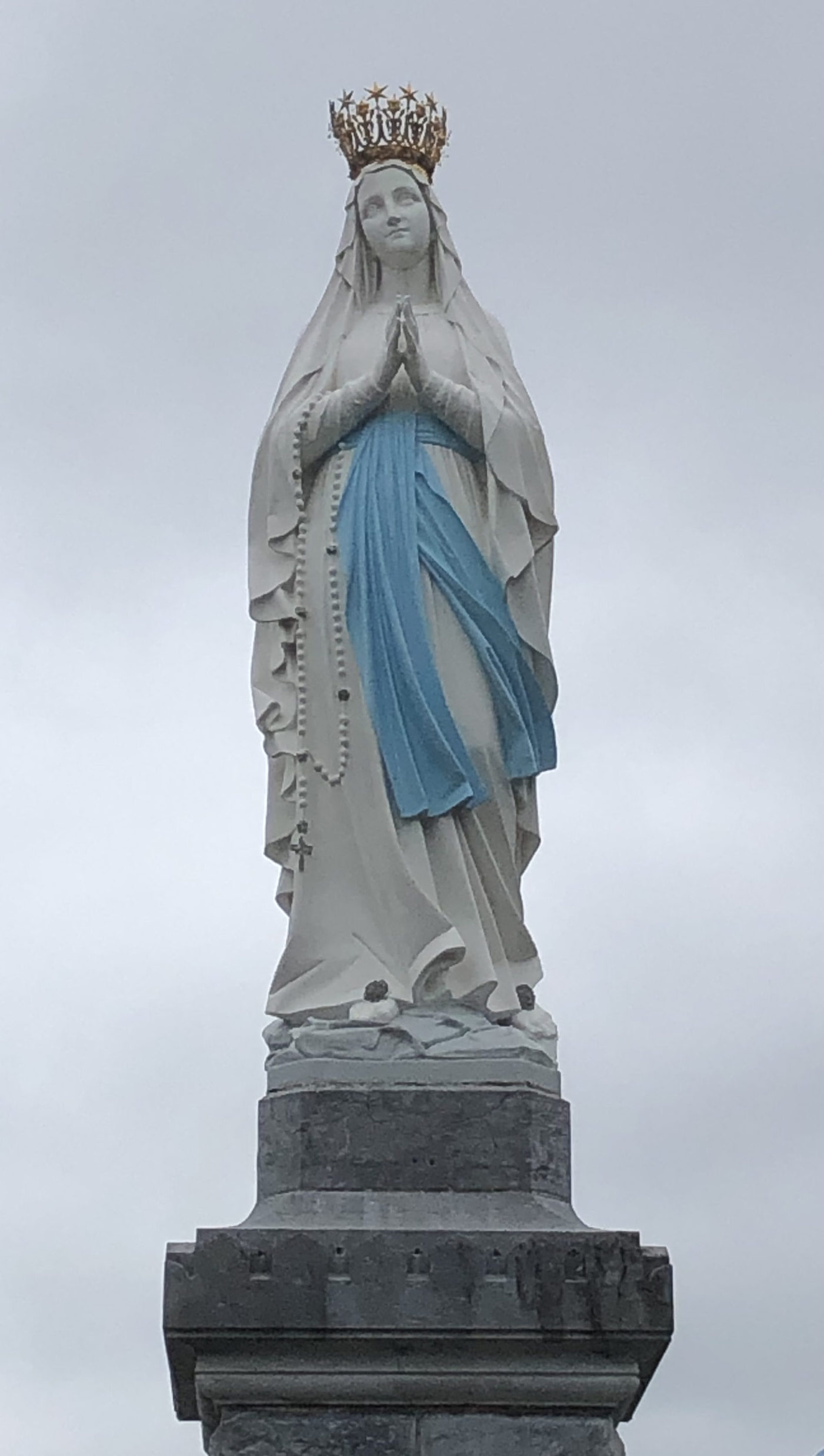
In the niche of the Grotto at Lourdes stands a statue of Mary by Joseph-Hugues Fabisch (1812–1886). This statue is 1.83 cm high and made of Italian Carrara marble. On 4 July 1864, it was placed in the Grotto where Mary appeared to Bernadette Soubirous. The crypt at Lourdes, located above the Grotto, is the first church in the sanctuary to be consecrated. The consecration takes place on 19 May 1866. Bernadette Soubirous is present. The crypt has two side entrances. In 1904, the long corridor to the crypt was constructed.
The pilgrimages to Lourdes received a huge boost in 1866, as in that year the town of Lourdes was connected to the railway network. The consequence of the train connection was that pilgrims from afar could travel to Lourdes more easily. Upon arrival at the station in Lourdes, the pilgrims proceed in procession to the Lourdes Grotto.
On 4 July 1866, Bernadette bids farewell to the Grotto, leaves Lourdes, and travels to Nevers to enter the convent of the Congregation of the Sisters of Charity. She is given the name Sister Marie-Bernard. The first part of this name, Marie, refers to Our Lady, and the second part underlines the connection with her godmother, after whom she was named at her baptism.
Marie-Thérèse Vauzou (1825-1907) became mistress of novices at the convent of Saint-Gildard in Nevers in 1861. Bernadette met her upon arriving at the convent. Marie-Thérèse Vauzou did not believe in Bernadette's visions and treated the new resident coolly and strictly. She was determined not to grant Bernadette the status of a famous woman. From 1881 to 1899, she was Mother Superior of the convent, thus after the death of Bernadette Soubirous. Marie-Thérèse Vauzou opposed the beatification and canonisation of Bernadette and expressed this when the seer died in 1879. She strongly requested that the beatification process be delayed until after her death. In 1909, two years after Marie-Thérèse Vauzou's death, the beatification process for Bernadette Soubirous began in Lourdes.
In the convent at Nevers, Bernadette (Sister Marie-Bernard) makes several pronouncements, such as “praying the Rosary is my favourite prayer” and “I am a pillar of the infirmary.”.
She works with the sisters in Nevers, but she is also often ill. In the convent of Nevers, Bernadette is responsible for the infirmary. She lives there for another 18 years and never returns to Lourdes. Bernadette dies on 16 April 1879 in the convent in Nevers at the age of 35, after lying for a long time in the “Sainte Croix” bệnh viện. Because of the white curtains around the bed, she calls this her white chapel, and she often holds a crucifix there. Bernadette is buried in the St. Joseph's Chapel, which was built in the convent garden. Later, she is laid out in a glass reliquary, which stands at the front right of the chapel. Bernadette Soubirous was beatified in 1925 and canonised in 1933.
During the Franco-Prussian War of 1870 to 1871, there were no pilgrimages to Lourdes, although a limited number of believers did travel to the Marian shrine on an individual basis, at considerable risk.
In 1873, the Ave Maria is sung for the first time at the Lourdes grotto.
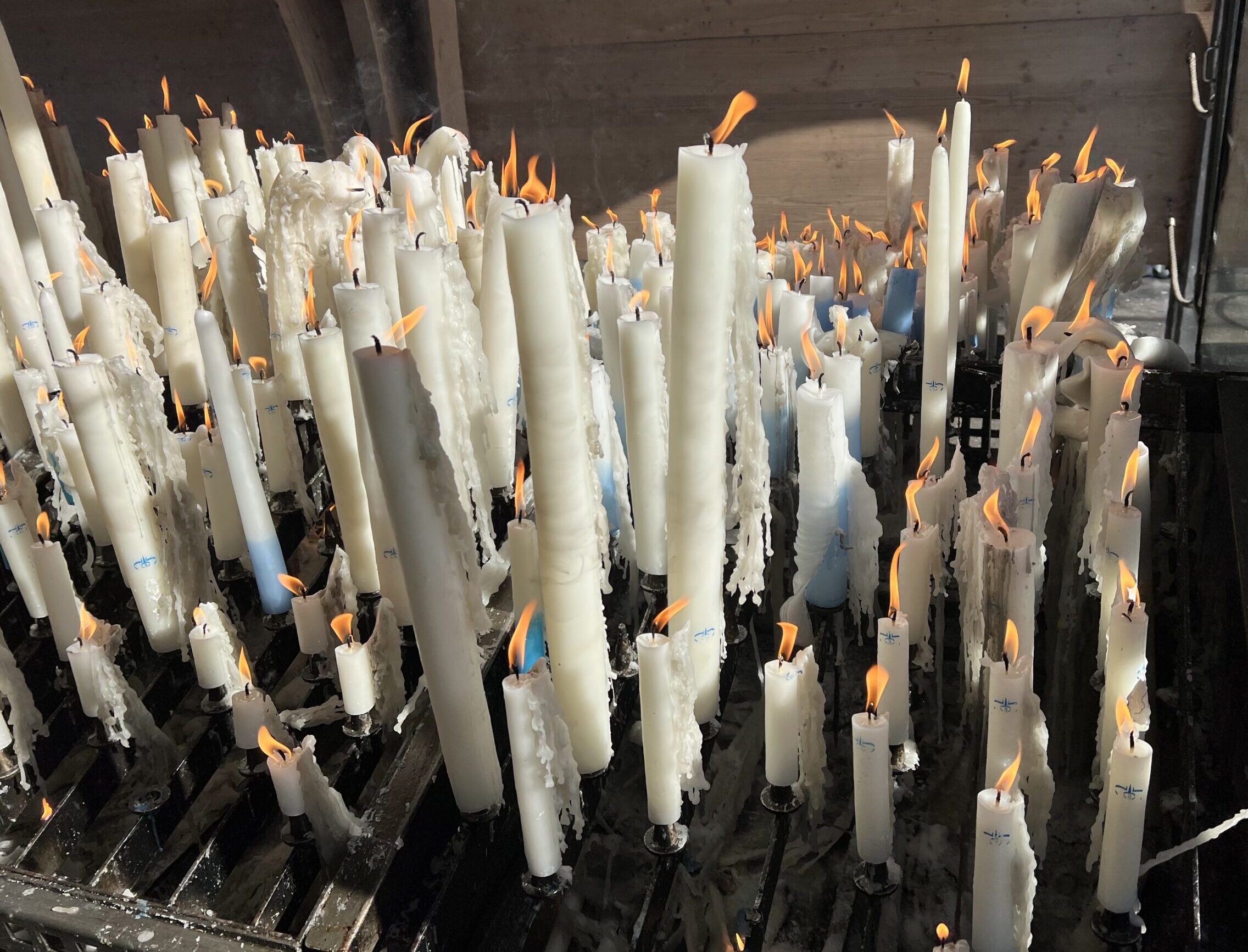
Also in 1873, an additional symbol was placed near the grotto, namely the large candelabrum. This is a votive offering in thanks from a blacksmith from Tarbes for the healing of his son. The boy is seriously ill and can no longer stand on his feet. He is taken to the grotto in Lourdes. At the grotto he drinks the water, rubs the spring water over both knees and is able to stand and walk again a little later. The father has the candelabrum he made placed at the grotto and lights the first candle on the candelabrum. Nearly 100 candles can be placed on the metre-high candelabrum.
On 13 March 1874, Pius IX, Pope from 1846-1878, born Giovanni Maria Mastei Ferretti (1792-1878), conferred the title “basilica” upon the Chapel of the Immaculate Conception. This is the upper basilica above the Grotto. In 1872, the spire was completed, and in that year, the first organised pilgrimage from Belgium to Lourdes took place.
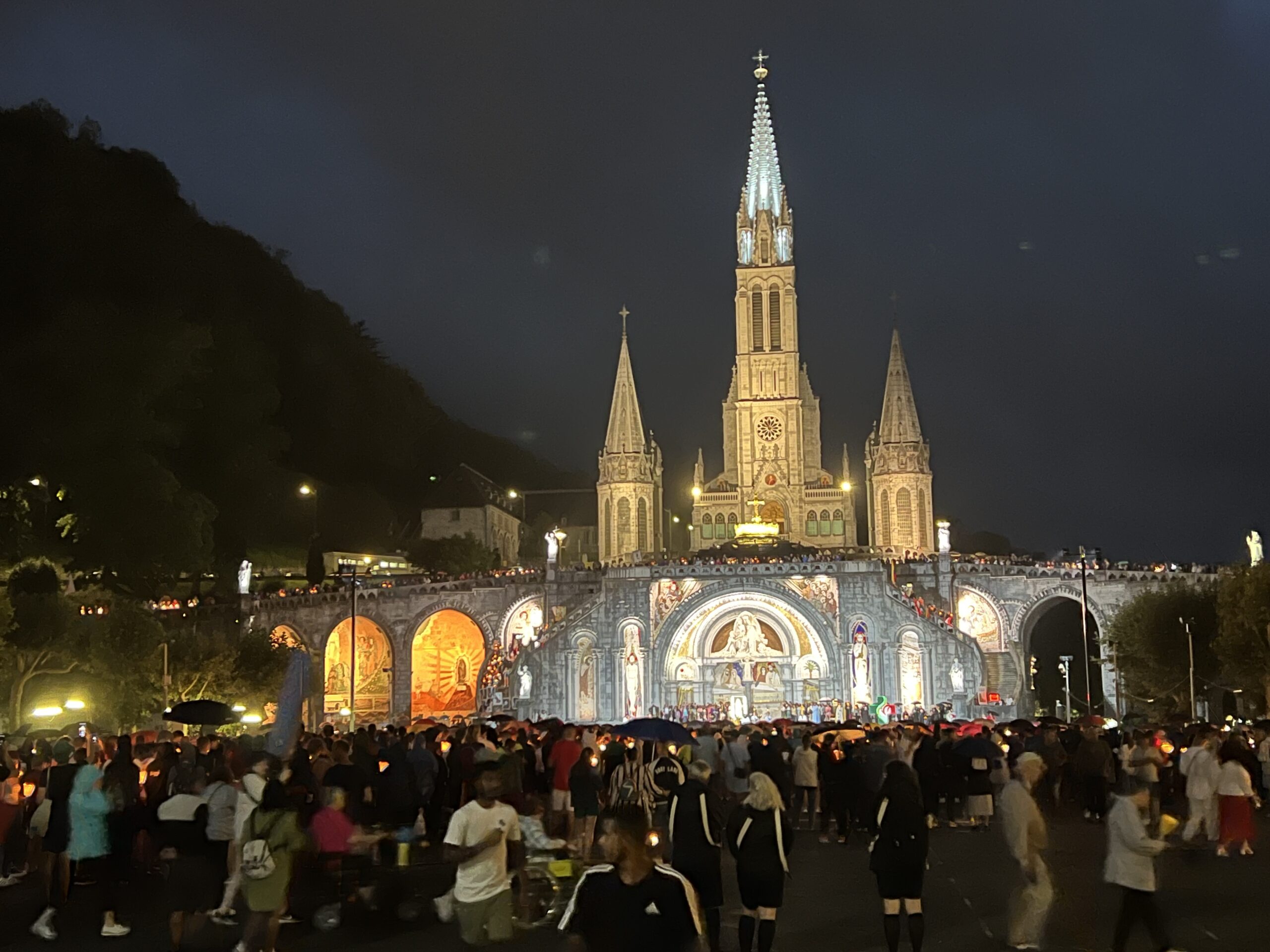
In 1874, Franciscan friar Marie-Antoine de Lavaur, born François-Léon Clergue (1825-1907) in Lavaur, conceived the torchlight procession that is still held in the evenings. This clergyman met Bernadette Soubirous on 16 July 1858 during her last apparition of Mary. Among other things, he stated that the “M” stood for Mary, but also for “marcher” which means to go and walk. The latter refers to going on a pilgrimage. Marie-Antoine de Lavaur is also known as “the saint of Toulouse” and “the apostle of the south”.
The solemn consecration of the Basilica of the Immaculate Conception took place on 2 July 1876. This upper church soon proved to be too small to accommodate the many pilgrims. Expanding the building was not possible. The idea then ripened to build another church. On 3 July 1876, the statue of the Virgin Mary was crowned, with the authorisation of Pope Pius IX. The effigy is known as the “Crowned Virgin” statue and depicts the glory of Mary. On 16 July 1883, exactly 25 years after the last apparition, the first stone was laid for the Basilica of Our Lady of the Rosary. In 1896, the work was ready for use and could seat 1500 people. In 1901, the space was consecrated.
The pilgrim's walkway from the station to the Lourdes grotto was improved in 1881 by the construction of the Boulevard de la Grotte.
In 1883, the first organised pilgrimage from the Netherlands to Lourdes was held.
On 28 January 1885, the “Hospitalité Notre-Dame de Lourdes” was founded by Prosper-Marie Billère (1817-1899), Bishop of Tarbes (1882-1899). This is a hospitality association and operates as a brotherhood of volunteer helpers for the sick from various countries. Members assist with guiding processions and carrying out logistical tasks. In 1901, this organisation became an association under French law. In 1928, the brotherhood was changed into an archconfraternity. These volunteer forces make it possible for the sanctuary to provide the necessary services to the sick and disabled.
In 1889, the first cure associated with Lourdes was reported in Belgium. A paralysed man from Liège was able to walk again after an intense novena to Our Lady and drinking water from Lourdes.
The Dutch, Limburg pilgrimage to Lourdes originated in 1921.
In 1923, the Dutch-language magazine “Stemmen uit Lourdes” was founded. This periodical would later become “Magazine voor De Pelgrim”.
The “Aéroport de Tarbes-Lourdes-Pyrénées” is located about 12 kilometres from the Sanctuary of Lourdes. The first aircraft carrying pilgrims arrived at this airport in 1948.

On 25 March 1958, the underground Basilica of St Pius X was consecrated by Cardinal Angelo Giuseppe Roncalli (1881-1963), later Pope John XXIII (1958-1963).
From 1975 onwards, the sick were carried in procession. Later, the sacramental procession, which was held in the afternoon during the pilgrimage season, became the procession of the sick.
On 25 March 1988, the Bernadette Church is consecrated.
In 1997, the “Accueil Notre-Dame” was completed. This centre receives thousands of pilgrims annually who require care.
During the corona pandemic of 2020-2022, bathing in the sanctuary was impossible. Due to the danger of contracting the virus, the baths were closed. In its place came a gesture with water, namely scooping water to wash one's face, hands, or more. After the pandemic, this change remained for a few years, and only in exceptional circumstances could a pilgrim still bathe entirely in Lourdes water. On 15 August 2024, the baths will be accessible again, and no restrictions will apply.
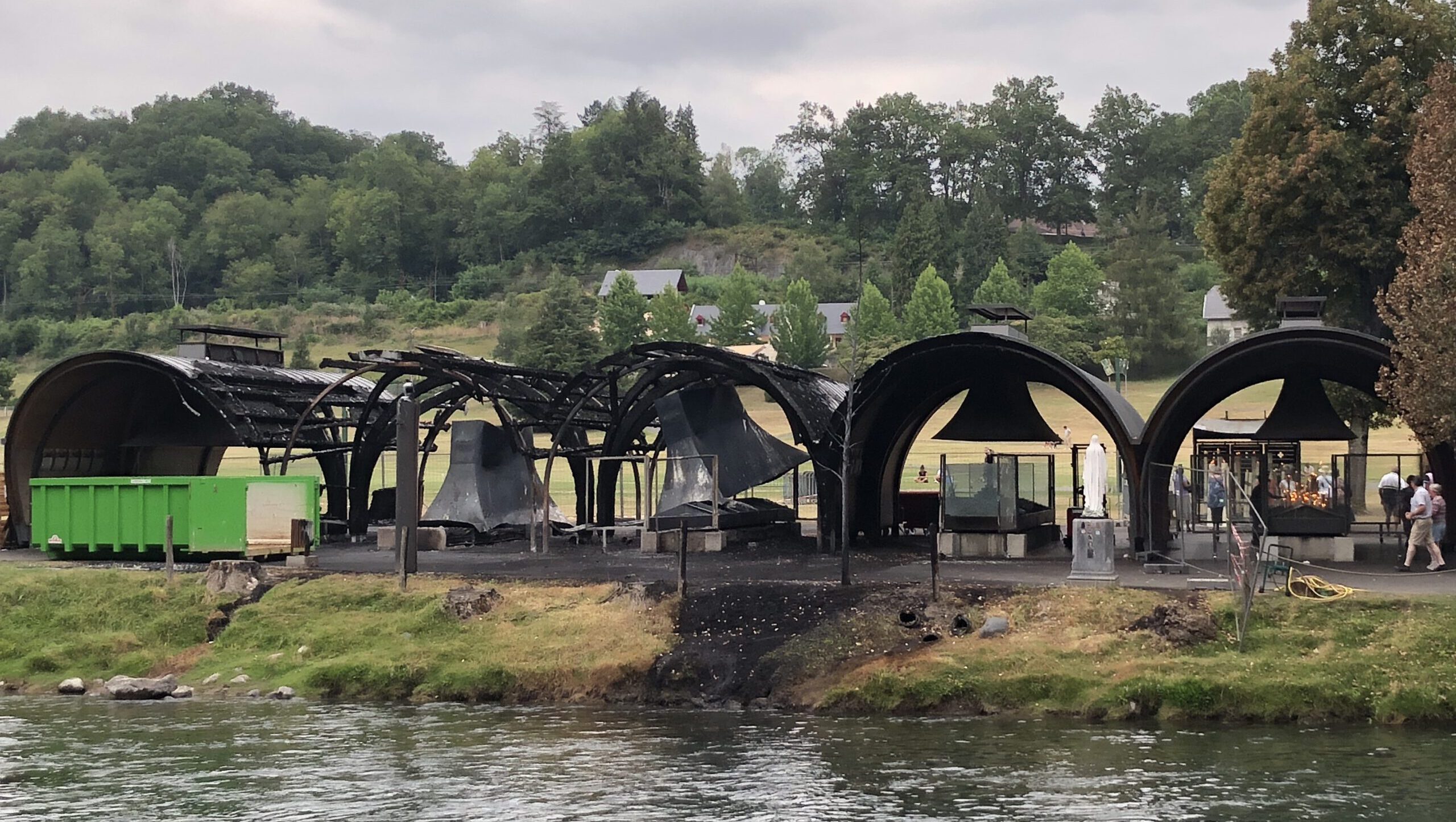
On 10 July 2022, a fire caused extensive damage to three candle chapels on the opposite bank of the Gave de Pau river, opposite the Grotto. It is believed that the hot wind caused the flames from the candles to spread to the chapels’ wooden structures. Security camera footage has ruled out arson. Given that few visitors came to the sanctuary in 2020 and 2021 due to the coronavirus pandemic, the fire comes at a very inopportune time. After all, candle sales account for around 40% of the pilgrimage site’s income, and 4,000 candles can burn simultaneously in the seven candle chapels. The damage is estimated at €1.5 million, against an annual budget for the entire sanctuary of €30 million. On 11 February 2023, the rector of the sanctuary, Michel Daubanes (1964), consecrated the new chapels, which had been destroyed by fire in 2022.
Michel Daubanes (born 1964) will succeed Olivier Ribadeau-Dumas (born 1961) as rector of the pilgrimage site on 1 September 2022. Michel Daubanes was installed during a Eucharist celebration in the Rosary Basilica on 22 September 2022. He has a mandate of 5 years, which can be extended once for a further 5 years. The new rector previously worked in Evreux and is a professor of biblical exegesis.
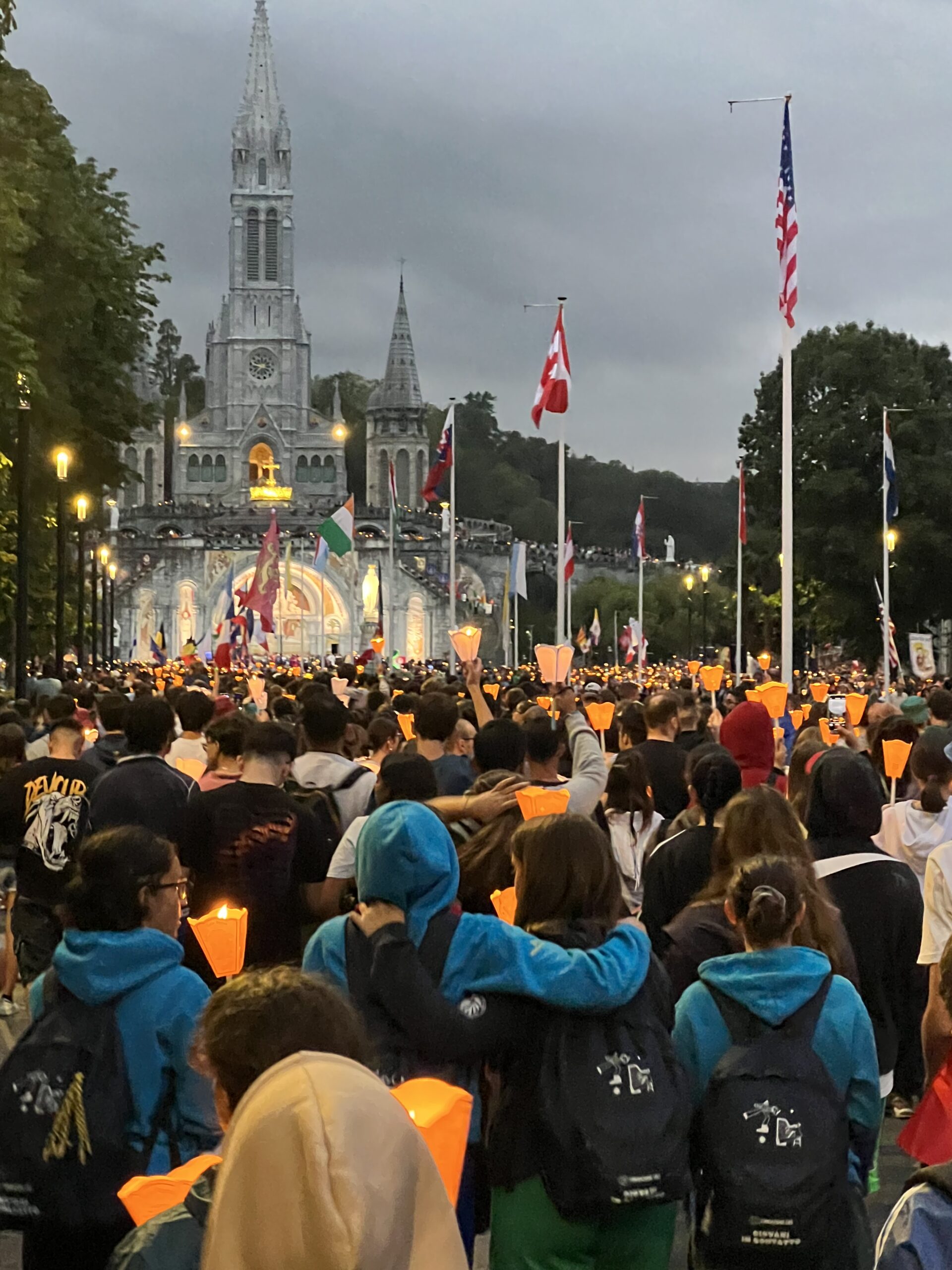
At the end of July 2023, there are an unprecedented number of pilgrims in Lourdes. On 28, 29 and 30 July, many young people are making a stopover in Lourdes. Afterwards, they will continue to Lisbon, Portugal, to attend World Youth Day, which Pope Francis will also be visiting.
~~~
relics
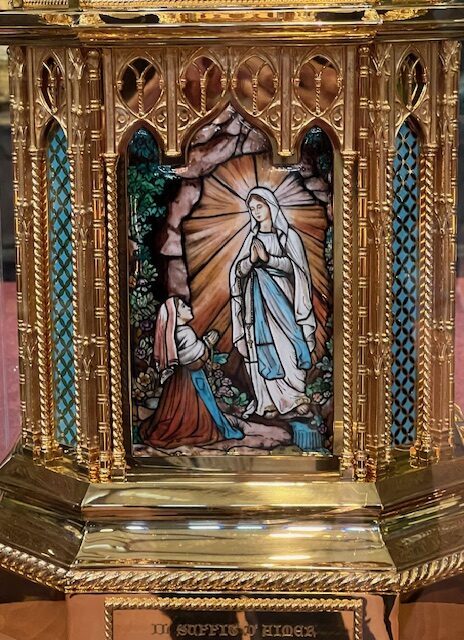
Relics of Bernadette Soubirous are kept in Lourdes, Nevers, and several other locations. A relic of Bernadette also travels in a special shrine. This allows Bernadette to be venerated in more places and brings attention to the significance.
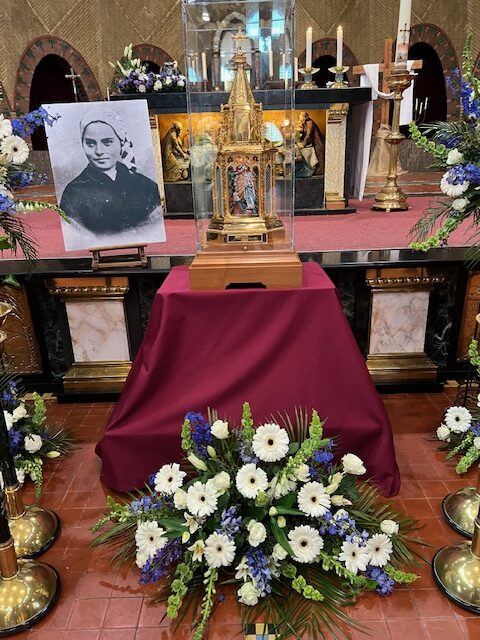
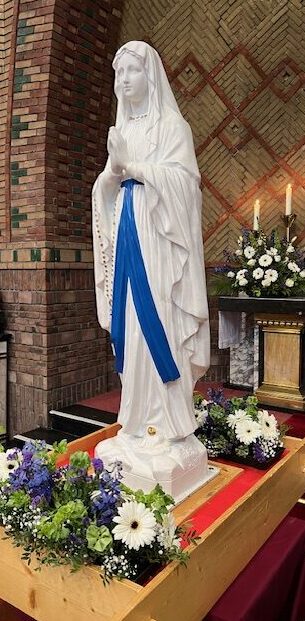
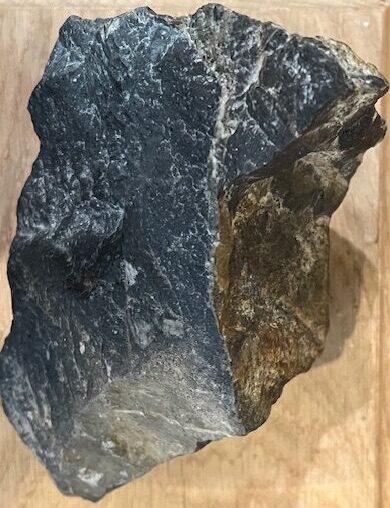
The relic will visit all 7 Dutch dioceses in April 2024. The travelling reliquary refers to the apparitions of Mary to Bernadette in 1858. Thus, the reliquary represents a piece of Lourdes in other places. The reliquary was specially made to go on tour, bringing Lourdes to people outside the renowned pilgrimage site. The tour in the Netherlands also encourages interested parties to come on pilgrimage to Lourdes and Nevers. This is the first time this relic has come to the Netherlands. On 23 April 2024, the relic, with a piece of stone from the Grotto of Lourdes and a statue of Lourdes, will be at the parish church “Our Lady of Lourdes” in Bergen op Zoom. There will be a welcome service in the morning, and many will visit the relic in the afternoon. In the early evening, there will be a eucharistic service, followed by a procession, and concluding with an all-night vigil. The following morning, the relic will depart.
~~~
wondering
Since 1858, miraculous, supernatural healings have occurred in Lourdes, and many pilgrims report experiencing healings of the heart. Once a year, a committee of more than 20 doctors meets. The members of this committee can declare a healing medically inexplicable after years of research.
In the Marian shrine of Lourdes, visitors share their feelings with Mary, presenting their joys and sorrows to Her. Each pilgrim is accepted by Our Lady, which gives the visitor support. Visitors to the Sanctuary of Lourdes generally do not expect to be healed immediately on site. Suddenly continuing life without a wheelchair is therefore a utopia. Most pilgrims therefore do not experience physical or spiritual healing, but rather encouragement from Our Lady. They receive strength from Mary to be able to continue. The prayer at the Grotto is the medicine for the soul. This changes the lives of the pilgrims. Mary ensures that her support has a healing effect. This experience also occurs when visiting Lourdes grottos elsewhere. Experience shows that demanding healing does not lead to an improvement in the situation. To date, 71 unnatural, miraculous healings have been recognised. A miraculous healing of the sick through the intervention of “Lourdes” is therefore unknown in medicine. Science faces a great mystery here.
In 1862, healings were first recognised as miracles by Bertrand-Sévère Mascarou-Laurence (1790-1870), Bishop of Tarbes-Lourdes (1845-1870).
In 1883, Georges-Fernand Dunot de Saint-Maclou (1828-1891) arrived in Lourdes as a permanent doctor to investigate healings at the pilgrimage site. He established the Lourdes Medical Bureau. This bureau investigates healings that are inexplicable according to the current state of medical science. Therefore, the bureau does not deal with miracles, but with inexplicable healings. A healing must be sudden, immediate, complete, and permanent. Approximately 1,500 healings are reported to the bureau annually. The vast majority of these are not considered miracles, as the sick have been to Lourdes and were healed through medical treatments. Prior to the recognition of a healing, investigations take place. In the case of an apparently inexplicable healing, experts from the bureau convene with the healed person to discuss the process and the outcome. The bureau can issue a certificate of healing.
Each year, there is a meeting to present recognised healings to the International Medical Committee of Lourdes, established in 1947. This committee comprises researchers from medical faculties of universities from many countries. A two-thirds majority is required to recognise a healing. Subsequently, it is up to the Church to decide if a miracle has occurred. To this end, the Bishop of Tarbes-Lourdes forwards the file to the Bishop of the diocese where the healed person resides. There, the diocese investigates whether a miracle has taken place.
The apparitions of Mary to Bernadette Soubirous take place in 1858 and since then some 8,000 healings have been recorded in Lourdes, with less than 1 per cent of these recognised by the Catholic Church as miracles.
Since August 2024, a renewed exhibition on the recognised miracles of Lourdes has been set up on the first floor of the John Paul II building. It provides explanations about the healed individuals and also sheds light on the work of the Lourdes Medical Bureau.
~~~

In October 2024, a stone cross was unveiled at the crossroads opposite the Grotto. The Armenian cross was created by visual artist Harout/Harut Yekmalyan (1965). This cross is also known as “Chatsjkar” in Armenian, and internationally it is referred to as “Khachkar”. The commemorative stone placed there symbolises the faith and presence of Armenian Christian pilgrims in Lourdes.
In November 2024, Sviatoslav Shevchuk (*1970), Major Archbishop of Kyiv-Halych (2011) and Metropolitan Archbishop of Kyiv (2011) of the Ukrainian Greek Catholic Church, blessed the icon in Lourdes that had previously been donated to the French shrine earlier in 2024. This icon is located in the Ukrainian chapel of the Rosary Basilica.
On 8 December 2024, the miraculous healing of John Jack Traynor (1883–1943) will be officially proclaimed by Malcolm McMahon (b. 1949), Archbishop of Liverpool since 2014 and formerly Bishop of Nottingham (2000–2014). This is the 71st officially recognised miracle of Lourdes. It is striking that this miracle took place 101 years earlier! A long history precedes the announcement of the miracle. John Jack Traynor was orphaned at a young age and his mother always expressed a strong faith in Mary. He served in the First World War (1914–1918) with the British Royal Navy. During the Great War, he was wounded twice. After the first injury, he was unconscious for five weeks, and the second time he was seriously wounded at the Battle of Gallipoli, which lasted from 25 April 1915 to 9 January 1916. Gallipoli is a peninsula of the Ottoman Empire, which now belongs to Turkish territory. He underwent several operations, but without success. The man lost the use of his right arm but refused an arm amputation proposed by doctors. Furthermore, he began suffering from epileptic seizures. In 1920, a surgeon in Liverpool treated his epilepsy. The operation failed and both of the unfortunate man’s legs became partially paralysed. By mid-1923, his condition had deteriorated further and the former soldier was admitted to a hospice for the terminally ill. In July 1923, John Jack Traynor took part in the Archdiocese of Liverpool’s first pilgrimage to the Sanctuary of Lourdes. On 25 July 1923, the man was immersed several times in one of the baths at Lourdes. Later that day, he took part in a procession and the blessing of the sick. After this, the epileptic seizures cease and he notices that further healing is taking place. He becomes increasingly able-bodied. Some time later, the man is completely healed. The doctors attending him speak of an inexplicable healing. On 26 July 1923, the man leaves Lourdes. In 1926, John Jack Traynor returns to Lourdes. On 7 July of that year, he went to the “Bureau des Constatations Médicales” to testify to the healing. On 2 October 1926, the chairman of the investigation bureau, Dr Auguste Vallet (1874–1967), signed the statement confirming that John Jack Traynor had received a supernatural healing. The healed man had by then become a member of the Liverpool Brancardier’s Association and, from 1926 until 1939, he returned to Lourdes every year to serve as a volunteer stretcher-bearer. On 26 December 1926, the healing was published in the “Journal de la Grotte”, the sanctuary’s official journal. In 1927, the healing was published in the journal “Les Annales”. John Jack Traynor died on 8 December 1943 from another illness. It is noteworthy that the conclusion drawn in Lourdes regarding the supernatural healing was not communicated to the Archdiocese of Liverpool. This was simply forgotten…
In 2023, on the occasion of the 100th anniversary of the first British pilgrimage to Lourdes, the “Traynor” case has been re-examined. The archive has been consulted and the evidence is beyond dispute. This leads to the official recognition of the healing a century later.
On 31 March 2025, the mosaics on the doors of the Basilica of Our Lady of the Rosary were covered. The creator of the artworks is Marko Rupnik (1954), a Slovenian mosaic artist, Catholic priest, Jesuit, and theologian. The reason for making the mosaics invisible is the growing outcry over the abuse by him, primarily involving women, on a psychological, sexual, and spiritual level, which became known in 2022.
In 2025, the crypt was refurbished. This is the prayer space beneath the upper and above the lower basilica. It is the first chapel of the Sanctuary of Lourdes. It is the only chapel of the sanctuary that visionary Bernadette Soubirous saw during her years in Lourdes.
~~~
The 72nd miracle at Lourdes occurs with Antonietta Raco. In 2009, the Italian is at the Sanctuary of Lourdes and is in her wheelchair. The woman goes to the baths, enters the water, and shortly afterwards feels an unusual sense of well-being. She is immediately healed of a rare neuromuscular disease that made it impossible for her to walk. She undergoes examinations multiple times, and the conclusion is that Antonietta Raco has been supernaturally healed, and a miracle has been recognised. Researchers at Lourdes reach this conclusion after a lengthy process of medical and scientific investigation. The publication of the researchers' decision takes place on 16 April 2025, by Michel Daubanes, rector of the Sanctuary of Lourdes. In 2025, Antonietta Raco is 67 years old and is the 72nd person to be supernaturally healed by the power of Lourdes.
The relic of Bernadette will visit places in the Flemish and Walloon dioceses in May 2025.
~~~
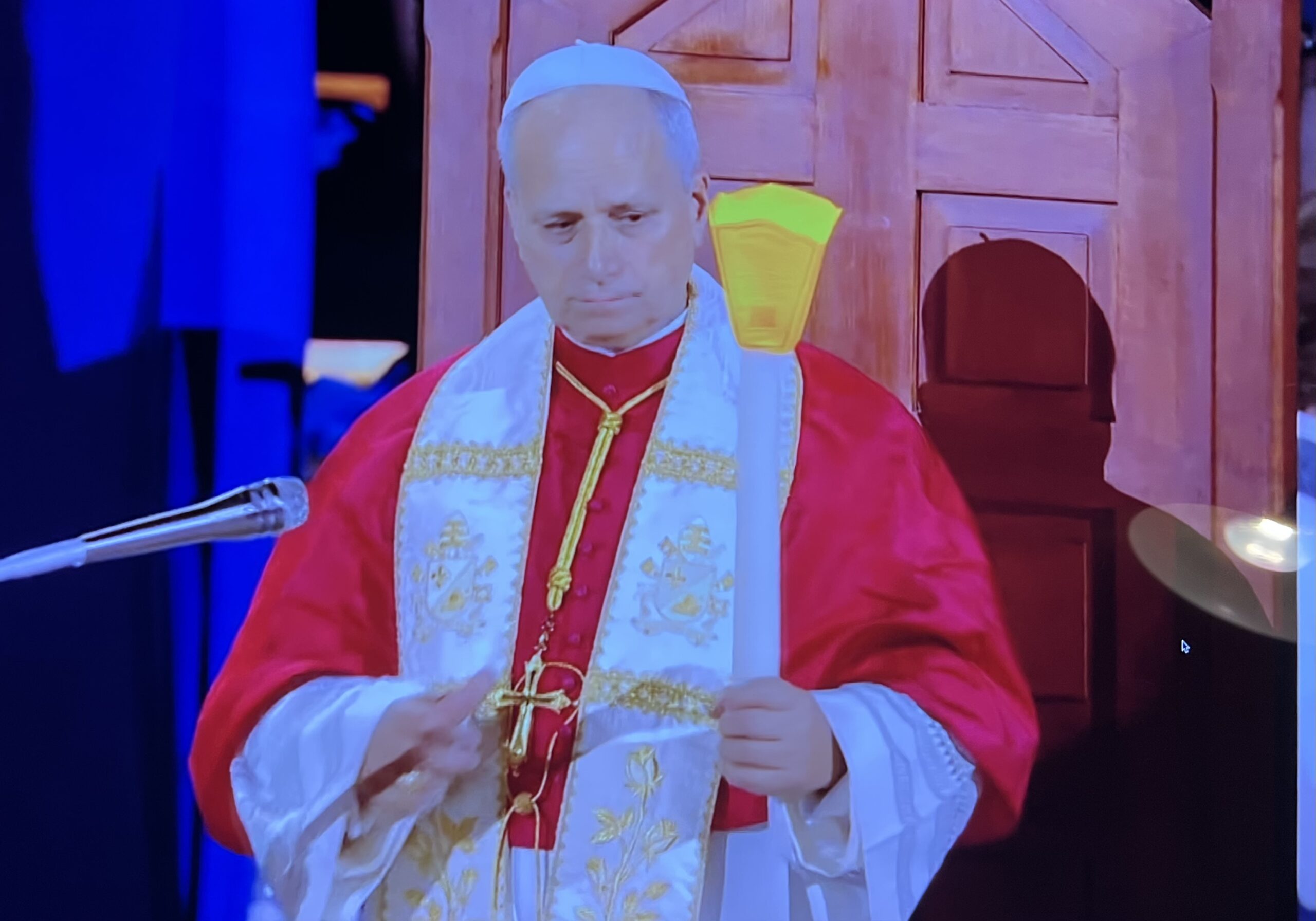
In Lourdes verblijft op 26, 27 en 28 september 2026 Leo XIV, paus vanaf 2025, geboren als Robert Francis Prevost (*1955), dit na een bezoek aan de Franse hoofdstad Parijs. Zijn programma in Lourdes omvat onder meer bidden bij de grot van de verschijningen, voorgaan in een eucharistieviering en deelnemen aan de kaarsjesprocessie. In de ochtend van 28 september vertrekt de kerkvader naar het Franse Metz. Om getuige te zijn aan het pauselijk bezoek in het Heiligdom van Lourdes zijn 150.000 kaarten in heel korte tijd verkocht.
~~~
The chosen themes for Lourdes are in 2026 “I greet you, full of grace, the Lord is with you”, in 2027 “In those days Mary set out in haste”, and in 2028 “His mercy extends to generations of those who fear him”.
Pilgrimage site
The Sanctuary at Lourdes is often entered through the large St. Michael's Gate, and the imposing Breton Cross is visible. To the left of this is the impressive, underground basilica. In the distance, visitors can see two basilicas placed one above the other: that of the Immaculate Conception, and below it, the Rosary Basilica. Continuing to walk and going to the right of these two basilicas, pilgrims arrive at the Grotto. It was at this Grotto that Mary appeared 18 times to Bernadette Soubirous. Thousands of candles are lit daily in Lourdes. This takes place on the other side of the River Gave de Pau. There are two Stations of the Cross to follow: one at ground level within the Sanctuary, and another on the hill next to the “Sanctuaire”. This second Stations of the Cross features large, white statues representing the stations.
For many, Lourdes is a place where everyone can feel welcome, regardless of their background or origin. Pilgrims consistently experience that the pastoral care for those on pilgrimage is extensive. The spiritual character of the Sanctuary is emphasised in many ways, such as by attending services, walking the Way of the Cross, visiting the Grotto, and participating in processions. Emphasis is clearly placed on prayer and singing, which is evident on a grand scale during the candlelight procession that winds through the Sanctuary in the evening. The parish church can also be visited. However, Bernadette never visited this church. Construction of this place of worship began in 1875, after she left for Nevers, and was only completed in 1903, after her death. The baptismal font from the previous church has been placed in the parish church. This indicates where Bernadette was baptised. A reredos hangs by the baptismal font. This was made to commemorate the 150th anniversary of the apparitions. Bernadette's baptismal certificate is also on display there. Furthermore, a “jubilee trail” can be followed, which visits the places where Bernadette lived or has been.
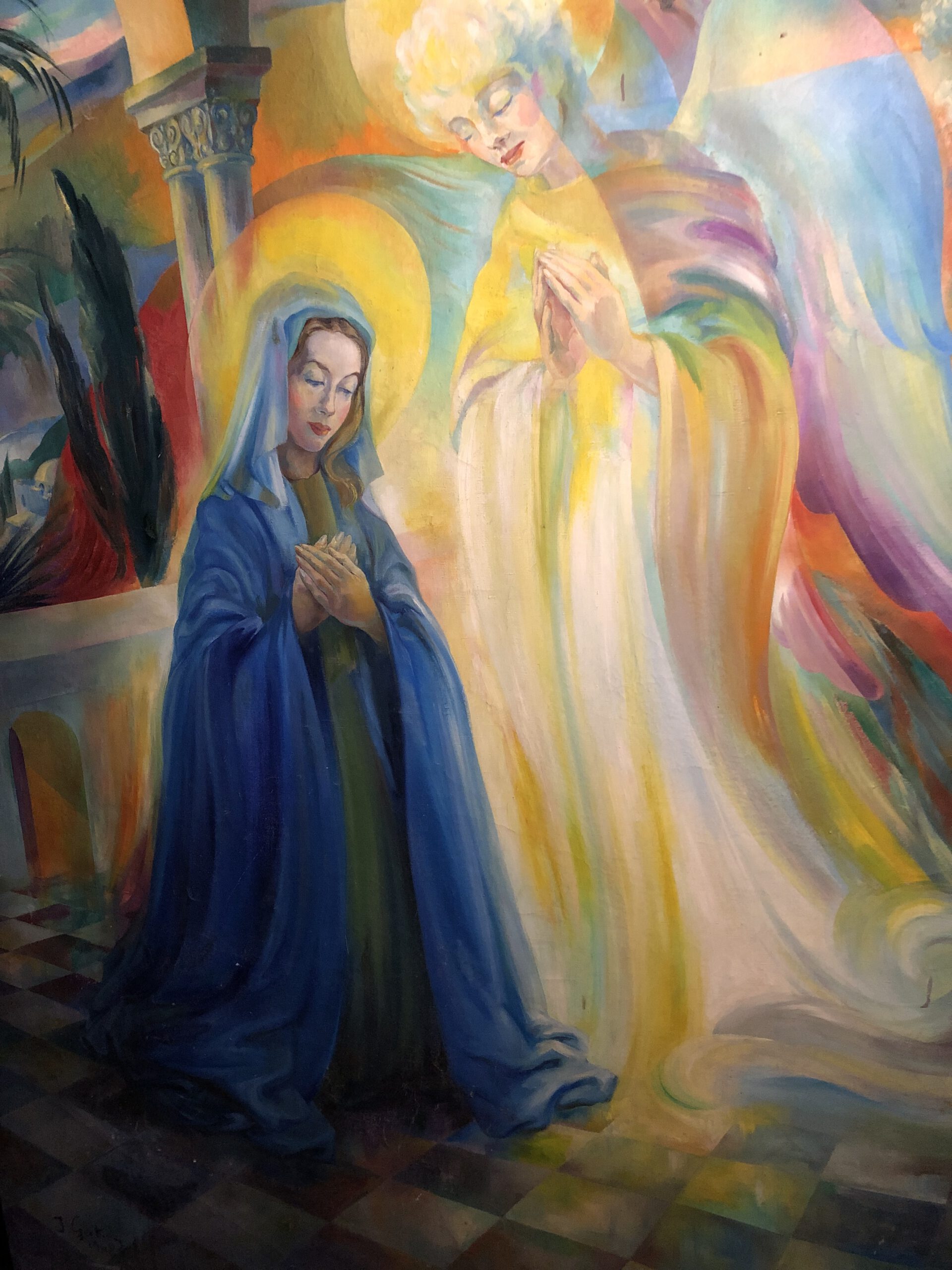
In the Bernadette Church of the Sanctuary of Lourdes hangs, amongst other things, a large icon of “Our Lady of Grace”. The original is located in the cathedral of Cambrai in France.
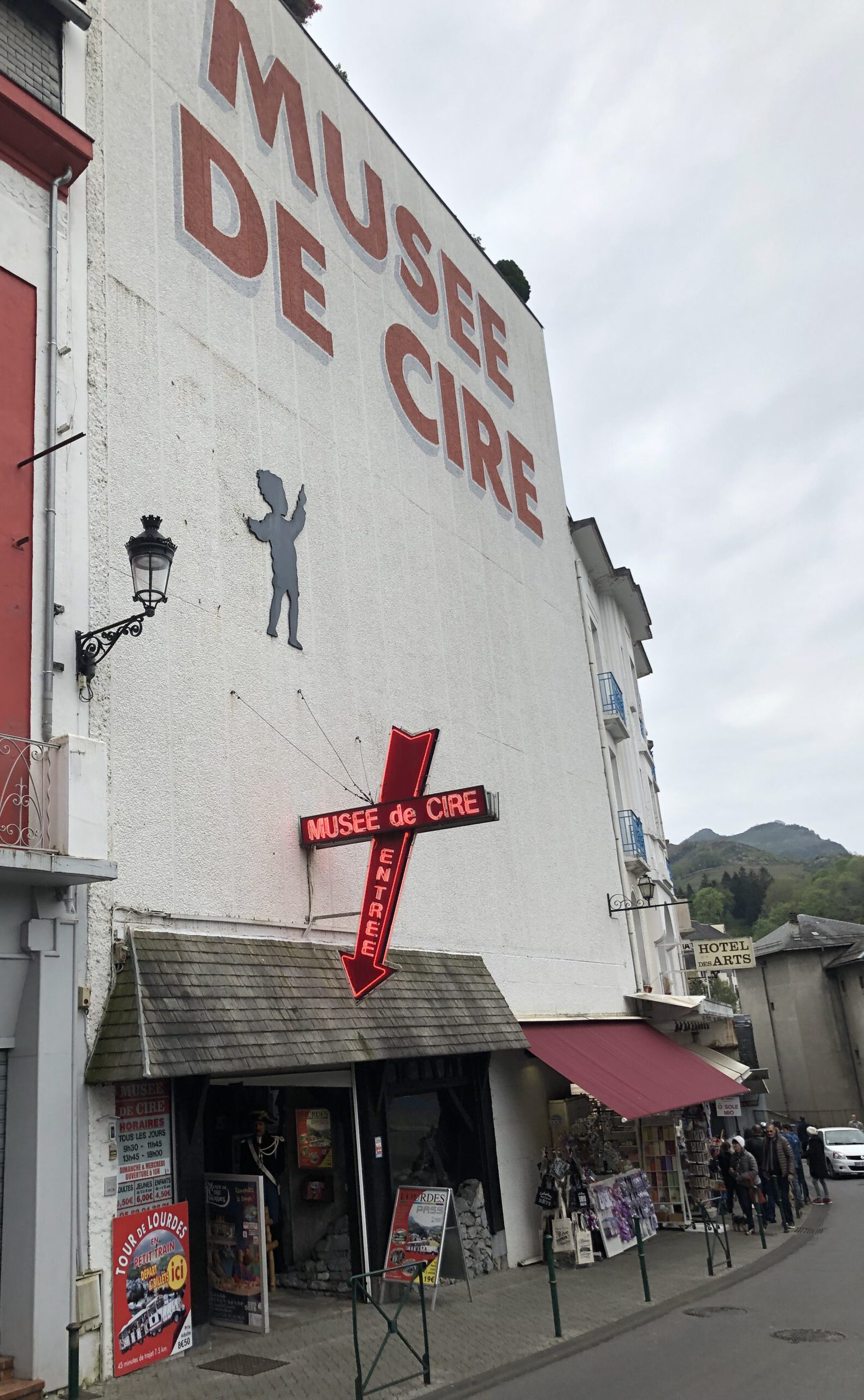
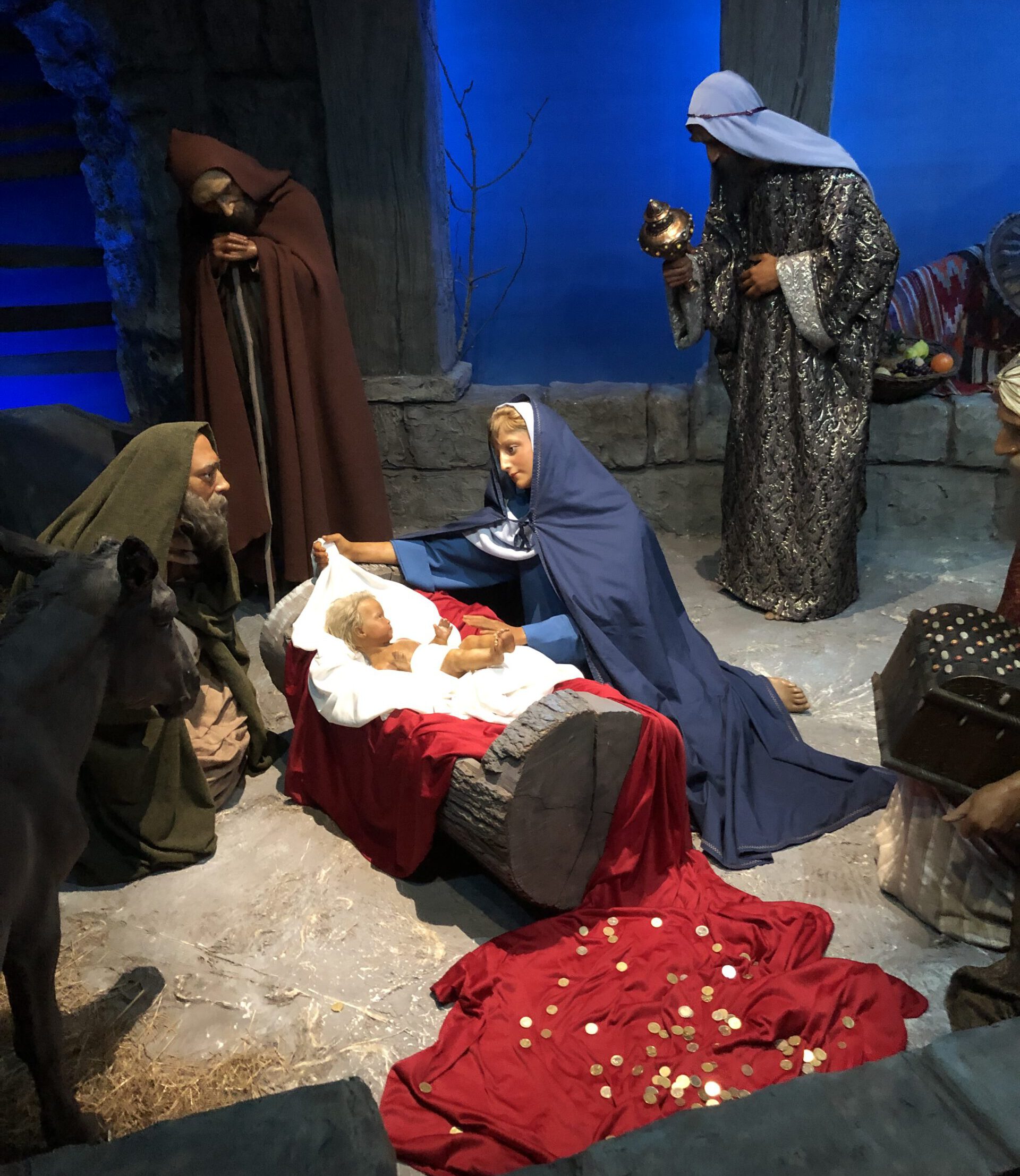
At 87 Rue de la Grotte, you'll find the “Musée de Cire Lourdes.” This wax museum displays life-sized wax figures. These figures depict, among other things, the visit of the angel Gabriel to Mary, the visit of the Three Wise Men to Mary, Joseph, and Jesus, the story of Bernadette, the Passion of Jesus, the Last Supper, and Mother Teresa at an audience with Pope John Paul II.
Veneration and devotion to Mary are very strong in Lourdes. Approximately 4 million people per year thank, honour, and praise Her in the world-renowned Sanctuary. A development is that an increasing number of pilgrims are travelling to Lourdes independently, rather than as part of an organised pilgrimage. This is due to a desire to experience a visit to Lourdes on an individual basis.
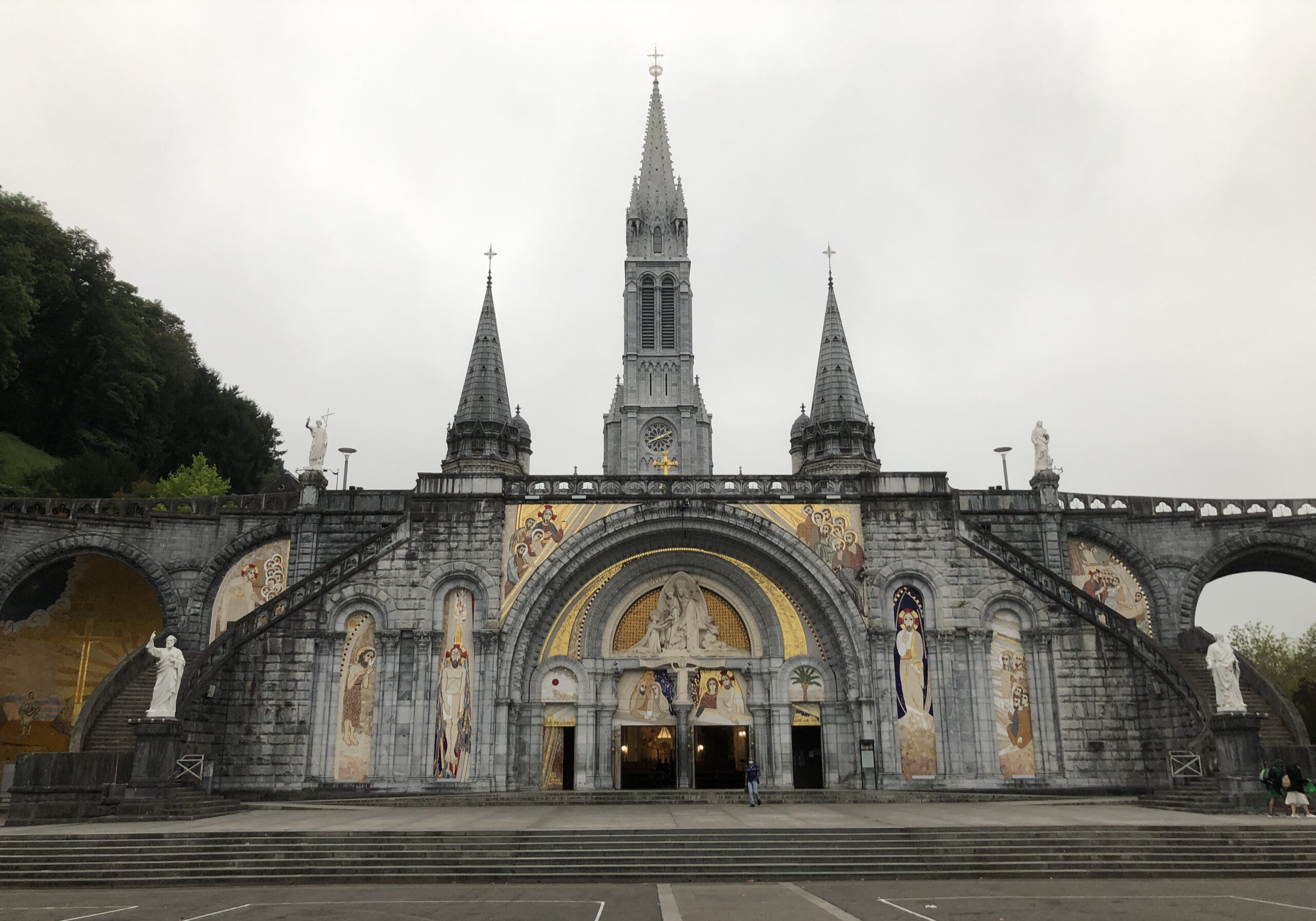
In Lourdes there is plenty to see, such as the elevated, large castle, the many shops, the countless bars, restaurants and hotels, and above all the Sanctuary of Our Lady of Lourdes.
It occasionally happens that the Grotto is inaccessible due to the large amount of water in the Gave de Pau river. Due to heavy rainfall and/or meltwater from the mountains, the water can reach into the Grotto. During major floods, lower-lying parts of the sanctuary and the town also become submerged. The walls along the river have been raised in places, but this is not a permanent solution. The reason for the floods is that the river was made too narrow in the past. Also, no reservoir was built to hold excess water. The most recent flood occurred on 7 September 2024.
From the end of 2025, the Sanctuary of Lourdes will have its own “heritage centre” for historical sources. Archives and religious works of art from Lourdes will be brought together here. It is a place for banners, sculptures, ex-votos, vestments, and paintings, among other things. There will also be an exhibition space to showcase the sanctuary's inventory to visitors of the Marian shrine.
ACCESSIBILITY
Lourdes is located in the south of France, between the larger towns of Pau and Tarbes. The pilgrimage site is about 20 kilometres from Tarbes and approximately 40 kilometres from Pau. On the E80/A64 motorway, near Tarbes, take exit 12 and then follow the N21.

Lourdes is also accessible by plane. Ossun Airport is located about 10 kilometres from Lourdes.
Lourdes also has a train station, providing national and international rail connections.
Websites: www.lourdes-france.org and www.lourdes-france.com, which provide information in 6 languages: German, English, French, Italian, Spanish and Dutch.
Experience
To Lourdes I go to entrust my hope, life, shortcomings, joy, and illness to Mary. In the most famous French Marian pilgrimage site, I see many less fortunate people and the sick. Then it dawns on me again that humans are so vulnerable. This place of pilgrimage deeply touches me and it does me good to be there. When I am in Lourdes, I feel a sense of gratitude to be able to come home again. I therefore visit Lourdes several times.

I am interested in the history of Lourdes, primarily the apparitions and their consequences. I am also interested in its earlier history. I hear that Charlemagne (c.745-814), King of the Franks (768-814) and Emperor of the Holy Roman Empire (800-814), emerged victorious from the Pyrenees. His troops fought against the Saracens in and around Lourdes, but another source tells me it was the Basques. The place was then called “Lorus”, later becoming Lourdes.
In Lourdes, more than elsewhere, I think of Bernadette Soubirous. What a humble life she led. Bernadette was often ill and faced many setbacks. I see her as an example, because my life is not a smooth path either, I suffer more and more from asthma and have often been ill. However, Bernadette had a much harder time, and I have been fortunate enough to live a more affluent life. This feels like landing in a good place.
A visit to Lourdes strengthens me and gives me strength. I feel happy with the rosary in my hands and to be able to come to the Grotto praying like this. When I am there, my eyes are fixed on the statue of Mary. While praying, my thoughts are very much with Mary. In my head, I feel like I'm in her home, because the door is always open there.
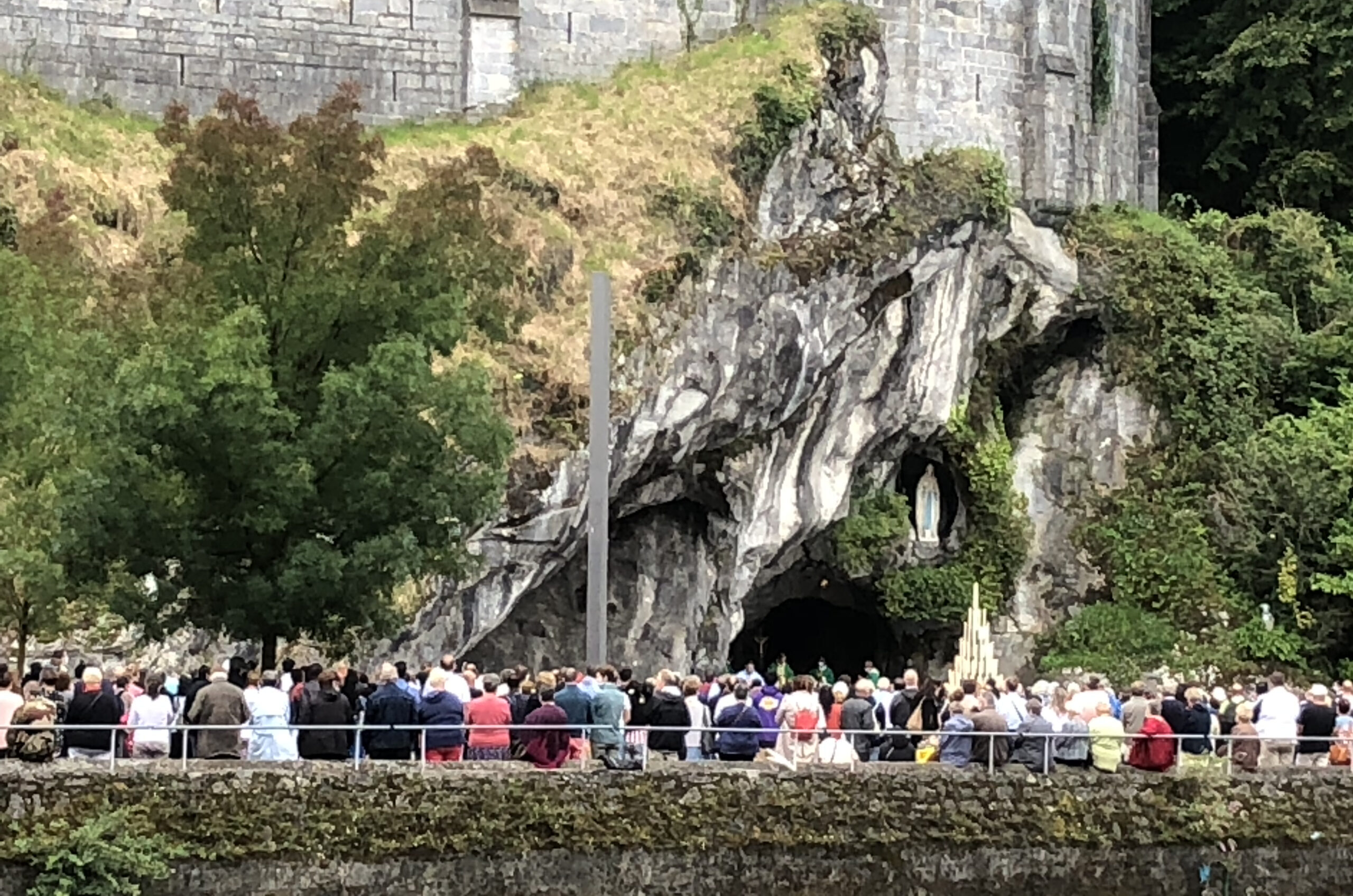
In Lourdes, the Grotto holds the greatest attraction for me. The niche, in which the statue of Mary stands, indicates the spot where the Lady appeared. This rock of Massabielle lies in the lowest part of the town. The Grotto has therefore been flooded by the rising waters of the river Gave de Pau on more than one occasion. I look at the swiftly flowing river. A flood is not imminent. Then I go to the Grotto and join a long queue of people. All those waiting want to enter the Grotto. A little later I pass the spring and see the Lourdes water flowing. I shuffle along a bit, make my way under the well-known statue of Mary, feel the rock, rub over the hard rock mass and slowly move on. Suddenly I stop. I turn around. I look at the statue and softly say: “Thank You for letting me come here.” Then I take a seat on a bench. I look at the statue of Mary and then at the visitors to the Grotto. I see people making the sign of the cross and praying. There are also those who kiss the rock and touch it with their hands and heads. I receive thoughts about my weaknesses and enter into prayer.
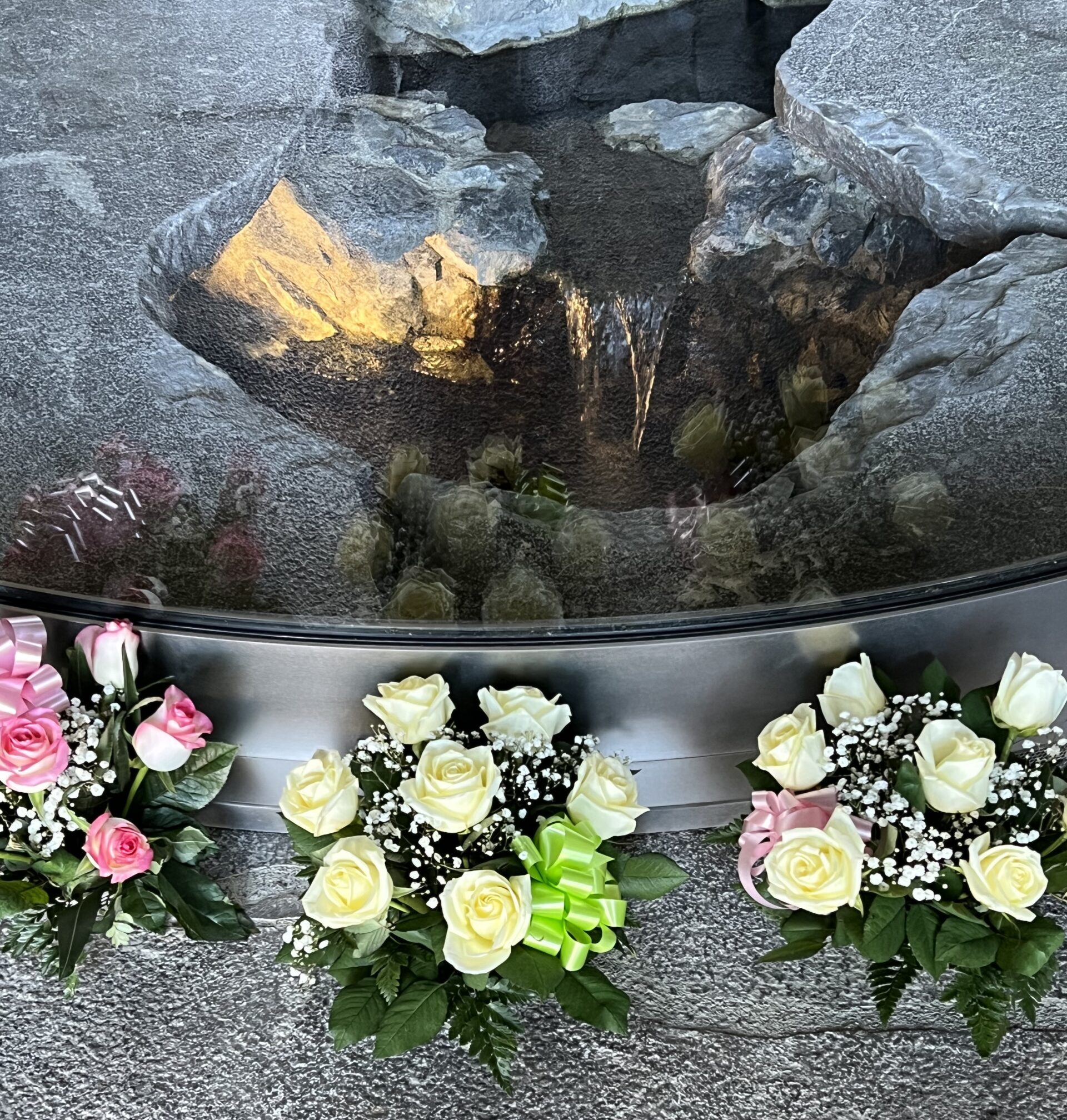
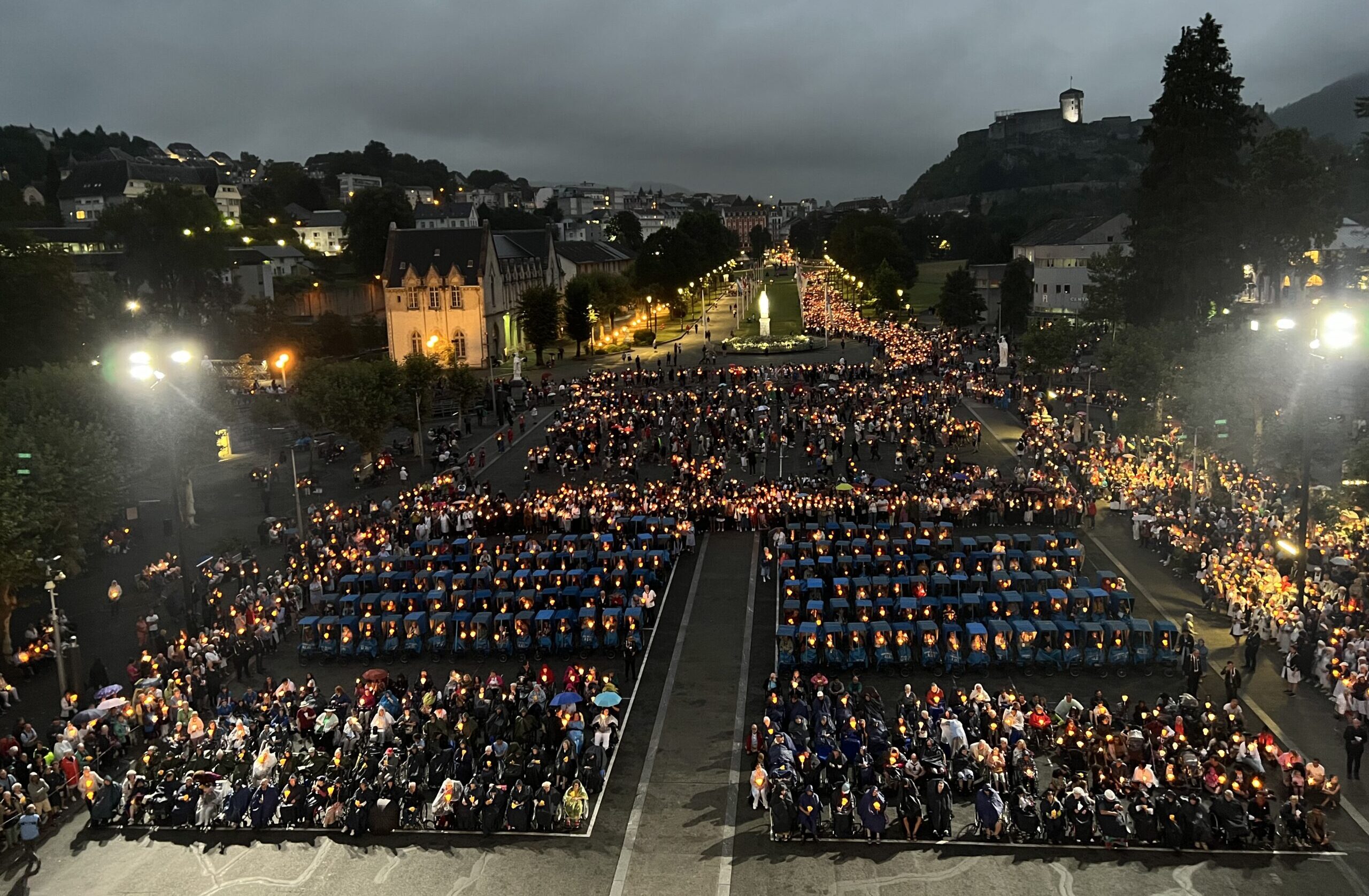
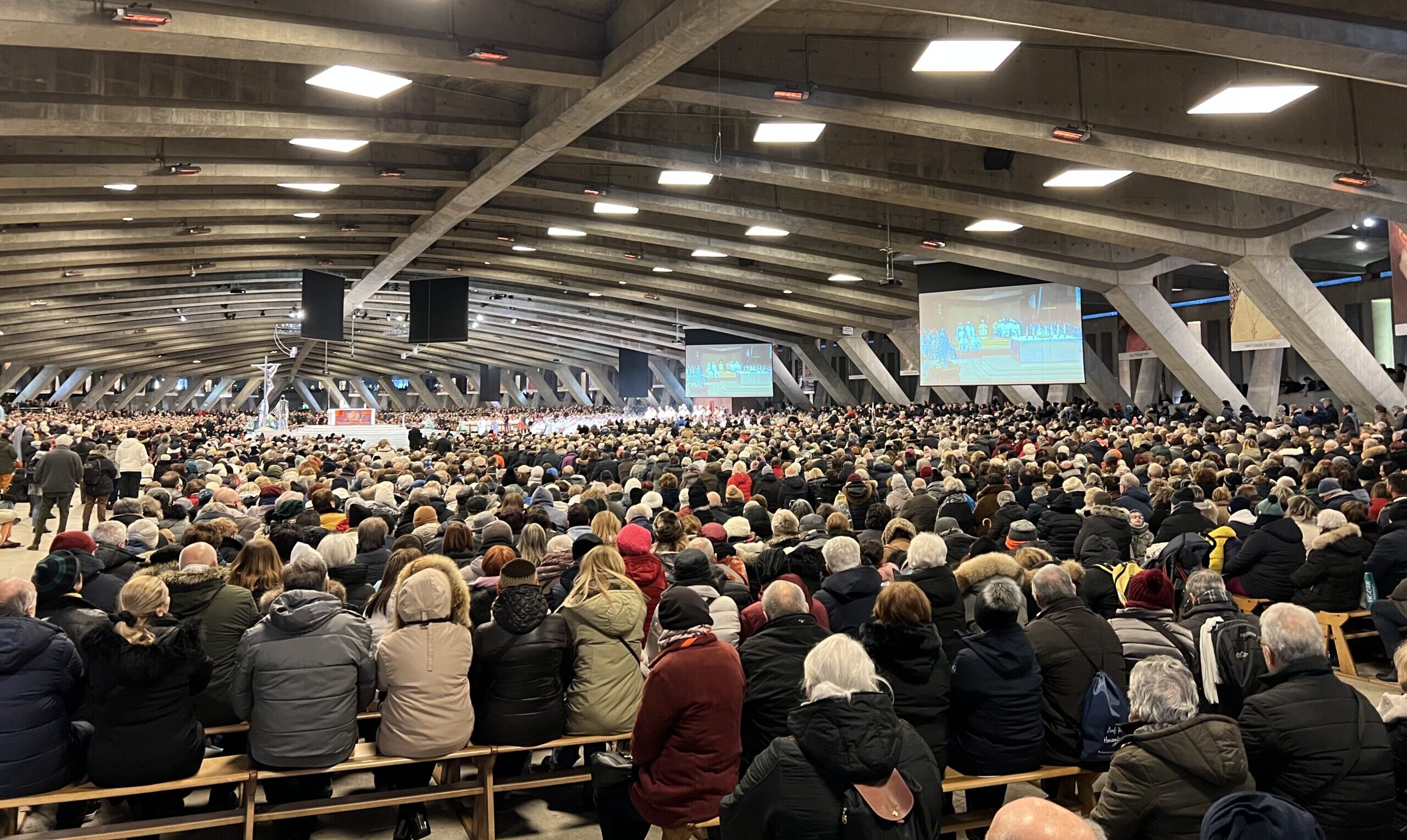
On several occasions in Lourdes, I have seen hundreds of people at a time going to the Grotto in little wheeled chairs. I always nod to them in a friendly way, and the reaction is usually a smile. How much good feeling friendliness can evoke. These people are ill; physically and/or mentally. I then wonder who is not ill. In my opinion, everyone is ill, even if the awareness of it is absent. Every human being has shortcomings, and so do I. I see these shortcomings as an illness. Because of these illnesses, no one is perfect, nor healthy. Yet I have healthy thoughts, is my conviction. This strikes me remarkably often in Lourdes. In Lourdes, I receive strength from Mary to carry on, despite my shortcomings. By receiving strength, I am very grateful to Her. By dwelling on this for a while, I get a lump in my throat. Receiving strength feels like a miracle. This enables me to go on, and this feels like good news. For being allowed to experience all this, I thank Mary.

In Lourdes, I see many sick, poor, and disabled people with full conviction of faith in Mary. Furthermore, I observe that there are relatively many young people in Lourdes. Many of them participate in the candlelit procession, which begins at 9 p.m. During the season from early April to late October, it takes place every evening through the Sanctuary. I see thousands of people joining the procession, and nearly everyone has a candle in their hand. So much singing and praying. What an experience I am allowed to have here. For me, Lourdes is a meaningful, deeply touching, empowering, and loving pilgrimage site.

At the Grotto of Lourdes, many are praying and my intentions go out to friends who are struggling with their health, or with the well-being of themselves, or their parents and children. One is seriously ill, another has seen a relationship end, and another is threatened with losing their job. Others are doing better and hope to maintain this. I ask this of Mary, but perhaps it is all a bit much put together. While praying for the Grotto, memories come to mind. Phases of life pass by; it seems like a film is being played.
Suddenly I notice that I am close to the spot where Bernadette prayed on 11 February 1858. How many millions have done the same as Bernadette here annually. All those people in prayer and in conversation with the Lady who is so intensely worshipped here. On 11 February each year, the first apparition of 1858 is commemorated, and thousands of pilgrims come to the sanctuary on that day.
Upon entering the Rosary Basilica, I see a leaflet lying there. The front displays an image of Mary in the niche of the Grotto, and the reverse side bears the text of a novena prayer. The beginning of this prayer reads: “Holy Virgin Mary, it was through learning from you that Bernadette entered into relationship with the Holy Trinity through the sign of the cross. By teaching her prayer and penance for sinners, you allowed her to share in the joy of salvation.”
I feel I can pray in many places. In fact, many places on Earth are suitable for me to pray to Mary. However, here at the Grotto, it's different for me. Is this because of Bernadette's history, the moving devotion of many, or is it due to my passion for this shrine? As I reflect on this and name more reasons, my thoughts suddenly turn strongly towards the Woman who brings so many people here. I look at the statue in the Grotto and speak kindly to Mary. I thank Her for the many good things that happen to others and myself. Doing this here gives me a good feeling. How much I may receive from Our Lady. Experiencing Lourdes not only colours my life but also shapes my bond with Mary. Now I realise more than ever that it always feels like coming home here.
Audio recording of the evening procession at Lourdes:
My pilgrimage to Lourdes is drawing to a close again. Now I'm already longing for another visit. Looking back on this and previous pilgrimages to this busy Marian shrine, I feel grateful. My heart has been deeply touched once more, and this is Mary's message in Lourdes. Firstly, She has eyes for Bernadette Soubirous. Mary finds in her the intermediary to convey messages of feeling. After Mary has touched Bernadette's heart, Our Lady does the same for the many visitors to Lourdes. I feel that Mary also touches me and strengthens me inwardly. Thank you, Mary.
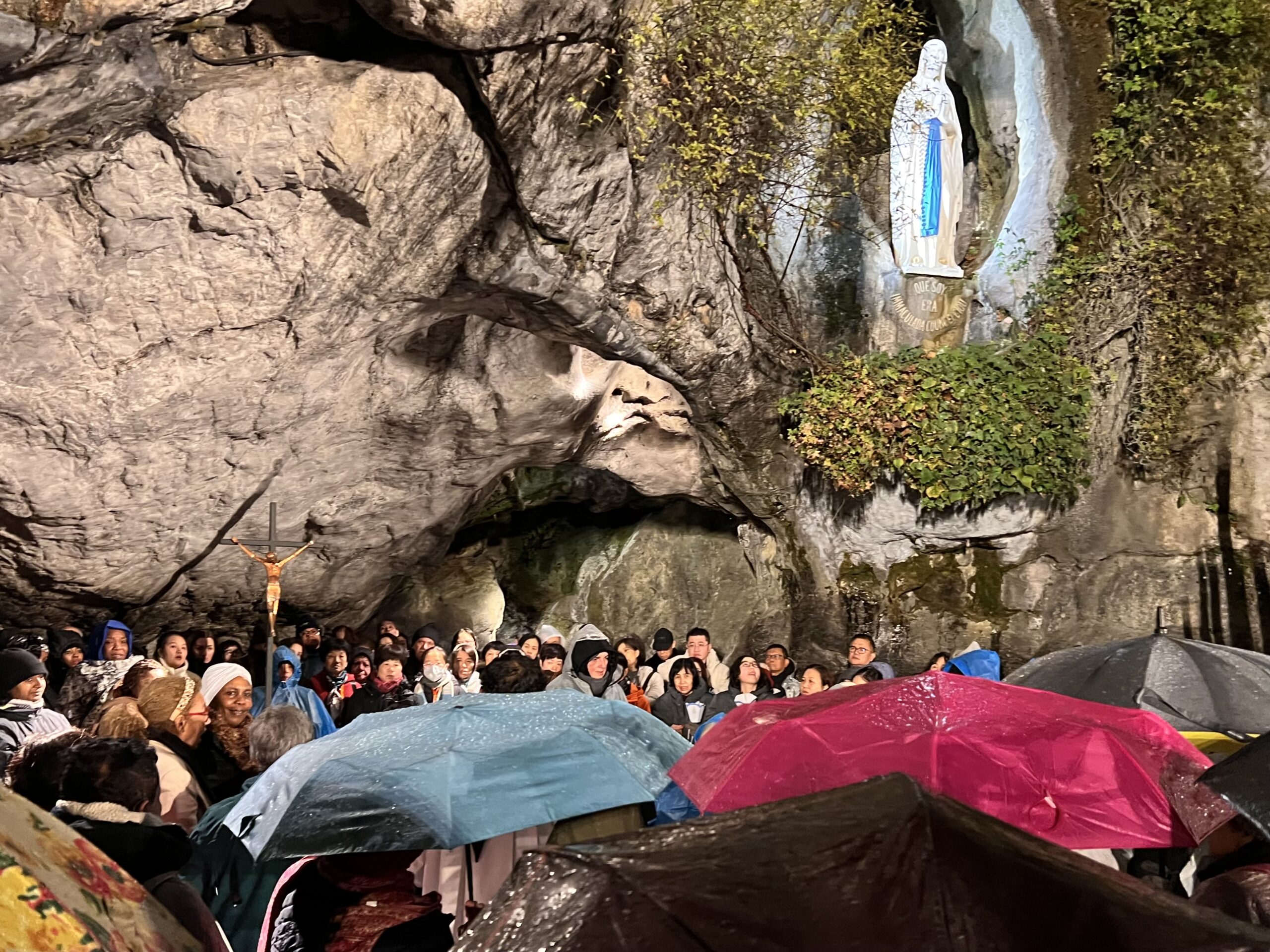
In the second half of November 2025, I will visit the Sanctuary of Lourdes again. The busy pilgrimage season is over, and in the evening, a Rosary prayer will be held at the Grotto instead of the candlelit procession. The announcement states that the prayer gathering will take place with torches, but I did not see these light sources. This might be due to the rain that has been making visitors wet for hours. A few hundred pilgrims are standing in and around the grotto, praying. This is indeed a special event.
A female friend visited Lourdes in the summer of 2026 and upon her return brought back, amongst other things, a holy card.
The text reads:
“Hail Mary,
teach us to pray, as You did with Bernadette.
All our heart and soul,
and show us the face of Your Son so that
he can lighten our soul.
You are the refuge of sinners,
forgive us our sins and
guide us on this earth until
the eternal glory of Our Lord Jesus Christ.
Our Lady of Lourdes, help us.
Our Lady of Lourdes, protect us.
Our Lady of Lourdes, pray for us.
Amen.”
Environment
In Lourdes, not far from the sanctuary, stands a remarkable Ukrainian Catholic church. This building is easy to find due to its golden domes. This is a Uniate church; a Roman Catholic church that uses Eastern rites in its liturgy. Icons can be seen in this place of worship, including those of the apparitions of Mary to Bernadette.
From Lourdes to the pilgrimage site in Lestelle-Bétharram is a 17km journey westwards. Montoussé is situated 61 km to the east, for Garaison it is 73 km and Saint-Bertrand de Comminges 83 km.
~~~

 Nederlands
  English (UK)
  Deutsch
  Français