History
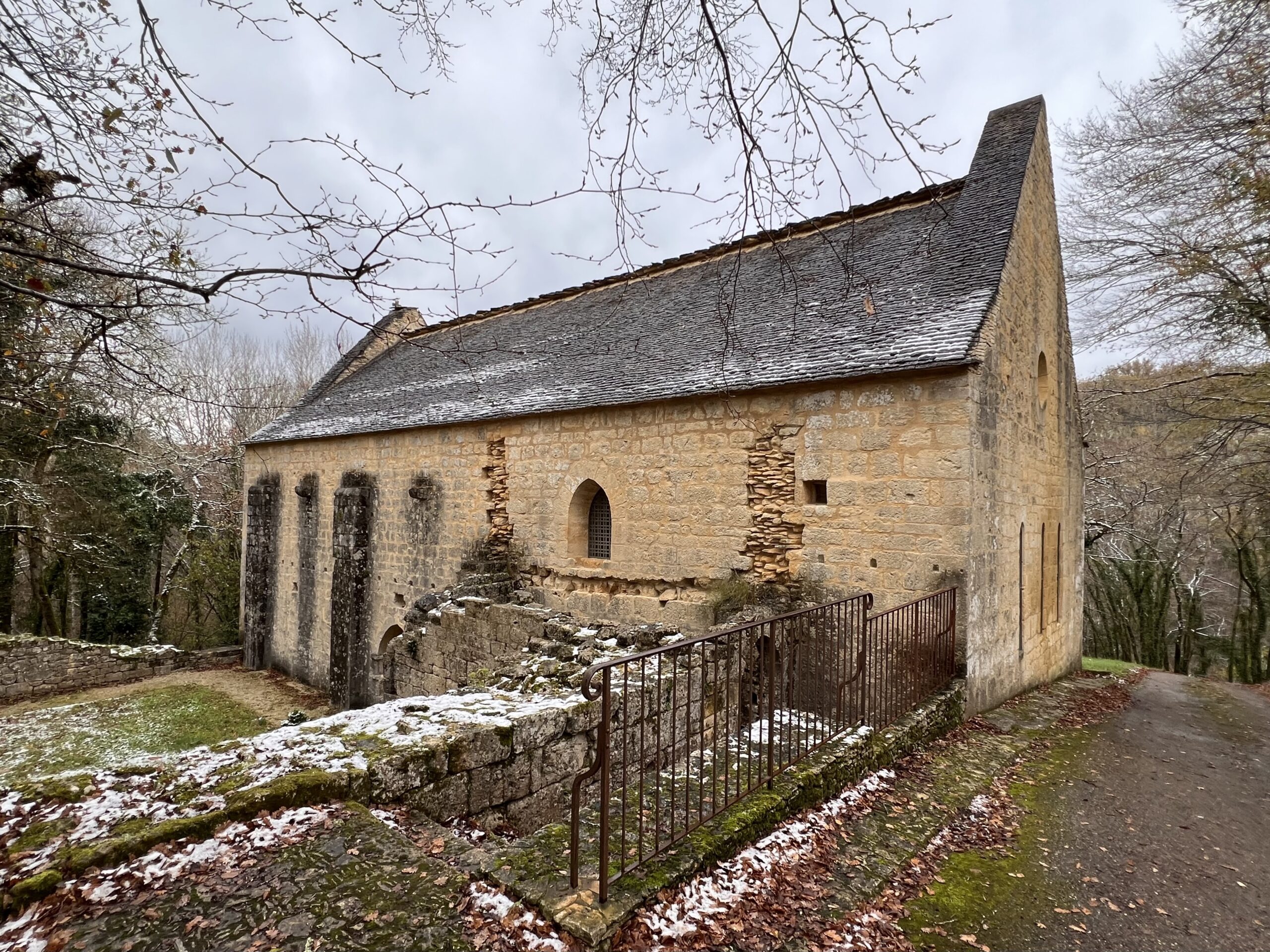
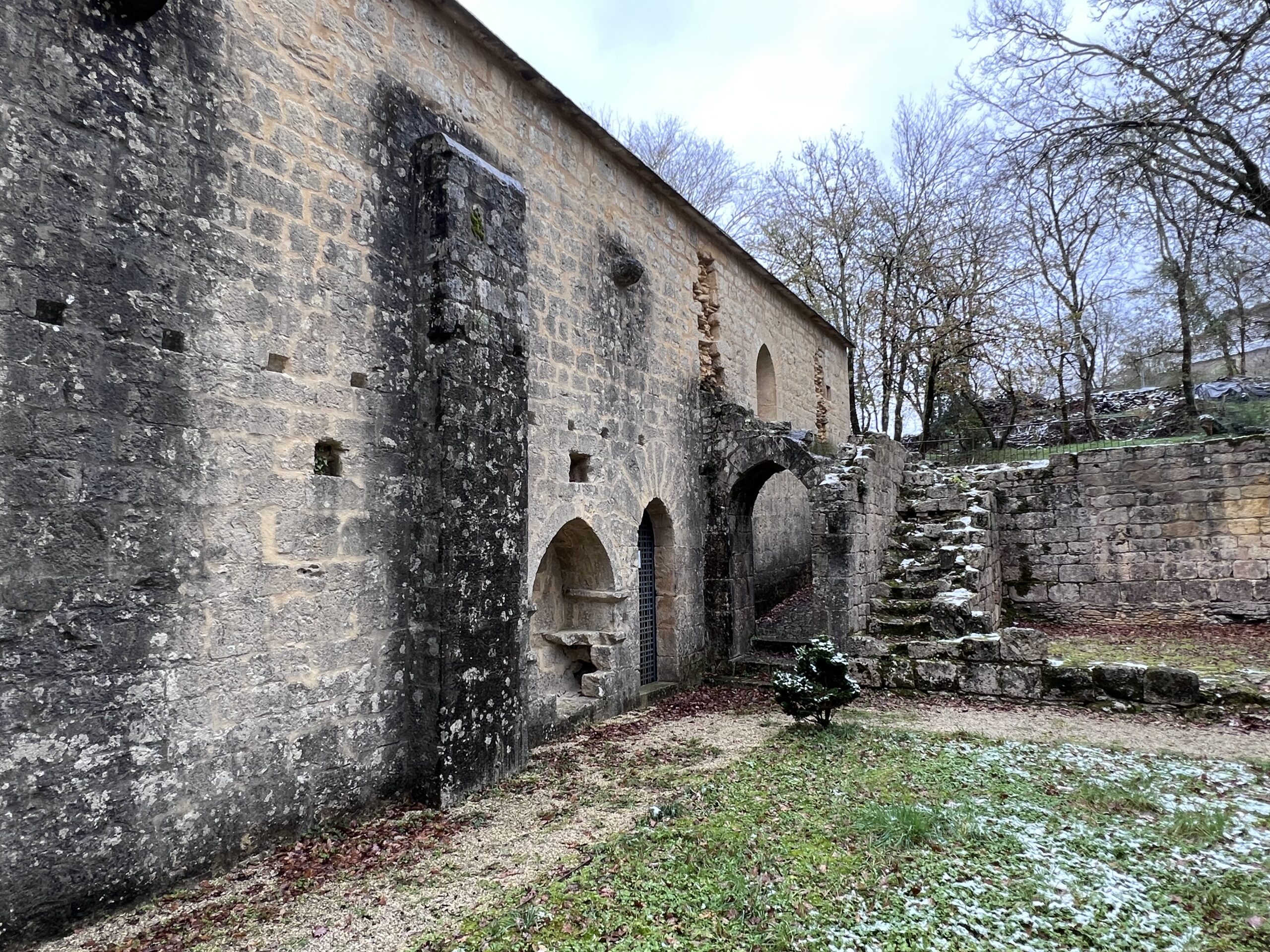
In the 13th century, there was a monastery inhabited by monks. The monastery was restored in 1545. At that time, there is mention of “Rotunda Spino,” which freely translates to “crown of thorns.” This name later became “Redon Espic.” The monastery and church were in a state of disrepair in 1755 and formed a ruin. In the 20th century, the church was restored, and since 1999, the complex of the church, garden, and ancient building remnants has been a historical monument.
The pilgrimage site owes its existence to a legend. The story is about a 14-year-old Marie-Jeanne Grave (1800-1814). She is the daughter of a farming family. They live in a hamlet that belongs to the municipality of Castels. Marie-Jeanne's father and mother are tenants of the farm owned by the mayor of Bézenac. Neither Marie-Jeanne nor her parents are religious. The people work every day of the week and often curse loudly. Marie-Jeanne herds the mayor's sheep in the Redon-Espic valley. In this area, there is a spring where the sheep can drink.
In that time, a contagious disease claims many lives and an effective cure is not available to combat the epidemic.
Maria appears twice to Marie-Jeanne Grave, namely at the end of June 1824 and in the first half of July of that year.
On a summer's day in June 1814, Marie-Jeanne is with the sheep in the valley, near the spring. Suddenly, she sees a lady in a beautiful, white gown and white shoes. The lady has a luminous cross on her chest. The lady introduces herself to Marie-Jeanne and says her name is Maria. The lady remarks that her parents must mend their ways, as must the villagers. If they do not, misfortune will strike, and they will die within a year. Without any mourners, they will be taken to the grave.
When Marie-Jeanne returns to the farm, she tells the others what happened. Her words are not believed, and the daughter is laughed at for the nonsense she has told. The mayor also does not believe Marie-Jeanne. He even threatens to punish her if she continues to tell such nonsense.
A few weeks later, Maria appears to Marie-Jeanne for the second time. Maria compliments her on relaying her words. Marie-Jeanne hears from Maria that the mayor is dying soon. She tells her parents and neighbours about the second apparition, but again she is not believed and people begin to ignore her. Maria's words come true, as the mayor dies. Some time later, her parents also pass away. They are taken to the grave by a mule. More villagers die from the epidemic.
On 24 November 1814, Marie-Jeanne Grave dies. During the procession to the graveyard, it begins to rain heavily, but the coffin and the pallbearers remain dry. The villagers then realise that Marie-Jeanne had told the truth. Subsequently, a veneration of Mary begins. However, the clergy do not embrace this, and the veneration of Our Lady ceases.
Years later, a priest arrives in the hamlet. The man hears about the apparitions and the subsequent events. The priest believes what happened and takes action by encouraging the veneration of Mary. In 1862, Charles-Théodore Baudry (1817-1863), Bishop of Périgueux (1861-1863), allows the priest to celebrate the Eucharist at the site of the 1814 apparitions. It is also then permitted to organise pilgrimages.
In 1923, an image of Mary is placed and blessed at the spring. The pilgrimages continue on a modest scale.
In 2007 the oratorio was restored.
Pilgrimage site
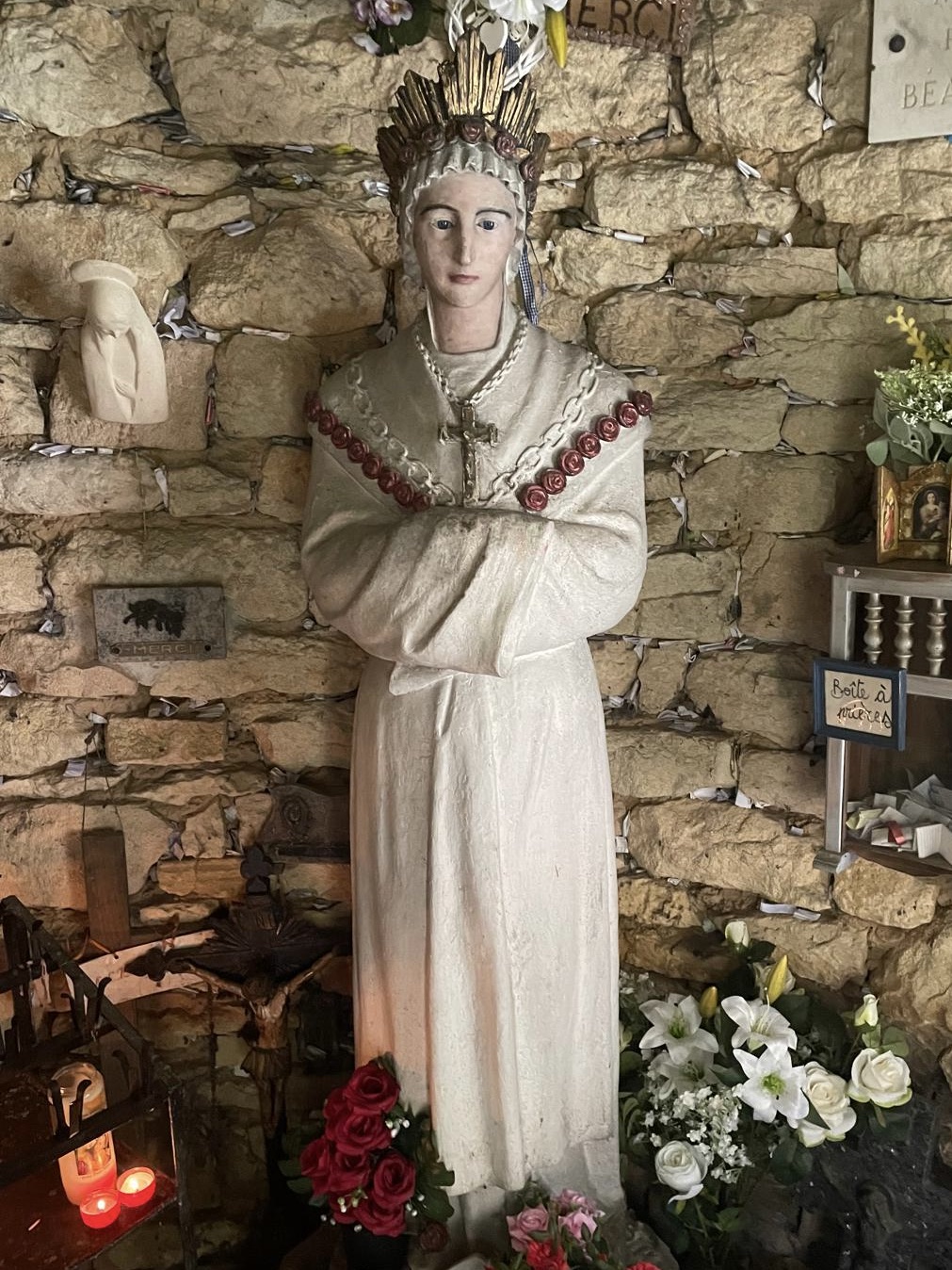
The Marian shrine is called “Notre-Dame de Redon-Espic” and is located in a valley on the hills of Périgord, near the river Le Moulant. The old church is named “Église prieuré Notre-Dame de Redon-Espic” (monastic church of Our Lady of Redon-Espic).
The little church appears like a deserted treasure in a green setting; a pearl in an oasis. It lies in a secluded valley with winding roads against a wooded hill.
The oratorio, situated a couple of kilometres from the old church, is a small, round building. This chapel is located at a dead-end street. This is where the annual pilgrimage takes place. There is then a procession from the monumental priory church (l’église du prieuré) to the oratorio.
The message from Mary to seer Marie-Jeanne Grave includes repentance, prayer, penance, and respecting the Sunday rest.
In the 21st century, the source supplies water to the villages of Saint-Cyprien and Castels et Bézenac.
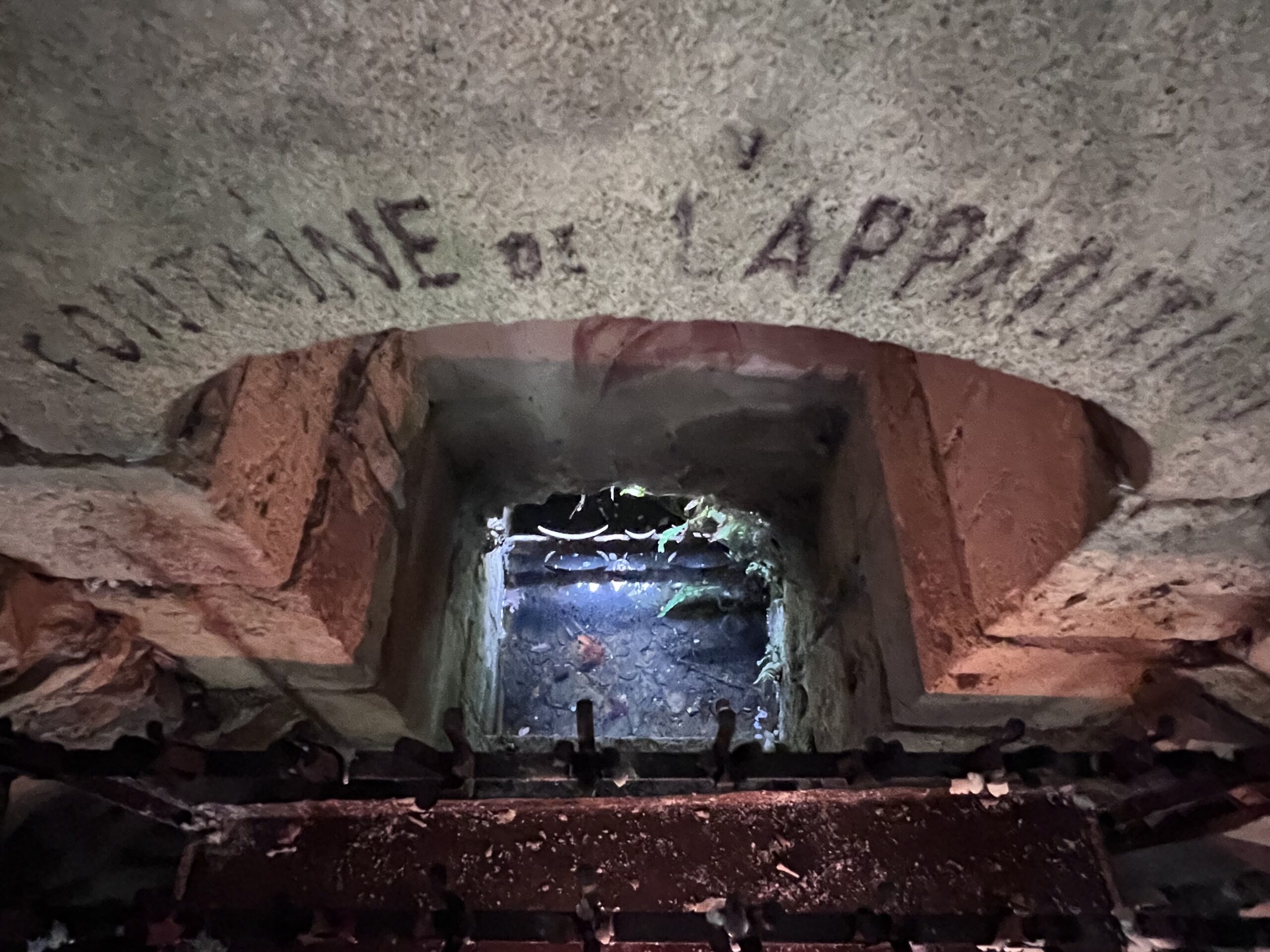
Believers regularly go to the site of the apparitions at the oratory and light candles there.
The annual, major pilgrimage to the oratory is on 8 September; the feast of the Nativity of Mary.
ACCESSIBILITY
The pilgrimage site of Redon-Espic is located between the major towns of Bergerac and Brive-la-Gaillarde, close to the Dordogne River and the village of Castels et Bézenac, next to the small river Le Moulant.
Redon-Espic lies a few kilometres from Saint-Cyprien. The old church is located near the D25 and D48 roads.
Address: Route de l’oratoire, 24220 Castel et Bézenac
Experience
A few more kilometres to go to the old church of Redon-Espic and the road gets narrower and narrower. Fortunately, I don't see any oncoming traffic, as the road width doesn't allow for passing.
There is parking available at the church. You alight and go down the stone steps. I come to a hermetically sealed door. Through a narrow, dusty window, some of the interior can be seen. Wooden, dusty benches and little else can I discern. Is the church still in use?, is my question. Then it's a case of going to the other side of the building, but there too the door grants me no access to the centuries-old church.
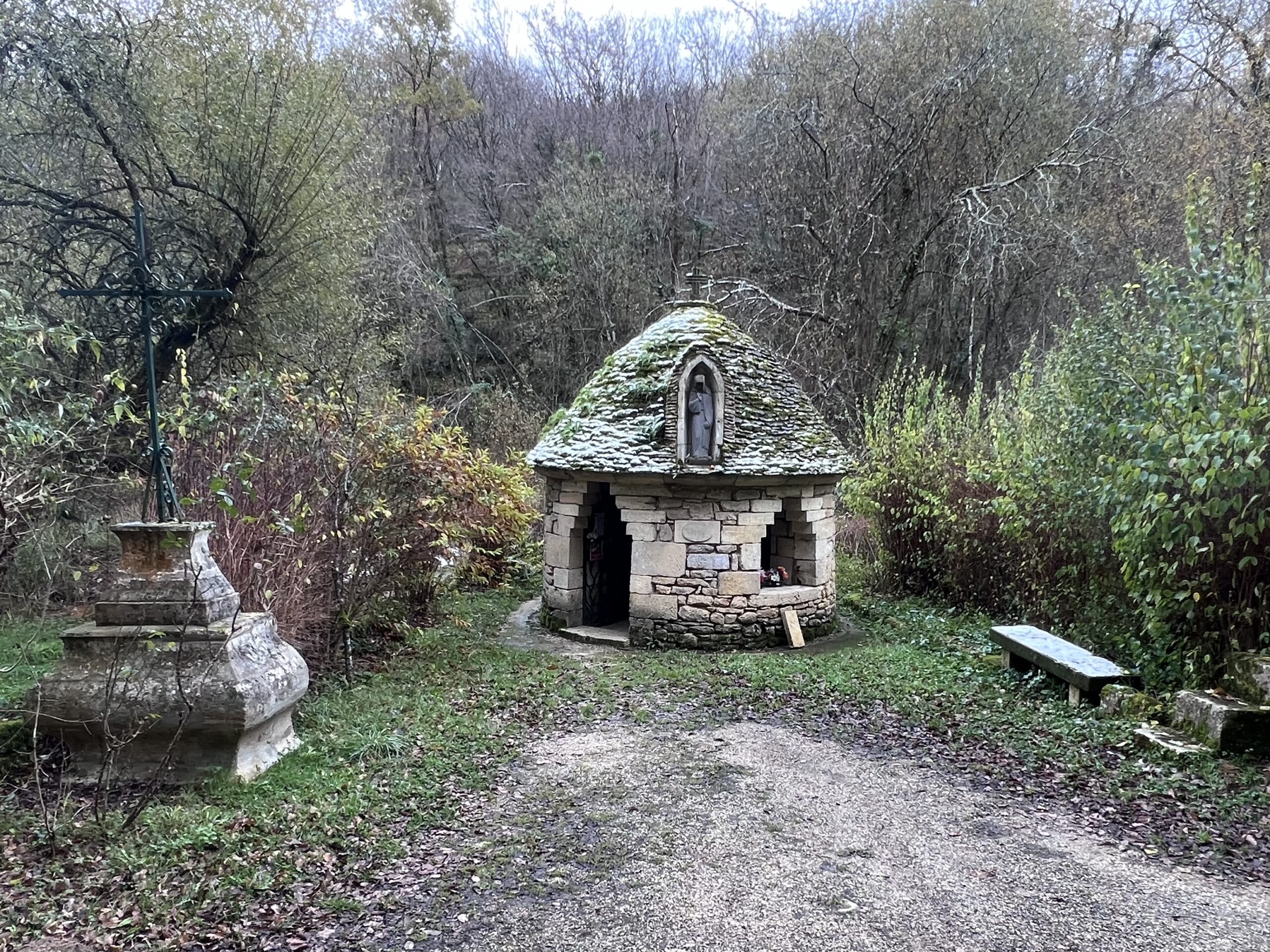
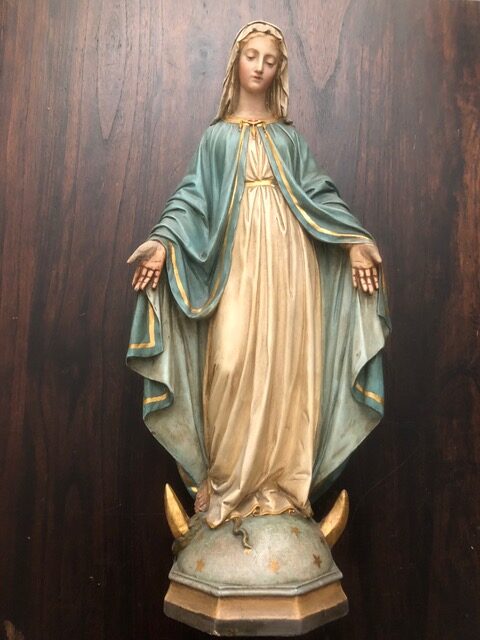
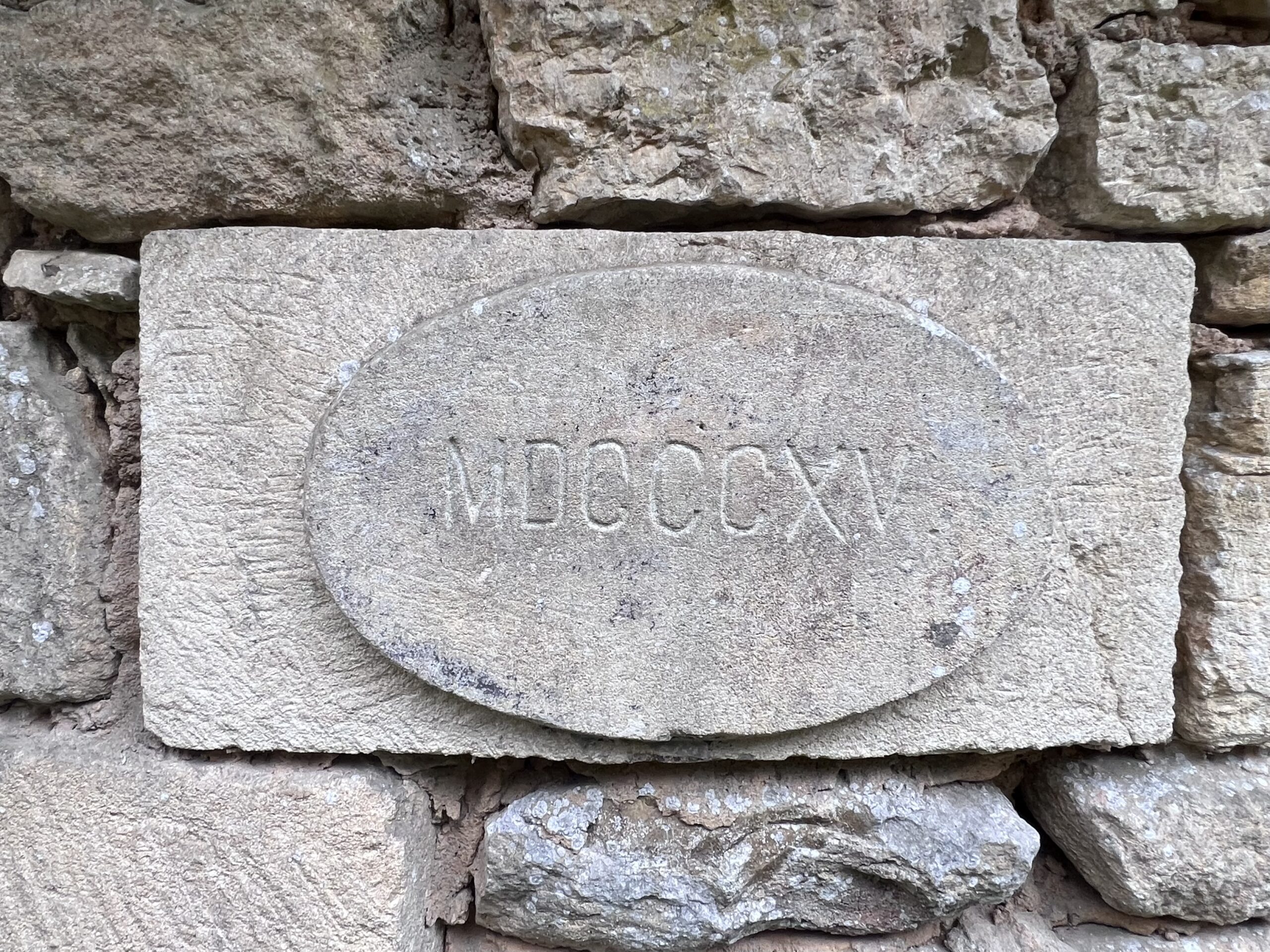
Next, I drive to the nearby oratory and after a few kilometres I reach the chapel. This is where Mary appeared! What a beautifully situated, round chapelfor prayer! In the wall, I see a stone with the year 1815. The chapel must have been built in that year. The large statue of Mary immediately reminds me of her image in La Salette in the high Alps. This is how She looked here too. Next to the statue of Our Lady is the spring where Mary appeared. What a miracle that I am allowed to stand here now.
In the chapel of apparitions, candles are burning, and now a few more lights are being added. While lighting the candles, I think of good people, and the intentions concern their well-being. After praying a few Hail Marys, I look at the ex-votos with thanks to Mary.
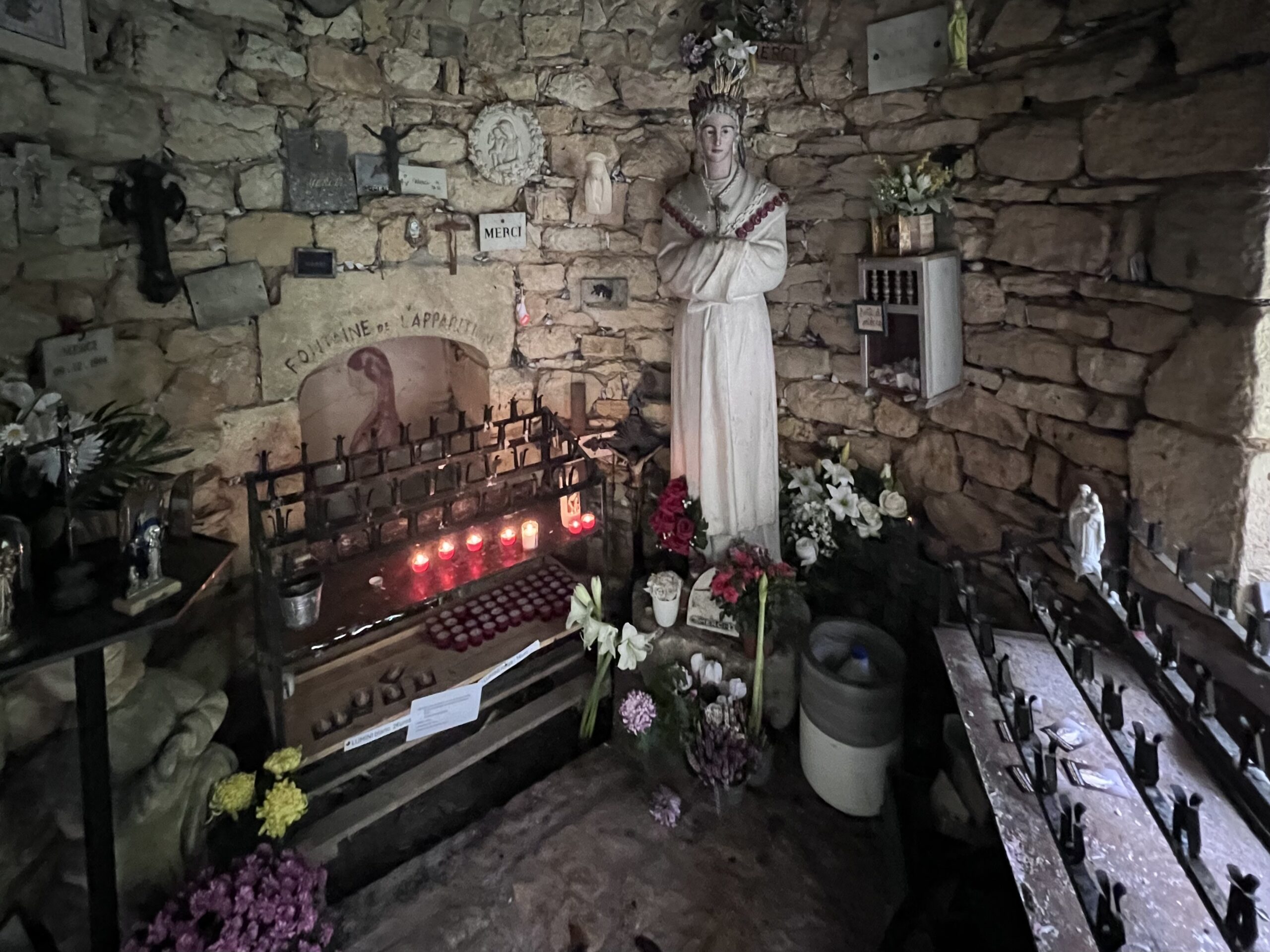
I linger a little longer in the particularly beautiful oratory, letting the impressions sink in, and this way I take beautiful thoughts home with me. The oratory is splendidly situated among trees and bushes. What a place to feel an apparition of Mary!
Thank you, Maria, for allowing me to come here too. What a richness this visit is to my life!
Environment
Travelling from Souillac to Redon-Espic means covering a distance of 44 km westwards. In Souillac, there is a large abbey church from the early 12th century, dedicated to Our Lady of the Assumption. The church has three domes. Fresco remnants from that period can be seen in the monumental building. Stained-glass windows date from 1860 and depict, among others, Our Lady and Saint Martin.
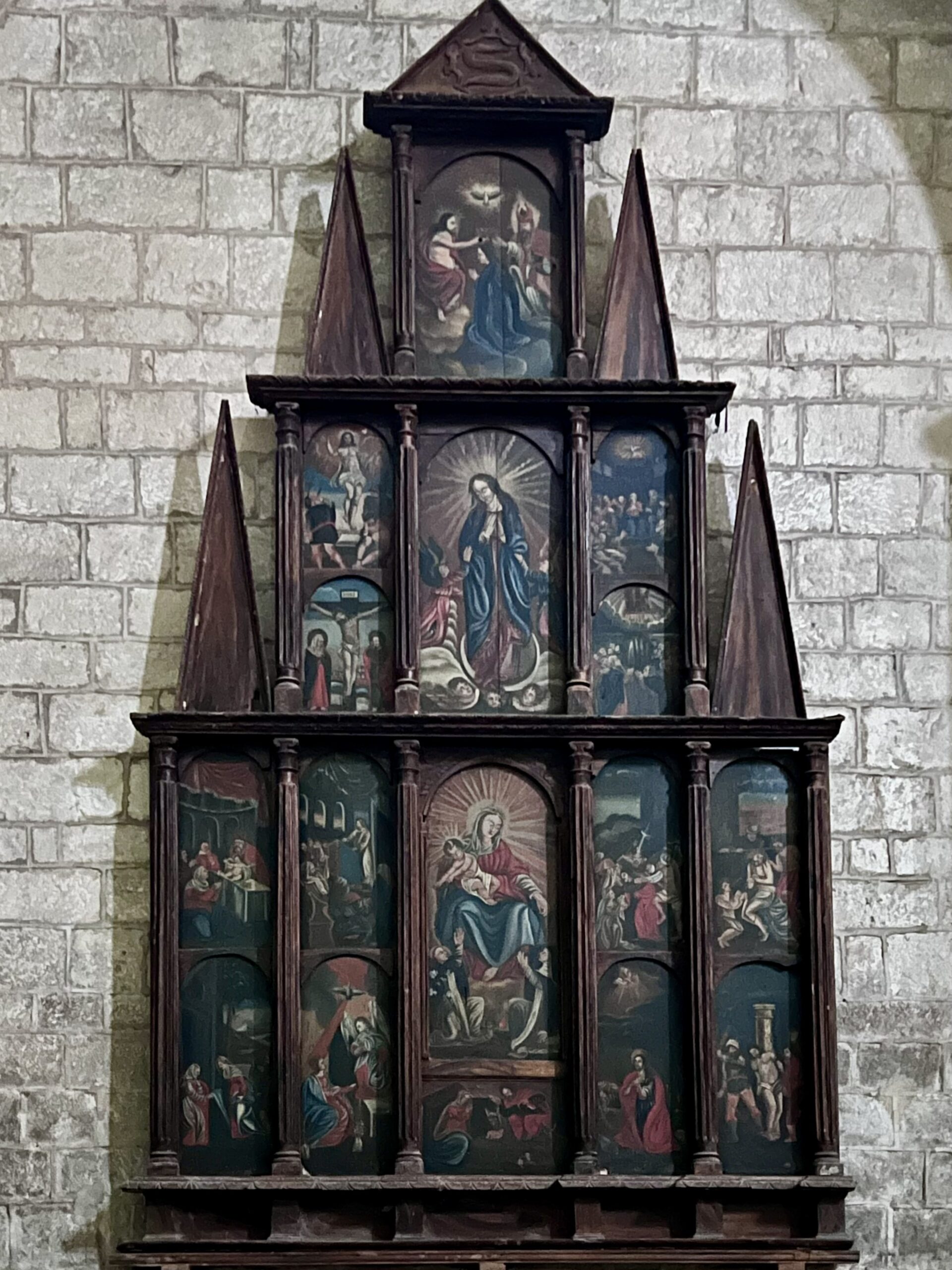
In the church, the legend of “le miracle de Theophiel” (the miracle of Theophilus) is depicted. The French abbot and poet Gautier de Coincy (1177-1236) writes about miracles of Our Lady. In 1263, Rutebeuf, a 13th-century French poet, created the first dramatic version in French literature, drawing inspiration from the works of Gautier de Coincy. He came up with a liturgical drama titled “le Miracle de Théophile” (the miracle of Theophilus). This is about Theophilus of Adana (Adana is now a large city in Turkey). Theophilus is a treasurer and commits fraud. Subsequently, he is dismissed and ostracised by the Bishop of Adana. The man hits rock bottom. This sinner sells his soul to the devil. Later, he repents, shows remorse, and is saved by the Virgin Mary, who lifts him out of poverty. He gets his job back. This story is depicted on the tympanum, with richly decorated walls at the entrance. In the portal, there is also an effigy of Isaiah, who, eight centuries before Christ, announces that a young woman will give birth to a child and name him Emmanuel (God be with us).
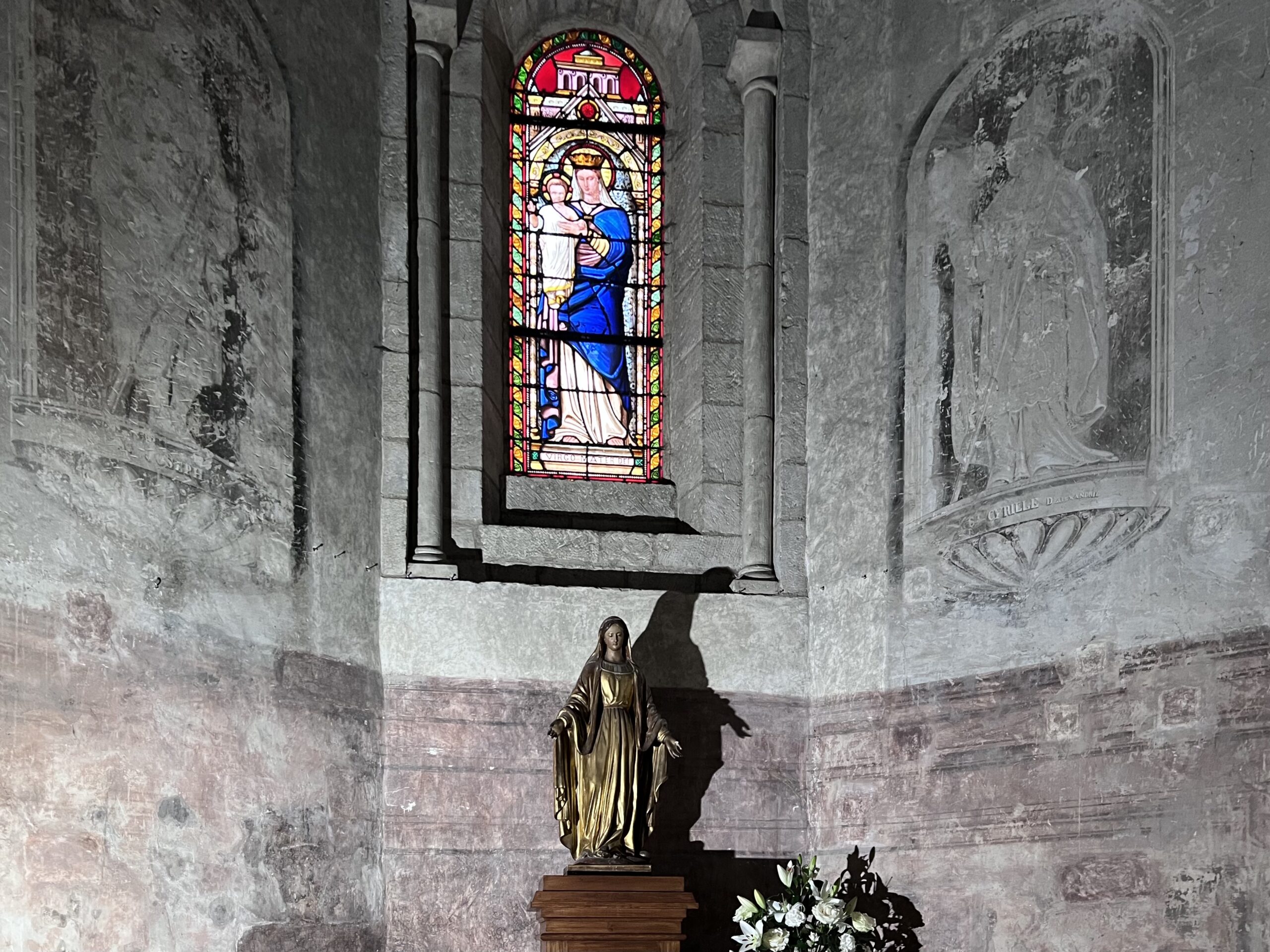
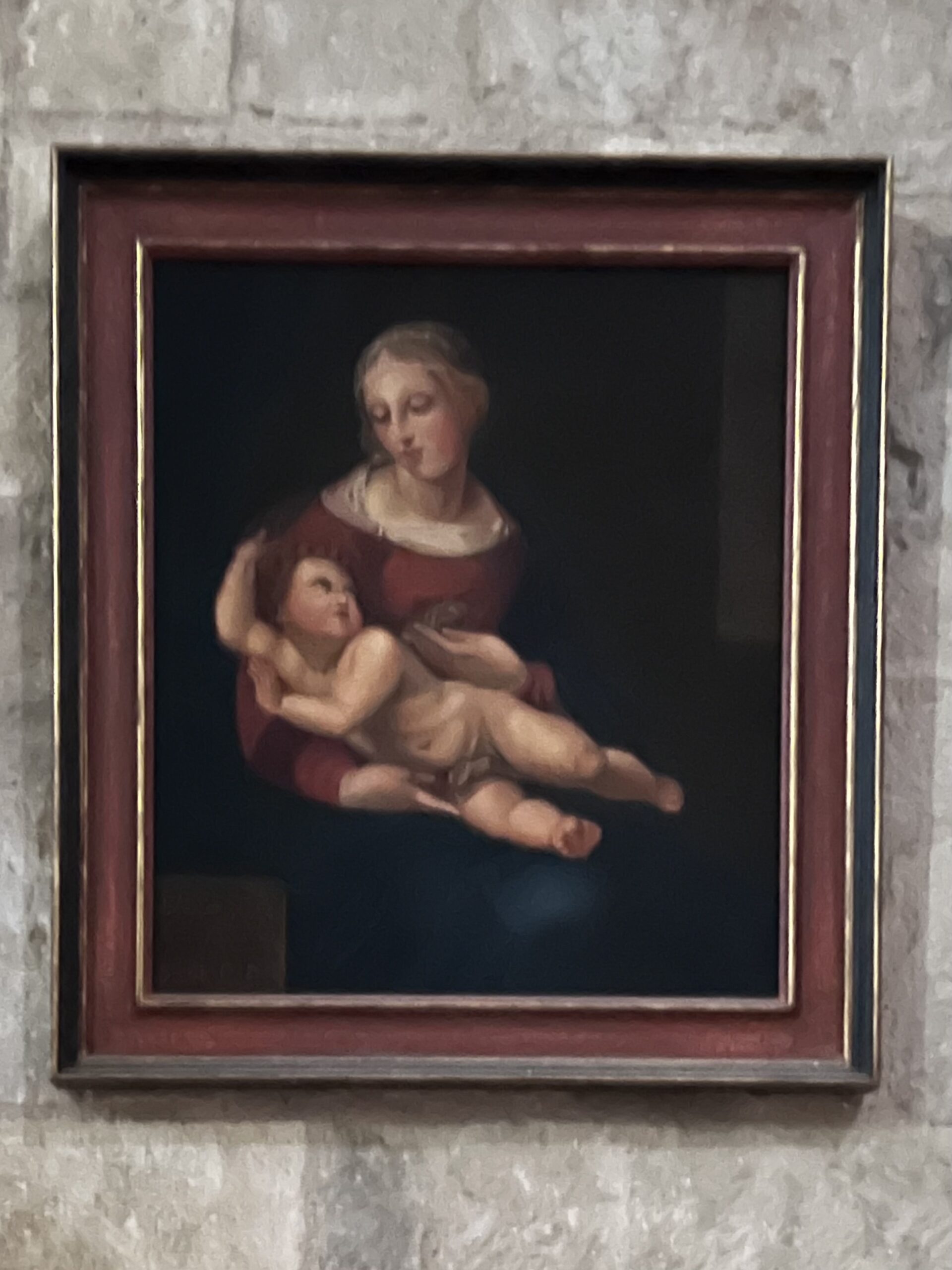
In the abbey church, in the Chapel of the Virgin Mary, hangs a painting of Mary with Child by Louis Vicat (1786-1861), a French engineer.
Van Castels (near Saint-Cyprien) to Redon-Espic is 8 km to the east.
Departing from Bergerac to arrive in Redon-Espic means travelling 61 km to the east.
From Cahors to Redon-Espic involves travelling 75 km to the northeast.
Leaving Périgueux and arriving in Redon-Espic requires travelling approximately 60 km to the south-east.
Travelling from the pilgrimage site of Rocamadour to that of Redon-Espic means travelling 66 km westwards.
~~~

 Nederlands
  English (UK)
  Deutsch
  Français