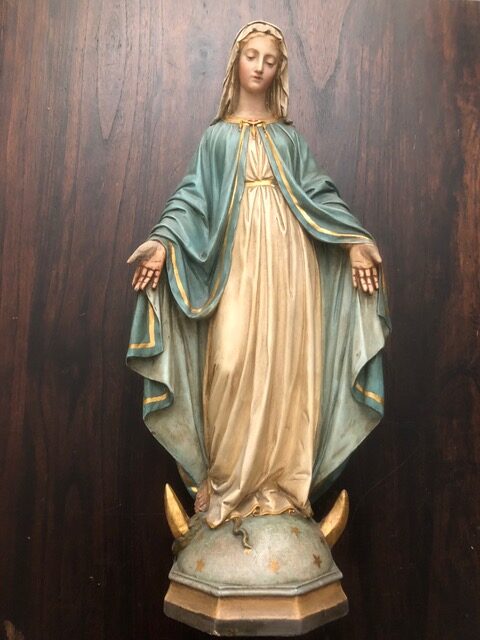
~~~
History
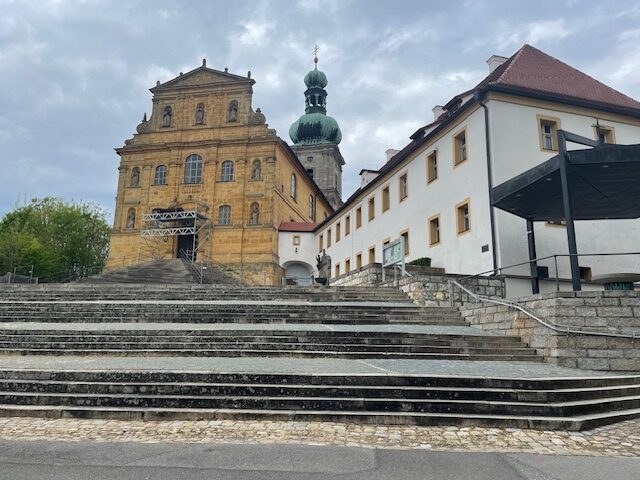
The history of the pilgrimage begins in the period 1633/1634. Two events are of importance, namely a war and an epidemic, which the population suffers from. Due to the Thirty Years' War (1618-1648), a conflict for the hegemony of the Holy Roman Empire rages in Europe, and in Amberg and its surroundings, a plague epidemic is rampant. This Black Death claims many victims. The population of Amberg turns to the Mother of God on several occasions and asks for help. If salvation comes, there will be an annual pilgrimage out of gratitude.
Caspar Hell (1592-1634), rector of the Jesuit college (1629-1634), donated the shrine image Maria-Hulp, a copy of the image by the painter Lucas Cranach (1472-1553), which is located in Innsbruck. On 3 September 1634, the effigy arrived on the mountain, over 500 metres high, which would later be named Mariahilfberg. A few months later, the plague had completely disappeared. The year 1634 thus marked the beginning of the pilgrimage site. The image was placed in the tower of the castle, which was converted into a chapel. In 1641, a thanksgiving chapel was added, and a small pilgrimage site began to emerge. After a fire in 1646, during which the image was rescued, reconstruction took place. In 1651, the chapel was consecrated. Soon, the small building was too small for the increasing number of visitors. This was also due to the many answered prayers.
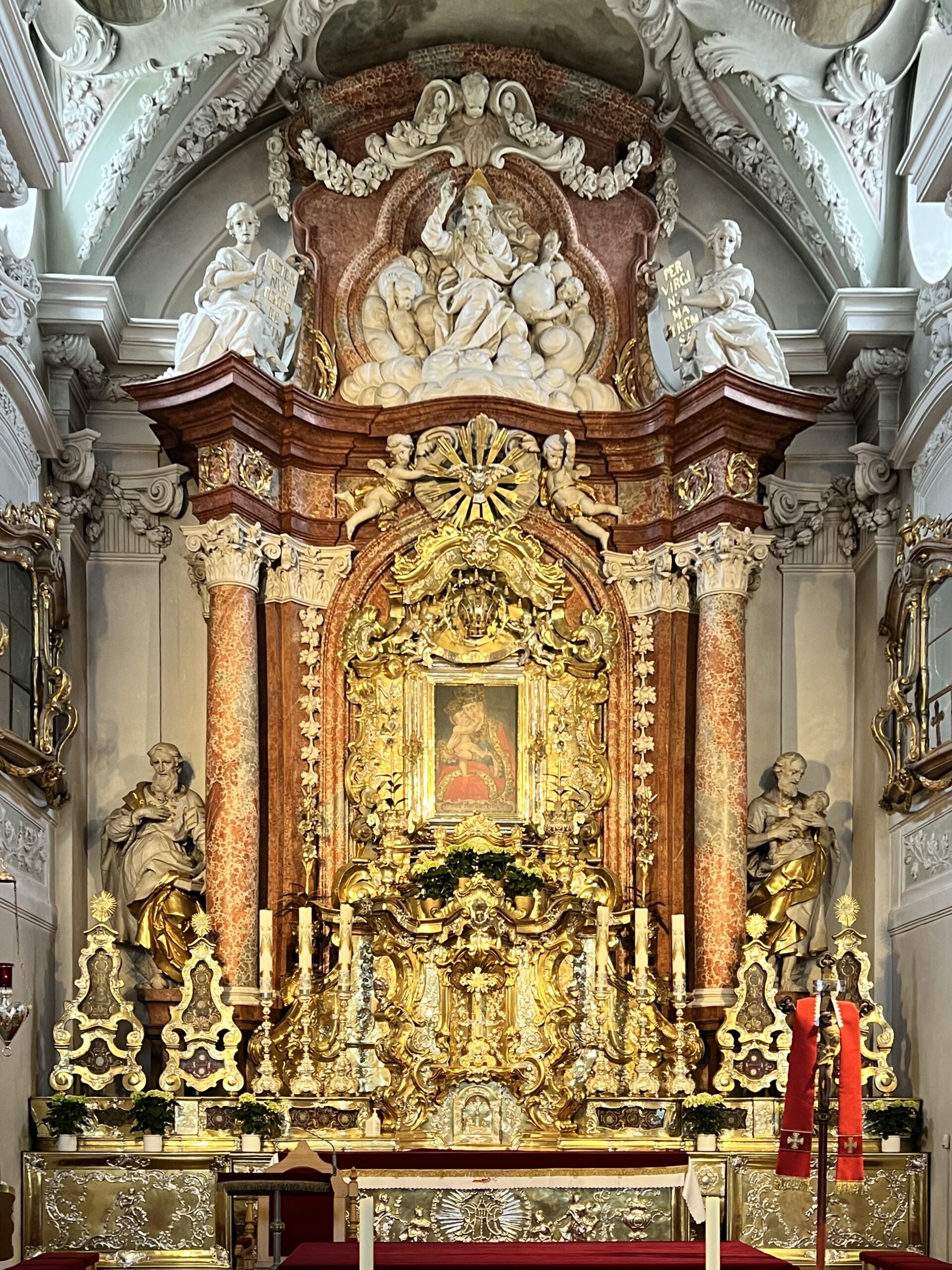
Work on the current, Baroque church began in 1696 on the site where the castle once stood. The designer of the building was Wolfgang Dientzenhofer (1648-1706). Georg Peimbl (1696-1702) supervised the construction, which lasted from 1696 to 1702. He was assisted by the Franciscan Philipp Plank (1660-1720). From 1702, the focus shifted to finishing and furnishing. The Italian Giovanni Battista Carlone (c.1640-c.1718) created the decorations for the marble high altar between 1702 and 1707. Paolo d’Allio (Paolo d’Aglio, 1655-1729), also Italian, added decorations to the ceiling of the nave, side chapels, and choir. The ceiling frescoes were painted in 1717-1718 by Cosmas Damian Asam (1686-1739). The consecration of the church took place on 6 September 1711, although it was not yet entirely complete. The church tower was built in 1726. The granite staircase dates from 1859.
In the period 1976-1981, there were extensive renovations.
In 2007 the Franciscans disappear after a long stay in Amberg. They are succeeded by Polish Franciscans.
Pilgrimage site
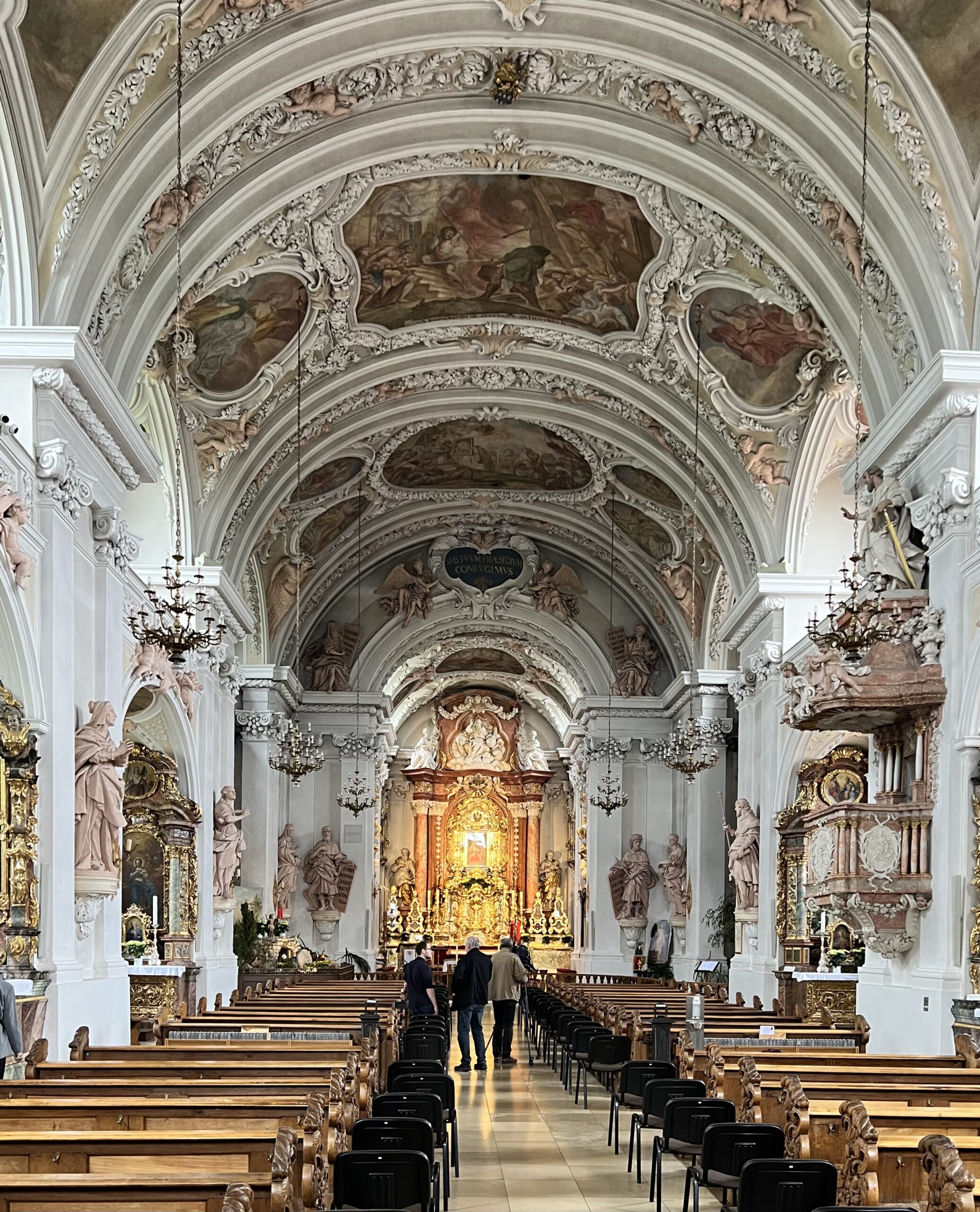
The pilgrimage church is dedicated to “Maria Hilf” (Mary's Help) and is an expression of the Counter-Reformation.
In the church, many statues, frescoes, and paintings can be seen.
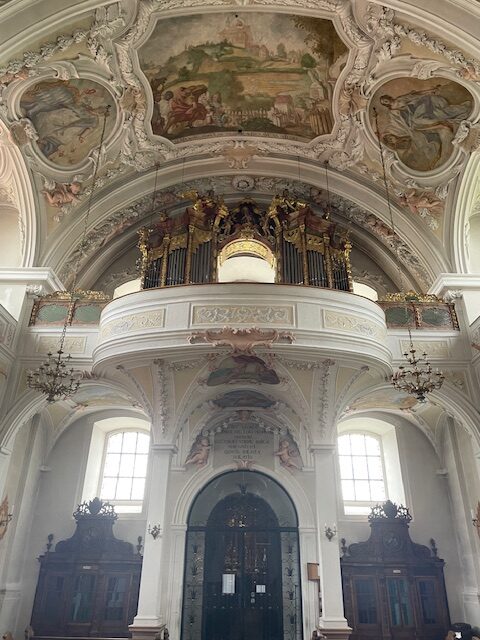
The frescoes on the ceiling, which depict history, portray the plague epidemic in 1634, the arrival of the icon of grace in 1634, the rescue of the icon from a fire in 1646, the consecration of the pilgrimage church in 1711, and believers on pilgrimage to the Mariahilfberg.
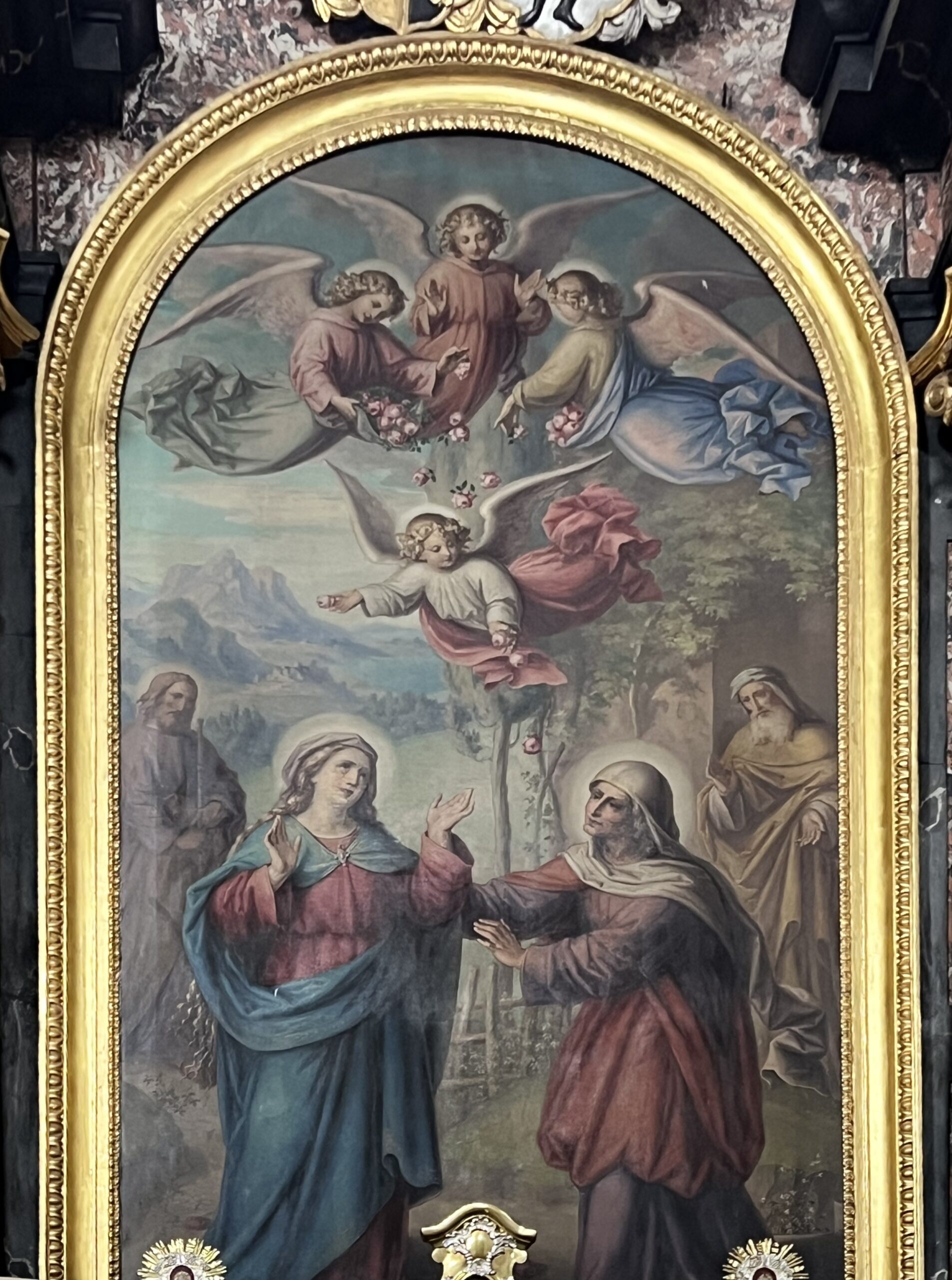
The images in the side chapels and chapel altars depict scenes from the New Testament and show the lives of saints. One side chapel shows the Visitation of Mary to her cousin Elizabeth, and another altar features the Holy Family. The left altar centrally displays the Immaculate Conception of Mary.
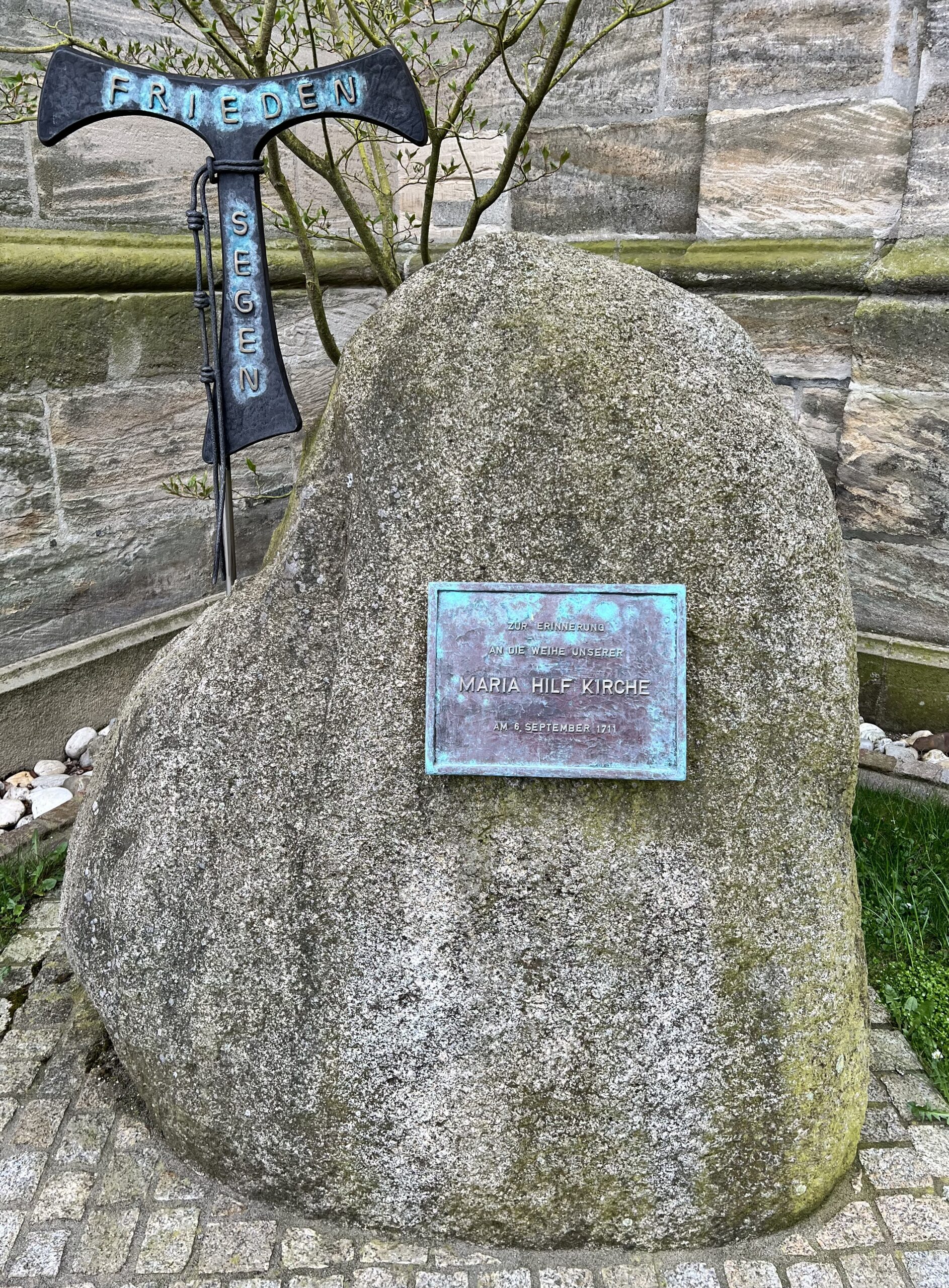
A large boulder commemorates the consecration of the church and bears the inscription “In memory of the consecration of our “Maria Hilf Kirche” on 6 September 1711".
The pilgrimage church is open daily.
ACCESSIBILITY
The address of the pilgrimage church is: Auf dem Mariahilfberg 3, D-92224 Amberg.
Current information can be found at www.amberg-st-martin.de and another source is
www.mariahilfberg-amberg.de
Experience
The pilgrimage site is situated on a mountain, and it is Mary who helps you get there. At “Mariahilfberg,” the flag says it all. Even the final metres are uphill, as entering the pilgrimage church requires climbing a few steps.
The church is a testament to faith. Almost every metre is filled with paintings, sculptures, and frescoes. What an impressive interior! A great deal of work has gone into making the beautiful even more magnificent.
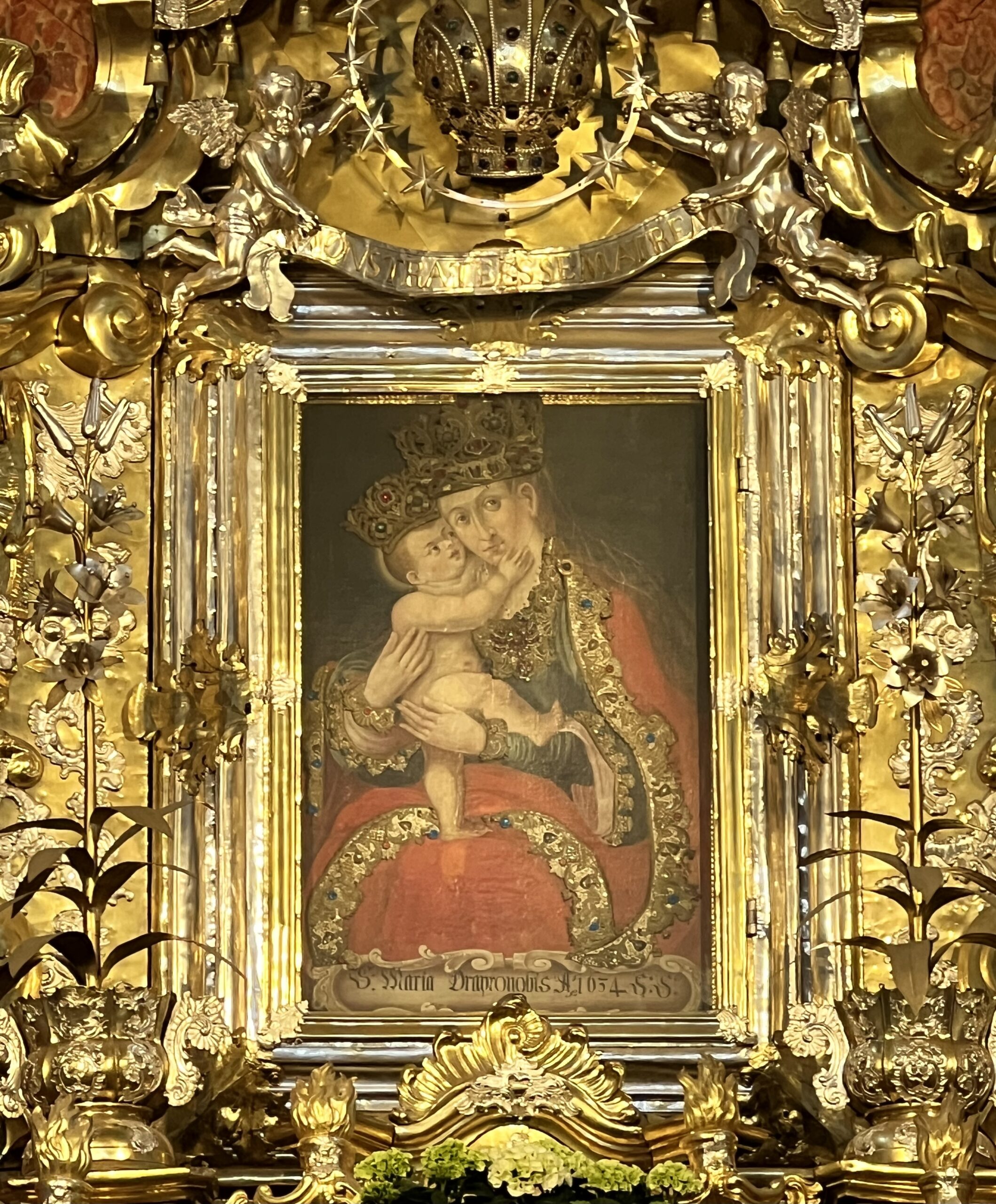
The pilgrimage church is a true Marian church. Our Lady is depicted here often. Here she is, among other things, crowned and is accompanied by her mother Anne, as well as her cousin Elizabeth. The high altar shows the devotional image, which is entirely framed in gold. Mary and Jesus are crowned, and the Mother holds her naked Child with two hands. Little Jesus looks at Mary, and She looks at me… Beneath the devotional image are the year “1654” and the words “pray for us”.
When admiring the frescoes, my neck is put to the test; so many ceiling paintings can be seen. What scenes! Here, even the marriage of Mary and Joseph is depicted.
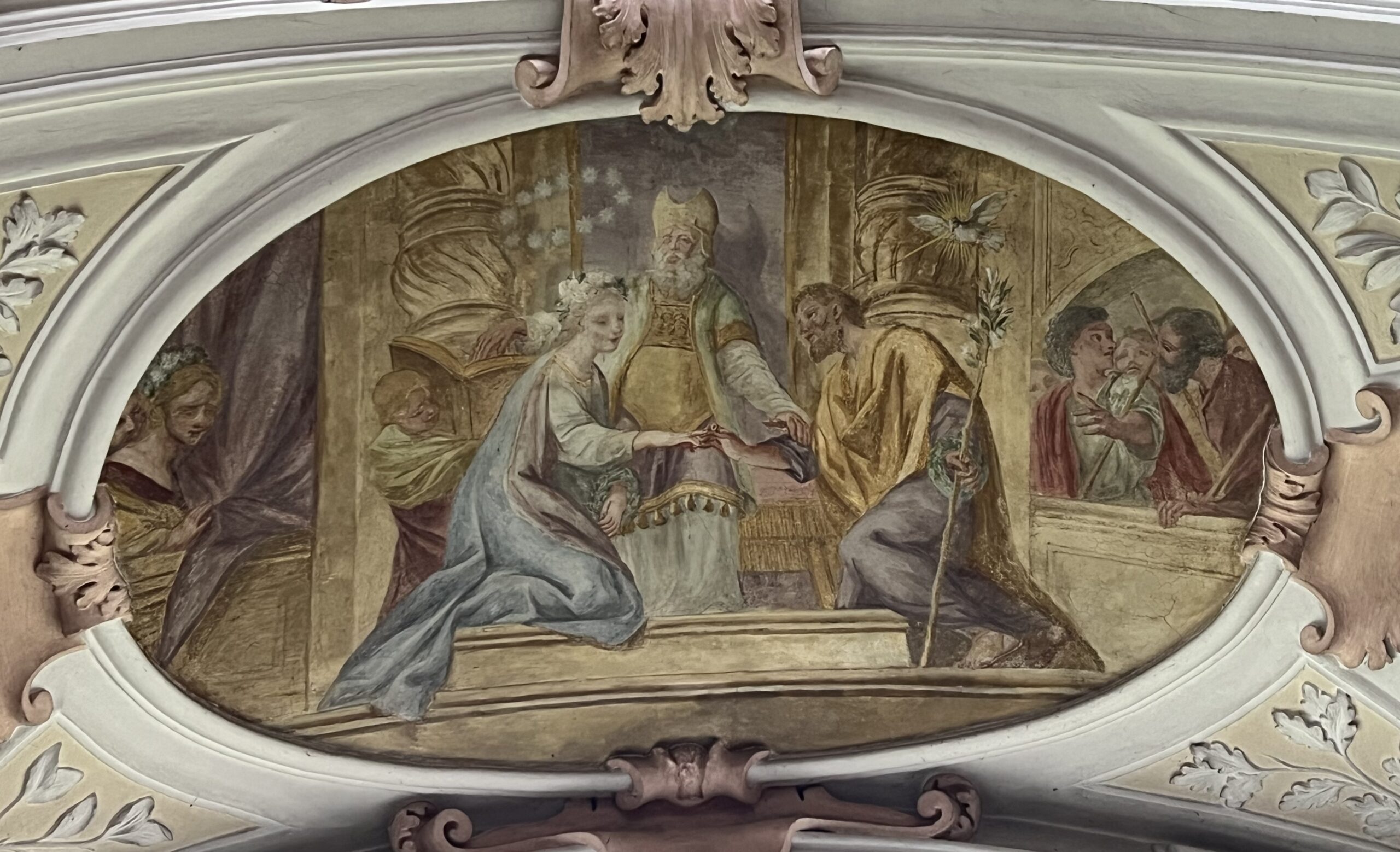
Next, I will take a closer look at the interior of the church. What an incredible amount of artistic expression in this space! What craftsmanship!
In the pilgrimage church, I find a holy card and on it there is also a poem. When I translate the text, it becomes:
”O Mary, help, O Mary, help!
Oh Maria, help me please!
A poor sinner comes to You.
Keep me alive, and do not let me perish.,
Let me not die in mortal sin.
Sta me bij in de laatste strijd,
O Mother of Mercy!”
A large boulder commemorates the consecration of the pilgrimage church. How much manpower is needed to move this boulder?
Finally, I visit the family chapel. There is a photo on display of Bishop Oswald Hirmer (1939-2011) from South Africa, who came here to pray, sing and laugh.
Environment
Going 72 km east from Nuremberg leads to Amberg.
Departing from Regensburg to arrive in Amberg means travelling 70 km to the north.
Departing from the pilgrimage site of Marienweiher and arriving at the one in Amberg involves travelling 112 km south.
Leaving the pilgrimage site of Heilbrünnl (Roding) to get to the Marian shrine of Amberg means travelling 63 km to the northwest.
Leaving the Czech city of Pilsen to go to Amberg implies travelling 136 km westwards.
~~~

 Nederlands
  English (UK)
  Deutsch
  Français