History
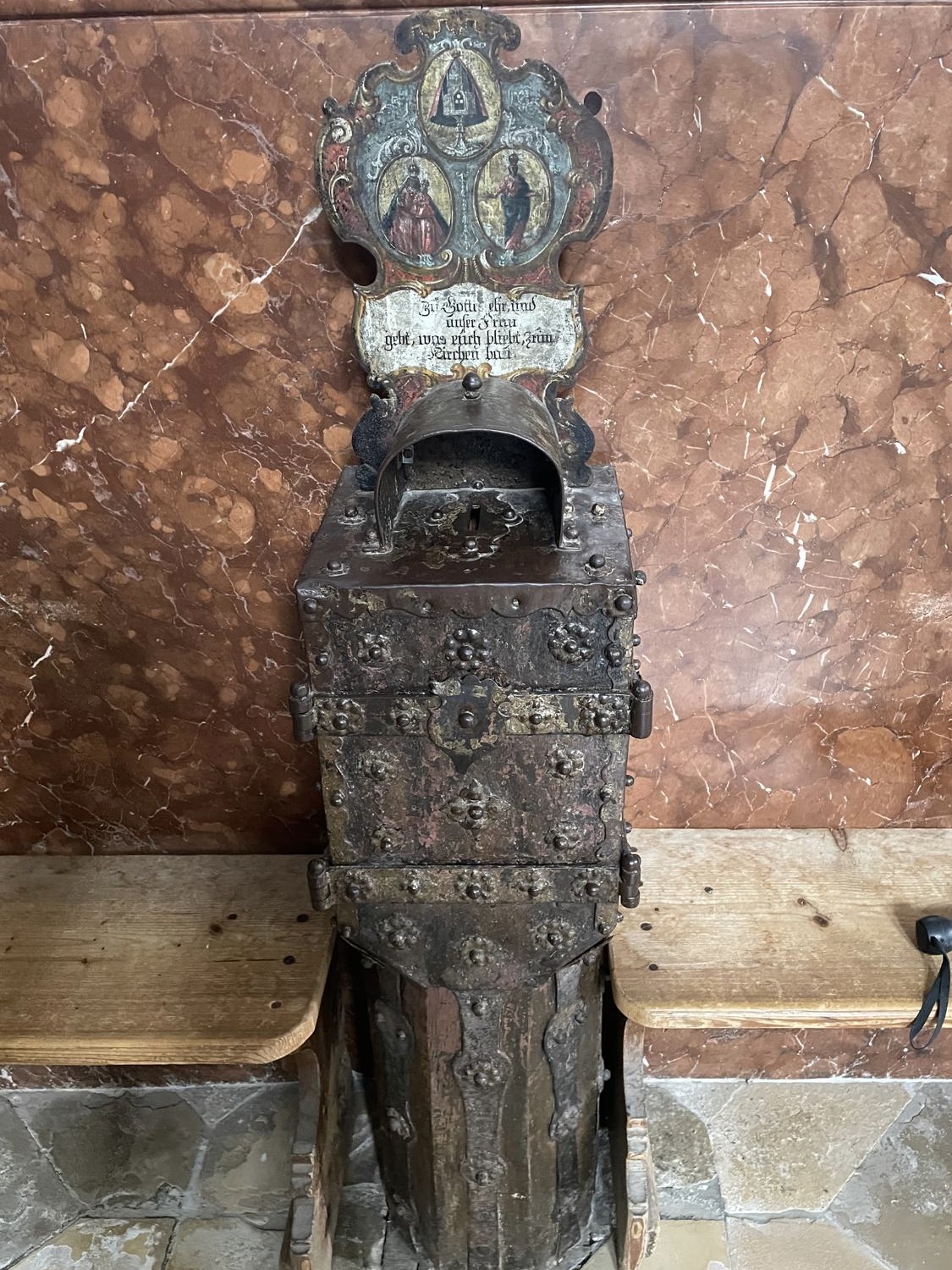
In the 10th century, relics from the Holy Land were brought to the Andechs Castle after a pilgrimage by Count Rasso (c. 900-954), an ancestor of the Counts of Andechs. From this pilgrimage, he brought back precious relics, including a crown of thorns, a whip, a shroud, and the cross.
The current pilgrimage church is dedicated to Saint Nicholas of Myra, patron saint of travellers, and Saint Elisabeth of Thuringia, a descendant of the noble House of Counts of Andechs. The patronage of Saint Nicholas dates back to the period of the Counts of Andechs. The castle of Andechs is first mentioned in 1080 and features a Chapel of Saint Nicholas.
In 1128, Count Berthold II of Andechs (c. 1080-1151) obliged his subjects to venerate the relics kept in the castle annually, including, from 1177 onwards, three hosts from Rome. These hosts formed the core of the pilgrimage site for centuries. Two of the hosts came from Gregory I the Great (c. 540-604), who was pope from 590 to 604. As a result, pilgrims went to the St. Nicholas Chapel of Andechs Castle to pray before the relics. The pilgrimage dates back to 1128, making Andechs the oldest pilgrimage site in Bavaria. Under Count Berthold IV von Diessen von Andechs (c. 1150-1204), the House of Andechs reached the peak of its power.
Political developments in the 13th century led to the decline of the Counts of Andechs' power. In 1246, Andechs Castle was destroyed, but the relics were safely secured in time. Pilgrimages drastically decreased, and some relics, including the three hosts, were lost after the destruction of Andechs Castle.
During a service in 1388 in the castle chapel, a mouse is said to have brought relics, including those of the three hosties, into the light. Digging commences under the altar and a chest containing relics emerges, including those of the three hosties. This becomes known throughout the region, and pilgrimages are revived. Augustinian friars are responsible for administering the pilgrimages.
In the early 15th century, the construction of the Andechs late Gothic pilgrimage church was encouraged by Ernst of Bavaria (1373-1438), Duke during the period 1397-1438. Construction of the church began in 1420.
In 1455, the Benedictine monastery was built on the initiative of Albrecht III von Bayern-Münich (1401-1460), Duke (1438-1460) and son of Ernst von Bayern.
In the 16th and 17th centuries, Andechs developed into a Marian shrine. Our Lady was then venerated alongside the many relics, including the three hosts. The Chapel of Our Lady was built between 1591 and 1594. The merchant and high official Ferdinand Vöhlin von Frickenhausen (1556-1603) made this financially possible.
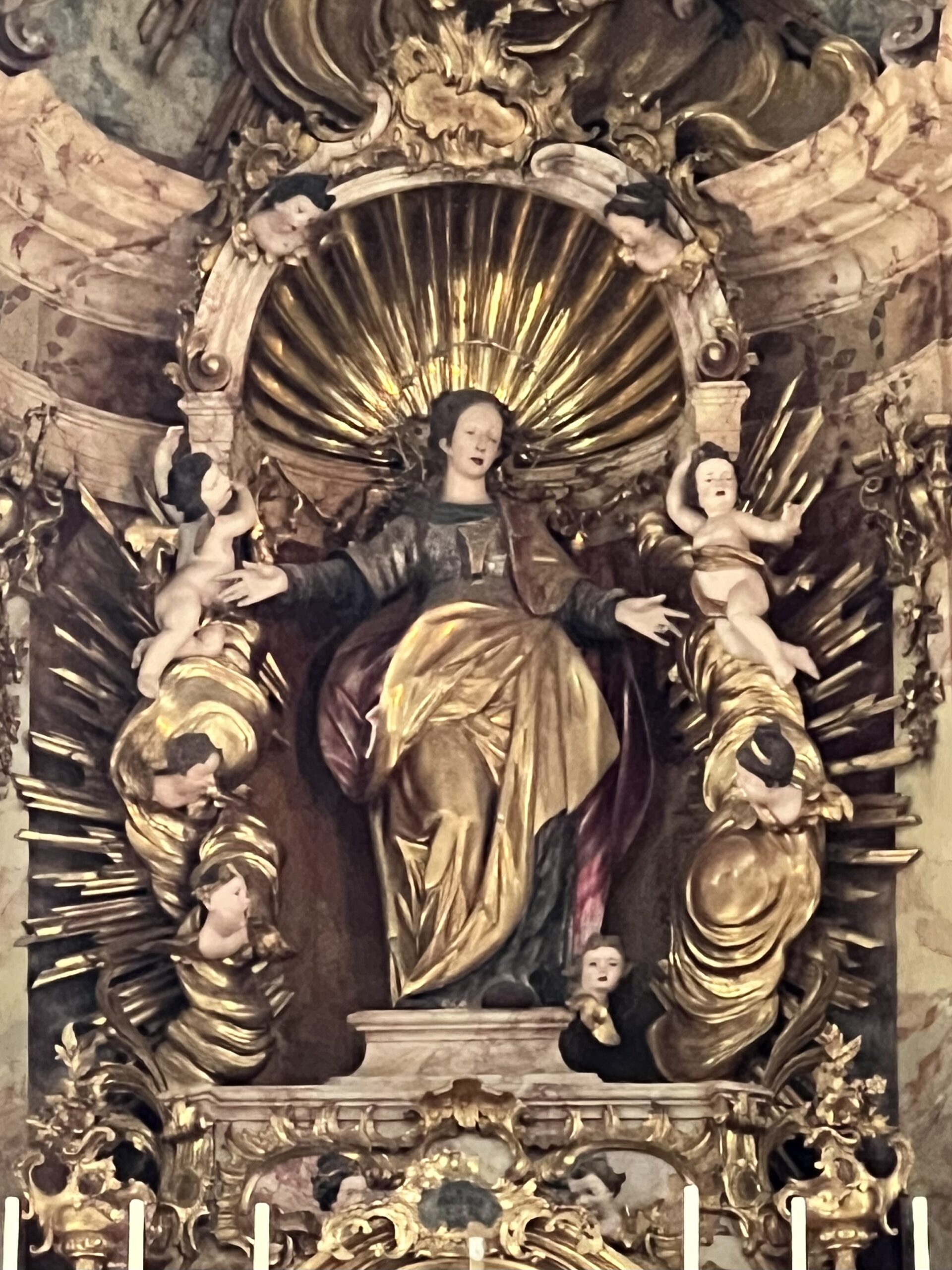
Since the 17th century, the Gothic grace image of the Immaculate Conception of Mary has been in the high altar. The wood carving is by Hans Degler (1564-1635) from the early 17th century. The sculpture of Our Lady is flanked by the likenesses of the prime patrons, Saint Nicholas of Myra and Saint Elisabeth of Thuringia.
During the Thirty Years' War (1618-1648), a conflict between Catholic and Protestant states, Swedish troops destroyed much in Andechs and the surrounding area. The statue of Mary was safely moved in time.
In 1672, the wrought iron railings were made for the “Holy Chapel.” The reliquary chapel was added to this holy chapel.
Due to a lightning strike and a subsequent large fire, almost the entire monastery and church were destroyed in the year 1669. The reconstruction of the monastery and church was completed in 1676.
In the first half of the 18th century, the Rococo style was realised in the church. Sculptors, painters and stucco workers collaborated on this, such as Johann Baptist Zimmermann (1680-1758), his son Franz Michael Zimmermann (1709-1784), Johann Georg Üblhör (1703-1763), Franz Xaver Feichtmayr (1705-1763) and Johann Philipp Helterhof (1725-1807). In 1755, the high altar was consecrated. It is a design by Johann Baptist Zimmermann and was executed by the sculptor Franz Xaver Schmädl (1705-1777).
The devotional image on the high altar is flanked by sculpted, silver-plated, and partially gilded statues of Saint Nicholas of Myra on the left and Saint Elisabeth of Thuringia on the right, a scion of the noble family of the Lords of Andechs. The artist is Johann Baptist Straub (1704-1784), who created the statues in 1750. Above this is a standing Madonna with outstretched arms by Hans Degler (1564-1635), who made it in 1608-1609.
In 1803, the monastery was dissolved due to political, anti-Catholic decision-making, yet pilgrims continued to visit. In 1804, the buildings were sold and then sold again more than once.
In 1846, Ludwig I (1786-1868), King of Bavaria (1825-1848), acquired the former monastery and church as business premises. He ensured that by 1850, Catholic activities were once again permitted. The monastery then belonged to St. Boniface Abbey in Munich. The pilgrimage church was, at that time, state property of Bavaria.
After the Second World War (1939-1945), interest in the pilgrimage site increased as believers were once again given freedom and the Nazi regime was defeated. The revival was also particularly due to the arrival in 1924 of relics of Saint Hedwig of Andechs (1174-1243). The church was renovated in 1941-1942.
Since 1967, the Mary Chapel has been dedicated to Saint Hedwig.
Since 2003, the route to the Spanish pilgrimage site of Santiago de Compostela has been possible again between Munich and Lindau. This brings pilgrims to the Marian shrine of Andechs, as this place lies on the pilgrimage route.
Between 2000 and 2005, the pilgrimage church is thoroughly restored.
Pilgrimage site
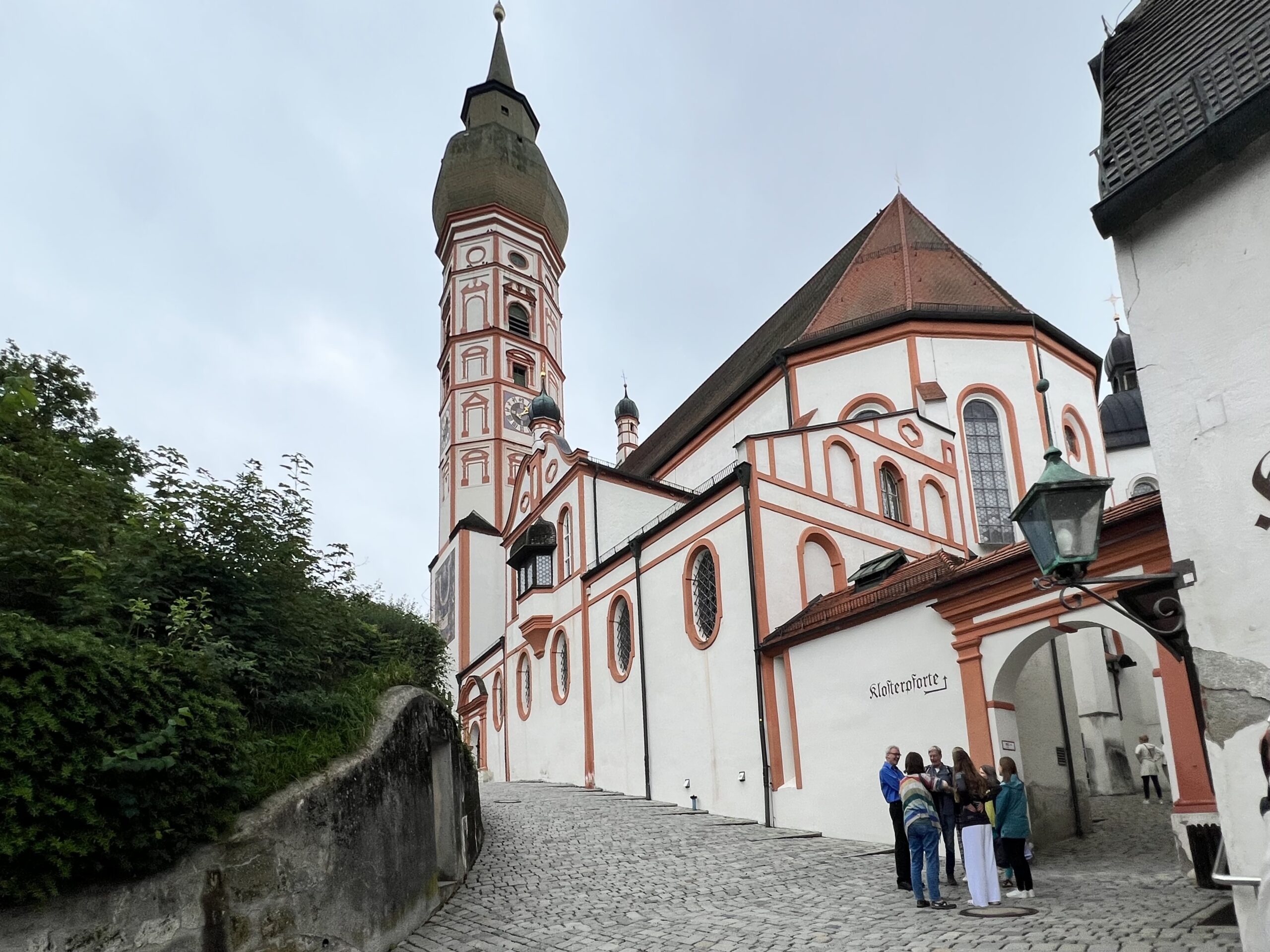
Bavaria's oldest pilgrimage site is located on the “holy mountain” and this at about 700 metres above sea level. The church tower can be seen from a great distance and is shaped like an onion. The pilgrimage church is dedicated to Saint Nicholas of Myra (270-342) and Saint Elisabeth of Thuringia (1207-1231), who comes from the lineage of the Counts of Andechs.
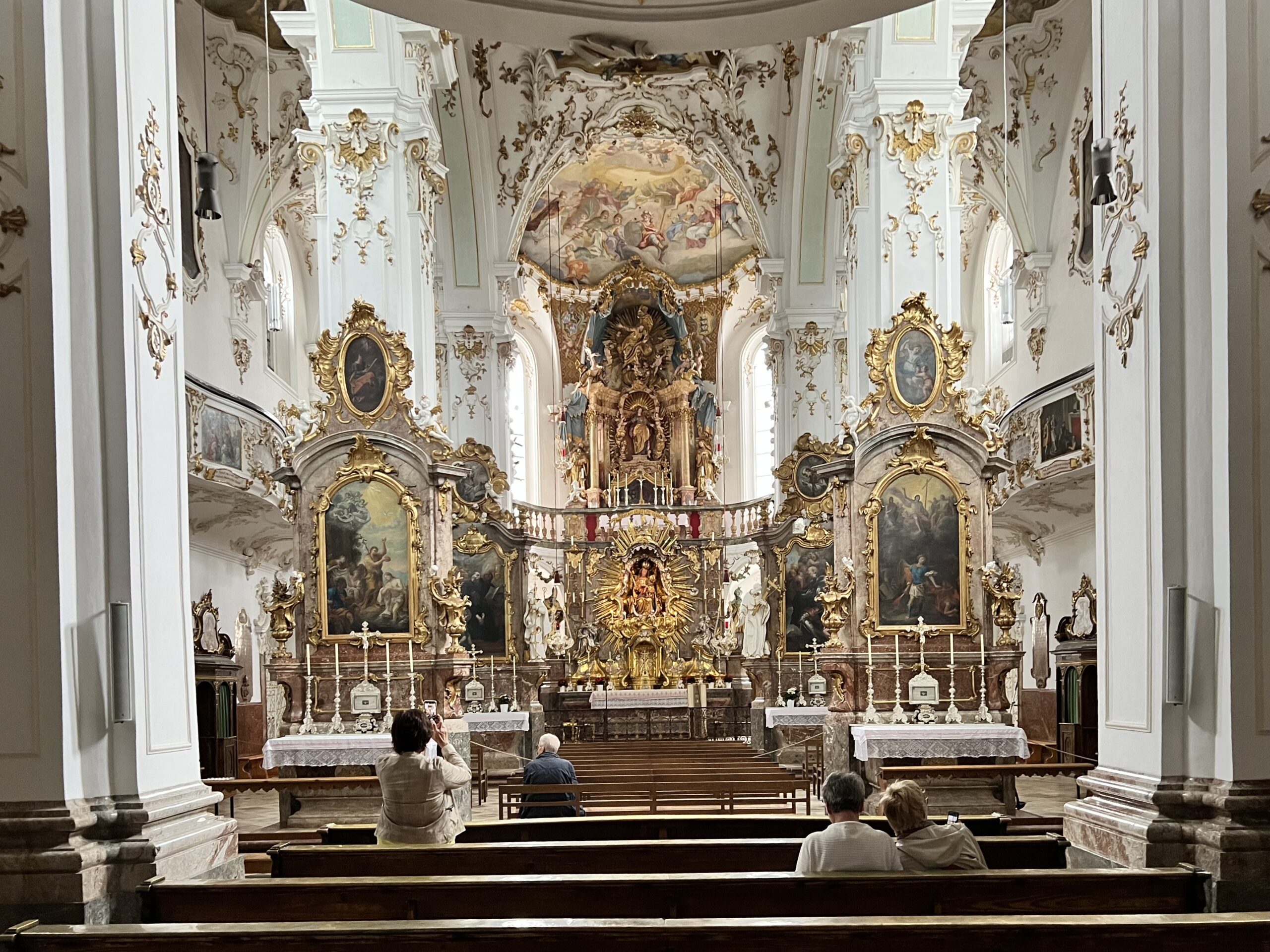
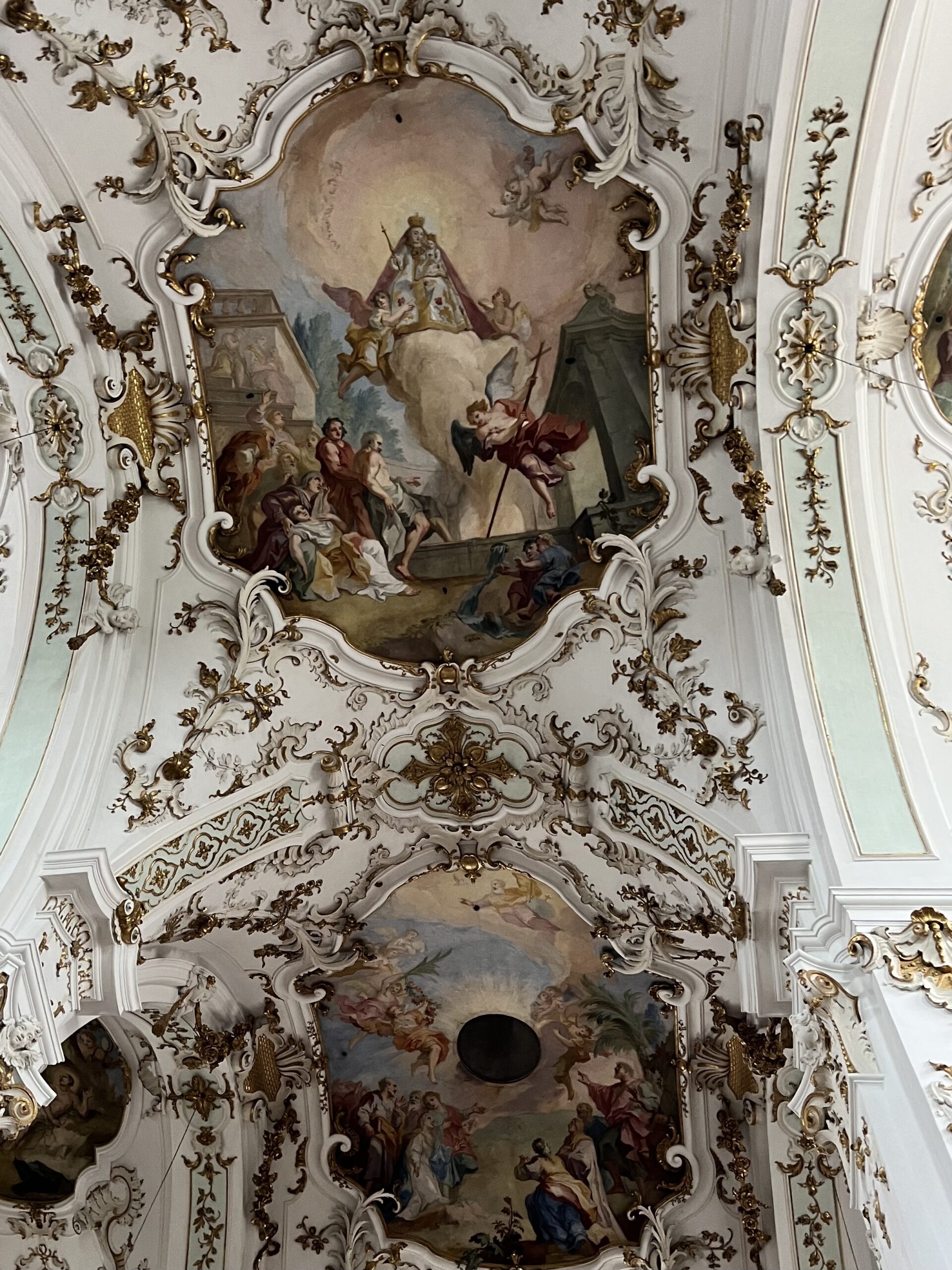
The interior of the basilica measures 30 metres in length and 15 metres in width, and is painted and decorated in the Rococo style. The painter and stucco decorator Johann Baptist Zimmermann (1680-1758) was particularly responsible for this in 1755. Numerous ceiling frescoes were also created.
In the lower part of the high altar is the devotional image of the enthroned Mother of God and her Child. Above this is a standing Madonna, with her arms spread wide.
The church houses many relics, including those of Saint Nicholas, Saint Elizabeth of Thuringia, the Crown of Thorns, and the three hosts. The relics are kept in the “Heilige Kapelle” (Holy Chapel), a side chapel.
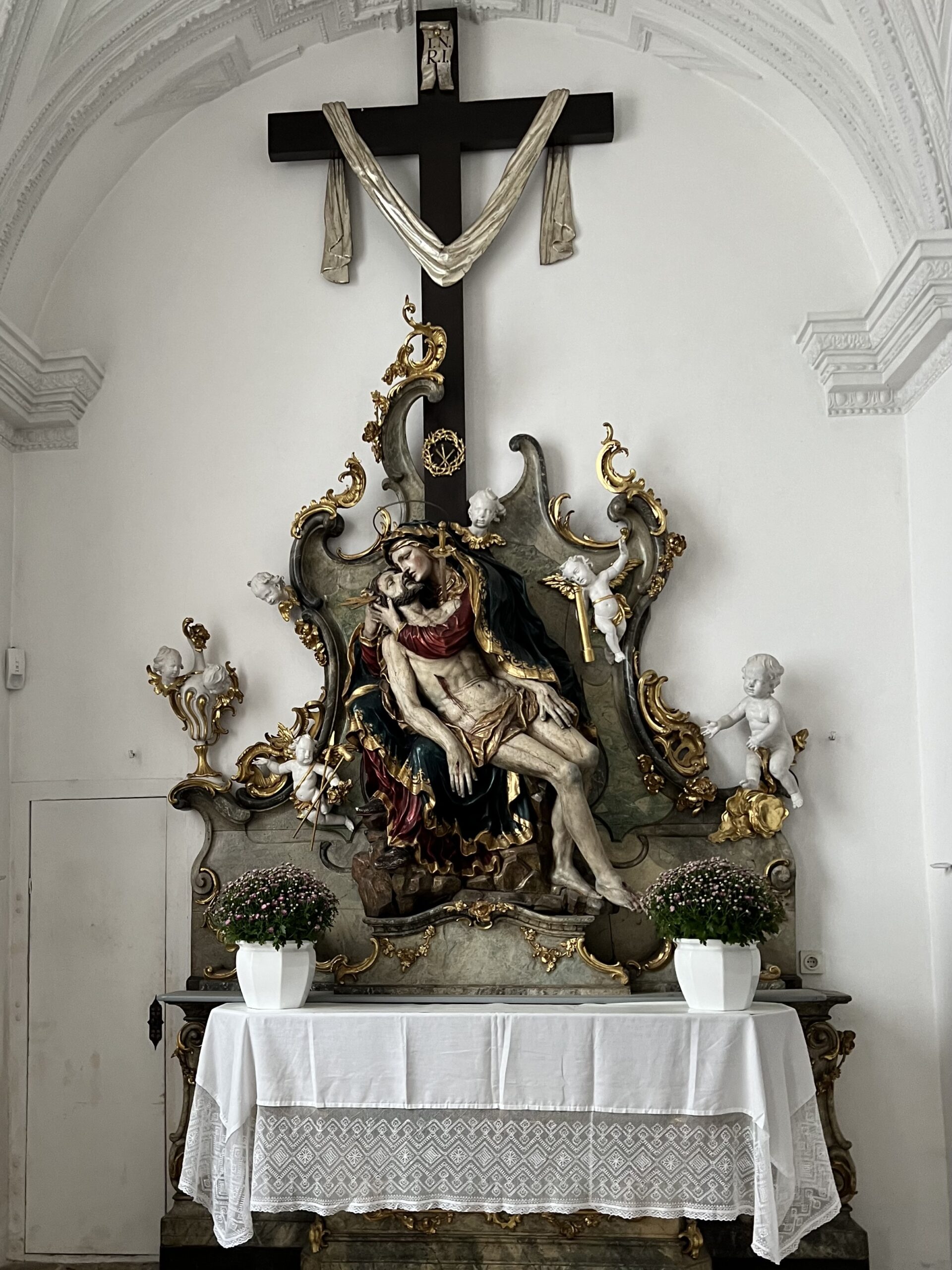
In the Chapel of Our Lady of Sorrows, a 17th-century Pietà stands on the altar. The statue was made by sculptor, stucco worker, architect and painter Hans Kruiper/Krumper (1570-1634).
The church and monastery are separated by a small garden; the garden gate is called “Pfortenhof”.
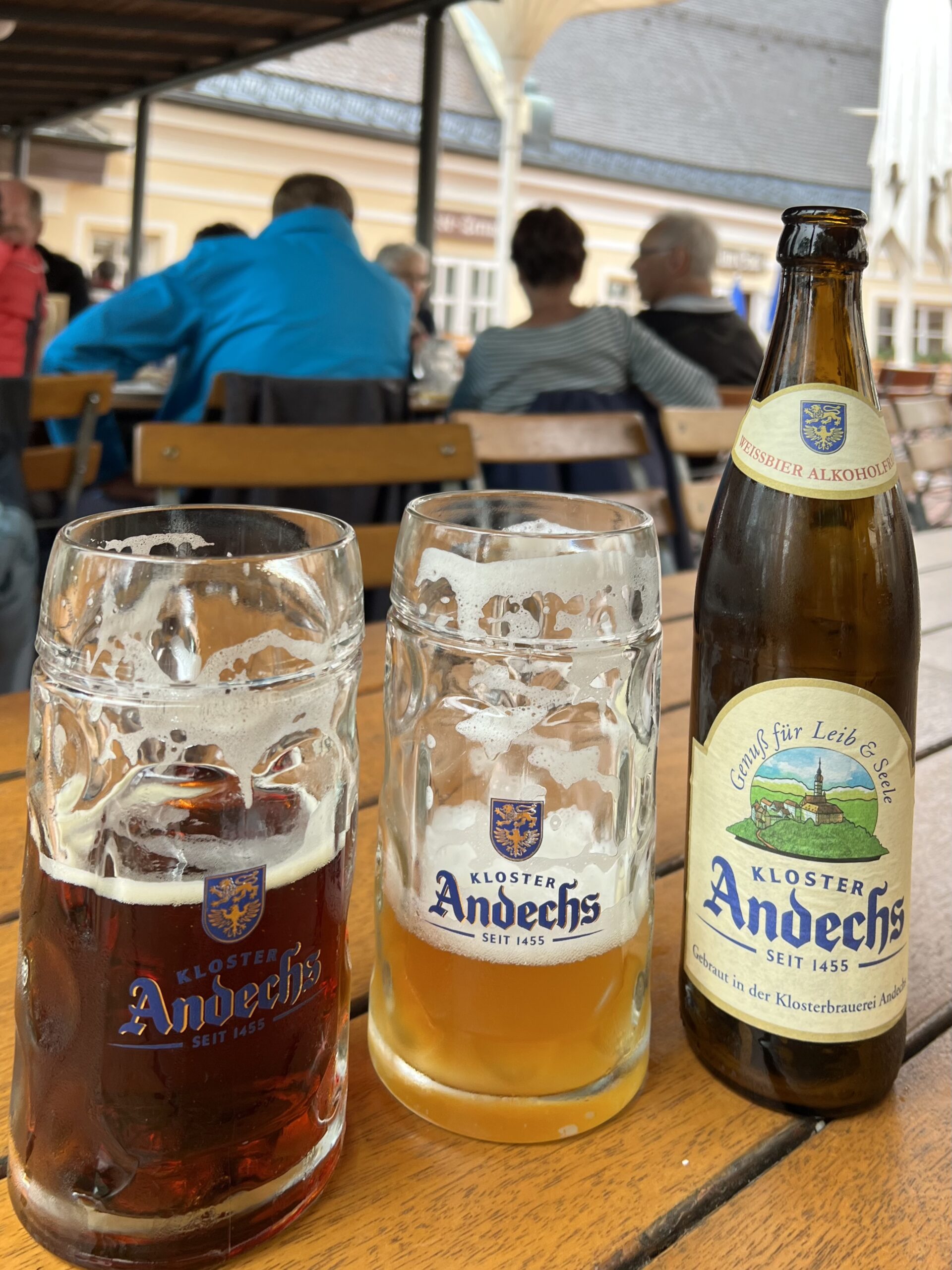
In the monastery shop, devotional items are available for purchase, as well as books about the shrine and the Catholic faith. In the “Klostergasthof” (monastery inn), beer from the Andechs monastery brewery is also available. Monks have maintained the tradition of brewing beer since 1455.
Next to the pilgrimage church, there is also a “Klostergasthof” (monastery inn), which has a restaurant and accommodation.
In Andechs, there is a “three-host festival” on the last Sunday of September. A monstrance with three hosts then goes in procession.
The pilgrimage church is open daily.
ACCESSIBILITY
The pilgrimage site of Andechs is located in the state of Bavaria.
The address of the monastery and church is Bergstrasse 11, 82346 Andechs.
Current information can be found at www.andechs.de.
Experience
As I approach the Holy Mountain, a large sign with a map welcomes me warmly.
Here, there is a Way of the Cross station from 1874 depicting Jesus being laid in the tomb. This depiction moves me and once again I feel great admiration for sculptors.
Next, I will continue up the mountain and read on a sign that this Holy Mountain was founded in the early 15th century. I am also told that many relics of saints are kept here. The name Holy Mountain originates from Herzog (Duke) Ernst, and this is because of the many relics that are preserved here.
Halfway up the mountain, I come to a chapel with many burning candles, and there hangs a painting of Mary and Child. They look at the visitors with wide eyes. Is this an invitation to light a few more candles?
After going up a few more metres, walking over large cobblestones, I arrive at the church and open the door. I am immediately transported to a world of beauty! It feels like an introduction to entering heaven. What a jewel this church is! I take my time to look around the church, because beauty deserves prolonged attention. In the tasteful chapel, beneath a cross, stands a Pietà. The faces of Mary and Jesus pressing against each other, something I haven't often seen. A sword in the Mother's upper body. Mary's face is etched with sorrow. What a profoundly moving work of art!
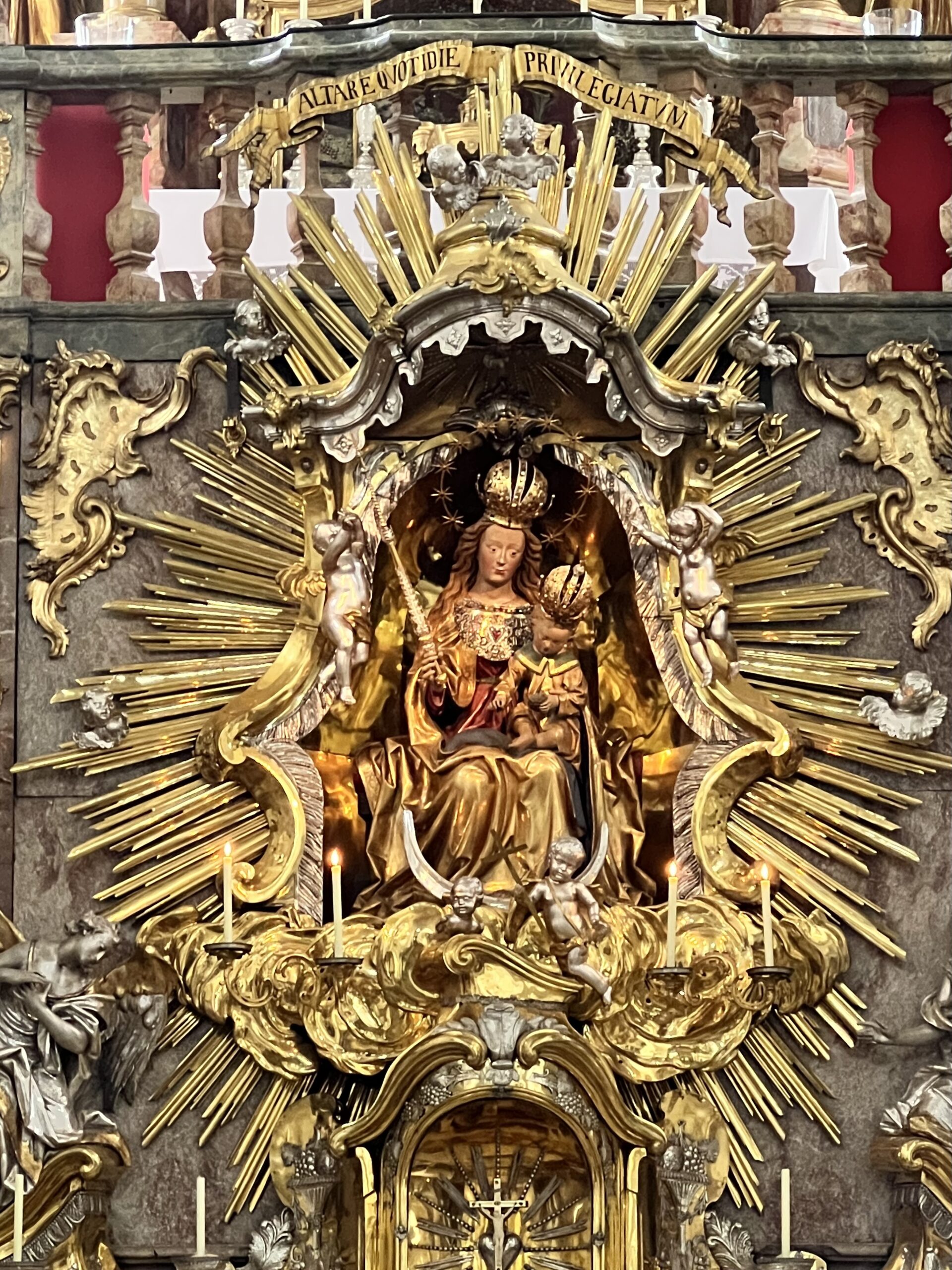
Next, I proceed further into the church, and by the high altar, it's time to pause. I let the images take their effect on me. Both Mary and Jesus are crowned, and golden rays surround them. Above this is another beautiful depiction, also with golden rays and putti. Saint Nicholas is also present here. Hello, good friend! The high altar in the basilica displays the image of the Immaculate Mary.
The ceiling of the church is entirely painted and the Virgin Mary is depicted multiple times. Many paintings are also attached to the walls. The ex-votos are more than numerous. What expressions of gratitude to Mary! I also see a lot of large, ornate candles.
Outside the church, there are many activities to undertake, such as visiting the brewery, watching the creation of wood sculptures, walking past the Stations of the Cross, and taking a stroll. Many people are sitting on a large terrace, enjoying the beer from Andechs and savouring its taste.
Environment
Going from Munich to Andechs is 45 km to the south-west.
Leaving Rosenheim to arrive in Andechs requires travelling 110 km westwards.
Leaving Augsburg to get to Andechs means covering 86 km to the southeast.
Travelling from Ingolstadt to Andechs involves going 120 km south.
~~~

 Nederlands
  English (UK)
  Deutsch
  Français