~~~
History
The origin of the pilgrimage site Maria Eck is based on a legend. Woodcutters observed rays of light from the sky on nights of major Marian feasts, which landed on the hill. The woodcutters saw these rays as divine proof to build a pilgrimage church in honour of the Mother of God. Some time later, a small chapel was built on the site of the current church. This chapel stood for a large part of the Thirty Years“ War (1618-1648). The chapel is located on land belonging to a larger area acquired between 1618 and 1624 by Sigismund Dullinger (1576-1634), Abbot of the Benedictine monastery of Seeon (1609-1634). In 1621, Abbot Sigismund Dullinger took the first step for a Marian shrine. In 1626, he provided for an improved chapel with the title ”Maria Hulp“ (Mary's Help). The shrine was then named ”Maria Egg,“ with the designation ”Maria Eck" dating from a later period.
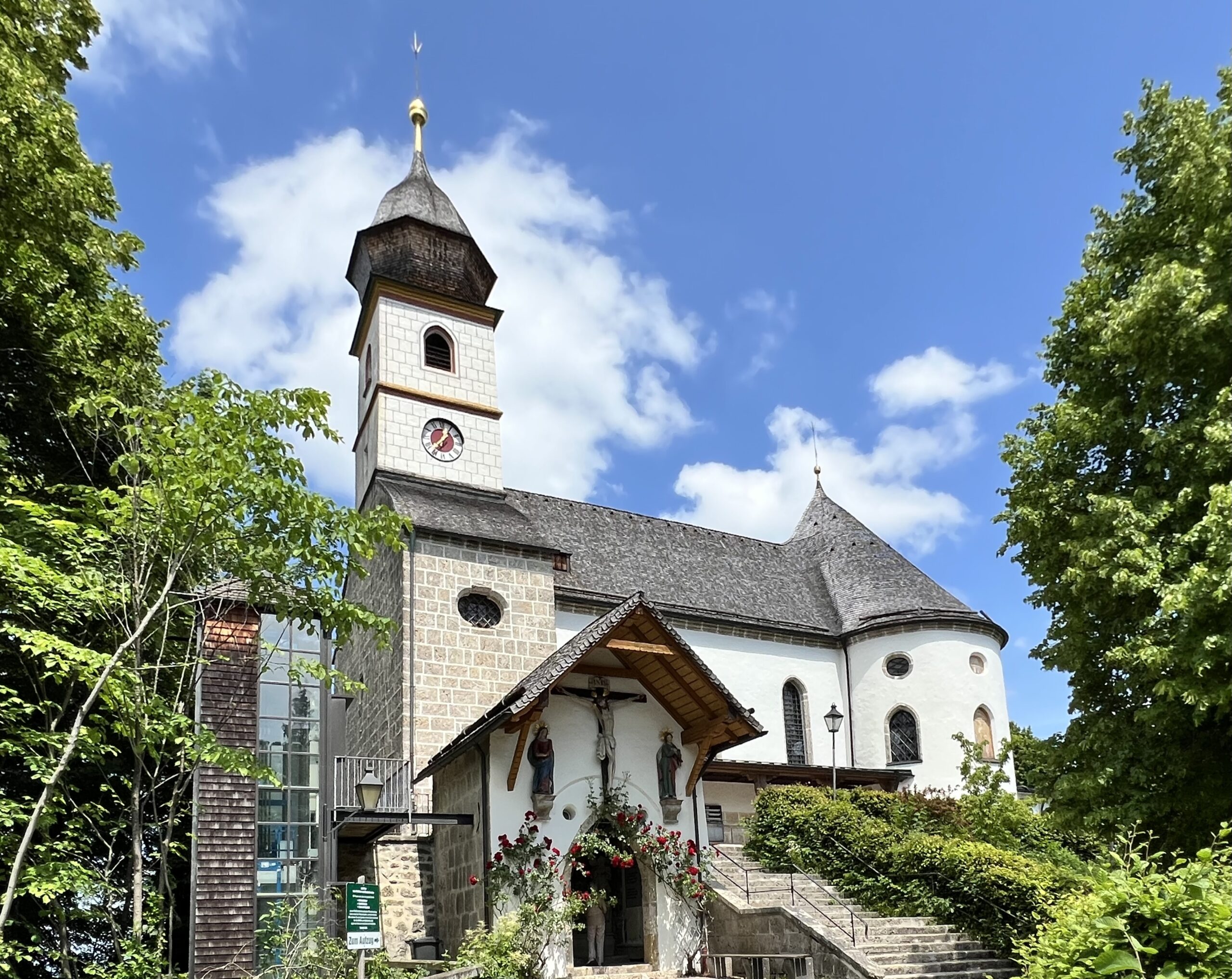
The first phase of the current pilgrimage church, Maria Eck, was built in 1636 by Benedictine monks. This larger church replaced a chapel. In 1642, a further phase saw the laying of the foundation stone for the new construction of the nave and tower.
Since 1651, the rosary has also been recited and there are processions on Marian feast days.
The monastery was built in 1730.
In 1803, the monastery closes due to government regulations unfavourable to Catholics. A large part of the church's furnishings are sold or destroyed. In 1806, there is a plan to demolish the church entirely. Soldiers are on their way to Maria Eck, and among them is the priest from Siegsdorf, Josef Lechner (1766-1832). The local farmers gather and resist the soldiers. They charge at them, and the soldiers flee. The priest and an assistant are captured by the farmers and are severely beaten by them.
In 1810 the pilgrimage church and the surrounding grounds were auctioned off to private individuals. This auction was overturned a month later due to local opposition. Pilgrims pray in front of the church. On 30 June 1813, the church was reconsecrated, and on 11 December of that year, the miraculous image returned to the church. This happened after the mediation of Crown Prince Ludwig (1786-1868), the later King Ludwig I of Bavaria (1825-1848).
In 1826, a road, the Wallfahrtstrasse (pilgrimage road), was constructed between the town of Siegsdorf and the pilgrimage site in 12 days. More than 1,400 workers and around 400 wagons were deployed for this purpose.
In 1884, the Franciscans unsuccessfully petitioned the Bavarian government to carry out ecclesiastical and school activities in Maria Eck. A few years later, Father Lorenz Totnan Seehuber (1828-1901) succeeded in obtaining permission for pastoral care and schools. He purchased the complex for 85,000 Marks. Subsequently, he negotiated with the Bavarian state and the Archdiocese of Munich. As a result, the first friars of the Franciscan Minorites moved into the monastery in mid-August 1891.
On 15 August 1891, Franciscan monks were active in the Marian shrine, marking the beginning of a new period of flourishing for the sanctuary.
During the Nazi regime in 1936, the church once again comes under public scrutiny. A high-ranking Nazi party leader demands the keys to the church and subsequently orders the church to be closed. Two bells are removed from the tower to be melted down for the arms industry.
Since 1954, Maria has been greeting visitors from the monastery roof. The statue is 3 metres high and made of copper plates.
On 31st May 1969, the chapels with the 15 mysteries of the Rosary were consecrated by Monsignor Roman Friesinger (1905-1977), parish priest of Ruhpolding.
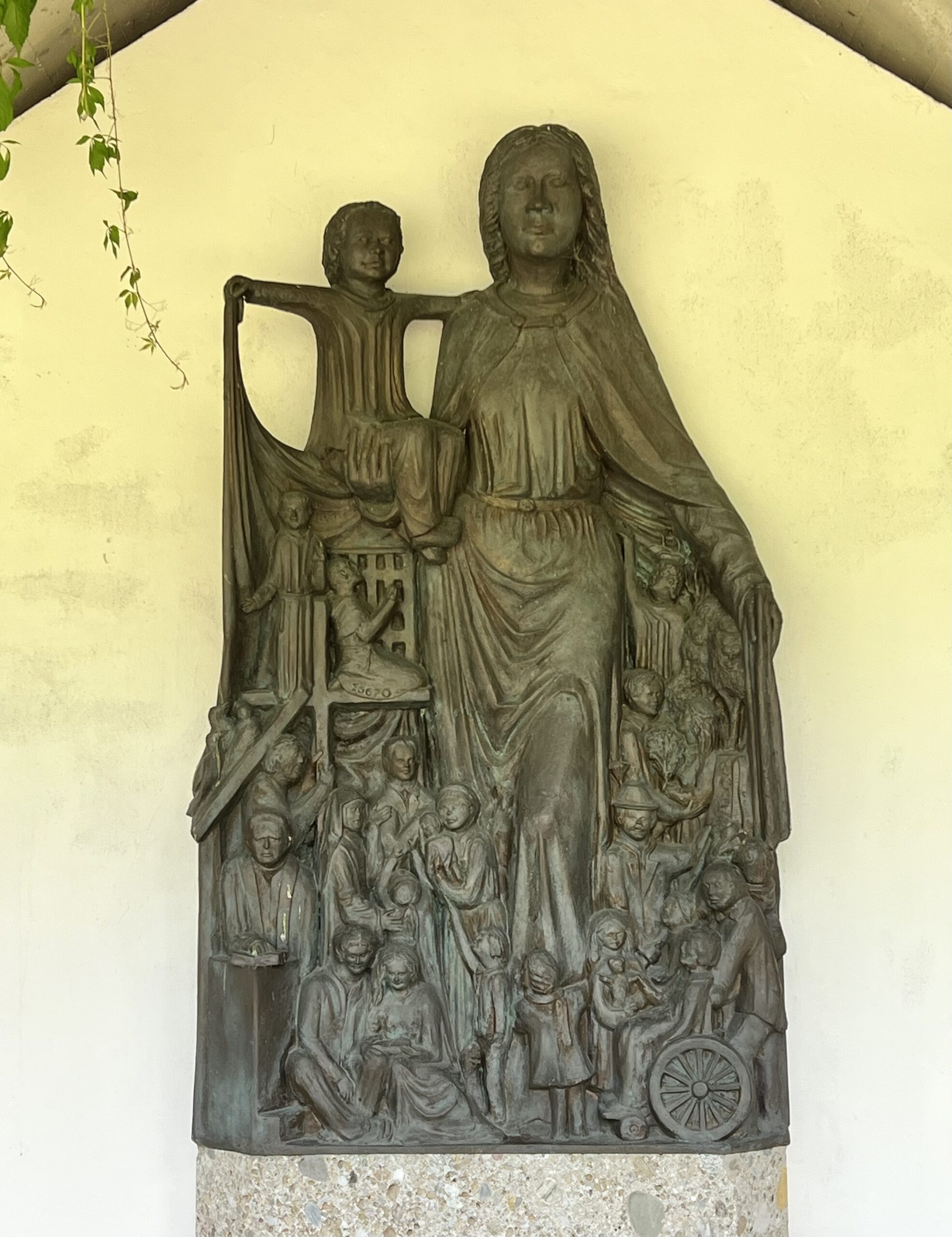
The image of the protective Madonna by sculptor Carsten Lewerenz (1959) was placed on 15 August 1988 with martyrs of the Second World War (1939-1945) under the mantle of Mary, such as Maximilian Kolbe (1894-1941), Edith Stein (1891-1942) and Rupert Mayer (1876-1945). The effigy is located in the pilgrimage church.
Fossilised coins have been found in the vicinity, which are considered to be Maria Eck tokens. The story goes that Our Lady turned the loot of a thief, who had plundered the church's offertory box, into stone as he fled, and this also applied to the coins.
Pilgrimage site
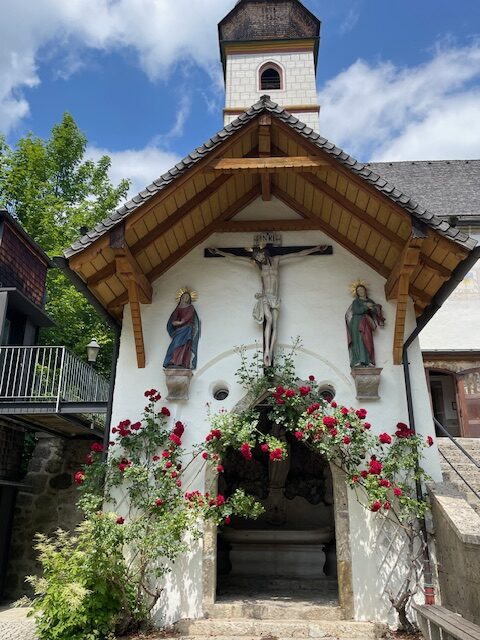
Maria Eck is the pilgrimage site with the highest cloister church in Germany. The Marian shrine lies 882 metres above sea level. The Marian site belongs to the Archdiocese of Munich and Freising.
In Maria Eck there is a monastery inn, with a hotel, café and restaurant, but for example in nearby Bergen there are also accommodation options, as well as in Ruhpolding and Traunstein.
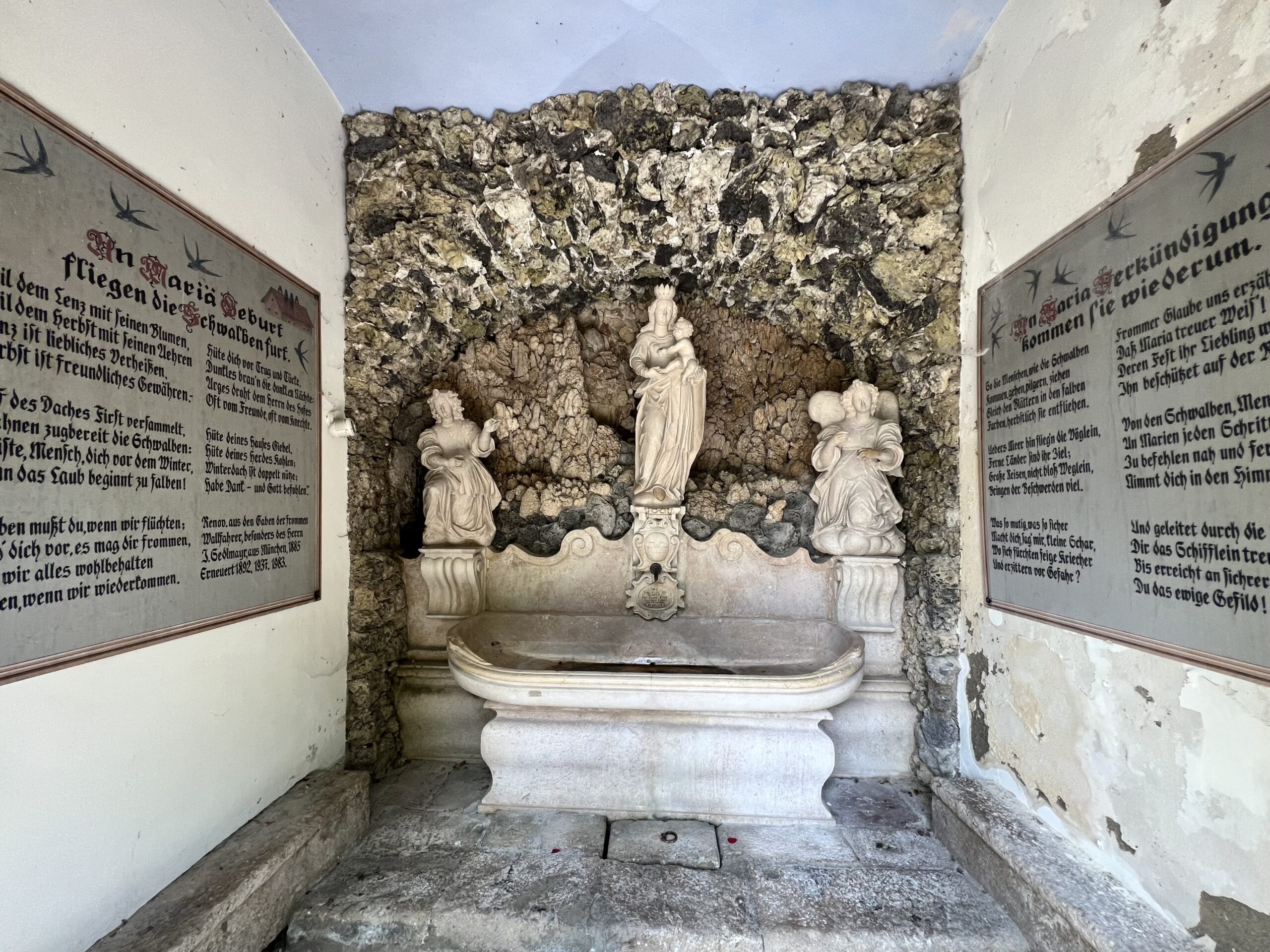
In front of the church is a chapel with Mary, her Child, a fountain, and on either side of the walls, two texts, namely about the Nativity of Mary and the Annunciation.
In the altar on the left, Anne, the mother of Mary, is depicted teaching her young daughter. On one side, father Joachim can be seen, and on the other, Joseph.
Next to the altar with the crucifixion, Mary is depicted as the Queen of the Rosary.
Over the centuries, restoration works have taken place, and a new organ was installed among other things in 2012.
Besides the church of Maria Eck, the nearby Antonius Chapel is also worth visiting.
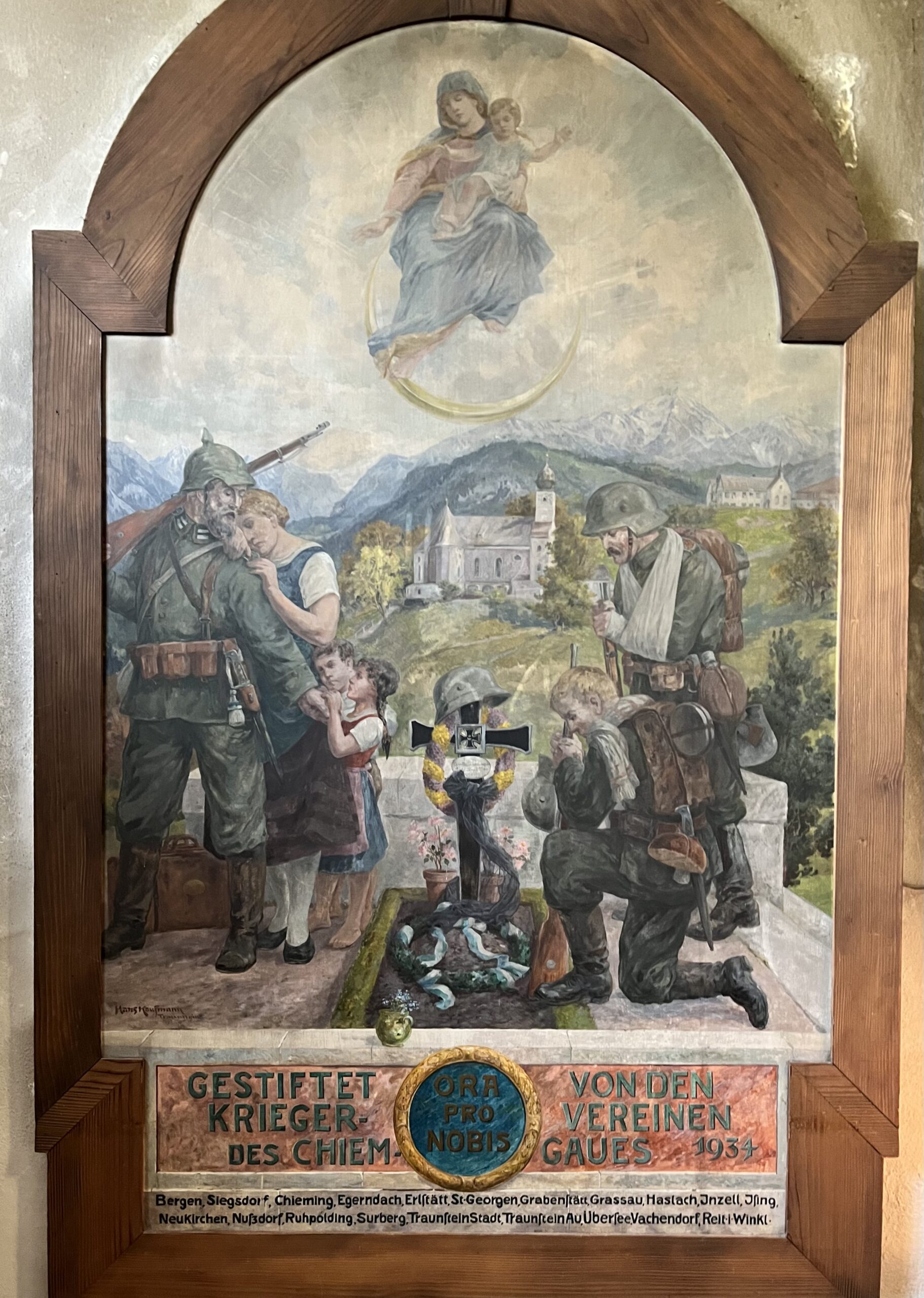
In the pilgrimage site, there is a great deal of attention paid to ex votos from soldiers and memorial plaques from wars, both in the church and on the surrounding grounds.
The annual holiday is 8 September, the Feast of the Nativity of Mary.
The pilgrimage church is open all year round.
ACCESSIBILITY
The pilgrimage site of Maria Eck is located near the town of Siegsdorf, to the east of the larger town of Rosenheim, in the south of the state of Bavaria. Maria Eck lies between the Bavarian Rosenheim and Austrian Salzburg, not far from the A8 Munich-Salzburg motorway.
Address: Maria-Eck-Strasse 2, 83313 Siegsdorf.
Current information can be found at www.kloster-mariaeck.de.
Experience
On the hill lies the pilgrimage site Maria Eck. I am pleased to be here to greet Mary at the highest Marian site in Germany. In front of the pilgrimage church is a chapel, and I visit this first on my tour of the sanctuary. Mary stands with her Son above a spring and in front of a rocky wall. On the left side of the chapel, the text of a poem about the Nativity of Mary can be read, and on the other wall, a text about the Annunciation.
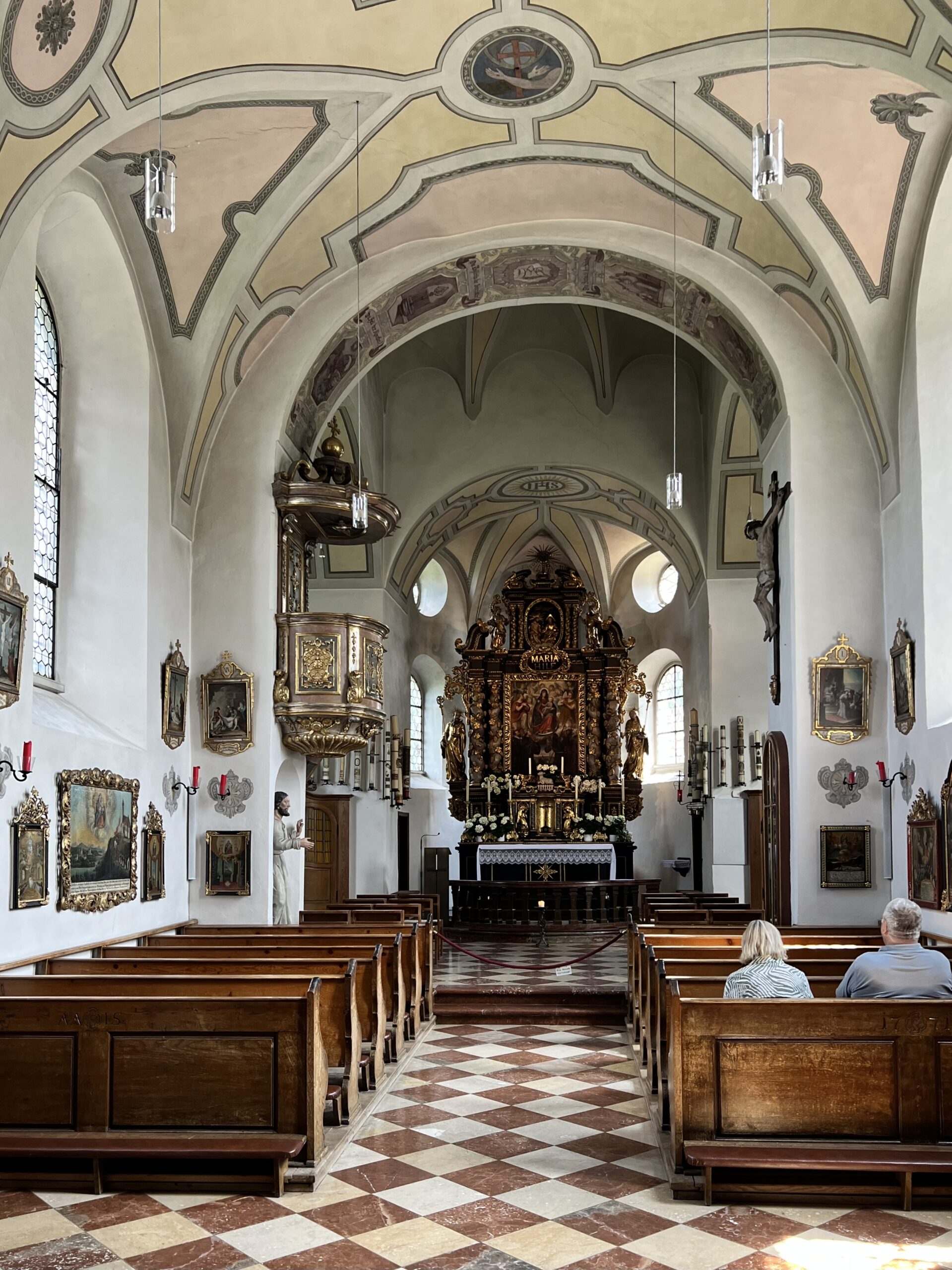
Next, I go into the church and stand gazing in wonder at the interior. What beauty! I can hardly believe my eyes, and when I reach the high altar, I see the statue of grace. I stand here for a long time, taking in the entire scene.
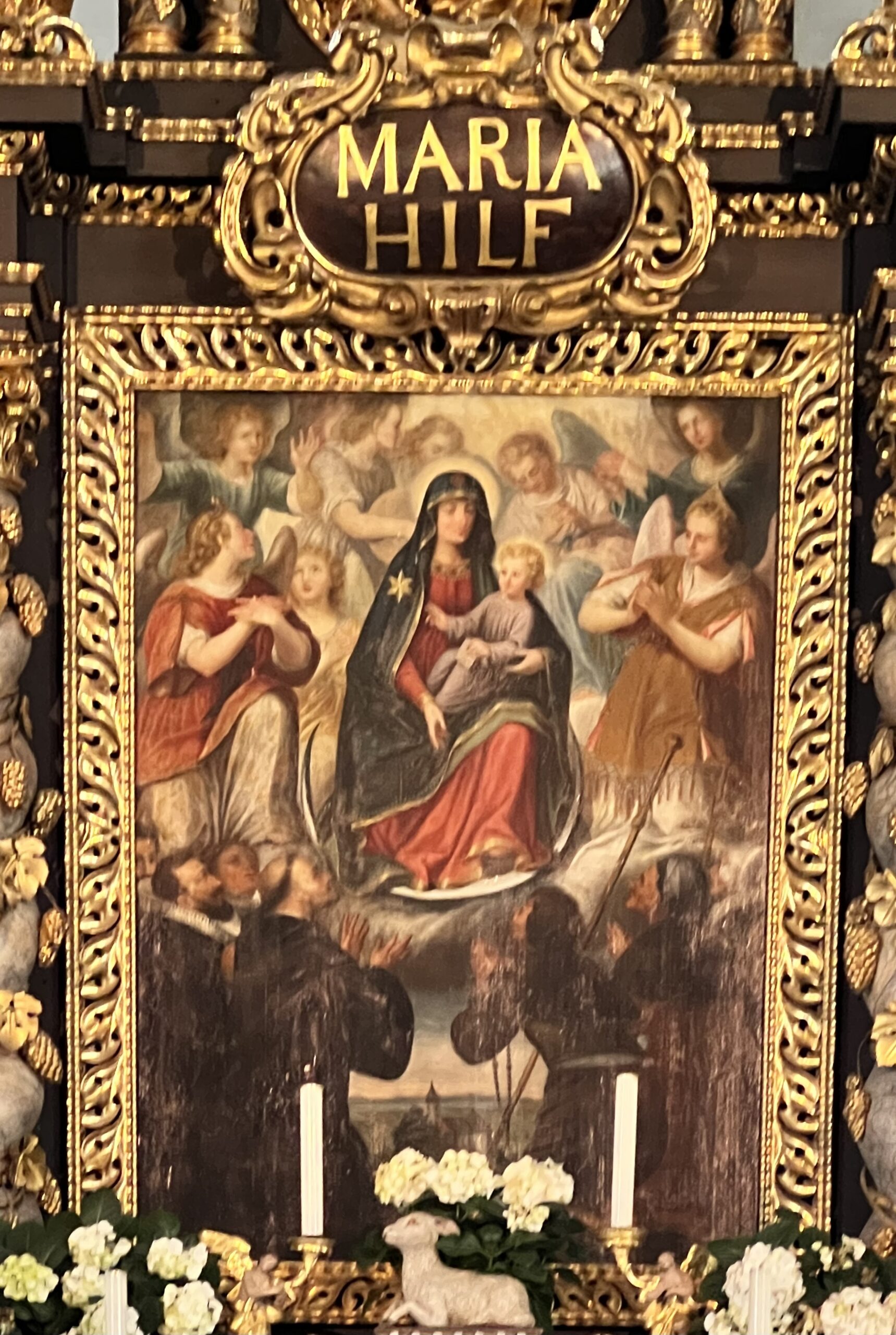
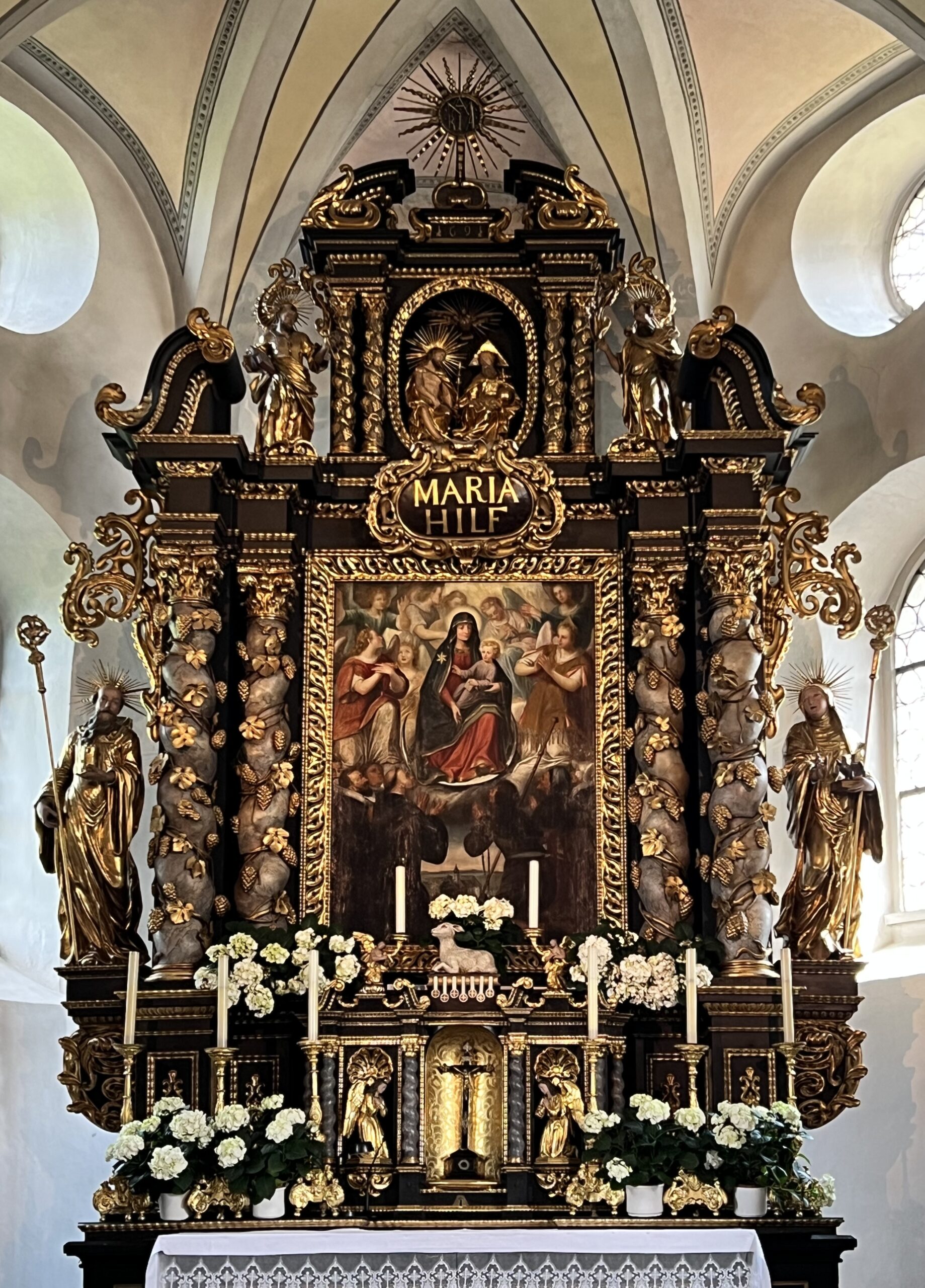
The devotional image shows Mary on clouds and a crescent moon, with her Child on her left arm. She is wearing a long, blue cloak and bears a hexagonal Star of David. Right at the bottom, I see an image of the church of Maria Eck from 1642 and this lower section has been altered later, so I am told. Our Lady is modelled on the most important western pilgrimage image of Mary from the Basilica of Santa Maria Maggiore in Rome (Mary of the Snow). Large angels surround Her with a heavenly, joyful mood. Below them are depicted pilgrims and a monk, representing Honorat Kolb (1603-1670, OSB, Order of Saint Benedict), abbot of Seeon, who was confessor here and died here. On the far right is depicted Sister Scholastica (c. 480-c. 547).
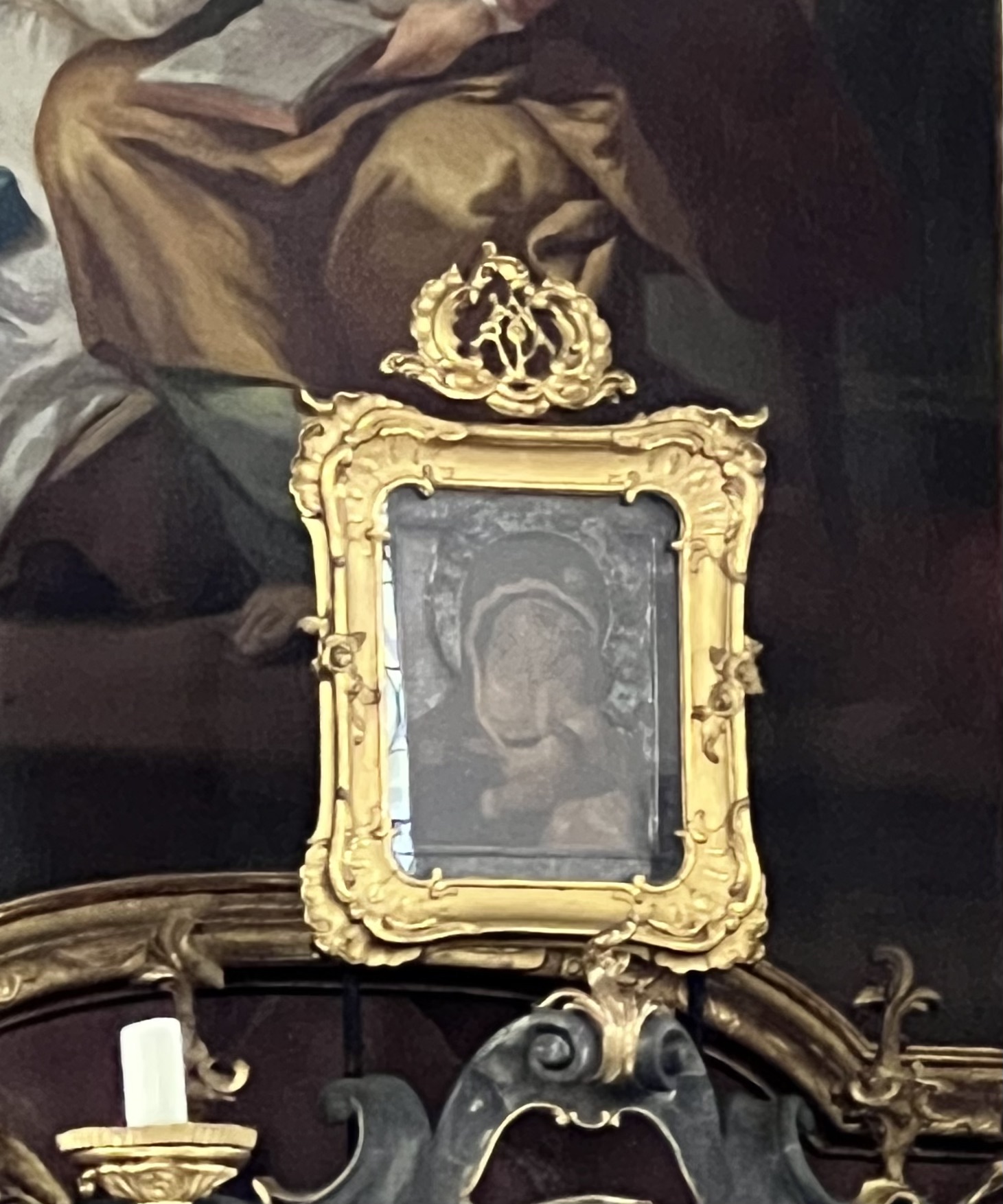
I find the Byzantine icon of Mary with Child particularly beautiful. I understand that this artwork was made in Russia and came here via a journey. A family member of the noble Polish Radziwill/Radvila family takes it from his country and goes to Rome with it to have it touched by the image of Mary in the Basilica of Santa Maria Maggiore. Subsequently, the touched, painted image comes to the Seeon Abbey and then he gifts it to the church of Maria Eck.
On the west side of the church, I see three old paintings hanging with Latin inscriptions, which refer to the legend of the origin of this pilgrimage site. The paintings show the rays of light above the mountain, indicating that a special place for Mary must come here, a blind man pointing the way, and workers busy with the spire of the church tower.
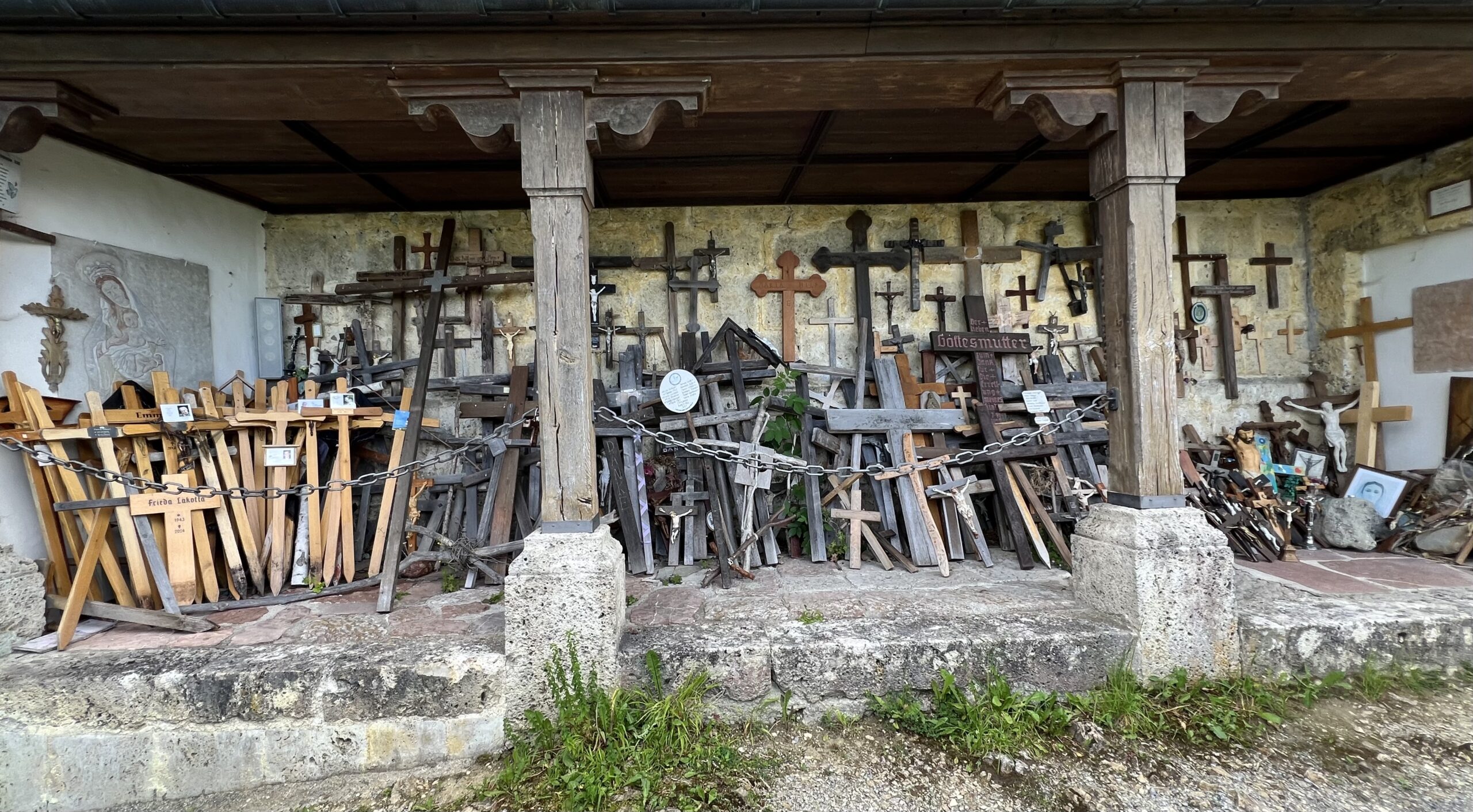
After visiting the church, I take a walk around the building and at the rear I come to a canopy where hundreds of crosses for processions are kept. What a collection! I take a cross and walk a few metres with it, but it’s not a procession now.
To conclude the visit, I will go to the hotel/restaurant, which is located near the pilgrimage church. I take a seat at a table and look at the menu. The waiter comes over. I order something to drink, pronounce it, and point it out on the menu. A little later, another waiter brings a drink that I did not order, and which I do not accept. A moment later, he brings the correct beverage. When I want to pay, the first waiter comes to me. He asks what I first ordered, and I name it and point to it again. He then looks at me strangely. I pay for my order and conclude that the man is having a bad day. I do not feel that I am being treated as a customer.
Walking back to the car, I look back at the visit to Our Lady at this high sanctuary. I am happy to have met Mary here. Thank you, Mary.
Environment
There are many walks to be made in the vicinity of Bavarian Maria Eck.
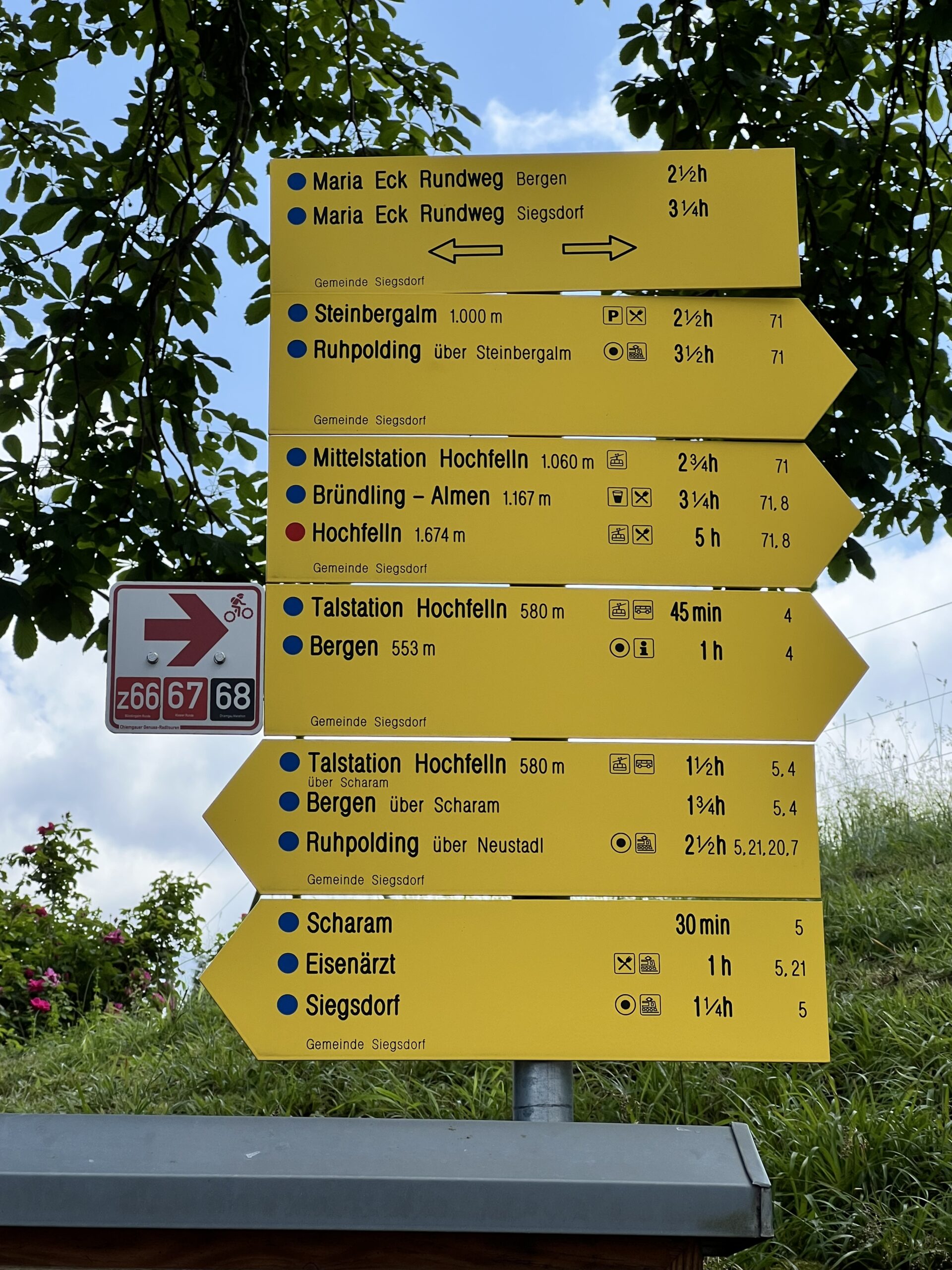
Going north from Ruhpolding to Maria Eck is 6 km.
To travel from the pilgrimage site of Altötting to that of Maria Eck means travelling 60 km to the south.
Departing from Berchtesgaden for Maria Eck involves covering 56 km to the northwest.
Leaving the city of Rosenheim to arrive in Maria Eck requires travelling 50 km east.
Leaving the big city of Munich and going to Maria Eck is to travel 110 km to the southeast.
From Austrian Salzburg to Maria Eck is a journey of 45 km eastward.
~~~

 Nederlands
  English (UK)
  Deutsch
  Français