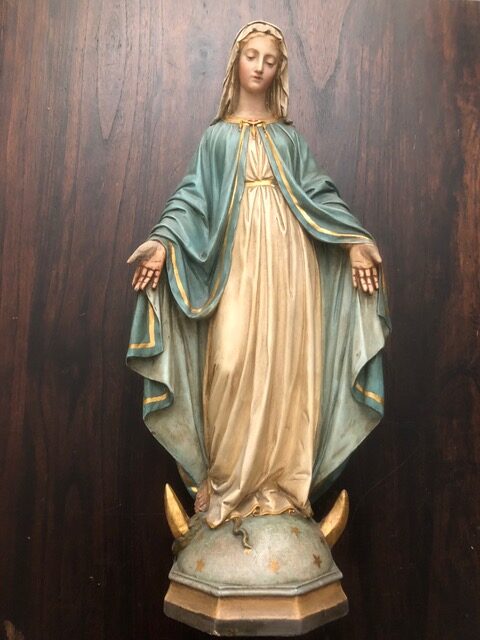
History
After the Thirty Years“ War (1618-1648), during which much conflict takes place between Catholic and Protestant states, a field chapel is built near Ziemetshausen. This happens in 1650 and it houses the 16th-century Vesper image (pietà). The infectious disease known as ”the plague" claims many victims, and believers seek refuge at the pilgrimage site to obtain Mary's protection. A larger chapel is built in 1673. In 1725, a pilgrimage church is constructed. The structure is by Siepert Kramer (1679-1753). Unfortunately, this building soon falls into a poor state of repair due to its weak foundations, and it is demolished in 1754.
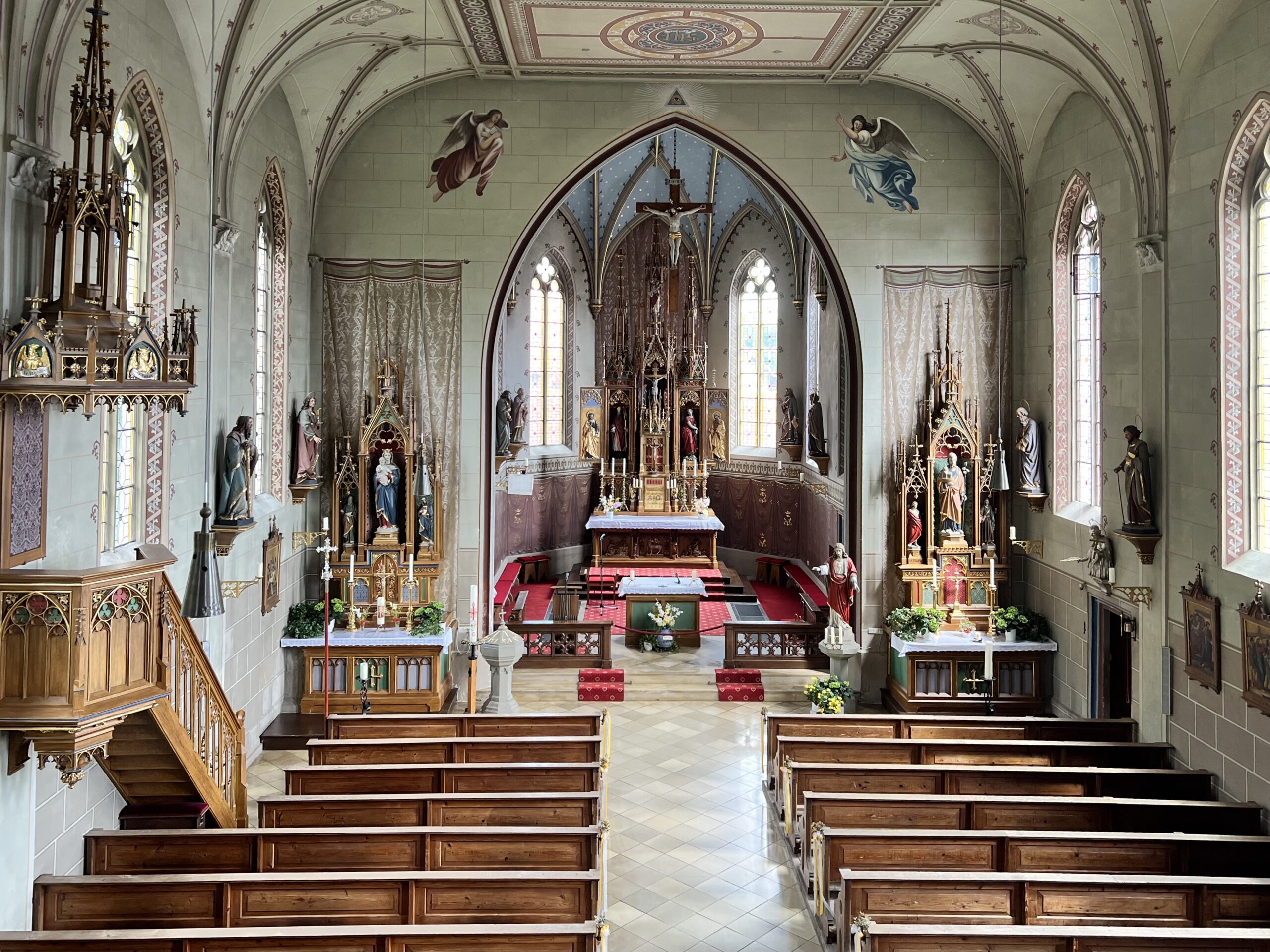
The current pilgrimage church was built in the Rococo style between 1754 and 1756. The architect was Johann Georg Hitzelberger (1714-1792). The church was consecrated on 7 August 1756. The frescoes on the vaults are by the Bavarian painter Balthasar Riepp (1703-1764).
In 1788, the demolition of the church was prevented by a Ziemetshausen pastor who opposed the Protestant, Austrian authorities. Under Ludwig I (1786-1868), King of Bavaria (1825-1848), religious life was once again given room to flourish.
In the period 1867-1869, the altars, confessionals, and pulpit were replaced with a Neo-Romanesque interior.
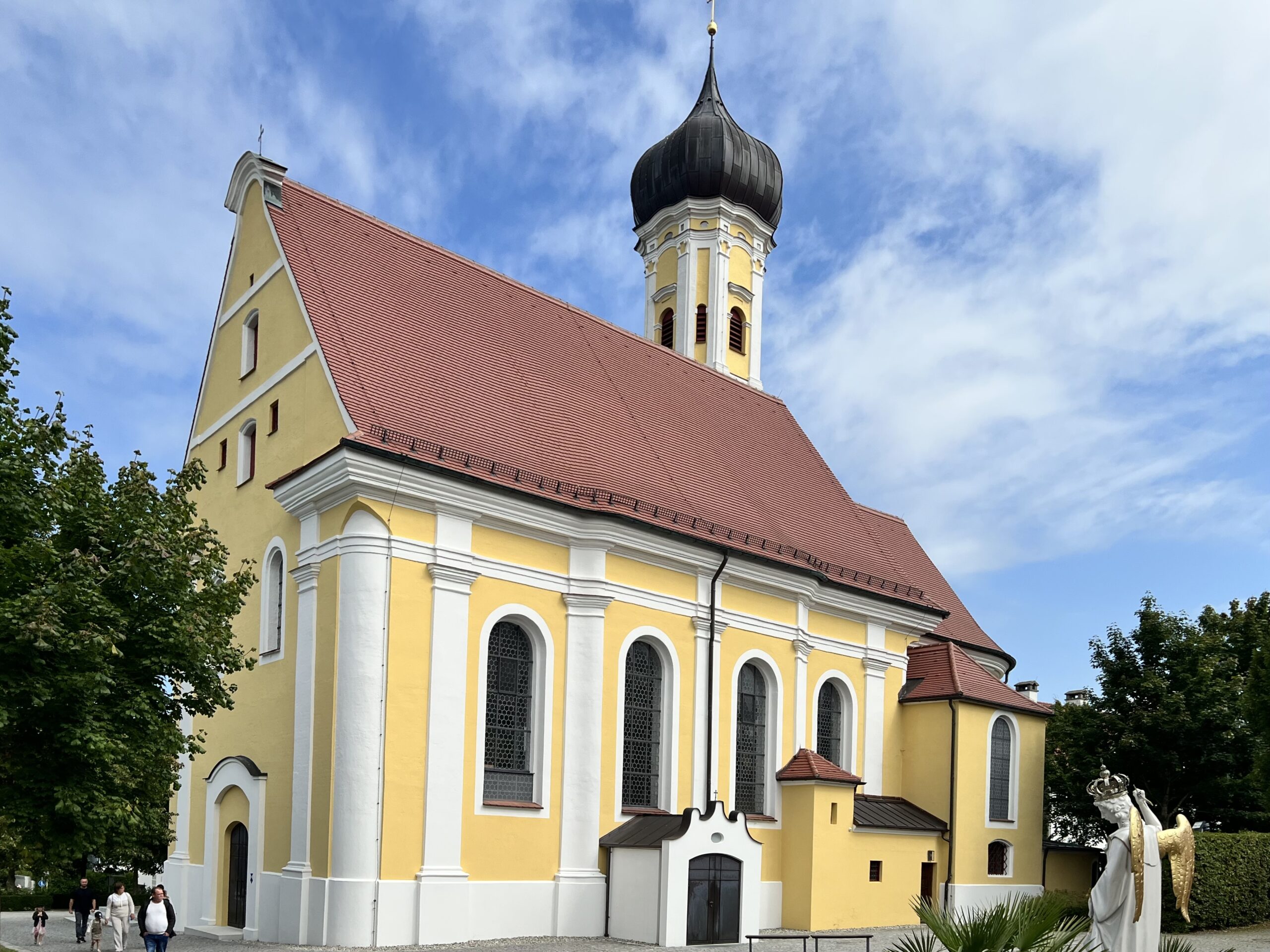
The Stations of the Cross in the church were consecrated in 1948 and were painted by Johann Baumann (1882-1959).
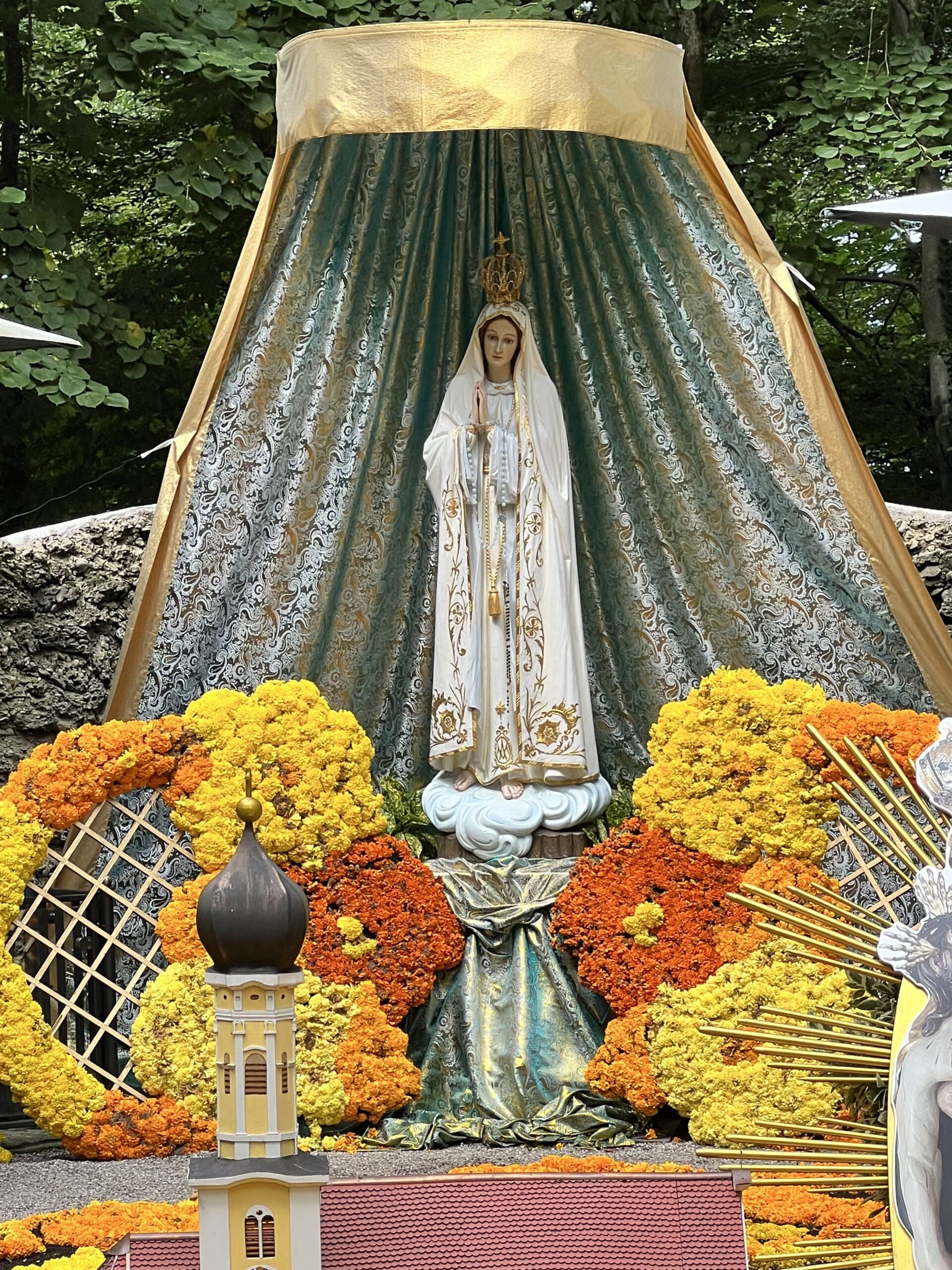
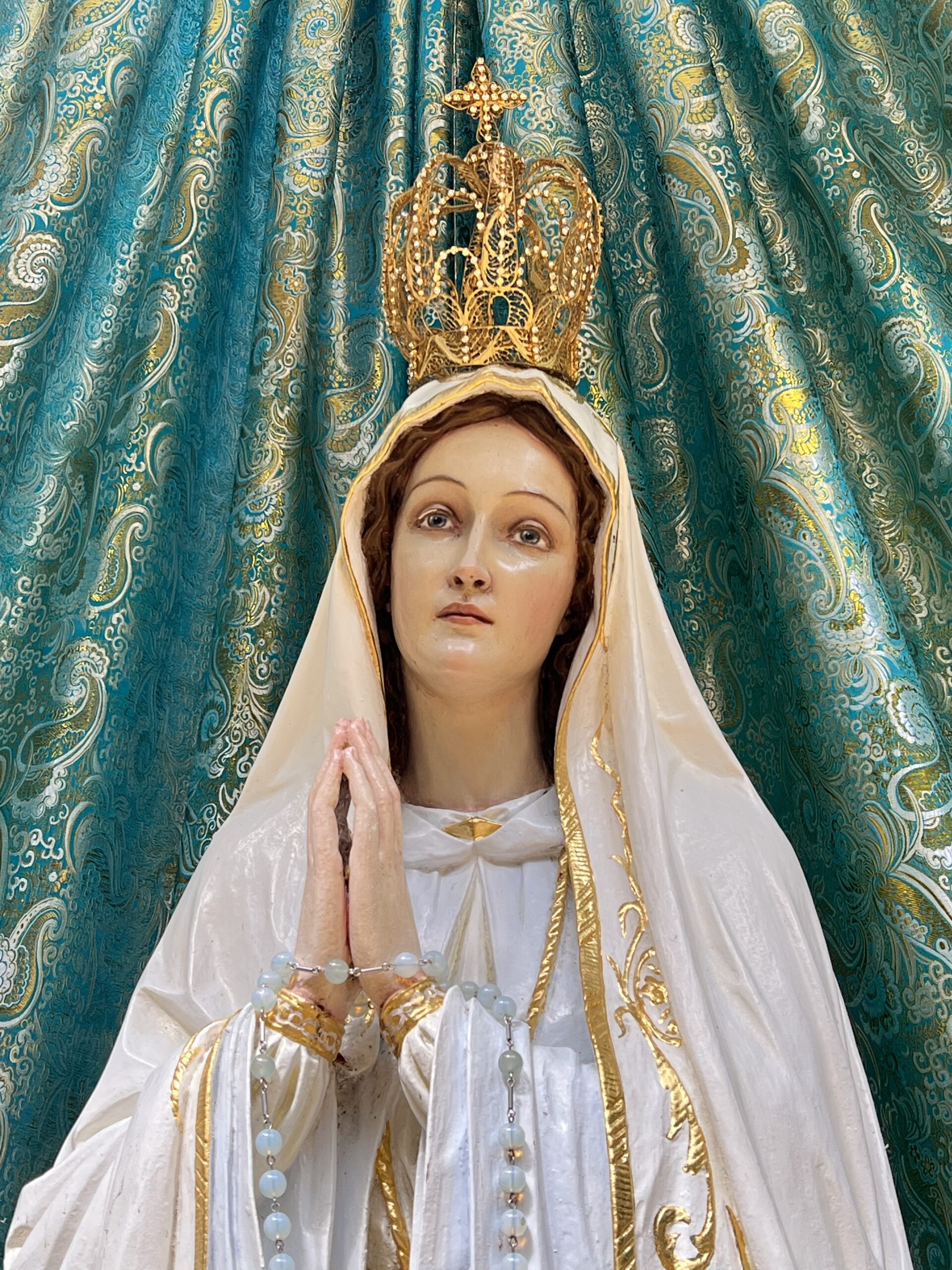
In 1957, for the 40th anniversary of the apparitions in Fátima, Portugal, a Fátima grotto was constructed. The statue of Our Lady of Fátima was created by sculptor Ludwig Schuster (1913-1997). In the 1980s, the statue was crowned by Rudolf Johannes Maria Koppmann (1913-2007), the Apostolic Vicar of Windhoek, the capital of Namibia (1957-1980), and chaplain at the hospital in Tutzing, Southern Bavaria (1982-1993).
The church's interior is being redecorated again, this time between 1959 and 1965. The chosen style is Rococo. The tabernacle is a gift from the noble politician Wolfgang Karl Friedrich Joseph Notger (Eugen) von Oettingen-Wallerstein (1885-1969).
In 1975/1976, the round “Engelskapelle” (chapel of the angels) was built, and in 1984, a large cross was erected.
Near the pilgrimage church stands a house for pilgrims. This “Pilgerhaus” was built in 1995.
A statue of Mary, depicting the patron saint of Bavaria, was erected at the Mary's Well in 1986. In 2004, the area around the church was redesigned with a forecourt and Mary's Well. In 2011, the Fatima Grotto and the adjacent herb garden with ex-votos were renovated.
Major renovation of the church in 2019-2023, covering both the exterior and interior.
From 1 February 2024, Pastor Michael Menzinger (*1973) will be the director of the pilgrimage site.
In 2025, the Marian shrine celebrated its 375th anniversary.
Pilgrimage site
Every year, around 400,000 people visit the pilgrimage church with the Fatima Grotto. This makes Maria Vesperbild the third most visited Marian pilgrimage site in Germany, after Altötting and Kevelaer. Maria Vespergild is the Swabian capital of Mary. Maria Vesperbild is known throughout the German-speaking part of Europe.
In the pilgrimage site, two miraculous images are venerated, namely the Vesperbild and the Madonna of Fatima.
The interior of the pilgrimage church is richly decorated.
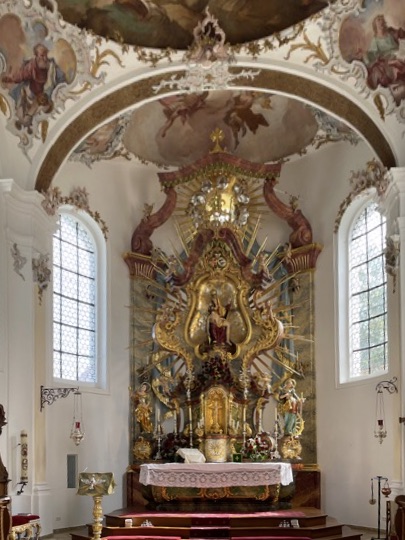
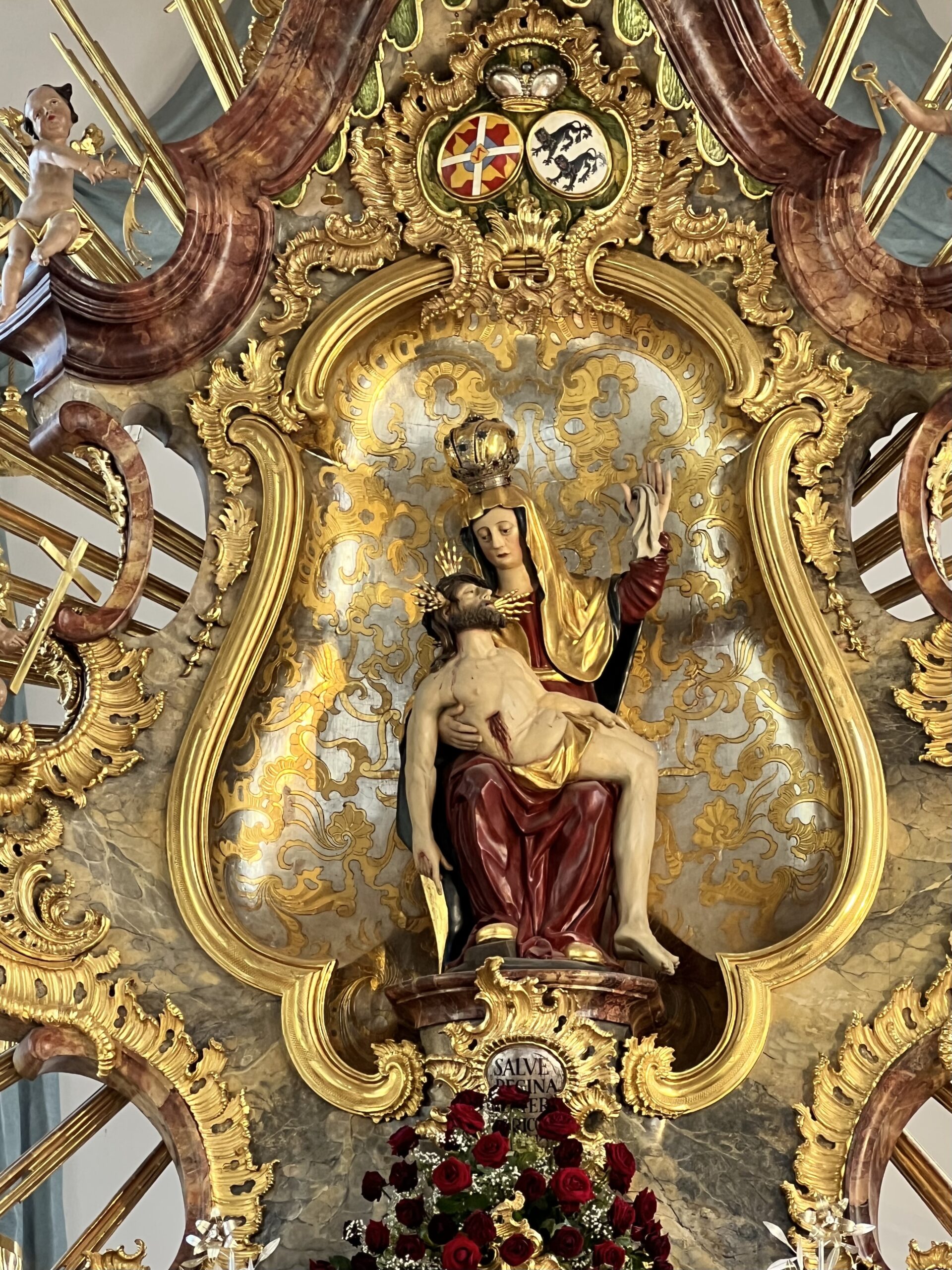
The wooden vesper image, dating from around 1550, is centrally placed in the high altar, surrounded by rays. This is the devotional image of the pilgrimage site, and the maker is unknown. Mary sadly holds her dead Son on her lap and, with a handkerchief in her hand, points pleadingly towards heaven. Jesus points with a finger towards the altar as a source of strength, and his arm hangs downwards. The crown, rays, and handkerchief were added to the devotional image later.
The left side altar features a painting showing an angel pouring baptismal water from a font, with Mary depicted below it.
To the side, near the high altar, stands a statue of Fatima, which is carried in processions.
The church also features votive offerings, with paintings depicting the Vesperbild beneath them. Old votive offerings have disappeared or been destroyed due to government secularisation. The oldest example dates from 1821.
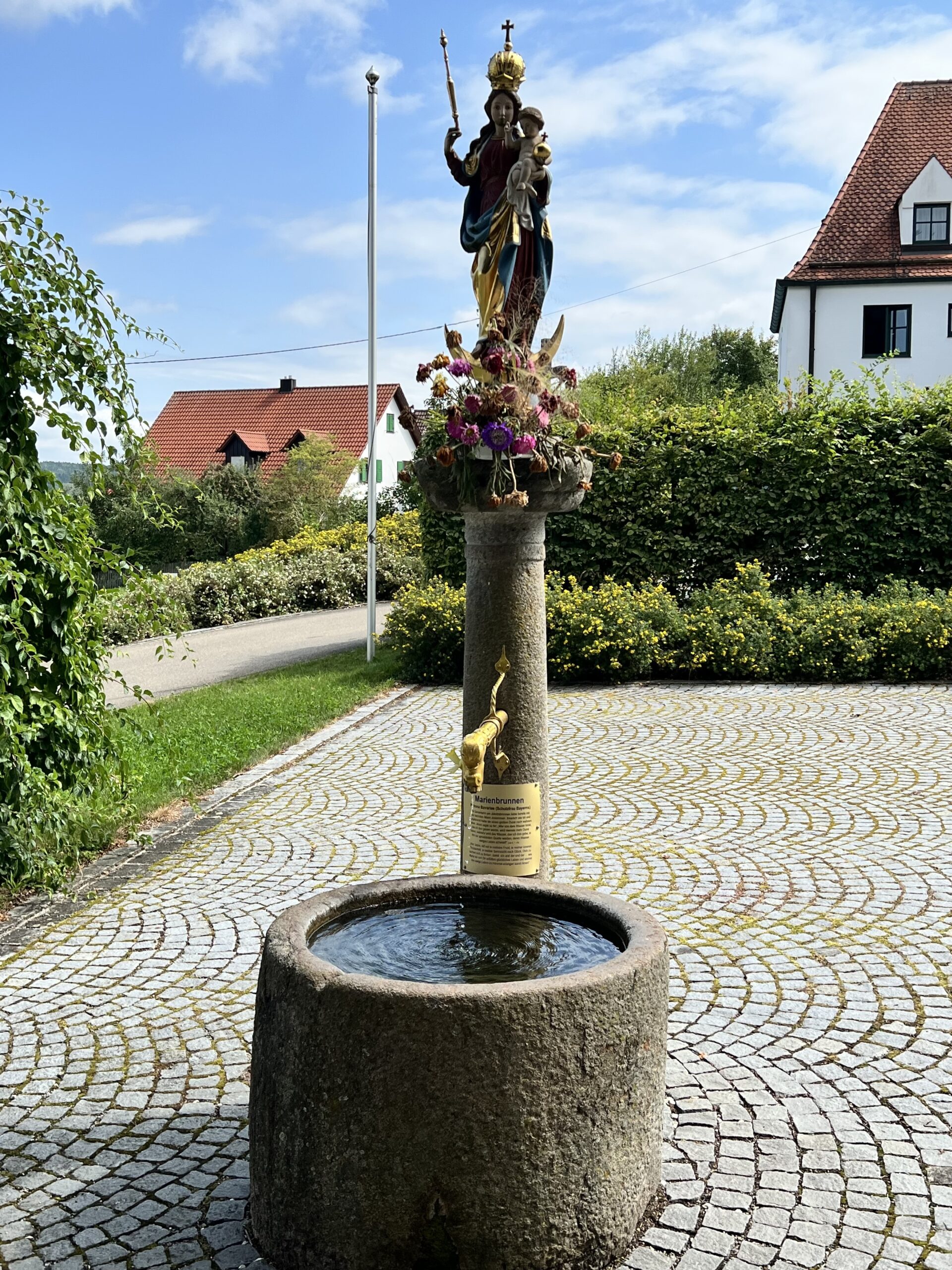
An old, baroque clock hangs in the pilgrimage church. It dates from 1730 and comes from the previous church.
The central vault is painted and depicts the veneration of the Vesper image by saints. It was created in 1755 by Balthasar Riepp (1703-1764).
Near the church, there is a Marian spring and this spring is located on the site where a spring was discovered centuries ago. The spring has been blessed and many make the sign of the cross with this water. The spring is dedicated to Mary, as she is the patron saint of Bavaria and has been since 1916 when Ludwig III (1845-1921), King of Bavaria (1913-1921), requested this of Benedict XV, Pope from 1914 to 1922 and born as Marquis Giacomo Giambattista della Chiesa (1854-1922).
Near the pilgrimage church, a “pilgrim house” has been realised.
Opposite the pilgrimage church lies a park featuring, among other things, a likeness of Padre Pio and a Fatima grotto, which receives many visitors. This grotto was built in the mid-20th century. Many candles and ex-votos can be seen here. On Fatima days, the pilgrimage site is busy, and these are the 13th of the months from May to October inclusive.
Every year on 15 August, the Feast of the Assumption of Mary, there is a candlelight procession. The procession concludes at the Fatima Grotto, where a carpet of flowers is laid out. There are more processions throughout the year, such as during the month of May.
The pilgrimage church is open daily. Every day there are services in the pilgrimage church and there is an opportunity for confession.
ACCESSIBILITY
The pilgrimage site Maria Vesperbild is located in Bavaria and belongs to the Diocese of Augsburg. Maria Vesperbild is situated southwest of Augsburg in a vast nature reserve.
The address of the pilgrimage church “Maria Vesperbild” is:
Schellenbacher Strasse 4, 86473 Ziemetshausen.
More information can be found by visiting www.maria-vesperbild.de.
Experience
I've read that it's a well-attended pilgrimage site, and that seems to be true, as upon arrival, many cars and a few buses are parked near the church. This is happening even on a Friday morning, at the end of August. On this day, no fewer than 7 activities are taking place, as can be read on a large sign.
The pilgrimage church immediately grabbed me upon entering. As if of its own accord, I go to the devotional image and gaze for a long time at the Pietà. How this depiction strikes me! Mary is crowned and many golden rays, cherubs, and flowers make the image even more intensely experienced. The small cloth in her left hand is eloquent. The side altars also show here how beautiful depictions of Our Lady are. What a wondrous occurrence befalls me here.
Then I look up and see the vault of the church. It is painted with scenes of the crucifixion and Mary stands there powerlessly. How that must hurt!
In the pilgrimage church, there are many statues, including a statue of Fatima. Our Lady of Fatima holds a special place in this pilgrimage site.
There are also many ex-votos to be seen in the church. They are countless testimonies of gratitude. How often Mary has helped!
In this pilgrimage church, Mary is also standing on a blue orb. She holds a sceptre in her left hand and her right hand is placed over her heart. Here too, I pause for a little longer. The artist wants to convey something, and then it's a matter of trying to put myself in the creator's shoes.
Another image also strikes me, namely flames, people, also an angel and Mary at the top. She is saving someone from the fire. Will I ever be helped by Her like that too?
After visiting the church, I'm going to the nature park. The route passes a wayside shrine and a via crucis, an outdoor altar, an image of Padre Pio, countless ex-votos, and then I'll come to a large floral carpet. What a beautiful experience this is! Behind the sea of flowers stands the statue of Our Lady of Fátima. This is the second highlight of this pilgrimage site. Many candles are burning here, and more are now being lit to thank Mary. I'll also tell Her a bit about friends. Then it's time to pray, as so many do here.
The artwork with the splendid flowers attracts a lot of attention from the pilgrims and from me as well. The Fatima statue makes the biggest impression on me. What a captivating face Mary has! How beautifully She is depicted! It feels like a great gift to behold Her here. Then I enter into prayer again; so much passes by with all sorts of thoughts.
After visiting the pilgrimage church and the park with the Fatima grotto, I'm going to the religious gift shop to buy something for friends.
Environment
In the vicinity of Maria Vesperbild, there are opportunities for walking and cycling.
From the nearby Ziemetshausen to Maria Vesperbild is 2 km to the south.
The distance from Krumbach to Maria Vesperbild is 18 km to the northeast.
To depart from Günzburg and arrive in Maria Vesperbild requires travelling 40 km to the southeast.
Leaving Augsburg to go to Maria Vesperbild means travelling 35 km in a south-westerly direction.
To travel from Stuttgart to Maria Vesperbild is 150 km to the southeast.
Schwabegg, near Schwabmünchen, with its parish church of the Assumption of Mary, is also worth visiting. From Schwabegg to Maria Vesperbild is 25 km to the northwest.
~~~

 Nederlands
  English (UK)
  Deutsch
  Français